Call Us
+86 136 6007 9809
Call Us
+86 136 6007 9809

Bolt Tightening Methods Explained: Torque Method vs Torque-Angle vs Yield Point Control (Engineering Selection Guide)
In modern mechanical engineering, bolt tightening control is one of the most critical factors determining joint reliability, sealing performance, and fatigue life.
Even experienced engineers may face failures caused not by bolt strength, but by incorrect tightening methods.
Product Specification
Bolt Tightening Methods Explained: Torque Method vs Torque-Angle vs Yield Point Control (Engineering Selection Guide)
In modern mechanical engineering, bolt tightening control is one of the most critical factors determining joint reliability, sealing performance, and fatigue life.
Even experienced engineers may face failures caused not by bolt strength, but by incorrect tightening methods.
At JUXIN FASTENERS, we provide industrial fastening solutions, including high-strength bolts (ISO 898-1 Class 8.8 / 10.9 / 12.9), controlled-preload bolted joints, and precision fastening systems for the automotive, energy, and heavy machinery industries.
1. Why the Bolt Tightening Method Matters More Than Bolt Strength
A key engineering fact is often overlooked:
Only about 10% of the applied torque becomes the actual bolt preload.
The remaining energy is lost due to:
Thread friction
Under-head friction
Surface condition variation
This means bolt preload is not controlled by torque alone—it is dominated by friction variability.
Even small changes in lubrication or coating can cause:
±30% preload variation
Severe joint inconsistency
Premature fatigue failure
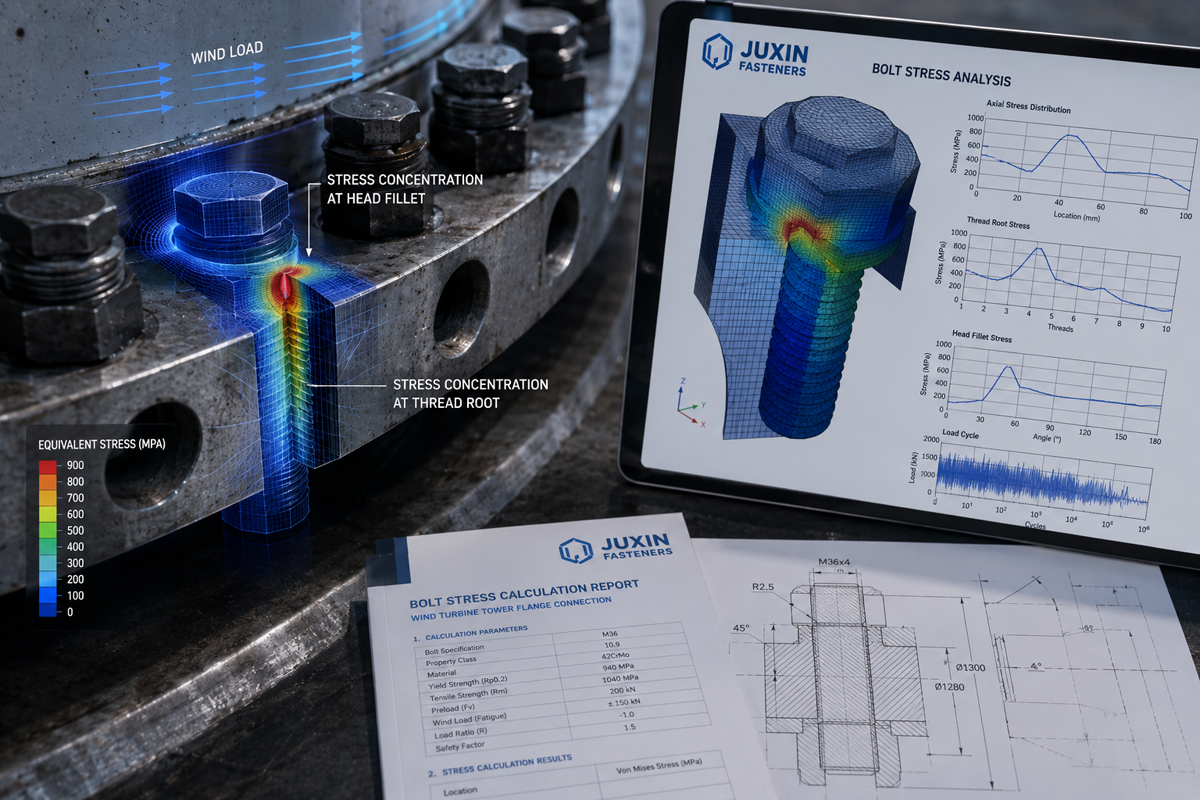
2. Torque Method (T = K × F × d): Simple but High Variability
The torque method is the most widely used tightening technique in industrial assembly.
2.1 Basic Formula
T = K × F × d
Where:
T = tightening torque
K = torque coefficient
F = preload force
d = nominal bolt diameter
2.2 Why Torque Coefficient (K-Factor) Is Critical
Typical K values:
Dry condition: 0.18 – 0.22
Light oil lubrication: 0.13 – 0.16
Zinc plated / Dacromet coatings: 0.15 – 0.19
Even within the same batch of bolts, K-factor variation causes major preload scatter.
2.3 Engineering Limitation
Torque method preload accuracy:
±15% to ±35% (typical)
Up to ±50% in worst cases
Because torque measures friction, not clamp force.
2.4 Application Range
Torque tightening is suitable for:
Low critical structural joints
Equipment housings
Brackets and supports
General industrial assemblies
Recommended bolt grades:
ISO 898-1 Class 8.8 and below
⚠ Not recommended for critical sealing or fatigue-loaded joints (e.g., engine cylinder heads).
3. Torque-Angle Method (TA Method): More Stable Preload Control
The torque-angle method is widely used in automotive and industrial high-strength bolted joints.
3.1 Two-Stage Tightening Process
Stage 1: Seating torque
Typically, 20%–50% of the target torque
Purpose:
Eliminate gaps
Seat mating surfaces
Stabilize joint geometry
Stage 2: Angle tightening
Bolt is rotated by a defined angle
Preload is generated mainly by:
Bolt elongation
Controlled elastic deformation
3.2 Why It Is More Accurate
Unlike the torque method:
Angle is directly related to bolt elongation
Friction has minimal influence in the second stage
Result:
Preload accuracy: ±10% to ±15%
3.3 Typical Industrial Applications
Automotive engine cylinder head bolts
Connecting rod bolts
Suspension structures
Transmission housings
Example procedures:
25 N·m + 90° rotation
18 N·m + 45° rotation
3.4 Limitations
Requires process validation testing
Requires angle-controlled tooling
No reliable post-assembly verification
3.5 Standards Reference
ISO 16047 (torque/preload testing)
ISO 898-1 (bolt mechanical properties)
4. Yield Point Method (Torque Gradient Method): Maximum Precision Control
The yield point tightening method (also known as the torque gradient method) is the most advanced tightening technology.
4.1 Working Principle
During tightening:
Torque vs angle curve is continuously monitored
Slope (stiffness) is calculated in real time
When slope drops to ~50% of peak value → yield point detected
The system stops automatically.
4.2 Engineering Advantage
Preload accuracy:
±4% to ±10% (highest among all methods)
Additional benefit:
Bolt is tightened close to the material yield strength
Maximum material utilization
Smaller bolt size possible for the same preload
4.3 Limitations
High-cost smart tightening systems required
Requires extremely consistent bolt material properties
No post-assembly verification possible
4.4 Typical Applications
Aerospace engines
Pressure vessels
Racing engines
Ultra-high precision mechanical systems
4.5 Standards Context
ISO 898-1 (high-strength bolt classification)
Engineering OEM tightening specifications
5. Engineering Selection Guide: How to Choose the Right Method
Step 1: By joint criticality
Non-critical structure → Torque method
Critical load-bearing joints → Torque-angle or yield method
Step 2: By bolt strength grade
≤ ISO 898-1 Class 8.8 → Torque method
≥ Class 10.9 → Torque-angle recommended
Ultra-high performance systems → Yield point method
Step 3: By the preload accuracy requirement
±30% tolerance → Torque method
±15% tolerance → Torque-angle method
±10% or better → Yield method
Step 4: By equipment capability
Basic tools → Torque method
Angle-controlled tools → Torque-angle method
Smart tightening systems → Yield point method

6. Multi-Bolt Joint Effect (Critical Engineering Insight)
In multi-bolt flange or structural joints:
Each bolt affects the preload of adjacent bolts
Tightening sequence changes load distribution
Elastic interaction must be considered
More precise methods (TA and yield control):
Reduce preload scatter
Improve load uniformity
Reduce joint relaxation risk
7. Engineering Conclusion
Bolt tightening is not just an assembly step—it is a load control engineering process.
Key engineering takeaways:
The torque method is cost-effective but highly variable
Torque-angle method provides balanced precision and cost
The yield point method delivers maximum accuracy and material efficiency
Friction is the dominant uncertainty factor in all torque-based methods
JUXIN FASTENERS – Engineered Bolting Systems for Critical Applications
We support global industries with:
ISO 898-1 high-strength fasteners (8.8 / 10.9 / 12.9)
Automotive engine fastening systems
Wind energy bolted joint solutions
Heavy machinery structural fastening
Customized preload-controlled bolt systems
Product Packaging
Packaging Standard
At Juxin Fasteners, we apply standardized export packaging to ensure product protection, traceability, and compliance with international logistics requirements.
1. Standard Export Packaging
Unless otherwise specified, all products will be packed according to our factory standard export packaging, which includes:
Moisture-resistant inner protection
Poly bag or small box packing as required
Reinforced export cartons
Clear labeling with part number, specification, batch number, and quantity
Palletizing for sea or air shipment when necessary
Our standard packaging is designed to ensure safe transportation, efficient warehousing, and long-distance international shipping.
2. Customized Packaging Options
We also provide customized packaging solutions according to customer requirements, including but not limited to:
Private labeling
Customized barcodes
Specific carton dimensions
Retail packaging
Special pallet configuration
Customer-specific marking and identification
So that you know, customized packaging may involve additional costs and extended lead time depending on the complexity of the requirements.
3. Compliance & Quality Assurance
All packaging processes are controlled under our ISO 9001 quality management system to ensure consistency, traceability, and product integrity throughout the supply chain.
Product Pictures
Contact Us
Tel.:
+86 020 8621 0320
+86 020 3121 6067
E-mail:
Technical Support:
Navigation
SEND INQUIREY