Call Us
+86 136 6007 9809
Call Us
+86 136 6007 9809

Bolt Fatigue Failure in Wind Turbines: Understanding the “Three Fracture Zones” and Engineering Prevention Solutions
Engineering Guide to Fatigue Failure Analysis of High-Strength Bolts in Wind Energy Applications
In wind turbine systems, especially in tower flange connections, bolt failure is one of the most critical safety concerns in long-term operation.
Product Specification
Bolt Fatigue Failure in Wind Turbines: Understanding the “Three Fracture Zones” and Engineering Prevention Solutions
Engineering Guide to Fatigue Failure Analysis of High-Strength Bolts in Wind Energy Applications
In wind turbine systems, especially in tower flange connections, bolt failure is one of the most critical safety concerns in long-term operation.
When a technician reports:
“A tower flange bolt has broken again.”
It immediately raises concerns for maintenance engineers and asset managers. In a 2MW wind turbine, dozens of high-strength structural bolts secure the tower base flange. A single failure can potentially compromise structural integrity and, in extreme cases, lead to catastrophic tower collapse.
However, the real engineering challenge is not the fracture itself—but correctly identifying the root cause.
Is it a material defect?
A design issue?
Or an assembly and preload problem?
Most failure analysis reports conclude with a single term:
Fatigue Failure
But “fatigue failure” is not a root cause—it is a failure mechanism. Behind it are multiple possible engineering origins that require very different corrective actions.
At JUXIN FASTENERS, we specialize in wind turbine bolts, high-strength structural fasteners, and fatigue-resistant bolted joint solutions for renewable energy and heavy industrial applications.
1. Why Bolts Fail Under Fatigue Loading
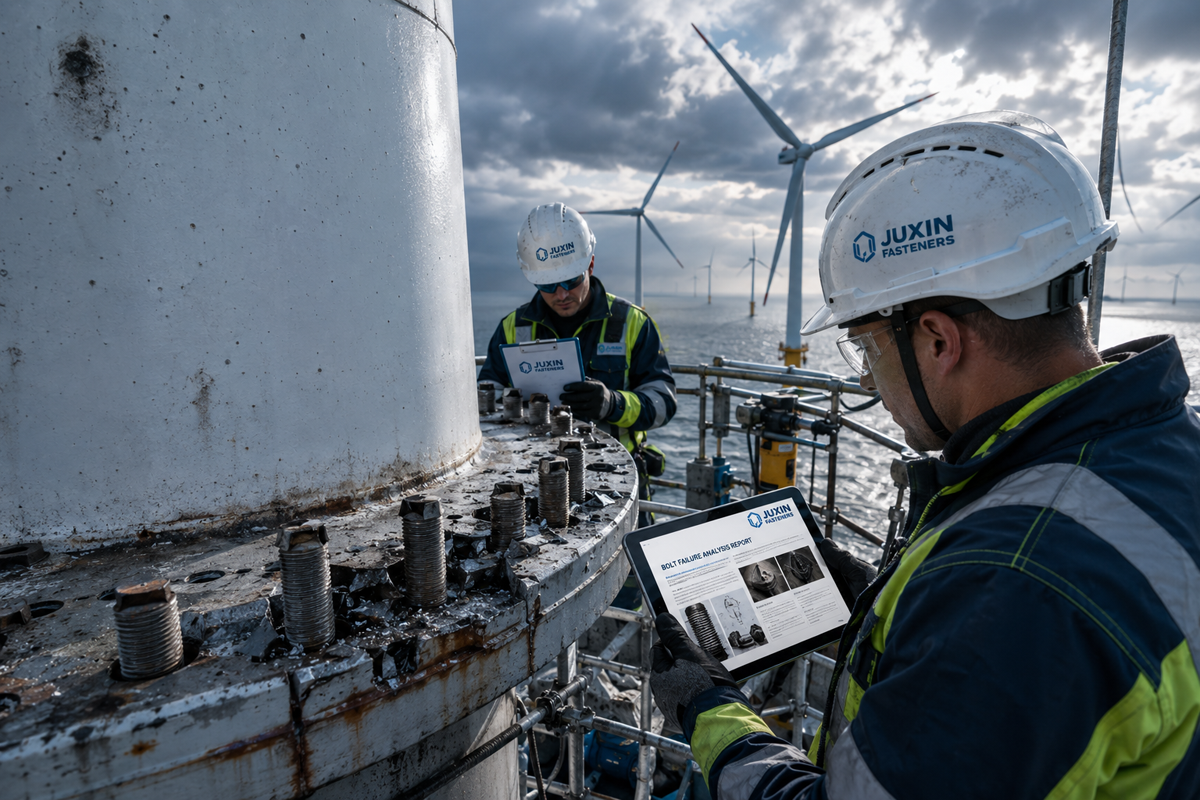
Bolts in wind turbine applications experience complex and fluctuating loads.
Taking a wind turbine tower flange bolted joint as an example:
Under no wind conditions: bolts mainly carry static preload
Under wind load: the tower experiences:
Axial tensile stress
Shear stress due to lateral forces
Dynamic vibration loads
This combined loading creates a highly variable stress state.
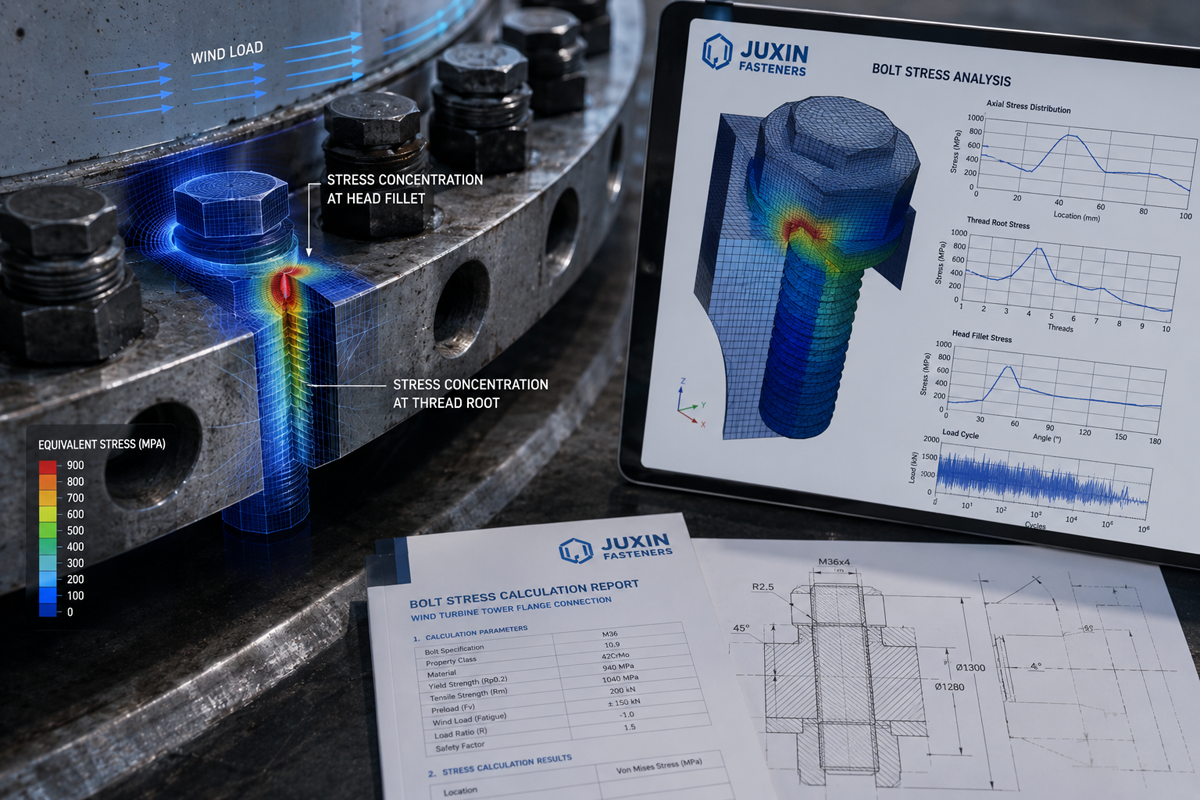
The most critical stress concentration areas include:
The first engaged thread near the nut
The fillet radius between the bolt head and shank
Key Engineering Insight
Bolt fatigue life is extremely sensitive to stress amplitude.
Even a 20% reduction in stress amplitude can increase fatigue life by 5 to 10 times.
This is why identical bolts can perform drastically differently depending on:
Wind site conditions
Installation preload accuracy
Structural stiffness
Load spectrum variability
2. The “Three Fracture Zones” of Fatigue Failure
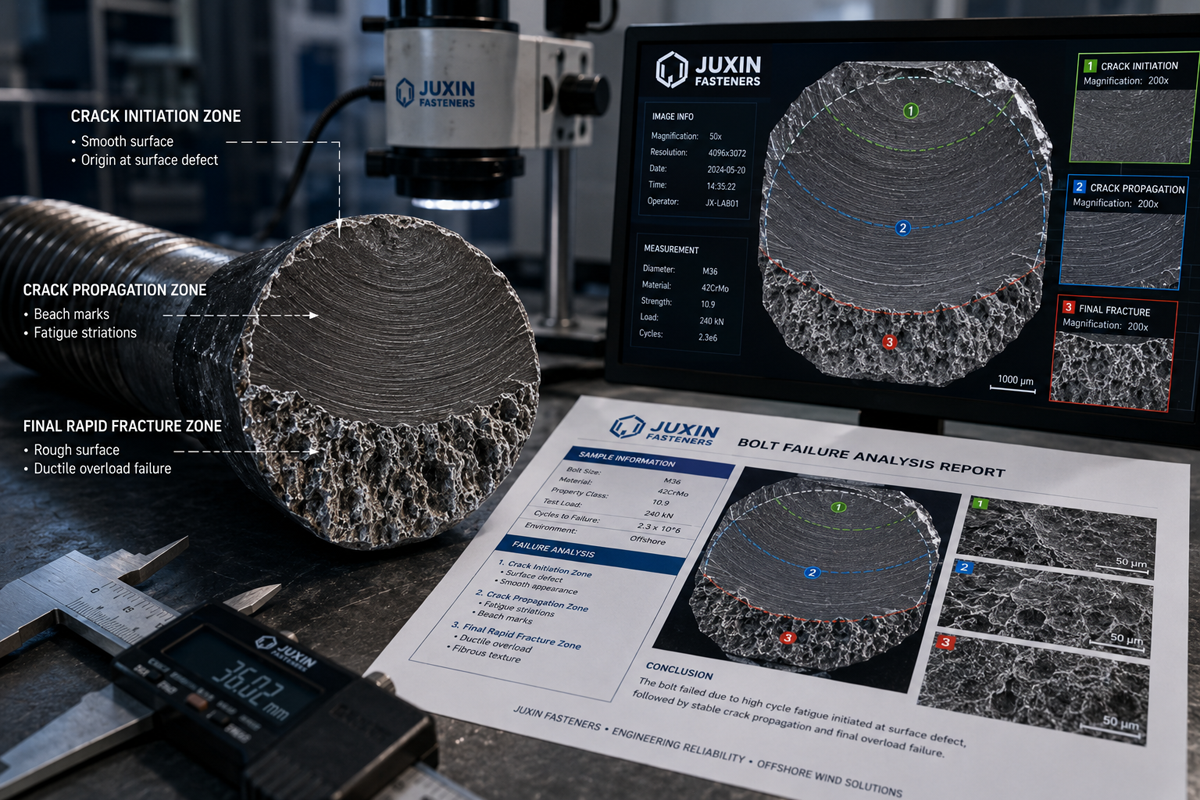
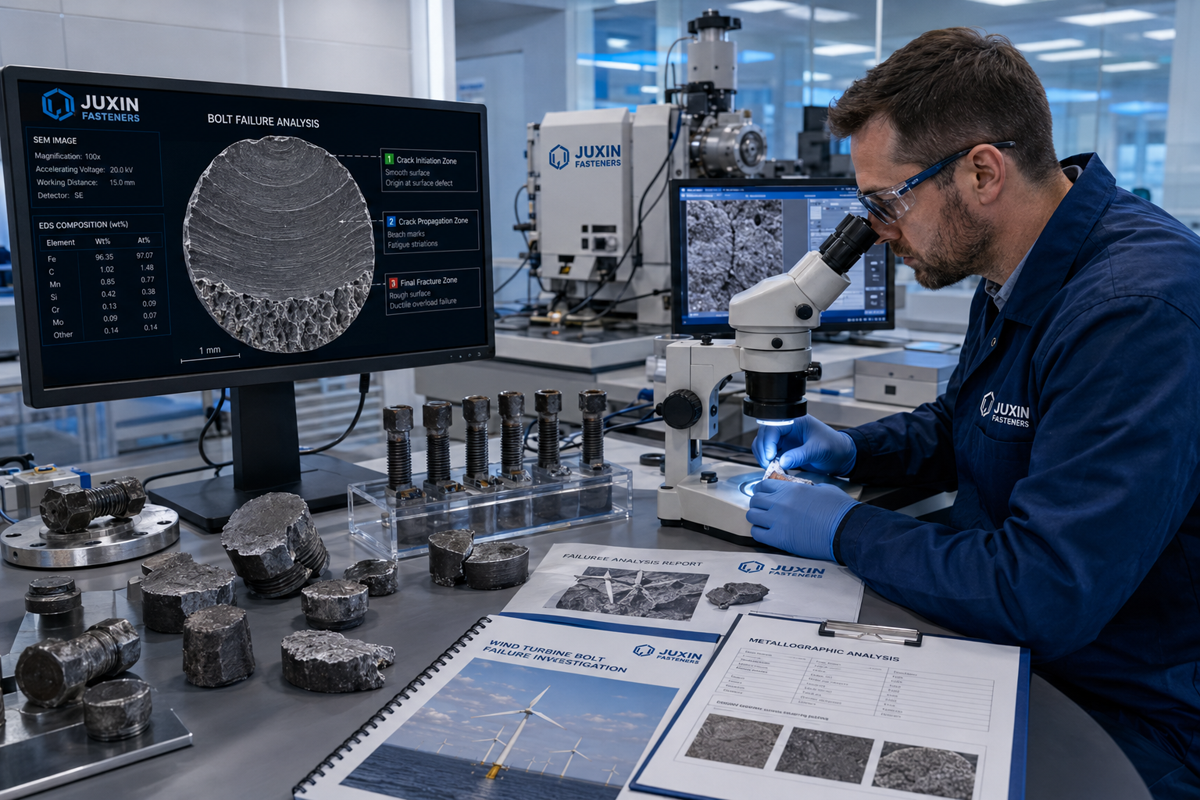
A fractured bolt contains critical forensic evidence. Engineers performing fatigue failure analysis of structural bolts can identify the root cause by examining the fracture surface morphology.
A typical fatigue fracture consists of three distinct zones:
2.1 Crack Initiation Zone (Origin of Fatigue Failure)
This is where the failure begins.
In high-strength bolts for wind turbines, crack initiation typically occurs at:
Thread root (most common)
Head-to-shank transition radius
Surface defects or machining marks
Visual Characteristics:
Smooth, relatively flat surface
Bright or polished appearance
Clear boundary from surrounding regions
If surface scratches, corrosion pits, or decarburization layers are observed, the root cause is often linked to:
Manufacturing defects
Heat treatment issues
Surface damage during installation
2.2 Crack Propagation Zone (Fatigue Growth Area)
This is the most characteristic region of fatigue failure.
It typically shows:
“Beach marks” (semi-circular patterns)
“Shell-like striations.”
Progressive crack growth patterns
Each visible arc represents a load cycle history.
Engineering Interpretation:
Narrow spacing → slow crack growth → long service life
Wide spacing → rapid crack growth → high stress amplitude
Under SEM (Scanning Electron Microscopy), finer fatigue striations confirm cyclic loading behavior.
2.3 Final Fracture Zone (Instant Failure Region)
Once the remaining cross-section can no longer carry the load, a sudden fracture occurs.
Characteristics:
Rough and fibrous surface
Darker appearance
Ductile overload features
Key Insight:
A smaller final fracture zone indicates:
Long fatigue propagation period
Lower average stress level
Gradual degradation process
3. Real Wind Turbine Failure Case Studies
Case 1: Tower Foundation Flange Bolt Failure (35CrMo Steel)
A failure analysis of tower flange bolts in a wind turbine foundation connection revealed:
Carbon content significantly below specification: only 0.009%
Severe decarburization at thread roots (≈23.5 μm), exceeding GB/T 3098.1 limits
Root Cause:
The decarburized layer reduced surface hardness and fatigue strength, while also introducing localized stress concentration.
Result:
→ Early fatigue crack initiation at the thread root
→ Progressive fatigue failure under cyclic wind loads
This is a manufacturing and heat treatment control issue.
Case 2: Pitch Bearing Bolt Failure (42CrMoA Steel)
In another case involving blade pitch system fasteners:
Chemical composition and mechanical properties met standards
However, metallographic analysis revealed severe Widmanstätten structure
Root Cause:
The abnormal microstructure significantly reduced toughness and fatigue resistance.
In high-vibration environments such as pitch systems:
Stress concentration accelerates crack initiation
Fatigue life decreases dramatically
This is a metallurgical raw material defect issue, not a design error.
4. VDI 2230 Bolt Design: The Engineering Basis for Fatigue Prevention
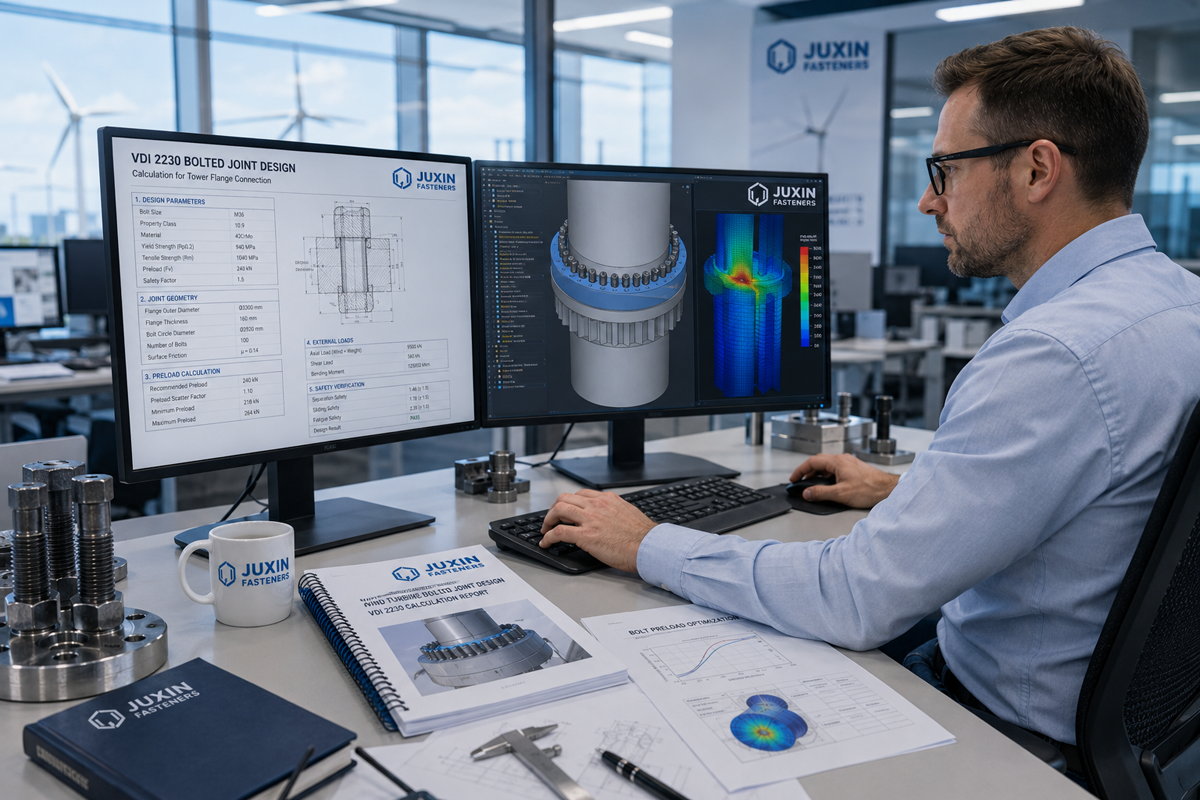
For wind turbine structural bolts, tower flange fasteners, and rotating equipment connections, fatigue design must follow internationally recognized standards.
The most widely accepted methodology is:
VDI 2230 Part 1 (2015) – High-Strength Bolted Joint Calculation
Key Parameter: Stress Amplitude (σa)
Fatigue failure is governed primarily by stress amplitude, not just static load.
Even with sufficient preload, fluctuating loads can cause:
Crack initiation
Crack propagation
Final fracture
Two Types of Thread Manufacturing Processes
1. Thread Rolling Before Heat Treatment
No residual compressive stress at the thread root
Lower fatigue resistance
Fatigue limit:
σASV = 130/d + 35 (MPa)
Engineering Note:
Large-diameter tower bolts for wind turbines are more prone to fatigue failure due to lower fatigue limits.
2. Thread Rolling After Heat Treatment (Premium Wind Turbine Bolts)
This is the preferred process for high-performance wind turbine fasteners.
Benefits:
Cold work hardening at the thread root
Continuous grain flow
Residual compressive stress layer
Fatigue improvement:
✔ Significantly higher fatigue resistance
✔ Delayed crack initiation
✔ Extended service life
Design Safety Requirement
According to VDI 2230:
Minimum fatigue safety factor: SD ≥ 1.8
Recommended for wind energy applications: SD ≥ 2.0
5. Improving Fatigue Life of Structural Bolts
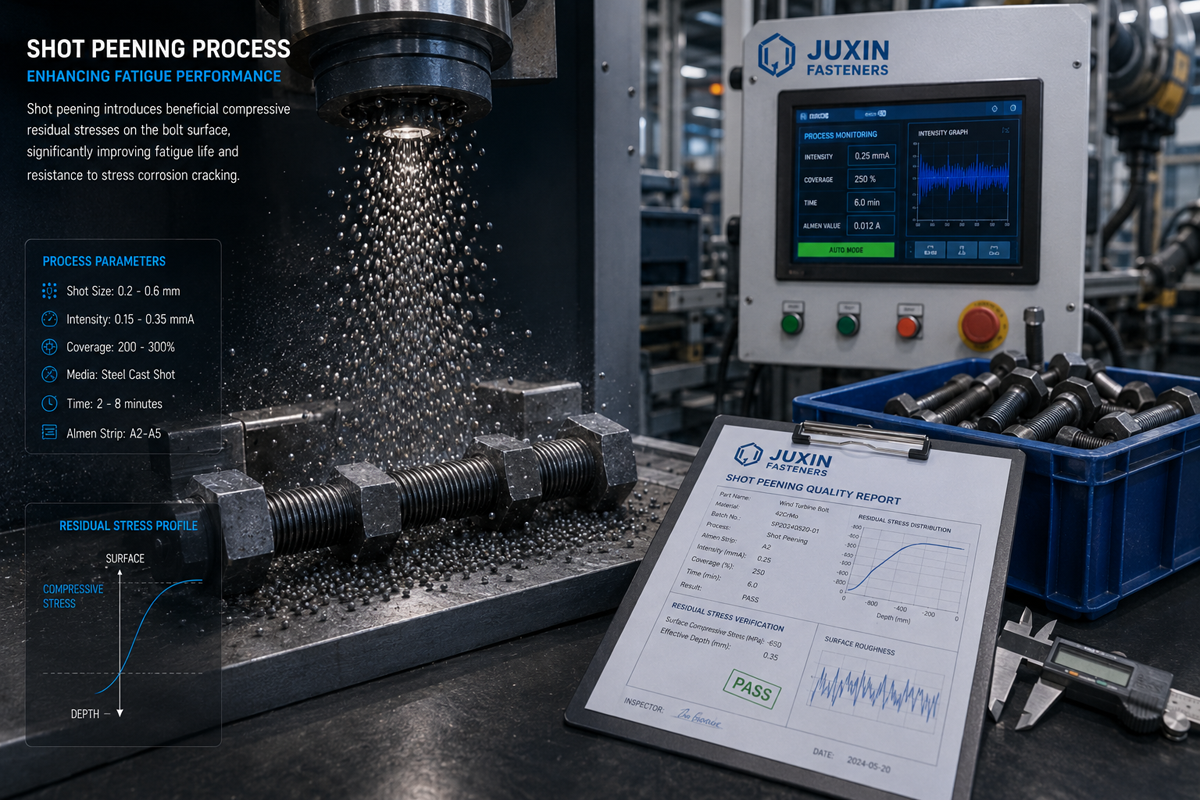
5.1 Surface Strengthening (Shot Peening)
Shot peening introduces compressive stress layers (0.2–0.5 mm depth).
Benefits:
Delays crack initiation
Reduces effective tensile stress
Improves fatigue strength by 30%–50%
This is widely used for:
Wind turbine tower bolts
Heavy structural bolted joints
Offshore wind fasteners
5.2 Thread Manufacturing Optimization
Post-heat-treatment thread rolling provides superior fatigue resistance
Higher surface hardness
Improved stress distribution
However, it requires:
Precise tooling control
Strict process consistency
6. Field Maintenance and Fatigue Prevention Strategy
For operating wind turbines, fatigue prevention is not only a design issue—it is also a maintenance strategy.
Recommended practices:
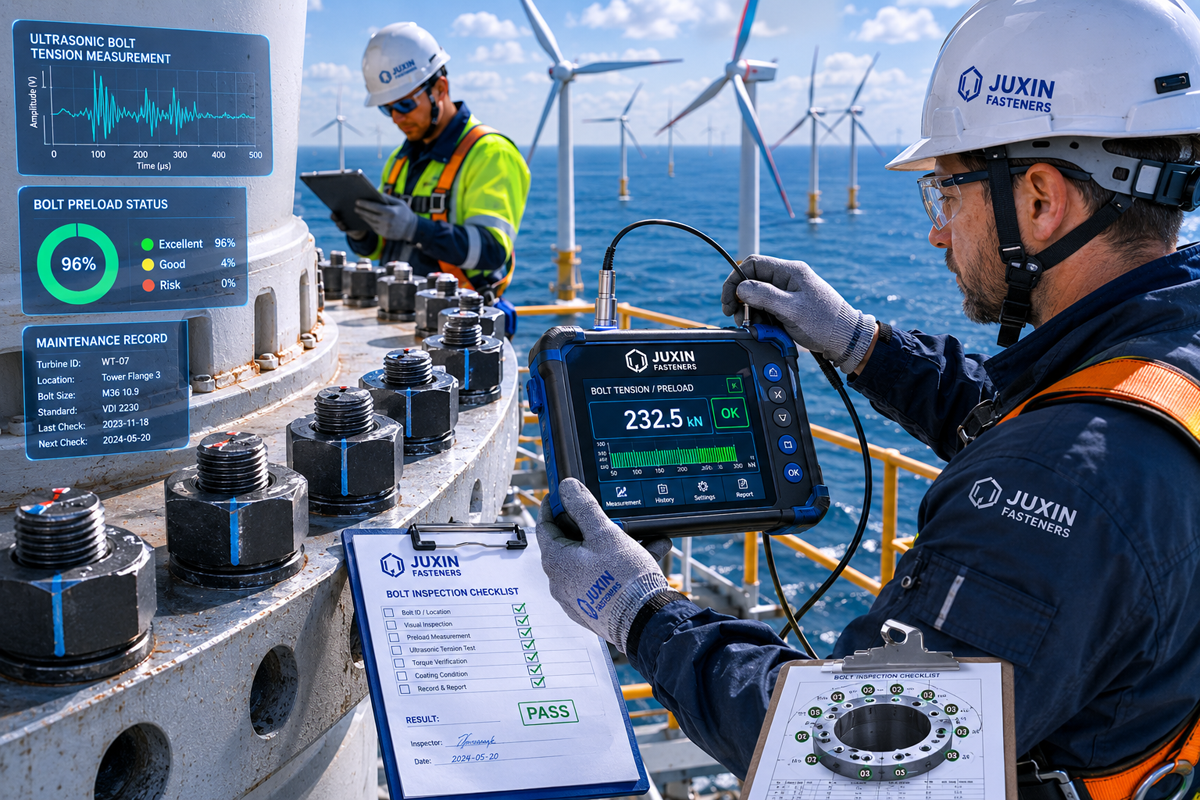
✔ Regular Bolt Preload Inspection
Loose bolts significantly increase stress amplitude and fatigue risk.
✔ Ultrasonic Bolt Tension Monitoring
Non-destructive measurement of bolt axial force in critical joints.
✔ Maintenance Data Tracking
Establish bolt health records to analyze long-term trends.
✔ Early Re-Tightening Strategy
Prevent cyclic loosening-induced fatigue accumulation.
Conclusion
In wind turbine engineering, bolt fatigue failure is not a single problem—it is a system-level issue involving material selection, manufacturing quality, installation accuracy, and structural design.
Understanding the three fracture zones allows engineers to identify accurately:
Manufacturing defects
Material metallurgy issues
Design-related stress concentration
At JUXIN FASTENERS, we provide:
Wind Turbine Structural Bolts
High-Strength Fatigue Resistant Bolts
Tower Flange Fasteners
VDI 2230 Designed Bolted Joint Solutions
Custom Engineering Fasteners for Renewable Energy
Our mission is to ensure that every wind turbine bolt system operates safely under millions of cyclic load cycles.
Product Packaging
Packaging Standard
At Juxin Fasteners, we apply standardized export packaging to ensure product protection, traceability, and compliance with international logistics requirements.
1. Standard Export Packaging
Unless otherwise specified, all products will be packed according to our factory standard export packaging, which includes:
Moisture-resistant inner protection
Poly bag or small box packing as required
Reinforced export cartons
Clear labeling with part number, specification, batch number, and quantity
Palletizing for sea or air shipment when necessary
Our standard packaging is designed to ensure safe transportation, efficient warehousing, and long-distance international shipping.
2. Customized Packaging Options
We also provide customized packaging solutions according to customer requirements, including but not limited to:
Private labeling
Customized barcodes
Specific carton dimensions
Retail packaging
Special pallet configuration
Customer-specific marking and identification
So that you know, customized packaging may involve additional costs and extended lead time depending on the complexity of the requirements.
3. Compliance & Quality Assurance
All packaging processes are controlled under our ISO 9001 quality management system to ensure consistency, traceability, and product integrity throughout the supply chain.
Product Pictures
Hot Products
Contact Us
Tel.:
+86 020 8621 0320
+86 020 3121 6067
E-mail:
Technical Support:
Navigation
SEND INQUIREY