Call Us
+86 136 6007 9809
Call Us
+86 136 6007 9809

JUXIN FASTENERS supplies round steel flare-in nuts for sheet-metal panels, industrial enclosures, control cabinets and equipment chassis. Unlike conventional self-clinching nuts, these threaded inserts are retained by mechanically expanding or flaring a designated portion of the nut during installation.
The cylindrical body is positioned in a prepared panel hole, then formed using suitable tooling to create a mechanical attachment. This design provides an internal threaded mounting point without welding.
Product Type: Round Flare-In Nut
Body Geometry: Cylindrical
Material: Steel
Material Grade: According to Approved Drawing
Product Family: JX-Z and Related Configurations
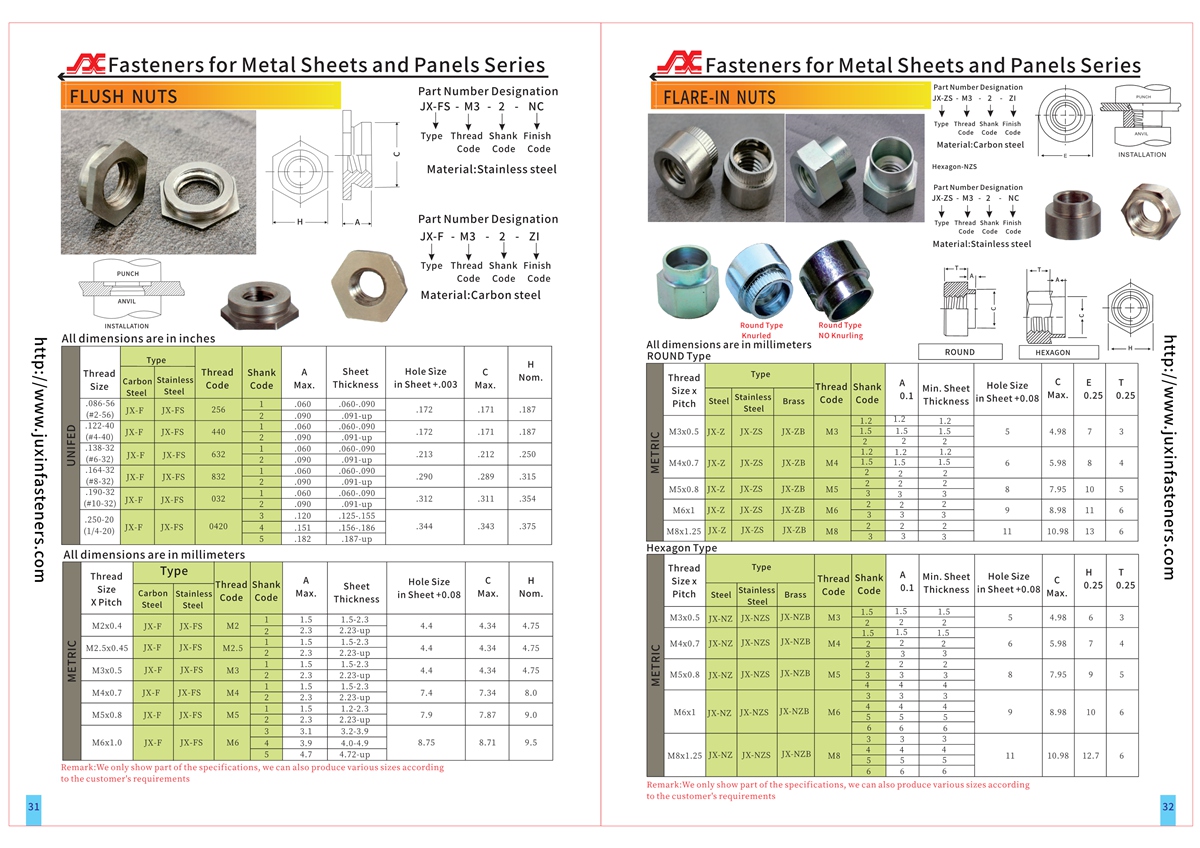
Thread Sizes: Subject to Confirmed Product Drawing
Installation: Mechanical Flaring or Swaging
Surface Finish: According to Project Requirements
Custom dimensions and OEM specifications may be reviewed against customer drawings.
Product Specification
Round Flare-In Nuts for Sheet Metal – Steel Threaded Insert Engineering and OEM Sourcing Guide
JUXIN FASTENERS supplies round flare-in nuts for manufacturers that need retained internal threads in sheet-metal panels, equipment housings, control cabinets and industrial chassis.
A round flare-in nut is a cylindrical threaded insert that is mechanically attached to a prepared mounting hole by deforming a designated portion of the fastener.
During installation, a suitable tool expands or flares the insert so that it becomes mechanically retained in the panel.
This attachment principle differs from conventional self-clinching nuts, which depend primarily on displacement of the parent-sheet material into the fastener's clinching features.
The round flare-in design is relevant when a manufacturing process calls for a formed threaded insert rather than welding, direct tapping or conventional self-clinching installation.
The appropriate configuration must be selected according to panel material, sheet thickness, hole geometry, installation access and the mechanical requirements of the finished assembly.
Product Design and Construction
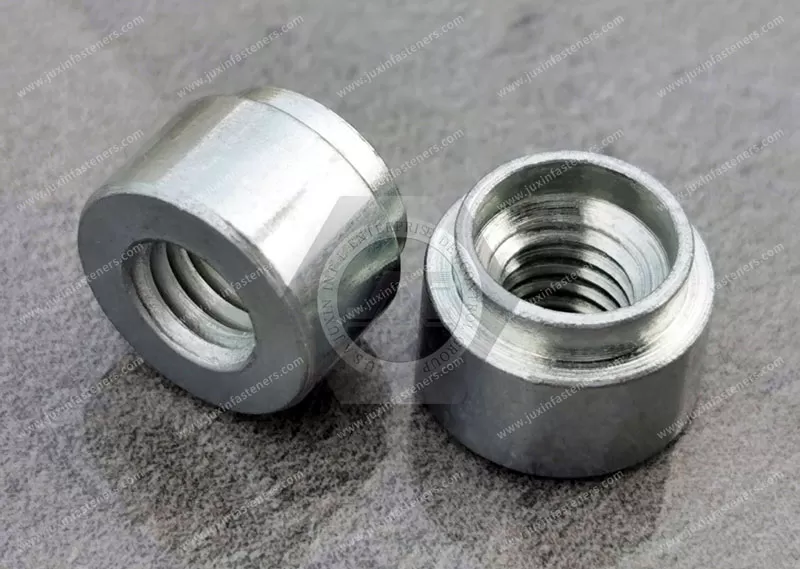
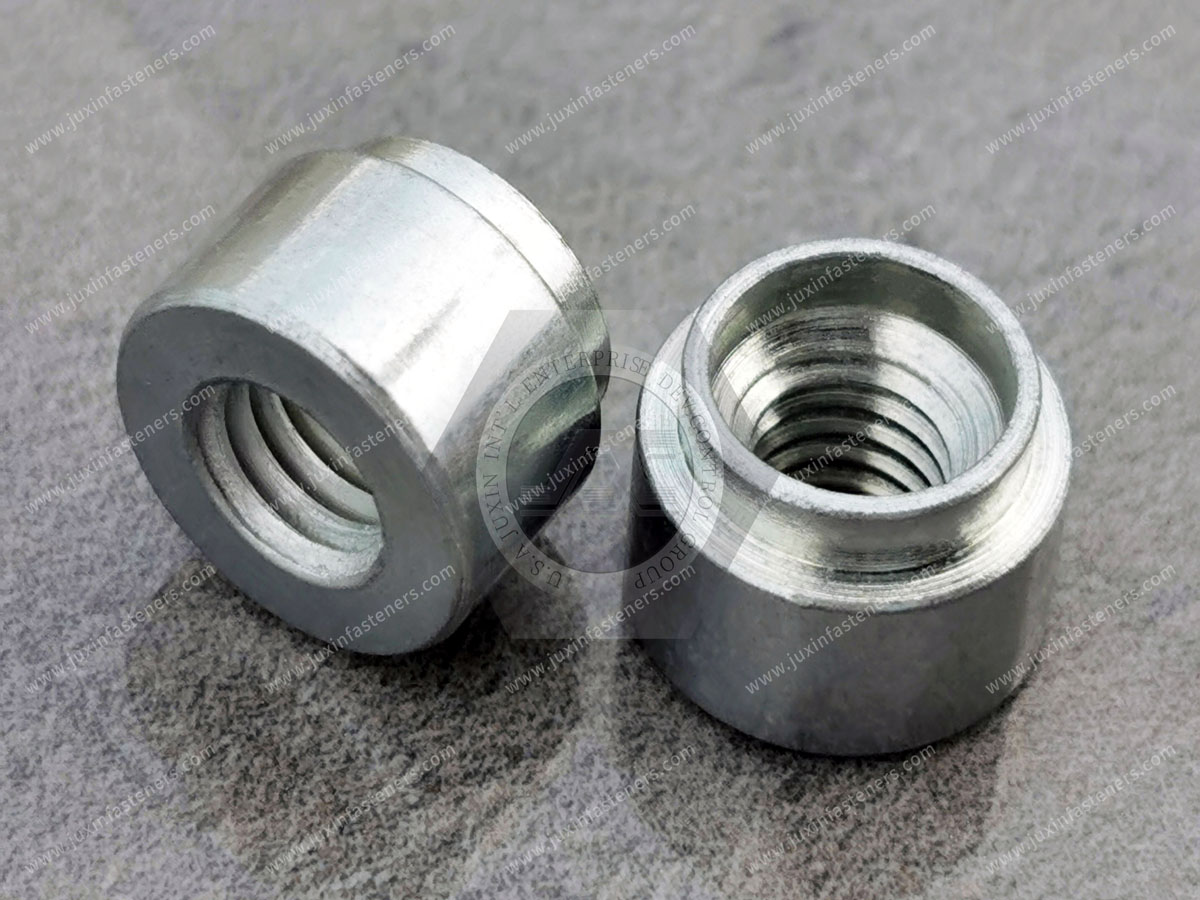
The product shown is a round-body flare-in nut with an internal thread and a cylindrical exterior.
The round geometry provides a compact form suitable for prepared circular mounting holes.
The supplied product information identifies JX-Z and related family designations.
Steel is the material category for this product page.
The final steel grade, dimensions, thread designation, surface finish and forming geometry must be established by the approved product drawing.
The round flare-in family should not be confused with hexagonal flare-in nuts, conventional self-clinching nuts or blind rivet nuts.
Although these products can all create threaded mounting points, their installation methods and retention mechanisms are different.
How a Round Flare-In Nut Works
A round flare-in nut is inserted into a correctly sized hole in the sheet-metal panel.
A suitable installation tool then acts on the designated deformable portion of the insert.
The material is mechanically expanded or flared to create a retained connection between the nut and the panel.
The resulting attachment provides a fixed threaded location for subsequent screw assembly.
The final shape and forming direction depend on the specific fastener geometry and tooling arrangement.
Correct installation must be based on the approved drawing rather than on a general description of the product family.
The insert must be supported and formed in a way that avoids damaging the internal thread or excessively deforming the surrounding sheet.
Engineering Information Gain – Why the Retention Mechanism Matters
Different sheet-metal threaded inserts may look similar before installation but behave differently during assembly.
A conventional self-clinching nut typically relies on the parent sheet flowing into a groove or undercut.
A flare-in nut relies on intentional deformation of the insert itself.
A blind rivet nut usually forms a backside upset through axial compression of its body, using an installation system designed for one-sided access.
These differences affect hole preparation, tooling, installation access, sheet compatibility and quality inspection.
Substituting one technology for another without reviewing the assembly drawing can lead to inadequate retention or incompatible tooling.
Engineers should therefore specify the fastening technology as well as the thread size.
Steel Material Selection
The supplied material information identifies several carbon steel and free-machining steel families as possible manufacturing materials.
Examples include C20, C45, C46 and the 1213, 1214 and 1215 steel families.
These materials differ in strength, ductility, machinability and response to forming or heat treatment.
They should not be treated as interchangeable alternatives.
For flare-in fasteners, material formability is especially important because the installation process intentionally deforms a portion of the nut.
A material that is too brittle for the intended deformation may crack during installation.
A material that is too soft or otherwise unsuitable may fail to retain the intended shape or mechanical performance.
The selected grade and condition must support both manufacturing and installation requirements.
Final material selection should be based on the approved drawing and the intended application.
Engineering Information Gain – Material Ductility Is Part of the Fastener Design
For a flare-in nut, installation performance is not determined only by the strength of the finished threaded component.
The deformable portion must undergo controlled plastic deformation during installation.
This creates a design trade-off between thread strength, forming behavior and the geometry of the retaining section.
The manufacturing process must preserve the required properties of the threaded region while allowing the intended forming operation.
Where heat treatment is proposed, its effect on installation ductility must be considered.
An engineering specification should therefore define the relevant material condition rather than relying only on a broad material description such as carbon steel.
Round Flare-In Nuts vs. Hexagonal Flare-In Nuts
Round and hexagonal flare-in nuts may be used for different mounting requirements.
A round flare-in nut fits a circular mounting hole and can simplify hole preparation where circular punches or drills are already used.
A hexagonal configuration may provide additional geometric resistance to rotation when installed in a correctly matched polygonal hole.
However, the rotational performance of either design depends on the complete fastener and panel arrangement.
A round body should not automatically be assumed to provide the same torque resistance as a hexagonal body.
Where the application involves significant tightening or removal torque, the engineer should confirm the required torque resistance using the selected configuration.
Engineering Information Gain – Circular Holes Are Convenient, but Rotation Must Be Evaluated
Circular holes are common in sheet-metal fabrication.
They can be produced using drilling, punching or other suitable manufacturing processes.
This makes round-body inserts attractive for many panel designs.
However, circular geometry alone does not provide a positive polygonal anti-rotation feature.
A round flare-in nut must obtain its rotational resistance from the installed mechanical connection and any other retention features included in the approved design.
For repeated screw installation or maintenance operations, torque resistance should be evaluated independently of axial retention.
A nut that resists being pushed out of the panel may still rotate under an excessive tightening torque.
Mounting-Hole Design
The mounting hole is a critical part of the flare-in connection.
The hole diameter must match the selected fastener's installation requirements.
An oversized hole can reduce the effectiveness of the mechanical attachment.
An undersized hole can prevent correct insertion or interfere with the intended forming process.
Hole roundness, burr condition, panel flatness and edge quality can also affect installation consistency.
The correct hole tolerance should be taken from the approved product drawing.
Engineers should avoid applying mounting-hole dimensions from another fastener family simply because the nominal thread size is the same.
Sheet Thickness Selection
Round flare-in nuts can be considered for suitable sheet-metal thicknesses where the fastener geometry permits proper forming and retention.
The supplied information does not establish one verified grip range or minimum sheet thickness for every product size.
The correct sheet-thickness range depends on the specific insert dimensions and installation method.
A sheet that is too thin for the selected configuration may not provide the intended mechanical support.
A sheet that is too thick may prevent the fastener from being formed correctly.
The approved drawing should identify the compatible panel thickness or thickness range.
Engineering Information Gain – Sheet Thickness and Forming Length Must Be Evaluated Together
The available material in the deformable section of a flare-in nut must be sufficient to form the intended retaining geometry.
At the same time, the surrounding sheet must support the installed connection.
These requirements are linked.
Changing the sheet thickness without reviewing the fastener geometry can alter the installation result.
For an OEM product family using multiple panel thicknesses, it may be necessary to evaluate more than one insert configuration.
Using a single fastener across several sheet thicknesses should be treated as a validated engineering decision rather than an assumption.
Installation Method
Round flare-in nuts require an installation process capable of forming the designated portion of the fastener.
The insert is positioned in the prepared mounting hole.
The tooling supports the assembly and applies the required forming action.
The deformable portion expands or flares to establish mechanical retention.
The final installation should preserve the required thread geometry and avoid unacceptable distortion of the parent sheet.
Tooling dimensions, support conditions, forming stroke and force must be determined for the selected part.
The supplied information describes an internal expansion or flaring operation, but does not establish one universal tooling arrangement for all configurations.
A production installation process should therefore be developed using the actual fastener drawing and representative panel material.
Installation Access Requirements
The installation method may require access to the relevant forming and support surfaces.
This requirement should be evaluated early in the enclosure design.
If the panel is folded or assembled before the nut is installed, tooling access may become restricted.
For suitable designs, flare-in nuts may be installed during an earlier sheet-metal manufacturing stage.
However, installation before bending must be evaluated for possible distortion or interference with subsequent forming operations.
A flare-in nut should not be classified as a one-sided blind fastener unless the exact product and installation process support that capability.
Axial Retention and Pull-Out Performance
The installed fastener must resist the axial forces expected during assembly and service.
Relevant loading may occur when a screw is tightened, when attached components are pulled away from the panel or during repeated maintenance.
The axial retention of a round flare-in nut depends on the formed geometry, panel thickness, material properties and installation quality.
No universal pull-out value can be assigned to the complete product family.
Where axial retention is important, the OEM should establish appropriate acceptance criteria and validation methods.
Torque Resistance
Torque resistance is important because the threaded insert must remain fixed while a mating screw is tightened or removed.
The installed connection must resist rotation relative to the sheet-metal panel.
Actual torque resistance depends on the insert geometry, formed attachment and surrounding panel material.
The installation process should be validated using representative production components.
Torque resistance of the insert-to-panel connection is not the same as the allowable tightening torque of the complete screw joint.
The mating screw, thread engagement, panel structure and assembly conditions must also be considered.
Thread Selection
Round flare-in nuts can be manufactured with internal threads specified by the approved drawing.
The supplied product description includes metric threaded configurations within the broader product family, but the available thread sizes for this particular round steel version should be confirmed against its dimensional table.
ISO 261 and ISO 965 provide relevant references for ISO metric threads.
ASME B1.1 provides relevant requirements for Unified inch threads where such configurations are specified.
Metric and Unified inch threads are not directly interchangeable.
An OEM RFQ should include the complete thread designation, including nominal size, pitch or threads per inch, and required tolerance class.
Surface Treatment and Corrosion Protection
Steel flare-in nuts may require corrosion protection depending on the operating environment.
The surface finish should be selected according to the approved product specification.
Electroplated zinc and other suitable coating systems may be evaluated where appropriate.
ISO 4042 is a relevant reference for electroplated coatings on threaded fasteners.
Coating selection should consider thread fit, corrosion exposure, material properties and the forming operation.
The coating must also be compatible with the installation process, since the deformable portion of the nut experiences mechanical strain.
A finish that appears satisfactory before installation may behave differently after flaring.
Where corrosion testing is specified, ISO 9227 or ASTM B117 may be used as relevant test methods.
Salt-spray results do not directly establish outdoor service life.
Any RoHS declaration or other regulatory requirement must be supported by appropriate documentation for the specified product and finish.
Engineering Information Gain – Consider the Coating After Installation, Not Only Before Installation
Flare-in installation deliberately deforms part of the fastener.
This means the surface finish may experience stretching, compression or local contact with installation tooling.
For corrosion-sensitive applications, the engineer should consider whether the selected finish remains suitable after installation.
Inspection of the formed region may be relevant where coating damage could affect service performance.
The correct evaluation depends on the coating system, deformation geometry and intended environment.
This consideration distinguishes flare-in nuts from threaded components that do not undergo significant forming during installation.
Electrical Cabinets and Power Distribution Enclosures
Round flare-in nuts may be used to create threaded mounting points in suitable metal cabinets and electrical equipment housings.
Potential applications include internal mounting brackets, removable panels and equipment supports.
The design should account for panel thickness, assembly access, vibration and corrosion exposure.
Where electrical grounding or bonding is required, the complete connection must be evaluated according to the applicable equipment requirements.
The presence of a metal fastener alone does not establish an approved electrical bonding path.
Industrial Control Boxes
Control boxes often require compact threaded mounting points for internal brackets, covers and mechanical accessories.
A flare-in nut may provide a retained thread where welding or direct tapping is undesirable.
The design should consider installation sequence, service access and the effect of repeated screw removal.
For equipment that is frequently serviced, torque resistance and thread durability should be included in the engineering evaluation.
Sheet-Metal Chassis and Equipment Housings
Metal chassis used in industrial equipment may contain multiple threaded mounting locations.
Round flare-in nuts can be considered for suitable panel designs requiring mechanically attached threaded inserts.
Potential applications include covers, brackets, internal supports and equipment mounting points.
The fastening system should be evaluated against the complete chassis geometry.
Nearby bends, edges, openings and adjacent components may affect the installation process.
Telecommunications and Electronic Equipment
Telecommunications housings and electronic equipment often use thin metal panels with closely spaced mounting points.
Round flare-in nuts may provide threaded attachment locations for selected brackets and enclosure components.
The suitability of the fastener depends on the panel material, mounting-hole design and required mechanical retention.
The engineer should also consider assembly clearances and the installation tooling needed to form the nut.
Industrial Machinery and Instrument Panels
Round flare-in nuts may be considered for machinery covers, instrument housings and other suitable sheet-metal components.
They can provide retained threads for removable components and service panels.
Where vibration or repeated maintenance is expected, the joint should be validated under representative operating conditions.
A separate screw-locking strategy may be required where loosening under vibration is a concern.
The flare-in connection's resistance to rotation should not be confused with the mating screw's resistance to loosening.
Round Flare-In Nuts vs. Self-Clinching Nuts
Both product families can provide retained internal threads in sheet-metal components.
Their installation mechanisms are different.
Self-clinching nuts generally rely on controlled displacement of the parent-sheet material into the fastener's retaining features.
Flare-in nuts rely on mechanical deformation of a designated portion of the fastener.
This difference influences tooling, material selection, hole preparation and installation inspection.
The correct choice depends on the approved joint design.
Round Flare-In Nuts vs. Blind Rivet Nuts
Blind rivet nuts are commonly selected when the installation process must be performed from one accessible side of the panel.
A round flare-in nut uses a forming process that must be evaluated according to the specific tooling and support arrangement.
The two technologies should not be treated as direct substitutes.
If one-sided installation is essential, the engineer should verify whether a blind rivet nut or another suitable blind fastener is more appropriate.
Round Flare-In Nuts vs. Weld Nuts
Weld nuts are attached through a welding process.
Flare-in nuts use mechanical forming.
Mechanical installation may be useful where the manufacturing process is intended to avoid welding heat or welding-related operations.
However, the complete installed cost depends on equipment, tooling, production volume, hole preparation and inspection requirements.
The appropriate technology should be selected based on the finished assembly rather than unit price alone.
Round Flare-In Nuts vs. Directly Tapped Holes
Direct tapping can be suitable where the parent sheet provides adequate material thickness and thread engagement.
In thinner sheets, direct tapping may provide limited thread engagement.
A separately installed threaded insert can provide an alternative fastening arrangement.
However, the performance of the installed flare-in nut must still be verified for the intended load and service conditions.
Engineering Information Gain – Compare Total Installation Cost
The purchasing cost of a threaded insert is only one component of the total fastening cost.
The complete process may include hole preparation, part feeding, positioning, forming, inspection and assembly.
A round flare-in nut may be attractive where the manufacturer already uses compatible round-hole fabrication processes.
However, specialized installation tooling and process validation must also be considered.
For OEM projects, the most economical option should be determined using the actual manufacturing sequence and required quality controls.
OEM Supplier Qualification
Procurement teams should identify the exact round flare-in nut configuration before comparing supplier quotations.
The product specification should include the approved drawing, material grade, thread designation, dimensions and surface finish.
The parent-sheet material and thickness should also be included because they influence installation compatibility.
Where performance is important, the RFQ should define required axial retention, torque resistance and installation acceptance criteria.
For recurring OEM programs, dimensional consistency and controlled engineering revisions are important to maintaining assembly compatibility.
Frequently Asked Questions
What is a round flare-in nut?
A round flare-in nut is a cylindrical threaded insert mechanically retained in a prepared panel hole by flaring or expanding a designated portion of the fastener.
Is a flare-in nut the same as a self-clinching nut?
No. The installation mechanisms differ. Flare-in nuts are formed during installation, while conventional self-clinching nuts rely primarily on displacement of the parent-sheet material.
Are round flare-in nuts suitable for thin sheet metal?
They can be suitable for compatible thin-sheet applications. The actual sheet-thickness range must be confirmed for the selected configuration.
How are round flare-in nuts installed?
They are inserted into prepared holes and mechanically formed using suitable installation tooling.
Do round flare-in nuts require welding?
No. Their attachment is created through mechanical forming.
Can round flare-in nuts be installed in stainless steel panels?
Compatibility must be evaluated for the selected fastener design, panel material, thickness and installation process.
What prevents the nut from rotating?
Rotational resistance is developed by the installed mechanical connection and any retention features included in the fastener design.
Can flare-in nuts be used for repeated screw assembly?
They may be suitable for serviceable threaded connections when the installed fastener and mating screw joint meet the required performance criteria.
Are custom sizes available?
Customer-specific dimensions and configurations may be reviewed against approved engineering drawings and manufacturing requirements.
What information is needed for a quotation?
The required thread, fastener drawing, panel material, sheet thickness, mounting-hole dimensions, surface finish, performance requirements and expected purchasing quantity.
Relevant International Engineering References
ISO 261 – ISO metric screw thread general plan.
ISO 965 – ISO metric screw thread tolerances.
ASME B1.1 – Unified inch screw threads, where applicable.
ISO 6508-1 and ASTM E18 – Rockwell hardness testing.
ISO 6506-1 and ASTM E10 – Brinell hardness testing.
ISO 4042 – Electroplated coating requirements for threaded fasteners, where applicable.
ISO 9227 and ASTM B117 – Salt-spray test methods, where specified.
These references support engineering specification and evaluation. They do not imply universal certification of every supplied configuration.
Related JUXIN FASTENERS Product Categories
Hexagonal Flare-In Nuts – for designs requiring a polygonal mounting-hole configuration.
Steel Self-Clinching Nuts – for threaded panel attachments using conventional clinching technology.
Stainless Steel Self-Clinching Nuts – for applications requiring a specified stainless steel fastener.
Self-Clinching Flush Nuts – for applications requiring threads without intended projection on either side of the sheet.
Blind Rivet Nuts – for applications requiring an appropriate one-sided installation system.
Self-Clinching Standoffs – for threaded mounting points that also provide component spacing.
These categories should be connected to their corresponding verified JUXIN FASTENERS product pages.
Request a Round Flare-In Nut Quotation
JUXIN FASTENERS supplies round flare-in nuts and related sheet-metal fastening components for industrial OEM applications.
For engineering review and quotation, please provide your product drawing or CAD file, required thread designation, material grade, panel material, sheet thickness and mounting-hole dimensions.
Please also specify the required finish, installation method, mechanical performance criteria, estimated annual usage and initial order quantity.
Our team can review the requested configuration and prepare a quotation based on confirmed technical and commercial requirements.
Email: info@juxinfasteners.com
Website: www.juxinfasteners.com
JUXIN FASTENERS – Round Flare-In Nuts and OEM Sheet-Metal Threaded Insert Solutions.
Product Packaging
Product Packaging
Round steel flare-in nuts are packed with protective materials appropriate to the confirmed product dimensions and shipment requirements.
The supplied packaging arrangement includes inner protective foam, outer cartons and palletized shipping where applicable.
Referenced carton dimensions include 29 × 19 × 19.5 cm and 23.5 × 17.5 × 8 cm. The appropriate carton size depends on the selected product and packing quantity.
A referenced pallet arrangement is 215 × 100 × 90 cm, subject to confirmation for the actual shipment.
Packaging quantities, carton weights, pallet configuration and labeling requirements are confirmed during order processing.
Different thread sizes and product configurations should be clearly identified to support warehouse handling and OEM assembly operations.
Customer-specific packaging and identification requirements may be reviewed during quotation.
Email: info@juxinfasteners.com
Website: www.juxinfasteners.com
Product Pictures
Contact Us
Tel.:
+86 020 8621 0320
+86 020 3121 6067
E-mail:
Technical Support:
Navigation
SEND INQUIREY