Call Us
+86 136 6007 9809
Call Us
+86 136 6007 9809

JUXIN FASTENERS supplies miniature self-clinching nuts for compact sheet metal assemblies requiring durable, reusable internal threads within limited installation space.
The JX-FE and JX-FEO configurations incorporate self-locking thread features, while JX-FEX and JX-FEOX use free-running threads. This allows engineers to select a fastening solution according to assembly torque, serviceability and joint requirements.
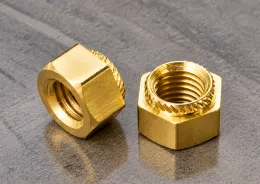
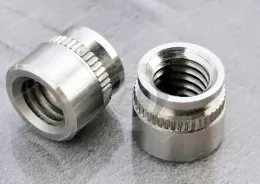
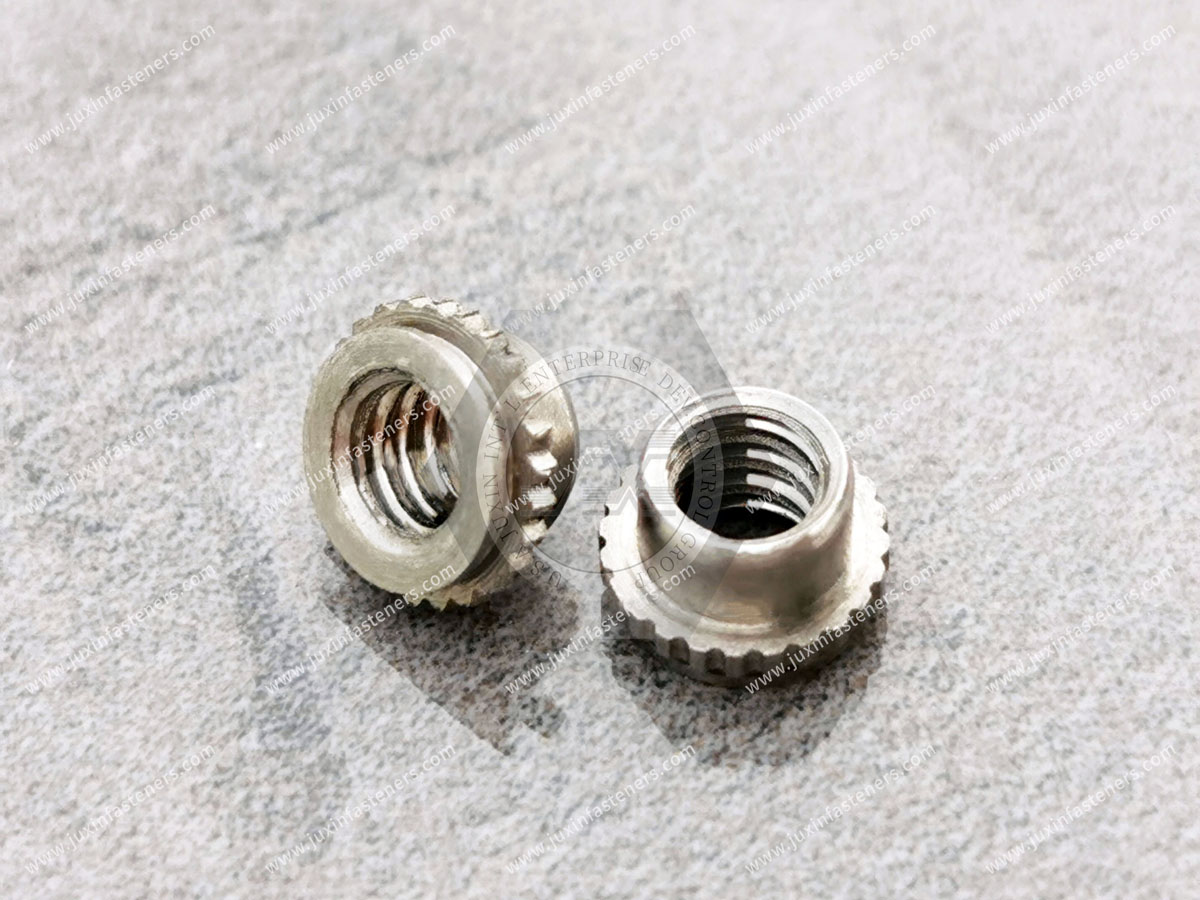
The miniature fasteners are installed by pressing their retention features into correctly prepared sheet metal holes. The knurled collar and undercut geometry work with displaced sheet material to provide mechanical retention.
The referenced product family includes metric and inch-series threads, with certain configurations intended for thin sheets. Exact thread sizes, minimum sheet thickness and installation dimensions depend on the selected model.
Stainless steel material options include grades corresponding to 302, 303, 316, 410, 420 and 430, subject to confirmation.
For OEM specifications, CAD drawings and quotations, contact info@juxinfasteners.com.
Website: www.juxinfasteners.com
Product Specification
Miniature Self-Clinching Nuts – JX-FE, JX-FEO, JX-FEOX and JX-FEX
Engineering Specifications, Thin-Sheet Installation and OEM Selection Guide
Product Overview
Miniature self-clinching nuts are designed to provide reusable internal threads in sheet metal assemblies where installation space is limited.
Compared with larger conventional fastening arrangements, miniature self-clinching nuts can reduce the space needed for a captive threaded connection.
The JX-FE, JX-FEO, JX-FEOX and JX-FEX product family provides locking and non-locking configurations for different assembly requirements.
These fasteners use mechanical interference and controlled sheet metal displacement to secure the fastener in the mounting panel.
The correct selection depends on thread size, host-sheet material, available sheet thickness, locking requirements and installation geometry.
Product Identification
Product category: Miniature self-clinching nuts
Main product types: JX-FE, JX-FEO, JX-FEOX and JX-FEX
Thread configuration: Internal female threads
Installation method: Press installation into prepared sheet metal holes
Retention design: Knurled collar and undercut geometry
Thread options: Locking and free-running configurations
Material family: Stainless steel
Material references: Grades corresponding to 302, 303, 316, 410, 420 and 430, subject to configuration review
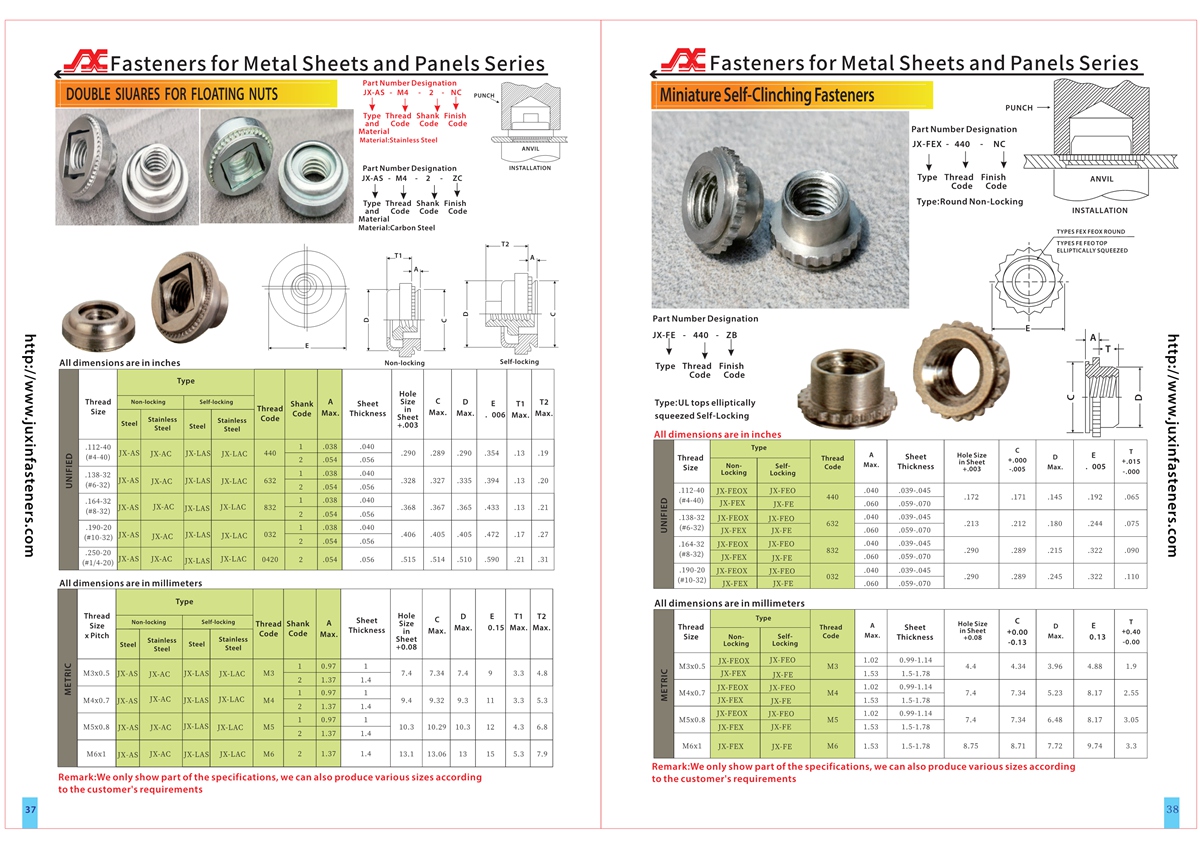
Thread sizes: Referenced family range includes metric M2–M6 and inch-series #4 through 1/4 in, subject to individual model availability
Sheet thickness: Certain family configurations are intended for thin sheets; exact minimum thickness requires drawing confirmation
Dimensional reference: Product specification PDF or CAD documentation, pages 37–38
Custom dimensions: Subject to engineering review
Locking and Non-Locking Product Types
The most important distinction within this miniature fastener family is the internal thread function.
JX-FE: Self-locking thread configuration
JX-FEO: Self-locking thread configuration
JX-FEX: Free-running, non-locking thread configuration
JX-FEOX: Free-running, non-locking thread configuration
A self-locking thread incorporates a feature that produces resistance to rotation during screw engagement.
A free-running thread is intended to allow normal screw engagement without an intentional prevailing-torque locking feature.
The correct type should be specified before purchasing.
JX-FE Versus JX-FEX
JX-FE is intended for applications requiring a locking-thread function.
JX-FEX provides a free-running internal thread.
Both belong to the miniature self-clinching fastener family.
The difference affects assembly torque, screw engagement, servicing and the mechanical requirements of the joint.
A locking version should not automatically replace a non-locking version.
The complete product drawing must also be checked before considering interchangeability.
JX-FEO Versus JX-FEOX
JX-FEO incorporates a locking-thread function.
JX-FEOX uses a free-running thread.
Engineers should select the configuration according to the actual need for prevailing torque.
The absence of a locking feature does not mean that the connection cannot be secured.
It means that the final joint must obtain its required resistance to loosening through the selected fastening architecture.
Why Miniature Self-Clinching Nuts Are Used
Miniature self-clinching nuts can be considered when the design requires:
Reusable internal threads
Limited installation space
Compact sheet metal assemblies
Reduced fastening hardware count
Controlled fastener positioning
Mechanical retention in a thin panel
An accessible threaded attachment point
Locking or free-running thread selection
The design must still provide sufficient sheet material around the installation hole.
Thin Sheet Metal Applications
The supplied family information describes configurations intended for sheets as thin as approximately 0.76 mm, with another source reference of 0.020 in.
These two values are not equivalent: 0.020 in is approximately 0.51 mm.
Therefore, neither should be applied universally to all four JX product types.
The minimum sheet thickness must be confirmed from the exact product drawing and host-material requirements.
A fastener suitable for one sheet thickness may not be suitable for another.
How the Self-Clinching Mechanism Works
The fastener is positioned in a correctly prepared mounting hole.
A press applies controlled squeezing force.
The knurled collar is embedded into the host sheet.
Sheet material flows into the undercut retention geometry.
This creates a mechanically retained threaded attachment point.
The retention process depends on controlled deformation of the mounting sheet.
The resulting performance must be verified for the selected fastener and host material.
Role of the Knurled Collar
The knurled collar helps resist rotation of the installed fastener.
During installation, the collar engages the surrounding sheet material.
The knurled geometry creates mechanical interference that contributes to torque-out resistance.
However, the presence of a knurled collar does not establish a universal torque-out rating.
Actual performance depends on sheet thickness, hardness, installation hole geometry and press conditions.
Role of the Undercut
The undercut provides a region into which sheet material can flow during installation.
This material engagement contributes to axial retention.
The design helps resist push-out or displacement of the fastener under relevant loading conditions.
The undercut must be filled appropriately during installation.
Insufficient installation force may produce incomplete material engagement.
Excessive force may deform the fastener or host sheet.
Torque-Out Resistance
Torque-out resistance is a measure of the installed fastener's resistance to rotation under the relevant test conditions.
It is especially important for locking miniature nuts because the mating screw encounters additional resistance from the locking-thread feature.
The installed fastener must resist rotation during assembly and servicing.
For locking versions, engineers should compare the specified prevailing torque with the installed fastener's torque-out capability.
This relationship should be evaluated using the actual host sheet and installation process.
Push-Out Resistance
Push-out resistance evaluates how effectively the fastener remains retained against axial displacement.
Relevant variables include:
Fastener geometry
Host-sheet material
Sheet thickness
Mounting hole diameter
Hole quality
Press force
Tool alignment
Installed condition
Required push-out values must be defined by the applicable product specification or customer drawing.
Locking Thread Function
JX-FE and JX-FEO incorporate self-locking thread features.
The locking mechanism is intended to provide prevailing torque during screw engagement.
Prevailing torque is not the same as the final tightening torque used to create joint preload.
It is also not a guarantee that the complete assembly will resist all vibration conditions.
The locking performance must be qualified against the application requirements.
Prevailing Torque and Reusability
Miniature locking nuts may be used in assemblies that require periodic servicing.
The locking torque can change with repeated screw installation and removal.
For this reason, engineers should specify the required installation and removal cycles where relevant.
The test program should consider:
Initial prevailing torque
Removal torque
Subsequent installation torque
Thread condition
Mating screw material
Surface condition
Lubrication
Acceptance criteria
No specific reuse-cycle capability should be assumed without verified product data.
Dry-Film Lubrication and Thread Galling
The supplied family information references dry-film lubrication for certain miniature locking fasteners.
Such lubrication may help control friction and reduce galling risk during repeated thread engagement.
However, the lubricant type, coating coverage and applicability to individual JX configurations must be confirmed.
A lubricant can also affect prevailing torque.
Therefore, lubrication must be evaluated as part of the locking-thread specification rather than treated as an independent finishing option.
Free-Running Thread Configurations
JX-FEX and JX-FEOX are identified as free-running configurations.
The referenced family includes thread tolerance classes 2B and 6H.
Class 2B is associated with Unified inch-series internal threads.
Class 6H is associated with ISO metric internal threads.
These designations belong to different thread systems.
They are not interchangeable.
The exact thread class must be confirmed for each ordered size.
International Thread Standards
ISO 261 may be relevant to metric thread designation.
ISO 965 may be relevant to metric thread tolerances.
ASME B1.1 may be relevant to Unified inch-series threads.
The final purchase specification should identify the complete thread designation and applicable standard.
Metric and inch-series threads should not be substituted based only on similar nominal diameters.
Applicable Locking-Thread Specifications
The supplied reference information mentions NASM25027 and NASM45938/7 for certain locking miniature fastener configurations.
These specifications may be relevant where explicitly required by an OEM.
However, the mention of a specification does not establish that every JX-FE or JX-FEO product conforms to it.
Compliance must be supported by product-specific documentation and the required test results.
Any requested standard, revision and acceptance criteria should be included in the RFQ.
Stainless Steel Material Selection
The supplied material options include grades corresponding to 302, 303, 316, 410, 420 and 430 stainless steel.
These grades differ in composition, mechanical properties, corrosion behavior and manufacturing characteristics.
302 and 303 are austenitic stainless steels.
316 is an austenitic stainless steel commonly evaluated for enhanced corrosion resistance in certain environments.
410 and 420 are martensitic stainless steels.
430 is a ferritic stainless steel.
The selected grade must be compatible with the fastener design and intended operating environment.
Not every listed material is necessarily suitable for every miniature fastener configuration.
Host-Sheet Hardness Compatibility
Self-clinching fasteners depend on the ability of the host sheet to deform around the retention geometry.
A fastener made from stainless steel is not automatically suitable for installation into every stainless steel sheet.
The sheet hardness and material condition must be checked.
Where the host sheet is too hard, insufficient material flow may occur.
Where the host sheet is too thin or otherwise unsuitable, the installation may fail to achieve the required retention.
The approved product drawing should define the installation conditions.
Mounting Hole Design
The mounting hole must match the selected miniature fastener.
Important design parameters include:
Hole diameter
Hole tolerance
Sheet thickness
Distance from hole to sheet edge
Distance to nearby holes
Distance to bends
Sheet hardness
Hole manufacturing process
Burr condition
Tooling access
A miniature fastener does not eliminate the need for adequate surrounding sheet material.
The designer should use the actual installation specification rather than generic hole dimensions.
Installation Process
A typical installation sequence includes:
Prepare the specified mounting hole.
Position the miniature fastener correctly.
Support the sheet with suitable tooling.
Align the punch and anvil.
Apply controlled squeezing force.
Verify that the fastener is properly seated.
Inspect the threaded opening.
Confirm the required retention performance.
The exact tooling arrangement and installation force depend on the fastener design.
Installation Quality Indicators
The supplied product information describes the embedded collar as a visual indicator of installation.
Visual inspection can help identify obvious seating problems.
However, appearance alone does not prove that the fastener meets the required mechanical performance.
A qualified process should also consider dimensional inspection, push-out testing, torque-out testing and thread-function checks where applicable.
Avoiding Installation Damage
Potential installation problems include:
Insufficient press force
Excessive press force
Incorrect mounting hole size
Misaligned tooling
Sheet deformation
Incomplete collar embedding
Thread damage
Fastener rotation
Loss of axial retention
These risks should be addressed during prototype and production validation.
Miniature Fasteners and Space-Constrained Design
The principal engineering advantage of a miniature self-clinching nut is the ability to create a captive threaded attachment within a restricted area.
However, reducing the physical size of the fastener can also reduce the available retention geometry and surrounding sheet material.
Engineers should not select the smallest available fastener without checking load requirements.
The design should balance space efficiency with retention performance and assembly access.
Application: Consumer Electronics
Compact electronic products often contain sheet metal frames, brackets and protective housings.
Miniature self-clinching nuts may be considered where small components require reusable threaded attachments.
The designer should review the available installation space and the location of nearby electronic components.
Where frequent servicing is expected, thread durability and assembly torque become important selection factors.
Application: Industrial Electronics
Industrial electronic equipment may use compact mounting plates, controller housings and internal brackets.
Miniature clinch nuts provide a possible alternative to loose nuts where access is limited during final assembly.
Locking versions may be considered when the joint specification requires prevailing torque.
The mechanical and electrical requirements of the complete assembly must be evaluated separately.
Application: Telecommunications Equipment
Telecommunications devices often require compact and repeatable fastening arrangements.
Miniature captive nuts can support assembly of sheet metal modules, covers and internal mounting brackets.
The fastener size, panel thickness and service requirements should be considered together.
Where vibration or transport loading is relevant, the final joint should be qualified accordingly.
Application: Medical Equipment Housings
Medical equipment housings may include compact metal panels and serviceable internal components.
Miniature self-clinching nuts can be evaluated for appropriate non-implantable mechanical assembly applications.
Material compatibility, cleaning exposure and applicable product-specific regulatory requirements must be evaluated independently.
No medical-device qualification should be inferred from the fastener designation.
Application: Precision Instrumentation
Precision instruments may contain compact metal frames and small mounting interfaces.
Miniature self-clinching nuts can provide reusable threads where conventional loose nuts are difficult to position.
The engineer should consider installation-induced sheet distortion and the effect on nearby precision features.
Fastener installation should be completed and inspected before sensitive components are assembled where appropriate.
Application: Aerospace and Transportation Equipment
Weight and space constraints can make miniature fastening solutions relevant to transportation equipment.
However, any aerospace or safety-critical use requires application-specific approval.
Applicable material, traceability, locking performance and mechanical testing requirements must be established by the customer.
No aerospace certification is implied by reference to a NASM specification.
Miniature Self-Clinching Nuts Versus Conventional Nuts
A conventional nut normally requires access for positioning and tightening.
A miniature self-clinching nut is installed into the sheet before final assembly.
The installed nut becomes a captive threaded attachment point.
This may simplify later assembly operations where rear access is limited.
However, self-clinching installation requires compatible sheet material, appropriate hole geometry and suitable press tooling.
Miniature Self-Clinching Nuts Versus Rivet Nuts
Blind rivet nuts are typically installed by deforming the fastener body.
Self-clinching nuts rely on displacement of the host sheet material around retention features.
The installation processes and host-material requirements are different.
A blind rivet nut may be preferable where installation access is limited to one side.
A miniature self-clinching nut may be preferable where a compact captive threaded connection and compatible press installation are available.
Selection should be based on the complete assembly.
Miniature Self-Clinching Nuts Versus Weld Nuts
Weld nuts require a suitable welding process and compatible materials.
Miniature self-clinching nuts use mechanical press installation without requiring a weld at the attachment point.
This may avoid certain welding-related manufacturing considerations.
However, clinch nuts introduce their own requirements for hole preparation, sheet hardness and press tooling.
Neither technology is universally superior.
Design for Assembly
A miniature clinch nut should be selected early enough in the design process to allow for proper hole placement and tooling access.
The engineering team should confirm:
Installation sequence
Available press access
Sheet support
Distance to formed features
Thread engagement
Mating screw length
Assembly torque
Service access
Inspection requirements
The fastener should be considered part of the sheet metal manufacturing process, not only as a purchased component.
OEM Purchasing Considerations
Purchasing and supplier-development teams should distinguish between the locking and non-locking versions.
The RFQ should clearly identify:
JX-FE
JX-FEO
JX-FEX
JX-FEOX
The selected designation should be supported by the complete dimensional and performance requirements.
Additional purchasing considerations include:
Material grade
Thread size
Thread class
Sheet thickness
Host-sheet material
Required retention strength
Locking torque requirements
Surface condition
Inspection requirements
Order quantity
Annual forecast
Packaging
Delivery schedule
What Determines Product Pricing?
Pricing depends on the selected configuration and commercial requirements.
Relevant factors include:
Fastener type
Thread size
Stainless steel grade
Locking-thread design
Dimensional tolerances
Surface treatment
Testing requirements
Production quantity
Inspection requirements
Packaging
Delivery requirements
Customer-specific drawings
A complete drawing and specification will support a more accurate quotation.
Frequently Asked Questions
What are miniature self-clinching nuts?
They are compact captive threaded fasteners installed mechanically into compatible sheet metal.
Which versions have locking threads?
JX-FE and JX-FEO are identified as locking versions.
Which versions have free-running threads?
JX-FEX and JX-FEOX are identified as free-running versions.
Can these fasteners be used in very thin sheets?
Certain configurations are intended for thin-sheet applications, but the minimum sheet thickness must be confirmed for each model.
Are stainless steel versions available?
Stainless steel material options are identified in the supplied product family information, subject to configuration confirmation.
Do locking miniature nuts guarantee vibration resistance?
No. Joint-level vibration performance must be evaluated for the application.
Are metric and inch threads interchangeable?
No. The thread designation and applicable tolerance standard must match the mating screw.
Can these fasteners be supplied according to an OEM drawing?
Customer drawings and special requirements can be submitted for engineering and commercial review.
Related Products and Internal Linking
Relevant JUXIN FASTENERS product categories include:
JX-U Miniature Self-Clinching Nuts
JX-UL Miniature Self-Locking Clinch Nuts
Self-Clinching Nuts
Stainless Steel Self-Clinching Nuts
Floating Self-Clinching Nuts
Self-Clinching Blind Nuts
Self-Clinching Studs
Self-Clinching Standoffs
Blind Rivet Nuts
Sheet Metal Fastening Solutions
The locking versus non-locking comparison should link to the relevant JX-U and JX-UL product pages where those pages are available.
The installation discussion should link to the broader self-clinching nuts category.
The alternative fastening section should link to the blind rivet nuts category.
Only verified internal URLs should be used when publishing these links.
Request an OEM Quotation
JUXIN FASTENERS supplies industrial fastening solutions for OEM engineering, purchasing and supplier-development projects.
For miniature self-clinching nuts, please provide:
Required product type
Thread size and standard
Stainless steel grade
Host-sheet material
Sheet thickness
Mounting hole dimensions
Locking or non-locking requirement
Required prevailing torque, if applicable
Required push-out resistance
Required torque-out resistance
Product drawing or CAD file
Surface treatment requirements
Inspection requirements
Estimated order quantity
Annual demand forecast
Packaging requirements
Delivery requirements
The submitted information will be reviewed against the selected product configuration and manufacturing requirements.
Email: info@juxinfasteners.com
Website: www.juxinfasteners.com
Product Packaging
Miniature self-clinching nuts can be packaged according to the selected product type, thread size, order quantity and customer requirements.
Protective inner packaging, outer cartons and palletized shipment may be used where appropriate.
Packaging should protect the internal threads, knurled collars, undercut retention features and locking-thread surfaces from mechanical damage and contamination.
Different product types and thread configurations should be identified and separated to prevent mixing.
For OEM and industrial distribution orders, packaging specifications may include part-number labeling, material identification, lot traceability and controlled packing quantities.
Actual carton dimensions, pallet configuration, packing quantities and shipment weights will be confirmed according to the approved order.
Customer-specific packaging and labeling requirements can be reviewed during quotation.
Email: info@juxinfasteners.com
Website: www.juxinfasteners.com
Product Pictures
Contact Us
Tel.:
+86 020 8621 0320
+86 020 3121 6067
E-mail:
Technical Support:
Navigation
SEND INQUIREY