Call Us
+86 136 6007 9809
Call Us
+86 136 6007 9809

JUXIN FASTENERS supplies stainless steel knurled-head thumb screws for tool-free fastening of removable panels, covers, and industrial equipment components.
The round knurled head provides a secure finger grip for convenient manual tightening and removal. Stainless steel options include SUS302, SUS303, SUS316, SUS410, SUS420, and SUS430, subject to specification review.
Suitable for electrical enclosures, instrumentation, machinery covers, and OEM assemblies, these thumb screws can be reviewed for custom thread sizes, head dimensions, materials, and production quantities.
Product Specification
Stainless Steel Knurled-Head Thumb Screws for Tool-Free Industrial Panel Fastening
Product Overview
Stainless steel knurled-head thumb screws are manually operated threaded fasteners designed for applications where panels, covers, guards, or equipment components must be secured and periodically removed.
JUXIN FASTENERS supplies knurled thumb screws for industrial OEM manufacturers, mechanical engineers, electrical enclosure builders, instrumentation manufacturers, production managers, and international purchasing organizations.
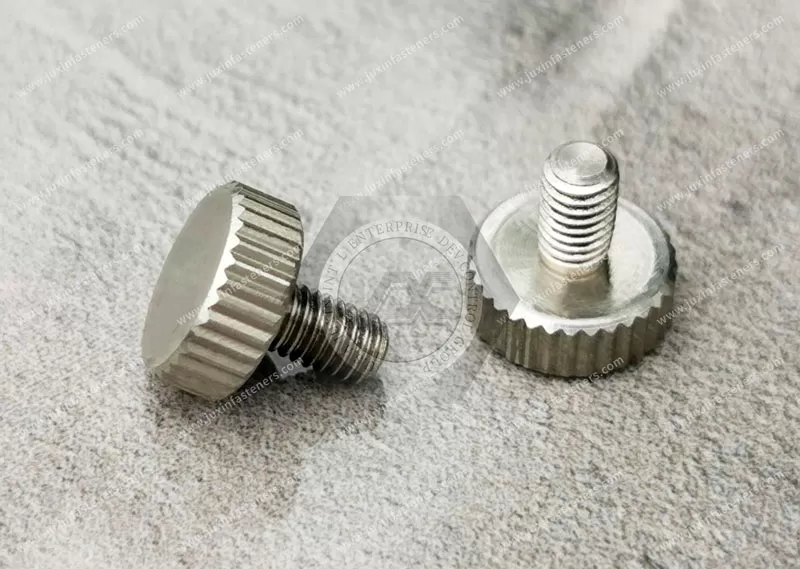
The distinguishing feature is a round head with a knurled outer gripping surface.
This textured head allows an operator or maintenance technician to rotate the screw using their fingers, without relying on a conventional screwdriver or wrench for normal manual operation.
A threaded shank engages a compatible internally threaded hole, nut, or insert.
The fastening force is generated through screw rotation and thread engagement.
Knurled thumb screws are particularly useful where access, serviceability, and convenient manual operation are important design requirements.
They are not automatically equivalent to captive panel screws, which incorporate additional retention features to prevent complete removal from a panel.
Product Construction and Main Features
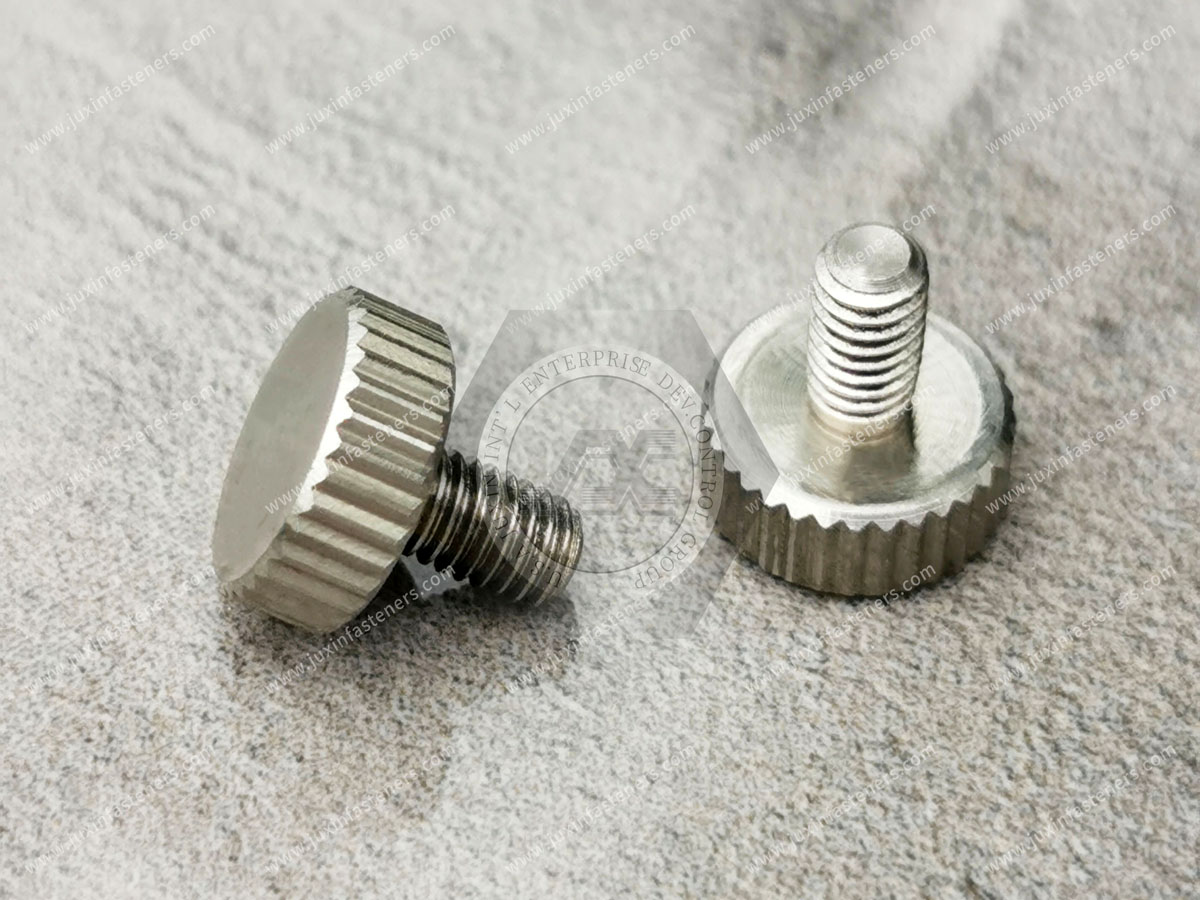
The illustrated product has a round knurled head and a threaded shank.
The knurled circumference provides a gripping surface for finger operation.
The head is intended to remain accessible during installation and removal.
The threaded shank engages a compatible mating thread.
The supplied product information identifies stainless steel material options and refers to additional steel and non-ferrous material classifications.
The actual head diameter, head height, shank diameter, thread pitch, thread length, and overall length must be confirmed from the applicable drawing.
The supplied information does not establish numerical tightening torque, tensile strength, or fatigue performance for the illustrated product.
Product Specifications
Product type: Knurled-head thumb screw
Primary terminology: Stainless steel knurled-head thumb screw
Alternative terminology: Knurled thumb screw, hand-tightened screw, manual panel fastening screw
Head configuration: Round knurled head
Drive method: Finger-operated manual tightening
Thread configuration: External thread
Thread system: According to the approved specification
Primary material family: Stainless steel
Stainless steel grades identified in the supplied information:
SUS302
SUS303
SUS316
SUS410
SUS420
SUS430
Additional material families referenced:
Steel
Non-ferrous metals
Dimensional customization: Subject to drawing review
Surface finish: According to the approved specification
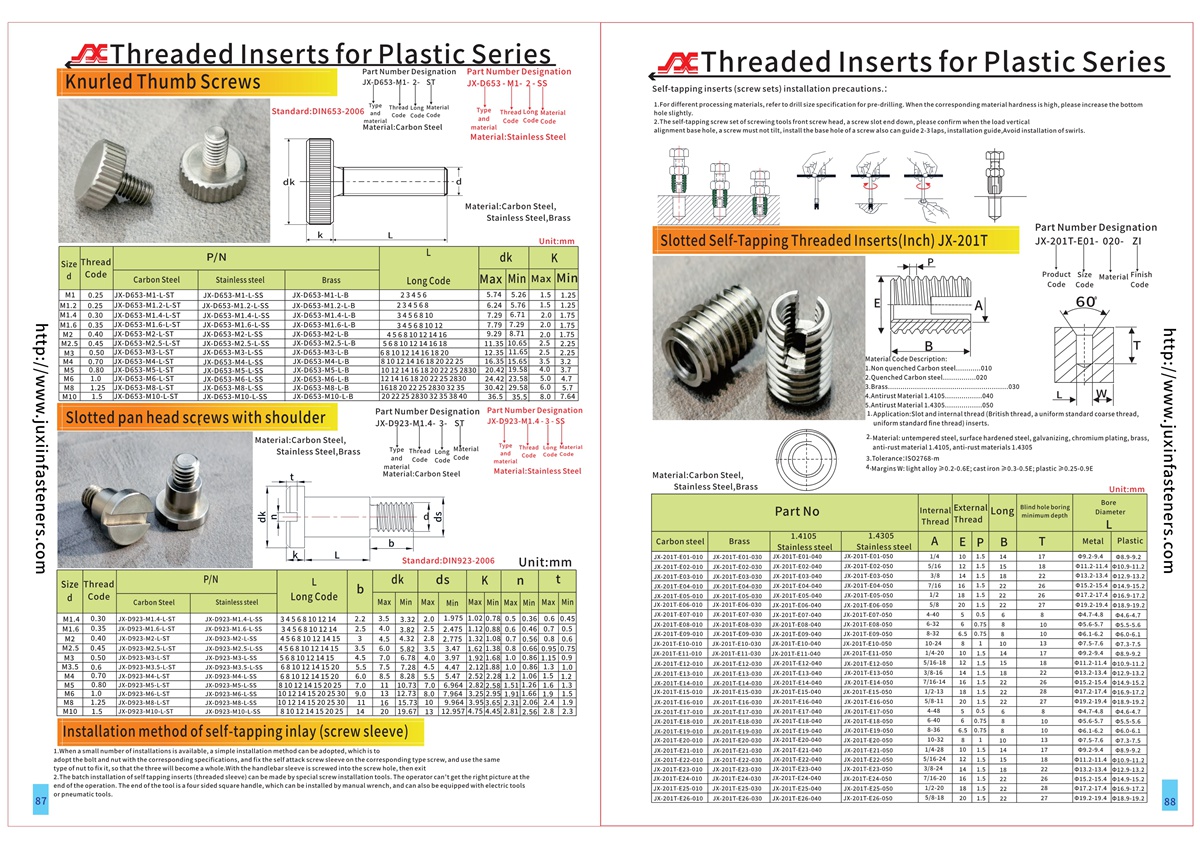
Technical reference: Product PDF and CAD documentation, pages 87–88
The complete dimensional table and confirmed available sizes have not been provided.
All dimensions, tolerances, and material configurations must therefore be verified against the approved drawing before procurement or production release.
Knurled Head Design and Manual Grip
The knurled head is the defining feature of this fastening design.
A knurled surface consists of a repeated textured pattern around the circumference of the screw head.
This texture improves finger engagement compared with a smooth cylindrical head.
For maintenance personnel and equipment operators, the design can make fastening and removal more convenient.
The effectiveness of the grip depends on head diameter, knurl geometry, surface condition, and available finger clearance.
A larger head may provide greater leverage for manual operation, but it also requires more installation space.
A smaller head may be useful in compact assemblies, although manual tightening can become more difficult.
Design engineers should therefore consider both available clearance and the required clamping function.
Knurled thumb screws should not be selected solely on appearance.
The head geometry must match the operator's access requirements and the mechanical needs of the assembly.
Stainless Steel Material Options
The supplied product information identifies several stainless steel grades.
These grades do not have identical corrosion resistance, strength, machinability, or heat-treatment characteristics.
Material selection should be based on the intended operating environment and the approved engineering requirements.
SUS302 Stainless Steel
SUS302 is an austenitic stainless steel grade.
It may be considered for selected fastening applications where its mechanical and corrosion characteristics meet the project requirements.
The material condition and manufacturing process must be defined in the approved specification.
SUS303 Stainless Steel
SUS303 is an austenitic stainless steel grade commonly selected for improved machinability.
This characteristic can be useful for precision-machined threaded components.
However, its corrosion behavior differs from other austenitic stainless steel grades.
SUS303 should not automatically be substituted for SUS316 in demanding corrosion environments.
SUS316 Stainless Steel
SUS316 is an austenitic stainless steel grade containing molybdenum.
It generally provides improved resistance to certain corrosive environments compared with common non-molybdenum austenitic grades.
It may be considered for applications involving moisture, cleaning exposure, or demanding environmental conditions.
However, suitability depends on the actual chemical exposure, chloride concentration, temperature, and surface condition.
SUS316 is not immune to all forms of corrosion.
SUS410 Stainless Steel
SUS410 is a martensitic stainless steel grade.
Its mechanical properties can vary according to heat treatment and material condition.
It may be considered where specific strength, hardness, and corrosion characteristics are required.
SUS420 Stainless Steel
SUS420 is a martensitic stainless steel grade capable of achieving different hardness levels depending on heat treatment.
The appropriate material condition must be selected according to the required screw performance and manufacturing process.
SUS430 Stainless Steel
SUS430 is a ferritic stainless steel grade.
Its corrosion resistance and mechanical characteristics differ from those of austenitic and martensitic stainless steels.
The grade should be selected according to the actual service environment and mechanical requirements.
For international OEM sourcing, the selected material should be identified by a complete approved specification rather than a general stainless steel description.
Steel and Non-Ferrous Material References
The supplied technical information also references steel and non-ferrous material classifications.
For steel materials, the source refers to DIN EN 10087 and DIN EN 10277-3 and identifies DIN EN ISO 683-4 as the replacement reference.
The correct current standard and applicable material condition should be confirmed for the intended product configuration.
For stainless steel, the source references A1 and A2 material groups under DIN EN ISO 3506-1.
These material groups must not be assumed to cover every stainless steel grade listed for the product.
For non-ferrous materials, the source references CU3 under DIN EN 28839.
Any requested material classification should be verified against the applicable current standard and customer specification.
These references identify potential engineering specification routes.
They do not establish that every material version is currently manufactured, stocked, or available in every dimension.
International Standards and Thread Requirements
For metric knurled thumb screws, the relevant thread geometry may be specified using ISO 68-1, ISO 261, ISO 724, and ISO 965.
ASME B1.13M provides an additional metric screw thread reference used in American industrial applications.
The thread designation should identify the nominal diameter, pitch, and tolerance class.
The supplied technical notes also reference stainless steel fastener material groups under ISO 3506-1.
The applicability of a particular material group or property class must be confirmed for the actual finished screw.
The complete fastener drawing should define the required dimensions and tolerances.
The product should not automatically be described as fully compliant with a particular DIN or ISO thumb screw dimensional standard unless the drawing establishes that compliance.
For inch-thread applications, UNC and UNF threads may be evaluated only where the required configuration is confirmed.
Metric and inch-thread fasteners are not directly interchangeable.
Engineering Dimensions and Length Measurement
For standard thumb screws with a projecting head, nominal screw length is commonly measured from the underside of the head to the end of the threaded shank.
The approved drawing should establish the applicable length convention.
Important dimensions include:
Nominal thread diameter
Thread pitch
Thread length
Overall shank length
Head diameter
Head height
Knurl geometry
Thread-end configuration
Dimensional tolerances
Surface finish
The source drawing notes refer to L, L ref., e, and ds.
One note states that when L is less than L ref., e equals zero and the diameter feature ds is omitted.
These symbols are drawing-specific and cannot be interpreted fully without the corresponding dimensional diagram.
They should not be converted into universal product rules without reviewing the original PDF.
For custom manufacturing, the customer drawing should define the required geometry and dimensional relationships.
Manual Tightening and Clamping Considerations
Knurled thumb screws are intended for convenient manual operation.
The available tightening torque depends on head diameter, knurl texture, operator grip, and assembly conditions.
Because they are normally tightened by hand, the achievable clamping force may be lower and less repeatable than that obtained with a torque-controlled tool.
This distinction matters when engineers select a fastener for vibration, structural loading, or safety-related applications.
For removable covers and access panels, moderate manual clamping may be sufficient.
For heavily loaded or vibration-sensitive joints, a different fastening system may be necessary.
The correct selection should be based on the required joint performance rather than the convenience of manual operation alone.
The supplied information does not establish a rated tightening torque for this product.
Thread Engagement and Mating Components
A thumb screw must engage a compatible internal thread.
Possible mating components include tapped metal holes, threaded inserts, retained nuts, and suitable threaded mounting blocks.
The required thread engagement depends on screw size, mating material, expected load, and assembly conditions.
For sheet-metal panels, a threaded insert or captive nut may be required where the sheet itself cannot provide sufficient thread engagement.
A self-clinching nut or rivet nut may be appropriate for certain thin-sheet applications.
However, the installation method and supporting material must be evaluated separately.
The thumb screw and mating component should be specified together to avoid thread mismatch or insufficient engagement.
Repeated Assembly and Maintenance Access
Knurled thumb screws are particularly useful in equipment that requires periodic access.
Examples include removable inspection covers, adjustment panels, instrument housings, and maintenance compartments.
The operator can loosen the screw manually when the design provides adequate finger clearance.
This can reduce dependence on separate tools during routine servicing.
However, a standard thumb screw can be completely removed from its mating thread.
If loose-part prevention is required, a captive thumb screw or captive panel screw may be a better choice.
The distinction is important in applications where dropped or misplaced hardware creates maintenance or contamination concerns.
Stainless Steel Thumb Screws Compared with Carbon Steel Thumb Screws
Stainless steel and carbon steel thumb screws may serve similar mechanical functions.
However, their material properties and corrosion behavior differ.
Stainless steel may be preferred where corrosion resistance is an important selection criterion.
Carbon steel may be suitable for other applications when an appropriate surface treatment and mechanical specification are used.
The correct material choice depends on environmental exposure, mechanical requirements, mating components, and total procurement cost.
Stainless steel should not automatically be described as stronger than carbon steel.
The relevant material grade and property requirements must be compared.
Knurled Thumb Screws Compared with Wing Screws
Knurled thumb screws use a textured cylindrical head.
Wing screws use projecting wings to provide manual turning leverage.
A wing screw may be easier to operate where additional finger leverage is required.
A knurled thumb screw may offer a more compact external profile in some assemblies.
The correct selection depends on available clearance, desired manual torque, appearance, and frequency of operation.
Knurled Thumb Screws Compared with Captive Panel Screws
A standard knurled thumb screw is removable from its mating thread.
A captive panel screw includes a retention mechanism intended to keep the screw attached to the panel when disengaged.
Captive designs may be preferable for equipment requiring frequent servicing or loose-hardware control.
Standard thumb screws may be appropriate where complete removal is acceptable.
These two product categories should not be treated as interchangeable without reviewing the assembly requirements.
Knurled Thumb Screws Compared with Socket Head Screws
Socket head screws are normally operated using a compatible hex key or driver.
They may be more appropriate where controlled tightening torque is required.
Knurled thumb screws prioritize manual accessibility and convenient removal.
The choice depends on the required clamping force, installation process, and maintenance frequency.
Industrial Applications
Electrical Enclosures and Control Cabinets
Electrical control cabinets often incorporate removable access covers, protective panels, and service compartments.
Knurled thumb screws can provide convenient manual fastening where the joint does not require high installation torque.
Stainless steel versions may be considered where the environment and material requirements justify their use.
Design engineers should verify electrical clearances, panel retention requirements, and the accessibility of the screw head.
Industrial Automation Equipment
Automation systems frequently contain adjustable brackets, protective covers, and operator-accessible components.
Knurled thumb screws can simplify routine access where tool-free adjustment is appropriate.
The design should ensure that manual loosening does not compromise a safety-related function.
Instrumentation and Measurement Equipment
Precision instruments may require removable covers, calibration access panels, and adjustable mounting components.
A compact knurled head can be useful where the operator needs direct finger access.
The correct material, thread size, and head geometry should be selected according to the instrument design.
Telecommunications Equipment
Telecommunications equipment may incorporate removable covers, communication module housings, and equipment panels.
Stainless steel knurled thumb screws can be evaluated for selected fastening points where periodic access is required.
The choice should account for vibration, service conditions, and the need for loose-part control.
AI Data Center and Server Equipment
AI data centers contain server enclosures, network cabinets, power equipment, and serviceable metal panels.
Knurled thumb screws may be considered for selected covers, access panels, and equipment housings.
Where frequent maintenance is expected, engineers should evaluate whether a standard removable screw or a captive screw provides the better solution.
The product should not be assumed suitable for structural rack support or other high-load functions without engineering validation.
Power Electronics and Electrical Equipment
Power converters, UPS systems, and electrical equipment housings often require serviceable covers and protective panels.
Knurled thumb screws may simplify access where manual fastening is permitted.
The equipment designer must evaluate electrical safety, vibration, temperature, and retention requirements.
Semiconductor Manufacturing Equipment
Semiconductor equipment may contain precision housings, inspection covers, and service panels.
Knurled thumb screws can be considered for selected mechanical access functions.
Where cleanliness or contamination control is critical, a captive fastening solution may be preferable.
Material and cleaning requirements should be reviewed separately.
Medical and Laboratory Equipment
Medical and laboratory instruments may use removable covers and adjustment components.
Stainless steel thumb screws may be considered where their material properties and manual operation suit the design.
Cleaning compatibility, corrosion exposure, and applicable regulatory requirements must be assessed separately.
No medical-device certification is implied.
HVAC and Building Control Equipment
HVAC controls and industrial ventilation equipment may contain access covers and adjustment panels.
Knurled thumb screws can provide convenient fastening where manual operation is acceptable.
The designer should evaluate vibration, corrosion exposure, and service access.
Industrial Machinery and Maintenance Panels
Machinery manufacturers frequently need fastening solutions for inspection covers, protective housings, and removable equipment panels.
Knurled thumb screws can reduce the need for hand tools during routine access.
However, the fastening system must meet the mechanical and safety requirements of the equipment.
Where a panel must remain attached or requires controlled tightening, an alternative fastener may be necessary.
Design Engineering Considerations
The selection of a knurled thumb screw should begin with the required function of the joint.
The engineer should identify whether the screw is intended for frequent access, occasional servicing, manual adjustment, or general panel retention.
The next step is to determine the required thread size and engagement length.
Head diameter and knurl geometry should then be evaluated for manual grip and available clearance.
Material selection should consider corrosion exposure, strength requirements, appearance, and compatibility with the mating component.
Where vibration is present, the engineer should assess whether the screw requires an additional retention method.
The approved drawing should define the final dimensions and tolerances.
Production Efficiency and Assembly Considerations
For production managers, the total installed cost of a fastener includes more than the component purchase price.
Relevant factors include handling time, installation tooling, assembly accessibility, inspection, maintenance, and replacement.
Knurled thumb screws can simplify manual fastening operations in suitable applications.
They may also reduce dependence on separate hand tools during routine equipment servicing.
However, manual tightening introduces variation in applied torque.
For assemblies requiring repeatable preload, a torque-controlled fastening system may be more appropriate.
Production teams should validate the intended installation method before release.
Common Selection and Installation Problems
Insufficient Finger Clearance
A knurled head requires enough surrounding space for manual operation.
Restricted access may make the screw difficult to tighten or remove.
Incorrect Thread Specification
A metric thumb screw must be matched with the correct metric internal thread.
Metric and inch-thread systems must not be mixed.
Insufficient Thread Engagement
A short engagement length may not provide the required mechanical performance.
The joint design should establish the appropriate thread engagement.
Excessive Manual Tightening
Excessive force can damage threads or deform sensitive components.
The required fastening method should be defined.
Vibration-Induced Loosening
A standard thumb screw may loosen in some vibration environments.
Additional retention measures or a different fastener design may be necessary.
Incorrect Material Selection
Different stainless steel grades have different corrosion and mechanical characteristics.
The selected grade must match the application.
Unnecessary Use of Removable Screws
Where loose-part prevention is required, a captive thumb screw may be more appropriate.
Corrosion and Dissimilar-Metal Contact
The interaction between the screw and mating component should be evaluated in corrosive environments.
OEM Engineering Selection Checklist
Before approving a knurled thumb screw for production, confirm:
Thread diameter
Thread pitch
Thread tolerance
Screw length
Head diameter
Head height
Knurl geometry
Stainless steel grade
Material condition
Surface finish
Mating component material
Required thread engagement
Manual access clearance
Expected tightening method
Vibration exposure
Corrosion environment
Frequency of removal
Loose-part retention requirements
Inspection requirements
Annual purchasing quantity
The approved drawing should establish the final dimensional and material requirements.
OEM Purchasing and Supplier Qualification
JUXIN FASTENERS supports inquiries from OEM manufacturers, mechanical engineers, purchasing engineers, procurement managers, supplier development teams, and international industrial supply chains.
For accurate quotation, buyers should provide the required thumb screw configuration and applicable engineering drawing.
The purchasing specification should identify thread size, pitch, screw length, head dimensions, knurl geometry, stainless steel grade, surface finish, and expected order quantity.
Where applicable, buyers may also specify material documentation, dimensional inspection, packaging, and drawing revision control requirements.
For repeat purchasing programs, customers may provide annual demand, delivery schedules, and quality expectations.
Any required RoHS or REACH documentation should be identified during quotation.
Manufacturing feasibility, inspection scope, and commercial conditions must be confirmed before order acceptance.
Custom Knurled Thumb Screws for OEM Applications
JUXIN FASTENERS welcomes technical inquiries for standard and customer-specific knurled-head thumb screws.
Potential customization requirements include:
Metric thread specifications
Customer-defined thread lengths
Custom head diameters
Custom head heights
Different knurl patterns
Alternative stainless steel grades
Steel or non-ferrous material options
Customer-defined surface finishes
Dimensional tolerances
Thread-end configurations
Special assembly requirements
Customer-specific inspection requirements
Custom packaging
Annual production demand
Custom manufacturing feasibility depends on the required geometry, material specification, manufacturing process, tooling, inspection requirements, and production volume.
Customers are encouraged to submit 2D engineering drawings, available 3D CAD models, and purchasing specifications for review.
Frequently Asked Questions
What is a knurled thumb screw?
A knurled thumb screw is a threaded fastener with a textured head designed for convenient manual tightening and removal.
What is the advantage of a knurled head?
The textured surface provides additional finger grip compared with a smooth head.
Are stainless steel thumb screws suitable for wet environments?
Some stainless steel grades provide useful corrosion resistance in wet environments. The correct grade must be selected according to the actual exposure conditions.
What is the difference between SUS303 and SUS316 thumb screws?
SUS303 is commonly selected for machinability, while SUS316 generally offers improved resistance to certain corrosive environments. The correct selection depends on the application.
Can thumb screws be tightened without tools?
Yes. Knurled thumb screws are designed for manual operation, provided the required clamping force is compatible with hand tightening.
Are knurled thumb screws captive?
Not necessarily. Standard thumb screws can be completely removed from their mating threads. Captive thumb screws incorporate additional retention features.
Are metric and UNC thumb screws interchangeable?
No. Metric and UNC threads have different specifications and are not directly interchangeable.
Can thumb screws be used in vibration-sensitive equipment?
They may be used where the joint design provides adequate retention. A standard manually tightened thumb screw should not automatically be considered vibration-resistant.
Can JUXIN FASTENERS review custom thumb screw drawings?
Customer-specific drawings and technical requirements may be submitted for engineering review. Manufacturing feasibility and final specifications must be confirmed before quotation.
What information should an OEM purchasing team include in an RFQ?
An RFQ should include thread size, screw length, head dimensions, material grade, surface finish, required quantity, inspection requirements, and delivery expectations.
Related Industrial Fastening Solutions
For related fastening requirements, consider these JUXIN FASTENERS product families:
Captive Panel Screws
Spring-Loaded Captive Panel Fasteners
Self-Clinching Nuts
Self-Clinching Standoffs
Precision Machined Screws
Custom Stainless Steel Fasteners
Brass Threaded Inserts
Industrial Panel Fastening Solutions
These product families provide different installation methods, material options, and retention characteristics.
The appropriate solution should be selected according to panel material, installation access, mechanical performance, and maintenance requirements.
Contact JUXIN FASTENERS for Knurled Thumb Screw RFQs
JUXIN FASTENERS supplies industrial fastening components for OEM manufacturers, mechanical engineers, purchasing managers, supplier development teams, production managers, and international industrial supply chains.
For stainless steel knurled-head thumb screws, manually operated panel fasteners, and customer-specific precision threaded components, our team can review technical drawings, material specifications, dimensional requirements, and purchasing quantities.
We welcome inquiries involving electrical enclosures, instrumentation equipment, telecommunications equipment, industrial machinery, power electronics, and custom OEM assemblies.
To request an engineering review or commercial quotation, please provide your technical drawings, required thread specifications, head dimensions, stainless steel grade, estimated purchasing quantities, and delivery expectations.
Email: info@juxinfasteners.com
Website: www.juxinfasteners.com
Contact JUXIN FASTENERS to discuss knurled thumb screw selection, custom fastening requirements, and long-term OEM supply opportunities.
Product Packaging
JUXIN FASTENERS provides protective packaging for stainless steel knurled-head thumb screws and other precision industrial fastening components.
Packaging can be arranged with inner protective materials, outer corrugated cartons, and palletized packing according to confirmed order requirements.
The packaging method should protect the knurled head surfaces, external threads, and stainless steel finish from damage during handling and transportation.
For OEM and industrial supply programs, customer-specific packaging arrangements may include protective separation, part-number identification, carton labeling, lot identification, and customer-defined packing instructions.
Final packing quantities, carton dimensions, pallet configurations, and labeling requirements will be confirmed according to the approved purchase order and shipment specifications.
Product Pictures
Contact Us
Tel.:
+86 020 8621 0320
+86 020 3121 6067
E-mail:
Technical Support:
Navigation
SEND INQUIREY