Call Us
+86 136 6007 9809
Call Us
+86 136 6007 9809

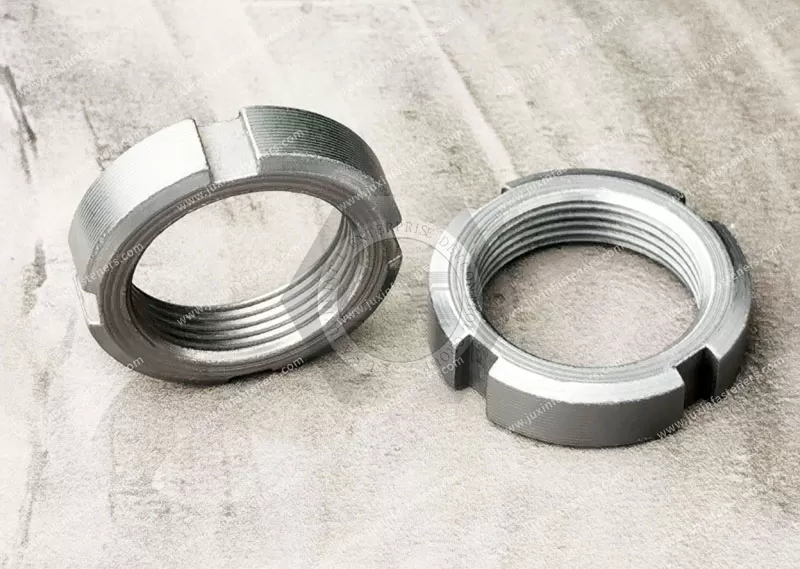
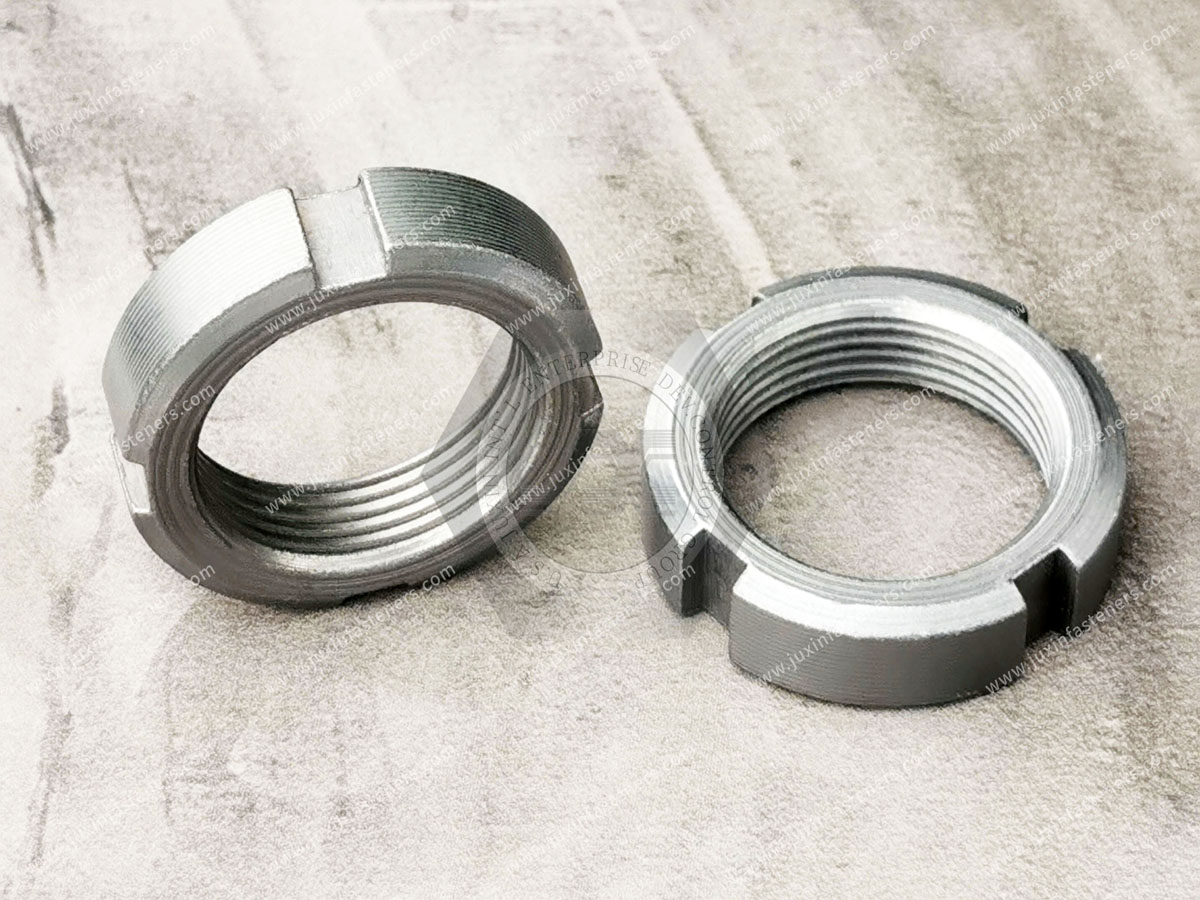
JUXIN FASTENERS supplies DIN 981 bearing locknuts, also known as slotted round nuts or shaft locknuts, for axial retention of bearings, gears, pulleys, and other rotating machinery components.
Available in carbon steel and stainless steel, with metric threads from M10×1 to M200×3. External slots allow installation using a compatible spanner wrench. These locknuts can be paired with suitable locking washers for secure shaft assemblies.
Ideal for industrial gearboxes, electric motors, machine tools, and OEM power transmission equipment. Custom specifications are available upon engineering review.
Product Specification
DIN 981 Bearing Locknuts and Slotted Round Nuts for Precision Shaft and Bearing Retention
Product Overview
Bearing locknuts are precision threaded fastening components used to locate and retain bearings and other rotating machinery components along a shaft or spindle.
JUXIN FASTENERS supplies slotted round nuts for industrial machinery manufacturers, power transmission equipment builders, bearing assembly operations, and OEM purchasing programs.
Also known as shaft locknuts, bearing retaining nuts, or slotted shaft nuts, these components provide axial positioning through threaded engagement with the shaft.
The external slots allow controlled tightening and adjustment using suitable spanner tools.
In a typical bearing assembly, the locknut is installed against the bearing inner ring or an appropriate spacer to establish the required axial position.
Where positive mechanical locking is required, a compatible tab washer or locking device may be used to resist unintended nut rotation.
The correct locking arrangement depends on the nut geometry, shaft groove, bearing design, and equipment operating conditions.
The supplied product family includes DIN 981-type slotted round nuts in carbon steel and stainless steel, with a stated metric thread range from M10×1 to M200×3.
How Bearing Locknuts Work
A bearing locknut engages an externally threaded shaft or spindle.
As the nut is tightened, its clamping face applies an axial force to the adjacent bearing inner ring, spacer, or other machine component.
This arrangement helps position the component along the shaft and maintain its intended location during operation.
The required tightening method depends on the bearing arrangement and assembly procedure.
Some bearing systems require controlled axial positioning without excessive preload.
Other applications may use the locknut as part of a defined bearing adjustment procedure.
The nut must not be tightened solely according to its thread size without considering the bearing manufacturer's installation instructions.
Excessive axial loading can affect bearing internal clearance, operating temperature, friction, and service life.
Insufficient retention may permit unwanted axial movement.
For applications using tab-type lock washers, the locking device provides an additional mechanical restraint against nut rotation.
Product Specifications and Available Configurations
Product type: Bearing locknut / slotted round nut
Reference standard: DIN 981
Relevant international dimensional standard: ISO 2982-2
Related locking device standard: DIN 5406
Common industry terminology: Bearing locknut, shaft locknut, bearing retaining nut, slotted round nut
Thread type: Metric threaded shaft connection
Supplied thread range: M10×1 to M200×3
Material options: Carbon steel and stainless steel
Identified carbon steel material: EN 1.0503 / C45-type steel
Additional material options: Subject to customer specifications and engineering review
Surface finish options: Bright finish and electro-zinc plating, where applicable
Heat treatment: According to selected material and approved drawing
Reference hardness: HRC 35–45 for specified heat-treated configurations only
Installation method: Compatible hook spanner, spanner wrench, or slotted locknut socket
Locking arrangement: Compatible tab-type lock washer or other approved locking device
Custom dimensions: Subject to technical drawing and manufacturing feasibility
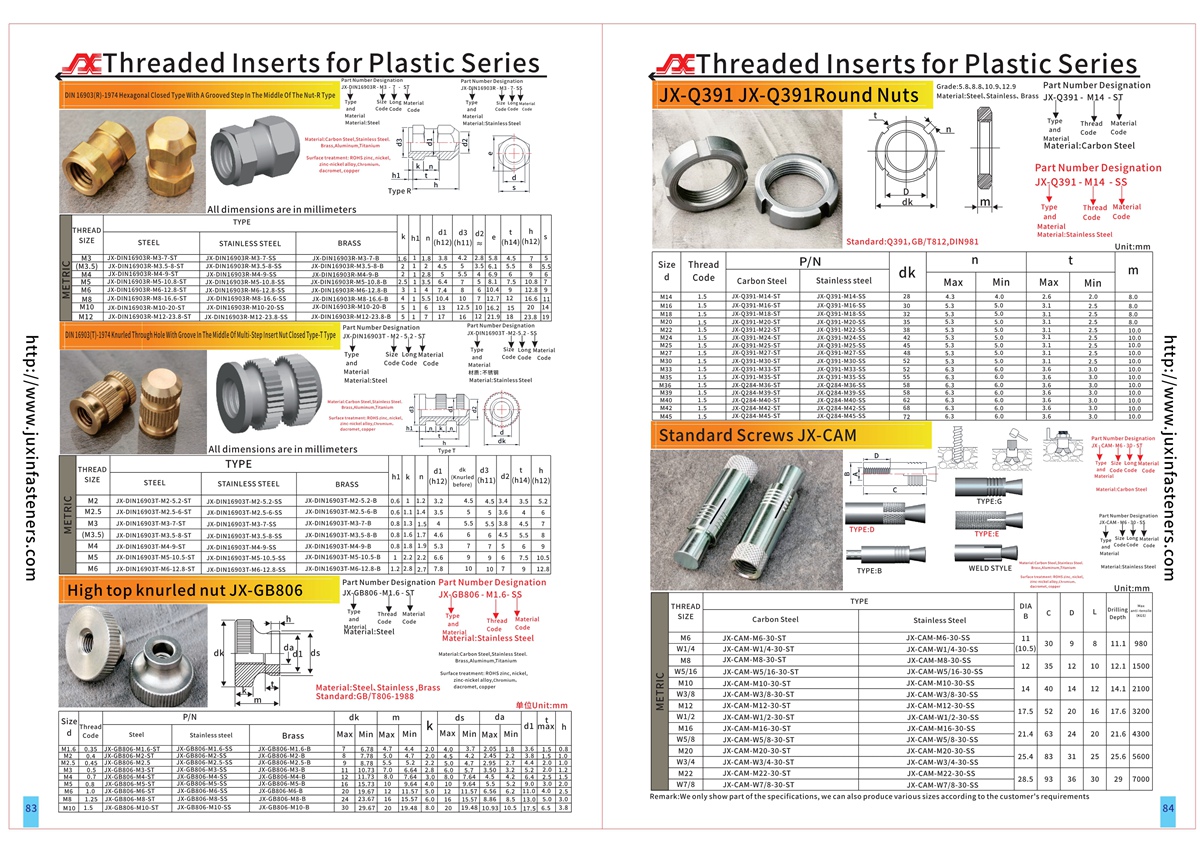
Technical reference: Product specification PDF and CAD documentation, pages 83–84
The stated thread range represents the supplied product family and does not establish that every intermediate diameter, thread pitch, material, or finish is available in every configuration.
Dimensions, tolerances, hardness, and locking compatibility must be confirmed against the approved drawing.
DIN 981 and ISO 2982-2 Bearing Locknut Standards
DIN 981 is an established reference for bearing locknuts used in shaft and bearing assemblies.
ISO 2982-2 specifies dimensions and related requirements for bearing locknuts and locking devices.
The standard addresses important dimensional characteristics, including the runout tolerance of the locknut clamping face relative to the thread pitch diameter.
This relationship is important because the clamping face should contact the bearing or spacer as intended without introducing excessive geometric error.
ISO 2982-2 also addresses compatible locking devices, including lock washers for four-slot locknuts and locking clip arrangements for applicable eight-slot configurations.
For international OEM procurement, the applicable standard edition and exact product designation should be identified on the engineering drawing.
A product described as DIN 981-type should not automatically be assumed to meet every dimensional or tolerance requirement of ISO 2982-2.
Standard conformity must be established through the approved specification and relevant inspection.
Bearing Locknut Dimensions and Engineering Selection
The correct bearing locknut must match the shaft thread and the mechanical requirements of the assembly.
Important dimensional characteristics include the internal thread designation, outside diameter, nut thickness, slot width, slot depth, and clamping-face geometry.
Thread pitch is particularly important.
A fine-pitch thread provides a smaller axial movement per revolution than a coarser thread of the same nominal diameter.
This can support more controlled axial adjustment where the shaft, nut, and bearing arrangement are designed accordingly.
However, finer threads do not automatically provide better retention or greater allowable load.
Thread engagement, material strength, manufacturing tolerances, and operating conditions must also be considered.
For precision bearing assemblies, the relationship between the threaded bore and the clamping face is particularly important.
The engineer should verify that the selected nut provides the required bearing contact geometry and acceptable face runout.
Metric Thread Range and Inch-Size Reference
The supplied metric thread range extends from M10×1 to M200×3.
Representative nominal diameter conversions include:
M10: 10 mm / approximately 0.394 in
M20: 20 mm / approximately 0.787 in
M30: 30 mm / approximately 1.181 in
M50: 50 mm / approximately 1.969 in
M100: 100 mm / approximately 3.937 in
M200: 200 mm / approximately 7.874 in
These inch values are dimensional references only.
They do not represent equivalent Unified or other inch-thread specifications.
Metric bearing locknuts cannot be directly substituted with UNC, UNF, or other inch-thread nuts without verified thread compatibility.
The thread pitch must be checked independently for each size.
For example, M10×1 identifies a 10 mm nominal diameter and a 1 mm pitch.
M200×3 identifies a 200 mm nominal diameter and a 3 mm pitch.
These examples identify the stated endpoints of the supplied range and do not define the pitch of every intermediate size.
Engineers should consult the approved dimensional drawing before selecting the mating shaft thread.
Bearing Locknuts with DIN 5406 Lock Washers
A common bearing locknut arrangement uses a tab-type lock washer to resist unwanted rotation.
DIN 5406 covers locking devices used with compatible bearing locknuts.
In a typical tab washer arrangement, the washer is positioned between the locknut and the adjacent bearing or spacer.
The washer includes an inner tab that engages a corresponding groove in the shaft.
After the locknut is tightened, a suitable outer tab is bent into one of the nut's external slots.
This creates a mechanical connection between the shaft, washer, and nut.
The inner tab restricts rotation of the washer relative to the shaft.
The outer tab restricts rotation of the nut relative to the washer.
The result is a positive mechanical locking arrangement.
The washer must be compatible with the nut size, slot geometry, and shaft groove.
Incorrect washer selection can prevent proper engagement or damage the locking features.
A tab washer should not be reused when deformation, cracking, or other damage compromises its locking function.
The locking washer is a separate component unless explicitly included in the approved product specification or purchase order.
Bearing Locknut Installation Procedure
Correct installation is important for bearing positioning, mechanical retention, and reliable operation.
Before assembly, verify the locknut thread designation, shaft thread condition, and bearing arrangement.
Inspect the shaft thread for burrs, damage, or contamination.
Confirm that the locknut turns correctly onto the shaft without excessive resistance.
Where a locking washer is required, install the correct washer and engage its inner tab with the shaft groove.
Position the bearing or adjacent spacer according to the equipment assembly procedure.
Thread the bearing locknut onto the shaft carefully.
Use the appropriate hook spanner or locknut socket to tighten or adjust the nut.
The required tightening method should follow the bearing or equipment manufacturer's instructions.
After the correct axial position or adjustment is achieved, engage the locking device according to its design.
For tab-type locking washers, bend an appropriate outer tab into a compatible nut slot.
Inspect the completed assembly to confirm proper seating, locking engagement, and clearance.
Where the assembly requires controlled bearing preload or internal clearance, perform the specified measurement and verification procedure.
Do not use uncontrolled hammering or unsuitable tools that could damage the nut slots, shaft threads, or bearing components.
Bearing Axial Location and Retention
Bearing locknuts are widely used to establish the axial position of rolling bearings on shafts.
In many arrangements, the locknut bears against the inner ring or an appropriate spacer.
The nut may be used with a shaft shoulder, sleeve, spacer, or other locating component.
The complete arrangement determines how axial forces are transferred through the assembly.
A bearing locknut should not be evaluated independently from the shaft and bearing design.
The correct selection depends on bearing type, shaft diameter, thread engagement, axial load, operating speed, and required adjustment.
For rotating equipment, the locking method must also account for vibration and operating conditions.
Where the bearing arrangement requires controlled preload, the adjustment procedure must be defined by the equipment design.
Precision Shaft and Spindle Applications
Machine tool spindles and precision rotating assemblies may require controlled axial positioning of bearings and associated components.
Slotted bearing locknuts can provide an adjustable threaded retaining element.
The fine-pitch thread and accessible external slots may support controlled assembly operations.
However, precision spindle applications can impose demanding requirements on clamping-face runout, thread accuracy, balance, and bearing preload.
Standard bearing locknuts should not automatically be assumed suitable for high-speed precision spindles.
Where tight rotational accuracy or high operating speed is required, the engineer should verify the complete assembly requirements and consider a dedicated precision locknut design where appropriate.
Carbon Steel Bearing Locknuts
Carbon steel bearing locknuts are suitable for many industrial machinery applications where strength, machinability, and wear resistance are important.
The supplied material information identifies EN 1.0503 / C45-type steel among the available options.
Material selection should consider the required mechanical properties, heat treatment, manufacturing process, and operating environment.
Bright steel configurations may be suitable for applications where additional corrosion protection is not required or is provided through other measures.
Electro-zinc plating may be specified for suitable steel configurations requiring improved corrosion protection.
The exact material grade and finish must be confirmed through the approved drawing.
Heat treatment should be selected according to the required mechanical properties.
The supplied hardness reference of HRC 35–45 applies only where specified for a particular heat-treated configuration.
It should not be interpreted as a universal hardness requirement for all bearing locknuts.
Stainless Steel Bearing Locknuts
Stainless steel bearing locknuts may be considered where corrosion resistance, cleaning exposure, or environmental durability is important.
Their suitability depends on the selected stainless steel grade and operating conditions.
Stainless steel should not automatically be assumed to provide the same strength, hardness, or wear characteristics as a heat-treated carbon steel configuration.
Thread galling can also be a consideration in stainless steel threaded assemblies.
Appropriate material pairing, surface condition, lubrication, and installation procedures may be necessary.
For washdown equipment, chemical exposure, or other corrosive environments, the exact stainless steel grade should be selected according to the application.
The supplied information does not establish 303 stainless steel as a standard grade for every JUXIN bearing locknut.
Any request for 303 stainless steel or another specific grade should therefore be reviewed against manufacturing feasibility and the approved material specification.
Surface Finish and Corrosion Protection
Bearing locknuts may require different surface treatments according to the operating environment.
Bright steel may be used in applications where the surrounding assembly provides adequate protection.
Electro-zinc plating can improve corrosion protection for suitable steel components.
However, corrosion resistance depends on plating thickness, post-treatment, exposure conditions, and the complete assembly.
The selected surface finish should also be compatible with the required thread tolerances and bearing contact surfaces.
For heat-treated high-strength steel configurations, the plating process may require evaluation of hydrogen embrittlement risk and appropriate process controls.
No universal salt-spray performance, coating thickness, or corrosion rating is established by the supplied product information.
Customers should identify specific finish and testing requirements during quotation.
Chamfered-Face and Stepped-Face Bearing Locknuts
Bearing locknuts are available in different face geometries across the broader industrial market.
Chamfered-face designs and stepped-face designs may have different dimensional and application requirements.
Chamfered-face designs can provide clearance for adjacent components and may be used in standardized bearing locknut arrangements.
Stepped-face designs are used in certain specialized bearing retention configurations.
These geometries should not be treated as interchangeable.
The correct face design depends on the bearing arrangement, locking device, contact surface, and applicable standard.
The supplied JUXIN product information does not establish both face configurations as standard available options.
Any request for a stepped-face or specialized chamfered-face design should be supported by a technical drawing.
Industrial Applications and Engineering Solutions
Industrial Gearboxes and Power Transmission
Gearboxes use bearings, shafts, gears, and spacers that require controlled axial positioning.
Bearing locknuts may be used to retain bearings and related components on threaded shafts.
The selection should consider axial loading, vibration, lubrication, operating temperature, and the required locking method.
For gearbox assembly, consistent tightening and locking procedures can support repeatable bearing positioning.
Electric Motors and Rotating Machinery
Electric motors and rotating equipment contain bearing arrangements that may require axial retention.
Slotted round nuts can be considered where the shaft and bearing design incorporates a threaded retaining arrangement.
The selected nut must be compatible with the operating speed, vibration environment, and bearing assembly procedure.
Where a specific bearing preload or clearance is required, the equipment manufacturer's instructions must be followed.
Machine Tools and Precision Spindles
Machine tools may use bearing locknuts for axial positioning in spindle and drive assemblies.
These applications can require close control of thread accuracy, clamping-face runout, and assembly adjustment.
Engineering teams should verify whether a standard DIN 981-type locknut satisfies the required precision.
Higher-precision configurations may require additional manufacturing and inspection controls.
Pumps and Compressors
Pumps and compressors contain rotating shafts and bearing arrangements that may require threaded axial retention.
Bearing locknuts can be used where the equipment design provides a compatible shaft thread and locking arrangement.
Material selection should consider moisture, lubricants, operating temperature, vibration, and maintenance requirements.
The locknut must be evaluated as part of the complete bearing and shaft assembly.
Industrial Automation and Machinery
Industrial automation equipment includes gear drives, actuators, rotating mechanisms, and mechanical transmission assemblies.
Slotted round nuts may provide adjustable axial retention for suitable shafts and machine components.
For production managers, standardized locknut selection and installation procedures can improve assembly consistency.
The required thread designation, locking washer, and tightening method should be clearly documented.
Robotics and Motion Control Equipment
Robotic equipment and motion systems may incorporate precision bearings, gears, pulleys, and rotating shafts.
Bearing locknuts may be suitable for selected axial retention applications.
The engineer should evaluate vibration, reversing loads, rotational accuracy, available installation space, and maintenance access.
High-precision applications require appropriate validation of the complete rotating assembly.
EV Drivetrain and Electric Motor Assemblies
Electric vehicle powertrain components and industrial electric drive systems may include bearings, shafts, and transmission components requiring axial location.
Bearing locknuts may be evaluated where the mechanical design incorporates a compatible threaded retention system.
Applications involving high rotational speed, fatigue loading, or safety-critical functions require specific engineering validation.
The supplied product information does not establish automotive qualification or application-specific performance ratings.
Wind Energy and Industrial Electrification
Wind energy equipment and industrial electrification systems contain rotating machinery and power transmission components.
Bearing locknuts may be considered for appropriate shaft and bearing retention functions.
The selection should account for vibration, cyclic loading, environmental exposure, and maintenance intervals.
For large or heavily loaded assemblies, the complete bearing retention design must be validated.
Semiconductor Manufacturing Equipment
Semiconductor equipment may include precision motion systems, rotating assemblies, and industrial drive components.
Bearing locknuts can be evaluated for suitable mechanical positioning applications.
Where cleanliness, low particle generation, or precision motion requirements apply, material selection and installation methods require additional review.
Cleanroom or vacuum compatibility should not be assumed without supporting data.
Bearing Locknuts Compared with Other Shaft Retention Methods
Bearing Locknuts vs. Standard Hex Nuts
Bearing locknuts typically provide a round external profile with slots for specialized installation tools.
Standard hex nuts use wrench flats and may not provide the geometry required for bearing retention assemblies.
The correct design depends on available space, shaft dimensions, bearing arrangement, and locking requirements.
Bearing Locknuts vs. Nylon-Insert Locknuts
Nylon-insert locknuts use a polymer locking element to create prevailing torque.
Conventional DIN 981-type bearing locknuts do not inherently contain a nylon insert.
They commonly rely on compatible mechanical locking devices or other approved retention methods.
Nylon-insert designs may have different temperature limitations and installation characteristics.
The two types should not be treated as interchangeable.
Bearing Locknuts vs. Precision Spindle Locknuts
Standard bearing locknuts are commonly used for general bearing retention.
Precision spindle locknuts may incorporate additional design features or tighter geometric controls for demanding rotational applications.
The correct selection depends on the required clamping-face accuracy, bearing preload, rotational speed, and assembly requirements.
Bearing Locknuts vs. Shaft Retaining Rings
Retaining rings engage grooves in a shaft or bore and provide axial retention through a different mechanical arrangement.
Bearing locknuts engage an externally threaded shaft and may permit axial adjustment through threaded movement.
The preferred method depends on the available shaft geometry, required load capacity, assembly space, and adjustment needs.
Bearing Locknuts vs. Shaft Collars
Shaft collars can provide axial positioning through clamping or other retention methods.
Bearing locknuts use threaded engagement with the shaft.
The appropriate solution depends on the required positioning accuracy, axial load, shaft preparation, and maintenance requirements.
Engineering Risks and Installation Considerations
Incorrect Thread Pitch
An incorrect thread pitch can prevent proper engagement or damage the shaft and nut.
The complete metric thread designation must be verified.
Insufficient Thread Engagement
Insufficient engagement may reduce the ability of the threaded connection to carry the intended load.
Thread engagement should be evaluated according to the material and joint design.
Excessive Bearing Preload
Overtightening can introduce excessive axial force into the bearing arrangement.
This may increase friction, operating temperature, and wear.
The correct adjustment procedure should follow the bearing manufacturer's instructions.
Inadequate Locking Washer Engagement
A tab washer that is incorrectly installed may fail to provide the intended mechanical locking function.
The inner tab, shaft groove, outer tab, and nut slot must be compatible.
Clamping-Face Runout
Excessive geometric error at the clamping face can affect contact with the adjacent bearing or spacer.
Precision applications may require inspection of the clamping face relative to the threaded bore.
Incorrect Material Selection
The selected material must satisfy mechanical strength, corrosion resistance, and operating temperature requirements.
Stainless steel and carbon steel configurations should not be substituted without engineering review.
Improper Installation Tools
Unsuitable tools can damage the external slots or surrounding components.
Compatible spanner tools or sockets should be used.
Unverified Vibration Resistance
A slotted round nut is not automatically self-locking.
The required locking method must be established for the complete assembly.
Information Gain: Evaluating Total Bearing Retention Performance
Selecting a bearing locknut solely by nominal thread diameter can overlook important assembly requirements.
For reliable bearing retention, engineering teams should evaluate the interaction of five elements.
First, the shaft thread must match the locknut thread designation and tolerance requirements.
Second, the locknut clamping face must provide suitable contact with the bearing inner ring or spacer.
Third, the tightening procedure must establish the intended axial position without damaging the bearing.
Fourth, the locking device must prevent unintended rotation under the expected operating conditions.
Fifth, the complete assembly must remain serviceable and inspectable during production and maintenance.
These factors influence bearing positioning, assembly repeatability, maintenance requirements, and potential equipment downtime.
For precision equipment, the dimensional relationship between the thread and clamping face can be as important as the nominal material strength.
For production teams, clear assembly instructions and appropriate inspection methods can reduce variation between operators and production batches.
For purchasing teams, evaluating the complete fastening arrangement provides a more useful basis for supplier comparison than unit price alone.
Production Management and Assembly Efficiency
Bearing locknuts are frequently installed as part of larger shaft and bearing assemblies.
Production managers should consider installation tooling, assembly sequence, inspection requirements, and operator accessibility.
A controlled production process may include incoming dimensional inspection, shaft thread verification, bearing positioning, locknut adjustment, and locking device engagement.
Where repeat production is required, the approved assembly procedure should identify the applicable thread designation and tightening method.
The process should also specify how the completed bearing arrangement will be inspected.
Depending on the application, inspection may include axial position, bearing clearance, rotational resistance, or other equipment-specific characteristics.
The objective is to achieve repeatable assembly results while avoiding unnecessary rework and bearing damage.
OEM Engineering Selection Checklist
Before approving bearing locknuts for production, engineering teams should confirm:
Required DIN 981 or ISO 2982-2 designation
Shaft thread diameter and pitch
Locknut outside diameter and thickness
Slot width and slot depth
Clamping-face geometry
Clamping-face runout requirements
Bearing type and mounting arrangement
Required axial positioning or preload
Compatible locking washer or locking device
Shaft groove geometry
Material grade
Heat treatment and hardness requirements
Surface finish and corrosion protection
Installation tool requirements
Operating speed and vibration conditions
Inspection and documentation requirements
Expected production quantity
The approved engineering drawing should establish the final requirements for the selected locknut.
OEM Purchasing and Supplier Qualification
JUXIN FASTENERS supports inquiries from industrial machinery manufacturers, bearing assembly operations, power transmission equipment suppliers, purchasing engineers, supplier development teams, and international OEM supply chains.
For accurate quotation, buyers should provide the required locknut designation, thread size, material specification, and technical drawing.
Purchasing requirements may include dimensional tolerances, heat treatment, surface finish, inspection documentation, and packaging instructions.
For repeat industrial supply programs, buyers may also specify annual demand, production schedules, lot identification, drawing revision control, and delivery requirements.
Any customer-specific first-article inspection, material traceability, or additional quality documentation should be identified during the RFQ stage.
Manufacturing feasibility, inspection scope, and commercial conditions should be confirmed before order acceptance.
Custom Bearing Locknuts and Slotted Round Nut Manufacturing
JUXIN FASTENERS welcomes technical inquiries for standard and customer-specific bearing locknut configurations.
Potential customization requirements include:
Metric thread diameter and pitch
Nut outside diameter
Nut thickness
Slot dimensions
Clamping-face geometry
Material grade
Heat treatment
Surface finish
Dimensional tolerances
Runout requirements
Locking washer compatibility
Customer-specific inspection requirements
Packaging and labeling
Annual production demand
Custom manufacturing feasibility depends on the required dimensions, material specifications, manufacturing process, tooling, inspection requirements, and production volume.
Customers are encouraged to submit 2D engineering drawings, available 3D CAD models, and purchasing specifications for review.
Frequently Asked Questions
What is a bearing locknut?
A bearing locknut is a threaded fastening component used to locate or retain bearings and other machine components on a shaft or spindle.
Are bearing locknuts also called slotted round nuts?
Yes. Slotted round nuts are commonly used as bearing locknuts or shaft retaining nuts when their geometry and specifications are suitable for the application.
What is DIN 981?
DIN 981 is an established dimensional reference for bearing locknuts used in shaft and bearing assemblies.
What is ISO 2982-2?
ISO 2982-2 is an international standard covering dimensions and related requirements for bearing locknuts and locking devices.
Can bearing locknuts be used with DIN 5406 locking washers?
Yes, where the nut, washer, and shaft groove are designed for a compatible locking arrangement.
What thread sizes are available?
The supplied JUXIN product information identifies a range from M10×1 to M200×3. Individual sizes and thread pitches must be confirmed from the applicable drawing.
Are stainless steel bearing locknuts available?
The supplied product information identifies stainless steel as a material option. Exact grades and configurations should be confirmed during quotation.
Can bearing locknuts be zinc plated?
Electro-zinc plating is identified as an available finish for suitable steel configurations, subject to the approved specification.
Are all bearing locknuts self-locking?
No. Conventional slotted bearing locknuts may require a separate locking washer, locking clip, or other approved locking method.
Can bearing locknuts control bearing preload?
A bearing locknut can form part of a bearing adjustment arrangement. The actual preload or axial setting must be established according to the bearing and equipment manufacturer's instructions.
Can bearing locknuts be used on high-speed spindles?
They may be suitable for selected applications, but high-speed spindle assemblies can require additional precision, balance, and retention controls.
Can JUXIN FASTENERS manufacture custom bearing locknuts?
Customer-specific drawings and technical requirements may be submitted for engineering review. Manufacturing feasibility and final specifications must be confirmed before quotation.
What should an OEM purchasing team include in an RFQ?
An effective RFQ should include the locknut designation, thread specification, dimensions, material, finish, tolerance requirements, estimated order quantity, annual demand, and delivery expectations.
Related Shaft Fastening and Industrial Locking Components
For additional shaft retention and mechanical assembly requirements, consider these related JUXIN FASTENERS product families:
Precision Locknuts
Slotted Round Nuts
Shaft Retaining Nuts
Lock Washers and Tab Washers
Round Nuts for Mechanical Assemblies
Custom Threaded Fasteners
Specialty Fastening Solutions
These product families address different shaft retention, threaded adjustment, and mechanical locking requirements.
The correct component should be selected according to the approved engineering drawing and complete assembly design.
Contact JUXIN FASTENERS for Bearing Locknut RFQs
JUXIN FASTENERS supplies industrial fastening components for OEM manufacturers, equipment builders, purchasing engineers, supplier development teams, production managers, and international industrial supply chains.
For DIN 981-type bearing locknuts, slotted round nuts, and customer-specific shaft fastening components, our team can review technical drawings, material specifications, dimensional requirements, and purchasing quantities.
We welcome inquiries involving industrial gearboxes, electric motors, machine tools, bearing assemblies, power transmission equipment, and custom OEM machinery.
To request an engineering review or commercial quotation, please provide your technical drawings, required thread specifications, material requirements, estimated purchasing quantities, and delivery expectations.
Email: info@juxinfasteners.com
Website: www.juxinfasteners.com
Contact JUXIN FASTENERS to discuss bearing locknut selection, custom slotted round nuts, and long-term OEM supply requirements.
Product Packaging
JUXIN FASTENERS provides protective packaging for bearing locknuts, slotted round nuts, and other precision industrial fastening components.
The supplied packaging arrangement includes inner polyfoam protection, outer corrugated cartons, and palletized packing for transportation.
Reference carton dimensions:
29 × 19 × 19.5 cm
23.5 × 17.5 × 8 cm
Reference pallet dimensions:
215 × 100 × 90 cm
These dimensions are reference packaging configurations and may vary according to locknut diameter, product weight, order quantity, and shipment requirements.
Packaging should protect the internal threads, external slots, clamping faces, and surface finishes from damage during handling and transportation.
For precision bearing locknuts, additional protective separation may be required to prevent contact damage to critical surfaces.
For OEM and industrial supply programs, customer-specific packaging arrangements may include protective wrapping, part-number identification, carton labeling, lot identification, and customer-defined packing instructions.
Final packing quantities, carton dimensions, pallet configurations, and labeling requirements will be confirmed according to the approved purchase order and shipment specifications.
Product Pictures
Contact Us
Tel.:
+86 020 8621 0320
+86 020 3121 6067
E-mail:
Technical Support:
Navigation
SEND INQUIREY