Call Us
+86 136 6007 9809
Call Us
+86 136 6007 9809

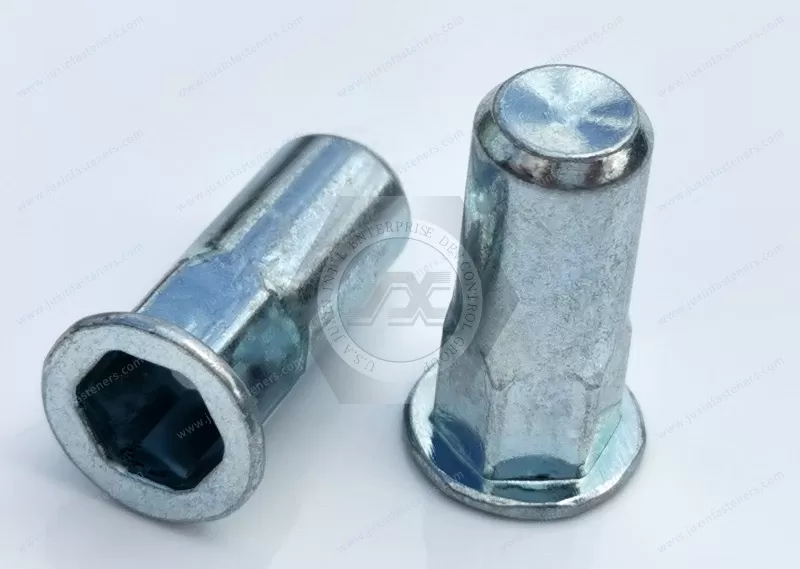
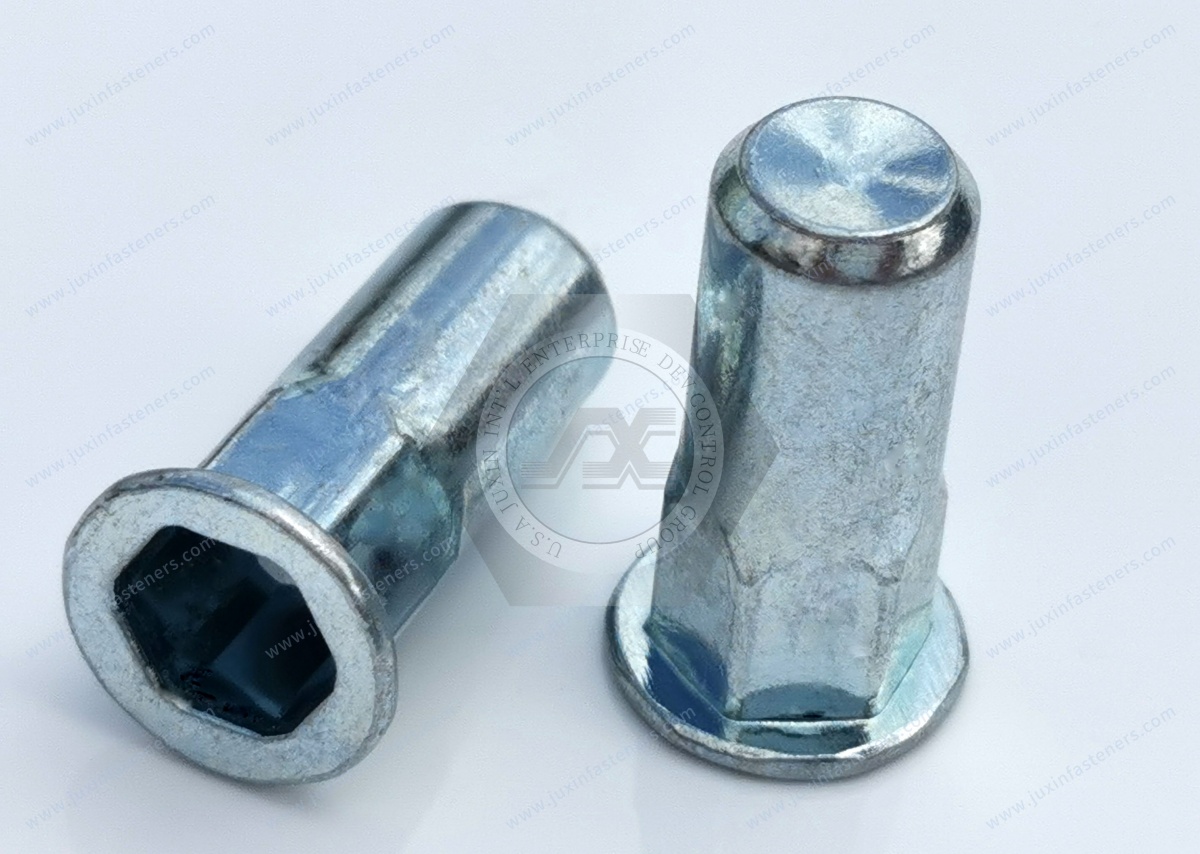
JUXIN FASTENERS provides closed-end half-hex blind rivet nuts designed to create reusable internal threads in thin sheet metal, hollow sections,
and industrial enclosures where installation access is available from only one side.
These steel blind threaded inserts combine four functional design features: a flat head for panel bearing support, a partially hexagonal body for mechanical anti-rotation engagement,
a closed end for protecting the internal thread cavity, and a blue zinc-plated finish for sacrificial corrosion protection.
Also referred to as closed-end partial hex rivet nuts, half-hex nutserts, sealed-end blind threaded inserts, and flat-head hex-body rivet nuts,
these fasteners are suitable for selected OEM equipment and fabricated sheet metal assemblies.
The product family covers M4, M5, M6, M8, M10, and M12 metric threads, with a stated series grip range of 0.5–4.0 mm.
Individual dimensions and grip ranges must be confirmed using the approved product drawing.
Closed-End Thread Cavity: The enclosed barrel helps prevent contaminants from entering directly through the back of the threaded insert.
Partial Hexagonal Body: Provides geometric resistance to rotation when installed in a correctly sized matching hole.
Flat Head / Large Flange: Offers a broad bearing surface to distribute installation and joint loads.
Steel Construction: Provides a mechanically robust threaded insert for appropriate industrial applications.
Blue Zinc Finish: Protects the underlying steel through a sacrificial zinc coating.
Single-Sided Installation: Allows assembly in enclosed or hollow workpieces without access to the opposite side.
Reusable Internal Thread: Supports removable mating screws and serviceable equipment components.
Drawing-Based Customization: Special dimensions, grip ranges, coatings, and packaging can be evaluated for OEM projects.
The closed-end design incorporates an enclosed barrel that separates the internal thread cavity from direct exposure through the back of the insert.
This is useful in industrial enclosures where dust, loose debris, moisture, or other contaminants may be present behind the mounting panel.
Unlike an open-end rivet nut, the closed-end design also limits the available screw penetration depth.
However, a closed-end rivet nut should not automatically be treated as a completely watertight or airtight fastener.
Fluid ingress may still occur around the flange-to-panel interface, through damaged coatings, or through other paths in the assembled structure.
Where an OEM project requires a specified ingress protection rating, the complete installed joint must be evaluated. Additional sealing washers, sealants, or other sealing features may be necessary.
A conventional round-body rivet nut relies significantly on the friction and mechanical retention created during installation.
A half-hex rivet nut incorporates a partially hexagonal body section that engages with a compatible non-round mounting hole.
This geometric engagement can improve resistance to rotation during screw tightening, loosening, and maintenance.
For OEM engineers, this distinction is especially important when the threaded connection will be repeatedly assembled and disassembled.
The actual spin-out torque depends on:
Hexagonal hole geometry and dimensional tolerances
Host panel material and hardness
Panel thickness
Insert body dimensions
Installation force or stroke
Thread engagement
Applied tightening torque
The half-hex design is not a substitute for mechanical qualification testing.
The flat head provides a relatively large bearing surface against the host panel.
This can help distribute compressive loads and reduce localized deformation around the mounting hole.
The design may be preferable to a reduced-head rivet nut where the application permits a protruding flange and requires a larger contact area.
For thin or relatively soft panels, engineers should evaluate flange dimensions, panel deformation, and push-through resistance.
Closed-end half-hex blind rivet nuts are installed using a compatible rivet nut setting tool.
The tool engages the internal thread and pulls the threaded portion toward the flange, deforming the designated unthreaded section behind the panel.
This creates mechanical retention without welding or tapping the parent material.
The installation method is useful for pre-finished sheet metal, enclosed profiles, and fabricated assemblies where welding may introduce unwanted heat or distortion.
| Parameter | Specification |
|---|---|
| Product Type | Closed-End Half-Hex Blind Rivet Nut |
| Alternative Name | Closed-End Partial Hex Nutsert |
| Head Style | Flat Head / Large Flange |
| Body Style | Partially Hexagonal |
| End Configuration | Closed End |
| Material | Steel |
| Surface Finish | Blue Zinc Plating |
| Metric Thread Sizes | M4, M5, M6, M8, M10, M12 |
| Series Grip Range | 0.5–4.0 mm |
| Installation Method | Blind, Single-Sided Setting |
| Custom Dimensions | Subject to Drawing Review |
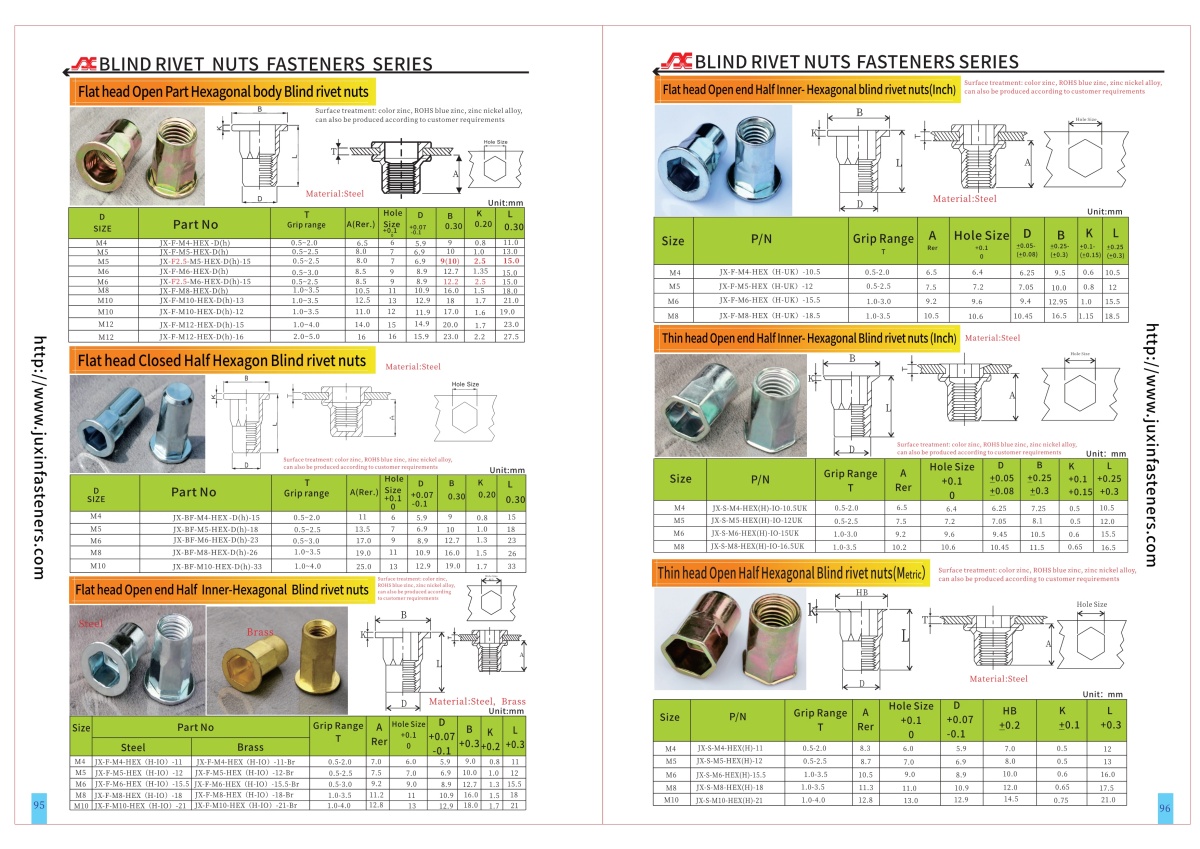
| Technical Reference | Product Catalog Pages 95–96 |
Important: The overall series grip range does not mean every thread size supports the complete 0.5–4.0 mm range. Select the correct version using the individual product specification.
Both configurations provide reusable internal threads and mechanical anti-rotation engagement when installed in suitable half-hex mounting holes.
The primary differences concern the enclosed thread cavity, screw penetration depth, and environmental protection strategy.
| Selection Factor | Closed-End Half-Hex | Open-End Half-Hex |
|---|---|---|
| Thread Cavity | Enclosed | Open through the barrel |
| Screw Penetration | Limited by internal depth | Can extend beyond insert |
| Direct Rear Contamination | Additional barrier | No enclosed rear barrier |
| Backside Clearance | Must accommodate closed barrel | Must accommodate installed body and screw |
| Anti-Rotation | Half-hex geometry | Half-hex geometry |
| Installation Access | One side | One side |
| Watertight Joint | Requires validation | Requires separate sealing design |
Select a closed-end half-hex rivet nut when the assembly benefits from an enclosed thread cavity, controlled screw penetration, and anti-rotation engagement.
For example, a removable mounting bracket on an electrical enclosure may require repeated maintenance access while limiting direct exposure of the internal thread cavity to debris behind the panel.
A closed-end insert may be appropriate, provided the enclosure's sealing, corrosion, and electrical requirements are evaluated separately.
An open-end half-hex rivet nut may be preferable when longer screws must pass through the insert or the application does not require an enclosed rear thread cavity.
The final choice should account for the available backside clearance and the assembled joint design.
Closed-end half-hex rivet nuts can provide removable mounting points for internal brackets, control panel structures, mounting rails, and enclosure components.
Their partially hexagonal body helps resist rotation during maintenance, while the closed end provides an additional barrier against direct contamination through the insert.
For applications involving electrical bonding or protective grounding, the joint must be designed and verified for electrical continuity. Zinc plating alone does not establish grounding suitability.
Potential applications include non-safety-critical brackets, equipment housings, interior support structures, and electrical component mounting.
OEM engineers should evaluate vibration, joint preload, environmental exposure, and mechanical retention under the intended operating conditions.
Closed-end half-hex rivet nuts can be considered for service panels, mounting brackets, equipment housings, and selected ventilation system components.
For equipment exposed to condensation or moisture, the coating system and complete sealing arrangement should be evaluated.
Machine guards, equipment covers, control boxes, and fabricated support structures frequently require threaded mounting points that can be accessed from one side.
A half-hex rivet nut can help maintain insert position during repeated servicing.
These inserts are suitable for evaluation in folded metal structures, hollow sections, fabricated cabinets, and other applications where welding or loose nut installation is inconvenient.
The blue zinc finish provides a sacrificial metallic coating over the steel substrate.
For engineering and procurement specifications, the coating should be defined by measurable requirements rather than color alone.
Relevant specifications may include ASTM B633 and ISO 2081, where applicable to the approved coating process.
Important purchasing requirements include:
Coating thickness
Passivation chemistry
Corrosion test requirements
Surface appearance
Restricted-substance compliance
Mating component compatibility
Storage and service conditions
Where RoHS compliance is required, the actual plating chemistry and supporting compliance documentation must be verified.
The blue zinc finish should not be assumed suitable for marine exposure, continuous outdoor service, or aggressive chemical environments without application-specific qualification.
JUXIN FASTENERS supports technical review of customer drawings for industrial threaded insert applications.
Customization inquiries may include:
Special metric thread dimensions
Unified inch-thread requirements
Modified flange dimensions
Half-hex body geometry
Alternative grip ranges
Closed-end barrel dimensions
Coating specifications
Customer-specific inspection requirements
OEM packaging and labeling
Manufacturing feasibility, tooling requirements, minimum order quantities, and delivery schedules are evaluated against the submitted drawing and project requirements.
For OEM production programs, industrial sourcing projects, and custom closed-end half-hex blind rivet nuts, please provide:
Thread size and pitch
Technical drawing or CAD model
Panel material and thickness
Mounting hole geometry
Required grip range
Mechanical performance requirements
Surface treatment specification
Estimated order quantity
Annual purchasing forecast
Packaging requirements
Our team can review the information and prepare a quotation based on the confirmed technical requirements.
JUXIN FASTENERS
Email: info@juxinfasteners.com
Website: www.juxinfasteners.com
Contact: https://www.juxinfasteners.com/contact-us/
Product Specification
| Thread Size | Standard Pitch | Nominal Diameter |
|---|---|---|
| M4 | 0.70 mm | 4 mm |
| M5 | 0.80 mm | 5 mm |
| M6 | 1.00 mm | 6 mm |
| M8 | 1.25 mm | 8 mm |
| M10 | 1.50 mm | 10 mm |
| M12 | 1.75 mm | 12 mm |
Thread geometry may be specified using ISO 261, ISO 724, and ISO 965, as applicable.
The thread sizes above identify the product family. Exact dimensions, tolerances, flange geometry, body length,
and installation requirements must be confirmed against the approved product drawing.
The stated product family grip range is 0.5–4.0 mm.
The correct grip range must be selected according to the actual panel thickness and installation conditions.
Important factors include:
Panel material and hardness
Sheet thickness tolerance
Coating thickness on the host panel
Installation hole geometry
Required backside deformation
Setting tool capability
Mechanical retention requirements
Do not select an insert solely by nominal thread diameter.
Closed-end blind rivet nuts require particular attention to screw penetration.
Because the rear of the insert is enclosed, an excessively long screw can contact the closed barrel before the intended joint preload is achieved.
This may cause false tightening torque readings, thread damage, insert deformation, or joint assembly problems.
The engineering review should account for:
Screw length measured from the applicable head reference.
Total clamped component thickness.
Washer thickness, if applicable.
Available internal thread depth.
Required minimum thread engagement.
Screw penetration tolerance.
Clearance to the closed end.
Engineering Recommendation: Validate screw length and thread engagement using the approved insert drawing and actual assembly stack-up before production release.
Half-hex blind rivet nuts require a mounting hole compatible with the partial hexagonal body.
A standard circular drilled hole should not be assumed suitable.
The engineering drawing should specify:
Across-flats dimensions where applicable
Hole geometry
Dimensional tolerances
Minimum edge distance
Panel thickness
Flange seating requirements
Surface condition
Tool accessibility
Correct hole geometry is essential for achieving the intended anti-rotation performance.
Verify the selected rivet nut and grip range.
Confirm the mounting panel material and thickness.
Prepare the specified installation hole.
Remove burrs and inspect the hole.
Select the correct setting tool and mandrel.
Engage the rivet nut with the mandrel.
Position the insert in the mounting hole.
Maintain perpendicular tool alignment.
Apply the validated installation stroke or setting force.
Form the retaining bulge behind the panel.
Release the setting tool.
Inspect flange seating and thread condition.
Perform qualification testing where required.
Recommended tests include:
Spin-Out Torque: Evaluates the resistance of the installed insert to rotation.
Axial Pull-Out Strength: Measures resistance to extraction from the host material.
Push-Out Resistance: Evaluates the insert's resistance to displacement through the panel.
Thread Integrity: Confirms that the internal thread remains functional after installation.
Installation Repeatability: Evaluates consistency across representative production samples.
Joint Reliability: Confirms the complete fastened assembly meets the application requirements.
No universal mechanical performance values should be assumed without test results for the selected insert, panel material, and installation conditions.
Please refer to the detailed product specification PDF and CAD drawing.
Catalog Reference: Pages 95–96.
For custom designs, provide the latest engineering drawing and revision number.
| Required Information | Engineering / Purchasing Purpose |
|---|---|
| Thread Size | Mating screw compatibility |
| Panel Thickness | Grip range selection |
| Hole Geometry | Anti-rotation engagement |
| Closed-End Depth | Screw penetration control |
| Material | Mechanical performance |
| Coating | Corrosion and compliance requirements |
| Mechanical Testing | Application qualification |
| Drawing Revision | Configuration control |
| Annual Volume | Commercial planning |
| Packaging | Production and logistics requirements |
JUXIN FASTENERS
Email: info@juxinfasteners.com
Website: www.juxinfasteners.com
Product Packaging
JUXIN FASTENERS provides protective packaging for steel closed-end half-hex blind rivet nuts.
Standard packaging consists of plastic inner bags, outer cartons, and palletized packaging when required.
Packaging quantities and configurations are determined according to product size, order quantity, and customer specifications.
| Packaging Type | Dimensions |
|---|---|
| Carton Option 1 | 29 × 19 × 19.5 cm |
| Carton Option 2 | 23.5 × 17.5 × 8 cm |
| Reference Pallet | 215 × 100 × 90 cm |
Dimensions are reference values. Final packaging configurations are confirmed for individual orders.
Customer-specific packaging requirements may include:
Bulk industrial packaging
Customized packing quantities
Customer part-number labels
Batch and lot identification
Barcode labeling
Protective packaging for plated steel components
Customized export cartons
Pallet configuration requirements
Customer-specific shipping marks
For recurring purchasing programs, customers may provide annual forecasts, scheduled delivery requirements, approved drawings, inspection specifications, and packaging instructions.
JUXIN FASTENERS
Email: info@juxinfasteners.com
Website: www.juxinfasteners.com
Contact: https://www.juxinfasteners.com/contact-us/
Product Pictures
Tags
Contact Us
Tel.:
+86 020 8621 0320
+86 020 3121 6067
E-mail:
Technical Support:
Navigation
SEND INQUIREY