Call Us
+86 136 6007 9809
Call Us
+86 136 6007 9809

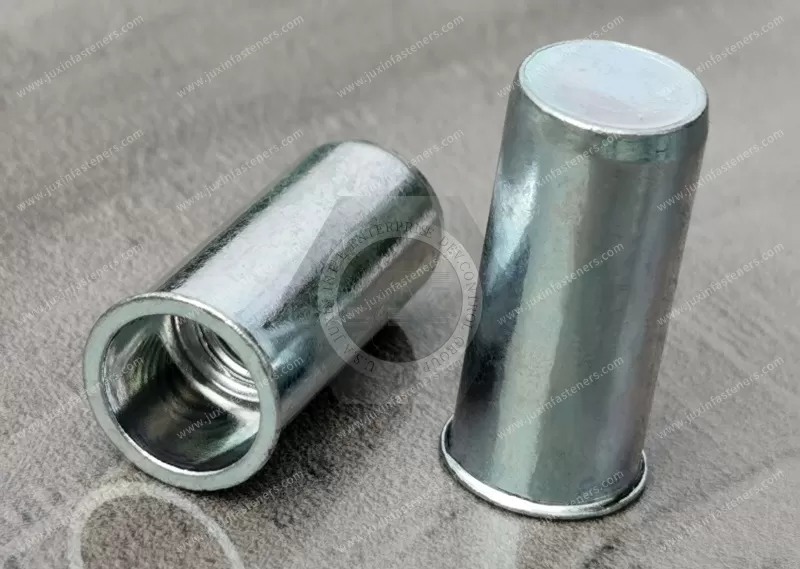
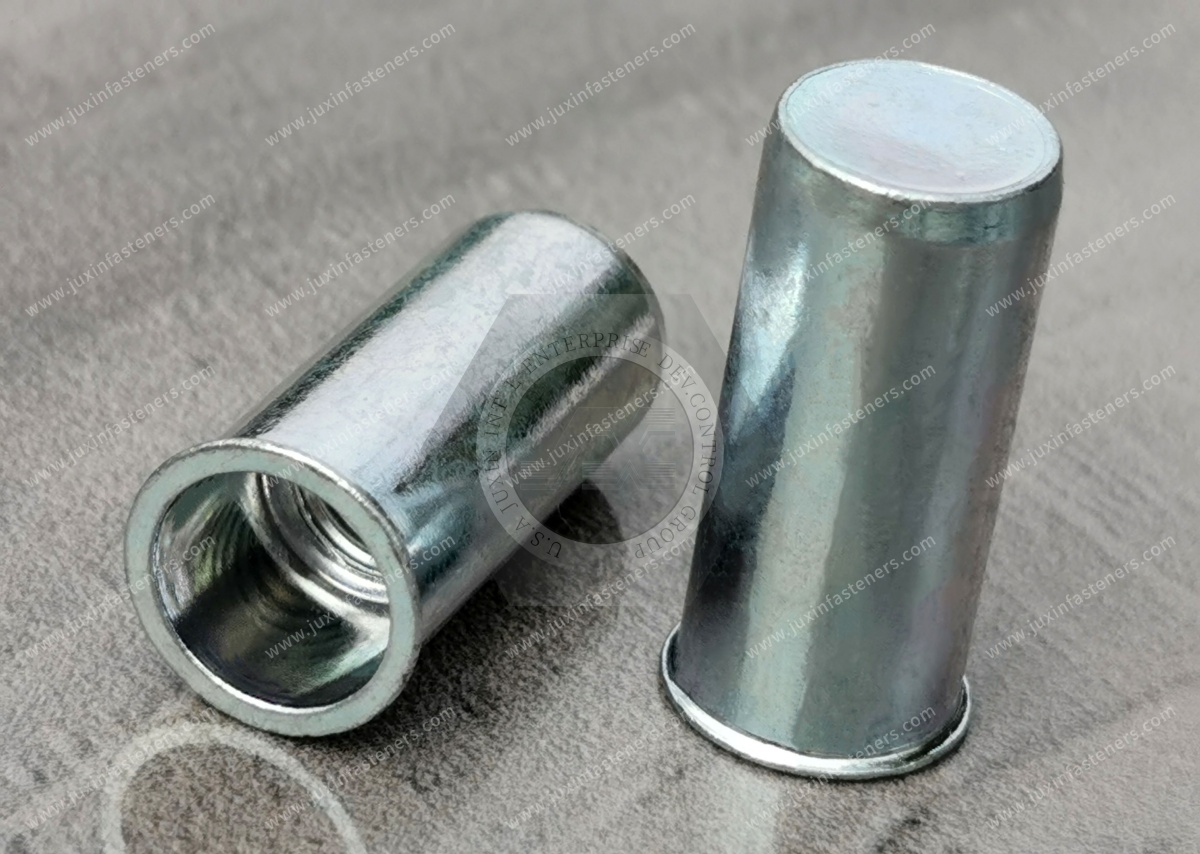
JUXIN FASTENERS manufactures thin head, closed-end steel blind rivet nuts with smooth round bodies for low-profile threaded fastening in sheet metal, hollow sections, and industrial assemblies requiring one-sided installation.
The thin flange reduces head projection, while the closed-end barrel prevents screws from passing through the insert end. During installation, the body deforms behind the panel to create a retained internal thread.
Product Features
Thread sizes: M3, M4, M5, M6, M8, M10
Material: Steel
Surface finish: Blue zinc plating
Grip range: 0.5–4.5 mm across the product family, depending on configuration
Head style: Thin head / Low-profile flange
Body style: Smooth round body
End style: Closed end
Installation: One-sided blind installation
Typical applications include electrical enclosures, control cabinets, machinery covers, compact equipment housings, and OEM sheet-metal assemblies requiring reduced flange projection and enclosed threaded inserts.
Product Specification
Technical Specifications — Thin Head Closed-End Steel Blind Rivet Nuts
Product Identification
| Parameter | Specification |
|---|---|
| Product Type | Thin Head Closed-End Blind Rivet Nut |
| Alternative Names | Low-Profile Rivet Nut / Blind Threaded Insert / Rivnut |
| Material | Steel |
| Available Metric Threads | M3, M4, M5, M6, M8, M10 |
| Head Configuration | Thin Head / Low-Profile Flange |
| Body Configuration | Smooth Round Body |
| End Configuration | Closed End |
| Surface Treatment | Blue Zinc Plating |
| Published Series Grip Range | 0.5–4.5 mm (approximately 0.020–0.177 in) |
| Installation | One-Sided Blind Rivet Nut Setting |
| Mounting Hole Diameter | Refer to approved product drawing |
| Flange Diameter and Height | Refer to approved product drawing |
| Body Length | Refer to approved product drawing |
| Internal Thread Depth | Refer to approved product drawing |
| Sealing Performance | Not specified; application validation required |
| Custom Dimensions | Subject to technical review |
Metric Thread Sizes and Imperial Reference
The following values represent standard ISO metric coarse thread pitches and their approximate US inch equivalents.
| Metric Thread | Pitch (mm) | Pitch (in) | Nominal Diameter (in) |
|---|---|---|---|
| M3 | 0.50 | 0.0197 | 0.1181 |
| M4 | 0.70 | 0.0276 | 0.1575 |
| M5 | 0.80 | 0.0315 | 0.1969 |
| M6 | 1.00 | 0.0394 | 0.2362 |
| M8 | 1.25 | 0.0492 | 0.3150 |
| M10 | 1.50 | 0.0591 | 0.3937 |
Important: Inch values are approximate dimensional conversions. ISO metric threads are not interchangeable with UNC or UNF threads.
Relevant thread references may include ISO 261, ISO 724, and ISO 965, subject to the approved product drawing.
For custom OEM projects requiring UNC or UNF threads, the requested configuration must be reviewed separately. ASME B1.1 may be referenced for applicable Unified thread requirements.
Grip Range — Metric and Imperial Reference
The published product-series grip range is 0.5–4.5 mm (approximately 0.020–0.177 in).
| Panel Thickness (mm) | Approximate Thickness (in) |
|---|---|
| 0.5 | 0.0197 |
| 1.0 | 0.0394 |
| 1.5 | 0.0591 |
| 2.0 | 0.0787 |
| 2.5 | 0.0984 |
| 3.0 | 0.1181 |
| 3.5 | 0.1378 |
| 4.0 | 0.1575 |
| 4.5 | 0.1772 |
These values are unit conversion references, not individual product grip specifications.
The actual grip range must be confirmed for each thread size and body length using the approved technical drawing.
Engineering Selection and Installation Guide
1. Thin Head Versus Standard Flat Head
Thin head rivet nuts are designed to minimize head projection above the mounting surface.
This is useful in assemblies where a conventional larger-head rivet nut could interfere with an adjacent component.
However, a thin head is not necessarily flush or countersunk.
Before selecting the fastener, engineers should verify:
Maximum permitted flange projection
Flange diameter and thickness
Available bearing area
Panel surface condition
Adjacent component clearance
Local panel deformation during installation
For applications requiring a completely flush surface, an appropriate countersunk design should be evaluated separately.
2. Closed-End Versus Open-End Configuration
Closed-end and open-end rivet nuts have different installation and screw engagement characteristics.
| Engineering Factor | Closed End | Open End |
|---|---|---|
| Barrel End | Enclosed | Open |
| Screw Passage | Limited by internal depth | May extend through the barrel |
| Direct Opening Through Barrel End | No | Yes |
| Screw Length Selection | Internal bottoming clearance critical | Backside clearance critical |
| Automatic Watertight Joint | No | No |
The closed-end design is useful where an enclosed threaded cavity is preferred.
However, neither configuration should be assumed to provide complete environmental sealing without testing.
3. Internal Thread Depth and Screw Bottoming
The internal thread depth is one of the most important design considerations for closed-end rivet nuts.
Unlike open-end inserts, closed-end rivet nuts have a finite internal cavity.
If the mating screw is too long, it may contact the closed end before the joint reaches the intended clamp load.
Potential consequences include:
Incomplete joint clamping
Misleading tightening torque readings
Internal thread damage
Deformation of the closed barrel
Reduced assembly reliability
Engineers should calculate screw engagement using the approved installed geometry rather than the uninstalled body length alone.
Recommended Engineering Check
Available screw insertion depth must exceed the actual screw penetration into the insert, with an appropriate allowance for dimensional tolerances and installation variation.
Confirm:
Usable internal thread depth after installation
Mating screw length
Total clamped component thickness
Washer thickness, if applicable
Thread engagement requirements
Required clearance before the closed end
The final clearance requirement should be established through joint design and representative assembly validation.
4. Mounting Hole Diameter and Tolerance
The smooth round body requires an appropriately sized mounting hole.
Excessive hole clearance can reduce rotational retention, while an undersized hole may prevent proper installation or damage the finish.
Mounting hole dimensions must be obtained from the approved product drawing.
For US engineering teams, mounting hole diameters and tolerances may be expressed in both millimeters and inches.
Do not calculate the required mounting hole directly from the nominal metric thread diameter.
5. Grip Range and Panel Compatibility
The published series grip range is 0.5–4.5 mm (approximately 0.020–0.177 in).
This does not mean every thread size is suitable for every panel thickness within that range.
Individual configurations must be selected according to their approved grip range.
For coated sheet metal or multilayer assemblies, verify the actual installed thickness and material behavior.
6. Installation Procedure
Confirm the rivet nut size and approved grip range.
Prepare the mounting hole according to the drawing.
Remove burrs and inspect the panel surface.
Select the correct setting mandrel and installation tool.
Insert the rivet nut until the thin head seats against the panel.
Hold the installation tool perpendicular to the mounting surface.
Apply the approved setting stroke or force.
Inspect the formed backside retention section.
Verify flange seating and thread integrity.
Confirm mating screw engagement without bottoming.
Manual or pneumatic setting tools may be used when compatible with the selected rivet nut and approved installation parameters.
7. Smooth Body and Anti-Rotation Performance
Smooth round-body rivet nuts rely on the mechanical interaction between the installed insert and the mounting panel for retention.
They do not have the additional anti-rotation geometry of knurled or hexagonal bodies.
For assemblies involving repeated screw removal, vibration, or elevated tightening torque, spin-out resistance should be evaluated.
Where greater anti-rotation engagement is required, an alternative body style may be appropriate.
8. Pull-Out Resistance and Panel Deformation
Axial pull-out performance depends on several factors:
Rivet nut material and geometry
Panel thickness and material
Mounting hole dimensions
Installation deformation
Flange geometry
Applied axial loading
A thin head may provide a different bearing area compared with a conventional larger flange.
For thin or soft panels, evaluate local deformation and the risk of pull-through.
No universal pull-out capacity should be assumed without representative test data.
9. Environmental Sealing and Contaminant Protection
The closed barrel eliminates the direct opening through the end of the threaded insert.
However, the installed joint may still permit leakage through the flange-to-panel interface or other assembly features.
For water, dust, pressure, or air sealing requirements, evaluate:
Flange seating
Panel flatness
Mounting hole condition
Coating integrity
Additional sealing elements, if required
Complete assembly leakage performance
Where applicable, enclosure ingress protection may be evaluated using IEC 60529.
The individual rivet nut must not be described as IP-rated, watertight, or airtight without supporting test evidence.
10. Blue Zinc Plating and Corrosion Requirements
The specified surface treatment is blue zinc plating.
For OEM purchasing, coating requirements should define:
Zinc coating thickness
Passivation type
Additional topcoat or sealing requirements
Required corrosion testing
Environmental exposure conditions
Applicable restricted-substance requirements
ASTM B633 and ISO 2081 may be referenced when technically applicable to the selected electroplated zinc coating.
Blue zinc appearance alone does not establish corrosion resistance or RoHS conformity.
11. OEM Validation and Quality Requirements
For production approval, representative testing may include:
Mounting hole inspection
Installation stroke or force verification
Flange seating inspection
Backside deformation inspection
Thread integrity
Screw bottoming clearance
Spin-out torque
Axial pull-out resistance
Repeated screw assembly
Coating condition
Corrosion testing where specified
Assembly sealing tests where required
Acceptance criteria should be established according to the application and approved technical documentation.
Technical Drawings and CAD
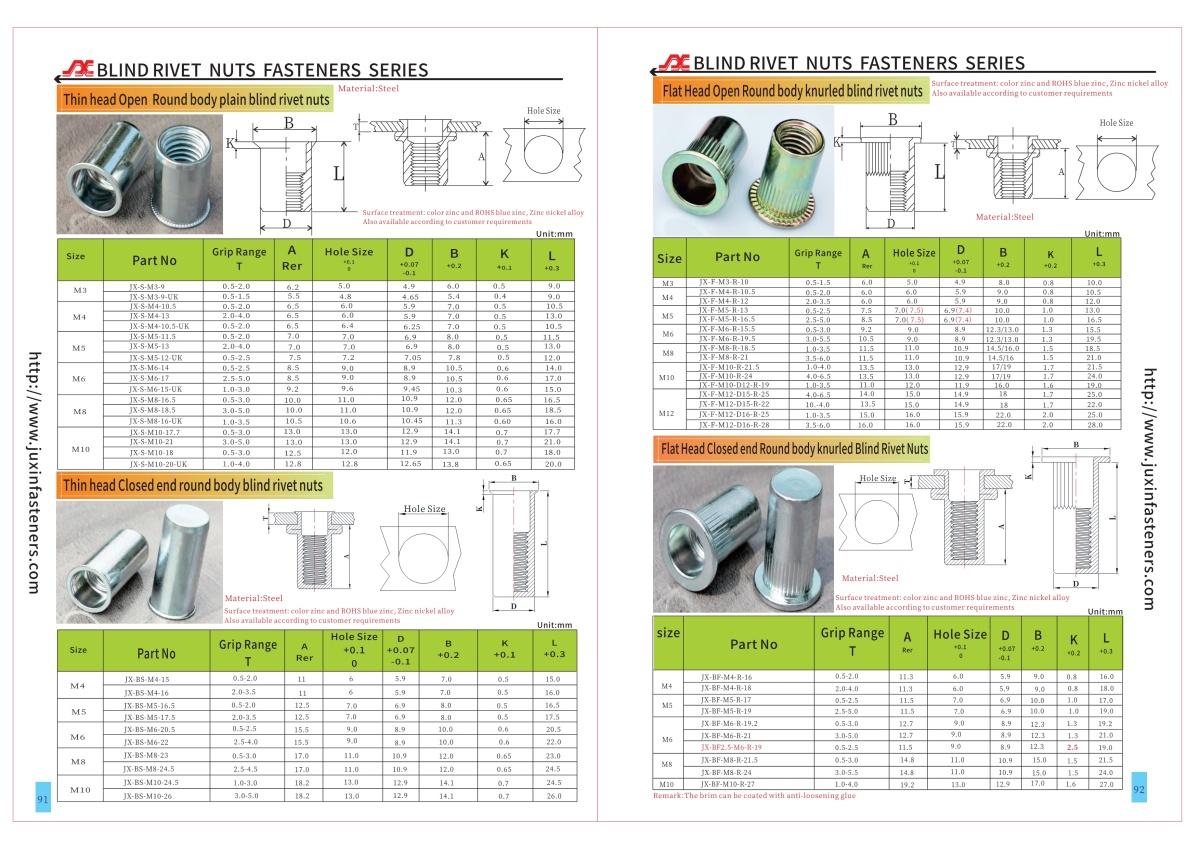
The existing product documentation references detailed specification PDF pages 91–92 and related CAD information.
Please confirm the applicable drawing revision and dimensions before finalizing installation hole size, flange geometry, body length, internal thread depth, or individual grip range.
OEM Technical RFQ Checklist
For accurate technical review and quotation, please provide:
Required metric thread size
Panel material and thickness, in mm or inches
Mounting hole diameter and tolerance
Maximum permitted head projection
Required grip range
Mating screw length
Minimum required thread engagement
Available backside clearance
Zinc coating and corrosion requirements
Mechanical retention requirements
Environmental sealing requirements, if applicable
Approved drawing or CAD model
Sample quantity
Initial order quantity and annual demand forecast
JUXIN FASTENERS supports drawing-based inquiries for standard and custom industrial blind rivet nut requirements.
How Closed-End Blind Rivet Nuts Work
A closed-end blind rivet nut is installed into a prepared mounting hole using a compatible setting tool.
The tool applies axial force to deform the designated section of the rivet nut body behind the panel.
This creates a mechanical retention feature while the head remains seated against the accessible panel surface.
Unlike an open-end rivet nut, the closed-end version has an enclosed barrel end.
This prevents a mating screw from passing completely through the insert and eliminates the direct opening through the barrel end.
However, the closed-end configuration alone does not guarantee a watertight or airtight joint.
Sealing performance depends on the complete installation, including the flange-to-panel interface.
Typical Industrial Applications
Electrical Enclosures and Control Cabinets
Thin head closed-end rivet nuts can provide internal threads for mounting brackets, covers, and accessories in fabricated electrical enclosures.
The enclosed barrel may help reduce direct contaminant entry through the insert end.
Where an enclosure requires a specified ingress protection rating, the complete assembly must be tested.
HVAC and Refrigeration Equipment
Suitable applications may include equipment panels, protective covers, access brackets, and sheet metal housings.
The thin head configuration can help reduce interference between adjacent panels and mating components.
For condensation-prone or outdoor environments, coating performance and joint sealing requirements must be evaluated separately.
Automotive and Transportation Equipment
Potential applications include non-critical brackets, interior equipment panels, access covers, and fabricated sheet metal components.
For vibration-exposed assemblies, engineers should verify spin-out resistance, pull-out strength, and the complete bolted joint design.
Industrial Machinery and Equipment Covers
Closed-end blind rivet nuts can provide threaded attachment points where backside access is restricted.
They may be used in machinery guards, removable covers, instrument housings, and fabricated steel enclosures.
Electronic Equipment and Instrument Housings
The low-profile head can be useful where space between adjacent components is limited.
The closed-end configuration may also be considered where designers want to avoid an open threaded passage through the insert body.
Electrical safety, grounding, and environmental protection must be verified at assembly level.
Why Choose Thin Head Closed-End Rivet Nuts?
This configuration combines two distinct engineering functions:
Reduced Surface Projection: The thin head helps accommodate assemblies with limited surface clearance.
Enclosed Threaded Barrel: The closed end eliminates the direct opening through the end of the insert.
Compared with standard flat-head open-end rivet nuts, this configuration may be more appropriate where both clearance and threaded-cavity protection influence product selection.
However, the thin flange may provide a different bearing area, and the closed barrel imposes a limit on available screw insertion depth.
Both factors must be evaluated before finalizing the design.
OEM Engineering and Procurement Support
JUXIN FASTENERS supports industrial purchasing and drawing-based sourcing requirements for closed-end steel blind rivet nuts.
Engineering teams can submit mounting hole dimensions, panel thickness, flange clearance, screw engagement requirements, and mechanical performance criteria.
Purchasing managers and supplier development teams can provide drawings, quantities, annual demand forecasts,
packaging specifications, and delivery requirements for quotation review.
Request a Technical Quotation
For standard or custom thin head closed-end steel blind rivet nuts, contact JUXIN FASTENERS with your technical drawing and purchasing requirements.
Email: info@juxinfasteners.com
Website: www.juxinfasteners.com
Contact: https://www.juxinfasteners.com/contact-us/
Product Packaging
Packaging & OEM Ordering — Thin Head Closed-End Steel Blind Rivet Nuts
Standard Export Packaging
JUXIN FASTENERS provides industrial export packaging for closed-end steel blind rivet nuts to support product protection, handling, storage, and international transportation.
The standard packaging arrangement includes protective inner plastic bags, outer cartons, and palletized shipment where required.
Packaging configurations are selected according to product dimensions, quantities, shipment conditions, and customer requirements.
Reference Carton Dimensions
| Packaging Type | Metric Dimensions | Approximate Inch Dimensions |
|---|---|---|
| Carton Option 1 | 29 × 19 × 19.5 cm | 11.42 × 7.48 × 7.68 in |
| Carton Option 2 | 23.5 × 17.5 × 8 cm | 9.25 × 6.89 × 3.15 in |
| Pallet Reference | 215 × 100 × 90 cm | 84.65 × 39.37 × 35.43 in |
These are reference packaging dimensions from the existing product information.
Actual carton selection, packing quantities, and pallet configuration must be confirmed for each order.
Product Protection and Identification
Packaging arrangements may include:
Protective plastic inner bags
Reinforced export cartons
Moisture-resistant protection where required
Product identification labels
Part number and specification marking
Batch identification and quantity labels
Palletized shipment when required
Packaging and identification requirements should be agreed before order confirmation.
Customized OEM Packaging
Customer-specific packaging options can be reviewed, including:
Private-label packaging
Customized barcode labels
Customer part-number identification
Specified carton dimensions
Customer-defined packing quantities
Special pallet configurations
Customer-specific marking and traceability requirements
Customized packaging may involve additional costs or lead times depending on the agreed requirements.
OEM and Industrial Bulk Purchasing
JUXIN FASTENERS supports purchasing inquiries from OEM manufacturers, equipment manufacturers, strategic sourcing teams,
and supplier development professionals.
For quotation review, please provide:
Required thread size and configuration
Approved technical drawing and revision
Material and coating requirements
Panel thickness and grip range
Installation and inspection requirements
Packaging and labeling specifications
Initial order quantity
Annual demand forecast
Requested delivery schedule
Sample availability, minimum order quantity, pricing, production lead time, and ordering conditions are confirmed during quotation review.
Request an OEM Quotation
For thin head closed-end steel blind rivet nuts, custom threaded inserts, and industrial bulk purchasing requirements, contact:
JUXIN FASTENERS
Email: info@juxinfasteners.com
Website: www.juxinfasteners.com
Contact: https://www.juxinfasteners.com/contact-us/
Please send your technical drawing, specifications, and purchasing requirements for review and quotation.
Product Pictures
Tags
Contact Us
Tel.:
+86 020 8621 0320
+86 020 3121 6067
E-mail:
Technical Support:
Navigation
SEND INQUIREY