Call Us
+86 136 6007 9809
Call Us
+86 136 6007 9809

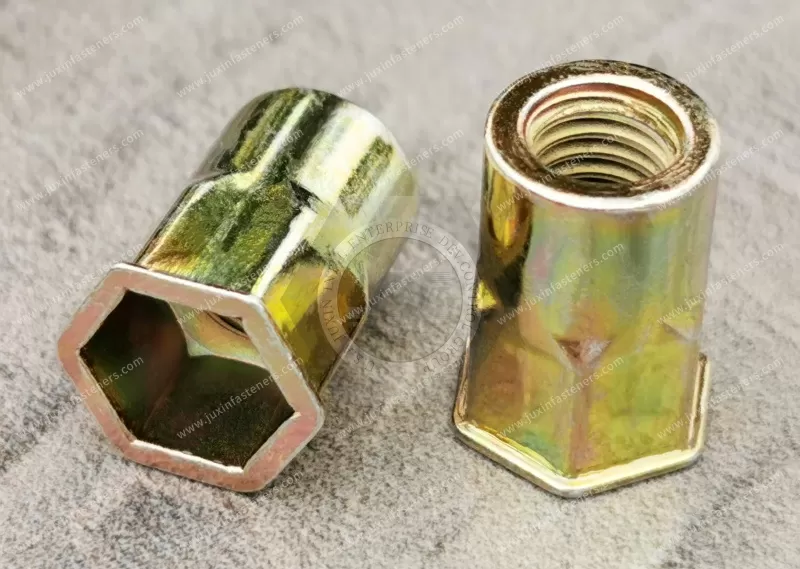
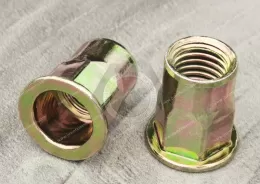
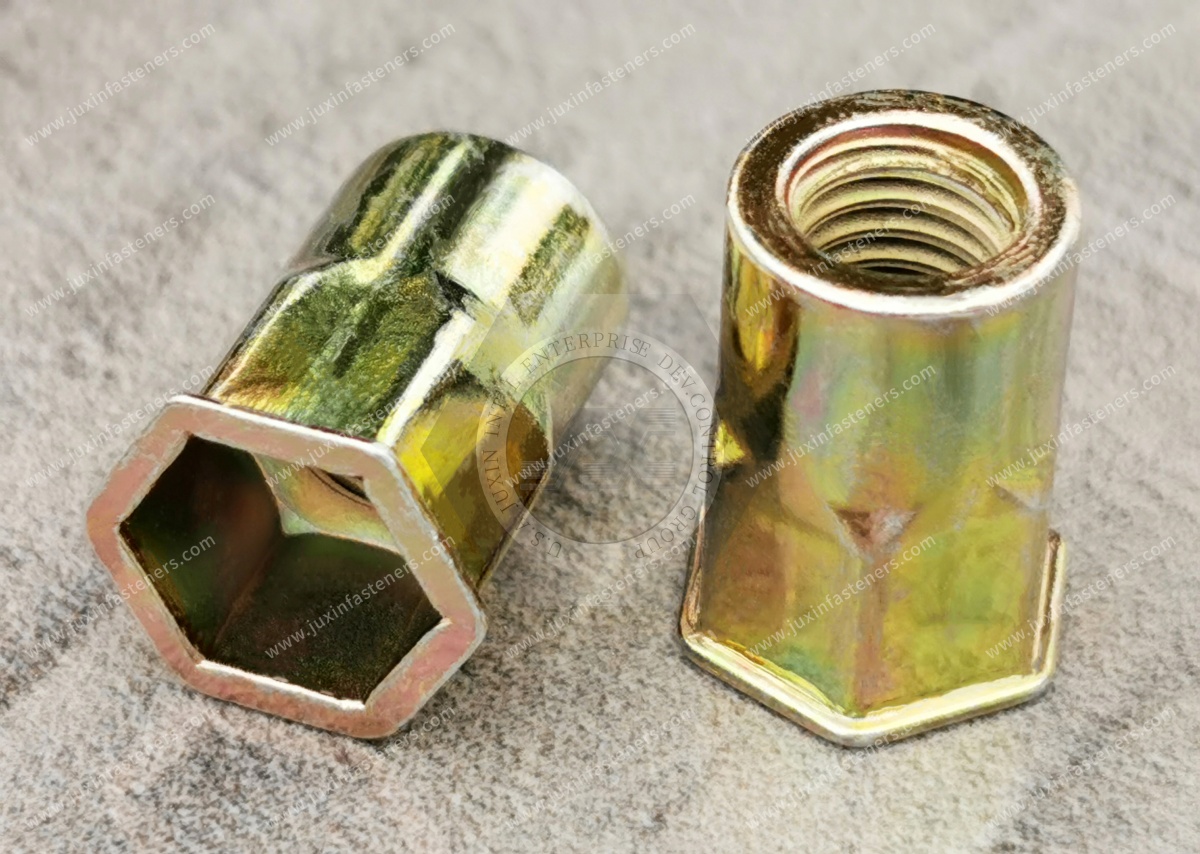
JUXIN FASTENERS manufactures thin head, open-end steel half-hex blind rivet nuts with color zinc plating for creating reusable internal threads in thin sheet metal, hollow sections, and industrial assemblies requiring one-sided installation.
The reduced-height flange minimizes head projection, while the partial hexagonal body engages with a matching non-round mounting hole to help resist insert rotation. The open-end barrel allows screw extension where sufficient backside clearance is available.
Product Features
Metric thread sizes: M4, M5, M6, M8, M10
Inch-series threads: Custom OEM requirements subject to drawing review
Material: Steel
Surface finish: Color zinc plating
Grip range: 0.5–3.5 mm (approx. 0.020–0.138 in) across the product family, depending on configuration
Head style: Thin head / Low-profile flange
Body style: Half-hex / Partial hexagonal body
End style: Open end
Installation: One-sided blind installation into compatible non-round mounting holes
Typical applications include telecommunications cabinets, electrical enclosures, industrial control equipment, electronic housings, removable equipment covers, and OEM sheet-metal assemblies requiring reduced flange projection and improved rotational resistance.
Product Specification
Thin Head Half-Hex Steel Blind Rivet Nut Specifications
| Parameter | Specification |
|---|---|
| Product Name | Thin Head Half-Hex Blind Rivet Nut |
| Material | Steel |
| Surface Finish | Color Zinc |
| Head Type | Thin Head / Reduced Head |
| Body Type | Partial Hexagonal |
| End Type | Open End |
| Metric Thread Sizes | M4, M5, M6, M8, M10 |
| Family Grip Range | 0.5–3.5 mm |
| Installation | One-Sided Rivet Nut Setting |
| Custom Dimensions | Available for Technical Review |
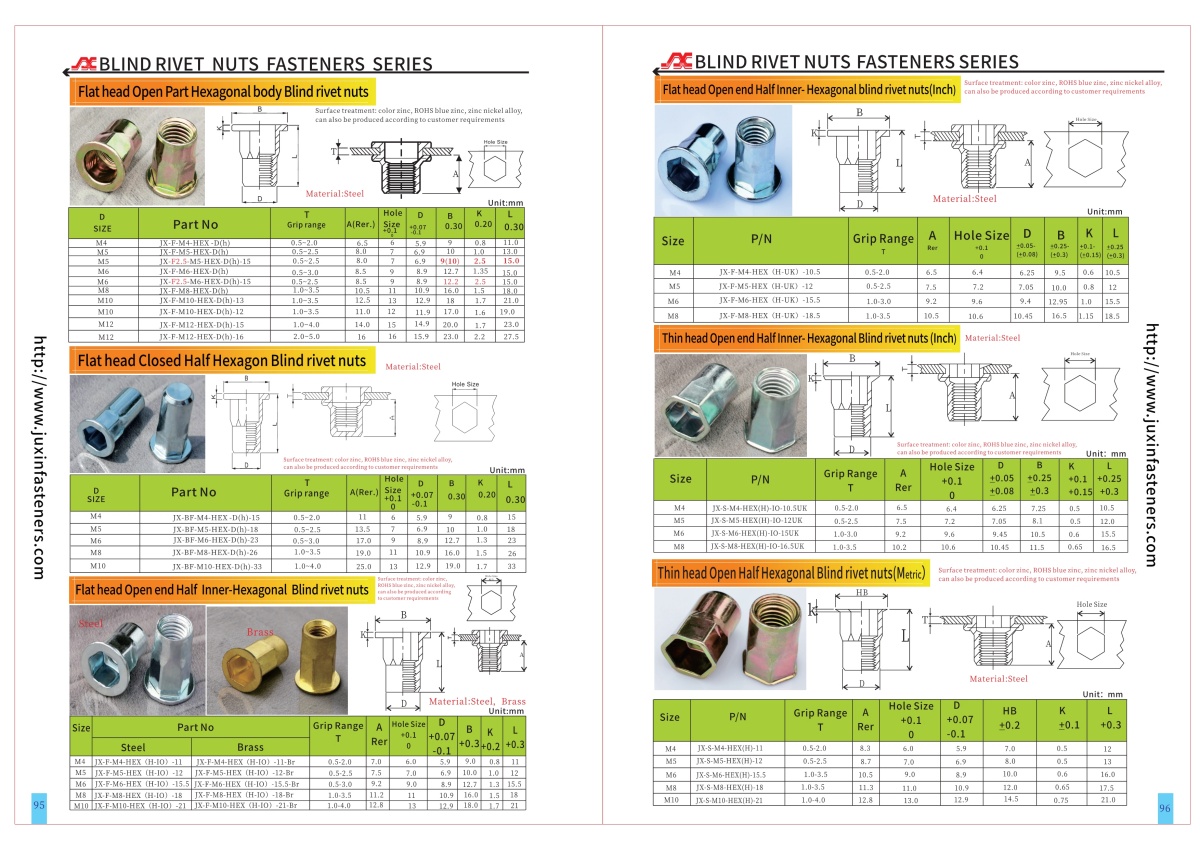
| Catalog Reference | Pages 95–96 |
Technical Selection Notes
Confirm the specific grip range for each thread size.
Use the approved mounting-hole geometry for the half-hex body.
Verify flange thickness and barrel dimensions from the product drawing.
Confirm setting-tool compatibility before production.
Define coating specifications and mechanical acceptance requirements for OEM applications.
Detailed dimensions and CAD information should be confirmed against the corresponding product drawing and catalog documentation.
For technical assistance, contact info@juxinfasteners.com.
Understanding the Thin-Head Half-Hex Design
Why Head Geometry Matters
The head of a blind rivet nut serves as a bearing surface on the accessible side of the parent material.
A conventional large-flange rivet nut may provide a wider bearing area, while a reduced-head design prioritizes compact geometry and lower protrusion.
The correct choice depends on the required bearing area, installation clearance and joint loading.
A smaller or thinner head should not automatically be considered interchangeable with a larger flange.
Why the Partial-Hex Body Matters
Round-body rivet nuts depend substantially on mechanical retention and frictional engagement to resist rotation.
A partial-hex rivet nut adds geometric engagement between the body and the mounting hole.
This can be particularly valuable where screws must be removed and reinstalled during equipment maintenance.
Nevertheless, the mounting hole must be manufactured according to the approved rivet nut drawing.
Excessive clearance or incorrect hole geometry may reduce anti-rotation performance.
Why the Grip Range Matters
Grip range identifies the material thickness interval for which a specific rivet nut configuration is intended.
Selecting an insert with an unsuitable grip range may result in incomplete setting, excessive deformation or insufficient mechanical retention.
For thin sheet metal assemblies, engineers should confirm:
Actual sheet thickness
Material grade and hardness
Surface coating thickness
Rivet nut barrel length
Setting stroke or force
Required pull-out and spin-out resistance
The panel thickness should be evaluated against the grip range of the exact selected part, not only the general product-family range.
Industrial Applications
1. Communication Cabinets and Telecommunications Enclosures
Communication equipment manufacturers often work with compact sheet metal housings containing removable covers, electronic modules and internal support brackets.
Thin-head half-hex blind rivet nuts provide a potential fastening solution where low head protrusion and serviceable internal threads are desirable.
Typical applications include:
Telecommunications cabinet panels
Network equipment enclosures
Internal electronic module brackets
Cable management supports
Removable inspection covers
Communication equipment mounting structures
For these assemblies, engineers should evaluate the available mounting space, panel thickness and required screw tightening torque.
2. Electrical Cabinets and Control Panels
Electrical cabinets commonly contain thin sheet metal components requiring secure mechanical attachment.
Blind rivet nuts can provide threaded mounting points without the need for rear-side nut access.
Potential applications include control cabinet brackets, panel covers, mounting supports and non-safety-critical mechanical accessories.
Where the fastening point forms part of a protective grounding or bonding system, electrical continuity must be separately verified.
A zinc-plated rivet nut should not automatically be assumed to provide a qualified electrical bonding connection.
3. Data Center and Network Equipment Housings
Equipment enclosures used in data center infrastructure may require compact, removable fastening points for sheet metal components.
Thin-head half-hex rivet nuts may be considered for:
Equipment housing panels
Internal mounting brackets
Network rack accessories
Service access covers
Cable support structures
The suitability of each fastening point depends on mechanical loading, installation clearance and service conditions.
4. Industrial Automation Equipment
Automation equipment manufacturers frequently use sheet metal housings, removable access panels and internal instrument supports.
The half-hex body can help reduce unwanted insert rotation during equipment servicing.
The open-end configuration also allows flexibility in screw length, provided sufficient rear clearance exists.
5. Electronic Equipment and Instrument Housings
Compact electronic enclosures may require threaded inserts that occupy minimal surface space.
Thin-head blind rivet nuts can be considered where a low-profile flange and removable mechanical connection are useful.
Designers should evaluate installed insert protrusion, screw clearance, electrical isolation requirements and vibration exposure.
6. HVAC and Industrial Machinery Enclosures
Potential applications include equipment covers, removable sheet metal panels and mechanical support brackets.
For outdoor or corrosive environments, the surface finish must be evaluated against the actual exposure conditions.
Thin Head Half-Hex Rivet Nuts Versus Alternative Fasteners
| Fastener Type | Main Advantage | Engineering Consideration |
|---|---|---|
| Thin Head Half-Hex Rivet Nut | Low-profile flange and anti-rotation geometry | Requires matching non-round hole |
| Standard Flat-Head Half-Hex Rivet Nut | Larger flange options | Greater surface protrusion |
| Round Body Rivet Nut | Round-hole installation | Spin-out resistance depends on design and installation |
| Countersunk Rivet Nut | Potentially flush head installation | Requires suitable countersink geometry |
| Weld Nut | Welded threaded connection | Requires welding access and process control |
| Self-Clinching Nut | Compact threaded attachment in suitable sheet metal | Requires compatible material, thickness and pressing conditions |
For OEM applications, the selection should be based on the complete joint rather than the insert alone.
Installation Recommendations
Step 1: Verify the Rivet Nut Specification
Confirm the selected thread size, grip range, material and surface finish.
Step 2: Prepare the Mounting Hole
Manufacture the mounting hole according to the approved partial-hex rivet nut drawing.
The hole profile, across-flats dimensions, corner geometry and tolerances must be suitable for the selected insert.
Step 3: Inspect the Parent Material
Check the panel thickness, hole condition and material suitability.
Excessive burrs, distortion or incorrect hole geometry can affect installation.
Step 4: Prepare the Setting Tool
Use a compatible manual, pneumatic, hydraulic or other suitable rivet nut installation tool.
Confirm that the mandrel matches the internal thread.
Step 5: Install the Insert
Position the rivet nut correctly and keep the setting tool perpendicular to the workpiece.
Apply the validated installation stroke or setting force.
Step 6: Inspect the Installed Connection
Check that the flange is properly seated and that the insert has formed correctly behind the panel.
Inspect thread integrity and verify the required mechanical performance where applicable.
Step 7: Validate the Mating Screw Assembly
Confirm the mating screw length, tightening torque and available clearance.
Avoid applying installation torque beyond the validated capacity of the fastening system.
Engineering Reliability: What OEM Teams Should Test
For production assemblies, dimensional conformity alone does not guarantee satisfactory installed performance.
JUXIN FASTENERS recommends that customers define relevant acceptance requirements for the following characteristics.
Spin-Out Torque
Measures resistance to rotation of the installed insert.
Axial Pull-Out Resistance
Evaluates resistance to extraction from the mounting panel.
Push-Out Resistance
Evaluates resistance to displacement through the parent material.
Thread Integrity
Confirms that the internal thread remains functional after setting.
Installation Consistency
Evaluates whether repeated installations produce consistent mechanical retention.
Corrosion Resistance
Determines whether the specified material and coating system are suitable for the service environment.
Test procedures and acceptance limits should be defined according to the actual assembly and customer requirements.
Steel Material and Color Zinc Surface Treatment
The documented product uses steel with a color zinc surface treatment.
Zinc plating is commonly specified for corrosion protection of steel components.
However, coating appearance alone does not establish coating thickness, passivation chemistry or corrosion performance.
For OEM procurement, the coating specification should define the required characteristics rather than relying only on a description such as color zinc.
Where applicable, international references may include:
ISO 261 — General-purpose metric thread plan
ISO 724 — Basic dimensions of metric screw threads
ISO 965 — Metric screw thread tolerances
ISO 2081 — Electroplated coatings of zinc on iron or steel
ASTM B633 — Electrodeposited zinc coatings on iron and steel
These standards are engineering references and do not establish that the product has been independently certified to them.
For RoHS-restricted applications, the specific coating chemistry and supporting documentation should be confirmed.
Custom Thin-Head Half-Hex Rivet Nuts for OEM Projects
JUXIN FASTENERS supports engineering review of drawing-defined industrial fastener requirements.
Potential customization areas include:
Non-standard thread sizes
Modified head dimensions
Special partial-hex body geometry
Custom barrel lengths
Application-specific grip ranges
Alternative surface finishes
Customer-defined dimensional tolerances
Special inspection requirements
Packaging and labeling specifications
Custom manufacturing feasibility and minimum order quantities depend on the approved product drawing, material requirements and expected production volume.
Procurement Checklist for OEM Buyers
For a more accurate quotation and technical review, please provide:
Required thread size and tolerance
Product drawing or reference part number
Parent material and thickness
Mounting hole dimensions
Material specification
Coating and corrosion-resistance requirements
Required mechanical performance
Estimated annual consumption
Order quantity and delivery schedule
Packaging and inspection requirements
Providing this information helps engineering and sourcing teams evaluate the correct insert configuration and reduce specification uncertainty.
Frequently Asked Questions
What is a thin-head half-hex blind rivet nut?
It is an internally threaded insert with a reduced-height head and a partially hexagonal body. It is installed from one side of the parent material to provide a reusable threaded fastening point.
Why choose a half-hex body instead of a round body?
The partial-hex geometry engages with a matching mounting hole and helps resist rotation during screw tightening and removal.
Can these rivet nuts be installed in thin steel panels?
Yes, provided the panel thickness, material and mounting-hole geometry fall within the approved requirements for the selected rivet nut.
Do thin-head rivet nuts sit completely flush?
Not necessarily. The reduced-height flange minimizes protrusion, but a completely flush surface requires appropriate head and panel geometry.
Are open-end rivet nuts suitable for waterproof enclosures?
An open-end rivet nut does not provide a sealed threaded barrier.
Applications requiring protection against water or contaminants may need closed-end inserts and additional sealing measures.
Can JUXIN FASTENERS provide custom dimensions?
Drawing-based customization requests can be reviewed for technical feasibility, minimum order quantity and production requirements.
Request an OEM Quotation
JUXIN FASTENERS provides industrial fastening and custom component solutions for OEM manufacturers, design engineers, procurement managers and global sourcing teams.
For thin-head half-hex blind rivet nuts, custom steel nutserts or drawing-based threaded inserts, send us your technical requirements and expected order quantities.
JUXIN FASTENERS
Email: info@juxinfasteners.com
Website: www.juxinfasteners.com
Contact: https://www.juxinfasteners.com/contact-us/
Product Packaging
Industrial Packaging and OEM Supply
JUXIN FASTENERS supplies thin-head half-hex blind rivet nuts using plastic inner bags, outer cartons and palletized packaging where required.
Reference Packaging Dimensions
| Packaging | Dimensions |
|---|---|
| Carton Option 1 | 29 × 19 × 19.5 cm |
| Carton Option 2 | 23.5 × 17.5 × 8 cm |
| Reference Pallet | 215 × 100 × 90 cm |
Actual packaging quantities and carton selection depend on product size and order requirements.
Custom packaging, part-number labeling, batch identification and customer-specific shipment arrangements can be reviewed for OEM purchasing programs.
Email: info@juxinfasteners.com
Website: www.juxinfasteners.com
Product Pictures
Tags
Contact Us
Tel.:
+86 020 8621 0320
+86 020 3121 6067
E-mail:
Technical Support:
Navigation
SEND INQUIREY