Call Us
+86 136 6007 9809
Call Us
+86 136 6007 9809

In edge-mounted sheet-metal fastening, the material used for a clip-on nut must support the geometry and manufacturing condition required for the spring element to interact correctly with the panel.
For projects that explicitly specify 65Mn spring steel clip-on nuts, engineers and procurement teams should look beyond the material name and
evaluate the complete relationship between material, forming, heat treatment, clip geometry, panel thickness, surface treatment and final assembly requirements.
Product Specification
In edge-mounted sheet-metal fastening, the material used for a clip-on nut must support the geometry and manufacturing condition required for the spring element to interact correctly with the panel.
For projects that explicitly specify 65Mn spring steel clip-on nuts, engineers and procurement teams should look beyond the material name and
evaluate the complete relationship between material, forming, heat treatment, clip geometry, panel thickness, surface treatment and final assembly requirements.
65Mn is encountered as a material designation in spring-component sourcing, including certain clip-on nuts, U-nuts, J-nuts and related spring fasteners.
However, the most important engineering principle is:
A material designation does not by itself define finished clip performance.
Specifying 65Mn alone does not establish:
clip retention force;
hardness;
heat-treatment condition;
fatigue life;
vibration resistance;
thermal-cycle performance;
corrosion resistance;
repeated-installation capability;
joint strength.
These properties depend on the finished component and its manufacturing and service conditions.
For OEM sourcing, JUXIN FASTENERS recommends treating 65Mn as one part of the technical specification rather than as a substitute for the complete fastener drawing.
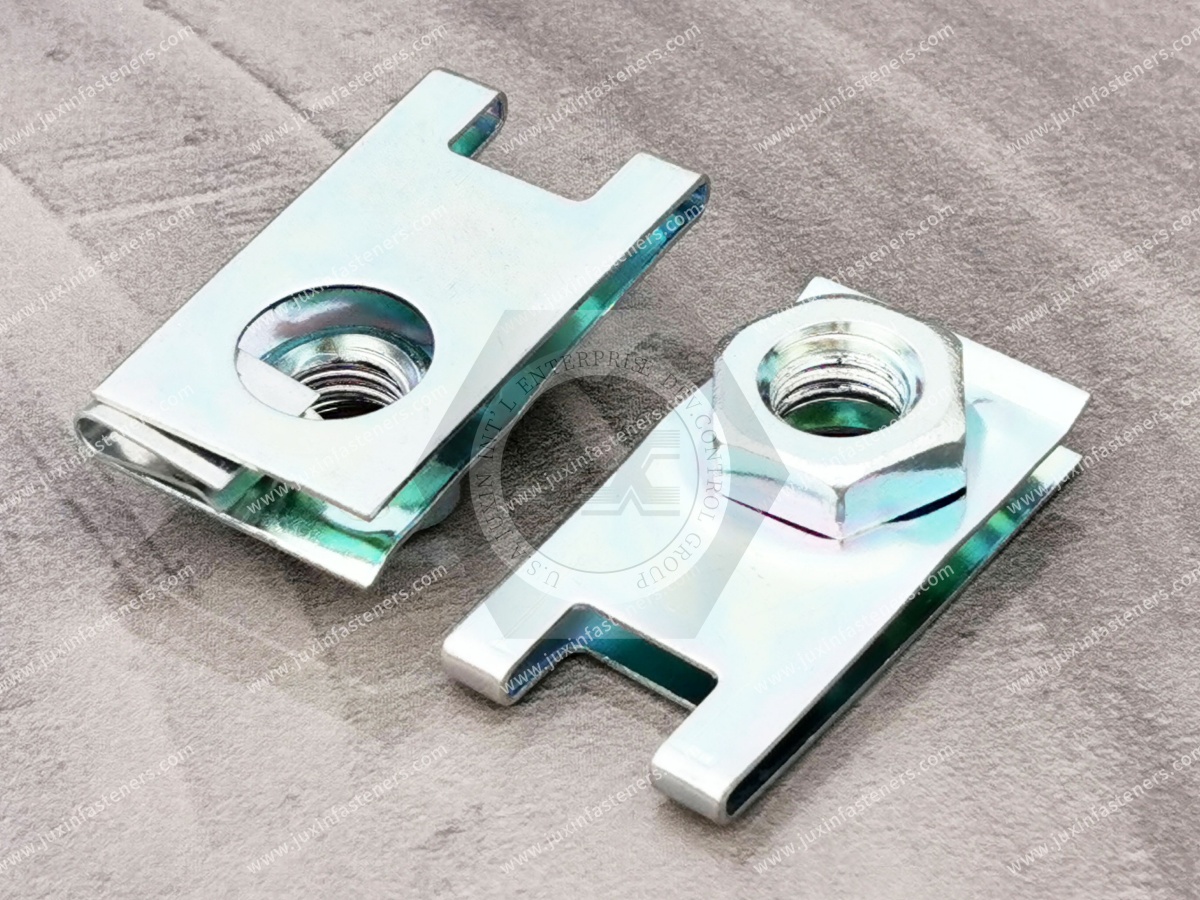
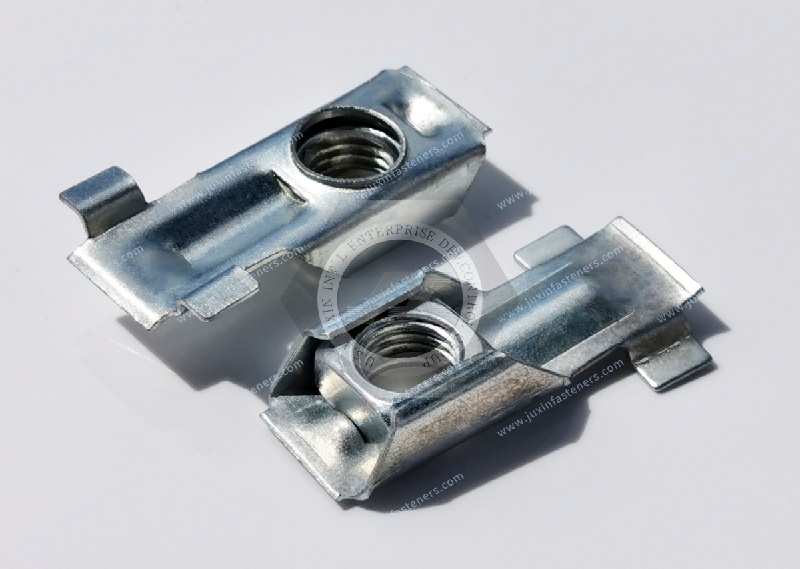
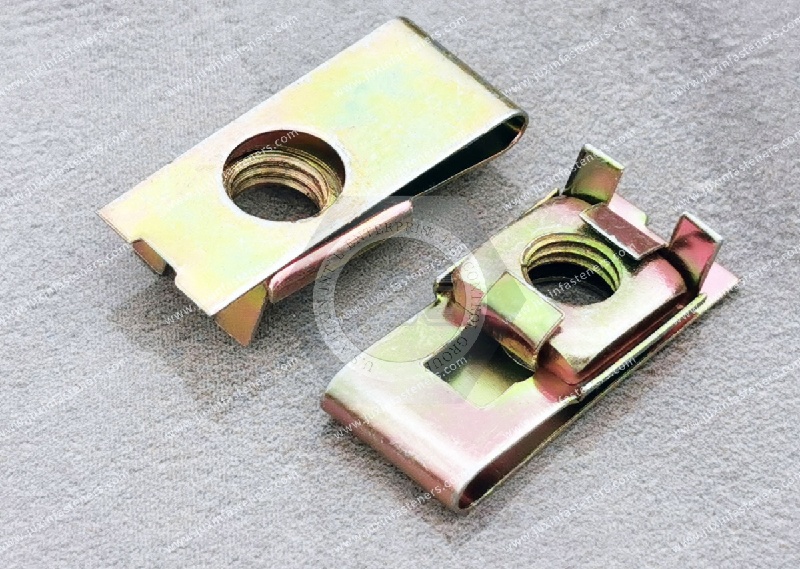
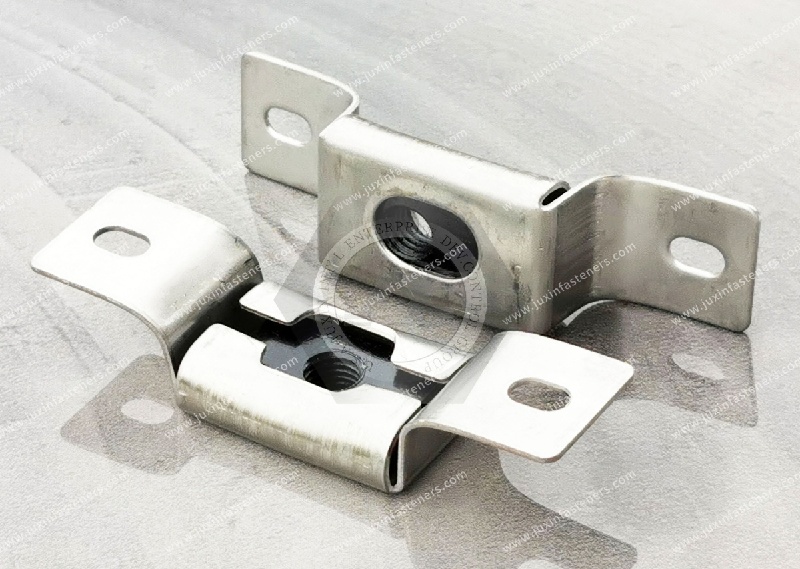
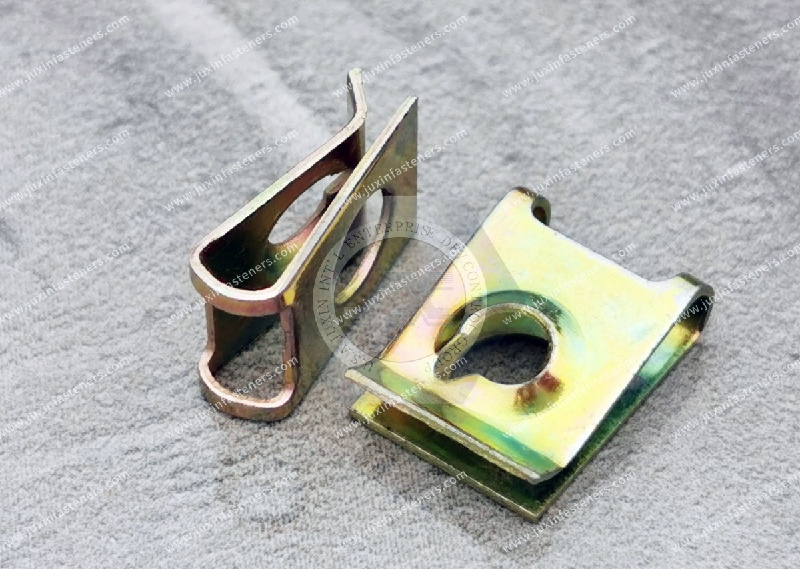
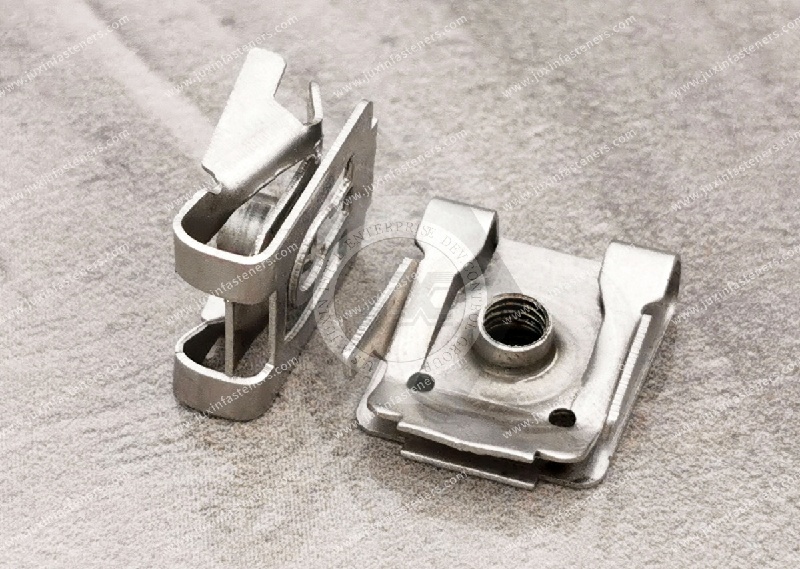
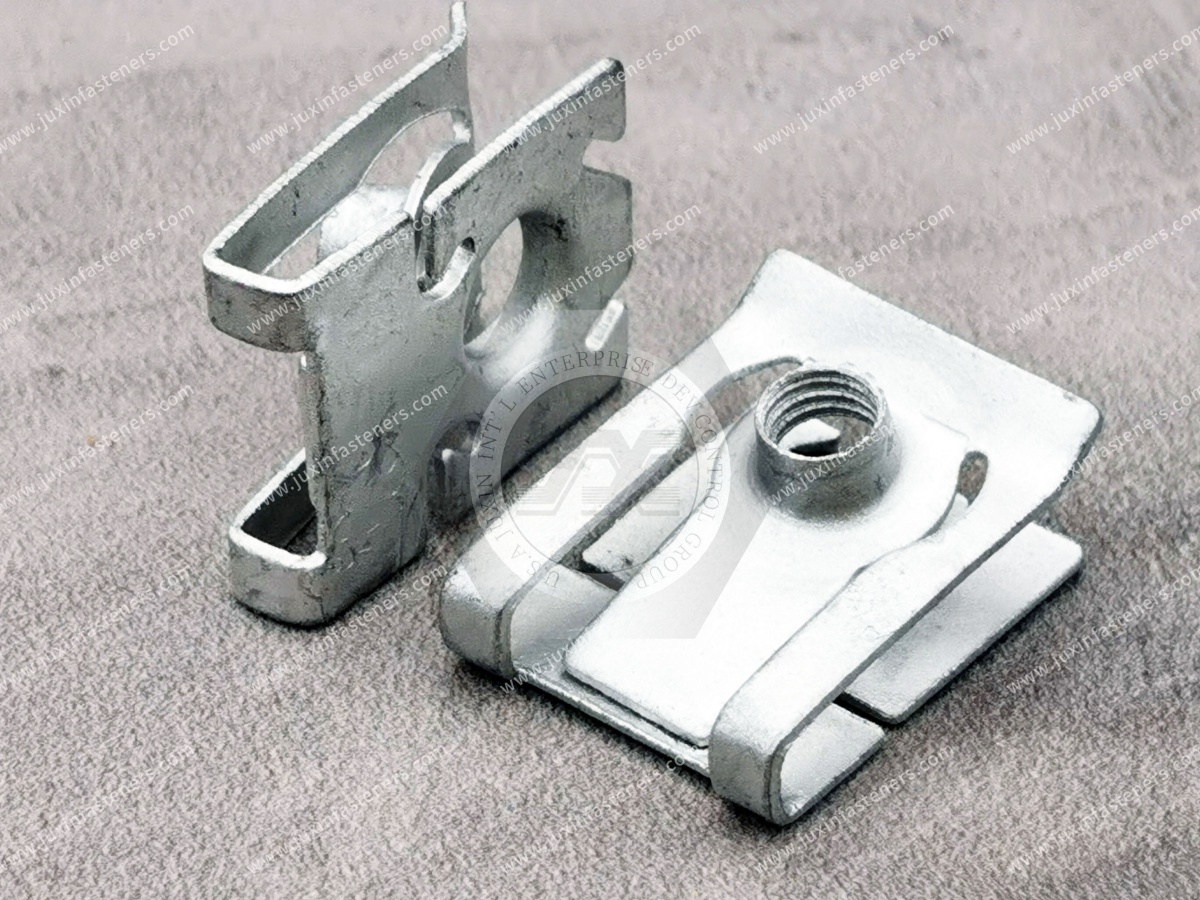
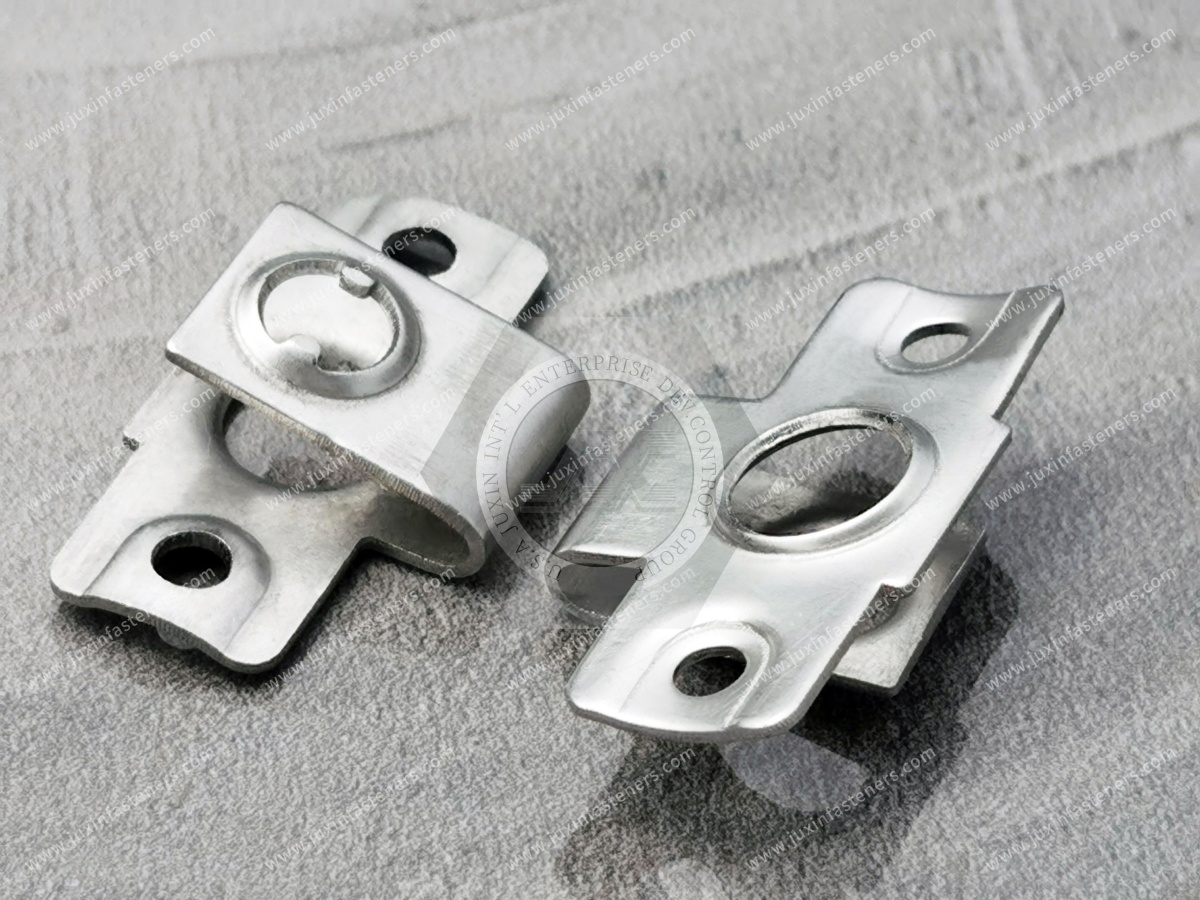
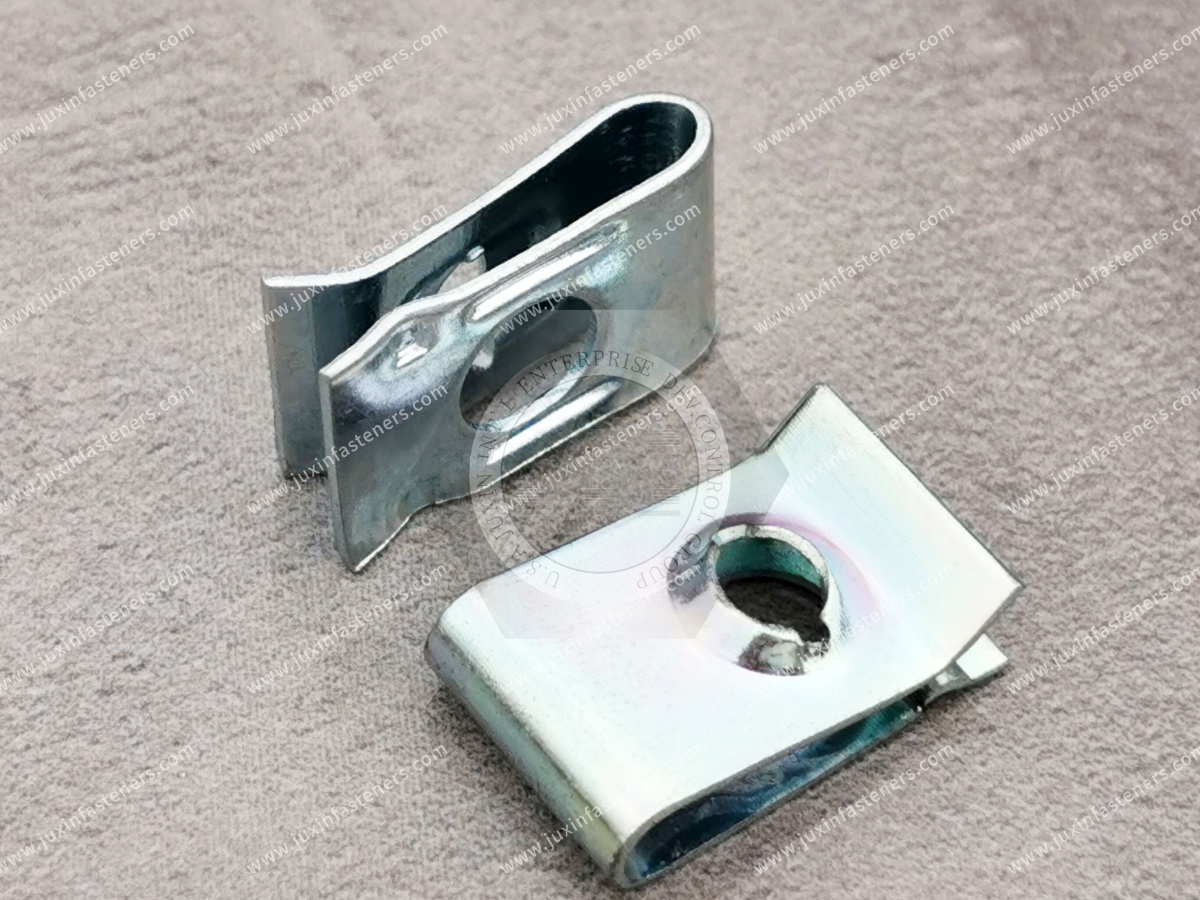
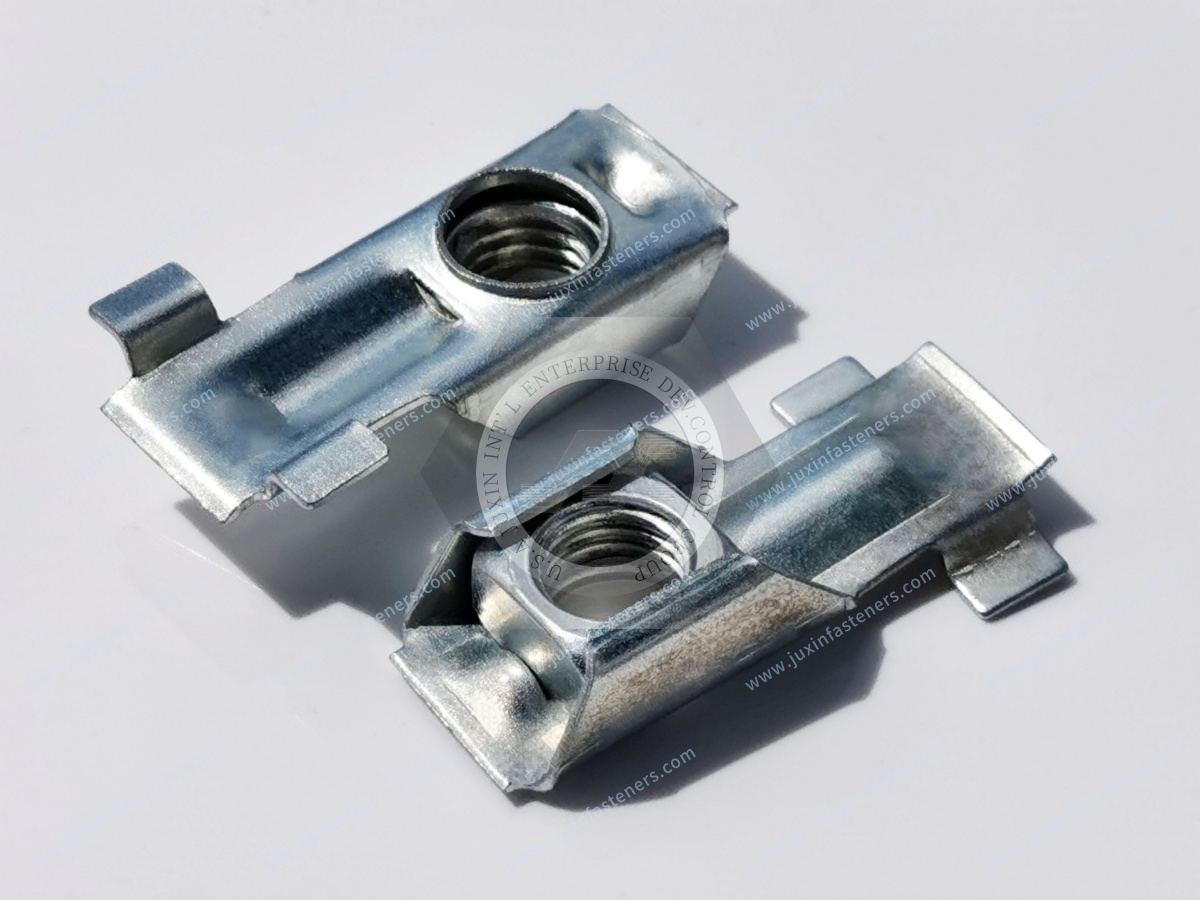
A 65Mn spring steel clip-on nut is an edge-mounted spring fastener manufactured from material specified as 65Mn for a particular product or customer requirement.
Depending on the design, this can include:
U-nuts;
J-nuts;
spring nuts;
clip-on nuts for tapping screws;
flanged-edge clip nuts;
other formed spring fasteners.
The clip body is designed to interact with the sheet-metal edge while positioning a thread or screw-engaging feature for subsequent assembly.
During installation, portions of the clip may deflect as the fastener passes over the panel edge.
The relationship between this deflection and the finished material condition is important.
But it is the finished fastener geometry plus material condition, rather than the material name alone, that determines how the clip behaves.
This distinction is especially important for global procurement.
A purchasing drawing may state 65Mn as the required material.
That tells the supplier something important about the customer's material requirement, but it does not automatically define the mechanical behavior of the completed clip-on nut.
Finished-part behavior can also depend on:
incoming strip condition;
forming sequence;
heat treatment where specified;
final hardness where specified;
clip geometry;
local bend radii;
dimensional tolerances;
coating process;
panel thickness;
installation deflection.
For this reason, engineers should avoid writing requirements such as:
“65Mn = high vibration resistance”
or
“65Mn = guaranteed spring retention.”
Those are separate performance questions.
A direct one-line equivalence should not be assumed.
Material designations from different standards systems can differ in:
chemical composition limits;
delivery condition;
mechanical-property requirements;
heat-treatment requirements;
product form;
test methods.
A material may appear similar to another grade based on nominal chemistry and still not be technically interchangeable under the customer's specification.
For global OEM projects, JUXIN FASTENERS should therefore not automatically convert 65Mn into an ASTM, SAE, DIN or EN grade without reviewing the applicable specifications and customer requirements.
If an OEM drawing requires an ASTM, SAE or EN material, that material should be sourced and evaluated according to the specified requirement rather than replaced solely on the basis of an informal equivalence table.
A clip-on nut differs from a conventional rigid nut because the clip portion may need to deflect during installation.
The spring element must operate within the intended relationship between:
geometry;
material condition;
panel thickness;
installation movement.
If the clip is forced beyond its intended condition, the material may enter a region where permanent deformation becomes significant.
That can alter the installed geometry.
Therefore, material selection cannot be separated from panel-fit design.
One of the central engineering concepts in spring clip design is the difference between elastic deformation and plastic deformation.
Within an appropriate elastic range, a material can recover substantially after the applied deflection is removed.
Once deformation exceeds the relevant material and component limit, permanent set can occur.
For a clip-on nut, this means the designer must consider not only material properties but also:
clip-leg geometry;
local bends;
panel thickness;
insertion path;
installation force;
amount of opening required during installation.
A suitable spring steel does not make the geometry immune to over-deflection.
Panel thickness directly influences how far the clip must open during installation.
If the panel is thicker than the condition intended for a particular fastener, the clip may experience greater deflection than expected.
Possible consequences can include:
difficult installation;
incomplete seating;
permanent deformation;
altered pre-assembly retention;
thread misalignment;
damage to the coating;
interference with surrounding geometry.
If the panel is substantially thinner than the intended fit condition, the clip may not interact with the sheet as designed.
This creates a basic engineering rule:
Select the clip for the actual panel condition—not from thread size and material alone.
Nominal panel thickness is only the starting point.
An OEM assembly may include variation from:
sheet tolerance;
coating thickness;
paint or powder coating;
overlapping sheet layers;
folded edges;
local forming.
The relevant question is therefore:
What panel condition will the finished clip actually encounter in production?
For tight-fit spring fasteners, engineering should consider the complete tolerance stack rather than testing only a nominal bare-metal sample.
Some spring steel fastener designs may require controlled thermal processing to establish the specified finished material condition.
Heat treatment can affect characteristics such as:
hardness;
strength;
ductility;
response to deflection;
residual stress.
However, a generic heat-treatment sequence should not be assigned universally to every 65Mn clip-on nut.
The required process depends on:
starting material condition;
product geometry;
manufacturing route;
required finished properties;
customer specification.
For this reason, JUXIN FASTENERS should follow the confirmed drawing or material/process requirement rather than publishing a universal heat-treatment recipe.
Heat-treated spring steels can develop different microstructures depending on composition and thermal processing.
But it is not technically appropriate to state that every 65Mn clip-on nut supplied under every condition necessarily has one specific microstructure without verified metallurgical data.
If an OEM project requires:
microstructure verification;
hardness testing;
heat-treatment documentation;
metallographic inspection;
those requirements should be defined specifically.
The website should not substitute a generic metallurgy statement for actual product verification.
Engineers often search for terms such as:
65Mn elastic recovery;
spring steel memory;
spring clip retention;
clip nut gripping force.
These searches reflect a legitimate engineering concern.
But elastic recovery in the final component depends on more than the steel grade.
The actual clip response is affected by:
Material Condition + Clip Geometry + Deflection + Panel Thickness + Manufacturing Process
Therefore, the correct engineering approach is to validate the finished fastener under its intended installation condition.
Permanent set can occur when a spring component is deformed beyond the range appropriate to its material and geometry.
In clip-on nut applications, possible causes include:
installing the fastener over an excessively thick panel;
forcing the clip over an incompatible folded edge;
incorrect installation tooling;
local geometric interference;
excessive opening during installation;
unsuitable material/process condition.
Specifying 65Mn alone does not eliminate these risks.
Panel-fit control remains essential.
Gemini's original draft connected 65Mn directly with repeated service access.
That requires more caution.
Repeated installation and removal can affect a spring clip depending on:
geometry;
installation deflection;
panel edge;
coating wear;
material condition;
removal method.
If repeated reuse is a functional requirement, it should be stated in the customer specification and validated for the specific component.
A spring steel designation should not be treated as an unlimited reuse guarantee.
For spring steel clip-on nuts, clip retention and joint strength remain different engineering concepts.
Clip retention concerns how the fastener remains positioned on the panel before and during screw installation.
Joint strength concerns the behavior of the completed screw-fastener-panel assembly.
The final joint depends on factors including:
mating screw;
thread engagement;
fastener geometry;
panel material;
panel thickness;
local bearing area;
tightening process;
clamp load;
tensile loading;
shear loading;
vibration;
temperature;
corrosion.
65Mn should therefore not be described as automatically creating a stronger bolted joint.
No material designation by itself guarantees vibration resistance for a completed fastening assembly.
Vibration behavior depends on the complete joint.
Relevant factors can include:
screw preload;
joint stiffness;
thread interface;
mating surfaces;
clip geometry;
panel stiffness;
vibration amplitude;
vibration frequency;
load direction;
environmental conditions.
A 65Mn spring clip may be selected because its material characteristics suit a particular spring-fastener design, but the actual assembly must still be evaluated for its vibration environment.
Temperature changes can affect a fastening assembly through:
material expansion;
contraction;
coating behavior;
joint movement;
changes in surrounding components.
However, it is not appropriate to state that 65Mn automatically maintains constant spring retention across a “wide temperature range” without product-specific test data.
For applications involving significant thermal cycling, engineers should define:
operating temperature range;
thermal-cycle profile where relevant;
surrounding materials;
required functional acceptance criteria.
The completed assembly can then be validated under representative conditions.
Automotive sheet-metal assemblies can use spring clips in suitable locations where edge-mounted fastening is appropriate.
Potential applications can include:
selected body-related brackets;
interior mounting structures;
service covers;
equipment shields;
non-structural panel attachments.
For these applications, engineers should evaluate:
panel thickness;
coating;
clip geometry;
assembly sequence;
service access;
environmental exposure;
vibration requirements where applicable.
The use of 65Mn material does not automatically establish automotive qualification, fatigue resistance, vibration performance or safety-critical suitability.
Those requirements must be specified separately.
Electric vehicles contain many sheet-metal and equipment structures outside the primary structural battery joint.
Suitable clip-on fastener applications may include selected:
electronics covers;
auxiliary brackets;
control housings;
service panels;
protective sheet-metal covers.
The fastener should be selected according to the actual assembly.
A 65Mn clip-on nut should not automatically be described as:
a battery enclosure sealing fastener;
an IP67/IP68 component;
a busbar fastener;
a grounding fastener;
a structural battery fastener.
Those are separate engineering functions requiring specific design and validation.
Rail vehicles can contain fabricated sheet-metal cabinets, communication enclosures and interior equipment structures.
Clip-on nuts may be considered for suitable:
cabinet panels;
service covers;
internal brackets;
communication equipment housings;
interior equipment panels.
Rail applications may involve vibration, shock, corrosion and lifecycle requirements.
A 65Mn material designation does not itself prove compliance with those conditions.
The relevant requirements should be defined by the rail equipment customer and validated at the assembly level.
Industrial machinery frequently uses sheet-metal:
covers;
control housings;
maintenance panels;
brackets;
access doors;
selected guards.
65Mn spring steel clip-on nuts may be evaluated where the specific material and clip geometry suit the application.
For safety-related guards or heavily loaded joints, application-specific engineering validation remains necessary.
Electrical cabinets use numerous folded and flat sheet-metal components where clip-on fasteners may be considered.
Potential applications include:
enclosure frames;
internal brackets;
removable panels;
access covers;
control housings.
The engineer should consider:
panel thickness;
coating;
edge geometry;
hole setback;
installation access;
corrosion environment.
Clip-on nuts should not automatically be treated as grounding or electrical bonding components.
HVAC equipment can contain fabricated sheet-metal housings, control covers and service panels.
For suitable edge-mounted applications, spring steel clip-on nuts may provide a removable fastening point.
Important variables include:
panel thickness;
flange geometry;
corrosion exposure;
service access;
screw interface;
coating.
The clip itself should not be assumed to provide air sealing, waterproofing or vibration isolation.
Robotics and automation systems frequently combine compact sheet-metal enclosures with electronics and serviceable covers.
Potential applications can include:
controller cabinets;
sensor housings;
automation equipment covers;
internal brackets;
service panels.
In these applications, panel fit and available assembly clearance may be as important as material selection.
Where 65Mn is used for a clip-on nut, the base steel generally requires an appropriate surface-protection strategy if corrosion resistance is part of the application requirement.
Potential project-specific finishes may include:
zinc-based coating systems;
phosphate-based finishes;
other customer-specified surface treatments.
The correct system should be selected according to the actual service environment and customer requirements.
A generic coating should not be used to infer a specific corrosion life.
Where zinc plating is specified, JUXIN FASTENERS places emphasis on environmentally compliant trivalent chromium zinc plating for applicable projects rather than legacy hexavalent chromium systems.
The OEM specification should still define the actual requirements, which may include:
coating type;
passivation;
coating thickness where specified;
appearance where relevant;
corrosion-test requirement;
acceptance criteria;
RoHS/REACH documentation requirements where applicable.
“Zinc plated” alone may not provide enough information for production sourcing.
This is particularly important for spring fasteners.
A coating adds material to the finished surface.
Depending on the geometry and tolerance, coating buildup can influence:
clip opening;
contact areas;
internal threads;
narrow clearances;
fit on the panel.
Likewise, paint or powder coating on the mating sheet-metal panel can change the effective installation condition.
The most relevant production interface is therefore:
Finished Clip + Finished Panel
not merely bare metal against bare metal.
Electrochemical processing of higher-strength or higher-hardness steels can require careful consideration of hydrogen embrittlement risk.
However, the risk cannot be determined from “65Mn” alone.
Relevant variables can include:
finished hardness;
strength condition;
residual stress;
acid cleaning or pickling;
electroplating process;
applied stress;
component geometry.
Therefore, JUXIN FASTENERS should not make a universal claim that every 65Mn clip nut requires the same post-plating baking cycle.
Where hydrogen embrittlement relief is required, the treatment should follow the applicable customer specification, coating specification or recognized process requirement relevant to the finished component.
A universal baking temperature and time should not be invented for every spring fastener.
For applicable projects, recognized ASTM frameworks can be considered for hydrogen embrittlement process control and evaluation.
ASTM B850 addresses post-coating treatments of steel for reducing hydrogen embrittlement risk,
while ASTM F519 provides a test method related to mechanical hydrogen embrittlement evaluation of plating/coating processes and service environments.
Their applicability must be determined for the specific material, hardness, process and customer requirement.
If corrosion testing is required, the RFQ should state:
test method;
exposure duration;
acceptance criteria;
coating specification.
ASTM B117 is commonly referenced as a salt spray/fog test method.
However, ASTM B117 does not by itself define how many hours a clip-on nut must pass and does not directly predict actual field service life.
The customer specification must define the required acceptance condition.
The question should not be reduced to “Which material is stronger?”
A more useful comparison asks:
What material does the drawing require?
What clip geometry is being produced?
What deflection occurs during installation?
What panel thickness must it fit?
What finished material condition is required?
What coating will be applied?
What service environment will the assembly experience?
For a broader discussion of carbon steel materials and coatings,
see the JUXIN FASTENERS guide Carbon Steel Clip-On Nuts: Material Grades, Coatings & OEM Selection at /solutions/carbon-steel-clip-on-nuts-material-coating-guide.
Material does not determine whether a U-nut or J-nut is geometrically correct.
The selection still depends on:
panel thickness;
edge geometry;
hole setback;
throat depth;
installation direction;
available clearance.
For detailed geometry guidance, see U-Nuts vs J-Nuts: Geometric Selection for Edge-Mounted Sheet Metal at /solutions/u-nuts-vs-j-nuts-geometry.
Folded and flanged sheet metal can create a different effective panel interface from a flat sheet edge.
If 65Mn is specified for a flanged-edge clip nut, engineers should still evaluate:
flange width;
sheet thickness;
number of layers;
bend radius;
hole setback;
coating;
installation path.
For additional guidance, see Clip-On Nuts for Flanged Edges: Fastening Folded Sheet-Metal Panels at /solutions/clip-on-nuts-for-flanged-edges.
Some spring clip geometries are intended to work with tapping screws rather than a conventional machine-threaded nut.
The material requirement does not make these products interchangeable with machine-threaded U-nuts or J-nuts.
The engineer should define:
mating screw;
clip geometry;
panel condition;
service requirements.
See the JUXIN FASTENERS guide Strong-Grip Clip-On Nuts for Tapping Screws: U-Nuts & Panel Fastening Solutions at /solutions/strong-grip-clip-on-nuts-tapping-screws.
Instead of specifying only:
“65Mn clip nut”
an OEM drawing or RFQ should build the requirement in layers.
Specify:
product type;
dimensions;
hole alignment;
throat/reach;
clip opening;
thread or screw interface.
Specify:
panel material;
nominal thickness;
thickness tolerance;
coating condition;
edge geometry.
If 65Mn is mandatory, state it clearly.
If an international material specification is required instead, specify that standard directly rather than relying on an assumed equivalence.
Where relevant, specify:
required hardness;
heat-treatment requirement;
finished-part mechanical criteria;
test method.
Do not assume these values from the material name alone.
Specify:
coating system;
passivation;
thickness where required;
environmental compliance;
corrosion test criteria.
Where necessary, define measurable requirements for:
clip retention;
installation behavior;
dimensional fit;
vibration testing;
thermal cycling;
repeated installation;
joint performance.
This turns a generic material request into an engineering specification.
Two quotations both stating “65Mn spring steel clip nut” may not represent technically equivalent components.
Procurement and supplier-development teams should compare:
material specification;
product geometry;
drawing revision;
material condition;
heat-treatment requirement where applicable;
finished hardness where specified;
dimensional tolerances;
thread or screw interface;
panel fit;
coating system;
hydrogen embrittlement controls where applicable;
corrosion-test requirement;
inspection criteria;
packaging;
annual production capability.
This is much more meaningful than comparing the material name and unit price alone.
When submitting an RFQ to JUXIN FASTENERS at info@juxinfasteners.com, include as much of the following information as available:
2D drawing;
3D CAD model where relevant;
existing sample or reference photo;
customer part number;
clip-on nut type;
U-nut, J-nut or other geometry;
metric or inch requirement;
thread size;
thread pitch where applicable;
mating screw specification;
panel material;
nominal panel thickness;
panel thickness tolerance;
hole diameter;
hole setback;
throat or reach requirement;
edge or flange geometry;
explicit 65Mn material requirement where applicable;
required material condition;
heat-treatment requirement where specified;
hardness requirement where specified;
functional clip-retention requirement where specified;
surface treatment;
trivalent chromium zinc requirement where applicable;
coating thickness requirement where applicable;
RoHS/REACH requirements where applicable;
corrosion-test method;
required corrosion-test duration where specified;
acceptance criteria;
hydrogen embrittlement control requirement where applicable;
operating environment;
vibration requirement where applicable;
thermal-cycle requirement where applicable;
prototype/sample quantity;
production quantity;
annual demand;
packaging requirements;
inspection requirements;
customer-specific specifications.
A technically controlled sourcing path for 65Mn spring steel clip-on nuts is:
Application → Clip Geometry → Panel Interface → Material Requirement → Finished Material Condition →
Heat Treatment Where Required → Surface Treatment → Process Risk Review → Functional Validation → Production Specification → Supplier RFQ → Repeat Supply
This approach prevents a material name from being used as a shortcut for engineering performance.
For drawing-based 65Mn spring steel clip-on nuts, U-nuts, J-nuts and related OEM spring fasteners, contact JUXIN FASTENERS at info@juxinfasteners.com.
Providing the actual drawing, panel thickness, material requirement, finished-part requirements,
coating specification and application conditions allows JUXIN FASTENERS to evaluate the component more accurately than specifying “65Mn spring steel” alone.
Product Packaging
Packaging Standard
At Juxin Fasteners, we apply standardized export packaging to ensure product protection, traceability, and compliance with international logistics requirements.
1. Standard Export Packaging
Unless otherwise specified, all products will be packed according to our factory standard export packaging, which includes:
Moisture-resistant inner protection
Poly bag or small box packing as required
Reinforced export cartons
Clear labeling with part number, specification, batch number, and quantity
Palletizing for sea or air shipment when necessary
Our standard packaging is designed to ensure safe transportation, efficient warehousing, and long-distance international shipping.
2. Customized Packaging Options
We also provide customized packaging solutions according to customer requirements, including but not limited to:
Private labeling
Customized barcodes
Specific carton dimensions
Retail packaging
Special pallet configuration
Customer-specific marking and identification
So that you know, customized packaging may involve additional costs and extended lead time depending on the complexity of the requirements.
3. Compliance & Quality Assurance
All packaging processes are controlled under our ISO 9001 quality management system to ensure consistency, traceability, and product integrity throughout the supply chain.
Product Pictures
Contact Us
Tel.:
+86 020 8621 0320
+86 020 3121 6067
E-mail:
Technical Support:
Navigation
SEND INQUIREY