Call Us
+86 136 6007 9809
Call Us
+86 136 6007 9809

When designing sheet-metal assemblies, equipment chassis, electrical cabinets, industrial machinery and fabricated enclosures,
the material and surface treatment of an edge-mounted spring fastener can affect manufacturing, panel fit, corrosion behavior and long-term component suitability.
Product Specification
When designing sheet-metal assemblies, equipment chassis, electrical cabinets, industrial machinery and fabricated enclosures,
the material and surface treatment of an edge-mounted spring fastener can affect manufacturing, panel fit, corrosion behavior and long-term component suitability.
Carbon steel clip-on nuts, including U-nuts, J-nuts and related spring fasteners,
are widely considered for industrial sheet-metal fastening where a mechanically installed, edge-mounted fastening point is required.
However, specifying a carbon steel clip-on nut involves much more than writing “carbon steel, zinc plated” on an RFQ.
Design engineers, materials engineers and sourcing professionals should distinguish between several different engineering layers:
Base Steel → Forming Process → Finished Clip Geometry → Surface Treatment → Panel Interface → Mating Screw → Completed Joint → Service Environment
Each layer can affect the final fastening system.
A steel grade alone does not define clip retention.
A coating alone does not define corrosion service life.
And neither the material nor the coating alone defines the strength of the completed screw-and-panel joint.
For OEM sourcing, JUXIN FASTENERS recommends specifying carbon steel clip-on nuts from the actual product drawing, panel condition,
surface treatment requirement and service environment rather than relying on generic material descriptions.
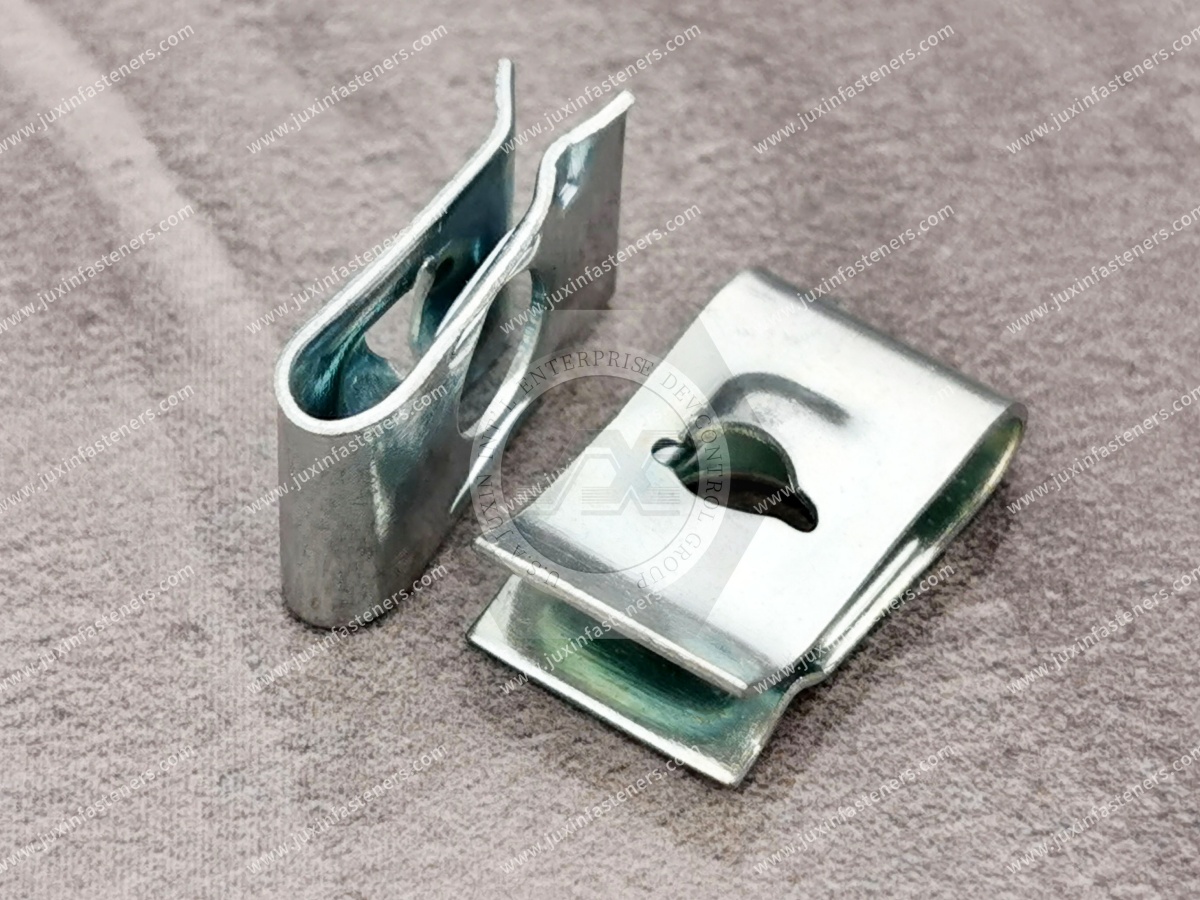
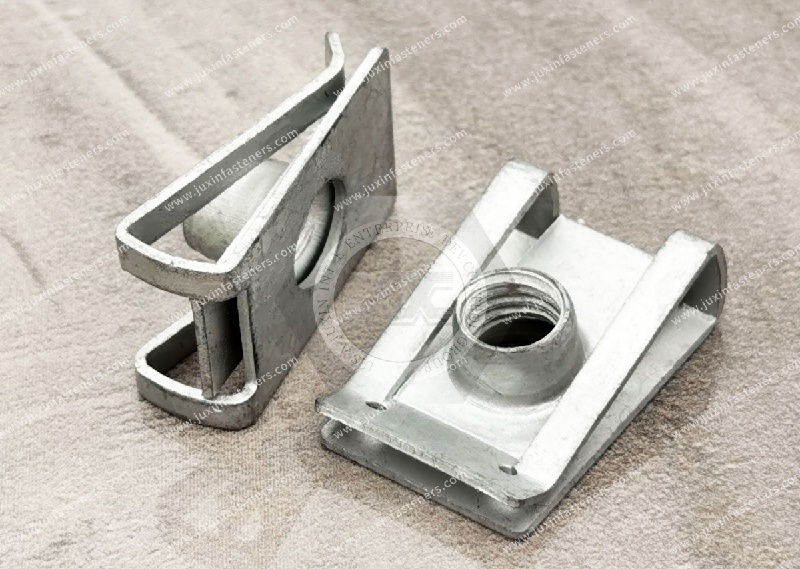
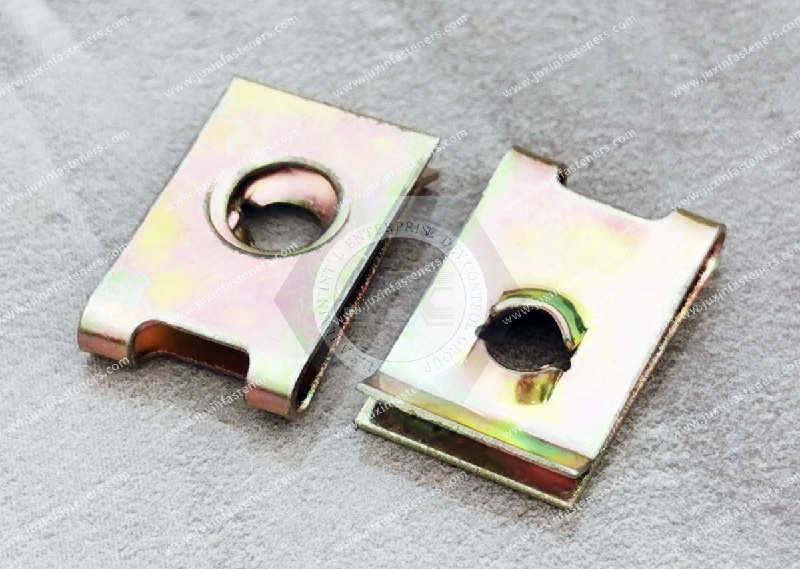
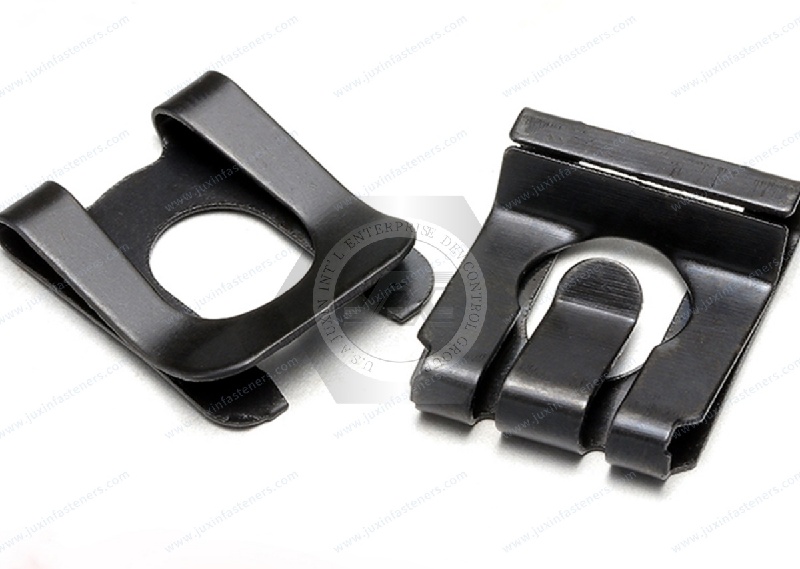
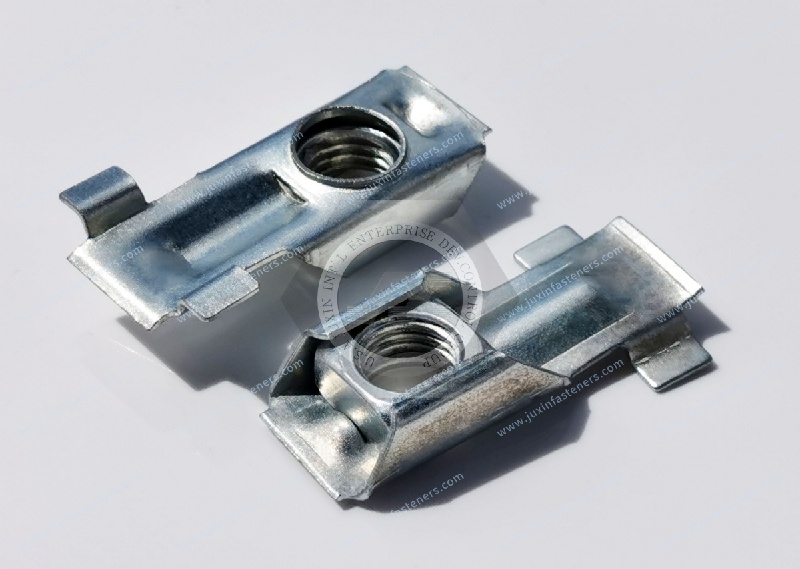
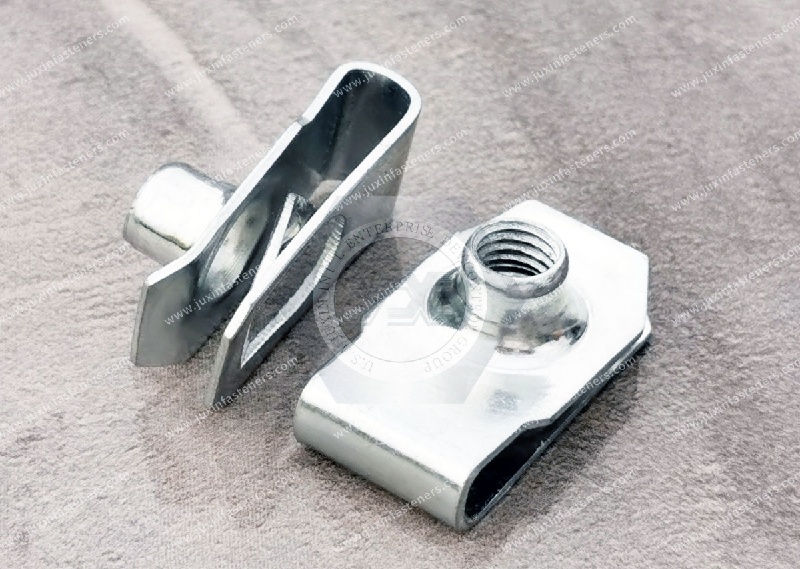
Carbon steel clip-on nuts are edge-mounted fasteners that use a formed metal body to engage a sheet-metal edge and position a threaded or screw-engaging feature for subsequent assembly.
Depending on the design, the product family can include:
U-nuts;
J-nuts;
clip-on spring nuts;
barrel-style clip nuts;
clip-on nuts for tapping screws;
clip-on nuts for flanged edges;
other drawing-based spring fasteners.
The clip geometry and the material work together.
The material must be suitable for manufacturing the required geometry, while the finished part must fit the intended panel condition and perform its specified fastening function.
This is why engineers should avoid treating “carbon steel clip nut” as a complete technical specification.
In commercial sourcing, the terms carbon steel and spring steel are sometimes used broadly.
They should not automatically be treated as interchangeable material specifications.
“Carbon steel” describes a broad family of steels.
“Spring steel” is commonly used for steels and material conditions selected for spring-type applications,
but the term by itself still does not identify a specific grade, heat-treatment condition, hardness or finished-part property.
For an OEM drawing, a more reliable specification may need to define:
material grade where required;
material condition;
applicable material specification;
finished-part requirements;
surface treatment;
dimensional tolerances.
If a customer requires a particular grade, JUXIN FASTENERS should evaluate that grade against the requested clip geometry and manufacturing requirements.
Clip-on nuts perform a different mechanical function from conventional rigid nuts.
During installation, the clip body may deflect as it passes over the sheet-metal edge.
After installation, the formed geometry must provide the intended relationship between the fastener and the panel.
This makes material selection important, but finished-part behavior cannot be predicted from carbon content alone.
Different carbon steel and spring steel grades provide different combinations of:
formability;
strength;
hardness potential;
response to thermal processing;
fatigue behavior;
manufacturing characteristics.
A material suitable for one spring-fastener geometry may not automatically be appropriate for another.
The manufacturing sequence can also matter because the material must withstand stamping, forming and any subsequent processing required by the product specification.
Therefore, an OEM should not select a clip nut solely by requesting “high-carbon steel.”
The required material should be linked to the actual product design.
A spring clip normally relies on controlled deflection during installation and service.
If the clip is forced beyond the condition for which it was designed, permanent deformation may occur.
This can be influenced by:
material;
material condition;
clip geometry;
panel thickness;
installation method;
amount of deflection;
local stress concentration.
It is therefore more accurate to evaluate the finished fastener and panel combination than to assume that a generic spring steel automatically provides unlimited “elastic memory.”
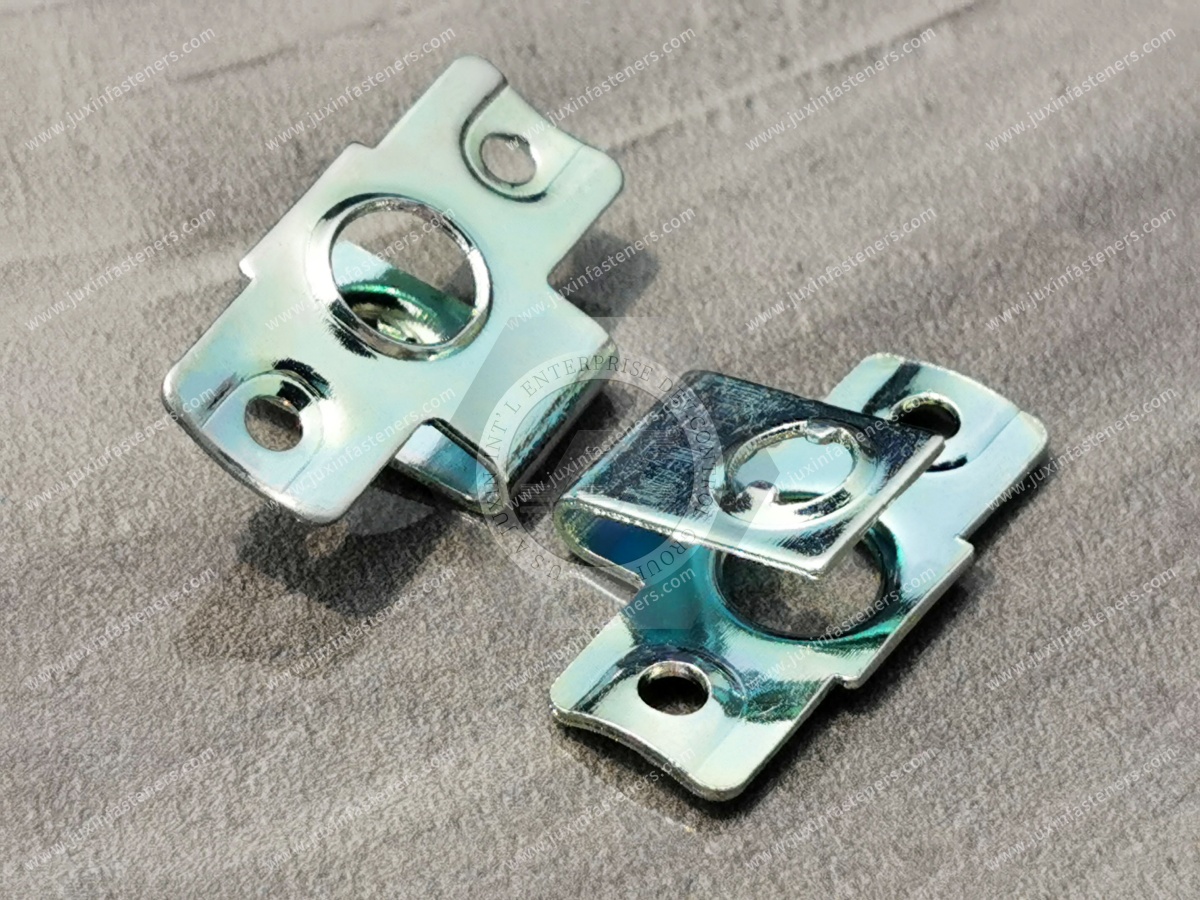
A common assumption is that a spring clip can be removed and reinstalled repeatedly without changing its retention behavior.
That should not be universalized.
Repeated installation can change the contact condition depending on:
clip design;
panel edge geometry;
material;
coating;
amount of deflection;
installation technique.
If repeated removal and reinstallation is important to the application, it should be identified as a functional requirement and validated accordingly.
A higher-strength steel does not automatically create a stronger completed fastening joint.
The completed joint can depend on:
mating screw;
thread engagement;
clip geometry;
panel material;
panel thickness;
local bearing area;
tightening process;
clamp load;
tensile loading;
shear loading;
vibration or cyclic loading;
service temperature;
corrosion.
This distinction is especially important when procurement teams compare alternative spring fasteners based only on material descriptions.
Clip retention describes how the fastener remains positioned on the panel before and during screw installation.
Joint strength describes the behavior of the completed fastening system.
The two are related through the overall design but are not equivalent.
A carbon steel clip can remain firmly positioned on the sheet while the final joint performance is limited by another element of the assembly.
Likewise, a material described as “high strength” does not automatically establish a high-strength joint.
Unprotected carbon steel can oxidize when exposed to moisture and environmental contaminants.
For this reason, carbon steel clip-on nuts commonly require an appropriate surface treatment when corrosion protection is part of the application requirement.
The coating decision should consider:
storage environment;
transportation;
indoor or outdoor use;
humidity;
condensation;
chemical exposure;
temperature;
mating materials;
cosmetic requirements;
customer environmental requirements;
friction requirements where relevant.
The correct coating should be selected for the actual application rather than from appearance alone.
Zinc-based coatings are widely used for carbon steel fasteners because zinc can provide sacrificial corrosion protection to the underlying steel.
For clip-on nuts, however, “zinc plated” is still incomplete as a specification.
An OEM may need to define:
coating system;
coating thickness or applicable specification;
passivation system;
sealing/topcoat where applicable;
appearance;
corrosion-test requirement;
restricted-substance requirements;
friction requirements where relevant.
JUXIN FASTENERS places particular emphasis on environmentally compliant trivalent chromium zinc plating where that finish is specified for the project, rather than legacy hexavalent chromium systems.
Where RoHS or REACH requirements apply, the exact customer specification and current restricted-substance requirements should be stated in the RFQ.
Trivalent chromium passivation is commonly used with zinc coating systems where restricted-substance compliance and corrosion protection requirements must be considered.
For OEM sourcing, the phrase “trivalent zinc” should still not replace a complete finish specification.
The drawing or purchasing specification should define relevant requirements such as:
coating type;
passivation;
appearance where critical;
required coating thickness where specified;
corrosion test method;
acceptance criteria;
restricted-substance documentation requirements.
This reduces ambiguity between supplier and customer.
Terms such as “white zinc,” “clear zinc,” “blue zinc,” “yellow zinc” or “black zinc” are often used commercially.
Color alone is not a reliable engineering specification.
Different coating systems can produce similar appearances while having different:
chemistry;
thickness;
passivation;
sealers;
corrosion performance;
restricted-substance status.
For global OEM procurement, specify the required coating system rather than relying solely on a color description.
Phosphate-based finishes combined with oil may be considered for certain carbon steel or spring fastener applications.
They can provide useful processing and temporary corrosion-protection characteristics depending on the system.
However, phosphate and oil should not automatically be treated as equivalent to zinc plating for corrosion protection.
Their suitability depends on:
storage conditions;
service environment;
oil retention;
customer specification;
subsequent handling.
For applications with defined corrosion requirements, the finish should be evaluated against the required test and service conditions.
There is no universal answer.
The selection should be application-specific.
A useful decision framework is:
Zinc-Based Coating
Consider where sacrificial corrosion protection and a specified passivation system are required.
Phosphate-Based Finish
Consider where the customer's product specification or manufacturing process calls for that finish and its characteristics are appropriate for the environment.
The engineer should then compare:
corrosion requirement;
dimensional impact;
friction requirements;
appearance;
environmental compliance;
mating materials;
storage conditions;
production process.
The finish should follow the engineering requirement, not the other way around.
This is an important consideration that generic coating guides often miss.
A clip-on nut is a dimensional interface with the sheet metal.
The final coated fastener is not dimensionally identical to the bare formed component.
Coating buildup can influence critical areas such as:
clip opening;
contact surfaces;
thread dimensions;
narrow clearances;
mating interfaces.
The effect may be small in many applications, but in tight-tolerance clip geometries it should not automatically be ignored.
This is especially important when an OEM changes from one coating system to another after the fastener geometry has already been approved.
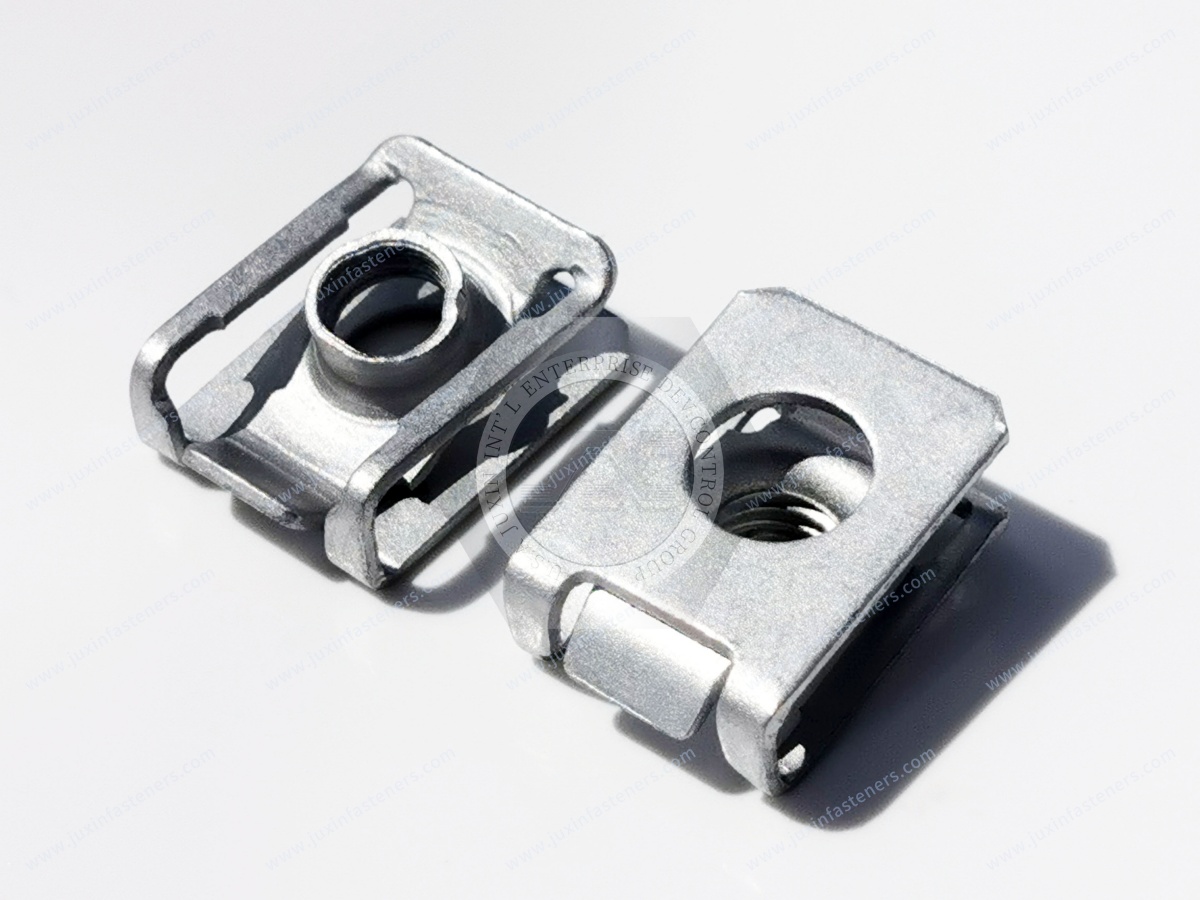
The fastener is only one side of the fit.
Paint, powder coating or another finish on the sheet-metal panel can also change the effective interface.
Engineers should therefore consider:
Finished Clip + Finished Panel
rather than:
Bare Clip + Bare Sheet
This is particularly relevant for electrical cabinets, HVAC housings and industrial enclosures where the panel may be coated before final assembly.
A procurement specification that simply says “corrosion resistant” is difficult to interpret consistently.
A better RFQ identifies:
base material;
coating system;
test method where required;
exposure duration where required;
acceptance criterion;
appearance requirements;
restricted-substance requirements.
This provides a measurable basis for supplier evaluation.
ASTM B117 is widely referenced for operating salt spray/fog test apparatus.
It provides a controlled test environment for evaluating coated specimens according to an applicable product or coating specification.
However, ASTM B117 by itself does not establish the required number of test hours for a clip-on nut, and it should not be treated as a direct predictor of real-world service life.
The OEM specification should separately define:
required exposure duration;
evaluation method;
acceptance criteria;
relevant coating or product requirements.
A requirement such as “ASTM B117” without further acceptance criteria is therefore incomplete.
This distinction is especially important for procurement.
A coating that meets a specified salt-spray test duration has demonstrated performance under that defined laboratory test.
It does not mean the fastener will survive the same number of hours, days or years in actual field service.
Real service environments may involve:
wet/dry cycling;
temperature changes;
chemicals;
mechanical damage;
crevice conditions;
dissimilar-metal contact;
coating abrasion.
Salt spray testing should therefore be used as a controlled qualification or comparison method according to the applicable specification, not as a direct calendar-life forecast.
Hydrogen embrittlement deserves careful treatment because oversimplified statements can create incorrect specifications.
Certain higher-strength or higher-hardness steel components can be susceptible to hydrogen-related delayed cracking under particular material, processing and stress conditions.
Hydrogen may be introduced during processes such as:
acid cleaning;
pickling;
electrocleaning;
electroplating.
However, susceptibility is not determined simply by the words “carbon steel” or “spring steel.”
Risk depends on factors including:
material strength/hardness;
manufacturing process;
surface preparation;
electroplating process;
residual stress;
applied stress;
component geometry.
Gemini's original draft stated that professional manufacturing requires mandatory post-plating baking for high-carbon spring fasteners.
That is too broad.
Hydrogen embrittlement relief procedures should be specified according to the material, hardness/strength condition, coating process,
component requirements and applicable standard or customer specification.
Where hydrogen embrittlement risk is relevant, the manufacturing plan may include appropriate process controls and post-coating treatment.
But a universal baking time or temperature should not be invented for all clip-on nuts.
Where applicable to the specific product and process, OEM engineers may reference recognized ASTM documents addressing hydrogen embrittlement risk and process control.
For example, ASTM B850 addresses post-coating treatments of steel for reducing the risk of hydrogen embrittlement,
while ASTM F519 provides a test method related to mechanical hydrogen embrittlement evaluation of plating/coating processes and service environments.
Their applicability should be determined from the actual product, material, hardness, coating process and customer specification.
They should not be presented as universal certification requirements for every carbon steel clip-on nut.
Risk management should not focus only on a post-plating oven cycle.
Depending on the product and specification, process planning can include consideration of:
material selection;
hardness/strength level;
forming process;
cleaning method;
acid exposure;
plating process;
timing of post-treatment where required;
verification requirements.
This process-based approach is more technically useful than simply writing “bake after plating” on every drawing.
Carbon steel clip-on nuts are frequently installed onto sheet metal made from another material or carrying another coating system.
Where dissimilar metals are exposed to an electrolyte, galvanic interaction may become relevant.
The risk depends on:
material combination;
coating condition;
exposed area;
moisture;
electrolyte;
geometry;
service environment.
Engineers should therefore consider the entire material stack rather than selecting the clip coating in isolation.
One of the most important procurement lessons is:
Raw material specification is not the same as finished-part specification.
Two fasteners manufactured from nominally similar steel can behave differently because of:
strip condition;
forming geometry;
thermal processing;
dimensional tolerances;
coating;
manufacturing sequence.
For critical OEM applications, the finished component requirements should be defined separately from the raw material name.
No.
This is another area where generic fastener marketing frequently overstates standardization.
ISO, DIN, EN, ASME/ANSI, SAE and ASTM standards can be relevant to particular aspects of a fastening system, such as:
threads;
materials;
coatings;
testing;
related fastener categories.
But not every proprietary clip-on nut geometry is directly defined by a specific international dimensional standard.
For drawing-based spring fasteners, the customer's drawing may therefore be the primary dimensional control document.
JUXIN FASTENERS should apply the relevant international or customer specification only where its scope actually fits the product or process.
For certain spring-nut products within its scope, SAE J891 can provide relevant industry terminology and dimensional context.
However, it should not be generalized to every clip-on nut geometry produced for every application.
The actual product type and customer drawing should determine whether a particular standard applies.
Clip-on nuts can use different threaded or screw-engaging architectures depending on product design.
For machine-threaded configurations, the RFQ should identify the actual thread requirement.
Depending on the project, this may include:
metric thread designation;
unified inch thread designation;
pitch;
tolerance class where applicable;
mating screw specification.
Specific thread availability should be confirmed against the requested JUXIN FASTENERS product geometry.
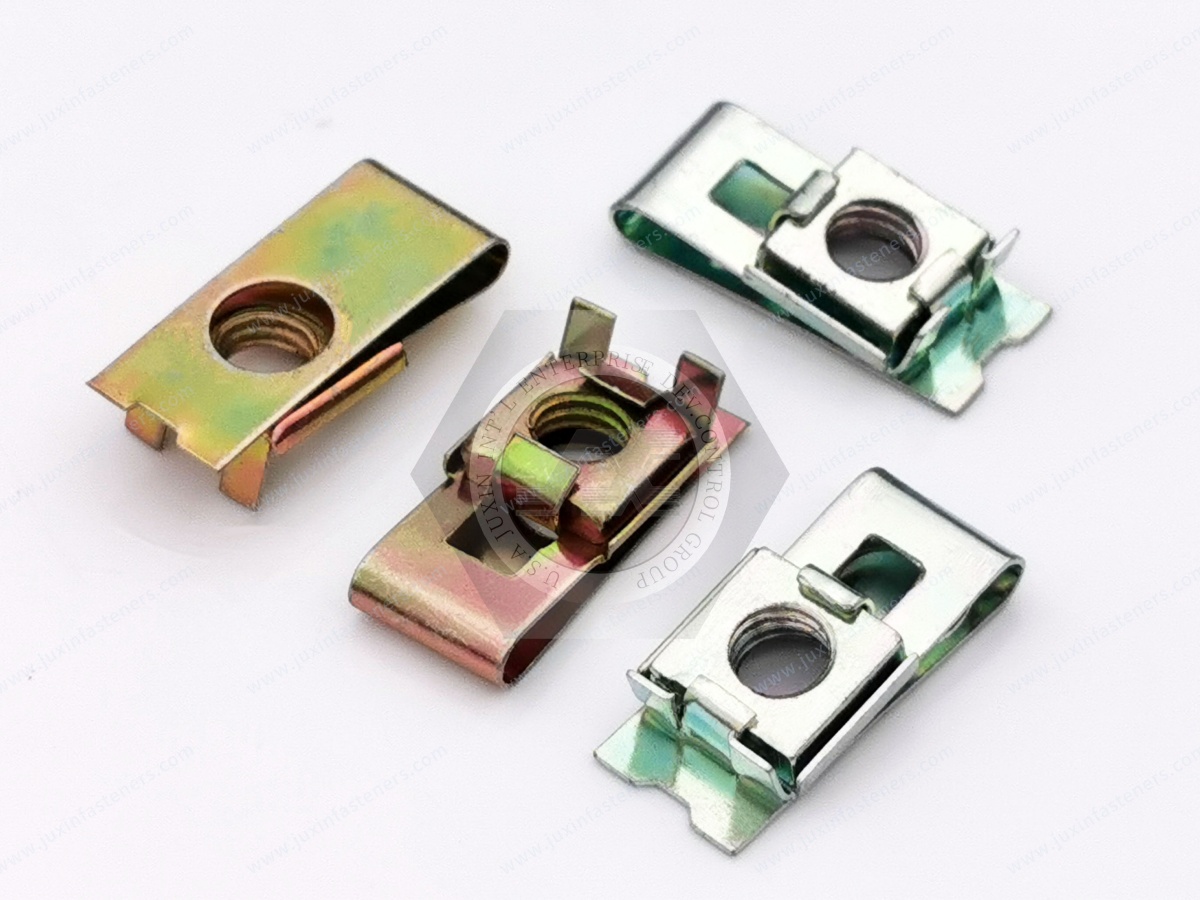
Carbon steel clip-on nuts can be considered for fabricated sheet-metal assemblies such as:
chassis;
equipment housings;
control panels;
brackets;
service covers;
folded panels;
access panels;
machinery enclosures.
The key selection variables are not limited to material.
Engineers should also evaluate:
panel thickness;
hole setback;
clip reach;
edge geometry;
mating screw;
coating;
installation sequence.
Electrical cabinets often use carbon steel clip-on nuts on suitable edge-accessible sheet-metal components.
Potential applications include:
enclosure frames;
internal brackets;
access covers;
removable panels;
control housings.
Because these products may be painted or powder coated, the final coated panel thickness and clip installation condition should be considered.
Clip-on nuts should not automatically be treated as grounding or electrical bonding components unless that function has been separately engineered and validated.
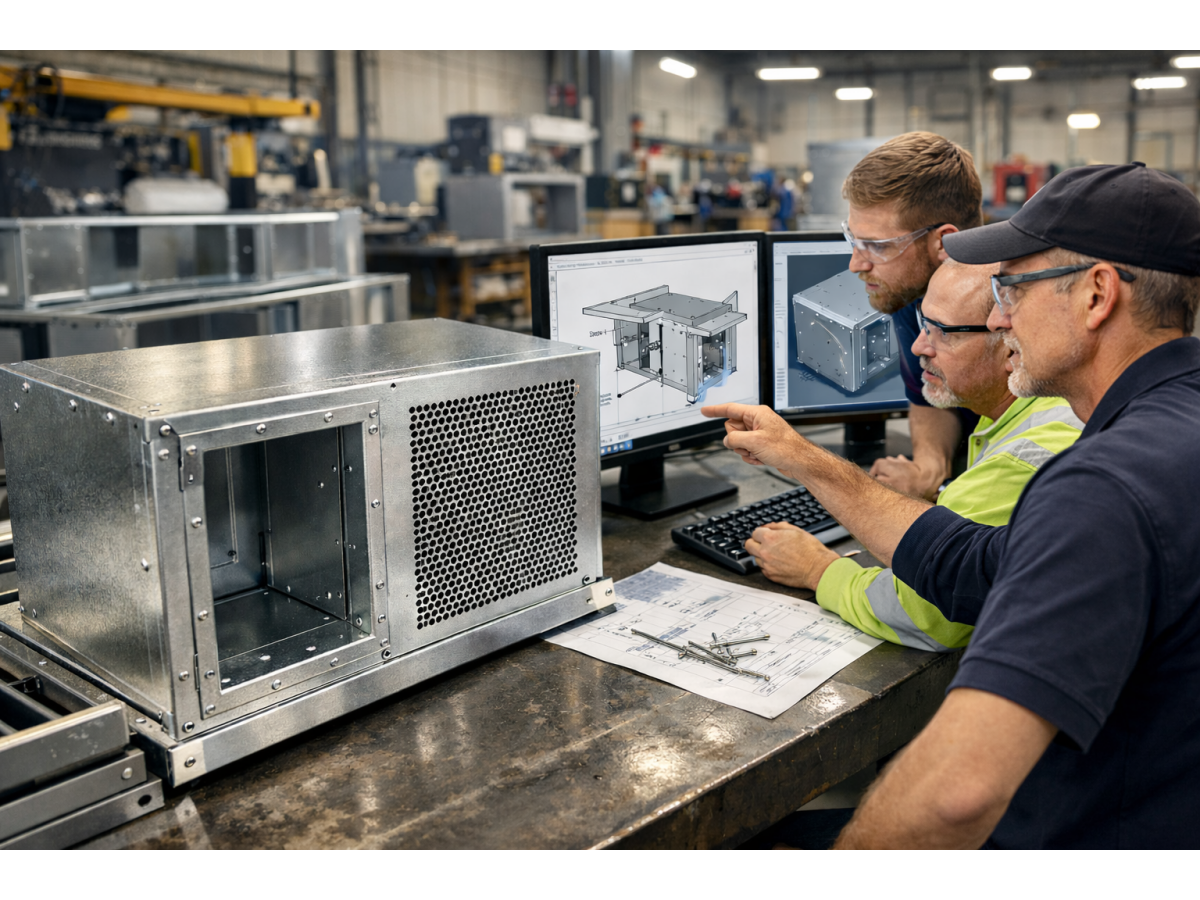
HVAC housings, air-handling equipment and control enclosures frequently use fabricated sheet metal.
Carbon steel spring fasteners may be suitable for selected indoor or protected applications when the specified coating matches the environmental requirement.
Where condensation, outdoor exposure or aggressive chemicals are relevant, coating selection requires greater attention.
The clip nut itself should not be assumed to provide air sealing or waterproofing.
Industrial machinery applications can include:
equipment covers;
control enclosures;
maintenance panels;
access doors;
non-structural guards;
brackets.
For these applications, material and coating selection should reflect both the production environment and service conditions.
Safety-critical or highly loaded connections require separate joint-level validation.
Carbon steel clip-on nuts may be considered for suitable automotive sheet-metal applications including:
selected brackets;
service covers;
interior mounting structures;
equipment panels;
other non-structural edge-fastening locations.
Automotive use does not automatically establish vibration, fatigue, crash, structural or corrosion qualification.
Those requirements must be specified and validated for the particular component and joint.
Automation equipment often uses compact sheet-metal enclosures and removable service covers.
Potential applications include:
controller cabinets;
sensor housings;
equipment covers;
internal brackets;
service panels.
In these applications, engineers may need to balance material cost, corrosion protection, panel fit and limited assembly clearance.
Carbon steel and stainless steel should not be selected from price alone.
A simplified engineering comparison is:
| Selection Factor | Carbon Steel Clip-On Nuts | Stainless Steel Clip-On Nuts |
|---|---|---|
| Corrosion strategy | Usually relies on a specified protective finish | Corrosion behavior depends on stainless grade and environment |
| Surface treatment | Often an important part of the specification | May differ depending on application and required finish |
| Material cost | Often commercially attractive for volume industrial applications | Typically considered where stainless material characteristics justify it |
| Galvanic compatibility | Must be evaluated with mating materials | Must also be evaluated with mating materials |
| Geometry availability | Confirm by product | Confirm by product and grade |
| Final selection | Application-specific | Application-specific |
JUXIN FASTENERS offers stainless clip-on nut options in relevant product families, including SUS304 and SUS316 options shown in existing product information.
However, material and dimensional availability should be confirmed for the specific requested geometry.
Material selection cannot be separated from geometry.
For folded or flanged sheet-metal applications, the engineer should evaluate:
base sheet thickness;
effective folded thickness;
coating buildup;
flange width;
bend clearance;
hole setback.
For more detailed flange geometry guidance, see the JUXIN FASTENERS article Clip-On Nuts for Flanged Edges: Fastening Folded Sheet-Metal Panels at /solutions/clip-on-nuts-for-flanged-edges.
U-nut and J-nut selection is primarily a geometry question rather than simply a material question.
Both may use carbon/spring steel depending on the product, but their panel interfaces can differ.
For a detailed comparison, see U-Nuts vs J-Nuts: Geometric Selection for Edge-Mounted Sheet Metal at /solutions/u-nuts-vs-j-nuts-geometry.
Barrel-style clip nuts introduce another threaded architecture.
Their selection should consider:
barrel geometry;
panel thickness;
thread engagement;
hole position;
installation access.
For more information, see Strong-Grip Clip-On Barrel Nuts: U-Nuts, Multi-Thread Engagement & Panel Fastening Solutions at /solutions/strong-grip-clip-on-barrel-nuts-u-nuts.
A useful engineering workflow begins with the application rather than the coating catalog.
Identify:
panel material;
panel thickness;
edge geometry;
clip type;
installation deflection.
Consider:
indoor or outdoor use;
humidity;
condensation;
chemicals;
temperature;
storage conditions.
Determine whether the customer requires:
a specific steel grade;
a spring steel specification;
a finished-part performance requirement.
Compare appropriate coating systems against:
corrosion requirement;
dimensional impact;
restricted-substance requirements;
appearance;
friction where relevant.
Consider the material strength/hardness and electrochemical processing route rather than applying a universal rule.
Specify applicable:
coating thickness;
corrosion test;
acceptance criteria;
material documentation;
restricted-substance documentation;
customer-specific tests.
Confirm that the final coated clip fits the final coated panel and performs as required with the specified mating screw.
Procurement teams should not compare carbon steel clip-on nut quotations using price and thread size alone.
Compare:
product geometry;
drawing revision;
base material;
material condition where specified;
thread requirement;
panel fit;
surface treatment;
passivation system;
coating thickness where specified;
corrosion-test requirement;
restricted-substance requirements;
hydrogen embrittlement controls where applicable;
dimensional inspection requirements;
packaging;
production volume.
This creates a more meaningful supplier comparison.
When submitting an RFQ to JUXIN FASTENERS at info@juxinfasteners.com, provide as much of the following information as available:
2D drawing;
3D CAD model if relevant;
existing sample or reference photo;
customer part number;
clip-on nut type;
U-nut, J-nut, barrel or other geometry;
metric or inch thread requirement;
thread size;
pitch where applicable;
mating screw specification;
panel material;
nominal panel thickness;
panel thickness tolerance;
hole diameter;
hole setback;
edge or flange geometry;
required steel grade if specified;
material condition if specified;
required surface treatment;
trivalent chromium requirement where applicable;
RoHS/REACH requirement where applicable;
coating thickness requirement where applicable;
corrosion test method;
required test duration where specified;
corrosion acceptance criteria;
hydrogen embrittlement control requirement where applicable;
operating environment;
manual or automated assembly process;
target tightening requirement where applicable;
prototype/sample quantity;
production order quantity;
annual demand;
packaging requirements;
inspection requirements;
customer-specific specifications.
A reliable sourcing path for carbon steel clip-on nuts is:
Application Environment → Clip Geometry → Panel Interface → Material Requirement → Surface Treatment → Process Risk Review →
Finished-Part Verification → Prototype Evaluation → Production Specification → Supplier RFQ → Repeat Supply
This prevents procurement from treating material and coating as isolated purchasing fields.
For drawing-based carbon steel clip-on nuts, U-nuts, J-nuts, spring nuts, barrel clip nuts and other OEM spring fastener requirements, contact JUXIN FASTENERS at info@juxinfasteners.com.
Providing the actual drawing, panel condition, material requirement, coating specification and service environment allows J
UXIN FASTENERS to evaluate the fastening requirement more effectively than specifying “carbon steel, zinc plated” alone.
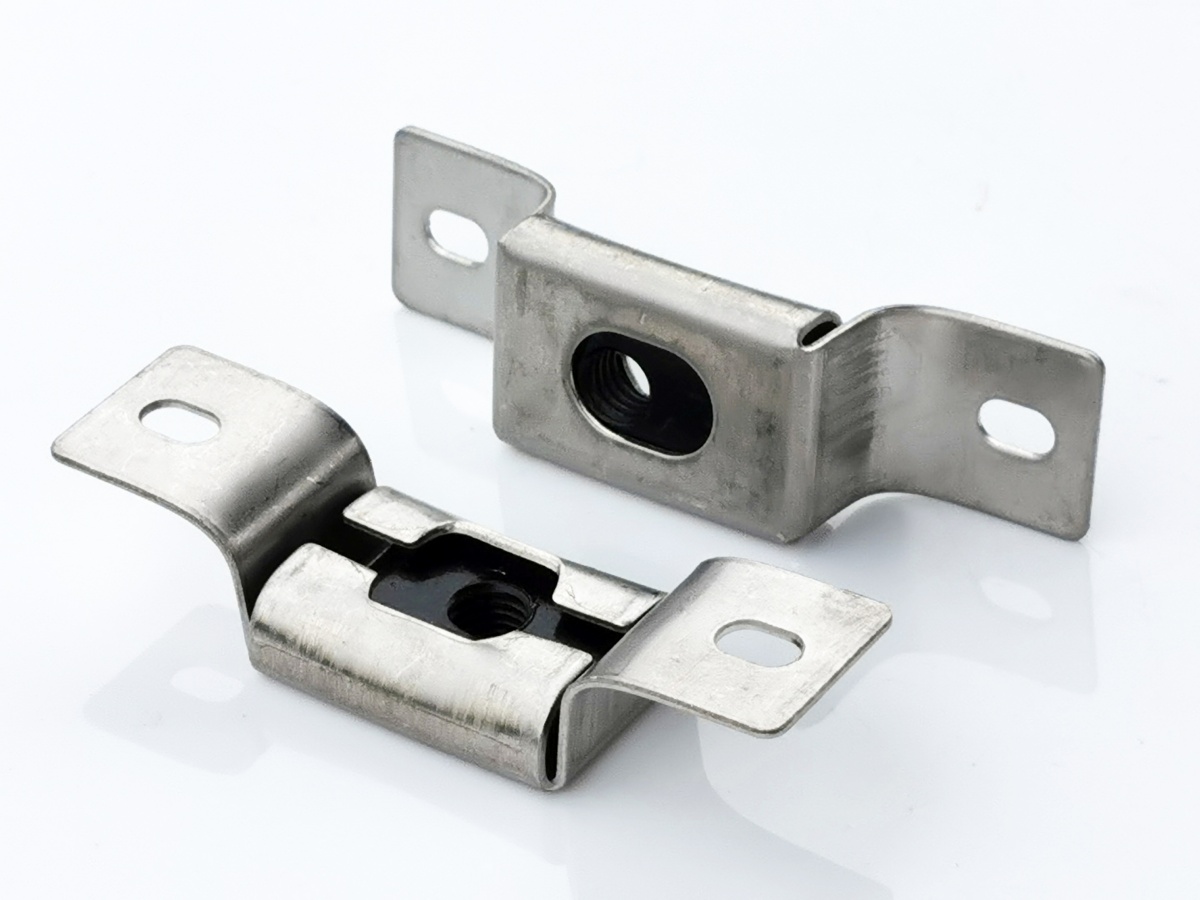
Product Packaging
Packaging Standard
At Juxin Fasteners, we apply standardized export packaging to ensure product protection, traceability, and compliance with international logistics requirements.
1. Standard Export Packaging
Unless otherwise specified, all products will be packed according to our factory standard export packaging, which includes:
Moisture-resistant inner protection
Poly bag or small box packing as required
Reinforced export cartons
Clear labeling with part number, specification, batch number, and quantity
Palletizing for sea or air shipment when necessary
Our standard packaging is designed to ensure safe transportation, efficient warehousing, and long-distance international shipping.
2. Customized Packaging Options
We also provide customized packaging solutions according to customer requirements, including but not limited to:
Private labeling
Customized barcodes
Specific carton dimensions
Retail packaging
Special pallet configuration
Customer-specific marking and identification
So that you know, customized packaging may involve additional costs and extended lead time depending on the complexity of the requirements.
3. Compliance & Quality Assurance
All packaging processes are controlled under our ISO 9001 quality management system to ensure consistency, traceability, and product integrity throughout the supply chain.
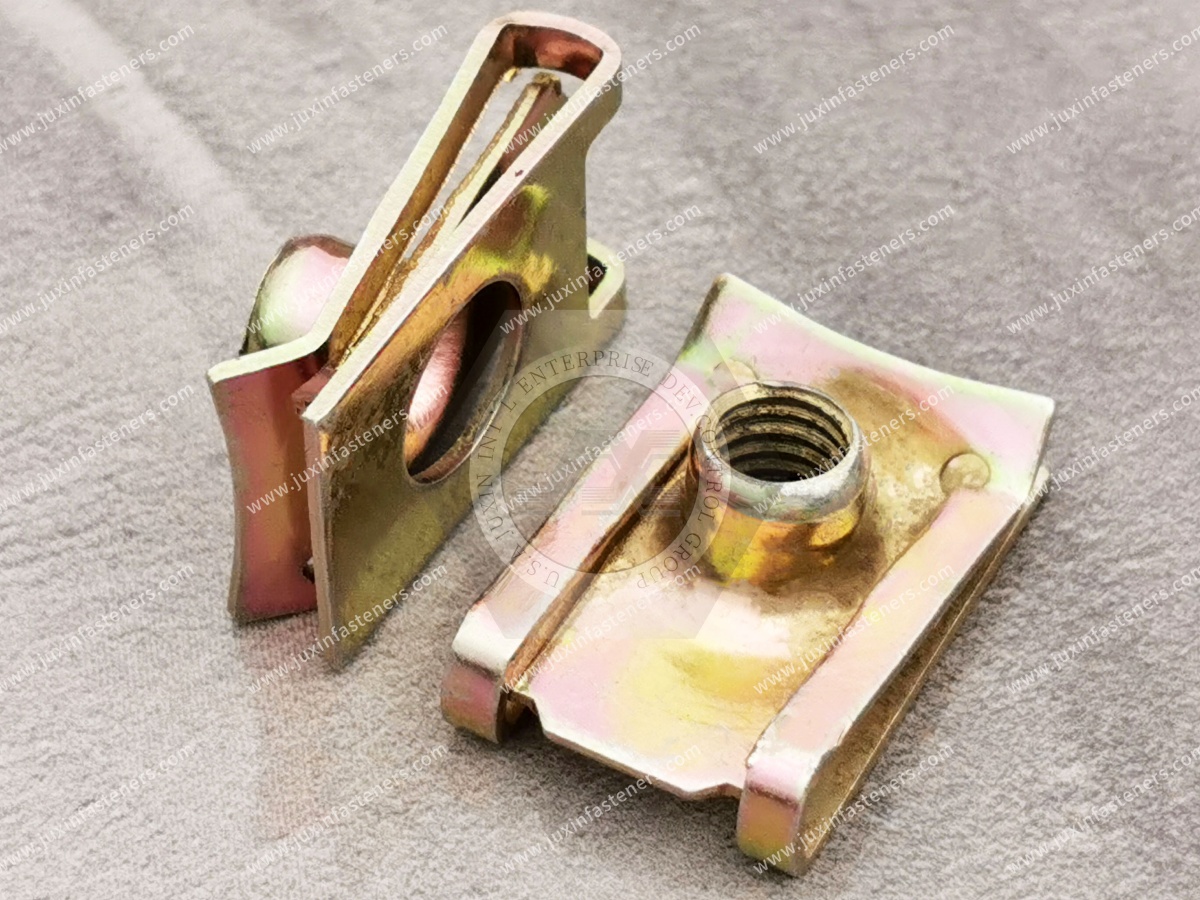
Product Pictures
Contact Us
Tel.:
+86 020 8621 0320
+86 020 3121 6067
E-mail:
Technical Support:
Navigation
SEND INQUIREY