Call Us
+86 136 6007 9809
Call Us
+86 136 6007 9809

In sheet-metal enclosures, electrical cabinets, industrial machinery and equipment housings, engineers frequently need to create
a threaded attachment point near a panel edge without relying on a loose nut that must be held from the backside during final assembly.
Standard U-nuts, J-nuts and other spring nuts can solve many edge-fastening problems.
Product Specification
In sheet-metal enclosures, electrical cabinets, industrial machinery and equipment housings, engineers frequently need to create
a threaded attachment point near a panel edge without relying on a loose nut that must be held from the backside during final assembly.
Standard U-nuts, J-nuts and other spring nuts can solve many edge-fastening problems.
However, some assemblies benefit from a clip-on configuration that retains a separate or integrated hex-nut-style threaded element within the fastener structure.
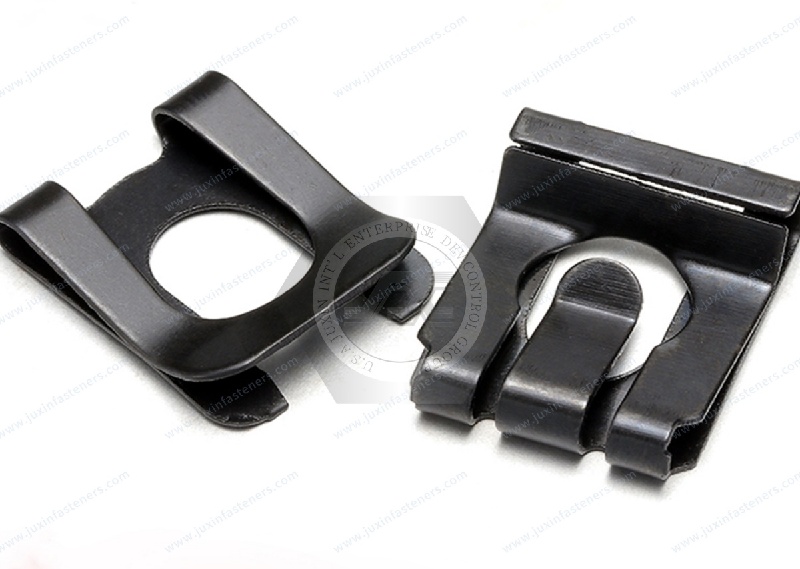
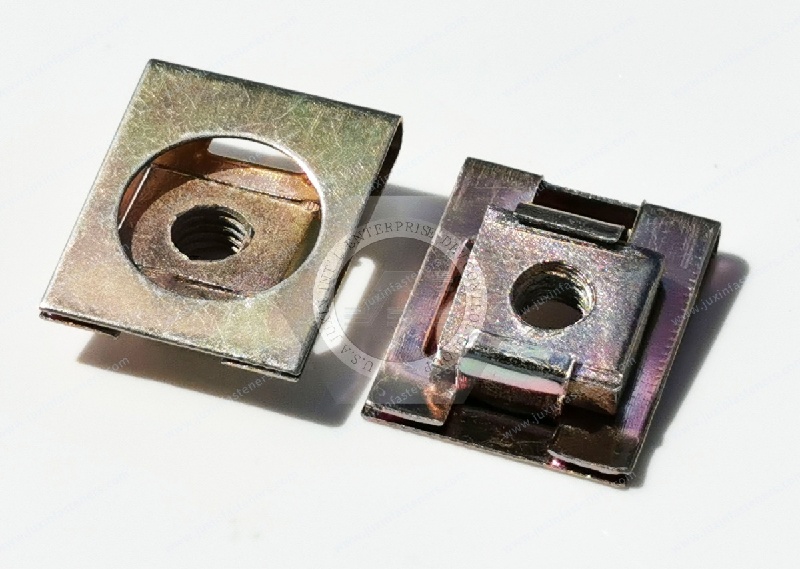
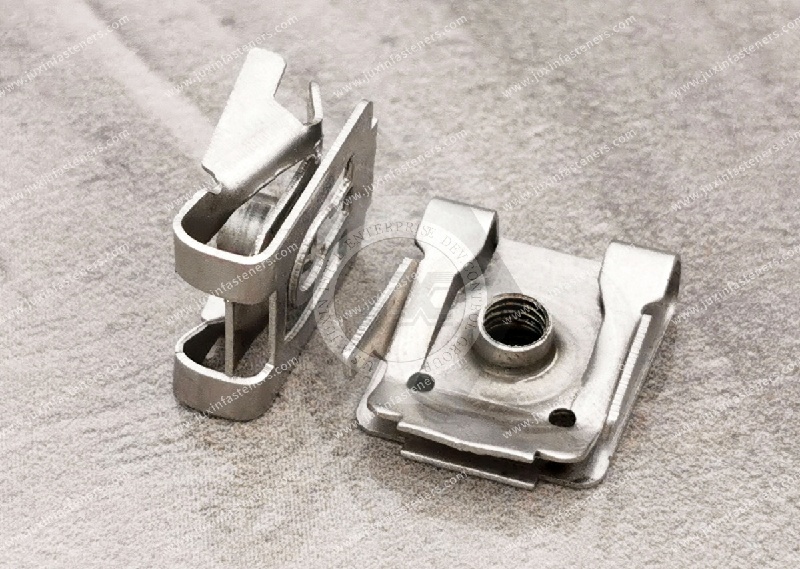
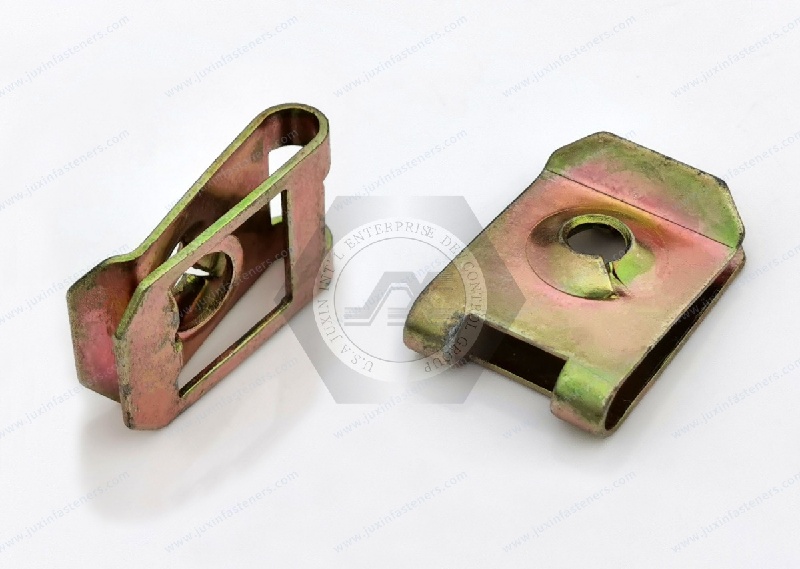
Strong-Grip Clip-On Enclosed Hex Nuts combine an edge-mounted spring clip with a captive threaded nut configuration, allowing the fastener to be positioned on the sheet metal before the mating screw is installed.
This can be particularly useful where:
backside wrench access is restricted;
a loose nut would be difficult to position during assembly;
the nut must remain associated with the panel during handling;
a defined machine-threaded fastening point is required;
equipment must later be opened for service;
the surrounding assembly makes conventional two-tool fastening inconvenient.
The engineering value of this fastener is therefore not simply “more torque.”
The more important question is:
Can the clip-on enclosed hex nut provide the required captive threaded interface while fitting the panel thickness, hole position, screw length, installation path and available internal envelope?
For OEM applications, JUXIN FASTENERS recommends evaluating the complete panel-and-screw interface rather than selecting the fastener only by thread size or product name.
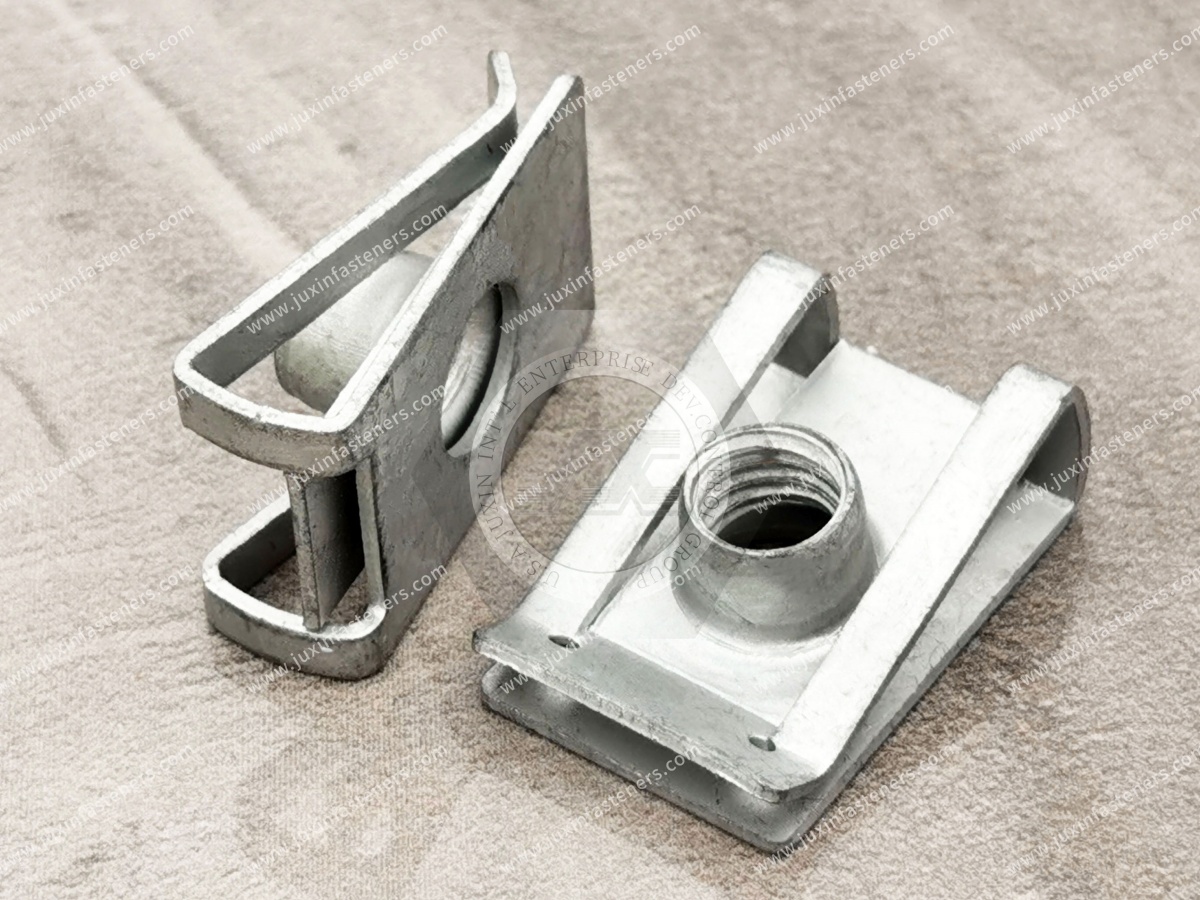
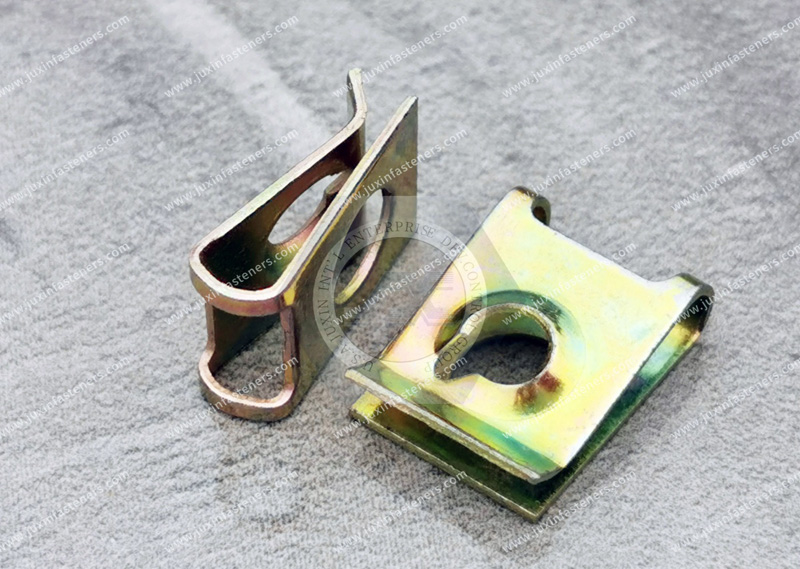
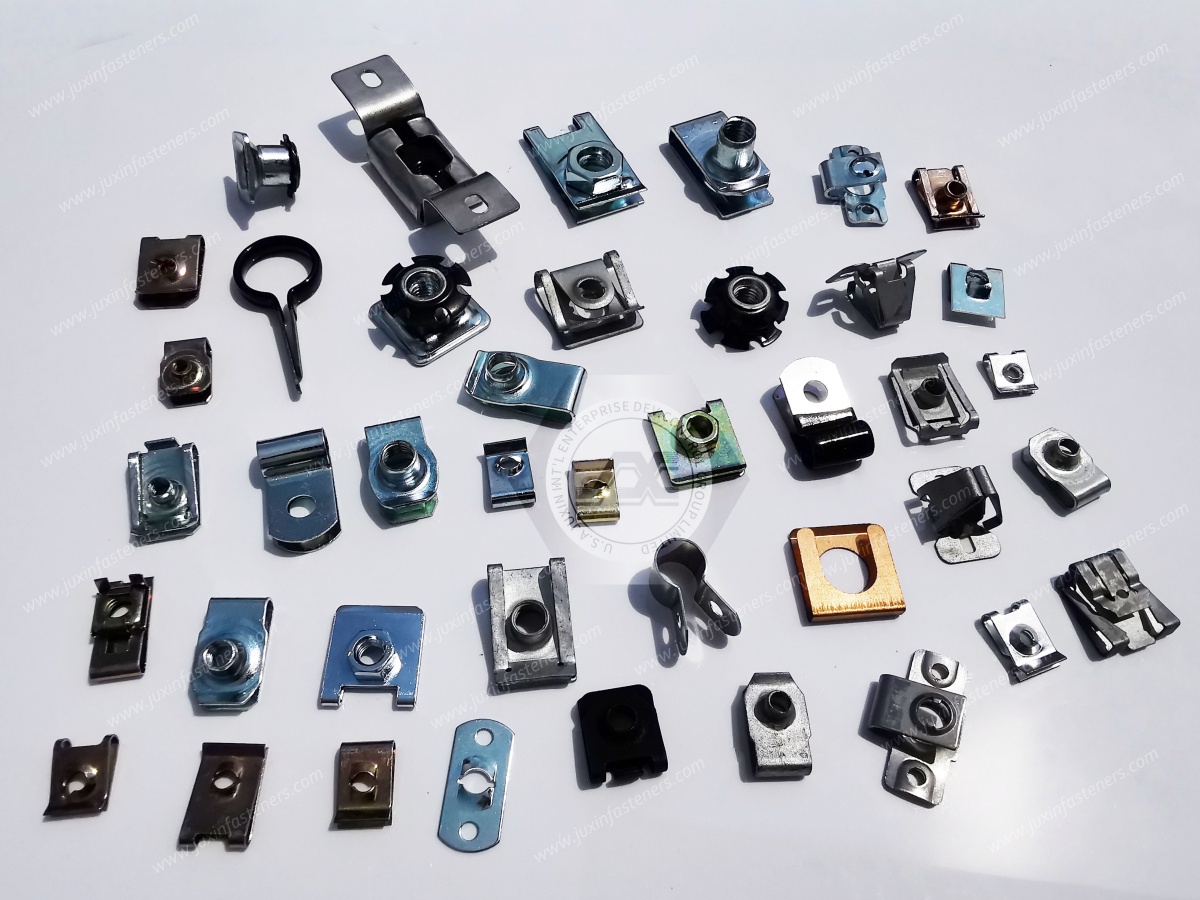
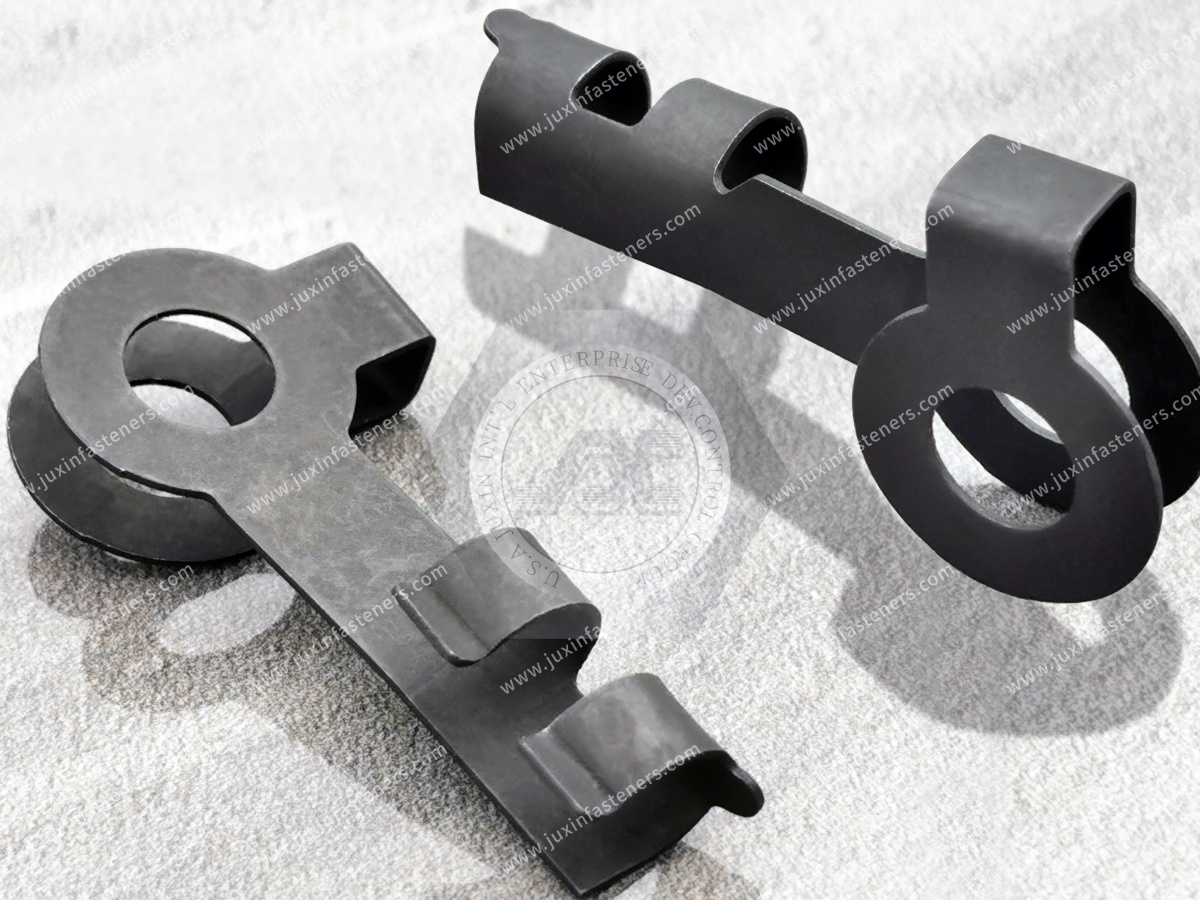
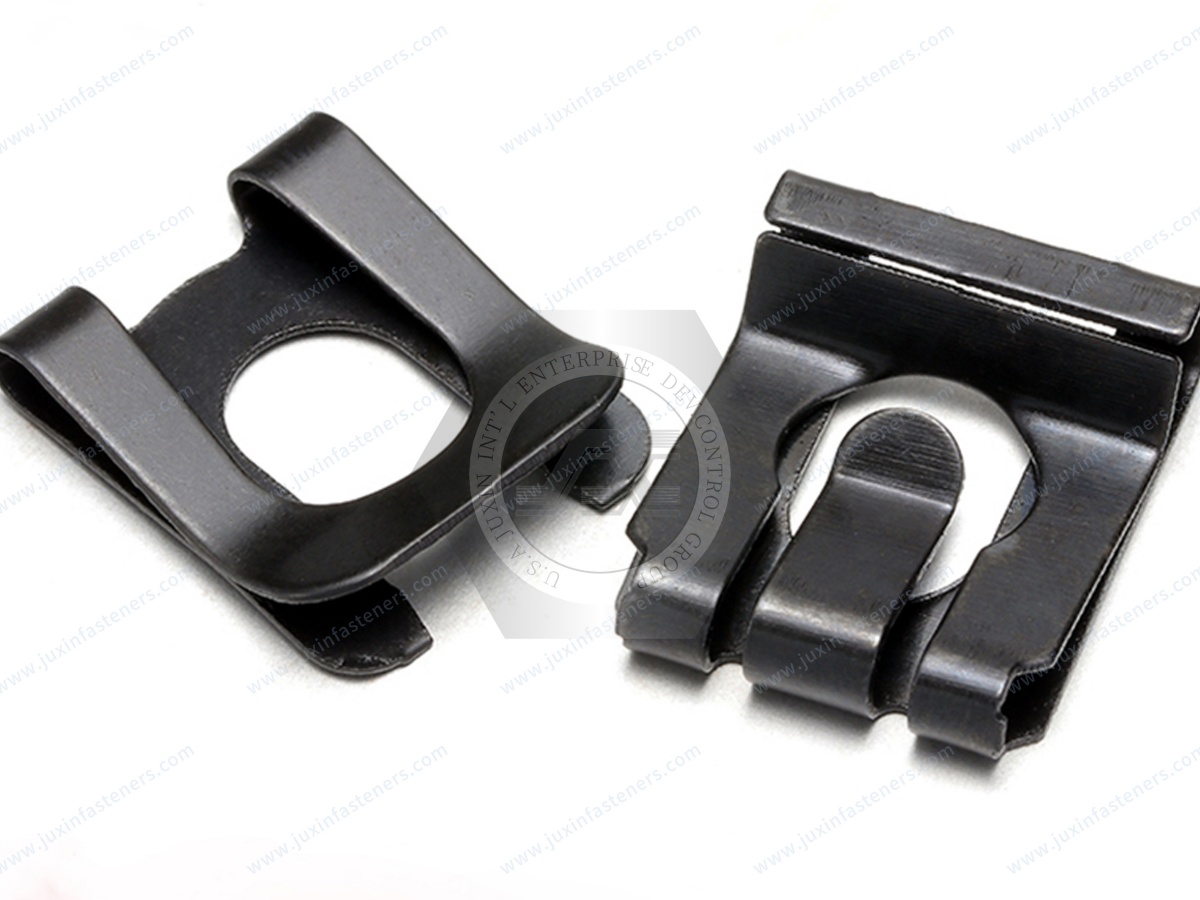
A clip-on enclosed hex nut is an edge-mounted fastening component that combines a spring-clip structure with a captive hex-nut-style threaded element.
The spring portion interfaces with the sheet-metal edge.
The captive nut portion provides the threaded connection for the mating screw.
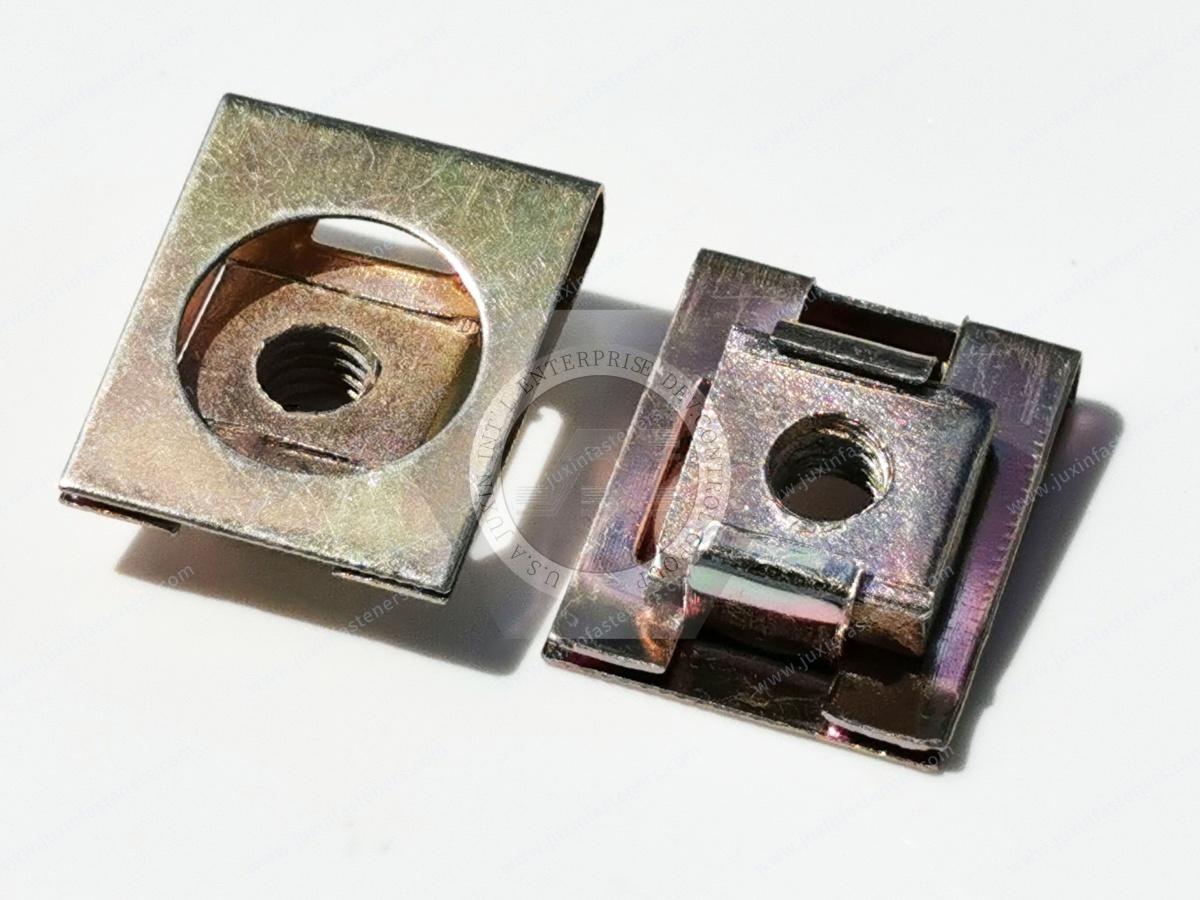
Depending on the specific design, the nut may be retained within a formed cage or related enclosure geometry that keeps the threaded component associated with the clip during handling and assembly.
This architecture can eliminate the need for an assembler to manually position and hold a separate loose nut behind the sheet metal while starting the screw.
However, the exact internal construction varies by product.
Engineers should therefore confirm the actual drawing rather than assuming that every commercial product described as an “enclosed hex clip nut,”
“captive hex spring nut,” or “hex nut cage clip” has the same geometry or functional characteristics.
Consider a conventional sheet-metal assembly using a loose hex nut.
One operator inserts the screw from the front.
The nut must be positioned behind the panel.
A wrench or other tool may then be required to prevent the nut from rotating during tightening.
This process is practical when both sides of the assembly are accessible.
It becomes much more difficult when the backside is obstructed by:
an enclosure wall;
electrical components;
internal brackets;
cable routing;
insulation;
equipment modules;
another panel;
limited hand or tool clearance.
A captive clip-on nut changes the assembly sequence.
The fastener can first be installed at the panel edge. The threaded element is then positioned for the later screw-installation operation.
This separates nut positioning from final screw tightening and can simplify assembly where loose-nut handling would otherwise be difficult.
The functional behavior of an enclosed hex clip nut can be divided into several separate engineering tasks.
Understanding these tasks helps prevent engineers from attributing every performance characteristic to the spring cage itself.
The clip structure positions the threaded component relative to the sheet-metal edge.
Its purpose is to keep the fastener associated with the panel before the screw is installed.
Correct positioning depends on:
panel thickness;
clip geometry;
edge geometry;
hole setback;
throat depth;
installation direction;
surrounding clearance.
If these conditions do not match the fastener, the nut may not align correctly with the mating screw.
Once the mating screw engages the captive nut, the threaded connection becomes part of the completed joint.
Thread engagement, screw strength, nut material, tightening process and joint geometry then become important.
This function should not be confused with the spring clip's pre-assembly retention function.
The formed structure surrounding the nut can help retain the threaded element within the clip assembly.
Depending on the design, it may also influence:
available nut movement;
angular accommodation;
lateral alignment;
screw-tip clearance;
surrounding component clearance.
The actual behavior must be determined from the specific fastener geometry.
This is an important engineering question because the answer is:
Not automatically.
A visually enclosed or closed-bottom fastener should not automatically be treated as a calibrated screw stop.
If a particular product is specifically designed with a closed base that provides physical screw-tip containment, that feature may help control where the screw can protrude.
However, engineers must verify:
available internal depth;
screw length;
required thread engagement;
screw-tip geometry;
dimensional tolerances;
whether the base is actually designed to accept screw-tip contact;
whether bottoming could introduce undesirable loading into the fastener.
A screw that is too long can create an entirely different problem if it bottoms against a surface before the intended joint clamp condition is achieved.
Therefore:
Screw-length control should be treated as an engineering specification, not delegated automatically to the enclosed cage.
Electrical cabinets and compact equipment enclosures often contain components close to the backside of a fastening location.
These can include:
wiring;
cable bundles;
electronic modules;
terminal components;
insulation;
covers;
moving mechanisms;
adjacent brackets.
In such assemblies, screw protrusion should be checked during design.
Engineers should determine the maximum permissible screw extension beyond the threaded engagement zone and compare it with:
panel stack thickness;
nut depth;
required engagement;
screw length tolerance;
component clearance.
This creates a useful design rule:
Do not use an enclosed nut as a substitute for correct screw-length selection.
The fastener and screw should be specified together.
One of the strongest reasons to evaluate a clip-on enclosed hex nut is restricted backside access.
Once enclosure walls, internal barriers or equipment modules are installed, reaching behind a panel with a wrench may become impractical.
A captive fastener can reduce the need to coordinate a loose nut and screw from opposite sides of the assembly.
However, “restricted backside access” should not be confused with true blind installation in every case.
The clip itself still requires an accessible panel edge and an installation path.
If the edge cannot be reached during manufacturing, a clip-on fastener may not be suitable.
In such cases, engineers may need to evaluate another fastening method.
This is a critical distinction that is often overlooked.
A clip-on nut can eliminate the need to hold a loose nut from the backside, but the clip must still be installed from an accessible edge.
The engineer should therefore ask two separate questions:
Can I reach the backside of the joint?
and
Can I reach the panel edge to install the clip?
If backside access is unavailable but edge access exists, a clip-on enclosed hex nut may be a practical candidate.
If neither backside nor panel-edge access exists, another fastening architecture may be required.
This is one reason why clip-on nuts, blind rivet nuts, self-clinching nuts and weld nuts should not be treated as interchangeable technologies.
It is essential to separate clip retention from joint strength.
Clip retention describes how the spring clip remains positioned on the sheet-metal edge before and during assembly.
Joint strength describes the behavior of the completed screw-fastener-panel system under service loading.
The spring cage can help locate the captive nut, but the completed joint depends on factors including:
mating screw specification;
nut thread;
thread engagement;
nut material;
panel material;
panel thickness;
bearing area;
joint stack;
tightening process;
clamp load;
tensile loading;
shear loading;
vibration or cyclic loading;
environmental exposure.
The term Strong-Grip should therefore not be interpreted as a universal high-load, structural, vibration-proof, fatigue-resistant or high-torque performance rating.
Product-specific performance requirements should be validated against the actual assembly.
A captive hex-nut-style configuration may provide a different threaded architecture from a thin stamped or formed spring-thread design.
That does not mean every enclosed hex clip nut automatically supports a higher tightening torque.
Permissible tightening conditions depend on the complete system, including:
screw material and property class;
nut material;
thread dimensions;
thread engagement;
lubrication or coating;
panel support;
cage geometry;
installation method;
required clamp load.
For OEM applications, procurement teams should not request simply a “high-torque clip nut.”
Instead, provide the actual screw specification and intended tightening requirement so that the fastener can be evaluated in context.
One reason engineers may investigate a captive hex-nut configuration is the threaded element itself.
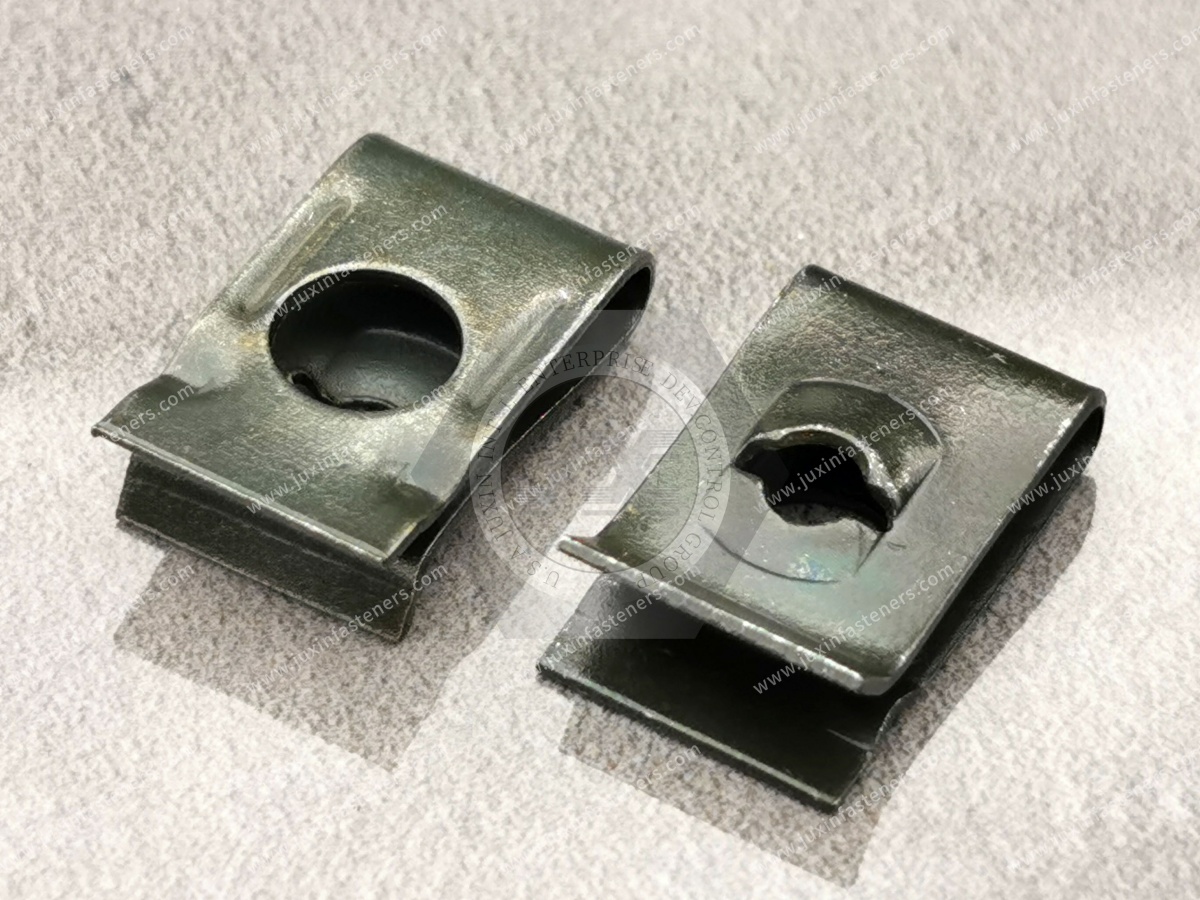
A separate nut-style component may provide a different engagement geometry from a formed sheet-metal thread.
However, the actual amount of thread engagement depends on the nut thickness and thread design.
It should not be assumed from the words “hex nut.”
Design engineers should verify:
thread designation;
thread pitch;
nut thickness;
screw engagement length;
screw length;
required assembly condition.
There is no universal number of engaged threads that should be applied to every clip-on enclosed hex nut application.
The cage or enclosure around a captive nut may help restrain the nut during screw tightening.
However, the ability of the assembly to react tightening torque depends on the actual interface between:
the nut;
the cage;
the clip;
the panel.
It should therefore not be stated that every enclosed hex clip nut “eliminates nut rotation” under all tightening conditions.
The relevant design questions are:
How is the nut captured?
How is torque reacted?
What prevents excessive movement?
Does the nut have controlled float?
What happens during tightening?
What panel condition supports the clip?
For applications with defined torque requirements, these questions should be evaluated from the product drawing and assembly validation.
Not every captive nut needs to be completely rigid inside its cage.
Some captive-nut designs intentionally permit limited movement to help accommodate manufacturing tolerances between the panel hole and mating component.
Where such movement exists, engineers should distinguish between:
controlled alignment movement
and
unwanted looseness.
The permitted movement, if any, should be defined by the actual product geometry.
JUXIN FASTENERS should confirm the relevant configuration from the requested drawing or sample rather than assuming all enclosed hex clip nuts are rigid or floating designs.
Even though the fastener contains a captive threaded element, the clip still interfaces with the sheet-metal edge.
Panel thickness therefore remains critical.
If the sheet is outside the intended fit condition, possible problems can include:
incomplete seating;
incorrect thread alignment;
clip displacement;
installation difficulty;
interference with surrounding features.
The RFQ should specify:
nominal panel thickness;
thickness tolerance where critical;
panel material;
coating or paint condition where relevant;
whether the clip engages a single sheet or folded edge.
The product should be selected for the actual panel interface.
The distance from the panel edge to the fastening hole must correspond to the reach of the enclosed hex clip nut.
A fastener can have the correct thread and still be unusable if its captive nut does not align with the panel hole.
Engineers should therefore provide:
hole diameter;
edge-to-hole-center distance;
throat or reach requirement;
nearby bend locations;
surrounding clearance.
This follows the same geometry-first principle discussed in the JUXIN FASTENERS guide
U-Nuts vs J-Nuts: Geometric Selection for Edge-Mounted Sheet Metal at /solutions/u-nuts-vs-j-nuts-geometry.
Clip-on enclosed hex nuts can involve more than one functional material requirement.
The spring clip portion must perform its intended panel-retention function.
The captive threaded element must provide the specified threaded interface.
Depending on the design, these components may have different material or manufacturing requirements.
JUXIN FASTENERS should confirm the actual material specification for the requested product.
Generic terms such as “carbon steel” or “spring steel” should not be used to infer:
hardness;
tensile strength;
fatigue resistance;
vibration resistance;
heat-treatment condition;
torque capacity.
Where a customer requires a specific material grade, it should be included in the drawing or RFQ.
Surface finish should be selected according to the actual service environment and customer requirements.
Depending on product and project specifications, carbon-steel clip-on fasteners may use zinc-based coatings, phosphate-based finishes or other surface treatments.
Engineers and procurement teams should consider:
indoor or outdoor service;
humidity;
condensation;
chemical exposure;
mating materials;
cosmetic requirements;
coating compatibility;
customer corrosion requirements.
A generic finish should not be assumed to provide a specific salt-spray duration or service life.
Where corrosion testing is required, the test method and acceptance criteria should be specified.
Global OEM programs may use metric or inch fastener systems.
For an enclosed hex clip nut, specifying only “metric” or “inch” is insufficient.
The engineering requirement should include:
thread designation;
pitch where applicable;
mating screw;
screw length;
panel thickness;
hole setback;
clip geometry;
material;
finish.
Specific thread and size availability should be confirmed for the required JUXIN FASTENERS product configuration.
Do not assume that every enclosed hex clip nut geometry is available across every metric or unified inch thread.
Electrical cabinets and switchgear are strong potential applications for captive edge-mounted threaded fasteners because enclosure construction frequently limits access behind panels.
Potential attachment locations can include:
enclosure frames;
cabinet brackets;
access panels;
internal equipment supports;
control enclosure structures;
removable covers;
selected barrier-panel attachments.
The key engineering advantages are related to assembly accessibility and captive hardware.
For each location, engineers should evaluate:
edge accessibility;
panel thickness;
hole setback;
screw length;
internal component clearance;
service requirements;
corrosion environment.
Clip-on enclosed hex nuts should not automatically be treated as electrical grounding, bonding or busbar fasteners.
Those functions require separate electrical and mechanical design validation.
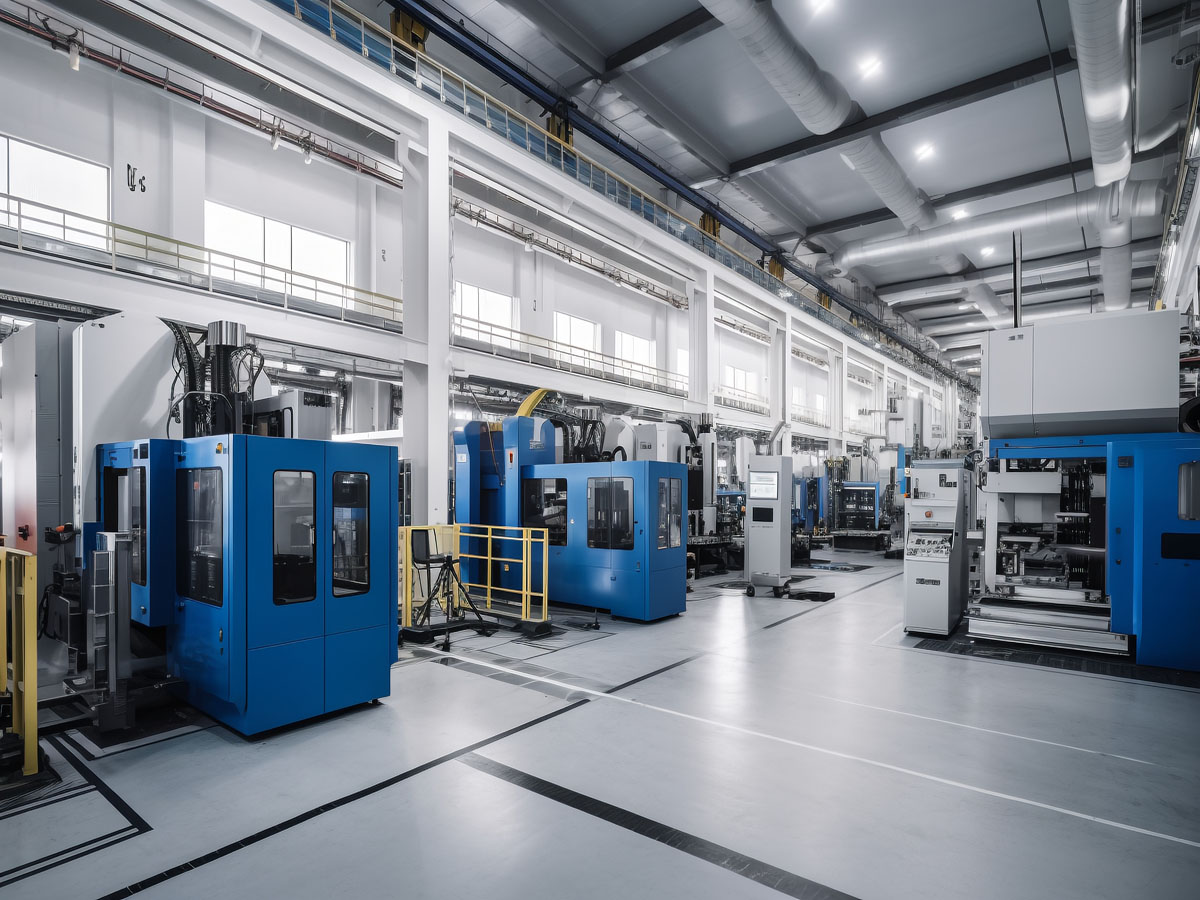
Industrial machinery frequently uses sheet-metal guards, covers, control boxes and maintenance panels.
A captive hex clip nut can be considered where a conventional loose nut would be difficult to hold during assembly or service.
Potential applications include:
machine control enclosures;
equipment covers;
access panels;
maintenance doors;
internal mounting brackets;
selected guard attachments.
For safety-related guards or load-sensitive assemblies, the fastening system must satisfy the machine designer's specific requirements.
The product name alone does not establish structural or safety-critical suitability.
Rail equipment may contain electrical, communication and service cabinets built from fabricated sheet metal.
Captive fasteners can be useful where maintenance access and hardware control are important.
Possible applications include suitable:
equipment cabinets;
communication enclosures;
interior service panels;
access covers;
internal brackets.
Rail applications can involve vibration, shock, corrosion and lifecycle requirements.
Those conditions must be defined and validated for the actual joint.
A clip-on enclosed hex nut should not automatically be described as rail-qualified, vibration-proof or cyclically validated without product-specific evidence.
Air-handling equipment, fan housings, control enclosures and other HVAC assemblies frequently use removable sheet-metal covers.
Clip-on captive nuts may be evaluated for suitable edge-accessible locations where service personnel need to remove and reinstall panels.
Important considerations include:
panel thickness;
folded-edge geometry;
corrosion exposure;
screw accessibility;
internal clearance;
maintenance frequency.
The fastener itself should not be assumed to provide air sealing, waterproofing or vibration isolation.
Compact automation equipment often places electronics, controllers, sensors and wiring inside sheet-metal enclosures with limited internal space.
In these designs, the captive-nut concept can reduce the need to reach behind a panel with a loose nut.
Potential applications include:
controller cabinets;
automation equipment housings;
sensor enclosures;
removable covers;
internal mounting brackets;
service panels.
The designer should pay particular attention to screw protrusion because sensitive equipment may be located close to the fastening point.
A standard U-nut can be an efficient solution when its thread or screw interface, panel fit and joint requirements suit the application.
An enclosed hex clip nut may deserve consideration when:
a captive nut-style threaded element is preferred;
loose-nut handling is impractical;
backside wrench access is limited;
the assembly requires a defined machine-threaded interface;
serviceability favors captive hardware;
the available panel edge permits clip installation.
The final choice should be made from the actual joint requirements rather than assuming one design is universally stronger.
Barrel clip nuts represent another clip-on fastening architecture.
The correct choice depends on the actual product geometry and assembly requirement.
For barrel-style designs, engineers should evaluate:
panel fit;
barrel geometry;
thread engagement;
hole position;
installation access;
serviceability.
JUXIN FASTENERS provides additional engineering guidance in Strong-Grip Clip-On Barrel Nuts: U-Nuts,
Multi-Thread Engagement & Panel Fastening Solutions at /solutions/strong-grip-clip-on-barrel-nuts-u-nuts.
Neither product family should automatically be treated as stronger than the other without application-specific evaluation.
A blind rivet nut is installed through a prepared hole and mechanically deforms to create a captive threaded attachment.
An enclosed hex clip nut is installed from a panel edge.
This creates a fundamental selection difference.
Choose the architecture based partly on access:
Edge accessible: a clip-on solution may be considered.
Edge inaccessible but installation hole accessible from one side: a blind rivet nut may be more appropriate.
These technologies are not equivalent and should not be substituted solely because they provide internal threads.
Self-clinching nuts are mechanically installed into suitable sheet material and become permanently retained in the panel.
Clip-on enclosed hex nuts are edge-installed and can support different manufacturing and service strategies.
Self-clinching may be preferred where:
permanent captive installation is required;
the panel material and thickness are suitable;
installation equipment is available;
the fastening location is not accessible from an edge.
Clip-on nuts may be attractive where:
edge installation is available;
no press installation is desired;
service or replacement considerations favor a clip-on component.
The correct selection depends on the complete manufacturing process and joint design.
Weld nuts create permanent threaded attachment through a welding process.
They may be appropriate when the parent material, production process and joint requirements support welding.
Clip-on enclosed hex nuts avoid a welding operation but require an accessible edge and suitable panel geometry.
For OEM sourcing, the decision should consider:
production volume;
panel material;
coating sequence;
equipment investment;
installation access;
serviceability;
load requirements;
environmental requirements.
One of the most useful design practices for enclosed captive nuts is to treat the mating screw and clip nut as a system.
Before releasing the fastener specification, engineers should define:
screw diameter;
thread pitch;
screw length;
screw-tip style where relevant;
property class or material where required;
coating;
installation torque requirement;
joint stack thickness;
required thread engagement;
allowable backside protrusion.
This prevents a common situation in which the correct captive nut is selected but an inappropriate screw length creates interference inside the enclosure.
A reliable selection process can begin with the assembly rather than the catalog.
Record:
panel material;
nominal thickness;
thickness tolerance;
edge condition;
coating or paint condition.
Measure:
hole diameter;
hole setback;
available throat depth;
nearby bends;
internal clearance.
Determine:
whether the backside is accessible;
whether the panel edge is accessible;
installation direction;
assembly sequence.
Specify:
metric or inch thread system;
thread designation;
pitch where applicable;
screw length;
required tightening condition.
Confirm that the screw, captive nut and surrounding components can coexist through the full tolerance range.
Determine whether the panel must be removable and whether captive hardware is advantageous during maintenance.
Where mechanical, vibration, environmental or safety requirements are significant, validate the actual assembled joint rather than relying on generic product terminology.
For supplier development and cost-reduction projects, an alternative enclosed hex clip nut should not be approved solely because it has the same thread.
Procurement and engineering should compare:
clip geometry;
nut geometry;
panel fit;
hole setback;
throat depth;
screw engagement;
cage construction;
available nut movement;
installation direction;
material;
finish;
surrounding clearance;
screw protrusion;
drawing revision;
inspection requirements.
A small dimensional difference can create an assembly problem even when both fasteners accept the same screw.
When transitioning from prototype evaluation to production sourcing, procurement teams should provide enough information to evaluate both the clip and the completed threaded interface.
When submitting an RFQ to JUXIN FASTENERS at info@juxinfasteners.com, include where applicable:
2D drawing;
3D CAD model if available;
existing sample or reference photo;
customer part number;
required enclosed hex clip nut geometry;
metric or inch requirement;
thread size;
thread pitch;
mating screw specification;
screw length;
intended tightening requirement;
panel material;
nominal panel thickness;
panel thickness tolerance;
hole diameter;
hole setback;
flange or edge geometry;
available installation direction;
internal clearance envelope;
material requirement;
surface treatment;
corrosion or environmental requirement;
application description;
manual or automated assembly process;
prototype/sample quantity;
estimated production quantity;
annual demand;
packaging requirements;
inspection requirements;
customer-specific specifications.
For an existing application, a drawing or physical sample is especially useful because commercial terms such as “enclosed hex clip nut,” “captive spring nut” and “hex nut cage clip” do not define every critical dimension.
The strongest sourcing path for an enclosed hex clip nut is:
Assembly Constraint → Panel Geometry → Access Analysis → Thread and Screw Definition → Captive Nut Geometry → Prototype Evaluation → Joint Validation → Production Specification → RFQ → Repeat Supply
This approach gives design engineers a more reliable way to solve restricted-access fastening problems while giving procurement and supplier-development teams a clearly defined component to source.
For custom or drawing-based Strong-Grip Clip-On Enclosed Hex Nuts, captive clip nuts and related spring fastener requirements, contact JUXIN FASTENERS at info@juxinfasteners.com.
Providing the panel drawing, mating screw specification and available assembly envelope allows JUXIN FASTENERS to evaluate the requested fastening configuration more effectively than specifying thread size alone.
Product Packaging
Packaging Standard
At Juxin Fasteners, we apply standardized export packaging to ensure product protection, traceability, and compliance with international logistics requirements.
1. Standard Export Packaging
Unless otherwise specified, all products will be packed according to our factory standard export packaging, which includes:
Moisture-resistant inner protection
Poly bag or small box packing as required
Reinforced export cartons
Clear labeling with part number, specification, batch number, and quantity
Palletizing for sea or air shipment when necessary
Our standard packaging is designed to ensure safe transportation, efficient warehousing, and long-distance international shipping.
2. Customized Packaging Options
We also provide customized packaging solutions according to customer requirements, including but not limited to:
Private labeling
Customized barcodes
Specific carton dimensions
Retail packaging
Special pallet configuration
Customer-specific marking and identification
So that you know, customized packaging may involve additional costs and extended lead time depending on the complexity of the requirements.
3. Compliance & Quality Assurance
All packaging processes are controlled under our ISO 9001 quality management system to ensure consistency, traceability, and product integrity throughout the supply chain.
Product Pictures
Contact Us
Tel.:
+86 020 8621 0320
+86 020 3121 6067
E-mail:
Technical Support:
Navigation
SEND INQUIREY