Call Us
+86 136 6007 9809
Call Us
+86 136 6007 9809

Types of Automotive Weld Nuts and Their Engineering Applications: Why Hex, Square, and Flange Designs Are Not Interchangeable
Introduction: Why Automotive Weld Nuts Cannot Be Standardized into One Type
In automotive manufacturing and mechanical assembly, weld nuts are essential fasteners for creating permanent threaded connections in thin sheet metal structures. However, despite serving the same basic function, automotive weld nuts are not standardized into a single type.
Product Specification
Types of Automotive Weld Nuts and Their Engineering Applications: Why Hex, Square, and Flange Designs Are Not Interchangeable
Introduction: Why Automotive Weld Nuts Cannot Be Standardized into One Type
In automotive manufacturing and mechanical assembly, weld nuts are essential fasteners for creating permanent threaded connections in thin sheet metal structures. However, despite serving the same basic function, automotive weld nuts are not standardized into a single type.
This is because different vehicle systems operate under vastly different mechanical conditions, including:
Vibration intensity
Load-bearing requirements
Heat exposure
Sheet metal thickness
Welding accessibility
Automation constraints
As a result, engineers must select different structural designs to ensure performance reliability.
The main categories include:
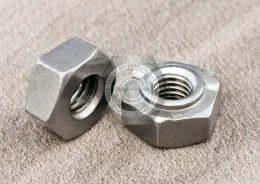
Hex weld nuts (thin-sheet body applications)
Square weld nuts (heavy-load structures)
Flange weld nuts (high-vibration and high-stress environments)
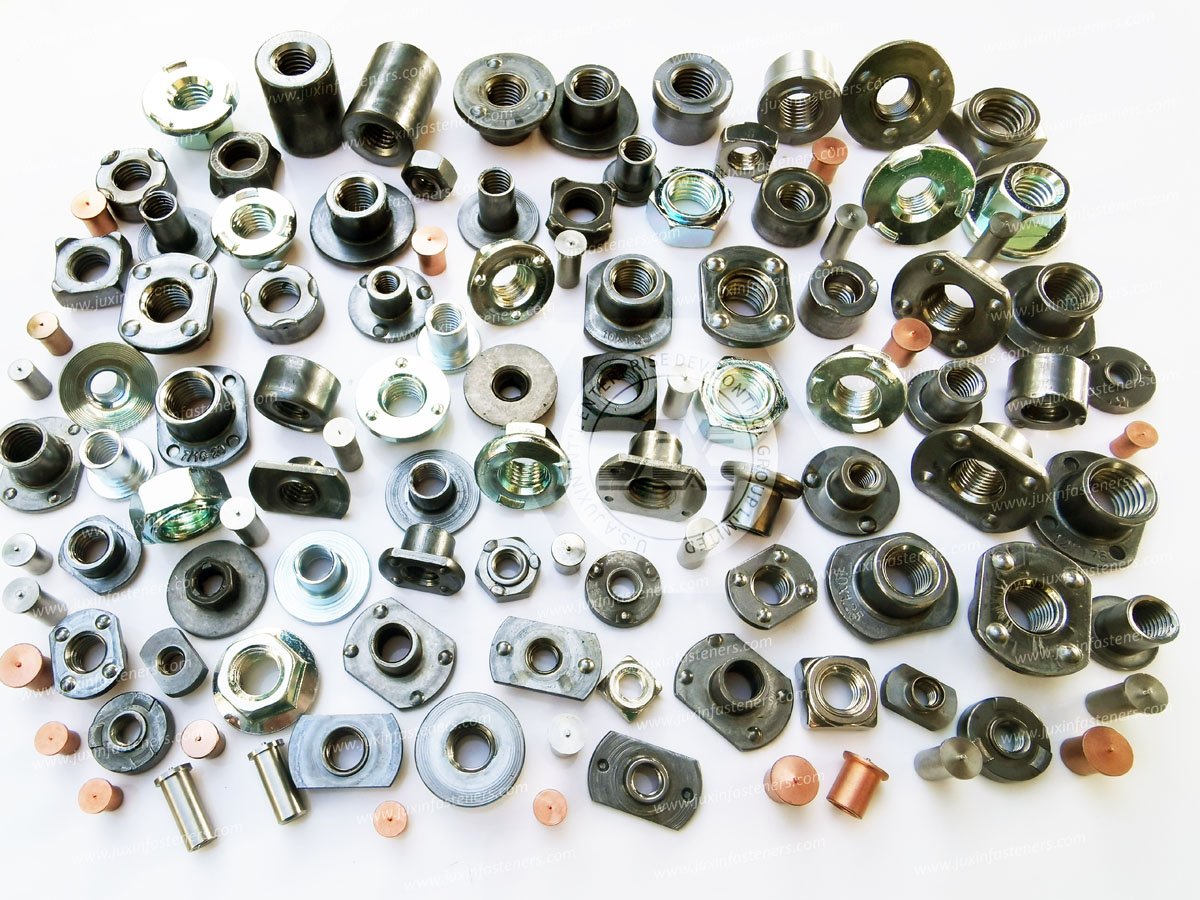
At Juxin Fasteners, we provide a full range of automotive weld nut solutions from M3 to M16, ensuring each connection point is engineered for its specific working conditions.
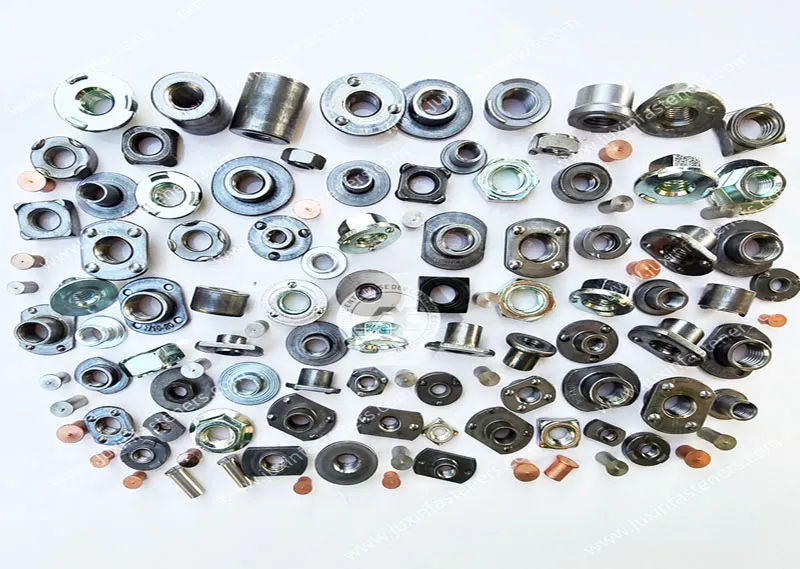
Hex Weld Nuts: The Standard Solution for Thin Sheet Automotive Structures
Among all fastening types, hex weld nuts are the most widely used in automotive applications for body-in-white (BIW) structures due to their efficiency and compatibility with thin sheet metal.
Structural Characteristics of Hex Weld Nuts
A hex weld nut typically features:
Three welding projections
Centering the boss for positioning
Hexagonal nut body for torque application
Resistance spot welding compatibility
The three-projection design ensures:
Uniform current distribution
Reduced heat-affected zone (HAZ)
Protection of internal threads from deformation
High precision welding results
Automotive Applications of Hex Weld Nuts
In automotive manufacturing, hex weld nuts are commonly used in:
Interior door panel assemblies
Window regulator systems
Seat frame structures
Thin sheet metal brackets
These applications require fast installation, precise positioning, and high compatibility with automated production lines.
The hex weld nut automotive solution is ideal for thin-gauge sheet metal where space is limited and welding efficiency is critical.
Square Weld Nuts: Heavy-Load Structural Fastening Solution
Square weld nuts for automotive applications are specifically designed for high-load and high-shear environments where structural strength is the primary requirement.
Structural Characteristics of Square Weld Nuts
Square weld nuts are typically manufactured according to DIN 928 standards and feature:
Four welding corners acting as projection points
Square geometry for anti-rotation performance
High-strength material construction
Plug welding compatibility through sheet metal holes
Unlike hex weld nuts, the welding force in square weld nuts is distributed across four corners, significantly increasing load-bearing capacity.
In larger sizes (M8 and above), projection height is increased to:
Improve current concentration
Enhance weld nugget formation
Support high-current welding processes
Automotive Applications of Square Weld Nuts
The square weld nut automotive system is widely used in:
Subframe structures
Chassis main beams
Suspension control arms
Heavy structural brackets
These are high-stress components that require maximum tensile and shear resistance.
Because of their strength-oriented design, square weld nuts are not interchangeable with hex or flange types in critical structural zones.
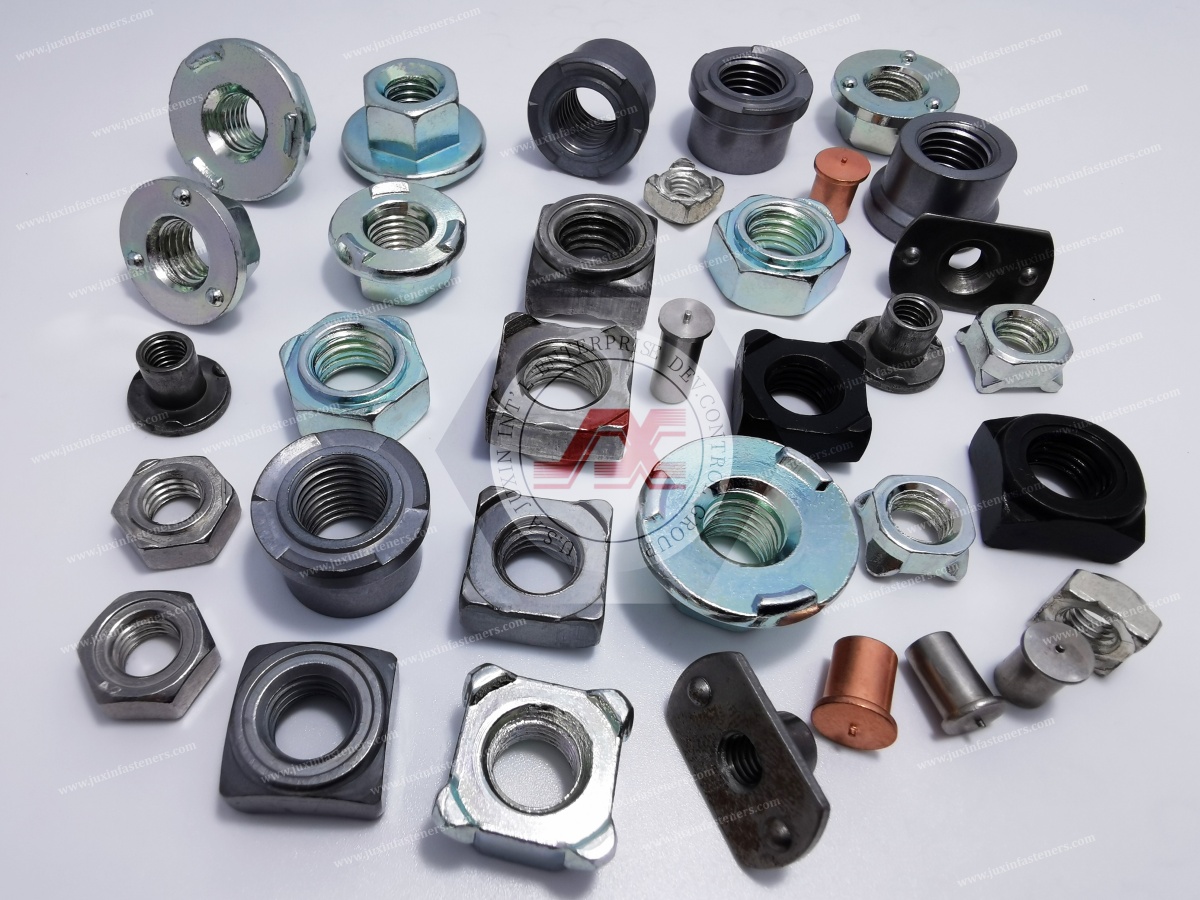
Flange Weld Nuts: Advanced Solution for High-Vibration Automotive Environments
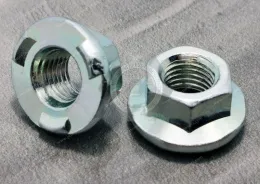
Flange-weld nuts for automotive applications are an enhanced design variant of hex weld nuts, optimized for vibration resistance and load distribution.
Structural Characteristics of Flange Weld Nuts
Flange weld nuts feature:
Enlarged flange base for increased contact area
Improved load distribution
Enhanced anti-loosening performance
Two main projection geometries:
Circular projections
Elongated (strip-shaped) projections
Circular Projection Flange Weld Nuts
This is the traditional design featuring:
Three circular projections
Stable and mature welding process
Reliable but standard-strength performance
Applications include:
General vibration environments
Standard automotive bracket systems
Non-critical structural connections
Elongated Projection Flange Weld Nuts
This is an upgraded high-strength design with:
Three elongated projections
Larger welding contact area
More uniform current distribution
Significantly higher tensile and shear strength
These advantages make them suitable for:
Engine mounts
Transmission connection points
Exhaust system joints
Critical safety-related assemblies
In these environments, flange-weld nuts for automotive solutions with elongated projections provide superior resistance to vibration, thermal cycling, and alternating loads.
Why Automotive Weld Nuts Are Not Interchangeable
Although hex, square, and flange weld nuts all serve to create threaded connections on sheet metal, they cannot be used interchangeably due to fundamental engineering differences.
1. Structural Load Requirements
Hex weld nuts → thin sheet, low-to-medium load
Square weld nuts → heavy load, high shear resistance
Flange weld nuts → vibration and fatigue resistance
2. Welding Process Compatibility
Hex weld nuts require boss positioning for thin sheet protection
Square weld nuts require higher energy input and stronger weld nuggets
Flange weld nuts require controlled current distribution for flange stability
3. Application Environment Differences
Interior trim → hex weld nuts
Chassis frame → square weld nuts
Engine and exhaust systems → flange weld nuts
4. Safety and Engineering Standards
Certain automotive areas require mandatory fastener types:
Thin sheet metal enclosures → hex weld nuts with locating boss
Chassis frame rails →square weld nuts for maximum strength
High-vibration zones → flange weld nuts with optimized projection design
Even within flange weld nuts, circular and elongated projection types are selected based on specific load conditions.
Engineering Selection Philosophy: “Right Nut for the Right Load”
Modern automotive engineering follows a strict principle:
Each weld nut must be matched to its mechanical environment.
At Juxin Fasteners, our automotive weld nut portfolio (M3–M16) is designed to ensure:
Optimal structural matching
Maximum welding efficiency
Long-term durability under vibration
Full compatibility with robotic welding systems
Conclusion: Complete Automotive Weld Nut System for Modern Manufacturing
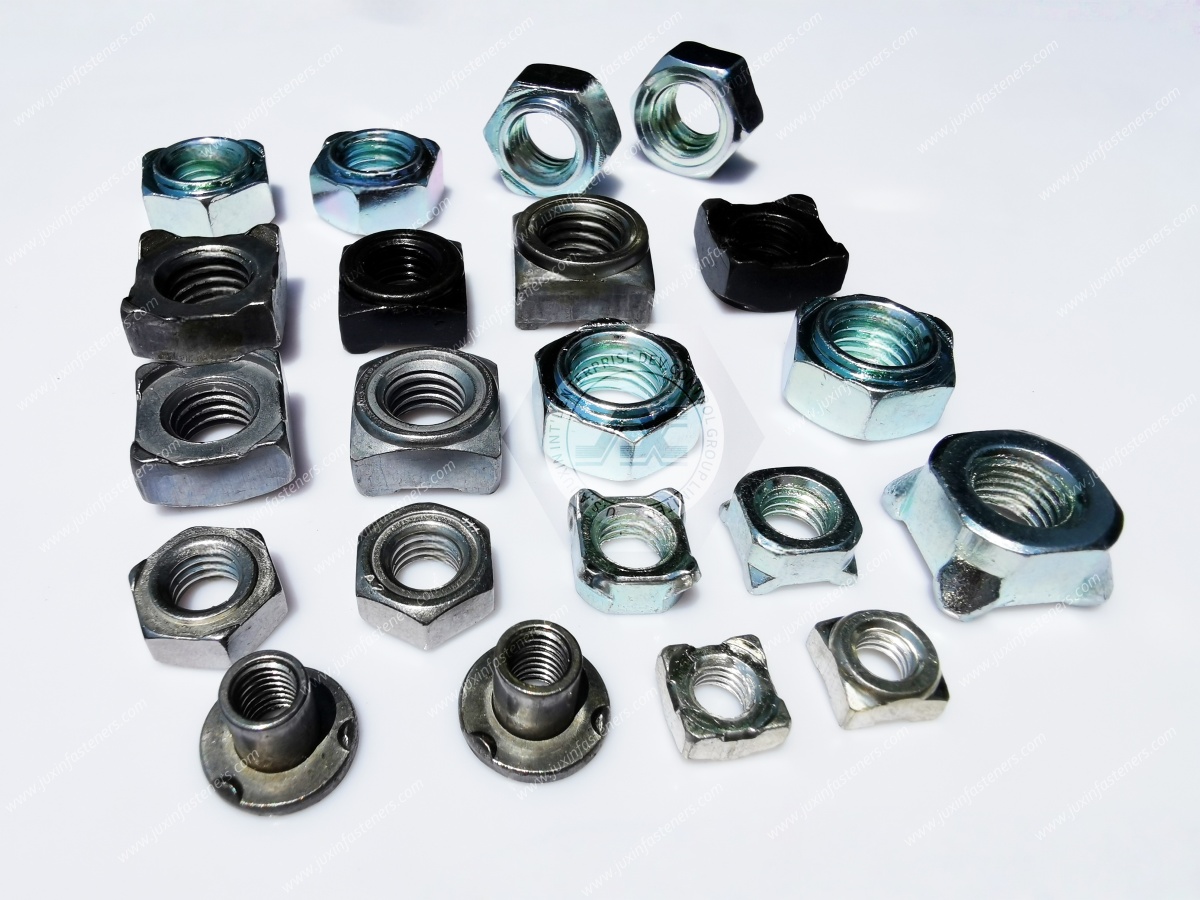
The classification of automotive weld nuts into hex, square, and flange types is not arbitrary—engineering requirements, welding physics, and structural performance needs drive it.
A complete fastening system requires:
Hex weld nuts for thin sheet metal precision assembly
Square weld nuts for heavy-duty structural support
Flange weld nuts for vibration and fatigue resistance
Together, these automotive weld nut solutions ensure that every connection point in a vehicle is optimized for its exact operating condition.
At Juxin Fasteners, we provide a full spectrum of automotive weld nuts from M3 to M16, supporting OEM manufacturers with reliable, high-performance fastening solutions for body, chassis, and powertrain systems worldwide.
Product Packaging
Packaging Standard
At Juxin Fasteners, we apply standardized export packaging to ensure product protection, traceability, and compliance with international logistics requirements.
1. Standard Export Packaging
Unless otherwise specified, all products will be packed according to our factory standard export packaging, which includes:
Moisture-resistant inner protection
Poly bag or small box packing as required
Reinforced export cartons
Clear labeling with part number, specification, batch number, and quantity
Palletizing for sea or air shipment when necessary
Our standard packaging is designed to ensure safe transportation, efficient warehousing, and long-distance international shipping.
2. Customized Packaging Options
We also provide customized packaging solutions according to customer requirements, including but not limited to:
Private labeling
Customized barcodes
Specific carton dimensions
Retail packaging
Special pallet configuration
Customer-specific marking and identification
So that you know, customized packaging may involve additional costs and extended lead time depending on the complexity of the requirements.
3. Compliance & Quality Assurance
All packaging processes are controlled under our ISO 9001 quality management system to ensure consistency, traceability, and product integrity throughout the supply chain.
Product Pictures
Contact Us
Tel.:
+86 020 8621 0320
+86 020 3121 6067
E-mail:
Technical Support:
Navigation
SEND INQUIREY