Call Us
+86 136 6007 9809
Call Us
+86 136 6007 9809

What is the ideal sheet metal thickness for welding fasteners?
There is no single universal sheet metal thickness that is ideal for every resistance-welded nut or stud.
Product Specification
What is the ideal sheet metal thickness for welding fasteners?
There is no single universal sheet metal thickness that is ideal for every resistance-welded nut or stud.
The appropriate sheet thickness depends on the fastener geometry, projection design, parent-metal material, electrical resistance,
thermal conductivity, welding current, weld time, electrode force, electrode configuration, and required joint performance.
A commonly encountered industrial sheet-metal range may include thin-gauge sheet around and below 1 mm through several millimeters and beyond,
but a fixed range such as 0.8 mm to 4.0 mm should not be treated as a universal specification for all weld fasteners.
The engineering objective is to establish a suitable thermal and mechanical balance between the weld fastener and the parent sheet.
If the sheet is too thin for the selected fastener and welding process, excessive localized heating can contribute to:
burn-through;
excessive indentation;
sheet distortion;
expulsion;
inconsistent weld formation.
If the sheet is relatively thick or has high thermal conductivity, the parent metal can act as a significant heat sink.
Depending on the fastener geometry and welding system, this may make it more difficult to achieve the required projection collapse and weld formation.
Therefore, sheet thickness should be evaluated together with the fastener projection geometry and the complete resistance-welding process, rather than selected from thickness alone.
          THERMAL BALANCE IN PROJECTION WELDING

              [ WELD FASTENER ]
                    ||||
                    ||||  ← Projection Geometry
                    ↓
        =========================
        |     PARENT SHEET       |
        |   Thermal Mass /       |
        |   Electrical Path      |
        =========================

          Current + Force + Time
                    ↓
          Controlled Weld Formation
For OEM applications, the goal is not simply to find the thinnest or thickest sheet that can physically accept a weld fastener.
The goal is to select a fastener-sheet-process combination that produces repeatable weld formation while maintaining the required structural performance and avoiding unacceptable sheet damage.
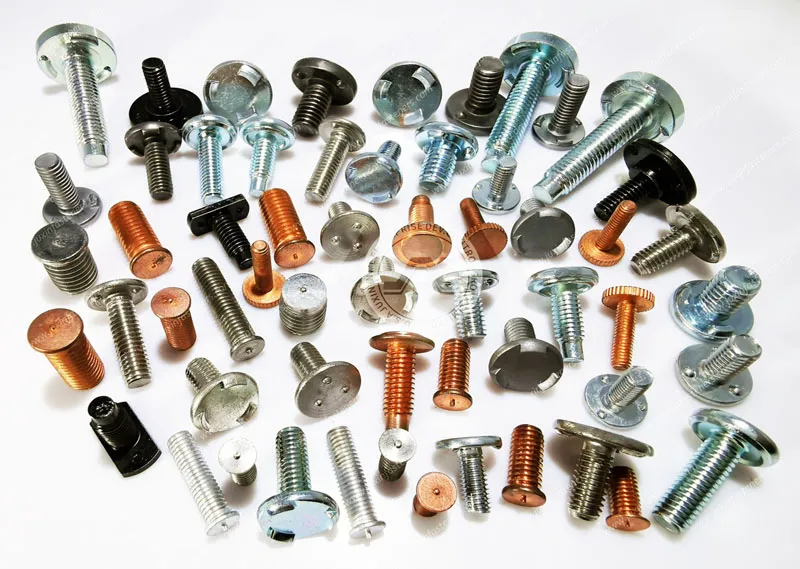
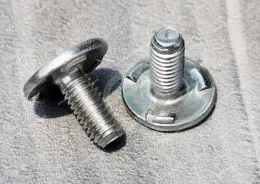
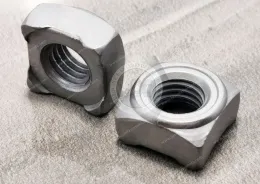
JUXIN FASTENERS provides weld nuts, weld studs, and customized weld fastener solutions for industrial applications where fastener geometry and parent-sheet conditions must be considered together during DFM and sourcing.
Sheet thickness directly influences the way electrical current and heat are distributed through a welded joint.
Resistance welding generates heat according to the relationship:
Q = I²Rt
where:
Q represents generated electrical heat;
I represents welding current;
R represents electrical resistance;
t represents the duration of current flow.
This relationship does not mean that engineers can simply increase current whenever a sheet becomes thicker.
The actual thermal response depends on the electrical and thermal properties of the fastener and substrate, contact conditions, projection geometry, electrode force, machine characteristics, and the welding schedule.
A successful process therefore requires a balance between:
Current + Resistance + Time + Mechanical Force + Material + Geometry
Sheet thickness is one part of this system.
When a parent sheet becomes very thin relative to the selected projection geometry and welding conditions, the weld area has less material available to absorb and distribute the generated heat.
Potential consequences include:
local melting beyond the intended weld zone;
burn-through;
excessive indentation;
distortion;
expulsion;
inconsistent nugget development.
The risk becomes particularly important when a relatively large weld fastener is being attached to a thin sheet.
The solution is not automatically to reduce the sheet thickness requirement or increase the welding force. The complete fastener and welding configuration should be reviewed.
Medium-gauge sheet metal is commonly used in automotive, electrical equipment, machinery, enclosures, structural assemblies, and other industrial applications.
However, even within this broad range, welding conditions can vary substantially.
Two sheets with similar thickness can behave differently if they have different:
material grades;
electrical resistivity;
thermal conductivity;
surface coatings;
hardness;
mechanical strength;
surface conditions.
Therefore, a sheet thickness specification should always be connected to the actual parent-metal material.
As sheet or plate thickness increases, the parent metal can absorb and conduct more heat away from the localized welding region.
This can influence projection heating and collapse.
For certain fastener and substrate combinations, achieving adequate weld formation may require changes to the welding schedule or fastener geometry.
However, increasing welding current or projection height should never be treated as an automatic solution.
Excessive energy can create expulsion, excessive indentation, local material damage, or other defects.
The correct process window must be established through engineering trials using the actual fastener, substrate, electrodes, and welding equipment.
Very thin sheet metal can present a difficult resistance-welding condition because the available parent-metal cross-section around the weld area may be limited.
Potential challenges include:
burn-through;
excessive indentation;
distortion;
inadequate mechanical support around the fastener;
narrow process window;
inconsistent weld formation.
For such applications, engineers may consider specially configured weld fasteners, modified projection geometry, local reinforcement, or alternative fastening technologies.
A specialized tab or locally reinforced welding area may also be considered when the surrounding sheet cannot provide sufficient thermal and mechanical capacity.
The correct solution depends on the actual application and should be validated through welding trials.
Medium sheet thicknesses can provide a practical substrate for standard projection weld nuts and studs, but there is still no universal thickness window that guarantees successful welding.
Fastener geometry must be matched to:
sheet thickness;
material;
weld projection configuration;
electrode arrangement;
welding equipment;
required joint performance.
For production applications, sample welding and destructive validation are preferable to assuming that a particular sheet thickness automatically guarantees adequate weld strength.
Heavy sheet or plate may require additional process development because of its greater thermal mass and heat dissipation characteristics.
Possible engineering considerations include:
welding schedule development;
electrode configuration;
projection geometry;
number and arrangement of projections;
heat input;
current distribution;
fixture design.
The objective is to achieve sufficient projection collapse and weld formation without introducing excessive heat into the surrounding material.
One of the most useful ways to understand sheet-thickness selection is through thermal balance.
The weld fastener and parent sheet do not necessarily have the same thermal mass, electrical resistance, or heat-transfer characteristics.
During the welding cycle, heat must be concentrated sufficiently around the intended weld locations while avoiding unnecessary heating of the surrounding panel.
          FASTENER / PROJECTION
                 ↓
        Localized Current Path
                 ↓
       ┌─────────────────┐
       │  Weld Interface │
       └─────────────────┘
                 ↓
       PARENT SHEET METAL
       Heat Distribution
       + Heat Dissipation
The fastener geometry affects how quickly the projection heats and collapses.
Factors can include:
projection size;
projection height;
fastener base geometry;
fastener material;
number of projections;
projection arrangement.
A fastener with inappropriate projection geometry can create an unstable welding condition even when the sheet thickness itself appears suitable.
The parent sheet acts as part of the electrical and thermal system.
A thicker or highly conductive substrate can remove heat from the weld region more rapidly.
A very thin substrate, on the other hand, may have insufficient material around the weld region to absorb the heat without local damage.
This is why thermal mass balance should be considered alongside mechanical load requirements.
Projection geometry is one of the most important variables when adapting a weld fastener to a particular sheet.
The projection is intentionally designed to concentrate current and mechanical force at a controlled contact area.
Its dimensions influence:
initial contact area;
current density distribution;
resistance heating;
projection collapse;
weld nugget formation;
local sheet deformation.
A projection that is appropriate for one fastener-sheet combination may not be appropriate for another.
For this reason, projection height should not be prescribed using a universal ratio without reference to the actual fastener design and welding process.
JUXIN FASTENERS can evaluate customized projection configurations according to the customer's:
fastener dimensions;
parent-sheet material;
sheet thickness;
welding equipment;
electrode configuration;
production requirements.
Burn-through occurs when localized heat causes excessive melting or penetration of the parent sheet.
It can be associated with a combination of:
excessive welding energy;
unsuitable projection geometry;
insufficient electrode force;
poor contact conditions;
inappropriate fastener-to-sheet combination;
inadequate process control.
Fastener geometry should be reviewed before simply modifying production parameters.
Potential design considerations include:
projection dimensions;
projection number;
projection arrangement;
weld base geometry;
fastener material.
The objective is to concentrate the welding energy where the joint needs it while limiting unnecessary damage to the parent sheet.
Welding current, time, and electrode force should be developed for the actual production combination.
A schedule that works for one material thickness should not automatically be transferred to another.
Process trials should examine both:
Weld formation
and
Parent-sheet condition
A visually acceptable weld can still have an unsuitable internal structure or insufficient mechanical performance.
Quality inspection should consider:
burn-through;
excessive indentation;
distortion;
expulsion;
incomplete projection collapse;
inconsistent weld formation;
parent-sheet cracking.
The acceptance criteria should be established according to the specific application, drawing requirements, customer specifications, and validated production process.
A thick substrate can create a different type of problem.
Because the parent material can conduct heat away from the weld region, the selected welding conditions may not generate the required local thermal response.
Possible symptoms include:
incomplete projection collapse;
insufficient weld formation;
inconsistent nugget development;
unstable process results.
The appropriate response should be determined through process development rather than by automatically increasing current.
Engineers should evaluate the complete system:
Fastener Geometry → Projection Design → Sheet Material → Sheet Thickness → Electrode Force → Current → Weld Time → Resulting Weld
This system-based approach is more reliable than using sheet thickness as the only process variable.
Before releasing a weld nut or weld stud design for production, engineers should review the following.
Thread specification;
fastener material;
overall dimensions;
base geometry;
projection geometry;
number and arrangement of projections.
material grade;
sheet thickness;
surface condition;
coating;
hardness;
local reinforcement;
edge distance;
surrounding geometry.
resistance welding method;
electrode configuration;
current capability;
electrode force capability;
weld time control;
squeeze and hold conditions;
electrode alignment;
fixture repeatability.
axial loading;
shear loading;
bending;
vibration;
fatigue;
temperature exposure;
corrosion environment;
required service life.
destructive pull testing;
push-out testing where relevant;
torque-out testing for threaded nuts;
cross-sectional examination;
visual inspection;
production process monitoring.
When selecting a weld fastener for sheet metal, the process can be structured as follows:
START
  ↓
Identify Parent Sheet Material
  ↓
Confirm Sheet Thickness
  ↓
Define Fastener Load Requirements
  ↓
Select Weld Nut / Weld Stud Geometry
  ↓
Review Projection Configuration
  ↓
Check Welding Equipment Capability
  ↓
Develop Welding Parameters
  ↓
Conduct Sample Welding
  ↓
Inspect Weld Formation and Sheet Condition
  ↓
Perform Application-Specific Mechanical Testing
  ↓
Validate Production Process
  ↓
PRODUCTION RELEASE
This sequence helps prevent a common sourcing mistake: selecting a fastener solely from thread size while ignoring the sheet-metal and welding conditions.
For procurement teams, sheet thickness should be included in the RFQ because it directly affects weld fastener selection and process development.
A useful OEM RFQ should provide:
fastener type;
thread size;
fastener drawing;
parent-sheet material;
parent-sheet thickness;
surface treatment or coating;
welding process;
production volume;
application;
expected loading;
inspection requirements;
applicable standards;
sample requirements.
For custom weld nuts and weld studs, providing the parent-sheet information at the quotation stage can allow the supplier to identify potential DFM issues earlier.
This is especially important when the fastener will be installed on thin stamped sheet, coated steel, stainless steel, aluminum, or other materials with different electrical and thermal characteristics.
JUXIN FASTENERS supports OEM customers with weld fastener sourcing, custom configurations, DFM discussions, and application-specific evaluation.
Weld Fasteners Solutions: JUXIN FASTENERS weld fastening solutions for industrial sheet-metal assemblies.
Projection Welding Process Optimization: Engineering considerations for welding current, electrode force, weld time, projection geometry, and process stability.
Projection Weld Nuts: Weld nuts designed for resistance welding applications.
Projection Weld Studs: Weld studs for threaded and mounting applications requiring permanent attachment to sheet metal.
Weld Fastener Selection: Engineering comparison of weld fasteners with alternative threaded fastening technologies.
Weld Fastener Failure Analysis: Root-cause analysis for weld-interface, parent-metal, and fastener failure modes.
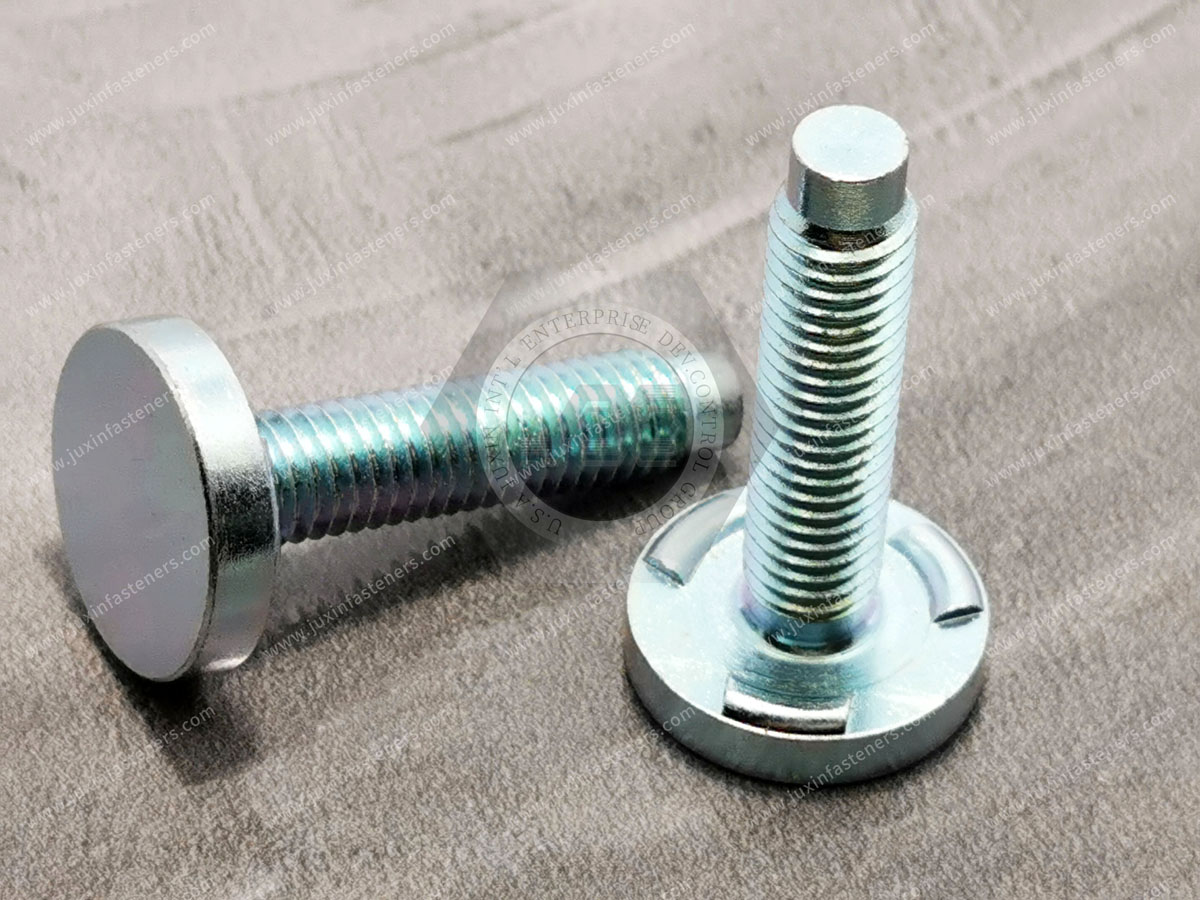
If the sheet is too thin for the selected fastener and welding process, localized heating can cause excessive indentation, expulsion, distortion,
or burn-through before a satisfactory joint is produced. The appropriate response may involve modifying the fastener projection geometry, welding process, local sheet design, or fastening technology.
The correct solution must be established for the actual material and production conditions.
No. A value such as 0.8 mm should not be treated as a universal minimum for every weld nut application.
Minimum suitable thickness depends on fastener geometry, projection design, substrate material, welding equipment, process parameters, and required joint performance.
A thick substrate can act as a heat sink and change the thermal behavior of the weld.
Depending on the material and process, this can make projection collapse and adequate weld formation more difficult.
Engineers should validate the complete fastener-sheet-welding combination rather than assuming that increasing current will solve the problem.
They can be considered for suitable stainless-steel applications, but the welding process must be developed for the actual stainless-steel grade,
sheet thickness, fastener material, surface condition, electrode configuration, and equipment. Stainless steel should not simply use the same welding schedule established for carbon steel.
Potentially, yes, but thin-sheet applications require careful evaluation of projection geometry, heat input, parent-metal capacity, and local deformation.
In some applications, reinforcement or an alternative fastening method may provide a more robust solution.
Yes. For OEM applications, providing the parent-sheet material and thickness gives the supplier critical information for evaluating fastener geometry and welding compatibility.
It also helps identify DFM issues before tooling and mass production.
Need to select a weld nut or weld stud for a specific sheet-metal thickness?
Send JUXIN FASTENERS your 2D drawing, parent-sheet material, sheet thickness, welding process, application requirements, and annual production volume.
Email: info@juxinfasteners.com
JUXIN FASTENERS provides OEM weld nuts, weld studs, custom weld fasteners, and engineering support for application-specific fastener selection, DFM evaluation, sample testing, and production sourcing.
The more complete the substrate and application information provided during the RFQ stage, the more effectively the weld fastener can be matched to the actual production process.
Product Packaging
Packaging Standard
At Juxin Fasteners, we apply standardized export packaging to ensure product protection, traceability, and compliance with international logistics requirements.
1. Standard Export Packaging
Unless otherwise specified, all products will be packed according to our factory standard export packaging, which includes:
Moisture-resistant inner protection
Poly bag or small box packing as required
Reinforced export cartons
Clear labeling with part number, specification, batch number, and quantity
Palletizing for sea or air shipment when necessary
Our standard packaging is designed to ensure safe transportation, efficient warehousing, and long-distance international shipping.
2. Customized Packaging Options
We also provide customized packaging solutions according to customer requirements, including but not limited to:
Private labeling
Customized barcodes
Specific carton dimensions
Retail packaging
Special pallet configuration
Customer-specific marking and identification
So that you know, customized packaging may involve additional costs and extended lead time depending on the complexity of the requirements.
3. Compliance & Quality Assurance
All packaging processes are controlled under our ISO 9001 quality management system to ensure consistency, traceability, and product integrity throughout the supply chain.
Product Pictures
Contact Us
Tel.:
+86 020 8621 0320
+86 020 3121 6067
E-mail:
Technical Support:
Navigation
SEND INQUIREY