
Call Us
+86 136 6007 9809
Call Us
+86 136 6007 9809

Aug. 16, 2026
Self-Clinching Nuts for Aerospace and Rail Transportation: Engineering and OEM Sourcing Guide
Aerospace and railway equipment manufacturers require fastening systems that support lightweight construction, reliable mechanical connections, efficient assembly, and long-term maintenance.
For suitable sheet metal components, self-clinching nuts provide permanent threaded attachment points without the need for conventional tapping, loose nuts, or welded connections.
Also known as press-in nuts, clinch nuts, or self-clinching threaded nuts, these fasteners are installed into prepared holes using controlled compressive force.
During installation, the surrounding sheet material flows into the fastener's retention features, creating a mechanical interlock that resists rotation and axial displacement.
This fastening method can be valuable in aircraft interior equipment, railway passenger compartments, electrical cabinets, HVAC housings, and other transportation-related sheet metal assemblies.
However, transportation applications introduce engineering considerations beyond ordinary industrial enclosure manufacturing.
Material hardness, sheet thickness, installation quality, vibration, fatigue, corrosion, maintenance requirements, and applicable qualification procedures must all be evaluated.
JUXIN FASTENERS supplies self-clinching nuts and related industrial sheet metal fastening components for suitable OEM applications.
We welcome drawing-based inquiries involving standard fastening products, alternative sourcing, and custom manufacturing requirements, subject to technical and commercial feasibility review.
This engineering guide explains how to select self-clinching nuts, evaluate installation performance, prevent common assembly failures, and prepare technically complete RFQs for aerospace-related and railway equipment projects.
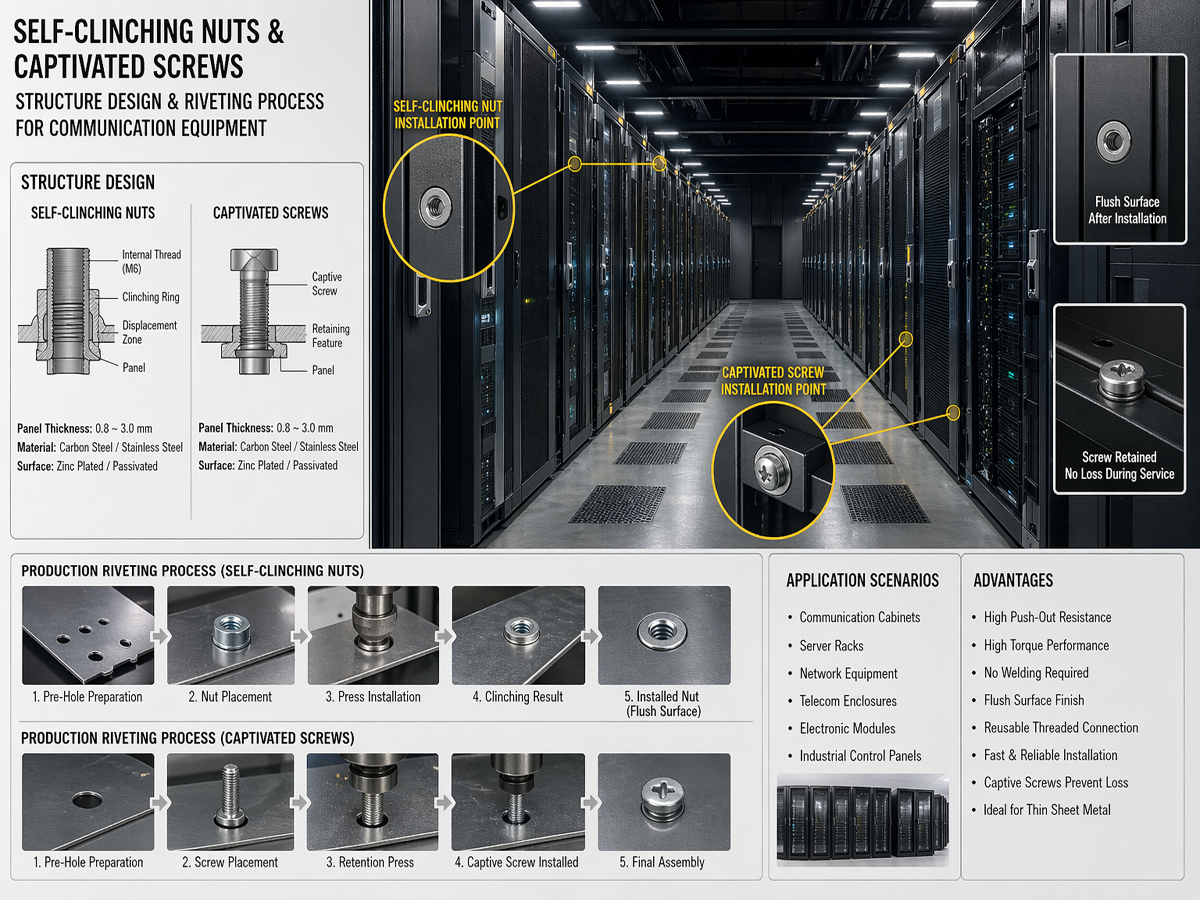
How Self-Clinching Nuts Work in Thin Sheet Metal
A self-clinching nut creates a retained threaded connection through controlled plastic deformation of a compatible sheet material.
The fastener is positioned in a prepared mounting hole and pressed into the panel using suitable tooling. Under compression, sheet material flows into the nut's undercut or other retention features.
The resulting mechanical interlock provides resistance to two important failure modes:
Axial displacement, commonly evaluated through push-out resistance.
Rotation within the panel, commonly evaluated through torque-out resistance.
The nut remains mechanically attached to the sheet after installation, allowing a mating screw to be installed during a later assembly operation.
Unlike a conventional tapped hole, the threaded engagement is provided by the nut rather than the limited thickness of the sheet.
Unlike a loose nut, the fastener does not normally need to be held separately during subsequent assembly.
Unlike a conventional rivet nut, a typical self-clinching nut relies primarily on deformation of the surrounding sheet rather than collapse of a tubular fastener body.
These distinctions affect design requirements, tooling, installation access, and long-term performance.
A self-clinching nut is not automatically suitable for every thin-sheet application. Its retention depends on the interaction between the fastener geometry, sheet material, hole dimensions, and installation process.
Why Self-Clinching Nuts Are Considered for Lightweight Transportation Equipment
Aircraft and railway equipment manufacturers often use thin metal panels to reduce mass, simplify fabrication, and integrate mechanical and electrical components.
However, reducing sheet thickness can make conventional threaded attachment difficult.
A thin sheet may not provide sufficient thread engagement for a directly tapped hole. Loose nuts can complicate assembly when the opposite side becomes inaccessible.
Welding may introduce additional processing steps, thermal effects, or material compatibility concerns.
For suitable sheet metal designs, self-clinching nuts can provide several advantages:
Permanent internal threads in compatible thin metal panels.
Reduced handling of loose fastening components.
Compact attachment geometry.
Controlled installation using press equipment.
Repeatable threaded mounting positions.
Potential reduction in tapping or welding operations.
Improved accessibility for downstream assembly.
Convenient removal and replacement of mating screws during maintenance.
These benefits should be evaluated against the requirements of the complete assembly.
A self-clinching nut may help simplify a lightweight panel design, but the total weight includes the fastener, mating screw, panel geometry, and any reinforcement required.
Similarly, eliminating a loose nut does not automatically reduce manufacturing cost if specialized installation tooling, additional inspection, or qualification is necessary.
The best fastening solution is determined by assembly-level performance, manufacturability, and total cost rather than fastener price alone.
Aerospace Applications: Where Self-Clinching Nuts May Be Appropriate
Aircraft contain numerous sheet metal assemblies, but conventional industrial self-clinching nuts are not universally approved for aerospace use.
Potential applications for technically compatible and properly approved products include selected nonstructural components such as aircraft cabin interior panels,
equipment covers, lightweight electronic housings, cable management brackets, and service-access assemblies.
Each application requires evaluation against its actual engineering and regulatory requirements.
Aircraft Cabin Interior Panels and Access Covers
Aircraft interiors incorporate lightweight panels, covers, brackets, and supporting components that may require removable threaded connections.
Where the base material is suitable, a self-clinching nut may provide a retained thread for attaching an access cover or nonstructural support component.
Important design factors include panel thickness, sheet hardness, edge distance, fastener protrusion, tool clearance, maintenance access, and mechanical loading.
For assemblies subject to aviation-specific requirements, the approved design authority must determine whether the selected fastener and installation process are acceptable.
Electronic Equipment Housings and Mounting Brackets
Aircraft-related electronic equipment may use metal enclosures and internal mounting brackets.
Self-clinching nuts may simplify assembly where a permanent threaded interface is needed and conventional loose-nut access is inconvenient.
However, the mechanical fastening function must be distinguished from electrical bonding or grounding.
A self-clinching connection should not be assumed to provide a verified electrical bond without suitable design and testing.
Equipment vibration, thermal expansion, enclosure geometry, and maintenance requirements must also be considered.
Aircraft Seating and Cabin Equipment
Certain cabin equipment accessories and nonstructural covers incorporate sheet metal components.
A self-clinching nut may be considered for a suitable attachment location only after the required mechanical and qualification criteria have been established.
Structural seating connections, occupant-restraint systems, primary aircraft structures, flight-control assemblies, and other safety-critical applications require dedicated approved fastening solutions.
An ordinary industrial clinch nut must not be represented as approved for these applications without appropriate qualification and design authority acceptance.
Railway Applications: Passenger Interiors, Electrical Cabinets and Equipment Housings
Railway vehicles contain numerous sheet metal components that require reliable mounting and practical service access.
Suitable self-clinching nuts may be considered for selected passenger interior panels, equipment enclosures, control cabinets, HVAC covers, cable management brackets, and maintenance-access assemblies.
The fastening system must be evaluated according to the actual railway project requirements.
Passenger Interior Panels
Rail vehicle interiors frequently use removable covers and supporting brackets.
A retained threaded nut can simplify installation where the panel design allows controlled press installation and sufficient mechanical retention.
The design should account for vibration, repeated servicing, panel stiffness, environmental exposure, and applicable material or fire-performance requirements.
The fastening component alone does not establish compliance of the complete interior assembly.
Rail Electrical and Control Cabinets
Electrical cabinets and control equipment housings may require threaded attachment points for covers, mounting plates, and mechanical support components.
Self-clinching nuts can be considered where compatible sheet metal and installation access are available.
For these applications, engineers should assess mechanical retention, vibration, corrosion protection, electrical clearances, and maintenance access.
If a threaded connection also performs an electrical bonding function, the complete bonding arrangement requires separate verification.
HVAC Equipment and Service Compartments
Rail HVAC housings and service equipment may experience vibration, temperature variation, condensation, and periodic maintenance.
A suitable self-clinching nut can provide a retained threaded interface for compatible sheet metal components.
However, the complete screw joint must be designed for the operating environment.
Mechanical retention of the nut does not automatically prevent loosening of the mating screw.
Selecting the Correct Self-Clinching Nut for the Sheet Material
Sheet material compatibility is one of the most important selection criteria.
Conventional self-clinching nuts depend on the ability of the sheet material to plastically deform into the fastener's retention geometry.
The sheet must have suitable ductility and hardness relative to the selected fastener.
The same fastener may behave differently in different sheet alloys or material conditions.
Aluminum Sheet Metal
Aluminum is frequently used in lightweight transportation assemblies.
Certain aluminum alloys are suitable for selected self-clinching nut designs, but alloy designation and temper are important.
A relatively soft aluminum sheet and a higher-strength heat-treated aluminum alloy may not provide equivalent installation behavior.
Engineers should identify the actual aluminum alloy, temper, sheet thickness, hardness, and required retention performance before selecting the fastener.
When steel or stainless steel nuts are installed in aluminum, galvanic corrosion risk must also be considered where moisture or other electrolytes may be present.
Carbon Steel Sheet
Compatible carbon steel sheets may provide suitable material flow for conventional self-clinching nuts.
However, high-strength or hardened steel panels may be too hard for certain designs.
The actual material grade, hardness, and thickness should be checked against the selected fastener's installation requirements.
Stainless Steel Sheet
Stainless steel panels may require self-clinching nuts specifically designed for harder sheet materials.
A standard nut intended for softer carbon steel or aluminum may not achieve adequate retention in stainless steel.
The nut's material, hardness, retention geometry, and installation requirements must be compatible with the panel.
Composite and Sandwich Panels
Aircraft and railway equipment may incorporate composite or sandwich structures.
Conventional self-clinching nuts designed for ductile sheet metal should not be assumed suitable for these materials.
Composite and sandwich panels may require specialized inserts, bonded attachments, or other approved fastening systems.
The correct solution depends on the panel construction, load path, and qualification requirements.
Engineering Selection: Sheet Thickness, Hole Geometry and Edge Distance
A self-clinching nut should be selected before the final sheet metal design is released.
The nut's installation geometry determines important requirements for the surrounding panel.
Minimum Sheet Thickness
Each fastener design has a specified minimum compatible sheet thickness.
If the sheet is too thin, there may be insufficient material to form the required mechanical interlock.
Possible consequences include low torque-out resistance, low push-out resistance, poor seating, or panel deformation.
The required thickness must be obtained from the selected fastener specification rather than estimated from thread size alone.
Mounting Hole Diameter
The installation hole must be manufactured to the specified diameter and tolerance.
An oversized hole may reduce the material available for clinching.
An undersized hole may interfere with installation or damage the panel.
The required hole dimensions depend on the particular fastener design.
Hole Quality and Burr Control
Hole quality affects installation consistency.
Burrs, irregular geometry, and local distortion can prevent proper seating.
For many conventional self-clinching designs, unintended chamfering or countersinking removes material needed for retention.
The approved installation instructions should determine hole preparation and fastener insertion direction.
Minimum Edge Distance
A self-clinching nut requires sufficient surrounding sheet material.
If the hole is too close to an unsupported edge, installation may cause local deformation or inadequate retention.
The minimum edge distance depends on the fastener geometry, panel material, and thickness.
It should not be replaced with a generic assumption.
Distance from Bends and Formed Features
Aircraft and rail sheet metal assemblies often contain flanges, bends, stiffeners, and formed profiles.
These features can restrict punch access, anvil support, or the available flat installation area.
Engineers should verify tooling clearance and local panel support before finalizing the design.
A useful design review considers not only whether the nut fits into the finished component, but also whether it can be installed repeatably during production.
Press Installation: Converting a Correct Design into a Reliable Joint
A correctly specified fastener can still fail if the installation process is unsuitable.
Self-clinching nuts are generally installed using controlled compressive force and appropriate punch-and-anvil tooling.
The required force depends on the fastener design, sheet material, thickness, and installation arrangement.
Tooling Alignment
The punch, fastener, mounting hole, and anvil should be properly aligned.
Misalignment may produce uneven seating, incomplete material flow, or panel distortion.
The panel must also be adequately supported during installation.
Installation Force
Insufficient force may prevent full mechanical engagement.
Excessive force may damage the panel, distort the fastener, or reduce dimensional accuracy.
Installation parameters should follow the approved product requirements and be validated using representative production materials.
Fastener Orientation
Certain self-clinching designs have specific installation directions.
Incorrect orientation can prevent the retention geometry from functioning as intended.
The production process should include appropriate identification and orientation controls.
Installation Before or After Surface Treatment
The sequence of forming, hole preparation, clinching, and finishing can influence product quality.
Anodizing, plating, painting, and other coatings may affect dimensional fit, surface condition, corrosion behavior, or electrical contact.
Installation before finishing may be appropriate for some assemblies, while other projects require a different approved process.
The sequence should be determined from the actual material, coating specification, and installation requirements.
Why Installation Force Alone Is Not a Quality Guarantee
A press may reach its target force even when the resulting connection is defective.
For example, incorrect hole dimensions, unsuitable sheet hardness, or tooling misalignment may affect retention despite apparently normal force readings.
Force-displacement monitoring can be useful for process control, but the relationship between press measurements and actual mechanical performance should be established through validation.
This distinction is important when moving from prototype assembly to high-volume production.
Mechanical Performance: Push-Out, Torque-Out and Joint Reliability
Self-clinching nut performance must be evaluated at both the fastener-to-sheet interface and the complete bolted joint.
Push-Out Resistance
Push-out resistance describes the axial force required to displace the installed nut from the sheet under defined test conditions.
It depends on fastener geometry, sheet material, thickness, hole preparation, and installation quality.
The required acceptance value must be defined for the actual application.
Torque-Out Resistance
Torque-out resistance describes the installed nut's resistance to rotation within the panel.
This characteristic is important during screw installation and removal.
However, torque-out resistance is not the same as allowable screw tightening torque.
The mating screw, thread engagement, joint configuration, and tightening procedure must be evaluated separately.
Joint Strength and Load Path
An installed nut may achieve acceptable push-out and torque-out results while remaining unsuitable for the intended structural load.
The complete assembly may require evaluation of tensile loading, shear loading, pull-through, panel deformation, fatigue, and joint separation.
The actual load path should determine the required verification.
Vibration, Fatigue and Long-Term Service Conditions
Transportation equipment may experience repeated vibration, dynamic loading, temperature changes, and maintenance operations.
A self-clinching nut provides a retained threaded interface, but it is not inherently a screw-locking device.
Nut Retention and Screw Loosening Are Different Failure Mechanisms
A nut can remain securely attached to the sheet while the mating screw loses preload.
Similarly, a screw may remain engaged in the nut while the nut's retention in the panel becomes inadequate.
The engineering design must address both mechanisms.
Where vibration resistance is required, suitable preload control, locking features, or other validated joint-design measures may be necessary.
Fatigue and Cyclic Loading
Repeated loading can create stress concentrations around the mounting hole and surrounding sheet.
The presence of a retained nut does not eliminate fatigue risk.
For applications involving significant cyclic loading, the joint should be evaluated using representative geometry, material conditions, and load requirements.
Generic retention data should not be treated as proof of fatigue suitability.
Thermal Expansion
Dissimilar materials may expand and contract at different rates.
Temperature variation can influence joint preload, alignment, and local stresses.
The relevant operating temperature range and material properties should be considered during design.
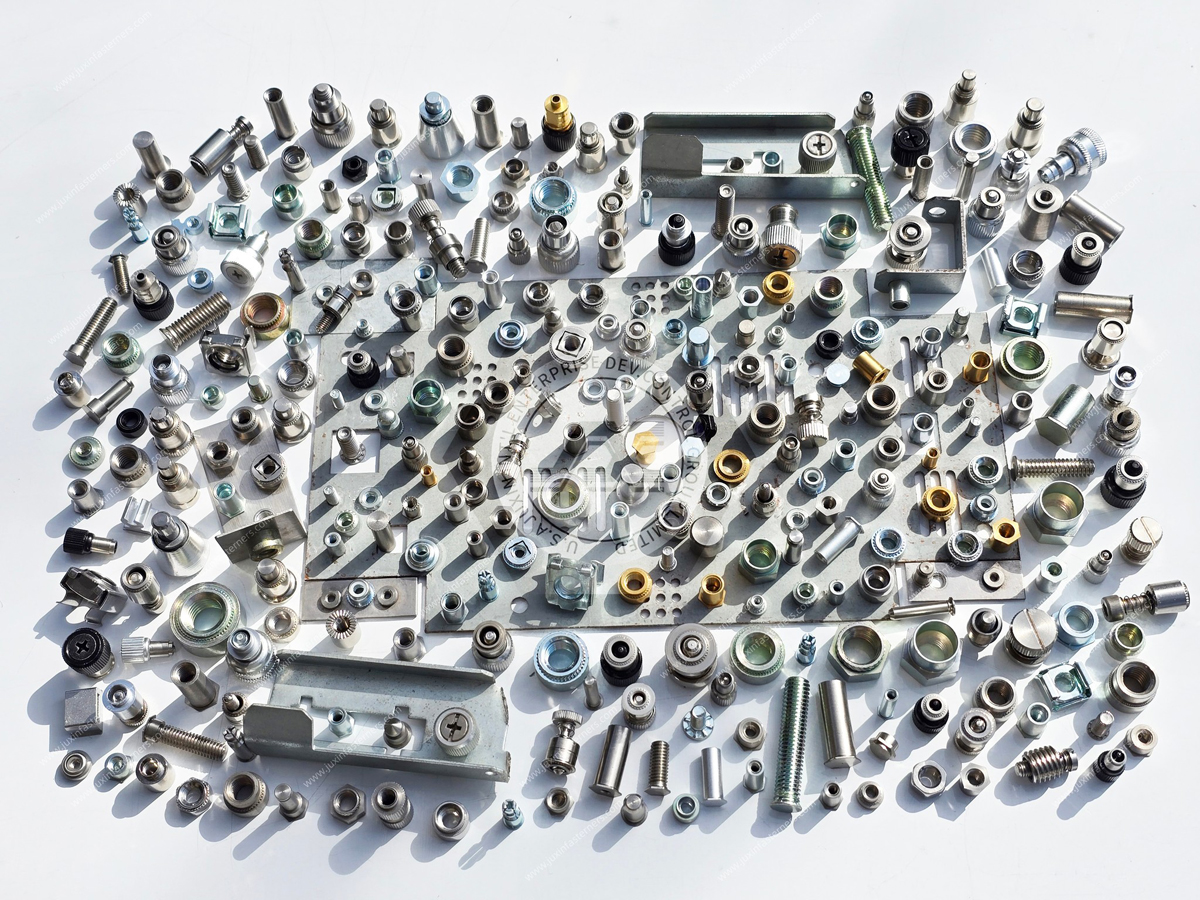
Corrosion Protection and Material Compatibility
Material selection should address both mechanical performance and environmental durability.
Carbon steel self-clinching nuts may be appropriate where the specified coating and environmental requirements are satisfied.
Stainless steel fasteners may offer useful corrosion characteristics in certain applications, but their hardness and installation compatibility must also be considered.
When dissimilar metals are used, galvanic corrosion should be evaluated according to the material combination, surface treatment, electrical contact, and environmental exposure.
For relevant high-strength steel materials and coating processes, hydrogen embrittlement risk may also require assessment.
The correct material and surface treatment should be selected for the complete assembly rather than on the basis of fastener appearance alone.
International Standards and Transportation Qualification Requirements
Self-clinching nuts should be manufactured and evaluated according to the approved product drawing and applicable customer specifications.
There is no single universal ISO or DIN standard that defines every commercial self-clinching nut geometry.
Many products use design-specific dimensions, installation requirements, and validated mechanical performance criteria.
Metric and Unified Inch Threads
For metric threads, applicable requirements may reference ISO 261 and ISO 965.
For Unified inch threads, ASME B1.1 may apply.
Metric thread sizes such as M3, M4, M5, and M6 may be relevant where available for the selected product design.
UNC and UNF threads may be required for certain inch-based assemblies.
Availability must be confirmed for each fastener design.
Metric, UNC, UNF, BSW, and BSF threads are not directly interchangeable.
For example, M6 and 1/4-20 UNC threads must not be treated as equivalent merely because their nominal diameters are similar.
The complete thread specification and installation geometry must be verified.
Aerospace Quality and Approval Requirements
Aerospace projects may require controlled drawings, approved materials, process specifications, traceability, inspection documentation, and design authority acceptance.
AS9100 may be relevant as an aerospace quality management framework when required by the customer.
However, quality management certification and approval of an individual aircraft component are separate matters.
A supplier's ability to manufacture a dimensionally conforming nut does not automatically establish its suitability for an aircraft installation.
JUXIN FASTENERS does not represent its products as aerospace-approved or qualified for flight-critical applications without verified supporting documentation and project-specific acceptance.
Railway Quality, Vibration and Fire Requirements
Railway projects may reference ISO 22163 for quality management requirements.
EN 61373 may be relevant to shock and vibration testing of railway rolling stock equipment, depending on the application.
EN 45545 may apply to fire-performance requirements for relevant railway materials, components, or assemblies.
These standards address different requirements.
They do not automatically establish that a particular self-clinching nut is approved for railway service.
The applicable requirements must be identified by the equipment manufacturer and assessed at the appropriate component or assembly level.
Design for Manufacturability: What Engineers Should Confirm Before Production
A fastening design should be evaluated for both mechanical function and practical production.
A nut may fit the CAD model while remaining difficult to install because of insufficient tooling clearance, unsupported sheet geometry, or an unsuitable assembly sequence.
A design review should confirm:
Compatible sheet material and hardness.
Minimum sheet thickness.
Correct mounting hole dimensions.
Sufficient edge distance.
Adequate clearance from bends and formed features.
Suitable punch and anvil access.
Correct fastener orientation.
Required installed height and protrusion.
Surface treatment sequence.
Mechanical retention requirements.
Inspection access.
Maintenance and replacement considerations.
These factors are especially important when a prototype is transferred into repeat production.
Prototype Validation vs. Production Validation
A successful prototype installation does not automatically establish production readiness.
Prototype work may involve careful manual positioning, individually prepared holes, or a small quantity of components.
Production introduces variation in sheet material batches, hole manufacturing, tooling wear, press alignment, and operator handling.
Before volume production, manufacturers should evaluate the selected installation process using representative materials and manufacturing conditions.
The appropriate validation scope depends on the application's risk and customer requirements.
Production-Line Efficiency and Quality Consistency
Production managers and manufacturing engineers must balance installation quality with assembly throughput.
For suitable applications, self-clinching nuts may reduce handling of loose components and simplify downstream screw assembly.
However, production efficiency depends on the complete process.
Relevant considerations include feeding and positioning, installation force, tooling accessibility, inspection time, rework risk, and maintenance requirements.
Installation Process Control
Production controls may include:
Fastener part-number verification.
Installation orientation checks.
Hole position and diameter inspection.
Press-tool alignment.
Force and displacement monitoring where appropriate.
Installed height verification.
Fastener presence inspection.
Periodic mechanical retention testing where specified.
Tooling maintenance.
Lot identification and change control.
The control plan should reflect the function and risk of the assembly.
Reducing Rework and Assembly Disruption
A poorly installed self-clinching nut can be difficult to correct after the panel has been finished or integrated into a larger assembly.
Potential consequences include panel replacement, additional inspection, production delays, and downstream assembly problems.
For this reason, prevention through suitable design, installation validation, and process control is generally preferable to relying on final inspection alone.
Common Self-Clinching Nut Failures and Corrective Actions
Understanding the likely causes of installation failures can improve engineering decisions and production quality.
The Nut Rotates During Screw Tightening
Possible causes include an oversized mounting hole, insufficient clinching, unsuitable sheet hardness, incorrect installation orientation, or inadequate material flow.
The investigation should focus on the fastener-to-sheet interface and actual installation conditions.
The Nut Pushes Out of the Panel
Possible causes include insufficient sheet thickness, incorrect hole geometry, incomplete installation, or loading beyond the validated retention capability.
The selected product's installation requirements should be checked against the actual panel.
The Panel Deforms During Installation
Possible causes include excessive press force, inadequate anvil support, insufficient edge distance, or unsuitable local sheet geometry.
Tooling alignment and panel support should be reviewed.
The Screw Damages the Internal Thread
Possible causes include incorrect thread selection, cross-threading, contamination, or excessive tightening.
Thread damage should be evaluated separately from nut retention.
Corrosion Appears Around the Installed Fastener
Possible causes include incompatible material combinations, damaged protective coatings, moisture exposure, or galvanic corrosion.
The complete material and coating system should be reviewed.
The Screw Loosens During Service
Possible causes include inadequate preload, vibration, joint relaxation, or unsuitable locking provisions.
The complete threaded joint should be evaluated rather than assuming the clinched nut itself provides vibration locking.
Choosing Between Self-Clinching Nuts, Rivet Nuts and Other Fasteners
Self-clinching nuts are one of several methods for creating threaded connections in sheet metal.
The correct selection depends on material compatibility, installation access, mechanical loading, production requirements, and qualification obligations.
Self-Clinching Nuts
These are suitable for compatible ductile sheet metal where controlled press installation can create the required mechanical interlock.
They may provide compact retained threads and simplify downstream assembly.
Rivet Nuts
Rivet nuts may be useful where access is available from only one side of the assembly.
They generally rely on deformation of the fastener body and have different installation requirements.
Weld Nuts
Weld nuts may be suitable for selected metal assemblies where welding is an acceptable and validated process.
Material compatibility, weld quality, distortion, and finishing requirements must be considered.
Specialized Inserts and Nutplates
Certain aerospace applications require approved inserts, captive fasteners, floating nutplates, or other specialized fastening systems.
These may be more suitable where structural loading, installation access, maintenance requirements, or qualification conditions make conventional self-clinching nuts inappropriate.
Composite Panel Inserts
Composite and sandwich panels often require dedicated insert systems rather than conventional sheet metal clinch nuts.
The appropriate attachment method must be selected for the actual panel construction.
The best choice should consider total assembly performance, manufacturing complexity, inspection, maintenance, and lifecycle cost.
Quality Control for OEM Self-Clinching Nut Supply
Industrial OEM customers may require consistent product dimensions, thread quality, material properties, surface treatment, and documentation.
Depending on the drawing and application, inspection requirements may include dimensional checks, thread verification, material identification, coating inspection, and lot identification.
Where required, installed performance may be evaluated through push-out and torque-out testing using representative sheet materials.
Incoming Fastener Inspection vs. Installed Joint Validation
Incoming inspection confirms the supplied fastener's conformity to specified characteristics.
Installed joint validation confirms that the fastener performs adequately in the selected panel under the defined installation conditions.
These are related but different activities.
A dimensionally acceptable nut may still produce inadequate retention if the sheet material, hole preparation, or press installation is incorrect.
Traceability and Engineering Change Control
Transportation projects may require controlled drawings, material records, part identification, batch traceability, and documented engineering changes.
A change in fastener material, hardness, coating, or clinching geometry may influence installation performance.
The applicable customer approval process should determine whether additional validation is necessary.
OEM Customization and Drawing-Based Manufacturing
Standard self-clinching nuts may be suitable when the required dimensions, materials, and installation characteristics match an established product design.
Custom fastening components may be considered where the assembly requires special dimensions, thread configurations, materials, or other design features.
However, custom geometry can affect tooling, manufacturing cost, installation performance, and qualification requirements.
A custom nut should not be selected solely because its external dimensions fit the available space.
The complete fastener-to-sheet connection must remain technically suitable.
JUXIN FASTENERS welcomes suitable drawing-based OEM fastening inquiries for manufacturing feasibility and quotation review.
Alternative Supplier Development and Second-Source Qualification
Supplier development teams may seek alternative sources to improve purchasing flexibility, reduce supply risk, or evaluate total procurement cost.
However, replacing an existing self-clinching nut requires more than matching the thread size.
Two products with similar external dimensions may have different clinching features, installation requirements, or mechanical retention characteristics.
A second-source evaluation should compare:
Approved part drawing and revision.
Thread specification and tolerance.
Material grade and hardness.
External dimensions and retention geometry.
Compatible sheet material and thickness.
Mounting hole dimensions.
Installation orientation and force requirements.
Push-out and torque-out requirements.
Surface treatment and corrosion specifications.
Inspection and traceability obligations.
Applicable customer qualification requirements.
Where the fastener is part of an approved aerospace or railway assembly, substitution must follow the required engineering and customer approval procedures.
A proposed alternative should not be described as a direct replacement until the relevant technical and qualification requirements have been satisfied.
Cost Optimization: Evaluate the Complete Fastening Process
The purchase price of a self-clinching nut is only one part of its total cost.
A meaningful sourcing comparison should consider fastener price, installation tooling, assembly cycle time, inspection, reject rates, rework, packaging, logistics, and long-term supply.
For example, a lower-cost nut may be commercially unattractive if it requires additional installation steps or creates higher assembly rejection rates.
Conversely, a suitable standard fastener may offer cost advantages over a custom design when its geometry and performance meet the application requirements.
Cost optimization should not compromise material compatibility, mechanical reliability, or required qualification.
MOQ, Lead Time and Long-Term Supply Planning
Minimum order quantity and delivery lead time depend on product geometry, material, surface treatment, manufacturing method, and requested quantity.
Standard products and custom drawing-based components may have different commercial requirements.
Prototype quantities may also require a different approach from scheduled production orders.
For repeat OEM programs, procurement teams should provide expected annual demand, order frequency, packaging requirements, and delivery expectations.
This information helps suppliers evaluate manufacturing feasibility and propose an appropriate commercial arrangement.
No specific MOQ, stock level, production capacity, or lead time should be assumed without quotation confirmation.
How to Select a Self-Clinching Nut Supplier for Aerospace-Related and Railway Projects
A suitable supplier should be evaluated according to the technical requirements of the product and the commercial requirements of the program.
Engineering teams need confidence that the selected nut is compatible with the sheet material, mounting hole, installation method, and mechanical performance requirements.
Manufacturing teams need a product that can be installed consistently using practical production processes.
Procurement and supply chain teams need clear specifications, competitive total cost, reliable communication, and an achievable supply arrangement.
For regulated transportation projects, the supplier must also be assessed against the required quality, documentation, traceability, and qualification obligations.
Technical Evaluation
Can the supplier review the drawing, thread standard, material, sheet thickness, installation geometry, and performance requirements?
Manufacturing Feasibility
Can the requested design and material combination be evaluated for production?
Are special tooling or custom manufacturing processes necessary?
Quality Requirements
What inspection, testing, traceability, and documentation are required?
Can the supplier confirm the applicable requirements before quotation?
Commercial Evaluation
What are the requested quantities, expected annual demand, delivery schedule, packaging requirements, and target commercial conditions?
Qualification and Approval
Does the project require aerospace-specific or railway-specific approvals?
Are there restrictions on supplier changes, materials, or manufacturing processes?
These questions should be resolved early to avoid unnecessary engineering work and quotation delays.
JUXIN FASTENERS: Self-Clinching Nuts and OEM Sheet Metal Fastening Solutions
JUXIN FASTENERS supplies industrial self-clinching nuts and related sheet metal fastening components for suitable OEM manufacturing requirements.
Relevant product inquiries may include metric self-clinching nuts, press-in threaded nuts, carbon steel clinch nuts, stainless steel clinch nuts, and custom drawing-based fastening components.
For compatible transportation-related applications, our team can review the supplied specifications to determine whether the requested fastening component is suitable for further technical and commercial evaluation.
The review may consider product geometry, thread requirements, material selection, sheet compatibility, surface treatment, order quantity, and requested documentation.
Aerospace or railway qualification requirements must be identified before product suitability or supply feasibility can be confirmed.
JUXIN FASTENERS does not imply that an ordinary industrial fastening product is approved for a regulated aircraft or railway application without verified supporting evidence.
Frequently Asked Questions
Can self-clinching nuts be used in aircraft interiors?
Certain self-clinching nuts may be considered for compatible nonstructural aircraft interior components, subject to material suitability, installation validation, and applicable engineering approval.
Are self-clinching nuts approved for aircraft structural applications?
Not automatically. Structural and safety-critical aircraft applications require appropriate qualified fastening systems and design authority approval.
Can self-clinching nuts be used in railway electrical cabinets?
They may be suitable for compatible sheet metal housings and mechanical mounting components when the relevant vibration, environmental, and project requirements are satisfied.
What sheet materials are suitable for self-clinching nuts?
Suitable materials depend on the selected fastener design. Certain aluminum alloys and carbon steel sheets may be compatible with conventional designs, while stainless steel may require specialized fasteners.
What happens if the sheet is too hard?
Insufficient plastic deformation may prevent the sheet from engaging properly with the nut's retention features, reducing installation reliability.
What happens if the installation hole is oversized?
An oversized hole may reduce the amount of material available for clinching and negatively affect mechanical retention.
What is the difference between push-out and torque-out resistance?
Push-out resistance measures resistance to axial displacement from the sheet. Torque-out resistance measures resistance to rotation within the sheet.
Does a self-clinching nut prevent vibration loosening?
No. Nut retention and mating screw loosening are separate concerns. The complete joint must be designed for the operating conditions.
Can an M6 self-clinching nut replace a 1/4-20 UNC nut?
No. Metric and Unified inch threads are different systems and are not directly interchangeable.
Can JUXIN FASTENERS manufacture custom self-clinching nuts?
Suitable custom fastening inquiries can be submitted for drawing-based technical and manufacturing feasibility review.
Can JUXIN FASTENERS support alternative supplier evaluation?
Suitable second-source inquiries may be reviewed against the existing drawing and performance requirements. Any required customer qualification and approval remain necessary.
What information should be included in an RFQ?
A useful RFQ includes the product drawing, thread specification, material, sheet thickness, mounting hole requirements, surface treatment, mechanical performance criteria, quantity, and required documentation.
Request a Quote for Self-Clinching Nuts and OEM Fastening Components
If you are developing aircraft interior equipment, railway electrical cabinets, passenger compartment components, transportation equipment housings, or other suitable sheet metal assemblies,
JUXIN FASTENERS welcomes inquiries for self-clinching nuts and related industrial fastening components.
To support efficient technical evaluation and accurate quotation, please provide the following information where available:
2D engineering drawing in PDF format.
3D CAD model, if available.
Product part number and drawing revision.
Thread size, pitch, and applicable thread standard.
Fastener material and required mechanical properties.
Sheet material, grade, and thickness.
Sheet hardness or material condition.
Mounting hole dimensions and tolerances.
Installation orientation and tooling constraints.
Required push-out and torque-out performance.
Surface treatment and corrosion requirements.
Applicable vibration, fatigue, or environmental requirements.
Inspection and traceability requirements.
Aerospace or railway qualification obligations, if applicable.
Prototype or production order quantity.
Estimated annual demand.
Required delivery schedule.
Existing reference sample or approved part specification for second-source evaluation.
Providing this information at the initial inquiry stage can reduce technical uncertainty, improve quotation accuracy, and help identify manufacturing or qualification issues before production.
For regulated aerospace and railway applications, all required approvals and documentation obligations should be disclosed before product selection or supplier substitution.
JUXIN FASTENERS supports international OEM sourcing discussions based on clear engineering drawings, practical manufacturing requirements, and commercially realistic supply planning.

JUXIN FASTENERS
Industrial Self-Clinching Nuts & OEM Sheet Metal Fastening Components
Website: www.juxinfasteners.com
Email: info@juxinfasteners.com
Send your engineering drawings and RFQ requirements to discuss your self-clinching nut or custom fastening project.
Contact Us
Tel.:
+86 020 8621 0320
+86 020 3121 6067
E-mail:
Technical Support:
Navigation
SEND INQUIREY



