
Call Us
+86 136 6007 9809
Call Us
+86 136 6007 9809

Aug. 16, 2026
Self-Clinching Nuts for Electronic Enclosures and Electrical Equipment
Modern electronic and electrical equipment requires compact, serviceable, and accurately manufactured sheet metal assemblies.
Server chassis, telecommunications equipment, industrial control cabinets, power supply housings, computer enclosures,
and electronic instrument cases frequently use thin metal panels that cannot provide sufficient thread engagement through conventional tapping alone.
Self-clinching nuts provide a practical method for creating permanent internal threads in suitable sheet metal components.
Also known as press-in nuts, clinch nuts, or self-clinching threaded fasteners, these components are installed into prepared holes using controlled compressive force.
During installation, the surrounding sheet material flows into the fastener's retention features, forming a mechanical interlock that resists rotation and axial displacement.
When properly selected and installed, self-clinching nuts can provide repeatable threaded attachment points for brackets, internal equipment supports, covers, mounting plates, and other mechanical interfaces.
JUXIN FASTENERS supplies self-clinching nuts and related sheet metal fastening components for industrial electronics, electrical equipment, and drawing-based OEM manufacturing requirements.
For electronics manufacturers, fastening performance depends on more than thread size. Engineers must consider sheet material, panel thickness, installation access, mounting hole accuracy, mechanical retention, corrosion protection, electrical requirements, and repeated service operations.
Manufacturing and procurement teams must also evaluate installation efficiency, inspection requirements, component consistency, sourcing cost, and long-term supply reliability.
This guide explains how to select and source suitable self-clinching nuts for electronic enclosures and electrical equipment.

What Are Self-Clinching Nuts for Electronic Enclosures?
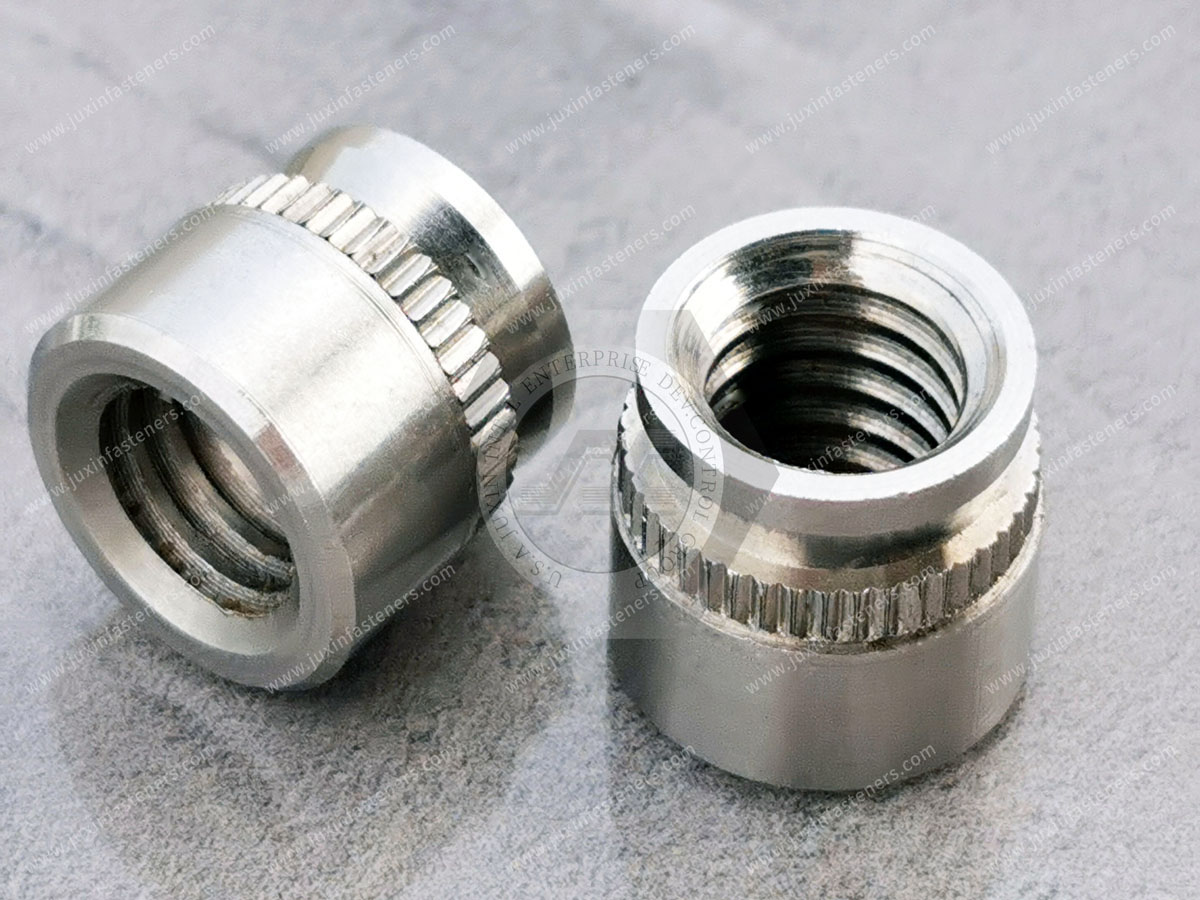
A self-clinching nut is a threaded metal fastener designed to become mechanically retained in a compatible sheet metal panel.
Unlike a conventional loose nut, a self-clinching nut remains attached to the sheet after installation.
Unlike a welded nut, its primary retention mechanism does not require a welding operation.
Unlike a rivet nut, a conventional self-clinching nut relies primarily on controlled displacement of the surrounding sheet material rather than deformation of a tubular fastener body.
This distinction is important because each fastening technology has different material, tooling, access, and performance requirements.
Self-clinching nuts are especially useful where an enclosure requires internal threads but the sheet is too thin for adequate conventional tapped thread engagement.
Potential advantages include:
Permanent threaded attachment points
Compact installation geometry
Reduced handling of loose nuts
Press-based installation
Repeatable fastener positioning
Access for subsequent screw assembly
Serviceable threaded connections
Compatibility with selected automated production processes
However, these benefits depend on correct product selection and installation.
Not every sheet metal material or enclosure design is suitable for conventional self-clinching nuts.
How Self-Clinching Nuts Work in Thin Sheet Metal
The installation process begins with a properly sized mounting hole in a compatible sheet metal panel.
The fastener is positioned in the hole and compressed using suitable press tooling.
As the installation force is applied, the sheet material plastically flows into the nut's undercut or other retention geometry.
The resulting mechanical interlock helps prevent the nut from rotating or being displaced during subsequent assembly.
Successful installation depends on the relationship between the fastener and the sheet.
Critical factors include:
Fastener design
Sheet material
Sheet hardness
Sheet thickness
Mounting hole diameter
Hole condition
Installation direction
Press alignment
Tooling support
Installation force
The thread diameter alone does not determine whether a clinch nut is suitable.
For example, two M4 self-clinching nuts may have different mounting hole requirements, minimum sheet thicknesses, and retention characteristics.
The approved product drawing and installation specification must be used.
Why Electronics Manufacturers Choose Self-Clinching Nuts
Electronic equipment manufacturers frequently need threaded attachment points in compact sheet metal assemblies.
Conventional tapping may provide insufficient thread engagement in thin panels.
Loose nuts may increase handling time or require access to both sides during final assembly.
Welding may introduce heat, distortion, surface damage, or additional manufacturing operations.
For compatible applications, self-clinching nuts provide an alternative that can simplify the fastening process.
Compact Threaded Connections
Electronic enclosures often have limited internal space.
A self-clinching nut can provide an internal thread without requiring a thick machined boss or separate nut-holding operation.
This can be useful in compact chassis designs where mechanical clearance is limited.
However, the nut's installed height, protrusion, and clearance envelope must still be considered.
Repeatable Assembly
A properly installed clinch nut remains positioned in the sheet during subsequent assembly.
This can simplify installation of brackets, covers, internal supports, and equipment modules.
For production teams, repeatable nut positioning may help reduce assembly variation and unnecessary handling.
Maintenance and Service Access
Electronic equipment may require periodic maintenance, inspection, replacement, or upgrades.
A retained threaded nut can allow mating screws to be removed and reinstalled without losing a loose nut inside the enclosure.
However, repeated service performance depends on the thread design, mating screw, installation torque, and mechanical condition of the joint.
A permanent clinched nut does not automatically guarantee unlimited reuse.
Reduced Secondary Operations
For suitable designs, self-clinching installation may eliminate a separate tapping or welding operation.
This can reduce manufacturing steps and support press-based assembly.
The actual cost advantage depends on production volume, equipment, tooling, fastener cost, inspection, and reject rates.
Self-Clinching Nuts for Server Cabinets and Data Center Equipment
Server cabinets, rack-mounted electronics, and data equipment contain numerous sheet metal brackets, supports, and mounting interfaces.
Suitable self-clinching nuts may be used in selected components such as:
Internal mounting brackets
Fan support brackets
Cable management components
Power supply mounting supports
Chassis covers
Internal sheet metal panels
Equipment support plates
Selected drive mounting structures
These applications require accurate positioning and reliable assembly.
Server Chassis Alignment
A server chassis may contain several brackets and internal components that must align with mounting holes and adjacent equipment.
A clinch nut installed in the wrong position can create assembly interference or force a bracket out of alignment.
Engineers should therefore evaluate mounting hole position, panel flatness, fastener protrusion, and mating component tolerances.
For assemblies with several fastening points, tolerance stack-up can affect installation consistency.
High-Density Equipment Packaging
Compact server and data equipment designs may place fastening locations close to other mechanical or electronic components.
The fastener's installation side and protruding geometry should be reviewed during enclosure design.
A nut that fits the panel hole may still interfere with a circuit board, cable, connector, fan, or adjacent housing.
Three-dimensional assembly review can help identify these conflicts before production.
Vibration and Service Conditions
Server equipment may experience vibration from cooling fans, transportation, handling, and operating machinery.
A properly retained self-clinching nut provides a stable threaded attachment point, but it does not automatically prevent the mating screw from loosening.
Where required, screw-joint vibration resistance must be evaluated separately.
Self-Clinching Nuts for Computer and Electronic Housings
Computer chassis, electronic instrument housings, and control boxes often use formed sheet metal panels.
Potential fastening applications include:
Chassis covers
Internal mounting plates
Equipment brackets
Power supply supports
Metal frame components
Access panels
Instrument support structures
For these assemblies, fastening selection should consider both initial production and future servicing.
Repeated Cover Removal
Some electronic enclosures require access during maintenance.
A retained threaded nut can simplify repeated removal and reinstallation of a cover.
However, engineers should consider thread wear, tightening torque, panel stiffness, and the risk of cross-threading.
Where frequent servicing is expected, the complete fastening system should be selected for the anticipated maintenance conditions.
Thin Panel Deformation
Thin sheet metal may deform if a screw is overtightened or if the joint concentrates excessive load near the fastener.
The clinch nut provides a threaded interface, but it does not eliminate the need for suitable joint design.
The surrounding sheet geometry, mating surfaces, screw head, and load distribution must be evaluated together.
Self-Clinching Nuts for Telecommunications Equipment
Telecommunications equipment frequently uses compact metal housings, racks, cabinets, and internal mounting structures.
Suitable self-clinching nuts may support:
Communication module brackets
Cable management hardware
Internal equipment supports
Rack-mounted electronic assemblies
Metal covers
Mounting plates
Selected electrical equipment enclosures
For telecommunications equipment, designers may need to balance enclosure space, corrosion protection, serviceability, and assembly efficiency.
Outdoor telecommunications equipment may also require additional environmental protection.
The fastening solution should be evaluated against the actual enclosure exposure and customer specification.
Self-Clinching Nuts for Electrical Control Cabinets
Electrical control cabinets and industrial electrical enclosures commonly use sheet metal panels to support internal components.
Potential applications include:
Control panel mounting brackets
Internal support rails and brackets
Cable management components
Cooling fan brackets
Equipment mounting plates
Cover fastening points
Selected circuit protection equipment supports
The fastening method must be appropriate for the mechanical and electrical requirements of the assembly.
Electrical Equipment Mounting
Electrical cabinets may contain contactors, relays, terminal blocks, controllers, and other equipment mounted to brackets or support structures.
Where self-clinching nuts are used, engineers should verify the mounting load, panel thickness, screw specification, and installation geometry.
The nut should not be assumed suitable for load-bearing or safety-critical equipment without appropriate validation.
Protective Earth and Electrical Bonding
An important engineering consideration is that mechanical retention does not automatically establish a reliable electrical bonding connection.
Paint, plating, oxide layers, surface contamination, and contact geometry can influence electrical continuity.
A self-clinching nut should not be assumed to provide a compliant protective earth or bonding connection merely because it is metal and mechanically retained.
Where the fastener forms part of a grounding or bonding path, the complete connection must be designed and verified according to the applicable equipment requirements.
Relevant electrical equipment standards may include IEC 60204-1 for certain machinery electrical equipment and IEC 61439 for applicable low-voltage switchgear and controlgear assemblies.
These standards do not automatically qualify an individual clinch nut. The finished equipment manufacturer must determine the relevant requirements and verification methods.
Self-Clinching Nuts for Power Supply Enclosures
Power supplies and power conversion equipment often use metal housings and internal mounting components.
Suitable self-clinching nuts may provide threaded attachment points for selected brackets, covers, and mechanical supports.
Important design considerations may include:
Installation clearance
Electrical insulation distances
Thermal conditions
Vibration
Corrosion protection
Mechanical loads
Service access
A metal fastener near energized components must be evaluated for electrical clearance and insulation requirements.
The fastener's location, installed height, and possible movement during assembly should be included in the equipment design review.
PCB Mounting and Electronic Module Support
Printed circuit boards and electronic modules are often mounted using spacers, standoffs, brackets, and threaded hardware.
Self-clinching nuts may provide the threaded interface in a supporting sheet metal chassis.
However, a clinch nut and a threaded standoff perform different functions.
The clinch nut creates a retained thread in the sheet.
A standoff establishes a defined separation distance between mounted components.
In some assemblies, both may be used together.
Controlling PCB Mounting Height
Circuit board position may depend on the chassis geometry, mounting bracket thickness, standoff length, and screw seating condition.
If the assembled height is incorrect, the board may experience bending or interference with adjacent components.
Engineers should evaluate the complete dimensional stack-up rather than the clinch nut alone.
Avoiding PCB Mechanical Stress
Excessive tightening or misaligned mounting points may introduce unwanted stress into a circuit board.
The fastener should support a properly designed mounting interface without forcing the PCB into an incorrect position.
Where sensitive electronics are involved, the required tightening procedure and mechanical support should be established by the equipment manufacturer.
Selecting Self-Clinching Nuts by Sheet Thickness
Sheet thickness is one of the first specifications to confirm.
Each self-clinching nut design has a defined installation geometry and minimum compatible sheet thickness.
The required thickness depends on the selected product.
A nut intended for one sheet thickness range should not automatically be installed in a thinner panel.
Why Minimum Sheet Thickness Matters
The sheet must provide enough material to flow into the fastener's retention features.
If the sheet is too thin, the mechanical interlock may be incomplete.
Possible consequences include:
Reduced push-out resistance
Reduced torque-out resistance
Poor seating
Panel distortion
Inconsistent retention
Fastener displacement during assembly
The minimum sheet thickness must be confirmed from the selected fastener's technical specification.
Does a Thicker Sheet Always Improve Retention?
Not necessarily.
Although greater sheet thickness may provide additional material, retention performance still depends on the fastener design, installation geometry, sheet hardness, and process conditions.
The approved installation specification must be followed.
Sheet Material Hardness and Ductility
Conventional self-clinching technology depends on controlled plastic deformation of the sheet.
For many designs, the sheet must be sufficiently softer than the fastener's clinching features and ductile enough to flow into the retention geometry.
This is important because electronic enclosures may be manufactured from carbon steel, stainless steel, aluminum, or coated sheet metal.
Carbon Steel Enclosures
Suitable low-carbon steel sheet may be compatible with certain conventional self-clinching nuts.
However, the actual steel grade, hardness, thickness, and coating condition must be considered.
Not every steel sheet has the same clinching characteristics.
Stainless Steel Enclosures
Stainless steel panels may require specially designed self-clinching fasteners.
A standard clinch nut intended for softer steel may not be suitable for a harder stainless steel sheet.
The product must be selected according to the actual sheet material and hardness.
Aluminum Enclosures
Aluminum sheet may be suitable for selected self-clinching nuts.
However, alloy and temper influence the material's deformation behavior.
A soft aluminum sheet and a high-strength aluminum alloy may require different fastening solutions.
The selected fastener must be validated for the actual material condition.
Coated and Pre-Finished Sheet Metal
Electronic enclosure panels may be supplied with zinc coatings, paint, powder coating, or other surface finishes.
These coatings can influence hole geometry, surface contact, and installation behavior.
The sequence of hole preparation, clinch nut installation, and coating should be defined during manufacturing planning.
The process must preserve the required mechanical and corrosion performance.
Mounting Hole Diameter and Hole Preparation
A correctly manufactured installation hole is essential for reliable clinching.
The required hole diameter is specific to the selected fastener design.
An oversized hole may reduce retention because insufficient sheet material is available to fill the fastener's undercut.
An undersized hole may prevent correct seating or cause unwanted panel deformation.
The hole diameter and tolerance must be taken from the approved fastener specification.
Burr Control
Burrs around mounting holes can interfere with fastener seating and material flow.
Hole quality should be consistent with the selected product's installation requirements.
For many conventional clinch nut designs, an unintended countersink or chamfer can remove material needed for proper retention.
The hole should therefore be prepared according to the fastener manufacturer's instructions rather than a generic machining rule.
Hole Position Accuracy
In compact electronic housings, small hole-position errors may affect alignment with covers, brackets, or internal modules.
The required positional tolerance should be based on the actual assembly function.
For critical mounting interfaces, engineers may specify appropriate geometric tolerances and datums.
Minimum Edge Distance
Self-clinching nuts require sufficient surrounding sheet material.
If a nut is installed too close to an edge, the sheet may deform or fail to provide adequate retention.
The required minimum edge distance depends on the fastener design, sheet material, and thickness.
The selected product's installation specification must be followed.
Installation Near Bends and Formed Features
Electronic enclosures often contain flanges, bends, embossed features, and narrow mounting surfaces.
These features can affect press access and sheet support.
Before finalizing the enclosure design, engineers should verify:
Available flat installation area
Distance from bends
Press punch access
Anvil clearance
Surrounding panel stiffness
Fastener orientation
Installed nut protrusion
Early review can help avoid costly sheet metal tooling changes.
Self-Clinching Nut Installation Methods
Self-clinching nuts are typically installed using controlled pressing force.
The correct force and tooling depend on the fastener design, sheet material, and panel thickness.
The installation process should follow the selected product's approved instructions.
Press Punch and Anvil Alignment
Proper alignment between the punch, fastener, panel, and anvil is important.
Misalignment can cause uneven seating, panel deformation, or incomplete clinching.
The tooling must support the sheet appropriately while allowing the intended material flow.
Installation Force Control
Insufficient force may prevent complete mechanical engagement.
Excessive force may damage the fastener or deform the panel.
The correct force should be established using the selected fastener's installation specification and representative production materials.
Avoiding Impact Installation
Conventional self-clinching nuts are generally intended for controlled press installation rather than uncontrolled hammering.
Impact installation may produce inconsistent retention or damage the surrounding sheet.
The approved installation method should be used.
Installation Before or After Painting
The manufacturing sequence can influence both clinching performance and finished enclosure quality.
Installing the nut before coating may be appropriate for some applications.
However, coating may affect threads, electrical contact surfaces, or dimensional clearances.
Installing after coating may introduce other concerns involving surface condition and mechanical retention.
The appropriate sequence must be determined for the actual enclosure material, fastener, coating, and functional requirements.
Push-Out and Torque-Out Resistance
Self-clinching nut retention is commonly evaluated through push-out and torque-out testing.
These tests measure different aspects of the mechanical connection.
Push-Out Resistance
Push-out resistance describes the force required to displace an installed fastener axially from the sheet under defined test conditions.
Performance depends on the fastener design, sheet material, thickness, hole geometry, and installation process.
The required acceptance value should be established according to the actual application.
Torque-Out Resistance
Torque-out resistance describes the installed nut's resistance to rotation relative to the sheet.
This is important because a rotating nut may prevent a screw from being tightened or removed correctly.
However, torque-out resistance is not equivalent to the allowable tightening torque of the final screw joint.
The complete assembly must be evaluated separately.
Why Installation Validation Matters
A clinch nut installed in one sheet material may not provide the same retention performance in another.
Even with the same nominal thickness and hole diameter, differences in hardness and ductility can influence material flow.
For OEM production, validation should use representative sheet material, hole preparation, tooling, and installation conditions.
Thread Size and Thread Standards
Electronic equipment manufacturers may specify metric or inch-threaded self-clinching nuts.
The correct thread system must be identified before quotation and production.
For ISO metric threads, relevant specifications may include ISO 261 and ISO 965.
For Unified inch threads, ASME B1.1 may apply.
Common metric thread sizes for suitable self-clinching nut designs may include M3, M4, M5, M6, and other specified dimensions.
Availability depends on the actual product design.
UNC and UNF variants may also be considered where supported by the selected product specification.
Metric, UNC, UNF, BSW, and BSF thread systems are not directly interchangeable.
For example, an M4 metric thread must not be treated as equivalent to a #8-32 UNC thread.
The complete thread specification and mating component requirements must be verified.
Thread Engagement and Screw Selection
The internal thread provides the connection to the mating screw.
However, the complete joint's performance depends on more than the nut's thread size.
Important considerations include:
Screw material
Thread specification
Engagement length
Joint geometry
Mating component material
Tightening torque
Surface condition
Repeated assembly requirements
The screw should be selected according to the actual mechanical requirements.
Excessive tightening may damage threads, deform the sheet, or compromise the assembly.
Repeated Service and Thread Wear
Electronic equipment may be opened and serviced multiple times.
Repeated screw installation can influence thread wear and the condition of the mating components.
Where frequent maintenance is expected, the thread design, screw selection, tightening method, and expected service cycles should be evaluated.
A self-clinching nut provides a retained threaded interface but does not eliminate normal thread wear mechanisms.
Material Selection for Electronic Enclosure Clinch Nuts
Material selection should consider the enclosure environment, sheet compatibility, corrosion requirements, and manufacturing process.
Carbon Steel Self-Clinching Nuts
Carbon steel self-clinching nuts may be suitable for many general industrial enclosure applications when the selected design is compatible with the sheet.
Surface treatment may be required according to the corrosion environment.
The coating must be compatible with the required dimensions and installation process.
Stainless Steel Self-Clinching Nuts
Stainless steel may be considered where particular corrosion characteristics are required.
However, stainless steel grade and hardness must also be compatible with the sheet material.
A stainless steel nut is not automatically suitable for installation into every stainless steel panel.
Surface Treatments and Corrosion Protection
Surface treatment selection may involve:
Corrosion resistance
Coating thickness
Thread fit
Electrical contact requirements
Appearance
Environmental exposure
Compatibility with mating materials
For outdoor or high-humidity electrical equipment, corrosion protection may be especially important.
The complete assembly environment should determine the required finish.
Electrical Continuity, Grounding and EMI Considerations
Electronic enclosure fastening can involve electrical requirements in addition to mechanical performance.
A self-clinching nut is primarily a mechanical fastening component.
Its use in electrical bonding, protective grounding, or electromagnetic shielding interfaces requires separate engineering evaluation.
Electrical Contact Resistance
Surface treatments, paint, oxides, contamination, and contact geometry can influence electrical resistance.
A metal-to-metal fastening connection should not automatically be considered a verified low-resistance electrical path.
Where electrical continuity is required, the design must establish suitable contact conditions and verification methods.
Protective Grounding
Electrical equipment may require protective bonding between conductive parts.
The applicable requirements depend on the equipment type and relevant standards.
A clinch nut should only be used as part of a protective bonding arrangement when the complete connection has been designed and verified for that purpose.
EMI Shielding
Electromagnetic interference control may require continuous conductive enclosure interfaces, appropriate gasket design, and suitable bonding between panels.
Self-clinching nuts may form part of a mechanical fastening arrangement used to secure such interfaces.
However, the nut alone does not guarantee electromagnetic shielding performance.
The enclosure design must address the complete electrical and mechanical interface.
Corrosion and Dissimilar Metal Contact
Where different metals are in contact and exposed to moisture, galvanic corrosion may be a concern.
For example, a steel fastener installed in an aluminum enclosure may require evaluation of surface treatments and environmental exposure.
The appropriate solution depends on the complete material system.
Production-Line Efficiency and Automated Installation
For high
Contact Us
Tel.:
+86 020 8621 0320
+86 020 3121 6067
E-mail:
Technical Support:
Navigation
SEND INQUIREY



