
Call Us
+86 136 6007 9809
Call Us
+86 136 6007 9809

May. 24, 2026
Anti-Loosening Fastener Technology in Rail Transit Systems
Engineering Mechanisms, System Solutions, and Future Development Challenges
1. Engineering Background: Why Anti-Loosening Fasteners Are Critical in Rail Transit
In modern rail transit systems—including high-speed rail, metro systems, and intercity trains—fastener reliability directly determines the structural safety of:
Bogie assemblies
Carbody structures
Interior modules
Track-side and electrical systems
Under long-term service conditions such as:
High-frequency vibration
Alternating axial loads
Thermal expansion cycles (-40°C to +85°C)
Continuous shock from wheel–rail interaction
Traditional bolted joints often suffer from self-loosening, a primary cause of maintenance downtime and structural fatigue risk.
Industry data show that more than 80% of bolt fatigue failures are linked to preload loss rather than material fracture.
Therefore, modern rail engineering increasingly relies on anti-loosening fastener systems to maintain stable clamp load throughout the lifecycle.
2. Mechanisms of Fastener Loosening in Rail Transit Applications
Fastener loosening in rail environments is mainly caused by:
2.1 Transverse vibration (Junker effect)
Relative micro-slip between threads reduces frictional resistance.
2.2 Preload relaxation
Loss of axial force due to:
Elastic recovery of materials
Surface embedment
Thermal cycling
2.3 Structural mismatch
Improper washer selection or insufficient thread engagement leads to uneven stress distribution.
3. Engineering Solutions: Anti-Loosening Fastener Technologies
3.1 Wedge-Thread Self-Locking Nuts
Wedge-thread systems (also known as Spirol-type locking threads) use a 30° wedge geometry at the thread root.
Working principle:
External thread crest engages wedge ramp
Lateral micro-movement is mechanically blocked
Preload is maintained under vibration conditions
Engineering advantage:
Purely mechanical locking (no adhesive required)
High resistance to dynamic loosening
Suitable for rail bogie and structural joints
3.2 Hard Lock Nut Systems (Double-Nut Wedge Mechanism)
Hard lock nuts utilize a dual-nut interference structure:
Upper nut: concave geometry
Lower nut: eccentric convex surface
Principle:
The eccentric interface generates a controlled wedge force, producing:
High frictional resistance
Stable preload retention under vibration
Application:
Heavy rail structures
High-load bolted joints
Safety-critical mechanical assemblies
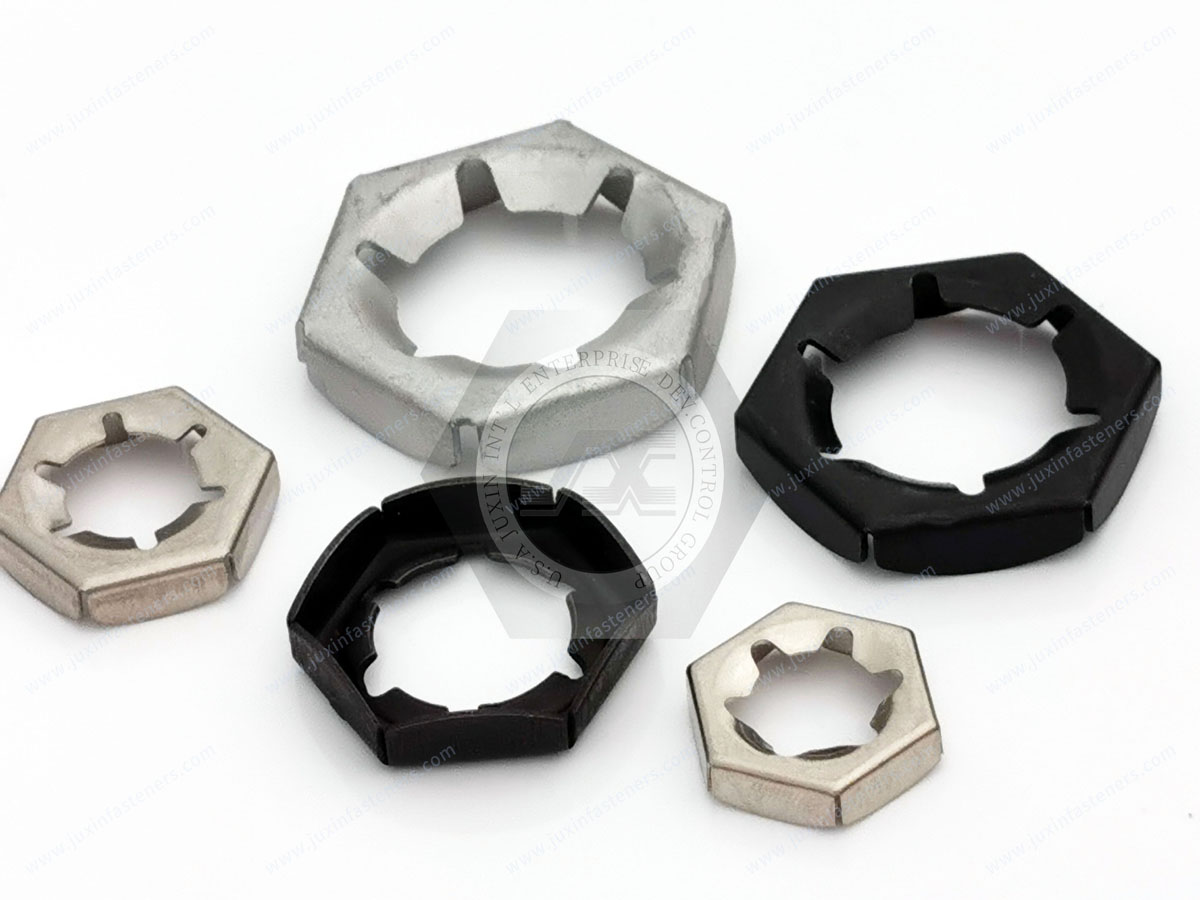
3.3 Slotted Self-Locking Nuts
Slotted nuts rely on elastic radial deformation.
Mechanism:
Slot creates controlled elastic expansion
Interference fit increases thread friction
Prevents rotational loosening
Advantages:
Simple structure
Cost-effective solution
Suitable for maintenance-grade rail components
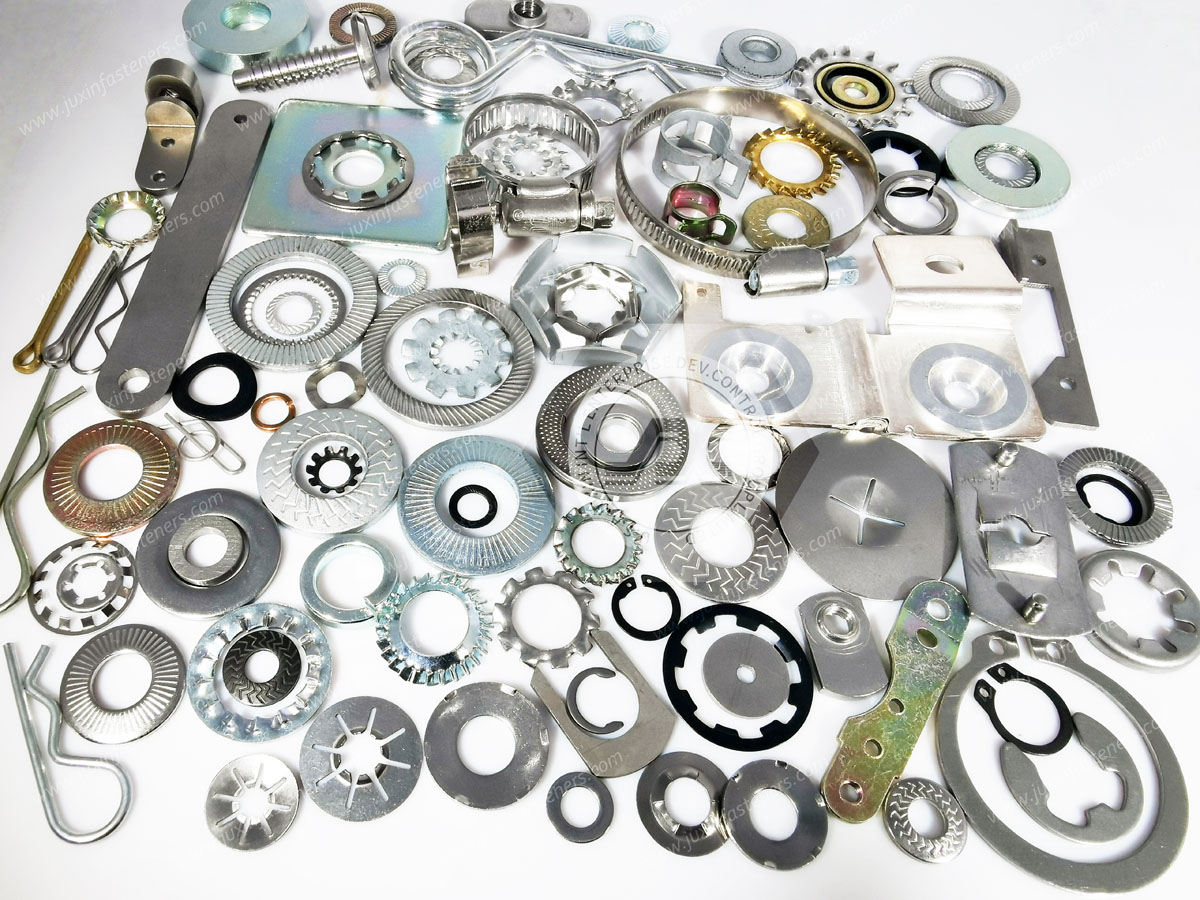
3.4 Spring Lock Washers
Spring washers provide anti-loosening through elastic preload compensation.
Key feature:
65°–80° open angle design
Elastic compression under tightening load
Function:
Maintains continuous contact pressure
Compensates for vibration-induced relaxation
3.5 Conical Washers (Belleville Washers)
Belleville washers provide high axial force in a compact space.
Engineering function:
Converts axial load into spring force
Maintains preload under thermal cycling
Application:
High-vibration rail fastening systems
Electrical and mechanical mounting points
3.6 Double-Toothed Lock Washers
Double-toothed washers are used:
Internal wedge geometry
External radial serrations
Mechanism:
Serrations bite into mating surfaces
Internal wedge prevents reverse rotation
Advantage:
High resistance to micro-slip
Effective under alternating load conditions
4. Importance of Preload Control in Rail Fastener Systems
Preload is the core engineering parameter of all bolted joints.
Failure analysis shows:
More than 80% of bolt failures are caused by insufficient or unstable preload.
Engineering requirement:
A properly designed rail fastener system must ensure:
Controlled torque application
Stable axial force retention
Resistance to relaxation under vibration
5. Bolt Preload Management Strategy (Engineering Practice)
Step 1: Controlled Tightening
Use calibrated tools such as:
Torque wrenches
Hydraulic tensioners
Ultrasonic bolt elongation measurement systems
Goal:
Maintain preload within design specification range.
Step 2: Verification and Quality Control
After installation:
Perform ultrasonic preload inspection
Conduct periodic torque re-checks
Validate assembly consistency across batches
Step 3: Digital Monitoring System
Advanced rail systems integrate:
Strain sensors
Data acquisition modules
Predictive maintenance software
This enables:
Real-time preload monitoring
Early warning of loosening risks
Lifecycle digital traceability
6. Rail Transit Bolt Management System Services
Modern fastening engineering is shifting from component supply to system-level bolt management services.
Core services include:
On-site bolt tightening validation
Preload measurement and audit
Vibration condition analysis
Maintenance optimization consulting
Lifecycle fastening data tracking
This approach significantly reduces:
Unplanned maintenance downtime
Fastener-related safety risks
Lifecycle operational cost (OPEX)
7. Current Industry Challenges in Anti-Loosening Fasteners
Despite major advancements, the rail fastener industry still faces key challenges:
7.1 Manufacturing process optimization
Need for:
Higher precision
Lower cost production
Improved consistency under mass manufacturing
7.2 Technology innovation gaps
Demand for:
Permanent anti-loosening mechanisms
Higher fatigue resistance systems
Maintenance-free fastening solutions
7.3 Intelligent fastening systems
Future systems require integration of:
Axial force monitoring
Predictive failure analysis
Digital maintenance platforms
8. Future Development Trends in Rail Fastener Engineering
The next generation of anti-loosening fastener systems will evolve toward:
8.1 High-performance materials
Alloy steel optimization
Advanced surface engineering
Corrosion-resistant coatings (Zn-Ni, Dacromet)
8.2 Structural innovation
Self-locking geometric systems
Hybrid mechanical + friction locking designs
8.3 Smart fastening systems
Embedded sensor monitoring
Real-time preload feedback
AI-based maintenance prediction
9. Engineering Value Summary
Advanced anti-loosening fastener systems provide:
Stable preload under long-term vibration
Reduced rail maintenance cycles
Improved operational safety
Lower lifecycle cost (TCO optimization)
Enhanced structural reliability in critical rail systems
10. Conclusion: From Fasteners to Engineering Safety Systems
Anti-loosening fastener technology in rail transit is no longer a simple mechanical component issue.
It is a system engineering discipline combining:
Mechanical design
Material science
Vibration dynamics
Digital monitoring
Through continuous innovation in wedge-lock systems, washer technology, preload management, and intelligent monitoring, rail transit fastener systems are evolving toward:
higher reliability, lower maintenance, and full lifecycle digital control.

 MORE NEWS
Sep. 27, 2026
Sep. 27, 2026
Sep. 27, 2026
Contact Us
Tel.:
+86 020 8621 0320
+86 020 3121 6067
E-mail:
Technical Support:
Navigation
SEND INQUIREY