
Call Us
+86 136 6007 9809
Call Us
+86 136 6007 9809

Aug. 11, 2026
Should a property class 10.9 or 12.9 bolt be black oxide treated, hot-dip galvanized, zinc plated, zinc-nickel coated or protected by another specified coating system?
There is no universal answer.
High-strength fastener surface treatment is an engineering decision involving several independent requirements:
Mechanical properties
Corrosion environment
Hydrogen-related risk
Thread dimensional allowance
Friction
Torque-preload behavior
Installation method
Joint design
Applicable product and coating standards
OEM or project specifications
A common misconception is:
"High-strength bolts should always be black oxide because hot-dip galvanizing damages high-strength steel."
That statement is too broad.
Hot-dip galvanized high-strength fasteners do exist, and ISO 10684 specifically addresses hot-dip galvanized fasteners within its scope.
The real question is whether the combination of fastener property class, material, manufacturing route, galvanizing process, thread system and application is properly qualified.
At the same time, black oxide should not be treated as a corrosion-performance equivalent to galvanizing.
The correct engineering principle is:
Surface Treatment Selection = Fastener Metallurgy + Corrosion Requirement + Thread System + Friction Requirement + Joint Design + Process Risk + Applicable Specification
This guide explains how engineers and procurement teams should compare black oxide and hot-dip galvanizing without relying on oversimplified rules.
Choose neither coating simply because the bolt is "high strength."
Minimal dimensional build is important
The application has limited corrosion exposure
Oil or another supplementary protective system is acceptable
Black appearance is required
Thread geometry must remain essentially unaffected by a thick metallic coating
The drawing or OEM specification requires black oxide
Substantial sacrificial corrosion protection is required
The fastener and thread system are specifically designed for galvanizing
ISO 10684 or another applicable project specification permits the combination
The mechanical property class is within the permitted/qualified system
Process-related hydrogen and metallurgical risks have been addressed
Tightening behavior has been validated for the finished fastener
The choice should therefore be made from the finished fastener system, not from coating preference alone.
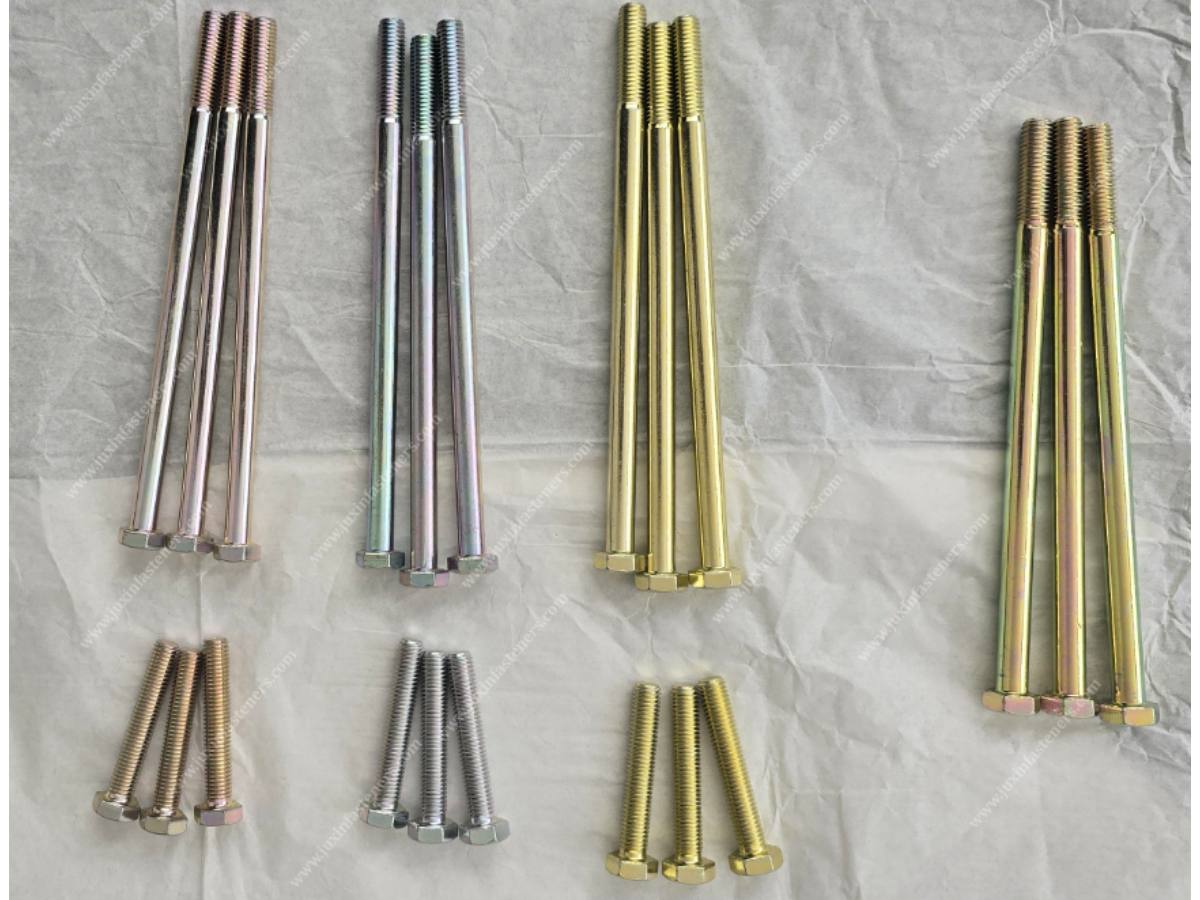
Property classes such as:
8.8
10.9
12.9
describe specified mechanical-property systems for carbon and alloy steel fasteners within the scope of ISO 898-1.
They do not prescribe one universal surface treatment.
A high-strength bolt may require different corrosion and assembly solutions depending on whether it is used in:
Industrial machinery
Automotive equipment
Heavy equipment
Outdoor structures
Wind-energy equipment
Transportation systems
Production equipment
Therefore:
Property Class ≠ Surface Treatment Specification.
The coating must be specified separately.
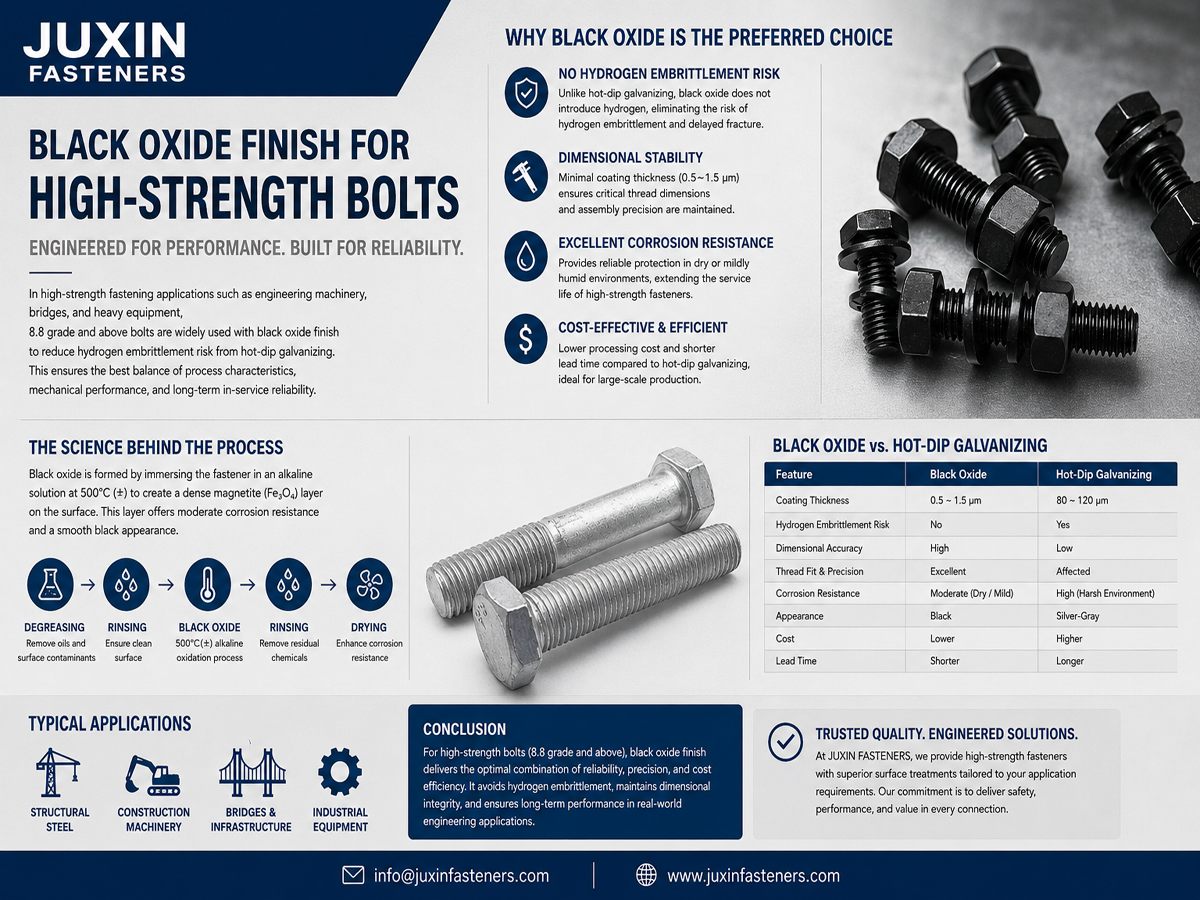
Black oxide is a conversion treatment applied to ferrous materials.
It produces a very thin dark surface layer and is commonly supplemented with:
Oil
Wax
Other post-treatment protection
Its main advantages can include:
Minimal dimensional change
Black appearance
Compatibility with precision components
Limited interference with thread dimensions
But its intrinsic corrosion protection is much more limited than a substantial sacrificial zinc coating system.
This is critical because an old engineering assumption sometimes becomes:
High-strength bolt → black oxide → outdoor corrosion protection
That is not a reliable specification strategy.
Black Appearance ≠ High Corrosion Resistance.
Black oxide chemically converts the surface of ferrous material rather than depositing a thick metallic layer.
Because the conversion layer is thin, it can be useful where dimensional build must be minimized.
For threaded fasteners, that can help preserve:
Thread geometry
Small clearances
Assembly compatibility
Precision features
However, black oxide performance depends heavily on the complete finishing system.
The specification should therefore identify more than:
"Black finish."
A dark fastener could potentially have several different surface treatments.
Therefore:
Black Color ≠ Black Oxide Specification.
The corrosion behavior of a black oxide fastener depends on factors including:
Black oxide process
Post-treatment
Oil or sealant
Handling
Storage
Humidity
Condensation
Chemical exposure
Outdoor exposure
It is unsafe to claim that black oxide provides a universal number of years of corrosion protection.
Service life cannot be predicted from appearance alone.
And:
Laboratory Corrosion Test ≠ Field Service Life.
If corrosion is an important design requirement, define the actual environmental and test requirements rather than simply specifying black oxide.
Hot-dip galvanizing applies a zinc-based coating by immersing suitably prepared steel components in molten zinc.
The resulting coating provides sacrificial corrosion protection.
Compared with black oxide, hot-dip galvanizing generally creates substantially greater coating build.
That difference affects:
Corrosion performance
Thread dimensions
Nut/bolt compatibility
Friction
Tightening behavior
Manufacturing process
Therefore black oxide and hot-dip galvanizing should not be treated as two cosmetic alternatives.
They solve fundamentally different surface-engineering problems.
| Engineering Factor | Black Oxide | Hot-Dip Galvanizing |
|---|---|---|
| Surface system | Conversion treatment | Zinc-based metallic coating |
| Dimensional build | Very small | Substantially greater |
| Sacrificial zinc protection | No | Yes |
| Outdoor corrosion capability | Limited; depends strongly on supplementary protection | Often selected for substantial atmospheric corrosion protection |
| Thread-fit impact | Usually relatively small | Requires deliberate thread allowance/system control |
| Appearance | Black | Metallic zinc appearance |
| Hydrogen/process considerations | Must be evaluated from complete pretreatment/process | Must be evaluated, especially where acid cleaning/pickling is involved |
| Friction effect | Depends on complete finish and post-treatment | Depends on finished galvanized system and lubrication |
| High-strength fastener use | Application/specification dependent | Application/property-class/specification dependent |
| Relevant specification | Drawing/process specification | ISO 10684 for fasteners within scope |
The key point is:
Black Oxide and HDG Are Not Performance-Equivalent Finishes.
This question requires more precision than the simple answer "yes."
Hot-dip galvanizing involves exposure to molten zinc at elevated temperature.
Whether this adversely affects a particular fastener depends on:
Steel composition
Heat-treatment condition
Fastener property class
Galvanizing process
Time-temperature exposure
Applicable standard
It is therefore incorrect to state that galvanizing temperature automatically destroys the quenched-and-tempered microstructure of every high-strength bolt.
Likewise, engineers should not assume that every high-strength bolt can be galvanized without qualification.
The correct rule is:
Galvanizing Process Compatibility Must Be Verified for the Actual Fastener.
ISO 10684 should be considered when specifying hot-dip galvanized fasteners within its scope.
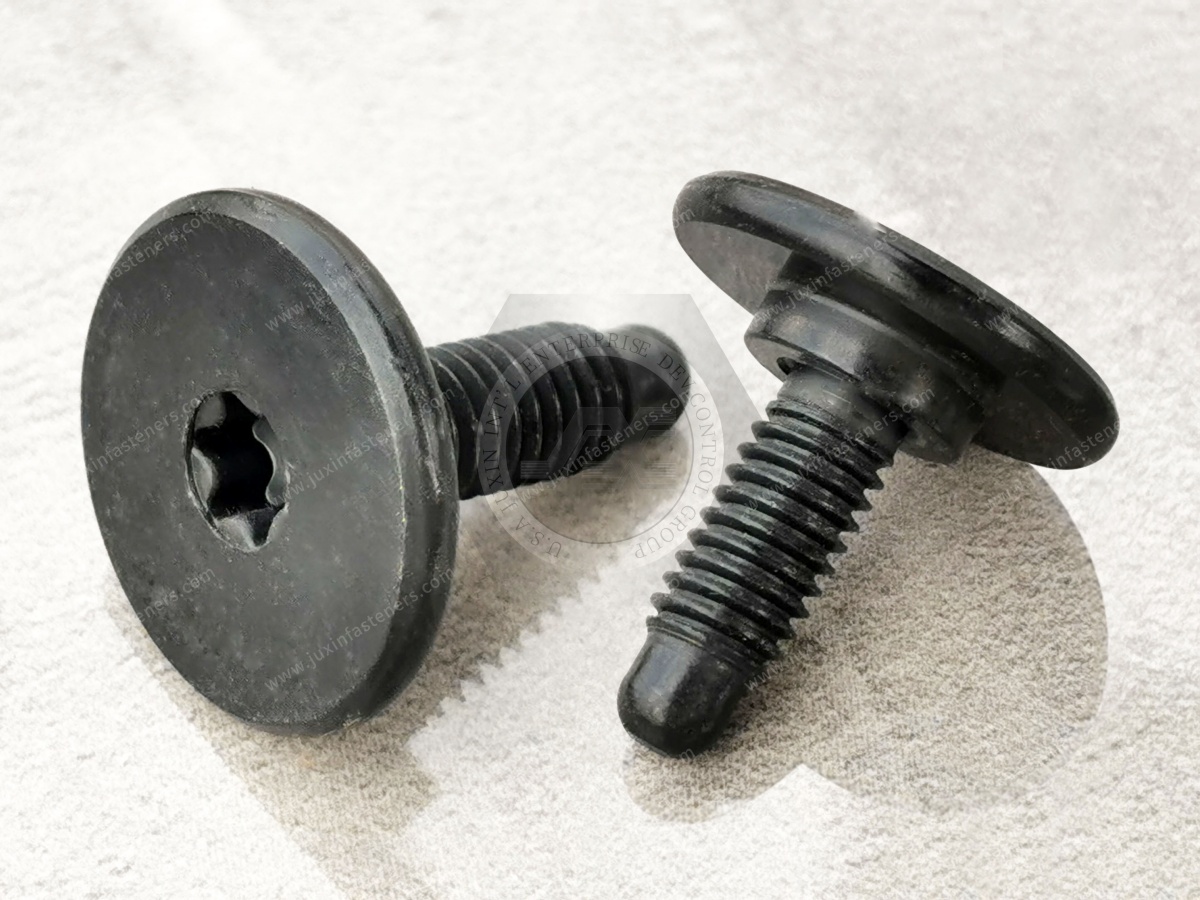
As fastener strength and hardness increase, sensitivity to manufacturing and environmental effects can become more important.
For higher-strength fasteners, engineers should review:
Material
Hardness
Heat treatment
Surface preparation
Pickling
Galvanizing
Residual stress
Application stress
Environmental exposure
This is why coating selection should be performed together with metallurgical review rather than after the bolt has already been designed.
Hydrogen embrittlement is one of the most important issues in high-strength steel fasteners.
Hydrogen may be introduced during manufacturing processes involving:
Acid cleaning
Pickling
Electrocleaning
Electroplating-related processing
Susceptible high-strength steel under tensile stress can experience delayed brittle fracture if sufficient diffusible hydrogen is present.
But the engineering discussion must distinguish:
Hot-Dip Galvanizing Process ≠ Electroplating Process.
The hydrogen risk mechanisms and process routes are not identical.
For hot-dip galvanizing, pretreatment—particularly acid pickling—requires appropriate control when susceptible high-strength steels are involved.
Therefore:
Coating Name Alone Does Not Define Hydrogen Embrittlement Risk.
The complete manufacturing route matters.
It is also incorrect to assume:
Black oxide = zero hydrogen embrittlement risk.
The final conversion treatment may not be the only relevant process.
Hydrogen exposure can potentially occur during earlier:
Cleaning
Pickling
Manufacturing
Surface-preparation operations
The supplier must evaluate the complete process route for susceptible high-strength fasteners.
This leads to a broader principle:
Finished Appearance Does Not Reveal Manufacturing Risk.
Another common procurement misconception is:
"If hydrogen is a concern, just bake the bolts afterward."
Post-process baking may be required by applicable specifications for certain processes and susceptible fasteners.
But it should not be treated as a guarantee that every hydrogen-related risk has been eliminated.
Effective hydrogen-risk management begins with:
Material selection
Process selection
Hydrogen-generating process control
Timing
Applicable specification
Validation
Baking ≠ Automatic Elimination of Hydrogen Embrittlement Risk.
Black oxide creates relatively little dimensional build.
Hot-dip galvanizing creates substantially more.
That difference is especially important on ISO metric threads.
A standard uncoated external thread and internal thread cannot simply receive substantial zinc coating without considering the resulting dimensional relationship.
For hot-dip galvanized fasteners, the thread system must follow the applicable allowance strategy defined by the relevant standard.
ISO 10684 addresses this issue for hot-dip galvanized fasteners within its scope.
Therefore:
Bare Thread Fit ≠ Galvanized Thread Fit.
It may appear easy to solve a tight galvanized assembly by cutting material from the internal thread after coating.
But removing zinc from the thread can alter the intended corrosion-protection system.
The correct thread allowance should be engineered as part of the fastener system.
This is much better than treating thread interference as a post-production defect to be repaired.
Thread geometry means coating on the flanks influences effective thread dimensions.
However, engineers should avoid applying one generic multiplier to every thread/coating system.
The correct dimensional strategy depends on:
Thread profile
Coating process
Coating thickness
Applicable standard
Internal/external thread allowance
For HDG fasteners:
Use the applicable standardized thread system rather than an informal coating-thickness rule.
Coating selection is frequently discussed only in terms of corrosion.
But for preload-controlled bolted joints, friction can be equally important.
A large portion of tightening torque is consumed in overcoming:
Thread friction
Under-head or nut-bearing friction
Therefore:
Torque ≠ Preload.
And:
Same Torque + Different Surface Treatment ≠ Same Preload.
Changing a high-strength bolt from black oxide/oil to galvanized—or to another coating system—can change tightening behavior.
The original torque specification should not automatically be carried over without review.
A lower-friction finish may increase preload at a given torque.
That sounds beneficial until the resulting preload exceeds the intended joint or fastener limit.
Conversely, excessive friction may produce inadequate preload despite apparently correct tightening torque.
Therefore:
Lower Friction ≠ Better Joint.
The correct friction range should support the intended preload window.
Imagine an OEM originally specifies:
Property Class 10.9 Bolt + Black Oxide/Oil
A supplier proposes:
Property Class 10.9 Bolt + Hot-Dip Galvanizing
The dimensions and property class may appear unchanged.
But the substitution can affect:
Thread allowance
Friction
Tightening torque
Corrosion behavior
Hydrogen/process risk
Assembly
Joint preload
Therefore:
Same Bolt + Different Coating ≠ Same Finished Fastener.
The change should be reviewed as an engineering change when these characteristics affect the application.
Electroplated zinc is another common corrosion-protection system, but high-strength fasteners require careful consideration of hydrogen embrittlement risk.
Relevant engineering controls can include:
Material/hardness assessment
Pretreatment control
Electroplating process control
Post-treatment requirements where applicable
Applicable fastener coating specification
Functional validation
This is one reason surface-treatment selection should begin during fastener design rather than after manufacturing.
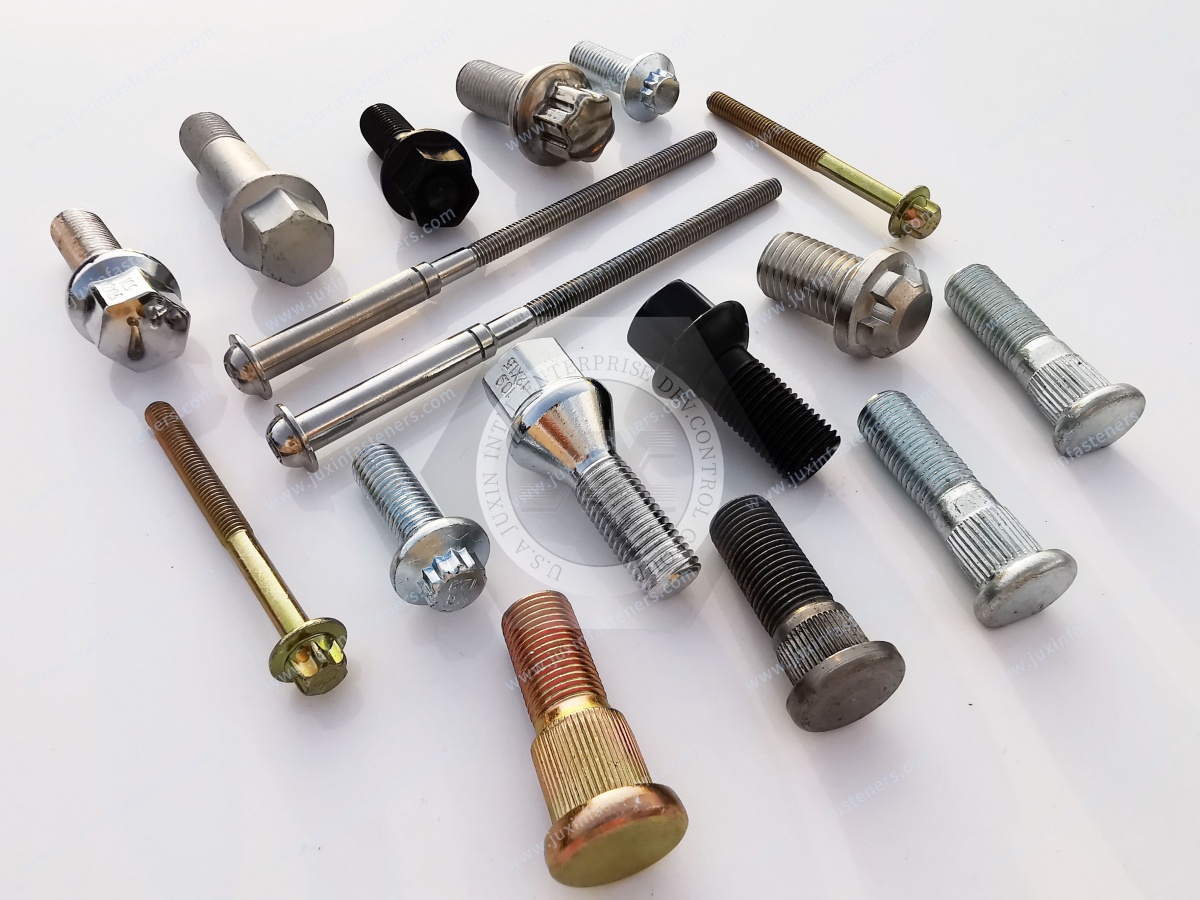
Zinc-nickel may be considered in demanding OEM applications requiring greater corrosion performance than conventional zinc systems.
But again:
Zinc-Nickel ≠ Automatic High-Strength Bolt Solution.
Engineers must still consider:
Hydrogen-related process risk
Coating thickness
Thread fit
Passivation
Sealer/topcoat
Friction
Torque-preload behavior
OEM specification
Corrosion resistance is only one part of the decision.
Non-electrolytically applied zinc flake coatings are used in many engineered fastener applications because the coating route can avoid some concerns associated with electrolytic deposition.
ISO 10683 addresses non-electrolytically applied zinc flake coating systems for fasteners within its scope.
However:
Zinc Flake ≠ Automatically Suitable for Every High-Strength Bolt.
The coating system still requires evaluation for:
Thickness
Thread fit
Friction
Corrosion requirement
Installation
Customer specification
JUXIN FASTENERS evaluates such surface-treatment requirements subject to drawing,
application and process review rather than treating every coating system as a standard interchangeable option.
| Requirement | Black Oxide | Electroplated Zinc | Zinc-Nickel | Hot-Dip Galvanizing |
|---|---|---|---|---|
| Minimal dimensional build | Strong advantage | Generally manageable | Generally manageable | Requires specific thread allowance |
| Basic corrosion protection | Limited without supplementary protection | Common industrial option | More demanding corrosion applications | Strong atmospheric sacrificial protection |
| Black appearance | Common | Possible with suitable conversion system | System-dependent | Not primary purpose |
| High-strength hydrogen consideration | Process route still matters | Important | Important | Pretreatment/process must be reviewed |
| Thread-fit consideration | Relatively small dimensional effect | Required | Required | Major design consideration |
| Friction control | Depends on oil/post-treatment | Depends on complete system | Depends on complete system | Depends on finished system |
| Typical selection driver | Dimensional stability / appearance | General industrial corrosion | Demanding OEM corrosion | Outdoor structural corrosion |
This table should be used as a selection framework—not as a universal coating ranking.
Corrosion coating discussions frequently become:
"How many salt spray hours?"
Salt spray testing can be useful for:
Process qualification
Comparative testing
Specification compliance
But:
Salt Spray Hours ≠ Field Service Life.
A fastener that reaches a particular laboratory test duration does not automatically correspond to a fixed number of years in:
Automotive service
Coastal environments
Industrial atmospheres
Wind turbines
Construction equipment
Actual field performance depends on:
Chloride exposure
Wet/dry cycling
Temperature
Chemicals
Damage
Joint geometry
Crevices
Dissimilar materials
Do not convert salt spray hours directly into years of service.
Even a well-coated bolt can be part of a poor corrosion system.
Consider:
Nut coating
Washer coating
Parent material
Damaged surfaces
Dissimilar metals
Water traps
Crevices
Installation damage
For example, replacing one component with a highly corrosion-resistant finish does not eliminate galvanic or crevice-corrosion risks elsewhere in the assembly.
Therefore:
Fastener Coating Selection Must Consider the Complete Joint.
Black oxide may be useful for high-strength bolts used in:
Machine tools
Industrial machinery
Motors
Gearboxes
Fixtures
Automation equipment
Indoor equipment
particularly when:
Dimensional build must be minimized
Black appearance is desired
Environmental exposure is controlled
Oil or supplementary protection is acceptable
But if machinery operates in:
Washdown environments
Outdoor exposure
Chemical environments
High humidity
the corrosion requirement should be reconsidered.
Construction and off-highway equipment can expose fasteners to:
Water
Mud
Road chemicals
Abrasion
Vibration
Temperature cycling
Black oxide should not automatically be selected simply because the bolt is property class 10.9 or 12.9.
The coating decision should be based on actual exposure and OEM requirements.
Possible systems may include zinc-based or other specified engineered coatings depending on the application.
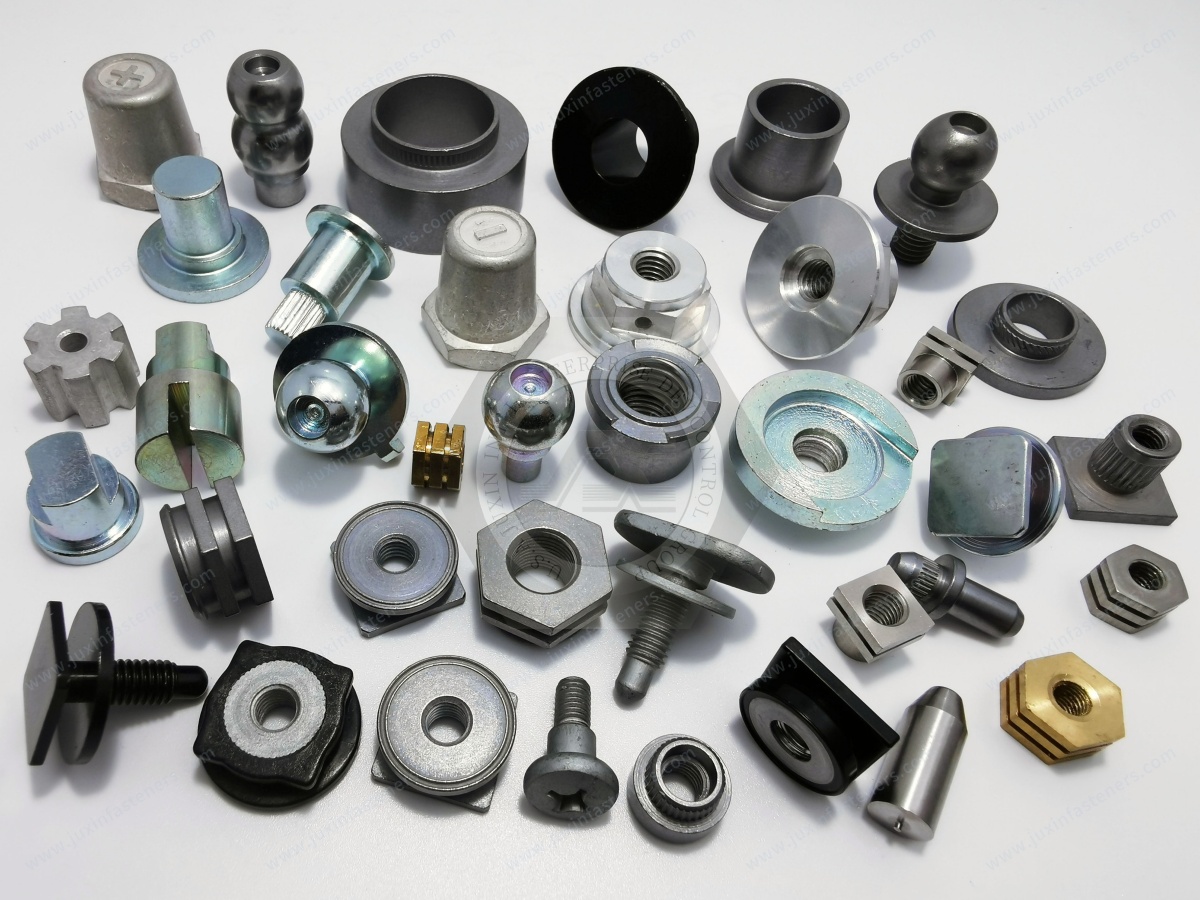
Automotive high-strength fasteners may require controlled combinations of:
Mechanical properties
Corrosion resistance
Friction
Torque-tension behavior
Appearance
Hydrogen-risk control
The surface finish is therefore part of the assembly engineering specification.
Automotive Bolt ≠ One Universal Coating.
Depending on location and OEM requirements, different fasteners within the same vehicle can use different surface-treatment systems.
Electric vehicles introduce additional concerns involving:
Mixed materials
Aluminum structures
Battery enclosures
Electrical isolation
Corrosion
Thermal cycling
A coated high-strength fastener may be mechanically suitable while the complete assembly still requires separate electrical and galvanic evaluation.
Therefore:
Coated Fastener ≠ Qualified Electrical Bond.
And:
Fastener Coating ≠ Battery-System Safety Qualification.
Wind-energy structures can contain large bolted connections exposed to:
Cyclic loading
Humidity
Outdoor weather
Coastal conditions
Difficult maintenance access
The coating selection must therefore consider both corrosion and tightening behavior.
Hot-dip galvanizing may be relevant for some fastener systems, while other applications may use different engineered coatings according to project requirements.
The correct finish is defined by the actual bolted connection and applicable specification—not by the industry name alone.
Railway and rolling-stock equipment can use high-strength fasteners in very different application classes.
Examples include:
Equipment mounting
HVAC
Interior structures
Electrical equipment
Secondary brackets
Exterior equipment
Primary structural, running gear, braking and other safety-critical connections require formal OEM/project-specific requirements and validation.
Therefore:
High-Strength Bolt + Coating ≠ Railway Safety Qualification.
A practical engineering decision can follow seven steps.
Identify:
Property class
Material
Hardness
Required proof/tensile properties
Fatigue considerations
Identify:
Indoor or outdoor
Humidity
Chlorides
Chemicals
Temperature
Wet/dry cycling
Specify:
Applicable coating standard
Corrosion test
White/red corrosion criteria where relevant
Customer-specific acceptance
Review:
Fastener strength/hardness
Pretreatment
Pickling
Electrochemical processes
Applicable post-treatment
Manufacturing controls
Review:
ISO metric thread tolerance
Coating build
Final gauging
HDG-specific thread allowance where applicable
Review:
Lubrication
Friction requirement
Installation torque
Torque-angle strategy where applicable
Target preload
Validate:
Dimensions
Mechanical properties
Coating
Thread fit
Installation behavior
Functional requirements
The decision is therefore:
Finished Fastener Qualification, not merely coating selection.
| Observed Problem | Possible Cause | Engineering Check |
|---|---|---|
| Bolt jams during assembly | Coating consumed thread clearance | Review final thread allowance and gauging |
| Correct torque but low preload | Friction higher than expected | Review coating/lubrication and torque-preload relationship |
| Excessive preload at specified torque | Friction lower than expected | Revalidate tightening specification |
| Delayed brittle fracture | Hydrogen-related or other metallurgical failure mechanism | Perform formal failure analysis |
| Black bolt corrodes rapidly outdoors | Black oxide protection unsuitable for environment | Reassess corrosion system |
| Galvanized bolt will not fit nut | Incorrect HDG thread allowance | Review ISO 10684 thread system |
| Coating passes salt spray but fails in field | Laboratory exposure not representative of service | Review real environment and assembly |
| Surface changed but torque spec remained unchanged | Coating substitution not fully qualified | Revalidate installation |
| Same property-class bolt behaves differently | Material, coating, friction or process differs | Perform second-source comparison |
Procurement should not qualify a supplier using only:
Bolt dimensions
Property class
Surface color
Price
A proper qualification should compare:
Drawing + Revision + Material + Mechanical Properties + Heat Treatment + Hardness + Thread + Geometry + Surface Treatment
+ Pretreatment + Coating Thickness + Friction + Installation Behavior + Functional Testing + Documentation + Change Control
For high-strength fasteners, ask:
Which material is used?
How is heat treatment controlled?
What mechanical properties are verified?
What hardness range applies?
What coating specification applies?
What pretreatment is used?
Is acid pickling involved?
How is hydrogen risk controlled?
Is post-treatment required by the specification?
What final thread requirement applies?
How is coating thickness controlled?
Is friction controlled?
How is torque-preload behavior validated?
Are coating-process changes controlled?
These questions provide much more sourcing value than asking only:
"Can you make black 10.9 bolts?"
Two black bolts can look identical while having different:
Material
Heat treatment
Hardness
Surface treatment
Oil/post-treatment
Friction
Hydrogen history
Mechanical performance
Likewise, two galvanized bolts can have different:
Zinc thickness
Thread allowance
Lubrication
Friction
Process route
Therefore:
Same Appearance ≠ Same Surface Treatment.
Same Dimensions ≠ Functional Equivalence.
A second source should be qualified from the drawing and functional requirements rather than visual similarity.
Surface-treatment decisions affect more than the fastener purchase price.
Consider:
Total Installed Cost = Part Price + Coating + Installation + Tooling + Inspection + Rework + Scrap + Downtime + Logistics + Warranty Risk + Supply Risk
A low-cost black oxide bolt may be expensive if it corrodes prematurely in an exposed application.
A corrosion-resistant coating may also become expensive if uncontrolled friction creates assembly failures.
Likewise, specifying HDG where it is unnecessary may introduce thread, assembly and cost complexity without corresponding application value.
The best finish is the one that meets the actual joint requirement at the lowest controlled lifecycle cost.
JUXIN FASTENERS supports standard and drawing-based fasteners for OEM and industrial applications, including:
Carbon steel bolts and screws
Drawing-based high-strength fastener requirements
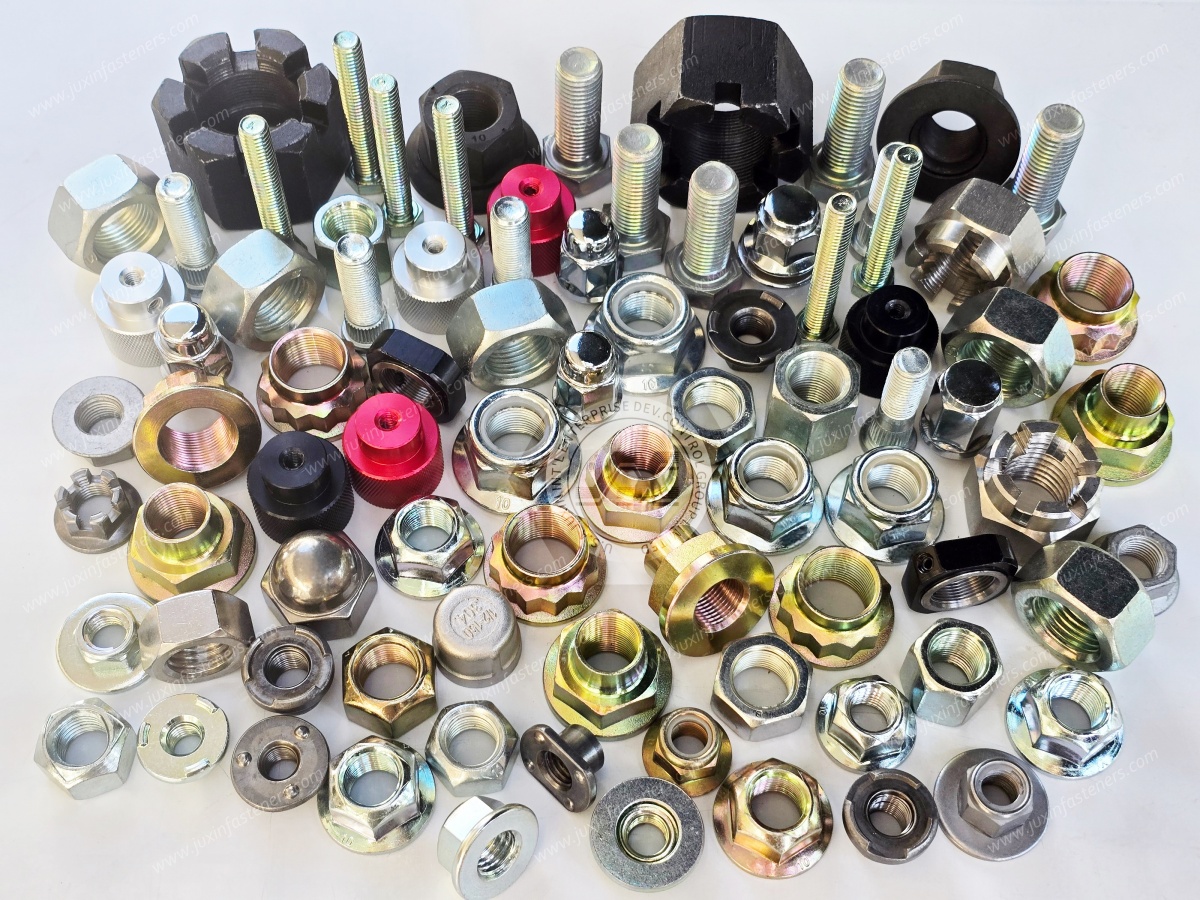
Nuts
Nylon insert lock nuts
All-metal lock nuts
All-metal flange lock nuts
Weld nuts
Weld studs
Precision washers
Self-clinching fasteners
Custom cold-formed fasteners
CNC machined components
Relevant surface-treatment requirements can be evaluated according to:
Drawing
Material
Mechanical property requirements
Thread tolerance
Corrosion requirement
Friction requirement
Installation method
Application environment
Customer specification
Commonly requested finishes such as black oxide, zinc plating and zinc-nickel can be reviewed according to the actual product requirement.
Other coating systems, including hot-dip galvanizing or zinc flake, should be evaluated subject to the applicable fastener,
drawing, process and project specification rather than assumed as interchangeable standard options.
No. Surface treatment depends on the application, environment, joint design and applicable specification.
Do not apply a universal yes/no rule. The fastener, material, process, property class and applicable requirements such as ISO 10684 must be reviewed.
No. That statement is too broad. Metallurgical compatibility depends on the actual fastener and galvanizing process and must be evaluated against the applicable standard.
Not automatically. Hydrogen risk depends on the complete manufacturing and surface-preparation route.
It provides limited protection and is commonly supplemented with oil or another post-treatment. It should not be treated as equivalent to substantial zinc-based corrosion protection.
Only if the resulting corrosion performance is appropriate for the actual environment and maintenance strategy. Outdoor exposure alone does not define suitability.
Yes. The substantial coating build requires an appropriate thread allowance system. ISO 10684 addresses hot-dip galvanized fasteners within its scope.
Do not assume so. Surface treatment and lubrication can change friction and therefore the torque-preload relationship.
No. Appearance alone cannot identify the surface-treatment chemistry.
No. Salt spray testing is useful for controlled comparative or specification testing but should not be directly converted into field service life.
No. They serve different requirements. Zinc-nickel may offer substantially different corrosion performance,
but coating selection must also consider dimensions, friction, hydrogen risk, cost and application.
Provide the drawing, property class, exact surface-treatment specification, post-treatment, thread requirements, corrosion requirement, friction requirement and application.
No. Marking and appearance do not establish complete material, heat-treatment, coating or functional compliance.
Provide the applicable fastener and galvanizing specification, property class, thread system, corrosion requirement,
lubrication/friction requirement and installation requirements.
For an engineered OEM joint, a coating change can affect corrosion, friction, hydrogen risk and dimensions.
It should be reviewed through the applicable engineering change-control process.
Compare the complete finished fastener specification—not merely diameter, length, property class and color.
For accurate technical and commercial evaluation, provide:
2D drawing
3D model if available
Part number
Drawing revision
Application
Fastener type
Thread size
Thread pitch
Thread tolerance
Fastener length
Grip length
Material
Mechanical property class
Heat treatment
Hardness requirement
Surface treatment
Exact coating specification
Coating thickness where applicable
Black oxide post-treatment where applicable
Passivation where applicable
Sealer/topcoat where applicable
Hot-dip galvanizing requirement where applicable
Final thread requirement
Corrosion requirement
Salt spray test requirement where applicable
White/red corrosion acceptance criteria where applicable
Friction requirement
Lubrication requirement
Installation torque
Target preload where applicable
Torque-angle requirement where applicable
Mating nut
Washer
Joint material
Service temperature
Outdoor exposure
Chloride exposure
Chemical exposure
Vibration
Fatigue requirement
Hydrogen embrittlement control requirement
Functional testing
Inspection documentation
PPAP or customer-specific documentation where applicable
Annual volume
Existing approved sample for second-source development where available
If the project involves changing an existing coating, also provide the current approved finish
and tightening specification so that the proposed change can be evaluated as a complete system.
This page should connect internally with existing JUXIN FASTENERS resources covering:
Fastener surface finish selection
Zinc plating vs. zinc-nickel coating
Trivalent vs. hexavalent chromate
Zinc plating color variation
PTFE-coated fasteners
Hydrogen embrittlement in high-strength fasteners
ISO metric thread tolerances and 6H/6g thread fit
Bolt tightening and over-torque
Torque, friction and preload
Bolt and nut strength class matching
Spring lock washers and flat washers
Automotive fastening solutions
Railway fastening solutions
Custom OEM fasteners
Second-source fastener qualification
Use the existing indexed JUXIN FASTENERS URL when implementing each internal link.
The intended content path is:
High-Strength Bolt → Material & Heat Treatment → Environment → Coating Selection → Hydrogen Risk
→ Thread Fit → Friction & Preload → Application Validation → Supplier Qualification → RFQ
The most important correction to the old black-oxide-versus-HDG discussion is that neither finish should be selected from a simplistic rule.
The decision should not be:
High Strength = Black Oxide
or:
Outdoor = Hot-Dip Galvanized
Instead, use:
Mechanical Properties → Environment → Corrosion Requirement → Metallurgical Risk → Coating Process → Thread Allowance → Friction → Preload → Joint Validation
Black oxide can be an effective finish where minimal dimensional build, black appearance and controlled-environment service are important.
Hot-dip galvanizing can provide substantial sacrificial corrosion protection when the fastener system is correctly designed and qualified for the process.
Other systems such as zinc plating, zinc-nickel and non-electrolytic coatings may be appropriate for different OEM requirements.
But in every case:
Property Class ≠ Coating Specification.
Black Appearance ≠ Black Oxide Specification.
Coating Name ≠ Complete Coating Specification.
Torque ≠ Preload.
Same Torque + Different Friction ≠ Same Preload.
Salt Spray Hours ≠ Field Service Life.
Corrosion-Resistant Fastener ≠ Corrosion-Resistant Assembly.
Same Dimensions ≠ Functional Equivalence.
For design engineers, this framework connects coating selection to actual bolted-joint mechanics.
For quality teams, it separates appearance from process and performance.
For procurement and supplier-development teams, it provides a much stronger basis for RFQs, second-source qualification and engineering change control.
JUXIN FASTENERS supports OEM, Tier-1, Tier-2 and industrial manufacturers with carbon steel fasteners, drawing-based high-strength fastener requirements,
nuts, lock nuts, weld nuts, weld studs, precision washers, self-clinching fasteners, custom cold-formed components and CNC machined parts.
For a high-strength bolt project, coating conversion, corrosion problem, torque-preload issue or second-source qualification, send your drawing, revision,
material and mechanical requirements, thread specification, surface treatment, corrosion requirement, friction requirement, installation conditions and annual volume for technical review.
JUXIN FASTENERS
Email: info@juxinfasteners.com
Website: www.juxinfasteners.com
Contact Us
Tel.:
+86 020 8621 0320
+86 020 3121 6067
E-mail:
Technical Support:
Navigation
SEND INQUIREY



