
Call Us
+86 136 6007 9809
Call Us
+86 136 6007 9809

Sep. 08, 2026
Industrial design and procurement teams specifying mating hardware for plastic assemblies require components that complement screw and bolt selections without introducing unnecessary electrical conductivity, galvanic interaction, excessive weight, or surface damage. Custom plastic nuts, nylon washers, industrial plastic spacers, and threaded standoffs form an important part of complete polymer fastening systems.
In applications ranging from electronic control panels and PCB assemblies to automotive components, EV battery systems, telecommunications equipment, semiconductor equipment,
HVAC systems, industrial machinery, and electrical enclosures, the correct mating hardware can influence clamping-load distribution, component positioning, electrical isolation, assembly access, and long-term dimensional stability.
The selection process should therefore consider more than nominal size. Engineers and procurement teams should evaluate the polymer family, material grade, thread configuration,
component geometry, mating fastener, substrate, operating environment, assembly method, inspection requirements, and expected service conditions.
JUXIN FASTENERS acts as an engineering-oriented supplier of industrial fastening and custom component solutions, supporting global OEM supply chains through manufacturing review, drawing-based production, multi-SKU BOM consolidation, and quality verification.
This guide outlines the engineering parameters, material performance considerations, application requirements, and procurement protocols necessary for specifying plastic nuts, washers, spacers, and standoffs for industrial OEM assemblies.
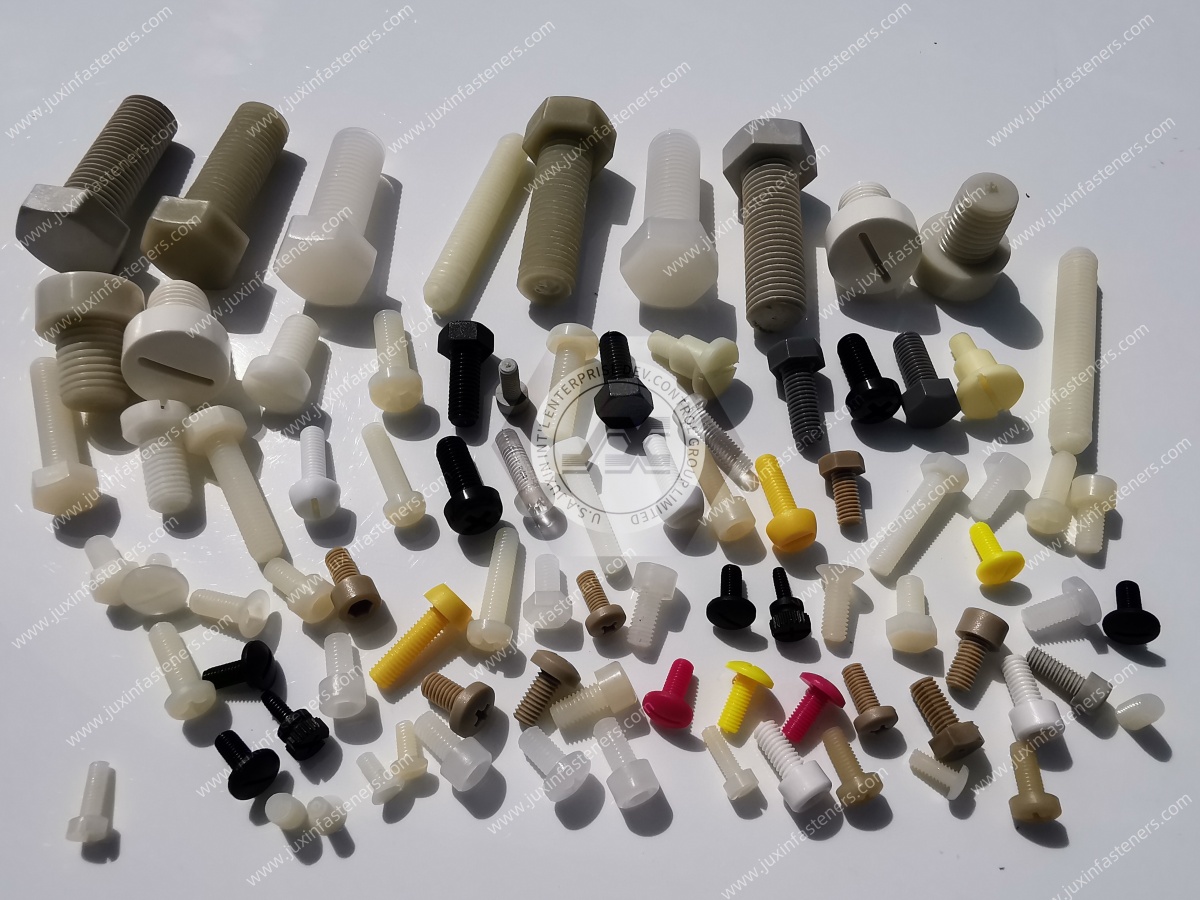
Selecting the correct mating nut ensures that the fastening system is compatible with the screw or bolt, installation method, available assembly space, substrate, and service environment.
Industrial applications utilize several primary configurations.
Standard hex nuts provide conventional wrenching flats for general clamping applications.
Depending on the application, engineers may specify metric threads based on the applicable ISO thread system or inch-based Unified Thread configurations used in accordance with relevant ASME/ANSI engineering practice.
The nominal thread size alone is not always sufficient for procurement. The drawing should identify the applicable thread system, nominal diameter, pitch, thread depth, and any required tolerance or functional requirements.
Nylon hex nuts and other engineering-plastic nuts are commonly selected where the assembly requires non-metallic fastening characteristics.
Potential advantages include:
Electrical isolation
Low component weight
Resistance to selected corrosive environments
Reduced risk of scratching sensitive surfaces
Compatibility with polymer and composite assemblies
Non-metallic fastening around electronic equipment
However, polymer materials do not behave exactly like metals under sustained load.
Engineers should evaluate moisture absorption, creep, temperature exposure, thread condition, tightening method, material grade, and long-term dimensional stability before replacing a metallic nut with a polymer nut.
This distinction is particularly important for assemblies exposed to elevated temperatures, continuous loading, humidity, or repeated installation.
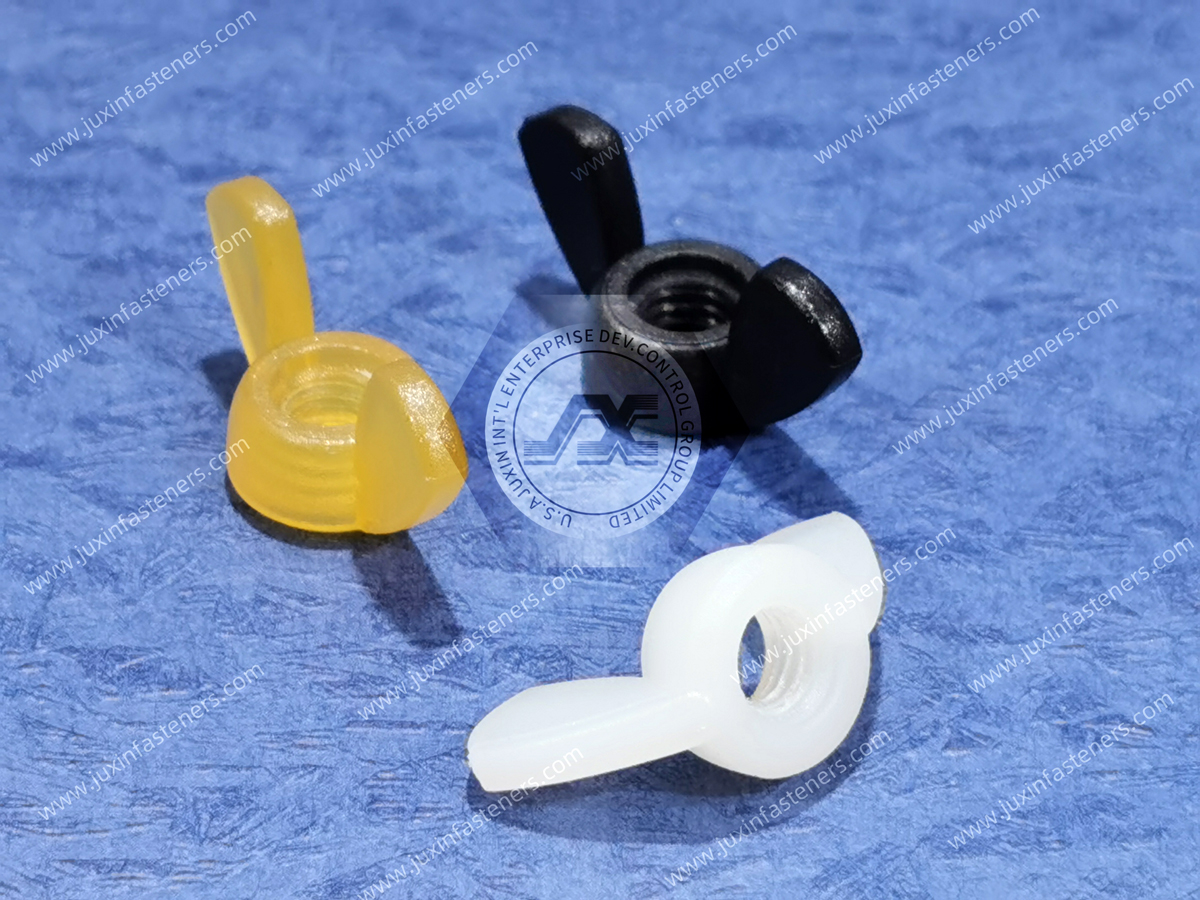
Wing nuts and thumb nuts are designed for applications where manual tightening, adjustment, or frequent access is important.
Potential applications include:
Instrument covers
Access panels
Electronic enclosures
Serviceable equipment
Adjustment mechanisms
Fixtures
The expected tightening frequency and required clamping condition should be considered when selecting this type of hardware.
Flange nuts incorporate an enlarged bearing surface around the fastening point.
The larger bearing area can help distribute contact pressure over a wider region of the mating surface compared with a smaller bearing interface.
This can be useful when fastening to relatively soft polymer, composite, painted, or sensitive substrates.
Actual load distribution depends on the nut geometry, mating washer or flange, substrate properties, fastener dimensions, tightening method, and joint design.
Where cyclic loading or vibration is present, engineers may consider locking or prevailing-torque configurations.
The engineering evaluation should consider:
Thread configuration
Mating screw specification
Expected vibration
Assembly frequency
Installation requirements
Reusability requirements
Temperature
Environmental exposure
Required joint performance
A component described as a “locking nut” should not automatically be treated as a universal solution for every vibration environment. The complete joint should be evaluated, including the screw, nut, substrate, preload, joint stiffness, and operating conditions.
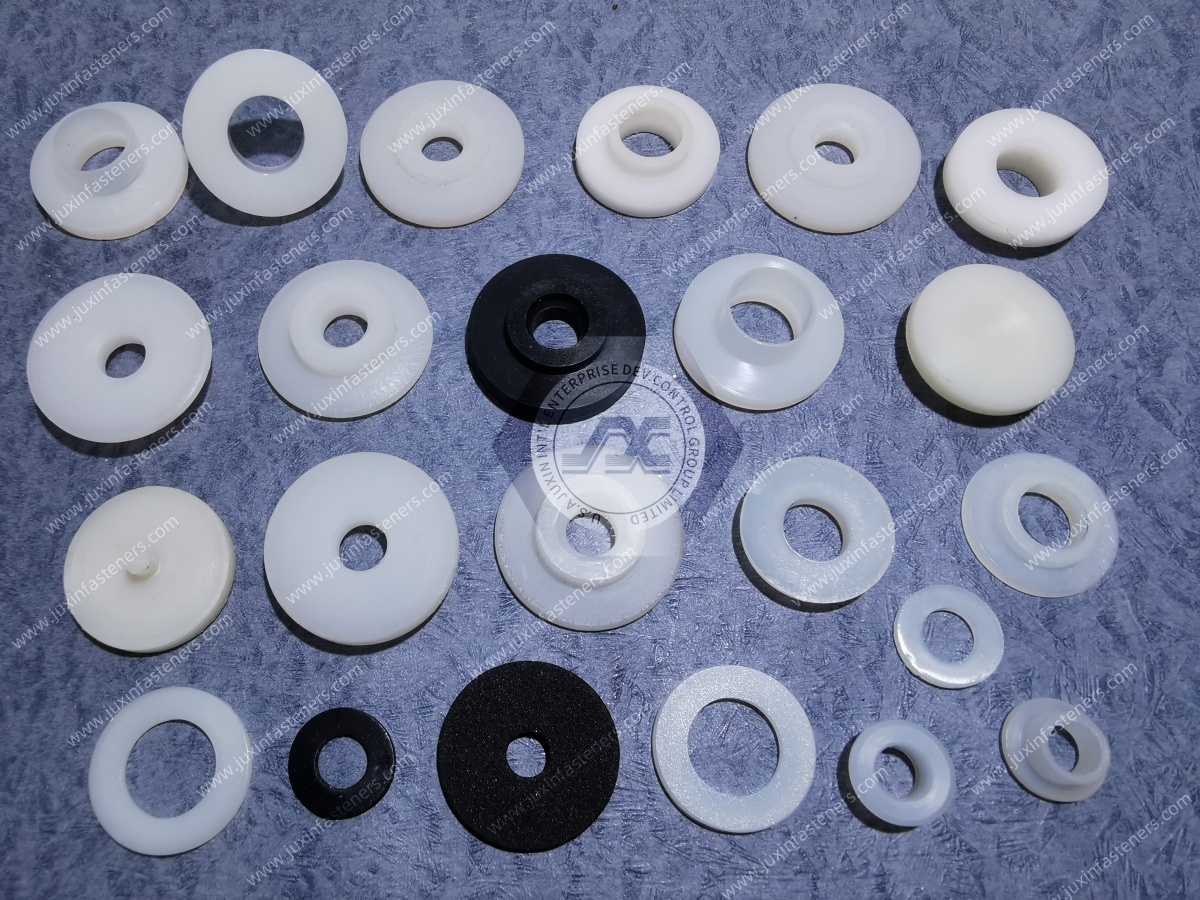
Washers and spacers are often treated as secondary hardware, but they can perform important mechanical, electrical, dimensional, and surface-protection functions.
Plastic flat washers distribute contact pressure around a clearance hole and can prevent direct metal-to-surface contact.
Typical applications include:
Electrical cabinets
Control panels
Electronics housings
HVAC equipment
Automotive components
Machinery
Sheet metal assemblies
Plastic enclosures
The inside diameter, outside diameter, thickness, and material should be selected according to the fastening geometry and load condition.
Where an established dimensional standard applies, the engineering drawing should identify the applicable standard rather than assuming that all plastic washers share the same dimensional requirements.
Nylon insulating washers are widely used when the design requires electrical separation or protection of the mating surface.
They can separate a metallic fastener from a conductive panel and help prevent an unintended conductive path through the fastening interface.
However, “nylon washer” should not automatically be interpreted as a certified insulation component for every electrical application.
Engineers should consider:
Operating voltage
Working temperature
Moisture
Contamination
Creepage
Clearance
Dielectric requirements
Material properties
Surrounding conductive components
Where regulatory or product-specific electrical requirements apply, the applicable certification or system standard should be specified separately.
Shoulder washers incorporate a raised insulating section around the fastener opening.
Depending on the design, this geometry can help isolate the fastener shank from the mounting hole while also providing a bearing or insulating interface around the fastener head.
Potential applications include:
Electrical cabinets
PCB assemblies
Power electronics
Transformers
Instrumentation
Telecommunications equipment
Antenna systems
Battery-related electrical assemblies
The exact insulating function depends on the washer geometry, material, installation method, and surrounding assembly.
Finishing washers can provide a more controlled appearance around exposed fasteners.
They may be used in:
Consumer electronics
Smart home equipment
Visible equipment housings
Commercial equipment
Instrument panels
For appearance-critical applications, the RFQ should identify material, geometry, color, surface appearance, and dimensional requirements.
Industrial plastic spacers maintain a defined physical separation between components.
They can be used to:
Maintain an air gap
Separate circuit boards
Position mounting plates
Prevent direct component contact
Control assembly height
Provide electrical separation
Create repeatable mechanical spacing
For electronics applications, PCB nylon standoffs are particularly useful because they combine spacing and fastening functions.
Material selection directly affects the service behavior of nuts, washers, spacers, and standoffs.
The polymer family can influence:
Mechanical strength
Stiffness
Creep behavior
Moisture absorption
Dimensional stability
Chemical resistance
Electrical characteristics
Thermal performance
Wear behavior
Manufacturing requirements
The following comparison provides an engineering starting point.
| Material Family | Typical Industrial Grades | Key Mechanical & Thermal Characteristics | Primary Applications | Design & Sourcing Considerations |
|---|---|---|---|---|
| Nylon / Polyamide | PA6, PA66, unfilled or reinforced grades | Good mechanical performance-to-weight ratio, toughness and electrical insulation | Electrical enclosures, consumer appliances, electronics and general industrial hardware | Evaluate moisture absorption, dimensional change, creep, temperature and long-term loading |
| POM / Acetal | Homopolymer / Copolymer | High stiffness, low friction, dimensional stability and wear characteristics | Precision spacers, bushings, sliding components and mechanical assemblies | Evaluate friction, chemical compatibility, thread behavior and dimensional requirements |
| PVDF | Various industrial grades | High resistance to many aggressive chemicals and useful environmental resistance | Chemical processing, semiconductor equipment and wet-process systems | Evaluate the specific chemical, concentration, temperature and exposure duration |
| PEEK | Various high-performance grades | High-performance mechanical, thermal and wear characteristics | High-temperature electronics, semiconductor equipment and specialized industrial machinery | Higher material and processing cost; grade, geometry and tolerance requirements should be reviewed carefully |
Both PA6 and PA66 belong to the polyamide family, but they should not automatically be treated as interchangeable materials.
Engineers should consider:
Moisture exposure
Operating temperature
Dimensional requirements
Mechanical loading
Thread retention
Required stiffness
Component geometry
Processing requirements
For precision plastic hardware, the material designation on the drawing should be sufficiently specific to avoid ambiguity during sourcing.
Glass-filled polyamide can provide increased stiffness and dimensional stability compared with appropriate unfilled grades.
However, reinforcement also changes processing and material behavior.
Potential considerations include:
Molding flow
Surface appearance
Machining behavior
Dimensional behavior
Material anisotropy
Cost
Resin grade
Therefore, “glass-filled nylon” by itself may not be a sufficiently complete engineering specification for a critical OEM component.
Where material performance is important, the required resin grade should be identified.
One of the most important engineering considerations when specifying nylon hardware is moisture absorption.
Polyamide materials can absorb moisture from the surrounding environment, which can influence dimensional and mechanical behavior.
This should be considered particularly for applications involving:
High humidity
Outdoor exposure
Tight dimensional tolerances
Precision electrical assemblies
Long-term storage
Environmental cycling
For threaded components, changes in material condition can influence dimensional relationships between mating threads.
Therefore, procurement specifications should avoid treating nylon as dimensionally identical to a non-hygroscopic engineering material.
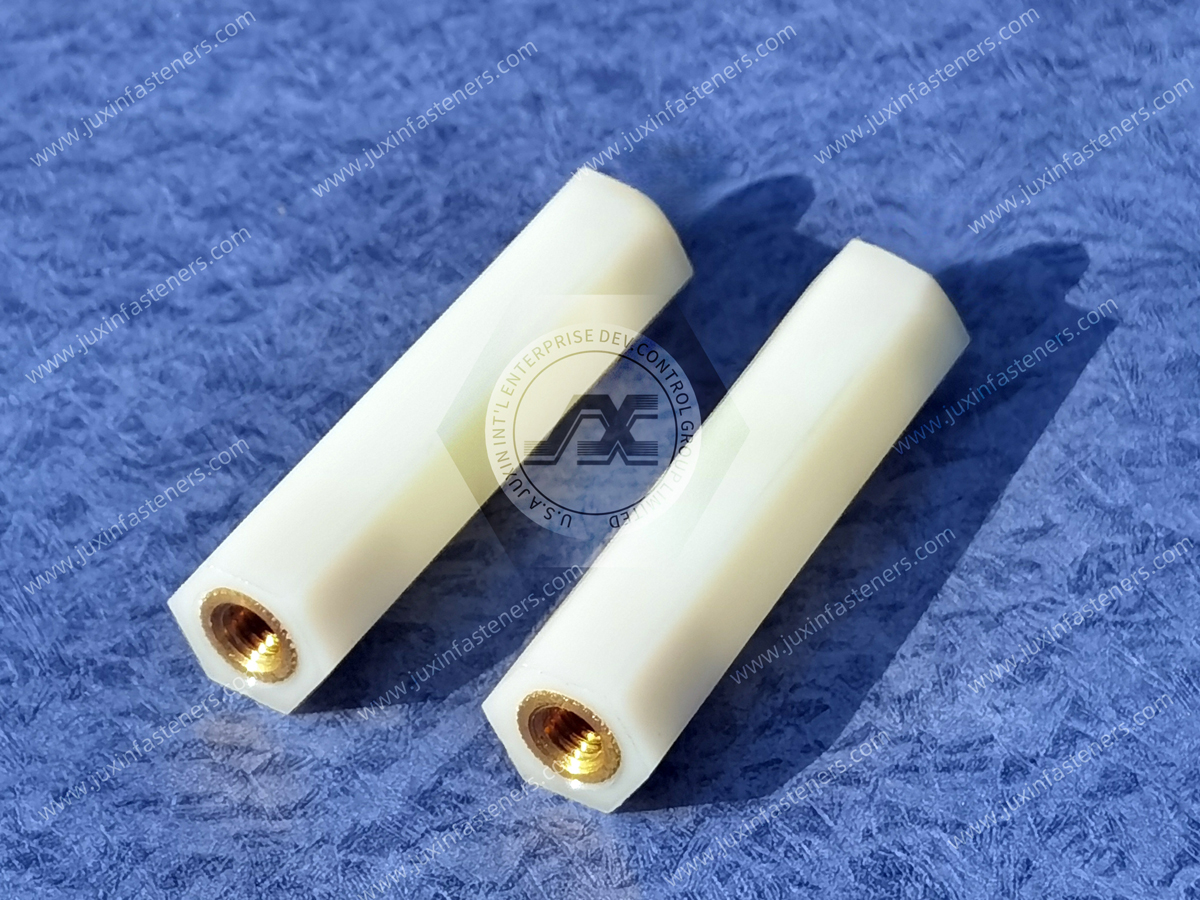
When mounting PCBs, panels, electronic modules, or stacked industrial subassemblies, the choice between a spacer and a standoff depends on how the joint is assembled.
Unthreaded spacers are generally tubular components with a defined inside diameter and outside diameter.
A screw, bolt, or tie-rod passes through the spacer while the spacer establishes the required separation distance.
This configuration is useful when the entire assembly stack is clamped by one continuous fastening system.
Typical applications include:
PCB mounting
Panel spacing
Electrical cabinets
Machinery
Instrumentation
Structural subassemblies
Female-to-female standoffs contain internal threads at both ends.
They allow two components to be independently fastened to the same standoff.
This configuration is particularly useful for modular electronic assemblies where controlled spacing and service access are required.
Male-to-female standoffs combine an external thread on one end with an internal thread on the other.
This configuration can simplify stacked assemblies where one mounting point needs to connect directly to another.
A practical engineering decision path is:
Through-bolt joint → unthreaded spacer
Independent component fastening → threaded standoff
Stacked electronic assembly → select female-female or male-female according to the mounting geometry
Electrical isolation requirement → select appropriate polymer and insulating geometry
Frequent service access → evaluate thread configuration and assembly accessibility
The distinction between a spacer and a standoff should therefore be based on the actual function of the component rather than simply the product name used by a catalogue.
Electrical isolation is one of the major applications for polymer fastening components.
Plastic nuts and washers can be useful when the design requires separation between conductive components.
Typical applications include:
Electrical control cabinets
Power supplies
Transformers
PCB assemblies
Battery systems
Telecommunications equipment
Antenna assemblies
Instrumentation
Electronic housings
Smart home devices
However, electrical isolation should be evaluated as part of the complete system.
Engineers should consider:
Operating voltage
Working temperature
Environmental contamination
Moisture
Creepage distance
Clearance
Dielectric requirements
Material properties
Adjacent conductive surfaces
A polymer washer should therefore not be specified simply as “insulating” without defining the electrical requirements of the assembly.
Where a particular regulatory or safety requirement applies, the engineering team should identify the applicable product, material, or system standard separately.
This is an important difference between polymer and metallic fastening components.
A metal nut and a polymer nut do not respond identically under sustained mechanical loading.
Engineering plastics can exhibit creep and stress relaxation under load, with the behavior influenced by temperature, material grade, stress level, geometry, and duration.
For a joint using plastic nuts, standoffs, or spacers, engineers should therefore consider:
Initial assembly load
Long-term clamping condition
Temperature
Load duration
Material grade
Component geometry
Thread configuration
Joint stiffness
Environmental exposure
This does not mean plastic hardware is unsuitable for loaded assemblies.
It means the joint should be designed according to polymer behavior rather than simply copying a metallic fastening design.
For applications involving continuous structural loading, elevated temperature, significant vibration, or demanding dimensional requirements,
the drawing and service conditions should be reviewed before material selection is finalized.
The application range extends well beyond consumer electronics.
Plastic fastening components can support:
Electrical isolation
Lightweight assemblies
Sensor mounting
Electronic housings
Battery-related components
Cable and harness systems
Interior and trim assemblies
For EV battery pack applications, material selection should consider electrical isolation, temperature, environmental exposure, assembly geometry, surrounding materials, and the required mechanical function.
Plastic washers, spacers, insulating components, and custom polymer hardware can be integrated into larger battery-pack fastening architectures where the application permits.
Battery-related assemblies can require non-metallic components for:
Electrical separation
Component spacing
Insulation interfaces
Cable and harness positioning
Module mounting
Enclosure interfaces
The selected polymer must be evaluated against the actual thermal, electrical, mechanical and environmental requirements.
Plastic washers, shoulder washers, nuts, spacers and standoffs can be used in:
Control cabinets
Electrical enclosures
Power electronics
Transformers
Instrumentation
Industrial control systems
They can provide separation between fastening hardware and conductive structures where the design requires electrical isolation.
Common applications include:
PCB standoffs
PCB spacers
Nylon washers
Insulating washers
Threaded mounting hardware
Electronic enclosure hardware
The required board-to-panel distance and fastening architecture determine whether a spacer or threaded standoff is more appropriate.
Plastic fastening components can be useful where:
Electrical isolation is required
Weight needs to be controlled
Sensitive surfaces require protection
Environmental resistance is required
Non-metallic components are preferred
Applications can include telecommunications equipment, base stations, antenna assemblies, communication enclosures and related electronic hardware.
Semiconductor equipment may require specialized polymer components for:
Electrical isolation
Chemical exposure
Precision positioning
Component spacing
Process equipment assemblies
Materials such as PVDF or PEEK may be considered where the operating environment exceeds the practical capability of standard nylon.
Material compatibility should be evaluated against the actual process chemicals, temperature, exposure duration, cleaning process, and dimensional requirements.
Rail applications may use polymer hardware in selected assemblies where weight, electrical isolation, environmental exposure, surface protection, or component positioning are relevant.
For rail projects, the applicable customer and system requirements should be defined before material and compliance claims are made.
Aerospace applications can involve demanding requirements for:
Weight
Environmental exposure
Electrical isolation
Dimensional stability
Mechanical reliability
Documentation
Traceability
Material and compliance requirements should be established at the project level rather than assuming that a general-purpose polymer component is automatically suitable for aerospace service.
Plastic washers, spacers, nuts and insulating components can be used in:
Control systems
Electrical housings
Sensors
Fan and motor assemblies
Instrumentation
Panel systems
The material should be selected according to the thermal, humidity, vibration and electrical environment.
Polymer hardware can be useful where electrical isolation, surface protection, weight reduction, or specific material compatibility is required.
For regulated medical equipment, however, the component specification must follow the applicable requirements of the finished product and customer quality system.
Robotic and automation systems may use polymer spacers and fastening components for:
Sensors
Control modules
Cable management
Electrical isolation
Lightweight subassemblies
Positioning components
The expected vibration, repeated motion, temperature, and service conditions should be considered when selecting the material and geometry.
Plastic washers and insulating components are particularly useful when fastening into:
Painted sheet metal
Aluminum panels
Stainless steel enclosures
Electrical cabinets
Thin metal housings
The washer geometry can help distribute contact pressure and protect the panel surface.
Smart home devices and consumer equipment may use plastic nuts, washers, spacers, and standoffs in:
Electronic housings
PCB assemblies
Sensors
Mounting brackets
Control modules
Display systems
For visible components, appearance, color consistency, dimensional stability, and assembly quality may become important sourcing requirements.
Plastic spacers, washers and insulating hardware can also be applied to:
Computer mounting brackets
Transformer assemblies
Instrument panels
Measurement equipment
Control modules
Industrial instrumentation
These applications often combine mechanical positioning with electrical isolation or surface protection.
Submitting a comprehensive Request for Quotation streamlines technical evaluation, sourcing comparison, and tooling or production planning.
Procurement managers and design engineers should provide as much of the following information as practical.
Specify the required hardware type:
Plastic hex nut
Nylon hex nut
Plastic flat washer
Nylon insulating washer
Shoulder washer
Cup washer
Threaded standoff
Female-female standoff
Male-female standoff
Unthreaded spacer
Custom plastic component
Identify:
Metric or Unified Thread
Nominal thread size
Thread pitch
Internal or external thread
Thread class where applicable
Thread depth
Through or blind thread
Mating screw specification
Metric requirements should identify the applicable ISO thread system.
Inch-based requirements should identify the applicable Unified Thread configuration and engineering requirements.
Provide:
2D technical drawing
3D CAD model
Outside diameter
Inside diameter
Thickness
Overall length
Thread dimensions
Head or flange dimensions
Chamfers
Radii
Critical tolerances
Datum requirements where applicable
A complete drawing significantly reduces technical clarification during quotation.
Do not simply specify “plastic” or “nylon” where the material affects component performance.
Where applicable, identify:
PA6
PA66
Glass-filled PA
POM
PVDF
PEEK
Required resin grade
Color
Surface requirements
Reinforcement
Material certification requirements
If the component is exposed to chemicals, heat, humidity, or sustained loading, the service environment should accompany the material specification.
Provide the actual service environment, including:
Operating temperature
Humidity
Chemical exposure
UV exposure
Outdoor or indoor use
Electrical environment
Vibration
Mechanical loading
Cleaning process
This information helps determine whether a standard nylon component is appropriate or whether another engineering polymer should be considered.
Include:
Installation method
Assembly frequency
Required tightening approach
Mating fastener material
Reusability requirements
Manual or automated assembly
Required assembly sequence
For polymer threaded components, assembly requirements are particularly important because excessive tightening can damage threads or deform the component.
OEM procurement teams may specify:
Dimensional inspection
Material verification
Appearance inspection
Functional testing
Sampling requirements
Inspection reports
Certificate requirements
Traceability requirements
Packaging specifications
The applicable quality requirements should be clearly stated in the RFQ.
For strategic sourcing, include:
Annual demand
Initial order quantity
Forecast volume
Batch size
Number of SKUs
Packaging requirements
Labeling requirements
Delivery requirements
Destination market
Approved supplier requirements
Multi-SKU BOM consolidation requirements
This is particularly important for OEM programs where one project may contain dozens or hundreds of related fastening components.
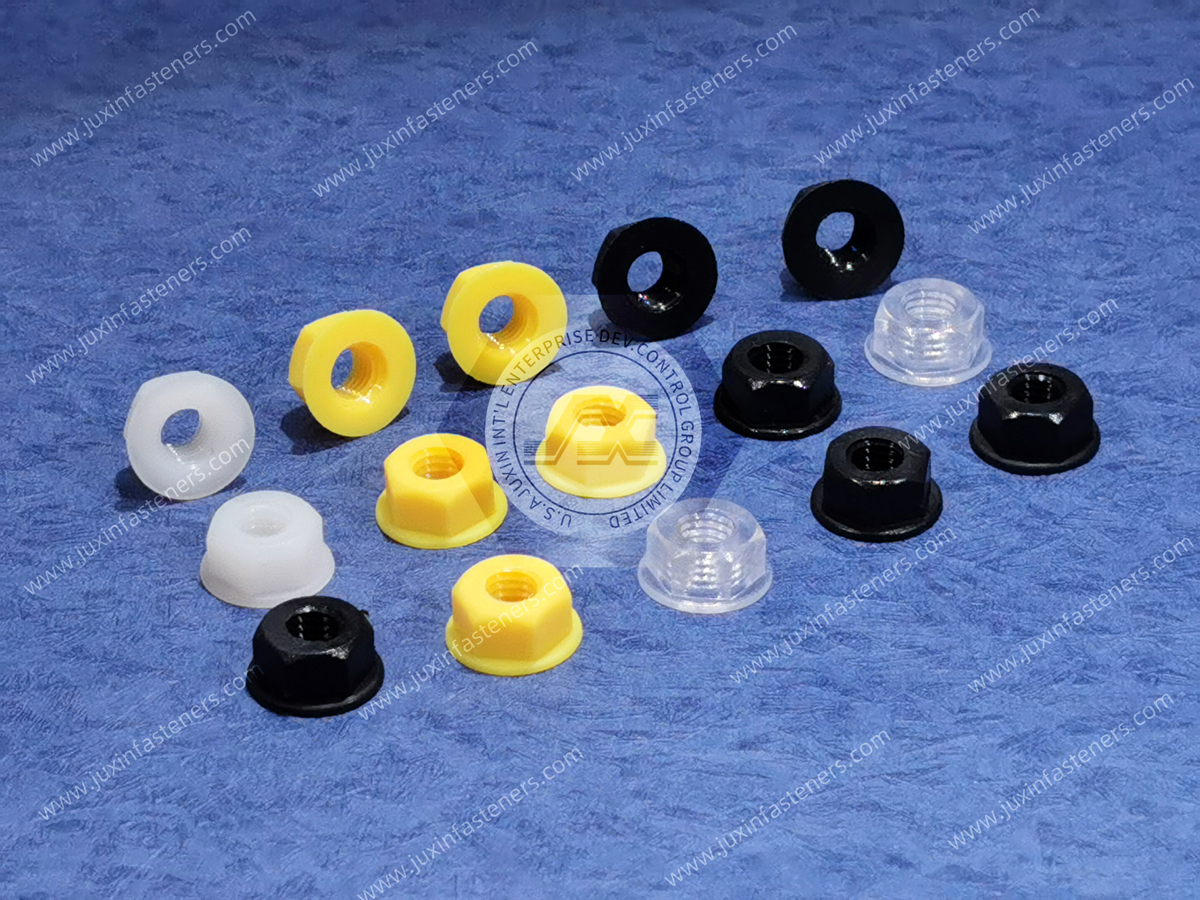
Standard components are useful when the required geometry, material, dimensions, and thread configuration already match an established specification.
Custom components become more valuable when the application requires:
Non-standard dimensions
Special thread configurations
Specific material grades
Custom colors
Integrated features
Special washer geometry
Non-standard standoff lengths
Custom packaging
Multi-SKU production
Drawing-specific tolerances
For OEM projects, customization should begin with the engineering drawing rather than simply modifying an off-the-shelf component after production begins.
A professional sourcing workflow connects:
Geometry → Material → Manufacturing Process → Tolerance → Assembly → Inspection → Packaging → Supply Chain
This integrated approach can reduce the risk of selecting a component that is inexpensive at unit level but creates downstream assembly, quality, or supply-chain problems.
Price alone is rarely sufficient when sourcing engineered plastic components.
A procurement evaluation should consider at least five dimensions.
Can the supplier understand:
Material selection
Thread requirements
Tolerance requirements
Assembly conditions
Environmental exposure
Application-specific risks
A supplier should be able to review the drawing and identify questions before production rather than simply manufacture against incomplete information.
Can the supplier consistently produce the required:
Geometry
Dimensions
Thread configuration
Material
Surface appearance
Batch quantity
For custom components, manufacturing capability should be evaluated against the actual part geometry rather than a generic catalogue description.
Can the supplier provide the required inspection and documentation according to the OEM's quality plan?
Quality requirements should be agreed before production.
Can the supplier manage:
Multi-SKU BOMs
Forecast changes
Repeat orders
Packaging
Labeling
Production scheduling
International shipments
This becomes increasingly important when plastic hardware is part of a larger OEM assembly.
For custom components, fast technical communication can be as important as unit price.
A strong RFQ process allows procurement, engineering, manufacturing, and the supplier to resolve technical questions before production begins.
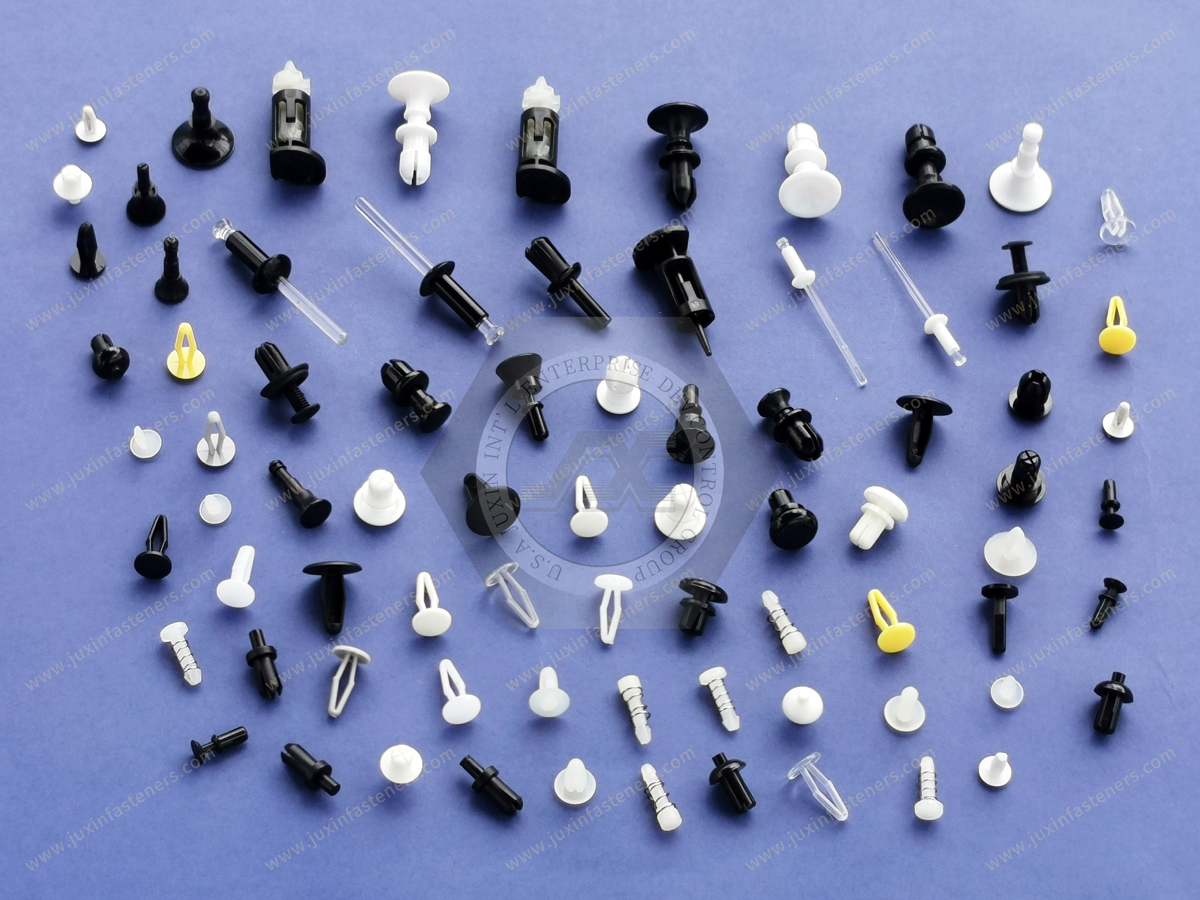
Plastic nuts and washers can provide electrical isolation, reduced weight, protection of sensitive surfaces, and resistance to selected corrosive environments.
They may also be useful where a non-metallic fastening solution is required.
The correct material should be selected according to the actual mechanical, thermal, electrical, dimensional, and environmental conditions.
Yes. Custom polymer nuts can be produced with commonly required metric or Unified Thread configurations, subject to the specific design, material, manufacturing process, and quality requirements.
For OEM sourcing, the engineering drawing should identify the applicable thread system, nominal size, pitch, and other relevant requirements.
Insulating washers and shoulder washers can separate a metallic fastener from a conductive panel or chassis.
Their effectiveness depends on the complete electrical design, including voltage, temperature, moisture, contamination, creepage, clearance, and material requirements.
The suitability of nylon depends on the specific polyamide grade, temperature profile, loading condition, exposure duration, and component geometry.
For more demanding thermal environments, engineering polymers such as PEEK or other suitable materials may need to be considered.
The material should be selected according to the actual operating conditions rather than using a universal temperature limit.
Spacers are generally unthreaded components used to maintain a defined distance between components.
Standoffs combine spacing with a fastening feature, typically an internal or external thread.
The correct choice depends on whether the assembly needs simple physical separation or independent component fastening.
Yes. Plastic washers are commonly used with metal screws and bolts to distribute contact pressure, protect surfaces, and provide electrical separation where appropriate.
The washer material and geometry should be compatible with the fastener, substrate, load condition, and service environment.
They can be suitable for certain vibration environments, but the complete joint must be evaluated.
Thread design, material, preload, joint stiffness, temperature, vibration profile, assembly method, and component geometry all influence resistance to thread back-out.
A generic plastic nut should not be treated as a universal vibration-locking solution.
The preferred RFQ package includes a 2D technical drawing, 3D CAD file, material requirement, thread specification, annual volume, application environment, quality requirements, and packaging requirements.
For multi-SKU projects, a BOM is highly recommended.
Yes, where the project requirements fit the applicable manufacturing and sourcing scope, JUXIN FASTENERS can review multiple related components as part of an OEM fastening program.
This can help procurement teams consolidate plastic nuts, washers, spacers, standoffs, and other fastening components within one sourcing workflow.

Optimizing an industrial supply chain with engineered custom plastic nuts, washers, spacers, and standoffs requires more than selecting the lowest unit price.
The component should be evaluated as part of the complete assembly:
Fastener → Thread → Material → Substrate → Load → Environment → Assembly → Inspection → Supply Chain
For engineers, the objective is to achieve the required mechanical, electrical, dimensional, and environmental performance.
For procurement and supply chain teams, the objective is to achieve that performance with consistent quality, competitive total cost, reliable delivery, and manageable multi-SKU sourcing.
JUXIN FASTENERS supports OEM and industrial fastening requirements involving custom plastic and nylon components, including:
Plastic nuts
Nylon hex nuts
Plastic flat washers
Nylon insulating washers
Shoulder washers
Insulating cup washers
Threaded standoffs
PCB spacers
Male-to-female standoffs
Female-to-female standoffs
Industrial plastic spacers
Custom polymer fastening components
These solutions can support applications across Automotive, EV, Battery Pack, Rail Transit, Aerospace, Electrical Cabinets, HVAC, Medical Equipment,
Construction, Machinery, Robotics, Sheet Metal Fabrication, Telecommunications, Semiconductor Equipment, PCB, Electronics, Base Stations, Antennas, Smart Home Equipment, Computer Brackets, Transformers, and Instrumentation.
For an engineering and OEM sourcing review, send your 2D/3D CAD drawings, material requirements, thread specifications, annual volume, application conditions, and quality requirements to:
JUXIN FASTENERS can review the component requirements and support the next step toward an OEM quotation and supply solution.
Explore the broader fastening architecture for industrial and OEM applications:
Custom Plastic & Nylon Fasteners for Industrial Applications
Custom Plastic Screws and Bolts
Threaded Inserts for Plastic
Self-Clinching Fasteners for Sheet Metal
EV Battery Pack Fastening Solutions
Electrical Cabinet and Electronics Fastening Solutions
PCB and Electronic Equipment Fastening Solutions
Semiconductor Equipment Fastening Solutions
Custom CNC Machined Fasteners and Components
 MORE NEWS
Contact Us
Tel.:
+86 020 8621 0320
+86 020 3121 6067
E-mail:
Technical Support:
Navigation
SEND INQUIREY