
Call Us
+86 136 6007 9809
Call Us
+86 136 6007 9809

Sep. 07, 2026
Industrial OEM design and procurement teams specifying custom plastic screws and plastic bolts need to balance mechanical requirements with weight,
electrical isolation, environmental compatibility, dimensional behavior and assembly requirements.
Unlike basic commercial hardware, engineered plastic screws and bolts may need to be evaluated according to the polymer grade, component geometry,
head style, drive configuration, thread form, thread fit, mating material and operating environment.
This is particularly important in industrial electronics, electrical enclosures, plastic housings, instrumentation, automation equipment,
chemical-processing-related equipment and other applications where a polymer fastening system may provide advantages over metallic hardware.
JUXIN FASTENERS supports OEM-oriented evaluation of plastic and nylon fastening requirements, including custom plastic screws,
nylon machine screws, plastic bolts and related polymer fastening components.
This guide explains how engineers and procurement teams can specify custom plastic screws and bolts, compare material options,
evaluate thread requirements and prepare an OEM RFQ using internationally recognized engineering and sourcing practices.
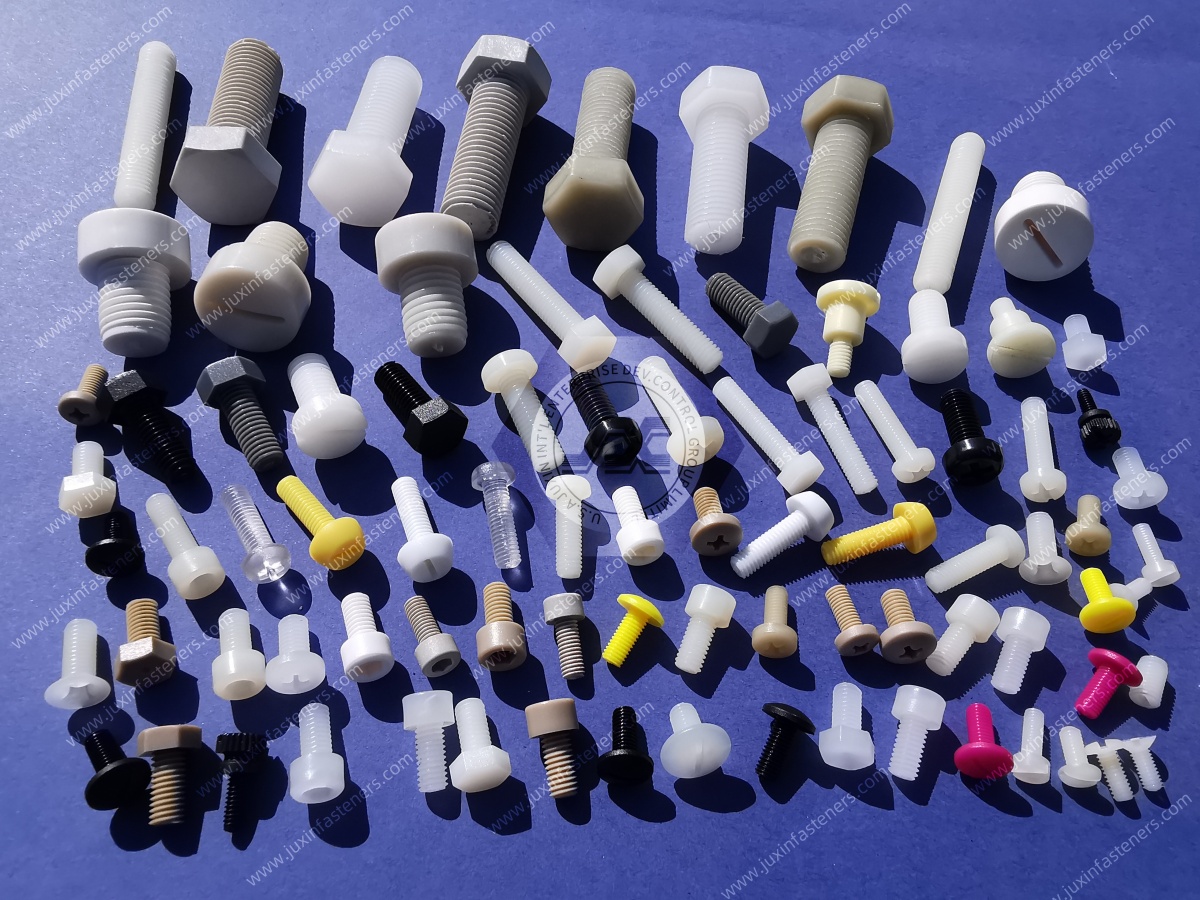
Selecting the correct screw or bolt geometry is an important part of the fastening design.
The same polymer can behave differently depending on the head configuration, drive style, thread geometry, bearing area, installation method and mating component.
Industrial applications commonly use several configurations.
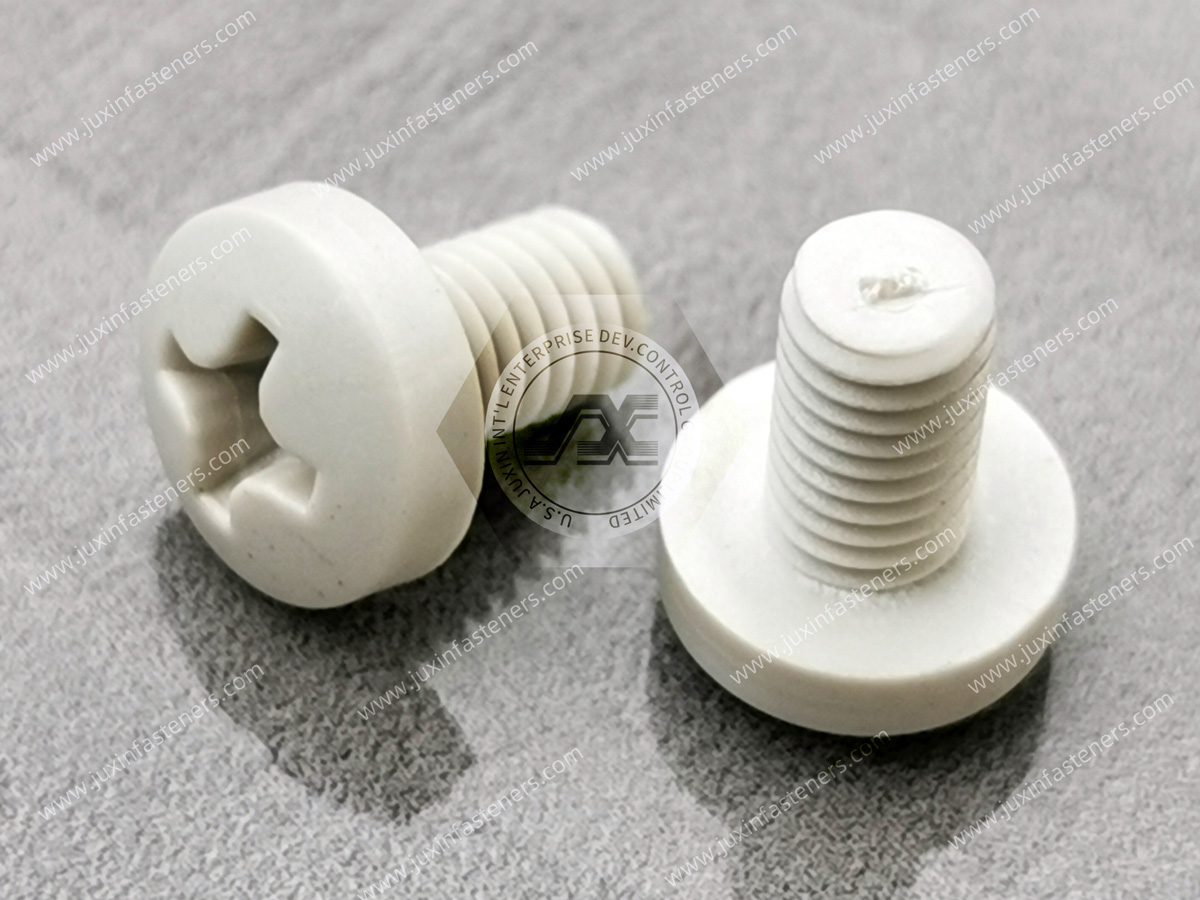
Pan head plastic screws provide a relatively broad bearing surface and a rounded head profile.
They can be considered for electrical enclosures, instrumentation housings, plastic covers, control equipment and other assemblies where the head remains above the component surface.
The final selection should consider available clearance, bearing surface, installation access and the geometry of the mating component.
Countersunk plastic screws are designed for applications where the screw head needs to sit flush or substantially flush with a prepared countersunk surface.
They can be useful for control panels, covers, sliding assemblies and other products where a protruding fastener head could interfere with adjacent components.
The countersink geometry should be matched to the actual screw head and mating material rather than assumed to be interchangeable across all applications.
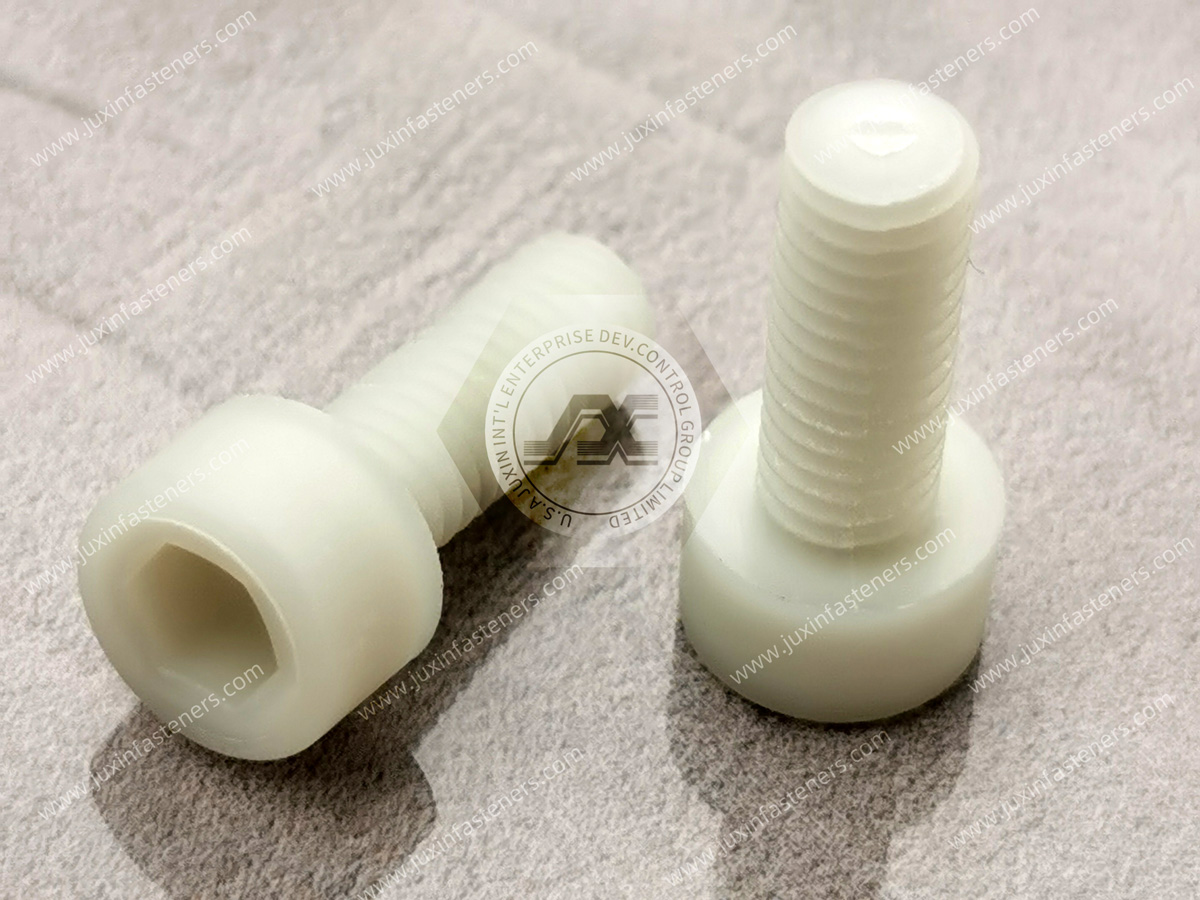
Socket head plastic screws use an internal drive and can be considered where installation access is restricted or where the designer requires a compact head arrangement.
The drive geometry should be selected according to the installation method and the mechanical limitations of the selected polymer.
Because polymer fasteners may have different torque and deformation behavior from metallic fasteners, installation requirements should be established for the specific material, geometry and assembly.
Plastic hex head bolts provide external wrenching access and can be useful where the assembly is designed around a conventional bolt-and-nut arrangement.
They may be considered for equipment covers, housings, brackets,
panels and other industrial assemblies where the application does not require the stiffness or sustained preload associated with some metal fastening systems.
The correct material and geometry remain application-dependent.
Plastic set screws, also called grub screws, can be considered for positioning, alignment or rotational retention in applications where the required loading is compatible with the selected polymer.
They are particularly relevant where a protruding screw head is undesirable.
However, engineers should evaluate the contact stress at the set-screw interface and the effect of polymer deformation when the component is used against a shaft or other hard mating surface.
Thread specification is one of the most important elements of a custom plastic screw or bolt RFQ.
For OEM applications, the thread should be identified clearly rather than specified only as “standard thread.”
Plastic fasteners can be designed around internationally recognized metric or inch-based thread systems, subject to the actual component design and manufacturing requirements.
Metric applications may reference ISO metric screw threads, including coarse and fine thread systems covered by applicable ISO standards such as ISO 261 and ISO 965.
In inch-based applications, ASME/ANSI Unified Screw Thread systems such as UNC and UNF may be relevant.
The appropriate standard depends on the customer's product design, market, mating hardware and engineering documentation.
JUXIN FASTENERS should not assume that a metric component can automatically replace an imperial component, or vice versa.
The thread designation, nominal diameter, pitch, tolerance and mating component should all be identified.
Thread tolerance becomes particularly important with polymer fasteners because polymers can respond differently from metals to temperature, moisture and mechanical loading.
For a custom plastic screw, engineers may need to evaluate:
Thread size
Pitch
Major diameter
Minor diameter
Thread profile
Thread tolerance
Mating thread
Temperature exposure
Moisture exposure
Assembly conditions
Required fit
International thread standards can provide the basic reference framework, but the final engineering requirement should be evaluated against the actual plastic material and component design.
For example, an application involving nylon may require consideration of moisture-related dimensional changes that would be less significant for some other polymer families.
Therefore, thread fit should not be selected purely by copying the nominal fit used for a metal screw.
Drive selection affects installation access, tooling and assembly consistency.
Common drive configurations include:
Hex socket
Phillips
Slotted
TORX or other internal drive configurations
External hex
Application-specific drive designs
For automated production, the drive should be evaluated against the actual installation tooling and polymer characteristics.
A drive configuration that works well with a metal fastener may not provide the same installation behavior with a polymer fastener.
Material selection is one of the most important engineering decisions when specifying custom plastic screws or custom plastic bolts.
Mechanical strength, stiffness, dimensional behavior, temperature response, moisture sensitivity,
chemical compatibility and wear characteristics can vary significantly between polymer families and between individual grades.
The following comparison provides a starting framework rather than universal performance guarantees.
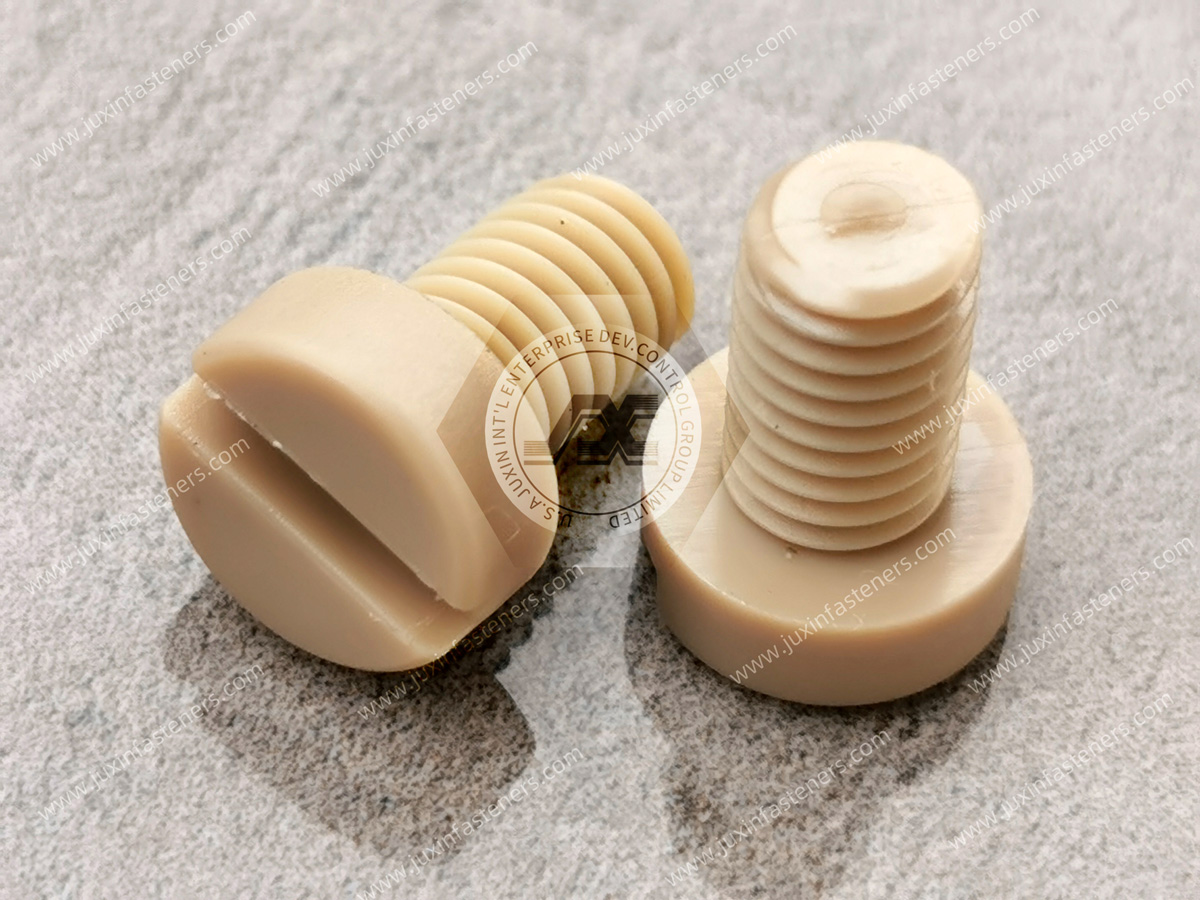
| Material Family | Typical Engineering Options | Key Characteristics to Evaluate | Typical Industrial Applications | Design & Sourcing Considerations |
|---|---|---|---|---|
| Nylon / Polyamide | PA6, PA66 and selected modified or reinforced grades | Useful mechanical performance-to-weight balance; moisture absorption and conditioning should be evaluated | Electronics, electrical equipment, control panels, housings, general industrial assemblies | Evaluate moisture, temperature, dimensional behavior and sustained loading |
| POM / Acetal | Homopolymer or copolymer grades | Often selected for stiffness, low friction and dimensional behavior in appropriate applications | Precision components, mechanical assemblies, sliding mechanisms, equipment components | Evaluate friction, wear, mating surface and environmental exposure |
| PVDF | PVDF grades for industrial applications | Useful chemical and environmental resistance in appropriate grades | Chemical-processing-related equipment, semiconductor-related equipment and demanding environments | Confirm actual chemical compatibility, temperature and exposure conditions |
| PEEK | Various PEEK grades | High-performance mechanical, thermal and chemical characteristics in appropriate grades | High-temperature electronics, specialized industrial equipment and demanding applications | Grade selection and processing requirements should be evaluated carefully |
Nylon is widely considered for industrial plastic fasteners because it provides a useful combination of mechanical properties, relatively low density, electrical characteristics and processability.
Commonly referenced families include PA6 and PA66.
However, the term “nylon” does not identify one single engineering material.
Different grades, formulations, reinforcement levels and conditioning histories can change the behavior of a nylon screw.
For OEM sourcing, the material specification should therefore identify the required grade where the application is performance-sensitive.
POM, commonly known as acetal, is often considered where stiffness, dimensional behavior, low friction or wear performance are important.
POM screws and bolts may be considered for precision industrial assemblies and mechanisms where the material's characteristics are compatible with the surrounding components.
The actual performance depends on the selected grade and application conditions.
PVDF can be considered when chemical and environmental resistance are important design requirements.
Applications may include selected chemical-processing-related equipment and semiconductor-related equipment.
However, “chemical resistant” should not be treated as a universal property. Engineers should identify the actual chemical, concentration, temperature and exposure duration before approving a PVDF plastic fastener.
PEEK is a high-performance engineering polymer that may be considered for demanding thermal, mechanical or chemical environments.
PEEK screws and bolts can therefore be relevant to specialized industrial equipment and high-temperature applications where more conventional polymer materials may require additional evaluation.
Because PEEK is a high-performance material, material grade, geometry, processing and application requirements should be reviewed carefully before specification.
A useful decision sequence is to start with the environment rather than the material name.
Application → Load → Temperature → Moisture → Chemical Exposure → Electrical Requirements → Dimensional Requirements → Material → Screw Geometry → Thread → RFQ
For example:
If the application prioritizes a balanced combination of weight, electrical isolation and general industrial performance, nylon may warrant evaluation.
If low friction and dimensional behavior are more important, POM may be considered.
If chemical exposure is a dominant design factor, PVDF may warrant evaluation.
If the application involves demanding thermal or chemical conditions, PEEK may be considered.
This is a screening framework, not a substitute for grade-specific engineering validation.
A plastic screw does not automatically require a threaded insert.
Direct polymer threads can be appropriate for many assemblies, particularly where loading, assembly frequency and environmental conditions are compatible with the selected plastic material.
However, the thread architecture should be reconsidered when the application requires repeated service, frequent assembly and disassembly, greater thread durability or a different load-transfer mechanism.
Direct plastic threads can be considered for lightweight assemblies where the polymer thread itself provides the required function.
They may be particularly appropriate when:
Assembly is relatively infrequent
Loads are compatible with the polymer
The surrounding plastic provides adequate support
Environmental conditions are controlled
The design does not require a separate metal thread interface
Threaded inserts for plastic can be considered when the designer wants to introduce a separate threaded interface into a polymer component.
Potential reasons include:
Repeated assembly and disassembly
Thread wear considerations
Different load-transfer requirements
Localized load management
Long-term service requirements
Integration with a metal mating screw
Threaded inserts can be installed using different technologies, including heat-staking and ultrasonic insertion, depending on the insert design, polymer substrate, component geometry and production process.
Neither heat staking nor ultrasonic insertion should be treated as universally suitable for every plastic.
For injection-molded housings and technical plastic components, insert selection should be considered together with the substrate material, boss geometry, installation process and production requirements.
Industrial housings and enclosures are among the most relevant application areas for plastic and nylon screws.
A housing may need to combine:
Polymer walls
Covers
Electronic components
Conductive components
Internal brackets
Sensors
Wiring
PCB assemblies
Service-access features
Plastic screws can provide a fastening option that is compatible with the surrounding polymer construction while also providing electrical isolation in applications where this property is required.
Common configurations may include:
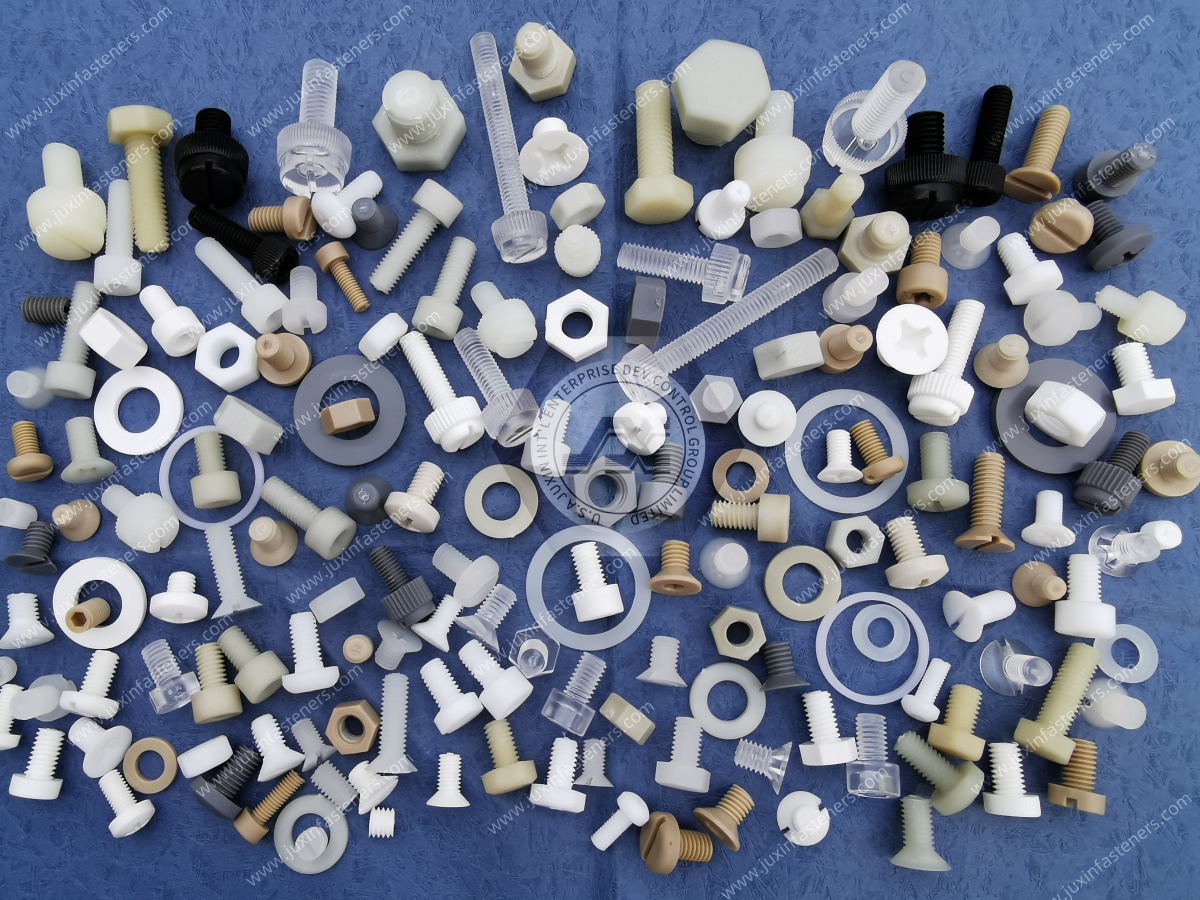
Pan head plastic machine screws
Countersunk plastic screws
Socket head plastic screws
Nylon machine screws
Plastic bolts
Plastic washers
Plastic spacers
The correct selection depends on the enclosure design and the functional role of the fastener.
For example, a cover-retention screw may have very different requirements from a fastener used to support an internal component.
Electronics and electrical equipment frequently require careful consideration of both mechanical fastening and electrical isolation.
Plastic and nylon screws can be evaluated where engineers need a non-conductive fastening component.
Potential applications include:
Electrical enclosures
Instrumentation
Control panels
Sensor assemblies
Electronic housings
PCB-related assemblies
Cable-management components
Internal electrical equipment structures
The fastener should not, however, be considered an automatic solution for electrical safety.
The complete design may need to address:
Creepage
Clearance
Conductive component spacing
Insulation system
Moisture
Temperature
Contamination
Applicable product standards
Where an electrical assembly depends on the polymer fastener for isolation, the selected material and actual environmental conditions should be evaluated.
Industrial equipment can use plastic screws and bolts in applications where weight, electrical isolation, surface compatibility or material compatibility are important.
Potential applications include:
Machine covers
Protective guards
Instrument housings
Sensor covers
Lightweight panels
Automation equipment
Industrial control equipment
Cable-management systems
Plastic brackets
Internal equipment assemblies
The important engineering question is not whether the machine is “industrial,” but what the individual fastener is required to do.
A plastic screw may be appropriate for a protective cover while a metal fastener or insert-based design may be more appropriate for a heavily loaded structural connection on the same machine.
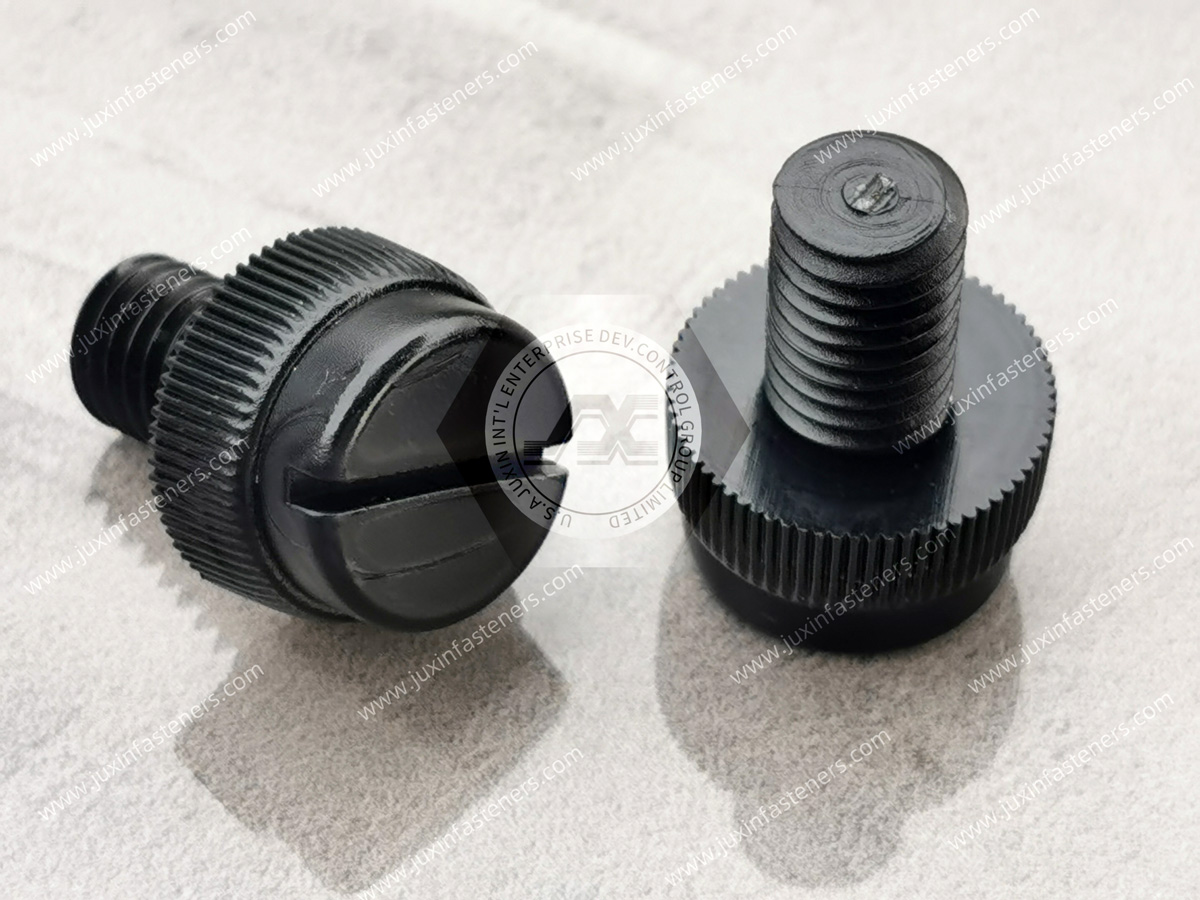
Head style is not simply a cosmetic choice.
It affects:
Bearing area
Surface clearance
Installation access
Component interference
Tool access
Assembly sequence
Countersink geometry
Overall enclosure design
For example, a countersunk screw can help achieve a flush surface, while a pan head screw can provide a different bearing interface.
Socket head configurations can be useful where access is limited.
External hex bolts may be appropriate where conventional wrench access is required.
During OEM development, the head style should therefore be selected together with the surrounding component geometry.
The terminology can vary between industries and product catalogs.
In general, a plastic screw is commonly used where the fastener engages with a mating thread, threaded insert or similar threaded feature.
A plastic bolt is often used in applications involving a nut or through-hole assembly.
The distinction can become less clear in commercial product catalogs, particularly for smaller polymer fasteners.
For procurement, the safest approach is to provide the drawing, thread specification, head style, length, material and mating component rather than relying only on the words “screw” or “bolt.”
The fastener cannot be evaluated independently from the component into which it is installed.
A plastic screw may be installed into:
Plastic
Metal
A threaded insert
A composite
A molded component
A nut
A specialized threaded interface
The mating material affects thread interaction, installation behavior, load transfer and long-term joint behavior.
For example, a nylon screw installed into a metal nut creates a different fastening system from a nylon screw installed directly into a plastic housing.
Likewise, a plastic screw engaging a threaded insert for plastic has a different interface from a direct polymer-to-polymer thread.
This is why OEM specifications should identify the mating component whenever possible.
Moisture is particularly relevant when specifying nylon screws.
Nylon can absorb moisture from the surrounding environment, and the resulting effects depend on resin grade, conditioning history, humidity, temperature and exposure duration.
Potential engineering considerations include:
Dimensional change
Thread fit
Mechanical properties
Assembly consistency
Long-term joint behavior
For applications with tight dimensional requirements or variable environmental exposure, the nylon grade and expected conditioning state should be considered during design.
This is one reason why a generic statement such as “PA66 screw” may not contain enough information for a performance-critical OEM application.
A procurement team should avoid sending an RFQ that contains only:
“Please quote plastic screws.”
That description does not provide enough information for reliable technical evaluation.
A stronger RFQ should identify the complete component requirement.
Specify the required component:
Plastic machine screw
Nylon machine screw
Plastic bolt
Socket head screw
Pan head screw
Countersunk screw
Hex head bolt
Set screw
Other custom plastic fastener
Provide:
2D technical drawing
3D CAD file where available
Overall length
Thread diameter
Thread pitch
Head diameter
Head height
Shank dimensions
Critical tolerances
Special geometry
Identify the required polymer family and grade where known.
Examples include:
PA6
PA66
POM
PVDF
PEEK
Reinforced polymer grades
Customer-specified engineering plastics
The specification should also identify whether natural, black or another color is required.
For custom colors, the customer should provide the appropriate color reference or sample where applicable.
Provide the conditions relevant to the actual application:
Operating temperature
Storage temperature
Humidity
Water exposure
Chemical exposure
Electrical requirements
Expected loading
Vibration
Assembly frequency
The purpose is not to force the supplier to assume a generic performance value, but to give the engineering team enough information to assess material and component suitability.
Procurement teams should provide:
Prototype quantity
Production quantity
Annual demand
Packaging requirements
Labeling requirements
Inspection requirements
Documentation requirements
Delivery location
Drawing revision
Quality requirements
This information helps establish a practical quotation and sourcing basis.
For global OEM sourcing, the applicable standard should be identified from the customer's product requirements.
Depending on the fastener and application, relevant references may include:
ISO for international metric thread and dimensional requirements
DIN for applicable German/internationally adopted fastener specifications
ASME/ANSI for applicable inch-based thread systems
ASTM for relevant material and testing specifications
EN for applicable European requirements
BS for applicable British standards
SAE for applicable automotive or engineering specifications
Not every standard applies to every plastic screw or bolt.
The engineering team should therefore identify the applicable standard from the actual drawing, product specification and market requirement rather than attaching multiple standards generically to every component.
For procurement managers and supplier-development teams, evaluating the supplier involves more than checking the unit price.
A useful supplier assessment should consider:
Technical Fit → Material Understanding → Drawing Review → Quality Requirements → Production Feasibility → Commercial Basis → Supply Chain Requirements
The supplier should understand what the component is intended to do and what information is needed to assess it.
For custom plastic screws and bolts, procurement teams may also need to evaluate:
Engineering communication
Drawing interpretation
Material traceability requirements
Inspection expectations
Packaging
Revision control
Prototype and production sourcing
International shipment requirements
Documentation
This approach helps separate a simple catalog purchase from an OEM engineering sourcing project.
For custom plastic screws, custom nylon screws, plastic bolts and related OEM components, the most useful RFQ package can be summarized as:
Application + Drawing + Material + Thread + Environment + Quantity + Quality Requirements
Explain where the screw or bolt is used and what function it performs.
Provide the latest 2D drawing and, where available, 3D CAD data.
Specify the polymer family and grade where already determined.
If material selection is still open, provide the required operating conditions and performance priorities.
Identify:
Metric or inch thread
Nominal diameter
Pitch
Thread tolerance where applicable
Internal or external mating thread
Direct plastic thread or insert-based design
Provide:
Temperature
Moisture
Chemicals
Electrical conditions
UV or outdoor exposure where relevant
Cleaning or processing conditions
Provide:
Prototype quantity
Trial quantity
Production batch quantity
Estimated annual volume
Identify:
Inspection requirements
Material documentation
Packaging
Labeling
Traceability
Applicable customer specifications
Required quality records
Providing this information helps the supplier establish the technical and commercial basis for the RFQ rather than quoting from an incomplete product description.
One of the most important engineering principles in polymer fastening is that the fastener and the joint should be evaluated together.
The actual fastening system may be represented as:
Plastic Screw → Mating Thread → Housing Material → Joint Geometry → Installation Method → Environment → Service Conditions
Changing any one of these variables can affect the overall behavior of the connection.
For example, changing from a direct plastic thread to a threaded insert changes the interface.
Changing from nylon to POM changes the material characteristics.
Changing from a metal mating nut to a plastic mating component changes the joint architecture.
Changing the operating environment from dry indoor service to humid or chemically exposed conditions can also change the material-selection priorities.
This complete-system approach provides more useful information for engineers than simply comparing the tensile strength of two fastener materials.
For many OEM products, the screw or bolt is only one component of the fastening system.
Depending on the design, engineers may also require:
Plastic nuts
Nylon nuts
Plastic washers
Nylon washers
Plastic spacers
Nylon spacers
Threaded inserts for plastic
Other custom plastic components
This creates a broader product architecture:
Plastic Screws & Bolts → Plastic Nuts → Plastic Washers → Plastic Spacers → Threaded Inserts → Complete Plastic Assembly Solution
For JUXIN FASTENERS, this product relationship also creates a natural sourcing path for OEM customers who need multiple polymer fastening components rather than a single SKU.
For internal website navigation, the relevant product pages should be connected using their verified live JUXIN FASTENERS URLs rather than guessed URLs.
Plastic screws can provide useful advantages in selected applications, including lower component mass, electrical isolation, galvanic isolation and compatibility with certain polymer housings or finished surfaces.
Whether these advantages outweigh the mechanical and environmental characteristics of metal depends on the application.
Plastic screws and bolts can be specified using internationally recognized metric and inch-based thread systems where applicable.
Metric applications may reference applicable ISO thread specifications, while inch-based applications may use ASME/ANSI Unified Thread systems such as UNC or UNF.
The actual thread specification should be confirmed from the customer drawing and mating component.
Nylon can absorb moisture from its environment.
Moisture can affect dimensional behavior and mechanical properties, with the degree of change depending on resin grade, conditioning history, humidity, temperature and exposure.
Applications with tight dimensional or long-term mechanical requirements should therefore evaluate moisture effects during material selection.
Some engineering polymers are suitable for more demanding temperature environments than others.
Standard nylon grades may be suitable for selected moderate-temperature industrial applications, while polymers such as PEEK can be considered for more demanding thermal environments.
Actual suitability must be determined from the selected grade, component geometry and operating conditions rather than from the generic material name alone.
Common configurations include pan head, countersunk or flat head, socket head and other application-specific head designs.
Hex head configurations are also used for plastic bolts.
The appropriate head style depends on installation access, bearing area, clearance, mating geometry and assembly requirements.
Nylon screws are a specific category of plastic screws made from nylon or polyamide materials.
“Plastic screw” is a broader term that can include nylon, POM, PVDF, PEEK and other polymer materials.
The correct material should be selected according to the application's mechanical, environmental, electrical and dimensional requirements.
Direct plastic threads can be suitable for selected applications.
A threaded insert may be considered when repeated assembly, thread durability, localized loading or a different thread architecture is required.
The correct choice depends on the substrate material, component geometry, installation process and service conditions.
A strong RFQ should include the 2D drawing, 3D CAD information where available, material grade, thread specification, head style, environmental conditions,
expected loading, quantities, packaging and quality requirements.
Providing the complete specification helps establish the technical and commercial basis for supplier evaluation and quotation.
Selecting the right custom plastic screws, custom nylon screws, plastic bolts or nylon bolts for OEM applications requires more than identifying a nominal size.
The component should be evaluated according to its:
Application + Drawing + Material + Thread + Environment + Quantity + Quality Requirements
This information provides the foundation for an engineering and sourcing review.
JUXIN FASTENERS can then evaluate the stated component requirements and establish the appropriate RFQ basis according to the information supplied.
For OEM procurement, supplier development and engineering teams, providing the complete drawing and application requirements at the beginning of the sourcing process can reduce ambiguity and make supplier comparison more meaningful.
Submit your 2D/3D CAD files, material requirements, thread specifications, environmental conditions, quantity information and quality requirements to JUXIN FASTENERS.
Email:
info@juxinfasteners.com
Application + Drawing + Material + Thread + Environment + Quantity + Quality Requirements → Engineering Review → RFQ
 MORE NEWS
Contact Us
Tel.:
+86 020 8621 0320
+86 020 3121 6067
E-mail:
Technical Support:
Navigation
SEND INQUIREY