
Call Us
+86 136 6007 9809
Call Us
+86 136 6007 9809

Nov. 18, 2026
Custom Blind Rivet Nuts for OEM Manufacturing
In the design of modern industrial enclosures, automotive chassis, and telecommunications equipment, engineering teams are constantly challenged to reduce structural weight. This necessitates the use of thin-gauge steel and aluminum alloys. However, thin sheet metal presents a significant fastening problem: there is insufficient material depth to tap durable, load-bearing threads. Furthermore, these assemblies frequently feature closed-box architectures (like tubular frames or sealed electrical cabinets) that completely eliminate access to the reverse side of the panel, rendering traditional nuts and bolts useless.
One widely used engineering solution is the blind rivet nut (also known as a threaded insert). As an Industrial Fastener Manufacturer, Juxin Fasteners specializes in Custom Fastener Manufacturing, producing made-to-drawing blind rivet nuts that are developed against customer-defined dimensional, mechanical, and production requirements.
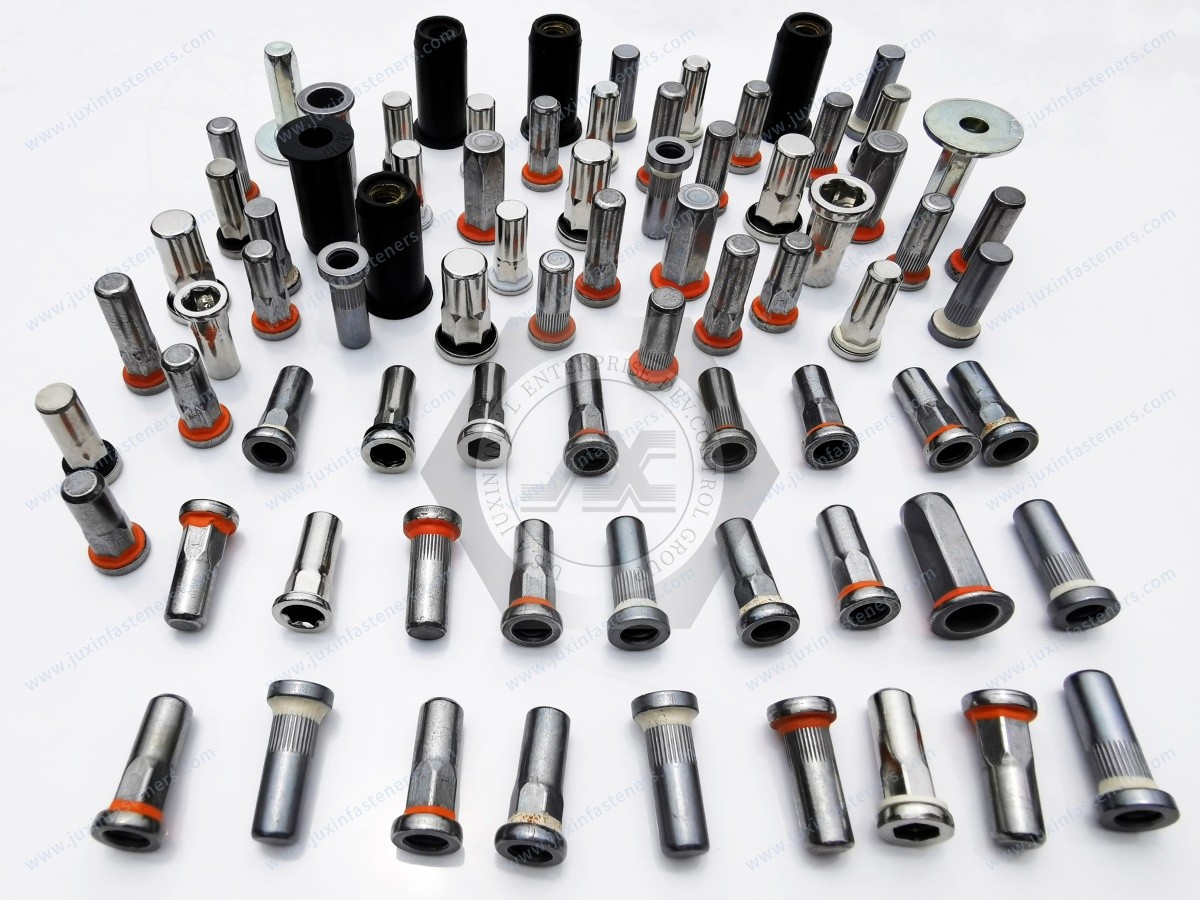
The Mechanics of Blind Rivet Nut Installation
A blind rivet nut is a tubular, internally threaded fastener that can be installed entirely from one side of the workpiece. The mechanical process relies on controlled deformation:
Insertion: The fastener is inserted into a pre-punched or laser-cut hole in the host metal.
Pull-Up (Upsetting): A specialized pneumatic or battery-operated installation tool threads into the nut. The tool then pulls the internal threads axially toward the face of the panel.
Collapse: Because the unthreaded portion of the nut's shank is intentionally engineered with a thinner wall, the axial pulling force causes this specific section to buckle and fold outward against the blind side of the sheet metal.
Locking: This collapse forms a permanent, mechanical flange on the blind side, securely clamping the sheet metal between the newly formed blind flange and the fastener's visible front head. The tool then unthreads, leaving a high-strength, permanent internal thread ready for bolt installation.
Head Style Selection for Specific Applications
The head style of a blind rivet nut dictates how it interfaces with the front side of the host material. Selecting the correct head style is critical for both structural performance and aesthetic requirements in OEM manufacturing.
* Flat Head (Large Flange): This is the most common and robust head style. The large flange provides maximum bearing surface against the host material, which significantly increases resistance to pull-through failure. Flat head rivet nuts are ideal for applications where the fastener needs to act as a spacer or where the mating component will sit flush against the flange rather than the panel itself. It also provides the best performance in softer, thinner materials by distributing the load over a wider area.
* Countersunk Head: When a completely flush surface is required on the front side of the panel—often for cosmetic reasons or to avoid interference with moving parts—a countersunk head is used. This requires the host material to be pre-countersunk prior to installation. Countersunk rivet nuts typically have a standard 90-degree or 120-degree profile. They offer excellent aesthetic results but require more precise hole preparation and generally have lower pull-through resistance than flat head variations.
* Reduced Head (Low Profile): Reduced head rivet nuts offer a compromise between flat and countersunk styles. They provide a near-flush profile without the need for pre-countersinking the hole. While not perfectly flush, the minimal protrusion is often acceptable for many mating components. They are faster to install than countersunk styles as they eliminate the countersinking step, but they sacrifice some pull-through resistance compared to a full flat head.
Overcoming Torque-Out and Pull-Out Failures
Standard catalog rivet nuts often fail in demanding industrial applications through two primary modes: torque-out (spinning in the hole) and pull-out (tearing through the sheet). Juxin Fasteners addresses these failures through custom engineered geometries:
* Hexagonal Body Designs: The most effective defense against torque-out is the hex body blind rivet nut. Installed into a corresponding hex hole, the fastener achieves positive geometric resistance against rotation. This is critical for automated assembly lines where pneumatic impact drivers can easily over-torque and spin round-bodied nuts. Full hex bodies provide resistance along the entire shank, while half-hex bodies offer resistance primarily near the head.
* Knurled Round Bodies: When hex holes cannot be punched due to tooling limitations, custom splined or diamond-knurled shanks provide enhanced friction against the hole wall, significantly improving torque-out resistance compared to smooth bodies. The depth and pitch of the knurl can be customized based on the hardness of the host material.
* Grip Range Customization: Pull-out failure occurs when the nut is installed into a material thickness outside its designated "grip range." If the sheet is too thin, the collapse fold does not clamp tightly; if too thick, the fold forms improperly inside the hole. Our engineering team calculates exact grip ranges based on your precise 2D drawings or 3D CAD models to establish a testable installation window.
Mechanical Performance Testing and Validation
Ensuring the reliability of a blind rivet nut joint requires rigorous mechanical testing. For critical OEM applications, Juxin Fasteners can discuss validation requirements and the availability of project-specific testing documentation focusing on key performance metrics:
* Torque-Out Testing: Measures the rotational force required to spin the installed rivet nut within the host material. This determines the maximum tightening torque that can be applied to the mating bolt without damaging the joint.
* Pull-Out Testing: Measures the axial force required to pull the installed rivet nut completely through the host material. This dictates the maximum tensile load the joint can support.
* Push-Out Testing: Measures the axial force required to push the installed rivet nut out the back of the hole (in the direction opposite to installation). While less common than pull-out, it is relevant in applications where the fastener acts primarily as a standoff.
* Ultimate Tensile Strength: Measures the breaking strength of the internal threads or the fastener body itself.
The performance in these tests is heavily dependent not just on the fastener, but on the host material's thickness, hardness, and the precision of the prepared hole.
Material Selection and Galvanic Compatibility
Selecting the correct raw material is vital for both tensile strength and long-term corrosion resistance. We manufacture custom blind rivet nuts in:
* Carbon Steel (Zinc Plated): The industry standard for high-strength steel assemblies. We offer various plating thicknesses and chromate conversions (e.g., clear, yellow, black) to meet specific ASTM salt spray requirements. Zinc plating acts as a sacrificial anode, protecting the underlying steel from rust.
* Stainless Steel (304 and 316): Essential for medical devices, food processing equipment, and marine applications. 304 stainless offers excellent general corrosion resistance, while 316 stainless provides superior resistance to pitting and crevice corrosion in chloride-rich environments (like salt water or de-icing salts). It is important to note that stainless steel rivet nuts are significantly harder to install than carbon steel or aluminum and require specialized, high-pull-force installation tooling.
* Aluminum Alloys: When fastening into thin aluminum enclosures (like 5052 or 6061 alloys), using an aluminum rivet nut may reduce some galvanic compatibility concerns when the complete joint is appropriately designed. Galvanic corrosion occurs when two dissimilar metals are in electrical contact in the presence of an electrolyte (like moisture). Pairing carbon steel hardware directly with aluminum in wet environments can accelerate bi-metallic corrosion under certain conditions, which may eventually degrade the mounting hole and compromise the joint. Aluminum rivet nuts can be appropriate for aluminum assemblies after evaluating the complete material couple and are lightweight, though they offer lower tensile strength than steel alternatives.
* Brass: Utilized in specific electrical applications requiring high conductivity and non-magnetic properties. Brass is relatively soft and easy to install but is typically limited to low-load applications.
Multi-Process Fastener Manufacturing Capabilities
Juxin Fasteners is an OEM/ODM Fastener Manufacturer, meaning we control the manufacturing process to deliver exact specifications.
* Cold Heading: For industrial batch production, the primary body of the blind rivet nut is typically formed via high-speed cold heading. This process optimizes the grain flow of the metal, maximizing tensile strength while minimizing material waste. Cold heading is highly efficient for high-volume runs of standard and moderately customized geometries.
* Internal Thread Production: Internal threads can be produced by tapping or suitable thread-forming methods, selected according to material, geometry, volume, and required thread class. Metric and unified threads are different systems and are not interchangeable.
* CNC Machining for Secondary Operations: For highly specialized custom designs—such as non-standard head thicknesses, customer-defined sealing features requiring assembly-level ingress-protection validation, or unique overall lengths—we can integrate CNC turning centers to perform precision secondary operations on the cold-headed blanks. This Multi-Process Fastener Manufacturing approach allows us to deliver complex geometries at competitive high-volume price points.
Integration with Installation Tooling
The success of a blind rivet nut application is inextricably linked to the installation tooling. Even a perfectly manufactured fastener will fail if installed incorrectly.
* Spin-Pull vs. Spin-Spin Tools: The most reliable installation method is the spin-pull-spin cycle. The tool spins the mandrel into the nut, pulls the mandrel axially to collapse the fastener to a precise stroke length or pressure setting, and then spins in reverse to disengage.
* Stroke vs. Pressure Control: Advanced installation tools can be set to pull either a specific distance (stroke) or until a specific resistance is met (pressure). Stroke-controlled and force-controlled tools each have appropriate applications; the correct settings must be established through installation trials on representative panels rather than assumed from nominal fastener dimensions.
Hole Preparation, Edge Distance, and Assembly Access
Hole diameter and shape are functional dimensions, not simply clearance values. An oversized round hole can reduce anti-rotation performance, while an undersized hole may scrape coatings or prevent insertion. Laser-cut holes can contain taper, recast material, or burrs; punched holes may have rollover and fracture zones. Specify the hole-making process, tolerance, burr direction, and inspection method on the panel drawing. For hex-body inserts, verify across-flats dimensions and corner radii against the actual fastener geometry.
Check edge distance, spacing between neighboring holes, and panel flatness. A narrow flange close to an unsupported edge may deform the sheet before the insert reaches its intended load. In box sections, the blind-side collapse envelope must clear internal ribs, wiring, insulation, and other hardware. Installation-tool nosepiece clearance matters just as much as the fastener envelope when designing dense electronic cabinets.
Installation Trials and Acceptance Criteria
A useful qualification trial uses production-representative panel thicknesses at both ends of the proposed grip range, the intended hole process, and the actual installation tool. Record tool settings, formed backside geometry, head seating, thread condition, and any panel distortion. Evaluate torque-out and axial retention with a documented fixture and loading direction. The torque needed to tighten the mating screw must not be confused with the measured torque-out resistance of the installed insert.
For serviceable equipment, include repeated bolt installation, vibration exposure, and corrosion conditions when relevant. Closed-end inserts may limit an opening through the threaded body, but a sealed enclosure still requires evaluation of the head-to-panel interface, mating hardware, and complete assembly. An IP rating cannot be assigned to an untested generic rivet nut.
Design Decisions That Affect Total Installed Cost
The lowest insert price does not always produce the lowest assembly cost. A hex-body design may improve resistance to rotation but require a more demanding punch or laser profile. A reduced head may eliminate countersinking but alter bearing area. A longer grip range may simplify inventory while reducing optimization for a narrow panel thickness. Compare tooling, hole preparation, installation time, scrap risk, service access, and inspection needs alongside the fastener price. This makes the quotation relevant to both engineering and procurement teams.
OEM RFQ and Production Planning
We partner with OEM engineering and procurement teams to ensure seamless transition from prototype design to full Industrial Batch Production. When requesting a quotation, please provide:
* 2D technical drawings (with clear tolerancing) or 3D CAD files.
* Host material specifications and exact panel thickness.
* Required material and corrosion protection (plating) requirements.
* Estimated annual demand (EAU) and initial batch requirements.
For Custom Engineered Fastening Solutions, contact our engineering team at Juxin Fasteners via info@juxinfasteners.com to initiate your drawing-based manufacturing RFQ.
 MORE NEWS
Contact Us
Tel.:
+86 020 8621 0320
+86 020 3121 6067
E-mail:
Technical Support:
Navigation
SEND INQUIREY