
Call Us
+86 136 6007 9809
Call Us
+86 136 6007 9809

Oct. 29, 2023
Fastener surface treatment is not simply a choice between silver, black or another appearance.
For engineered threaded fasteners, the coating can influence corrosion behavior, friction, tightening response, thread fit, dimensional compatibility, installation, electrical contact and manufacturing risk.
This means that a coating change can become an engineering change even when the base fastener remains dimensionally identical.
JUXIN FASTENERS supplies industrial and custom fasteners with selected surface-treatment systems according to customer drawings and project requirements, including applications for:
Screws
Bolts
Nuts
Lock nuts
Rivet nuts
Weld nuts
Weld studs
Blind rivets
Threaded inserts
Custom fasteners
Drawing-based precision components
Depending on the fastener material and application, surface-treatment options can include selected:
Zinc electroplating
Zinc-nickel systems
Zinc-flake coating systems
Phosphate finishes
Black finishes
Electrophoretic coatings
Other project-specific finishes
The correct coating should be selected from the joint requirement, not from appearance alone.
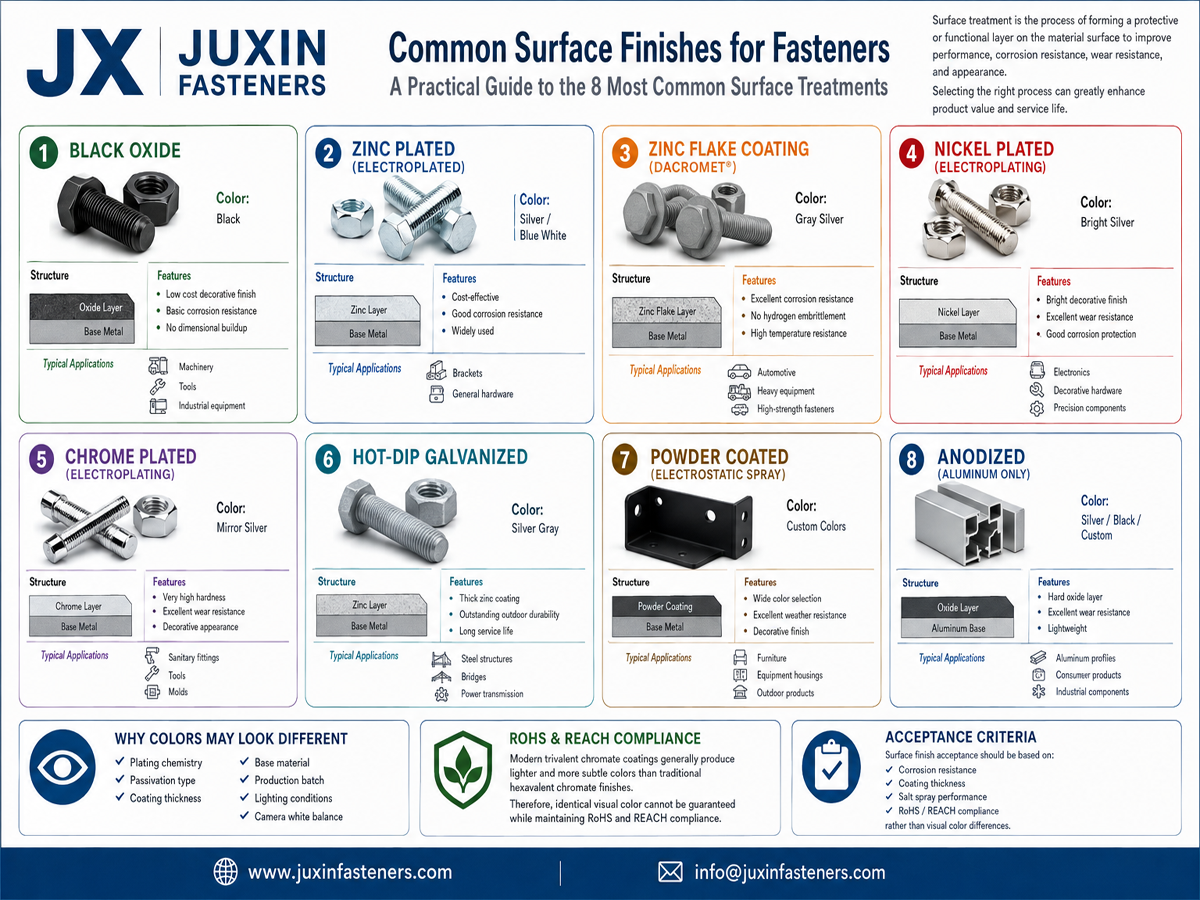
A coating can serve several different engineering purposes.
Depending on the application, these may include:
Corrosion protection
Friction control
Wear behavior
Appearance
Lubricant retention
Paint adhesion
Electrical-contact requirements
Assembly consistency
Compatibility with the parent material
Identification or cosmetic requirements
Not every coating performs all of these functions.
For example, a coating selected primarily for appearance should not automatically be assumed to provide the corrosion performance required for an exposed outdoor assembly.
Likewise, a coating selected for high corrosion resistance may alter tightening friction compared with the previous finish.
The correct question is therefore not:
"Which coating is best?"
It is:
"Which coating system satisfies the corrosion, friction, dimensional, installation and environmental requirements of this specific joint?"
A useful first-stage comparison is:
| Surface Treatment | Typical Engineering Reason to Evaluate It | Important Variables to Specify |
|---|---|---|
| Zinc electroplating | General corrosion protection and economical industrial finishing | Thickness, passivation, sealer/topcoat, friction, appearance |
| Zinc-nickel | Higher corrosion-performance requirements in selected applications | Alloy system, thickness, passivation, topcoat, friction |
| Zinc-flake | High corrosion requirements and selected high-strength fastener applications | Basecoat/topcoat system, thickness, friction, curing, thread fit |
| Phosphate | Lubricant retention, process function, paint preparation or selected internal applications | Type, oil/lubricant, coating weight, downstream process |
| Electrophoretic coating | Protective and appearance-driven applications | Film thickness, curing, thread masking/fit, adhesion |
| Black finish | Appearance or process-specific requirement | Exact process must be defined; "black" alone is insufficient |
| Stainless steel without added coating | Material-based corrosion strategy in suitable environments | Stainless grade, environment, galling, mating material |
This table is a selection framework rather than a universal specification.
Actual coating performance depends on the complete coating system and application.
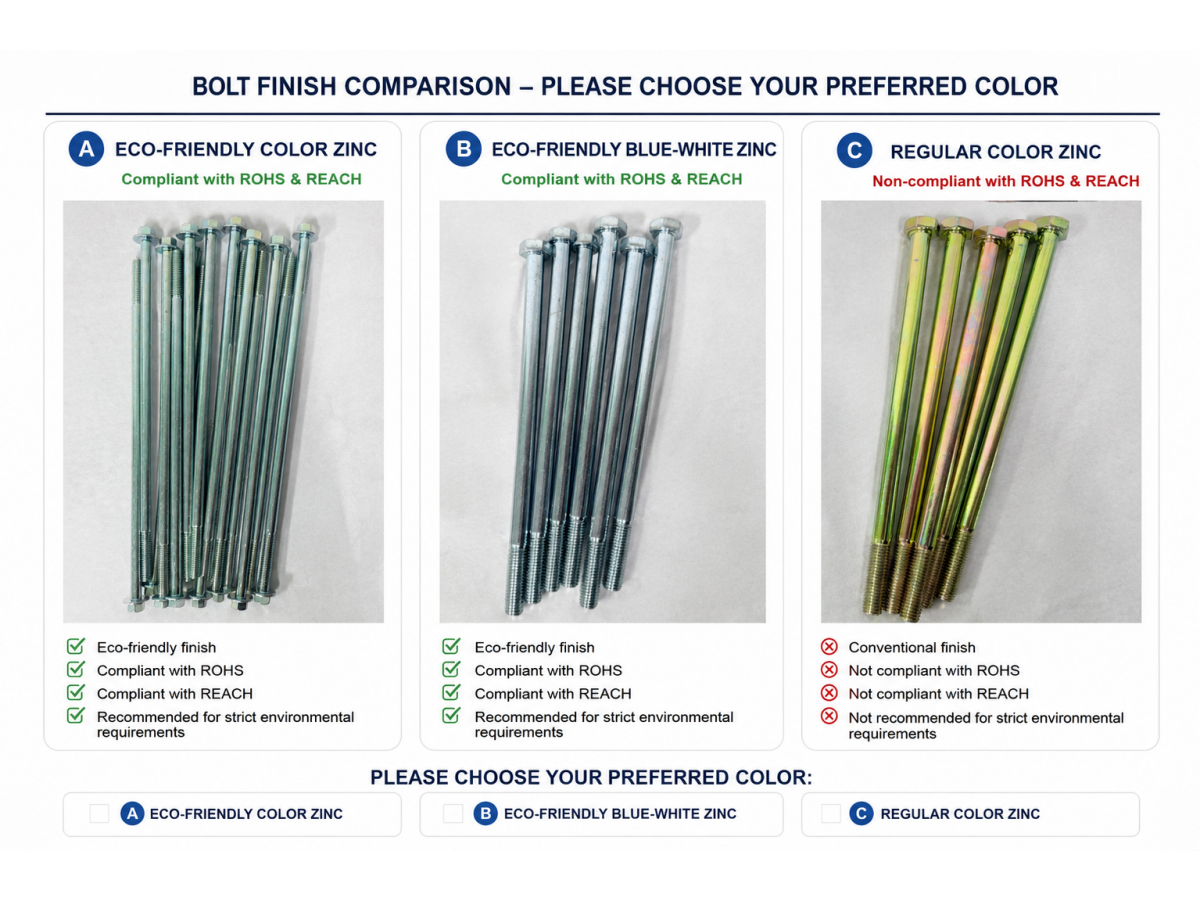
Zinc electroplating is widely used on carbon-steel fasteners because it can provide an economical protective finish while supporting a range of appearances and passivation systems.
Depending on the specified process, zinc-plated fasteners may be supplied with finishes such as:
Clear / silver appearance
Blue-white appearance
Black appearance
Yellow or iridescent appearance where applicable
Other specified passivation systems
However, color does not fully define the coating.
Two zinc-plated fasteners that look similar may have different:
Coating thickness
Passivation
Sealer
Topcoat
Friction behavior
Corrosion performance
Therefore:
Zinc color ≠ complete zinc coating specification.
Zinc plating may be evaluated for selected:
Industrial machinery
Electrical cabinets
General equipment
Interior assemblies
Brackets
Standard screws and nuts
Non-severe environmental applications
The actual suitability depends on the environmental and functional requirements.
For higher-strength steel components, electroplating requires additional engineering attention because hydrogen can be introduced during certain manufacturing and finishing processes.
Hydrogen embrittlement risk depends on factors including:
Material strength and hardness
Manufacturing history
Cleaning and pickling processes
Electroplating process
Part geometry
Stress state
Post-treatment controls
The correct approach is not simply to assume that every electroplated high-strength fastener will fail.
It is to evaluate the risk and specify an appropriate manufacturing and coating route.
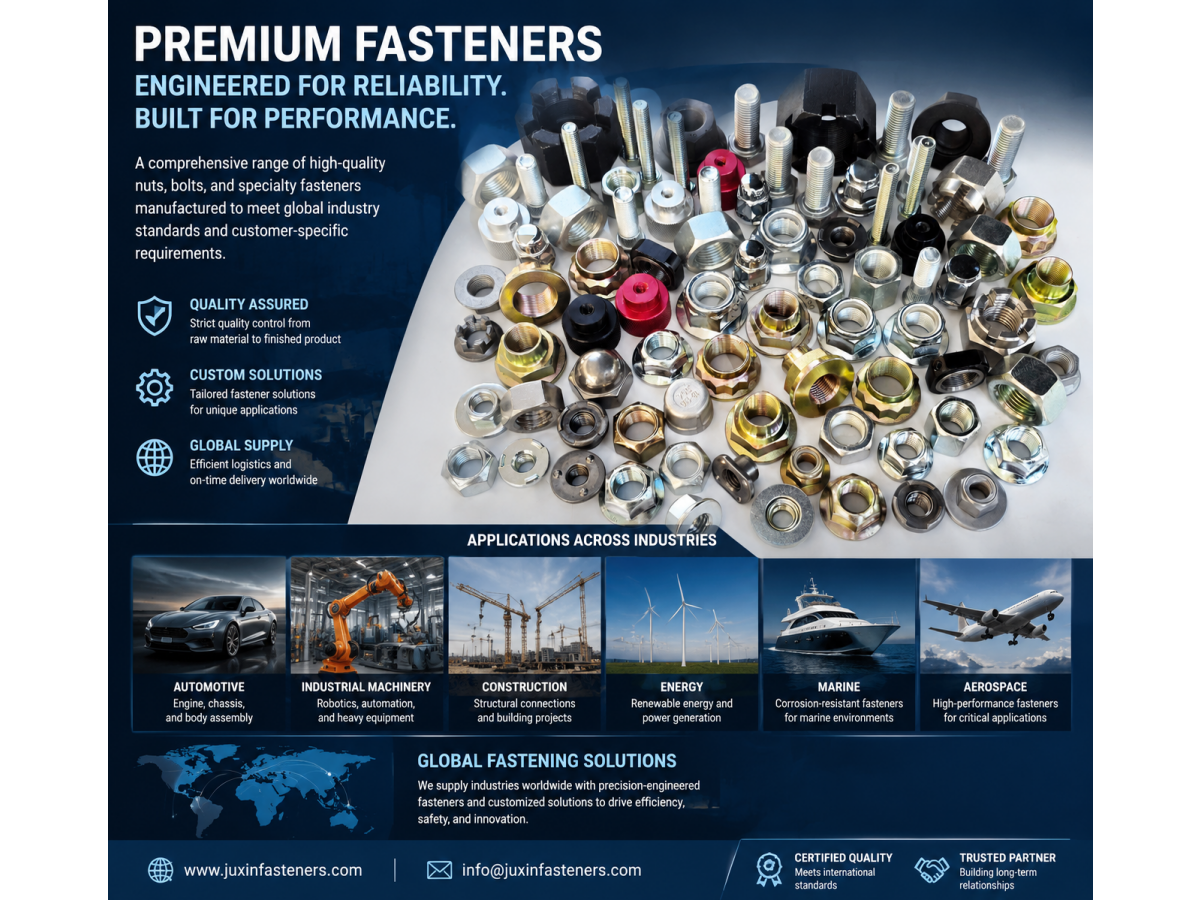
Zinc-nickel coating systems are often considered when a project requires greater corrosion performance than conventional zinc plating can provide under the specified test and service conditions.
Potential applications can include selected:
Automotive components
EV-related equipment
Outdoor machinery
Industrial equipment
Electrical systems
Corrosion-sensitive assemblies
Depending on the coating system, zinc-nickel can be combined with passivation and topcoat technologies to achieve different corrosion and friction characteristics.
"Black zinc-nickel" or "silver zinc-nickel" can be useful purchasing descriptions, but they do not fully define engineering performance.
An OEM coating specification may also need to control:
Zinc-nickel coating system
Coating thickness
Passivation
Sealer
Topcoat
Corrosion test requirement
Friction requirement
Appearance
Thread fit
Hydrogen embrittlement controls where relevant
This is particularly important when qualifying a second source.
A coating that looks the same may not behave the same during assembly.
Zinc-flake coating systems are widely evaluated for demanding corrosion environments and selected high-strength steel fasteners.
These systems generally use zinc and aluminum flakes in an engineered coating matrix, often combined with basecoat and topcoat layers.
Potential applications can include selected:
Automotive fasteners
EV structures
Outdoor equipment
Renewable-energy equipment
Heavy machinery
Corrosion-sensitive industrial assemblies
A major engineering reason for considering appropriate zinc-flake processes is that they can avoid the electrolytic deposition step associated with conventional electroplating.
However, this should not be simplified into:
"Zinc-flake = zero hydrogen embrittlement risk under every condition."
Hydrogen can potentially be introduced during other manufacturing or pretreatment stages.
For high-strength fasteners, the entire process route must be evaluated.
Different zinc-flake systems can use different:
Surface preparation
Basecoats
Topcoats
Coating thicknesses
Curing conditions
Lubricants
Friction modifiers
Therefore:
Zinc-flake coating name ≠ complete coating specification.
This distinction matters in OEM sourcing because changing the coating system may affect:
Corrosion performance
Friction
Tightening behavior
Thread fit
Appearance
Installation
A second-source component should therefore be evaluated against the required coating performance rather than simply matching the words "zinc-flake."
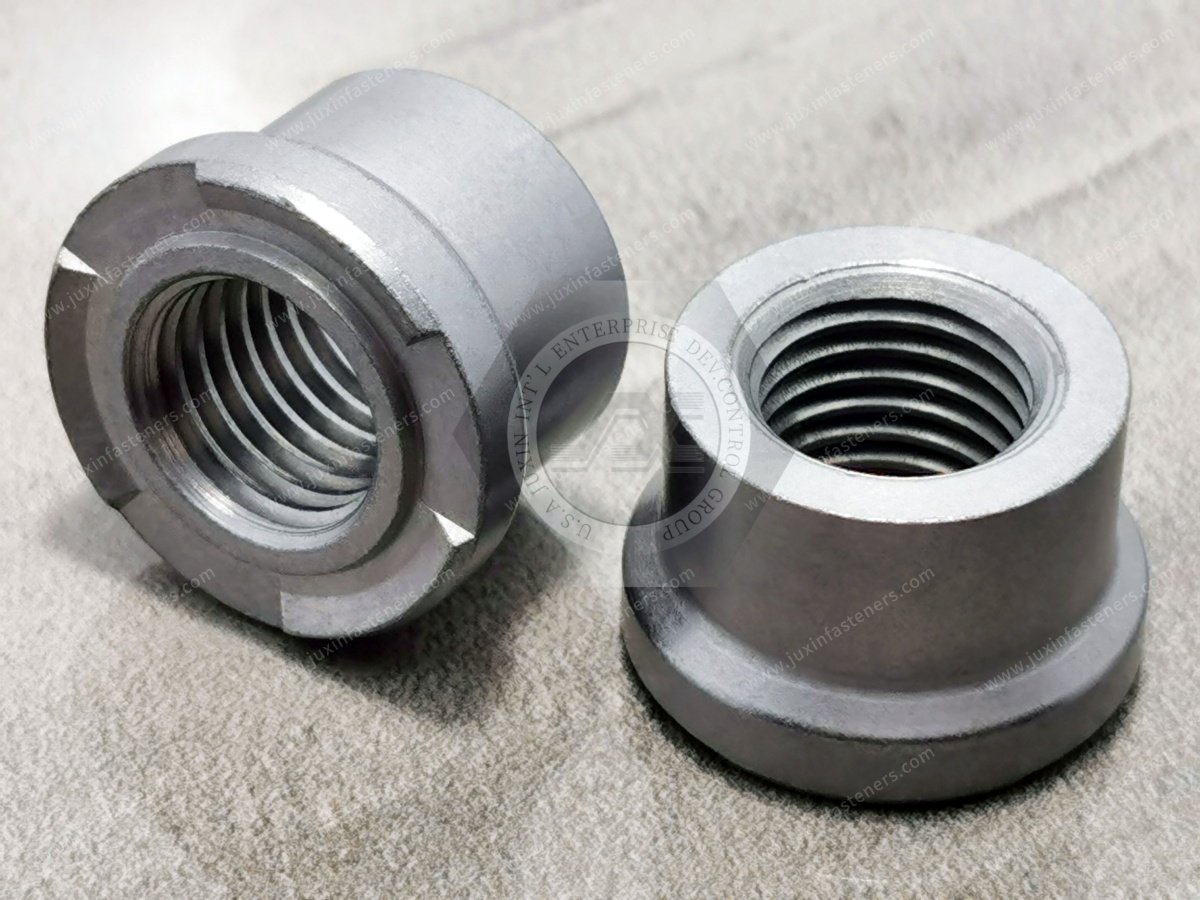
Phosphate conversion coatings can be used where the engineering requirement involves characteristics such as:
Lubricant retention
Oil retention
Surface preparation
Paint adhesion
Controlled appearance
Selected wear behavior
Phosphate finishes may be found on selected automotive, machinery and industrial components.
However, phosphate should not automatically be treated as a high-performance standalone outdoor corrosion coating.
Its performance depends strongly on the complete finish system, including oils, lubricants or subsequent coatings where applicable.
When oil or another post-treatment is used, the finished surface should be considered as a system.
The engineering specification should distinguish between:
Phosphate conversion layer
Oil or lubricant
Additional coating
Required corrosion performance
Friction requirements
This prevents purchasing teams from assuming that all black phosphate fasteners are functionally equivalent.
Electrophoretic coating, often referred to as e-coating, can provide a uniform organic coating on suitable components.
It may be evaluated where appearance and protective performance are important.
Potential applications can include selected:
Exposed equipment fasteners
Brackets
Automotive components
Industrial hardware
Appearance-sensitive assemblies
For threaded fasteners, however, film thickness must be considered carefully.
An organic coating applied to thread surfaces can influence:
Thread fit
Assembly torque
Engagement
Gauge acceptance
Masking or process control may therefore be required depending on the component and specification.
One of the most common sourcing mistakes is specifying only:
"Black finish."
Black appearance can result from very different surface-treatment systems, such as:
Black zinc
Black zinc-nickel
Black oxide
Black phosphate
Black zinc-flake system
Black electrophoretic coating
Other organic or inorganic finishes
These are not interchangeable.
They can differ significantly in:
Corrosion performance
Thickness
Friction
appearance
Process temperature
Hydrogen embrittlement considerations
Cost
Therefore:
Black color ≠ coating specification.
An OEM drawing should identify the required coating system or functional performance rather than relying on color alone.
Black oxide can provide a dark appearance and selected surface characteristics, particularly when combined with oil or other post-treatment.
However, it should not automatically be treated as equivalent to zinc-nickel or high-performance zinc-flake systems for corrosion protection.
If an existing drawing states only "black," engineering should determine whether the actual requirement is:
Appearance
Corrosion protection
Lubricity
Light reflection control
Identification
Another functional requirement
This prevents an appearance-driven substitution from unintentionally changing performance.
Fastener coating is added to a component that already has dimensional limits.
On threaded components, excessive or poorly controlled coating thickness can interfere with:
Thread engagement
Assembly
Gauging
Mating-component compatibility
This is particularly important for internal threads, where available clearance can be limited.
Engineering should therefore consider:
Base thread tolerance
Coating thickness
Coating distribution
External vs internal thread
Mating thread
Final gauging requirement
A corrosion coating that prevents proper assembly is not a successful coating solution.
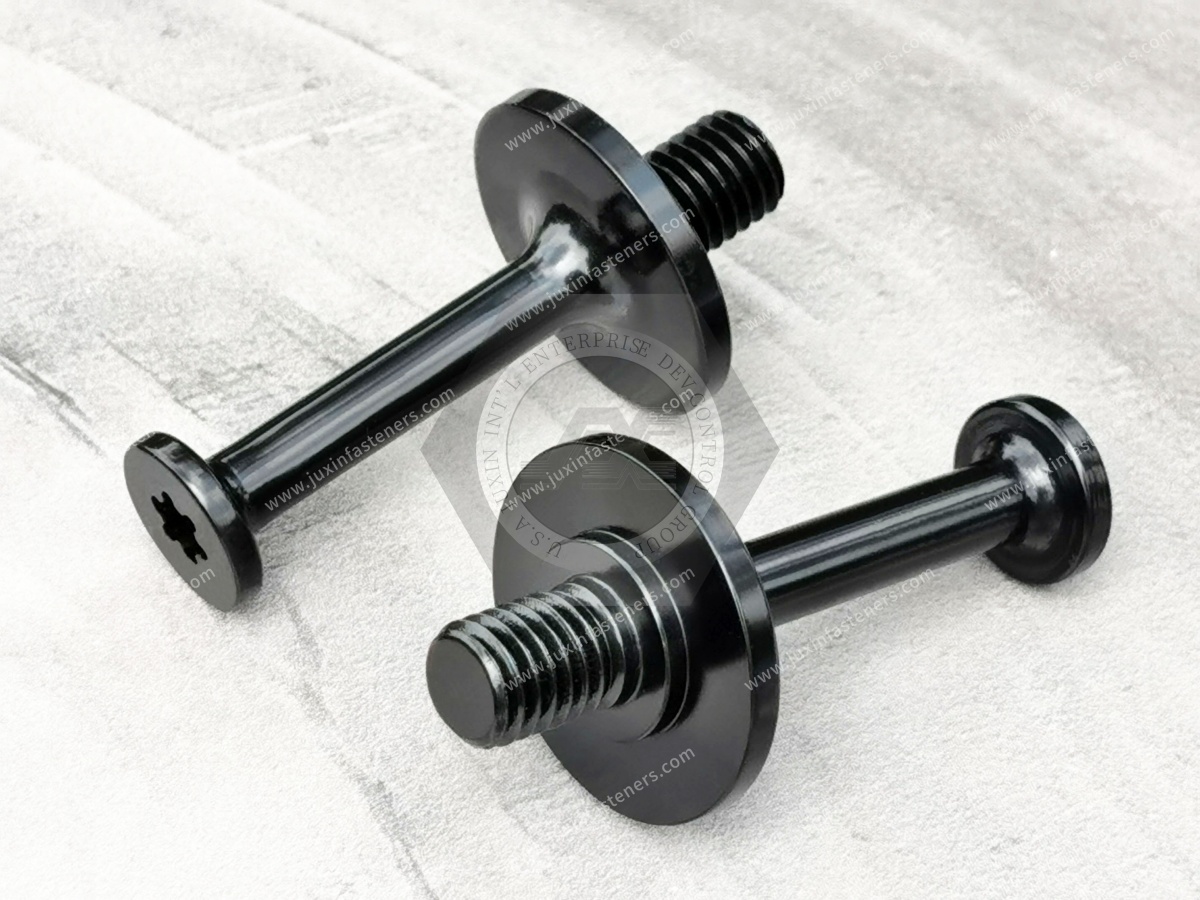
Increasing coating thickness may appear to offer more protection, but coating design involves tradeoffs.
Excessive thickness can create:
Thread interference
Dimensional problems
Poor fit
Assembly variation
Edge buildup
Increased process cost
Therefore:
More coating thickness ≠ automatically better fastener performance.
The coating system should provide the required functional performance while maintaining dimensional compatibility.
For threaded fasteners, coating selection cannot be separated from friction.
One of the most important principles is:
Torque ≠ Preload.
Torque is the input applied by the tightening tool.
Preload is the tensile force generated in the fastener that creates clamp load.
Friction at the threads and bearing surface strongly affects the relationship between them.
This means two dimensionally identical fasteners tightened to the same torque can generate different preload if their surface friction differs.
This becomes especially important when changing:
Coating type
Passivation
Topcoat
Sealer
Lubricant
Washer
Mating surface
Therefore:
Same torque + different friction ≠ same preload.
A coating substitution that appears harmless to purchasing may alter the mechanical behavior of the joint.
For torque-controlled OEM assembly, friction should be treated as an engineering characteristic when required by the application.
Suppose an OEM approves Fastener A with one coating system.
A purchasing team later receives a lower-cost quotation for the same dimensional fastener with another finish.
The supplier may claim:
Same material
Same dimensions
Same property class
Same corrosion requirement
But if the friction behavior is different, the existing tightening parameters may not produce the same joint preload.
This illustrates why:
Same dimensions ≠ functional equivalence.
For relevant assemblies, procurement should not approve coating substitutions without considering engineering impact.
For lock nuts and other prevailing-torque fasteners, the tightening system can become even more complex.
Prevailing torque ≠ preload.
Part of the measured tightening torque may be consumed by the locking feature before useful clamp load is generated.
Coating and lubrication can also affect prevailing-torque behavior.
For these products, sourcing teams should distinguish between:
Locking torque
Tightening torque
Preload
Clamp load
They should not be treated as interchangeable values.
Salt spray testing is frequently misunderstood in fastener sourcing.
A coating supplier may report performance such as a certain number of hours before defined corrosion criteria are reached under a specified laboratory test.
That can be useful for controlled comparison.
But:
Salt spray hours ≠ field service life.
A fastener that reaches a certain laboratory test duration cannot automatically be translated into a specific number of years in an automotive, coastal, solar, machinery or outdoor application.
Real-world corrosion depends on factors such as:
Wet/dry cycling
Temperature
Humidity
Chloride concentration
Chemical contamination
Coating damage
Joint geometry
Water retention
Drainage
Galvanic interaction
Maintenance
Therefore, salt spray requirements should be treated as test criteria rather than a direct service-life prediction.
Statements such as:
"720-hour salt spray coating"
are incomplete unless the test conditions and acceptance criteria are defined.
An engineering specification should identify, as applicable:
Test method
Test duration
Substrate
Coating system
Coating thickness
Passivation
Topcoat
Acceptance criteria
White corrosion criterion
Red corrosion criterion
Relevant drawing or OEM requirement
Without this context, comparing two "720-hour coatings" can be misleading.
Fastener corrosion cannot always be evaluated independently from the parent structure.
Mixed-metal assemblies may create galvanic interactions when dissimilar metals are electrically connected in the presence of an electrolyte.
Factors include:
Fastener material
Parent material
Coatings
Relative exposed surface areas
Electrical contact
Moisture
Chlorides
Joint geometry
Coating damage
Therefore:
Corrosion-resistant fastener ≠ corrosion-resistant assembly.
A stainless steel fastener, for example, should not automatically be assumed to solve a corrosion problem when connected to another metal.
The complete joint should be evaluated.
Carbon and alloy steel fasteners commonly require a surface-protection strategy where corrosion is relevant.
Depending on the application, engineers may evaluate:
Zinc electroplating
Zinc-nickel
Zinc-flake
Phosphate-based systems
Other specified finishes
Selection depends on:
Mechanical properties
Fastener hardness
Environment
Thread
Friction
Appearance
Assembly process
Corrosion requirement
Cost
The coating should be selected together with the fastener's material and manufacturing route.
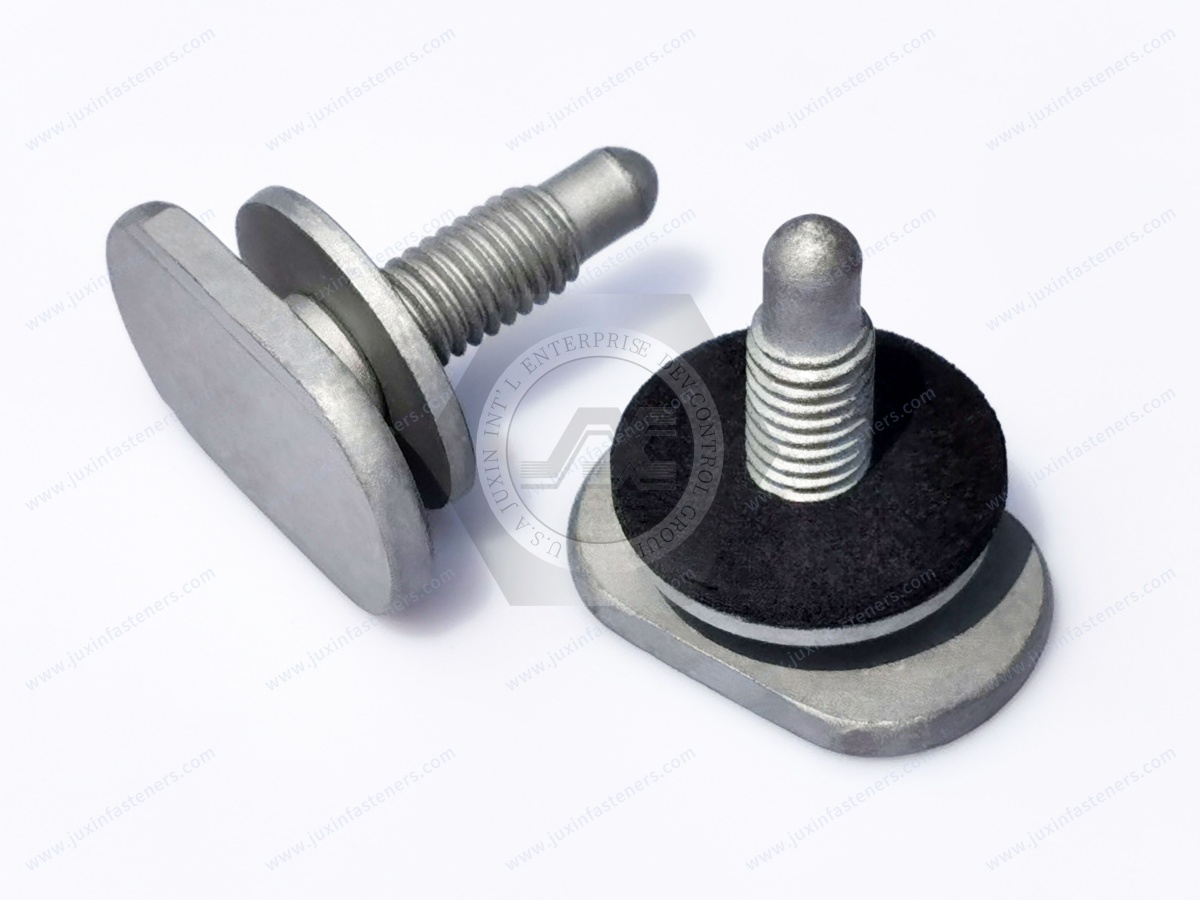
Stainless steel uses alloy composition and passive-surface behavior as part of its corrosion strategy.
In many applications, an additional sacrificial coating may not be required.
However, stainless fastener selection still requires consideration of:
Stainless grade
Chloride exposure
Chemicals
Temperature
Galling
Friction
Mating material
Galvanic corrosion
Stainless steel ≠ corrosion-proof.
And:
Stainless steel ≠ anti-loosening.
Corrosion performance and joint loosening are different engineering problems.
Aluminum fasteners may use surface treatments such as anodizing or other application-specific finishes.
But:
Anodizing ≠ corrosion-proof assembly.
The finished joint can still be influenced by:
Aluminum alloy
Mating material
Coating damage
Galvanic interaction
Thread fit
Preload
Environment
Repeated assembly
Aluminum fasteners should not be treated as direct substitutes for steel simply because weight reduction is desired.
Rivet nut coating selection must consider both the free component and the installation process.
Relevant variables include:
Rivet nut material
Parent sheet
Coating thickness
Thread fit
Body deformation
Installation
Corrosion environment
Galvanic compatibility
Because the body deforms during setting, the coating must remain compatible with the intended installation process.
Installed-joint validation can be more informative than evaluating coating appearance alone.
Weld fasteners require special consideration because the surface condition can influence the welding process.
Important variables include:
Fastener material
Parent sheet
Surface treatment
Projection geometry
Welding process
Electrical contact
Weld parameters
Thread protection
A coating change on a weld nut should therefore not automatically be treated as a cosmetic purchasing substitution.
Coating substitution can be a welding-process change.
The weld process may require review or revalidation.
High-strength steel fasteners require careful surface-treatment selection because corrosion protection must be balanced against manufacturing and material risks.
Engineering should consider:
Fastener hardness
Strength level
Cleaning process
Pretreatment
Coating process
Hydrogen introduction risk
Post-treatment controls
Thread fit
Friction
Required corrosion performance
The appropriate solution depends on the complete component and process specification.
There is no single coating that is automatically correct for every high-strength fastener.
Hydrogen embrittlement is an important consideration for susceptible high-strength steel fasteners.
Hydrogen can potentially be introduced during processes such as:
Acid cleaning
Pickling
Electroplating
Other manufacturing or environmental exposure routes
Risk is influenced by material strength, hardness, stress and process history.
Where applicable, engineering should review recognized international requirements such as relevant ISO or
ASTM specifications together with the customer drawing and application requirements.
A post-plating baking process may form part of a risk-control strategy where specified.
However:
Baking ≠ universal guarantee against hydrogen embrittlement.
Risk control begins with appropriate material, process selection and manufacturing control.
Automotive assemblies can expose fasteners to very different environments depending on location.
An interior trim fastener, body fastener, underbody component and electrical enclosure fastener should not automatically use the same coating specification.
Automotive coating selection may need to consider:
Exposure location
Steel strength
Parent material
Corrosion requirement
Friction requirement
Tightening process
Temperature
Stone or mechanical damage
Galvanic interaction
Appearance
OEM-specific specification
Potential coating systems can include zinc, zinc-nickel, zinc-flake, phosphate and other project-specific finishes.
The correct finish must be selected according to the actual application and OEM requirement.
EV assemblies add material combinations and thermal/electrical requirements that can influence fastener surface selection.
Potential applications include selected:
Battery enclosures
Electrical modules
Power electronics
Cooling equipment
Brackets
Cable-management hardware
Serviceable covers
Relevant considerations can include:
Galvanic compatibility
Corrosion
Friction
Thermal cycling
Electrical contact or isolation strategy
Serviceability
Sealing interfaces
A fastener coating alone does not establish battery-system electrical or sealing compliance.
Solar, energy-storage and other renewable-energy equipment can expose fasteners to outdoor environmental conditions.
Relevant variables may include:
Humidity
Chlorides
Temperature cycling
Condensation
UV exposure of adjacent materials
Dissimilar metals
Maintenance access
Expected service environment
Potential coating systems should be evaluated against the actual project specification rather than selected solely from a generic "outdoor" category.
Industrial machinery may operate in environments ranging from clean indoor factories to humid, oily or chemically exposed production areas.
Fastener surface requirements may therefore differ significantly.
Engineers and procurement teams should define:
Environment
Cleaning chemicals
Lubricants
Temperature
Corrosion requirement
Assembly torque
Appearance
Maintenance cycle
Zinc plating, phosphate systems, zinc-nickel, zinc-flake or other finishes may be evaluated depending on the actual requirement.
Electrical cabinets, power electronics, telecom systems and AI data-center equipment may use coated fasteners in:
Cabinets
Racks
Cooling equipment
Power modules
Control systems
Serviceable enclosures
Mechanical fastening and electrical function should be evaluated separately.
Conductive coating ≠ qualified electrical connection.
If a fastener is intended to form part of a grounding or current-carrying path, the electrical interface must be specifically engineered and validated.
For selected railway interior, enclosure and secondary equipment applications, coating selection may involve:
Corrosion environment
Interior or exterior exposure
Parent material
Maintenance
Vibration
Temperature
Project-specific requirements
JUXIN FASTENERS can support selected drawing-based railway fastening projects according to customer requirements.
Fasteners for primary structural, braking, running gear, crash or other safety-critical applications require the applicable OEM or project specifications and formal qualification.
A general coating description should never be interpreted as automatic railway safety qualification.
A technically valid coating must also be controllable through production and repeat supply.
Supplier-development teams should evaluate:
Exact coating system
Approved process route
Coating thickness
Passivation
Topcoat
Friction requirements
Corrosion-test requirement
Appearance
Thread fit
Process control
Inspection method
Change control
Production consistency
This becomes particularly important when multiple coating subcontractors or second-source suppliers are involved.
When qualifying an alternative fastener supplier, procurement should not compare coating color alone.
Same dimensions + same color ≠ functional equivalence.
A second-source review may need to compare:
Base material
Fastener hardness
Coating chemistry/system
Coating thickness
Passivation
Topcoat
Sealer
Friction
Thread fit
Corrosion testing
Appearance
Hydrogen embrittlement controls where relevant
Installation behavior
Assembly validation
For weld fasteners, welding behavior may also need to be evaluated.
For rivet nuts, deformation and installed retention may matter.
For torque-controlled bolts, friction can be critical.
The qualification plan should reflect the function of the specific fastener.
A useful OEM coating requirement may contain several layers.
For example:
Base Fastener → Material / Property Requirement → Surface Preparation → Coating System → Thickness
→ Passivation / Topcoat → Friction Requirement → Corrosion Test → Appearance → Special Process Controls
This is far more useful than a purchasing note such as:
"Black zinc, good salt spray."
The more functionally important the fastener, the more important it becomes to define the coating in engineering terms.
Several recurring mistakes create sourcing and assembly problems.
"Black" does not identify the coating technology.
The test method and acceptance criteria matter.
A coating change can change tightening behavior.
Excessive coating can interfere with mating threads.
The mating material and environment still matter.
Excess thickness can create dimensional and assembly problems.
The change may affect corrosion, friction, welding or installation.
Laboratory test duration does not directly predict years in the field.
Before releasing a coating specification or RFQ, answer these questions:
| Decision Question | Why It Matters |
|---|---|
| What is the base fastener material? | Determines compatible coating routes and process risks |
| What is the strength or hardness level? | Relevant to hydrogen embrittlement risk |
| What environment will the fastener see? | Drives corrosion requirements |
| What is the mating material? | Influences galvanic compatibility |
| Is tightening torque controlled? | Makes friction behavior important |
| Is the fastener welded? | Surface condition can influence welding |
| Does the fastener deform during installation? | Relevant to rivet nuts and similar products |
| Are threads coated? | Thickness can affect fit |
| Is appearance important? | May require color and cosmetic controls |
| Is the component safety- or function-critical? | Determines validation depth |
| Is this a second-source project? | Functional equivalence must be demonstrated |
This matrix helps connect coating engineering with procurement decisions.
For a technically meaningful quotation, provide as much of the following information as available:
2D drawing
Part number
Drawing revision
Fastener type
Base material
Property class or mechanical requirement
Heat-treatment condition
Thread specification
Required coating system
Coating thickness where specified
Passivation
Sealer or topcoat
Color / appearance
Friction requirement where applicable
Corrosion test requirement
Test method
Acceptance criteria
Mating material
Installation method
Operating environment
Annual volume
Applicable ISO, DIN, EN, ASTM, SAE or OEM specification
If the coating has not yet been selected, provide the functional requirements rather than guessing a coating name.
For example:
Required corrosion test
Fastener material and hardness
Assembly torque strategy
Environment
Appearance
Mating material
Temperature
Welding requirement
This allows the coating system to be evaluated against the actual engineering requirement.
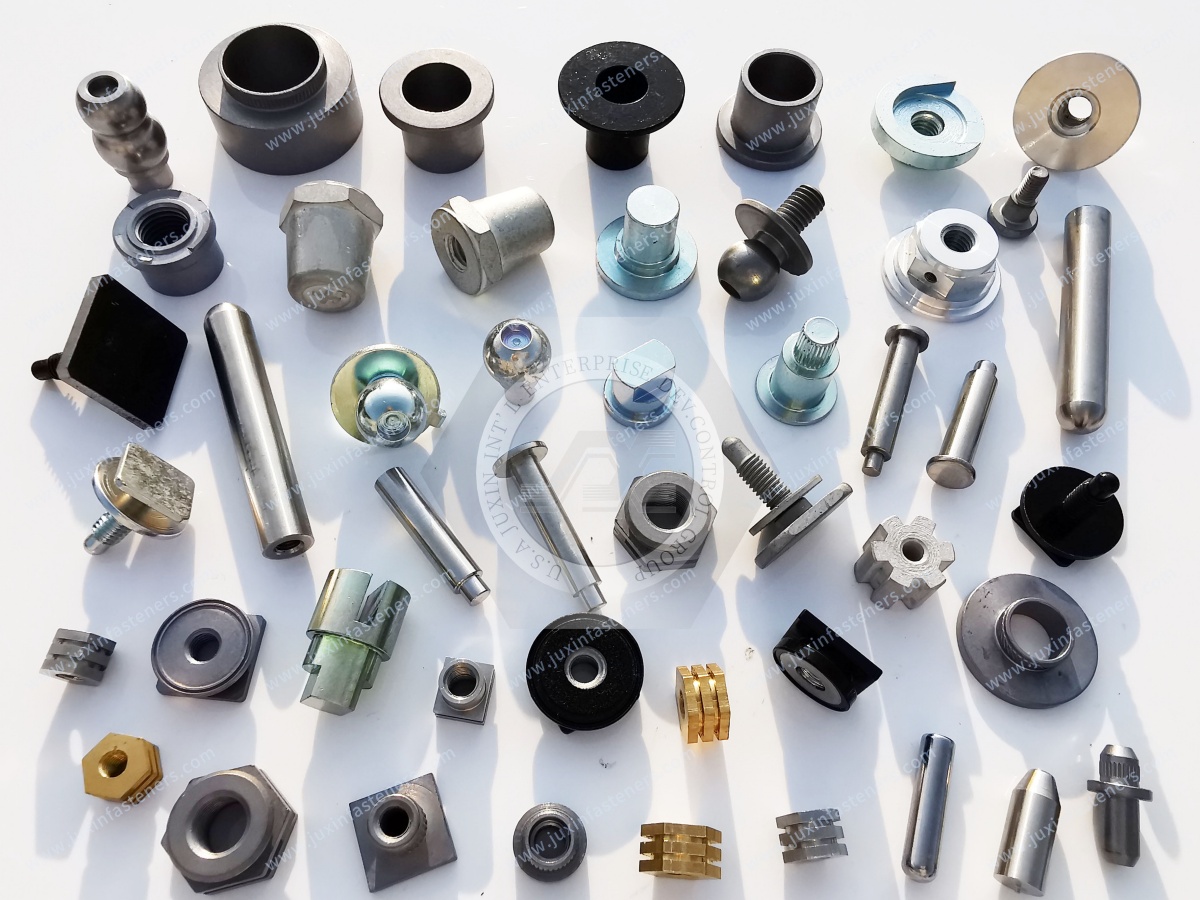
Two coating quotations are not technically comparable merely because both say "Zn-Ni" or "zinc-flake."
Procurement should compare:
Coating system
Thickness
Passivation
Topcoat
Friction control
Corrosion requirement
Thread fit
Process controls
Inspection
Packaging
Change control
A lower coating price can create higher downstream cost if it causes:
Thread interference
Tightening variation
Assembly rework
Corrosion failures
Weld-process instability
Additional inspection
Supplier requalification
A more useful commercial model is:
Total Installed Cost = Part Price + Coating + Installation + Inspection + Rework + Scrap + Downtime + Logistics + Supply Risk
Depending on the project, an engineered fastener coating program may follow:
Application Requirement → Base Material Review → Coating Selection → Friction / Thread-Fit Review → Quotation → Sample
→ Corrosion / Functional Testing → Assembly Validation → Approval → Production Supply
Not every project requires every step.
A general industrial screw and a high-strength torque-controlled automotive fastener do not carry the same technical risk.
Validation should match the application.
This page should serve as the surface-treatment and coating engineering hub within the JUXIN FASTENERS website.
Recommended internal-link relationships include:
Custom Fastener Manufacturing → manufacturing process, heat treatment and DFM
Automotive Sheet Metal Fastening → automotive coating, friction and corrosion considerations
High-Strength Fasteners → property class, preload and coating-process considerations
Stainless Steel Fasteners → stainless grades, corrosion and galling
Aluminum Fasteners → lightweighting and galvanic-corrosion considerations
Rivet Nuts → coating, grip range and installed-performance resources
Weld Nuts → coating and projection-welding compatibility
Weld Studs → welding process and surface-condition resources
Lock Nuts → prevailing torque and friction resources
Fastener Failure Modes → corrosion, loosening and joint-failure analysis
Industrial Fastener Solutions → cross-technology fastener selection
Use the existing indexed JUXIN FASTENERS URL when implementing these internal links.
There is no universal best coating. Selection depends on base material, fastener strength, corrosion environment,
friction requirement, mating material, temperature, installation process and cost.
No. Zinc-nickel may provide advantages for higher corrosion requirements, but conventional zinc can remain appropriate for less demanding environments.
The coating should match the application rather than simply selecting the higher-performance system.
It can be considered for selected high-strength fastener applications because appropriate zinc-flake processes avoid electrolytic deposition.
However, the complete manufacturing and pretreatment route must still be evaluated for hydrogen embrittlement risk and other requirements.
Not necessarily. Laboratory salt-spray duration is not a direct prediction of field service life. Test method, acceptance criteria, coating system and actual environment must all be considered.
Not automatically. The systems may differ in thickness, corrosion behavior, friction and process characteristics.
If the fastener is functionally controlled, the substitution should be reviewed.
Yes. Coating adds material to thread surfaces. Excessive or poorly controlled thickness can interfere with mating threads and final gauging.
The surface system influences friction at the threads and bearing surfaces. Because torque is not the same as preload,
changing friction can change the clamp force generated at the same tightening torque.
No. The correct choice depends on mechanical properties, environment, mating materials, galling, friction, cost and joint design.
JUXIN FASTENERS supports selected surface-treatment requirements for standard and drawing-based fasteners subject to technical review, coating availability and project specifications.
Send the drawing, material, mechanical requirements, thread, required coating or functional corrosion requirement, friction requirement if applicable,
mating material, operating environment, annual volume and relevant international or OEM specifications.
For industrial OEM sourcing, the finished fastener should be treated as a complete engineered component:
Fastener Geometry + Material + Mechanical Properties + Heat Treatment + Thread + Surface Treatment + Friction + Installation + Operating Environment
Changing the coating can affect several parts of this system.
That is why JUXIN FASTENERS recommends defining coating requirements during drawing review and supplier qualification rather than adding a color or finish after the fastener itself has already been selected.
If your project requires zinc-plated fasteners, zinc-nickel coated fasteners,
zinc-flake coated fasteners or another drawing-controlled surface treatment, send the available project information for technical and commercial review.
For an effective RFQ, provide where possible:
2D Drawing + Part / Revision + Fastener Material + Property Requirement + Thread + Coating Requirement + Mating Material + Installation Method + Environment + Annual Volume
Where relevant, also provide:
Coating Thickness + Passivation + Topcoat + Friction Requirement + Corrosion Test Method + Acceptance Criteria + Hydrogen Embrittlement Requirements + OEM Specification
This gives engineering, procurement and supplier-development teams a stronger basis for comparing suppliers and qualifying the finished fastener rather than comparing coating names alone.
JUXIN FASTENERS
Fastener Surface Treatment | Zinc Plating | Zinc-Nickel | Zinc-Flake | Custom Coated Fasteners
Email: info@juxinfasteners.com
Website: www.juxinfasteners.com
Contact Us
Tel.:
+86 020 8621 0320
+86 020 3121 6067
E-mail:
Technical Support:
Navigation
SEND INQUIREY



