
Call Us
+86 136 6007 9809
Call Us
+86 136 6007 9809

Aug. 11, 2026
Five Major Factors Behind O-Ring Failure and Engineering Solutions
Industrial Sealing Reliability Guide for Hydraulic, Pneumatic & OEM Systems | JUXIN FASTENERS
O-rings are among the most widely used sealing components in modern mechanical systems due to their simplicity, low cost, and excellent sealing performance. They are defined and standardized under international frameworks such as ISO 3601 (O-ring dimensional standards) and widely used in hydraulic and pneumatic systems across automotive, industrial machinery, and energy sectors.
However, despite their simple geometry, O-rings are responsible for a significant proportion of sealing failures. Industry experience shows that up to 70% of hydraulic and pneumatic leakage issues originate from improper selection, groove design, installation, or operating condition mismatch.
This article explains the five major causes of O-ring failure and provides engineering-based solutions aligned with international standards such as ISO 3601, ISO 1629, ISO 7745, and DIN 3771, helping engineers and procurement teams improve sealing reliability.
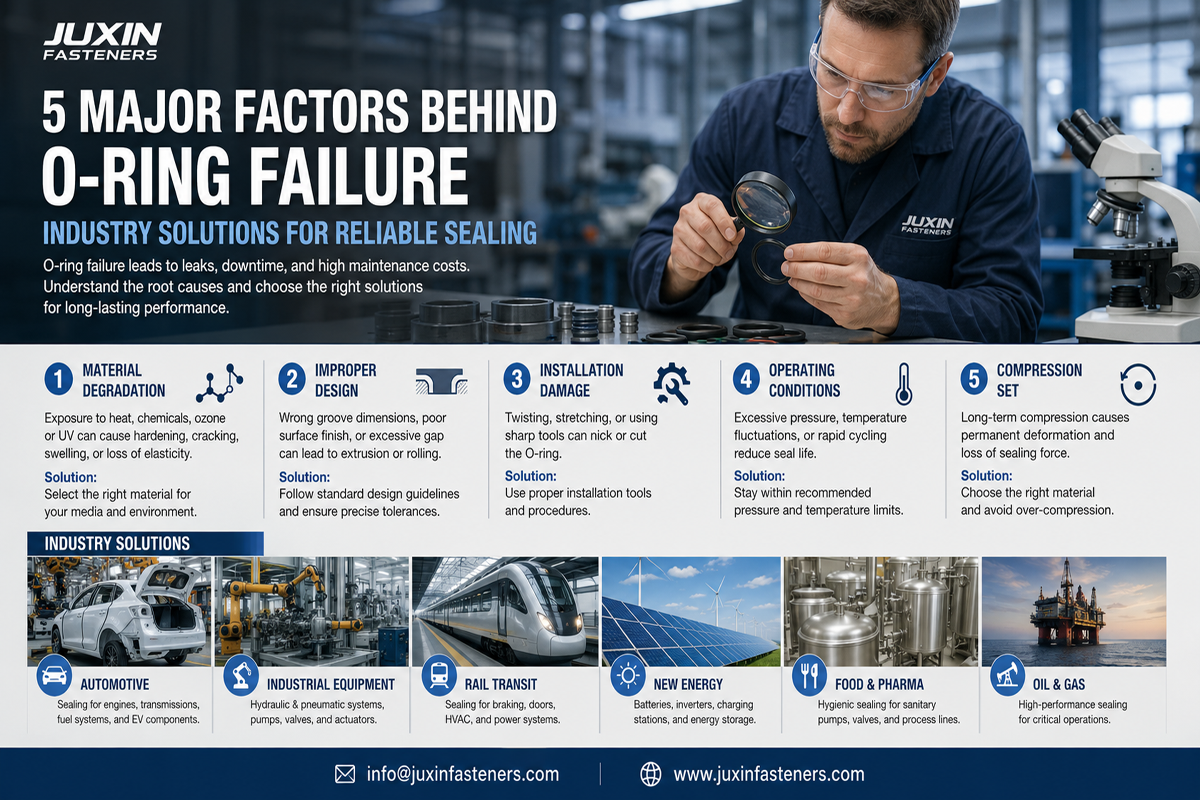
1. Incorrect Compression: The Most Common Cause of O-Ring Failure
1.1 Engineering Principle of Compression Sealing
O-ring sealing performance depends entirely on elastic deformation (squeeze compression) after installation. According to ISO 3601 design principles, correct compression ensures controlled contact stress between the elastomer and sealing surface.
1.2 Failure Mechanisms
Insufficient compression
Creates micro-clearance gaps
Leads to leakage under pressure
Becomes worse at low temperature due to rubber hardening and shrinkage
Excessive compression
Causes permanent deformation (compression set)
Accelerates material aging
Reduces service life by up to 50%
1.3 Engineering Compression Guidelines
Static sealing: 15% – 30% compression
Dynamic sealing: 8% – 20% compression
These values must be adjusted based on:
System pressure (ISO hydraulic design standards)
Groove tolerance accuracy
Elastomer hardness (Shore A)
2. Material and Media Mismatch: The Hidden Aging Acceleration Factor
2.1 Elastomer Material Standards (ISO 1629)
Common O-ring materials include:
NBR (Nitrile rubber) – oil resistant
FKM (Fluoroelastomer / Viton® type) – high temperature & chemical resistance
VMQ (Silicone rubber) – wide temperature range, low wear resistance
EPDM – water and steam resistance
2.2 Failure Mechanisms
NBR (Nitrile Rubber)
Degrades above 100°C
Hardening and loss of elasticity
Poor resistance to ozone and weathering
FKM (Fluoroelastomer)
Excellent in oils and fuels
Poor compatibility with hot water and steam
Swelling in aqueous media possible
Silicone Rubber (VMQ)
Excellent biocompatibility
Poor abrasion resistance
Not suitable for dynamic shaft sealing
2.3 Engineering Selection Rule
Before selecting an O-ring, engineers must define:
Medium type (oil, water, gas, chemicals)
Temperature range (continuous & peak)
Motion type (static / reciprocating / rotary)
For mixed media environments, compatibility testing (72-hour immersion test) is strongly recommended before mass production.
3. Seal Groove Design Defects: Structural Root Cause of Leakage
3.1 Relevant Design Standards
ISO 3601-2 – Groove dimensions and tolerances
DIN 3771 – O-ring groove design guidelines
3.2 Common Groove Design Failures
Incorrect groove width
Too narrow → excessive compression → cracking
Too wide → O-ring movement → wear and abrasion
Sharp edges and burrs
Cut or damage O-ring during installation
Create leakage initiation points
Poor surface finish
Excessive friction in dynamic seals
Accelerated wear and groove formation
3.3 Engineering Design Recommendations
Static groove width: 1.3 – 1.5 × cross-section diameter
Dynamic groove width: 1.5 – 2.0 × cross-section diameter
Edge radius: R0.1 – R0.3 mm
Surface roughness: Ra 1.6 – 3.2 μm
These parameters significantly improve sealing reliability and reduce micro-leakage risk.
4. Pressure Shock and Extrusion Damage in Hydraulic Systems
4.1 Failure Mechanism
In high-pressure systems (hydraulics, pneumatics, injection equipment), pressure spikes can force the O-ring into the clearance gap between mating surfaces.
When system pressure exceeds approximately 10 MPa, the following occurs:
O-ring extrusion into clearance gap
Shear damage at sealing edges
Progressive tearing under cyclic loading
Total seal failure over time
4.2 Engineering Solution: Back-Up Rings
To prevent extrusion failure, engineers should use PTFE back-up rings (anti-extrusion rings):
One-sided pressure → single back-up ring
Bidirectional pressure → dual back-up rings
4.3 Design Recommendations
Reduce clearance gap in precision hydraulic systems
Use higher hardness elastomers (Shore A 90+) for high pressure
Combine with ISO hydraulic system design standards
5. Improper Installation: The Most Overlooked Failure Cause
5.1 Installation Damage Mechanisms
Many O-ring failures are not design-related but installation-related:
Dry installation without lubrication → surface scratching
Installation over sharp threads → cutting damage
Excessive stretching → permanent deformation
Twisting during assembly → uneven compression
5.2 Engineering Installation Procedure (Best Practice)
Step 1: Groove inspection
Remove burrs and sharp edges
Clean contamination and machining debris
Step 2: Lubrication
Apply compatible grease based on media type
Ensure chemical compatibility with elastomer (ISO 3601 guidance)
Step 3: Controlled installation
Use guide sleeves over threads and steps
Avoid stretching beyond allowable elongation limits
Ensure uniform seating without twist
6. Engineering Summary: Why O-Ring Failures Are Preventable
O-ring sealing performance is not determined by size alone. It is the result of a complete engineering system:
Material selection (ISO 1629 elastomer classification)
Groove design (ISO 3601 / DIN 3771)
Compression control
Pressure management
Installation quality
Even small deviations in any one factor can result in leakage, downtime, or system failure.
7. Industry Application Scenarios
Properly designed O-ring systems are widely used in:
Hydraulic cylinders and power units
Pneumatic automation systems
Automotive engines and transmissions
Industrial pumps and valves
Energy and offshore equipment
JUXIN FASTENERS supports OEM sealing applications requiring:
High-pressure resistance
Chemical compatibility
Long service life
Precision groove matching
8. Conclusion: Engineering Reliability Starts with O-Ring System Design
The five major causes of O-ring failure are:
Incorrect compression
Material mismatch
Poor groove design
Pressure extrusion damage
Improper installation
By systematically controlling these factors according to ISO 3601 and DIN 3771 engineering principles, sealing reliability can be significantly improved while reducing maintenance costs and system downtime.
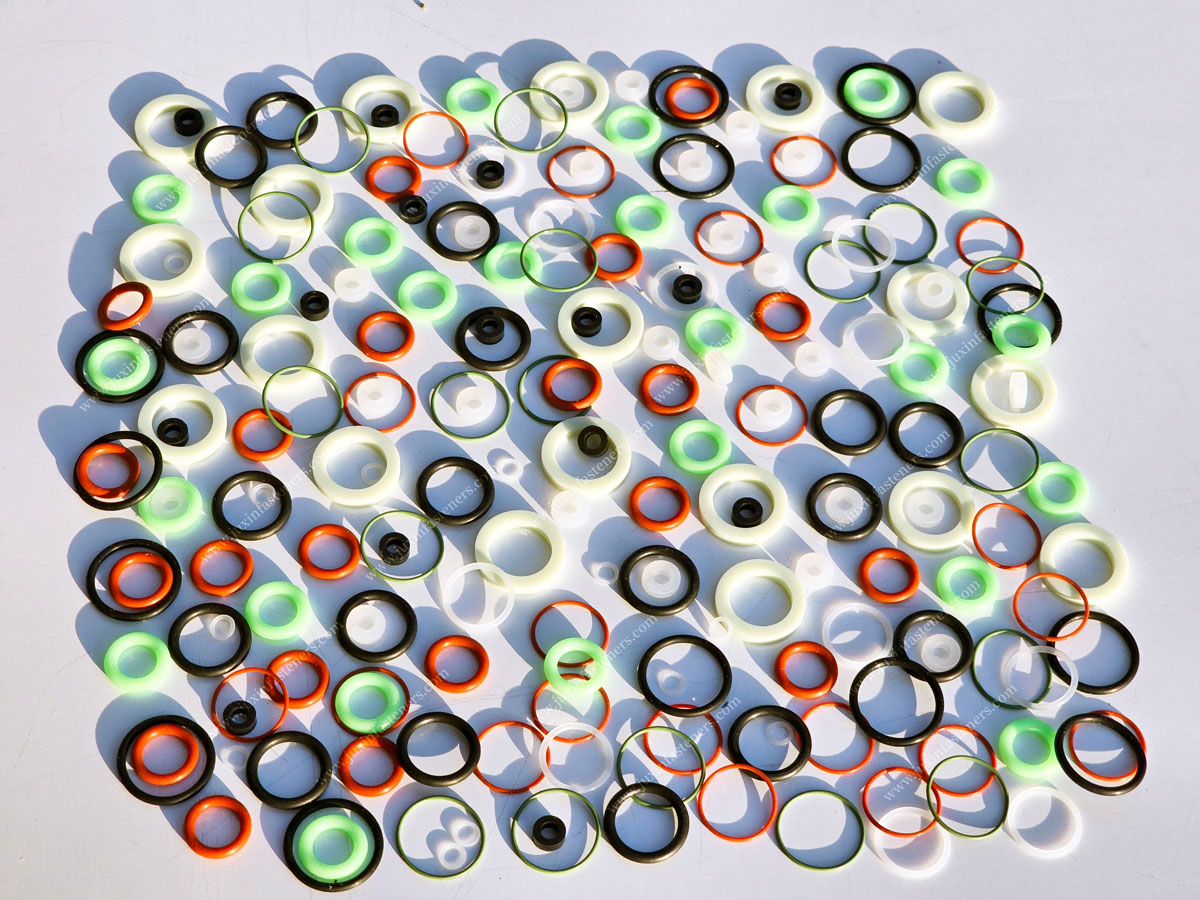
JUXIN FASTENERS Engineering Sealing Solutions
JUXIN FASTENERS provides industrial-grade sealing and fastening solutions for global OEM industries:
Precision O-rings (ISO 3601 compliant)
Hydraulic sealing components
High-performance elastomer materials (NBR, FKM, EPDM, VMQ)
Custom sealing system engineering support
https://www.juxinfasteners.com
info@juxinfasteners.com
 MORE NEWS
Sep. 27, 2026
Sep. 27, 2026
Sep. 27, 2026
Contact Us
Tel.:
+86 020 8621 0320
+86 020 3121 6067
E-mail:
Technical Support:
Navigation
SEND INQUIREY