
Call Us
+86 136 6007 9809
Call Us
+86 136 6007 9809

Aug. 11, 2026
Industry Solution for Black Oxide Treatment of High-Strength Bolts
Why Hot-Dip Galvanizing Is Rarely Used for High-Strength Fasteners (Grade 8.8–12.9)
In structural engineering, construction machinery, bridge systems, wind power equipment, and heavy industrial assemblies,
high-strength bolts (ISO 898-1 property class 8.8 / 10.9 / 12.9) are critical load-bearing components designed to operate under controlled preload conditions.
One consistent engineering practice across global OEM industries is that these fasteners are predominantly finished with black oxide (blackening)
treatment rather than hot-dip galvanizing (HDG).
This is not a cost preference alone—it is a decision driven by metallurgy, mechanical performance, thread precision, and long-term joint reliability.
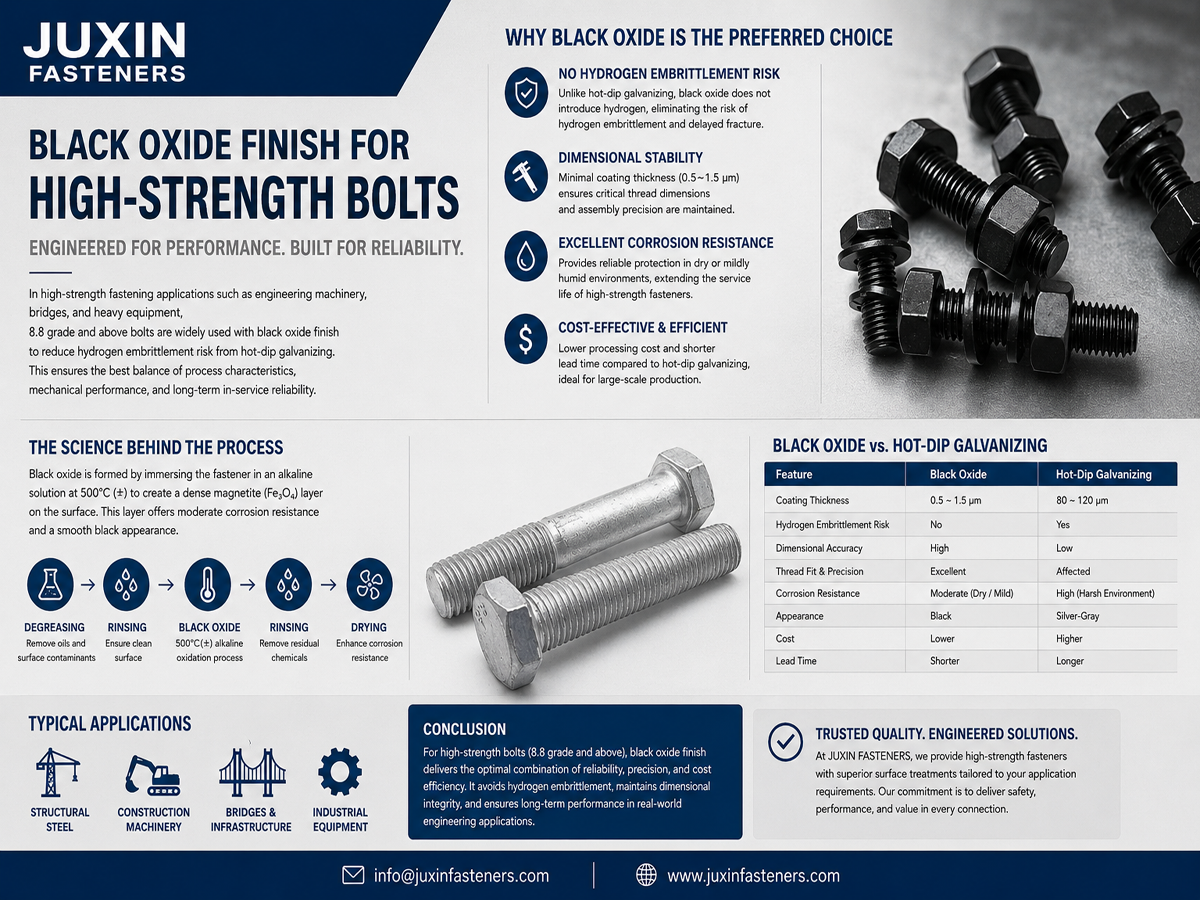
1. High-Strength Bolt Performance Requirements (ISO / DIN Standards Basis)
High-strength bolts manufactured according to:
ISO 898-1 (Mechanical properties of fasteners)
DIN EN ISO 4014 / 4017 (Hex head bolts and screws)
VDI 2230 (Bolted joint design methodology)
are designed to achieve performance through:
Quenched and tempered microstructure
Controlled yield strength and tensile strength balance
Precise preload-dependent frictional load transfer
Their structural integrity depends on maintaining a stable tempered martensite or sorbite microstructure, which is highly sensitive to excessive heat exposure.
2. Why Hot-Dip Galvanizing Is Rarely Used for High-Strength Bolts
2.1 Thermal Damage Risk (Core Technical Limitation)
Hot-dip galvanizing (HDG) requires immersion in molten zinc at approximately 450–500°C.
This temperature range overlaps directly with the tempering zone of quenched-and-tempered steels used in high-strength bolts.
Consequences include:
Loss of tempering stability
Reduction in toughness
Increased risk of tempered embrittlement
Higher susceptibility to brittle fracture under dynamic load
In engineering terms, this violates the fundamental design assumptions of ISO 898-1 high-strength fasteners.
2.2 Hydrogen Embrittlement and Stress Sensitivity
High-strength bolts already operate near material limits. HDG processes can introduce:
Hydrogen absorption during pickling
Delayed fracture under tensile preload
Crack initiation under cyclic loading
This is especially critical for:
Bridge tension systems
Crane structural joints
Heavy construction machinery
2.3 Dimensional and Thread Fit Distortion
Hot-dip galvanizing produces coating thickness typically:
80–120 μm (or higher at thread peaks)
This causes:
Pitch diameter increase
Thread interference
Loss of ISO 6g / 6H fit accuracy (ISO 965 tolerance system)
Need for post-tapping or thread rework
For precision preload-controlled joints, this is unacceptable because:
High-strength bolted joints rely on frictional preload, not thread interference.
Even small dimensional deviations can lead to:
Incorrect torque-preload relationship
Reduced clamping force stability
Premature loosening or overload failure
3. Why Black Oxide Treatment Is the Preferred Solution
3.1 Low-Temperature Surface Conversion Process
Black oxide treatment operates at approximately:
140°C – 180°C
This ensures:
No alteration of quenched-and-tempered microstructure
No degradation of mechanical properties
Full compatibility with ISO 898-1 high-strength grades
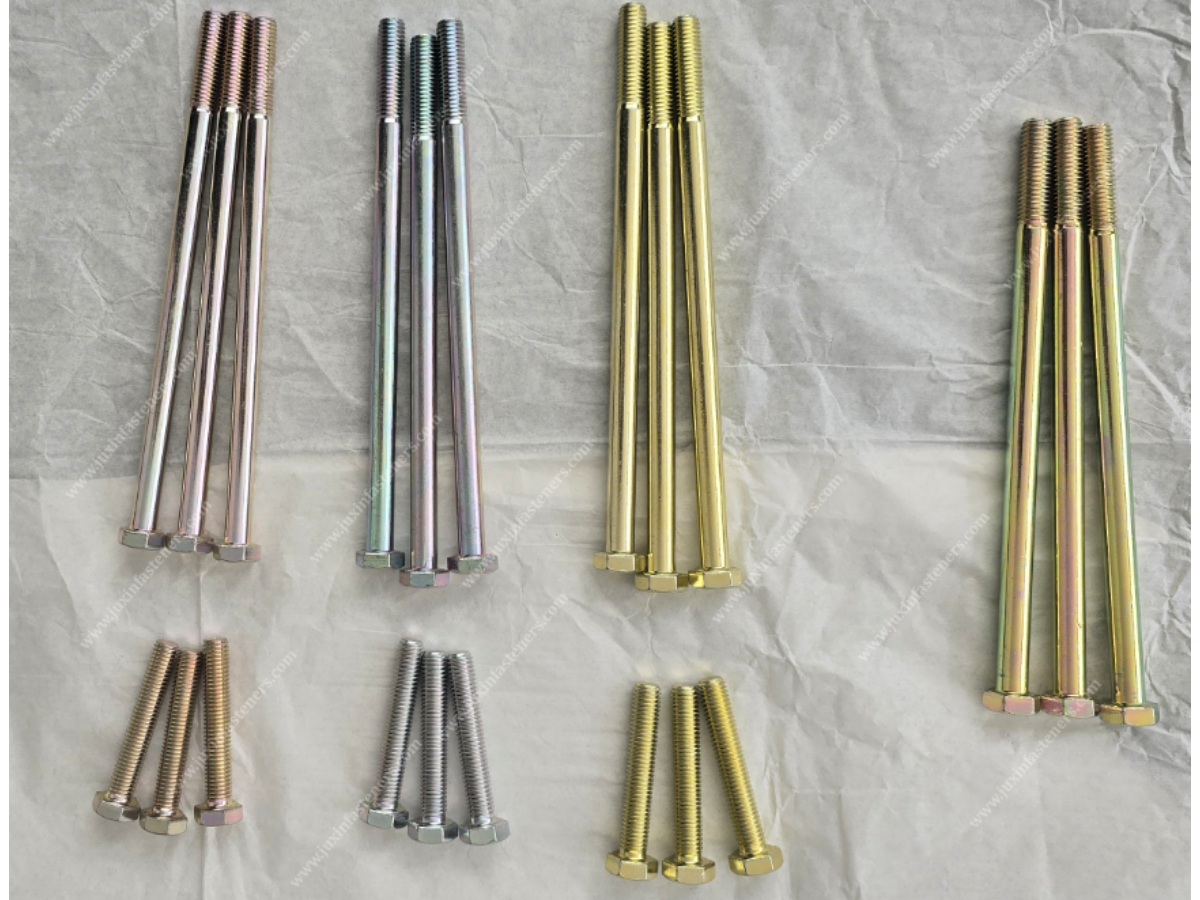
3.2 Protective Layer Formation (Fe₃O₄ Conversion Coating)
Black oxide forms a dense magnetite layer:
Chemical composition: Fe₃O₄ (magnetite film)
Thickness: 0.5–1.5 μm
No significant dimensional change
Key benefits:
Preserves ISO/DIN thread geometry (ISO 965 fit system)
No impact on torque coefficient consistency
Maintains preload accuracy in friction-based joints
3.3 Stability in Preload-Controlled Connections
High-strength bolts rely on:
Controlled tightening torque
Stable friction coefficient (μ)
Accurate preload generation
Black oxide ensures:
Minimal change in torque-tension relationship
Consistent assembly behavior
Reliable long-term preload retention
This is essential for VDI 2230-calculated bolted joint systems.
4. Cost and Manufacturing Efficiency Advantages
Black oxide treatment is widely used in OEM production because it offers:
4.1 Short Processing Cycle
Typically 1–2 hours total process time
Suitable for mass production lines
4.2 Lower Cost Structure
Approximately 30–50% of HDG cost
No post-treatment thread reworking required
4.3 Simplified Process Flow
Compared to HDG, black oxide eliminates:
Pickling stage complexity
Zinc immersion process
Thread re-tapping operations
Heavy post-coating dimensional correction
5. When Hot-Dip Galvanizing Can Still Be Used (Special Engineering Cases)
Although rare, HDG may be applied to high-strength bolts under strict engineering control:
5.1 Low Hydrogen Embrittlement HDG Process
Special controlled processes include:
Reduced immersion time
Modified zinc bath chemistry
Post-treatment stress relief
However, risks remain higher than black oxide.
5.2 Typical Application Scenarios
Wind power tower structures
Transmission towers
Extreme outdoor corrosion environments
Relevant standards:
ISO 10684 (Hot-dip galvanized fasteners)
DIN EN ISO 1461 (Hot-dip galvanized coatings)
5.3 Economic Limitation
Cost can be 2–3× higher than standard HDG
Requires specialized quality control
Limited to safety-critical infrastructure
6. Performance Comparison: Black Oxide vs Hot-Dip Galvanizing
Property | Black Oxide | Hot-Dip Galvanizing |
Processing temperature | 140–180°C | ~450–500°C |
Effect on mechanical strength | None | Risk of temper embrittlement |
Coating thickness | 0.5–1.5 μm | 80–120 μm |
Thread fit impact (ISO 965) | None | Significant distortion |
Cost efficiency | High | Medium–low |
Suitability for 10.9 / 12.9 bolts | Excellent | Limited / restricted |
7. Corrosion Protection Performance in Real Applications
When combined with:
Anti-corrosion oil coating
Storage protection systems
Controlled environment exposure
Black oxide-treated high-strength bolts can achieve:
5–10 years corrosion resistance in standard environments
Reliable performance in indoor and moderate outdoor conditions
This makes it ideal for:
Machinery assembly
Automotive structures
Industrial equipment
OEM production lines
8. Engineering Selection Guidelines (Practical Decision Logic)
Use Black Oxide When:
High-strength bolts (8.8 / 10.9 / 12.9 per ISO 898-1)
Preload-controlled friction joints (VDI 2230 design)
Precision thread fits (ISO 965 6g / 6H systems)
Mass production requirements
Indoor or standard outdoor exposure
Use Hot-Dip Galvanizing Only When:
Extreme corrosion environment
Structural steel infrastructure (towers, bridges)
Safety engineering allows reduced mechanical sensitivity
Controlled HDG process per ISO 10684
9. Conclusion: Why Black Oxide Is the Engineering Default for High-Strength Bolts
The dominance of black oxide treatment for high-strength bolts is not a cost-driven decision—it is a result of fundamental engineering constraints:
Preserves quenched-and-tempered microstructure
Maintains ISO 898-1 mechanical properties
Ensures accurate preload behavior under VDI 2230 design principles
Avoids dimensional distortion of ISO 965 threaded fits
Provides stable, cost-effective mass production performance
Hot-dip galvanizing, while excellent for corrosion resistance, introduces unacceptable risks in high-strength preload-dependent systems.
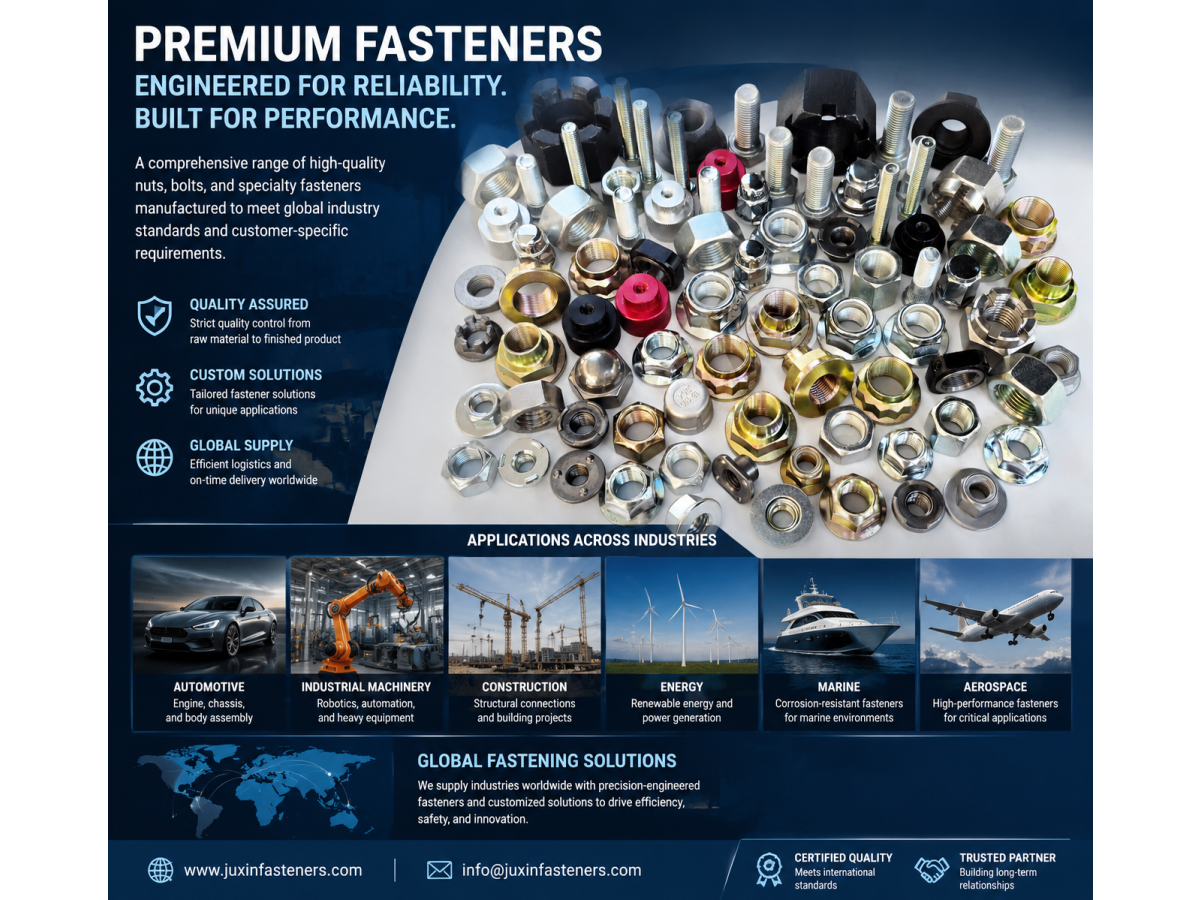
JUXIN FASTENERS Engineering Solutions
JUXIN FASTENERS supplies high-performance fastening systems for global OEM industries:
ISO 898-1 high-strength bolts (8.8 / 10.9 / 12.9)
DIN EN ISO standard fasteners
Black oxide treated precision bolts
Coating-compatible engineered fastening solutions
https://www.juxinfasteners.com
info@juxinfasteners.com
 MORE NEWS
Sep. 27, 2026
Sep. 27, 2026
Sep. 27, 2026
Contact Us
Tel.:
+86 020 8621 0320
+86 020 3121 6067
E-mail:
Technical Support:
Navigation
SEND INQUIREY