
Call Us
+86 136 6007 9809
Call Us
+86 136 6007 9809

Sep. 01, 2026
Selecting threaded inserts for injection molded parts is not simply a matter of matching the insert thread to the mating screw.
A reliable plastic fastening system depends on the interaction between the plastic resin, insert material, insert geometry, boss design, installation method and mechanical requirements.
An insert that performs well in one plastic component may not provide the same result in another design.
ABS, nylon, polycarbonate, PBT, PEEK and glass-filled polymers can behave differently during installation and under service loads.
For procurement managers, supply chain teams, structural engineers and product design engineers, the correct approach is to evaluate the insert as part of the complete fastening system.
This guide explains the key factors to consider when selecting threaded inserts for injection molded plastic components.
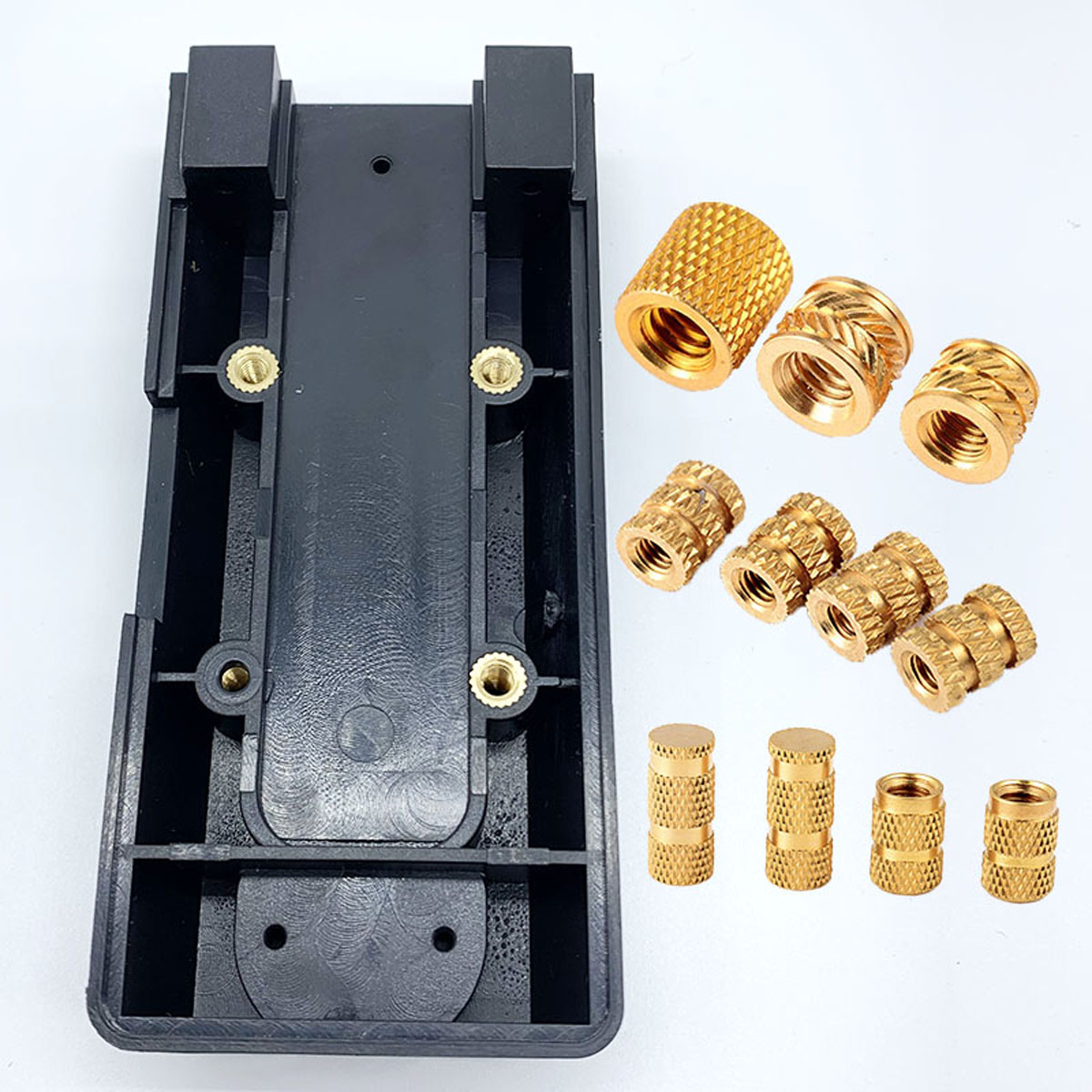
Injection-molded plastics offer major advantages for OEM products, including low weight, design flexibility and efficient high-volume production.
However, the plastic itself may not provide the required thread strength for:
Higher tightening torque
Repeated assembly
Maintenance access
Vibration
Long-term service
Higher clamp loads
Mechanical mounting
A metal threaded insert can create a reinforced fastening point inside the plastic.
But the insert must be correctly matched to the component.
The wrong insert geometry, excessive interference or inadequate boss design can result in:
Plastic cracking
Insert movement
Thread misalignment
Insufficient pull-out resistance
Insert rotation
Assembly problems
Premature fastening failure
The selection process should therefore begin with the application rather than the fastener catalog.
The first step is to identify the actual plastic material and grade.
Common materials used for injection-molded components include:
ABS
PA / Nylon
PC / Polycarbonate
PBT
PET
POM
PP
PEEK
Glass-filled polymers
Other engineering thermoplastics
Material grade is important because two plastics with the same generic name can have different mechanical properties.
ABS is widely used for electronic housings, automotive components and industrial products.
It can be suitable for several threaded insert solutions when the boss dimensions and installation parameters are correctly designed.
Nylon has different mechanical and dimensional characteristics from ABS.
Engineers should consider the specific PA grade, reinforcement and environmental conditions when selecting the insert.
Polycarbonate is frequently used for housings and components requiring impact resistance.
Insert geometry and installation force should be evaluated to avoid excessive local stress.
PBT is used in various electrical, automotive and engineering applications.
The insert and installation method should be selected according to the actual resin grade and component geometry.
PEEK is a high-performance engineering polymer used in demanding applications.
Its processing and mechanical characteristics differ significantly from common commodity plastics, so insert selection and installation parameters should be validated specifically for the application.
Glass-fiber reinforcement can significantly change stiffness, strength, shrinkage and installation behavior.
For threaded inserts in glass-filled plastic, engineers should use the actual resin grade when developing the fastening system.
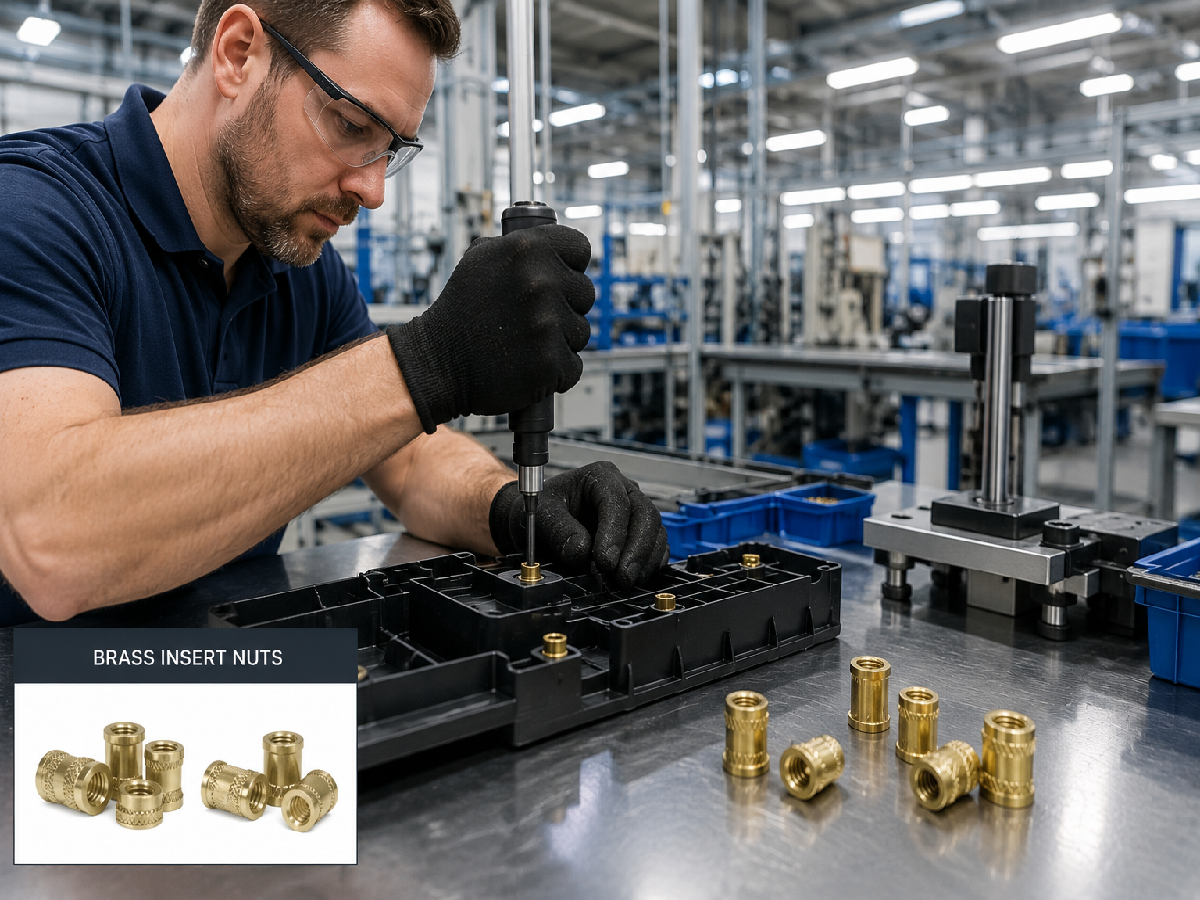
Once the plastic material is identified, determine how the insert will be installed.
The four common approaches are:
Molded-in
Heat staking
Ultrasonic
Press-in
Each method has different requirements.
Molded-in threaded inserts are positioned inside the injection mold before the polymer is injected.
The plastic flows around the external insert profile and mechanically integrates the insert into the finished component.
This method can be attractive for:
High-volume production
Stable product designs
Integrated fastening points
Automated molding processes
Reduced secondary assembly
Mold tooling must be designed to control insert positioning during the injection cycle.
Heat staking inserts are installed after molding.
Controlled heat softens the surrounding thermoplastic, allowing the insert to be pressed into the component.
After cooling, the polymer solidifies around the external insert profile.
Heat staking can be useful when:
Post-molding installation is preferred
Insert locations may change during development
Thermal installation is acceptable
Automated assembly is required
Installation temperature, heating time, pressure and cooling conditions should be developed according to the actual resin.
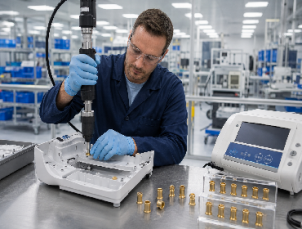
Ultrasonic threaded inserts use high-frequency mechanical energy to generate localized heating around the insert.
The softened polymer flows around the external profile before cooling and retaining the insert.
Ultrasonic installation can provide:
Fast cycle times
Localized heating
Repeatable installation
Automated production capability
Reduced overall thermal exposure
The ultrasonic parameters should be validated for the specific plastic component.
Press-in threaded inserts rely on mechanical interference.
The insert is pushed into a prepared hole using controlled force.
This method may be suitable when:
Heat should be avoided
The plastic can tolerate interference
Post-molding installation is required
Simple mechanical assembly is preferred
Hole diameter and interference are particularly important for press-in applications.
Thread size alone does not determine insert performance.
Before selecting an insert, define the loads and assembly conditions.
Important requirements can include:
Pull-out force
Torque-out resistance
Screw tightening torque
Clamp load
Repeated assembly
Vibration
Tensile load
Shear load
Service temperature
Environmental exposure
Pull-out resistance describes the axial force required to remove the insert from the plastic.
It depends on:
Insert length
External profile
Plastic strength
Boss geometry
Installation method
Component thickness
Torque-out resistance measures the insert's ability to resist rotation during screw tightening.
This is particularly important when the mating screw requires a defined tightening torque.
Knurled, ribbed and undercut external profiles can improve mechanical engagement with the polymer.
If the product will be opened repeatedly for service, a metal insert can provide a more durable thread than a directly molded plastic thread.
The required number of assembly cycles should be established during product development.
The insert material should be selected according to mechanical, environmental, weight and electrical requirements.
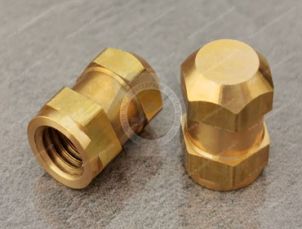
Brass threaded inserts are widely used for injection-molded plastic components.
Advantages can include:
Good machinability
Practical mechanical performance
Thermal conductivity
Electrical conductivity
Broad application suitability
Brass is commonly considered for:
Electronics
Electrical housings
Automotive components
Telecom equipment
Industrial machinery
Aluminum threaded inserts can be considered when weight reduction is important.
They can provide a metal thread while adding relatively low mass to the plastic assembly.
Stainless steel threaded inserts can be selected when corrosion resistance or higher mechanical performance is required.
Potential applications include:
Outdoor equipment
Industrial systems
High-humidity environments
Marine-related applications
Corrosive environments
The specific stainless steel grade should be selected according to the actual operating conditions.
The external geometry determines how the insert interacts with the plastic.
Common features include:
Knurling
Ribs
Barbs
Grooves
Undercuts
Flanges
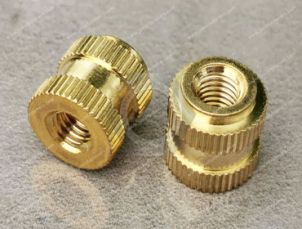
Knurled threaded inserts provide an external patterned surface designed to increase mechanical engagement.
They are commonly used where resistance to rotational movement is important.
Ribbed external profiles can provide additional mechanical retention within the plastic.
The geometry should be matched to the resin and required load.
Barbed profiles can help improve axial retention in selected plastic components.
Undercuts allow the polymer to mechanically lock around the insert.
They can be useful where pull-out resistance is an important design requirement.
A flange can provide a defined seating surface and may help distribute loads around the fastening point.
The insert and plastic boss must be designed together.
The boss provides the structural support around the metal insert.
Important dimensions include:
Boss diameter
Boss height
Wall thickness
Hole diameter
Insert outside diameter
Insert length
Installation depth
Distance from adjacent features
The boss should contain sufficient plastic around the insert to support installation and service loads.
An undersized boss can increase local stress.
An oversized boss can consume unnecessary space and material.
Wall thickness affects the ability of the plastic to withstand installation and service loads.
Thin-wall components require particular attention to interference and installation force.
For press-in applications, hole diameter is critical.
Excessive interference can increase installation force and create cracking.
Insufficient interference can reduce retention and allow insert movement.
For molded-in and thermal installation methods, hole geometry still needs to be considered as part of the overall component design.
Insert length affects:
Thread engagement
Pull-out resistance
Available boss depth
Load transfer
A longer insert is not automatically better.
The insert must fit the available component geometry without compromising the surrounding structure.
The insert should be positioned at the correct depth.
Incorrect installation depth can affect:
Screw engagement
Component alignment
Clearance
Assembly torque
Appearance
Controlled installation equipment can improve consistency.
The insert should not be specified independently from the mating screw.
Confirm:
Thread diameter
Thread pitch
Thread standard
Screw material
Screw length
Engagement depth
Tightening torque
Coating or surface treatment
The insert thread should be compatible with the actual mating fastener.
For OEM applications, specifying only "M4 insert" or "1/4-20 insert" may not provide enough information for final selection.
The fastening system should be evaluated under actual service conditions.
Consider:
Temperature
Humidity
Water exposure
Chemicals
Salt spray
Vibration
UV exposure
Electrical requirements
Maintenance conditions
For example, a plastic enclosure used outdoors may require different insert material and surface protection from an indoor electronic housing.
Production volume can influence the most economical installation method.
Press-in or post-molding thermal installation may provide flexibility.
These methods can be useful during product development or when insert locations may change.
Molded-in, heat staking and ultrasonic solutions can be evaluated depending on the component and production process.
The goal is to achieve the required quality while maintaining consistent cycle time and assembly cost.
Prototype testing is essential for demanding OEM applications.
Testing should use the actual:
Plastic resin + insert + component geometry + mating screw + installation process
Important validation tests can include:
Determine whether the insert remains secure when the mating screw is tightened to the specified torque.
Measure the axial force required to remove the insert.
For serviceable products, install and remove the mating screw for the required number of cycles.
Check:
Insert height
Position
Alignment
Thread condition
Boss dimensions
Where required, evaluate the assembly under actual or simulated:
Temperature cycling
Humidity
Vibration
Corrosive exposure
Before releasing an insert specification, engineering and procurement teams should confirm:
| Selection Factor | Key Question |
|---|---|
| Plastic resin | What polymer and grade is being used? |
| Component geometry | What are the boss and wall dimensions? |
| Installation | Molded-in, heat staking, ultrasonic or press-in? |
| Thread | Metric or inch? What size and pitch? |
| Insert material | Brass, aluminum or stainless steel? |
| External profile | Knurl, rib, barb, undercut or flange? |
| Insert length | Is sufficient thread engagement available? |
| Torque | What tightening torque is required? |
| Pull-out | What axial load must the insert withstand? |
| Environment | What temperature and exposure conditions apply? |
| Production volume | What is the expected annual quantity? |
| Validation | What testing is required before production? |
An M4 or 1/4-20 thread specification does not define the complete insert.
The outside diameter, length, external profile and installation method are equally important.
ABS, nylon and glass-filled nylon should not automatically be treated as equivalent materials.
For press-in inserts, excessive interference can create excessive stress and cracking.
Even a correctly designed insert can fail if the surrounding plastic structure is too weak.
The insert geometry should be compatible with the actual production equipment and installation process.
Prototype performance does not automatically guarantee mass-production consistency.
The final process should be validated using production-representative parts.
Automotive plastic components can require reinforced fastening points for electronic modules, brackets, covers and interior components.
Insert selection should consider vibration, temperature cycling and long-term service conditions.
EV platforms use extensive plastic and composite components around electrical and electronic systems.
Threaded inserts for EV components can be considered for selected housings, covers, electronic modules and supporting structures.
Application-specific thermal, vibration and mechanical requirements should be validated.
Electronic housings frequently require multiple screw connections in compact plastic structures.
Threaded inserts can provide durable fastening points for:
PCB assemblies
Internal brackets
Covers
Connectors
Electronic modules
Electrical equipment may require serviceable fastening points inside plastic enclosures.
Metal inserts can provide reinforced threads while maintaining a lightweight housing.
Telecom housings and cabinets often combine compact geometry with multiple internal fastening points.
Threaded inserts can support mounting of internal modules, brackets and covers.
Industrial equipment may use plastic guards, control panels and housings.
Threaded inserts can provide durable screw connections where direct plastic threads are insufficient.
Robotic systems use lightweight plastic housings and sensor components.
Threaded inserts can provide mounting points for sensors, covers, brackets and electronic modules.
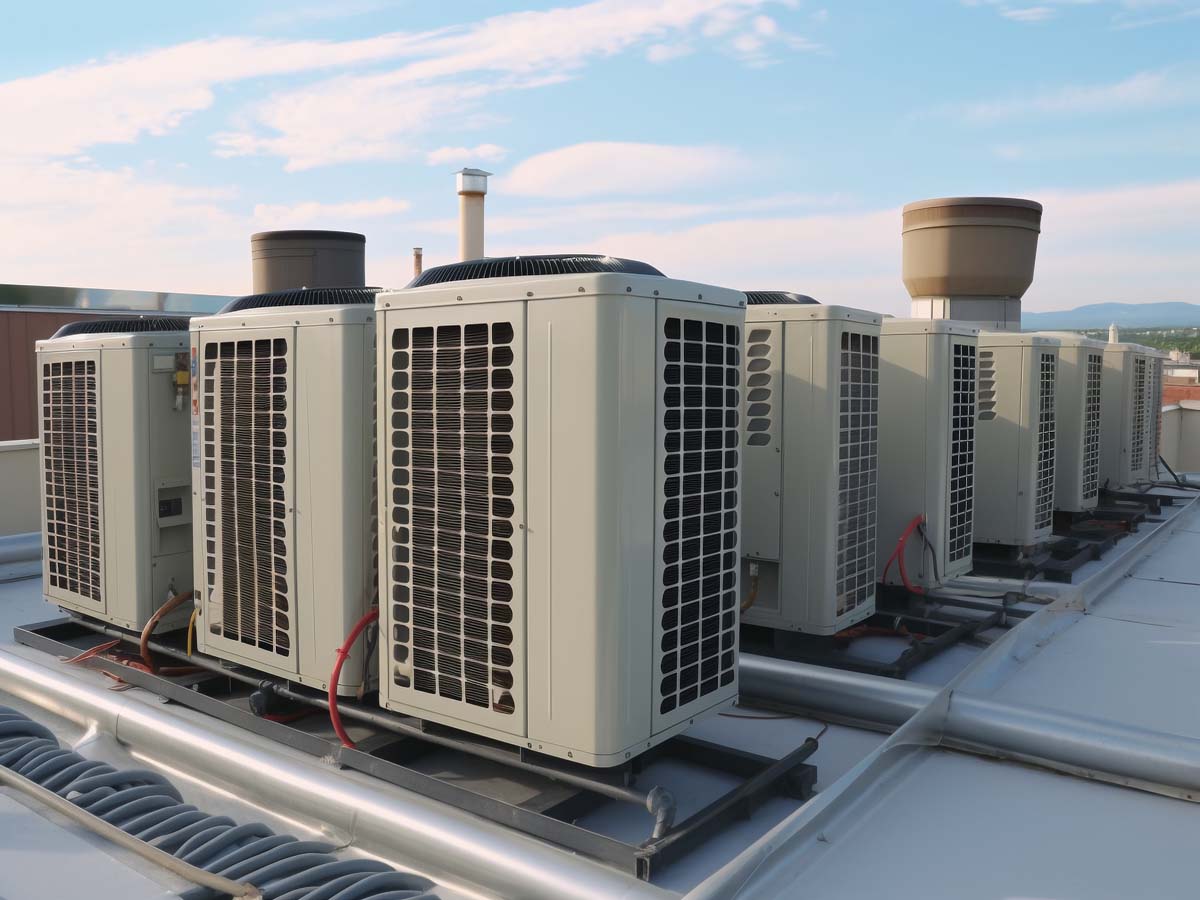
HVAC equipment can use injection-molded plastic covers, housings and control components.
Threaded inserts can provide reliable fastening points for components requiring assembly or service.
Medical and laboratory equipment may use engineered thermoplastics for housings and structural components.
Insert material and installation method should be selected according to the required mechanical and environmental performance.
For procurement managers and supply chain teams, an RFQ should contain enough information for the supplier to evaluate the application.
Recommended RFQ information includes:
Plastic resin and grade
Component drawing
Boss dimensions
Wall thickness
Hole diameter
Thread specification
Insert outside diameter
Insert length
External retention profile
Installation method
Insert material
Surface treatment
Required tightening torque
Pull-out requirement
Operating environment
Estimated annual quantity
A component drawing is particularly valuable for custom insert projects.
It allows the supplier to evaluate the insert as part of the complete fastening system rather than quoting a generic threaded insert.
Standard threaded inserts may not always meet the requirements of an OEM component.
A custom threaded insert for injection molded plastic can be developed around the actual component geometry and production process.
Customization may include:
Outside diameter
Overall length
Thread size
Thread pitch
Thread depth
Knurling
Ribs
Barbs
Undercuts
Flanges
Blind-end designs
Through-hole designs
Brass
Aluminum
Stainless steel
Special tolerances
Surface treatments
For custom projects, engineering drawings or component samples can help establish the appropriate insert configuration.
JUXIN Fasteners supports OEM and industrial customers sourcing threaded inserts for injection molded parts.
Our fastening solutions can support applications across:
Automotive
EV
Electronics
Electrical equipment
Telecom
Industrial machinery
Robotics
HVAC
Medical equipment
Plastic housings
Composite components
OEM assemblies
JUXIN can support different threaded insert requirements, including molded-in inserts, heat staking inserts, ultrasonic threaded inserts and press-in threaded inserts.
For custom applications, customers can provide engineering drawings, samples or component specifications for technical evaluation.
The objective is to match the fastening solution to the complete application:
Plastic resin + component geometry + insert design + installation method + mechanical requirements + production volume
If you are sourcing threaded inserts for injection molded parts, plastic threaded inserts, brass threaded inserts, molded-in inserts,
heat staking inserts, ultrasonic inserts, press-in inserts or custom OEM threaded inserts, contact JUXIN Fasteners.
For faster technical evaluation, please provide:
Plastic resin and grade
Component drawing
Boss dimensions
Wall thickness
Hole diameter
Thread size and standard
Insert dimensions
External profile
Installation method
Material requirement
Surface treatment
Required torque
Pull-out requirement
Operating environment
Estimated annual quantity
JUXIN Fasteners supports OEM and industrial fastening requirements from product specification through production supply.
JUXIN Fasteners
23+ Years of Fastener Industry Experience
OEM & Industrial Fastening Solutions
Email: info@juxinfasteners.com
Website: www.juxinfasteners.com
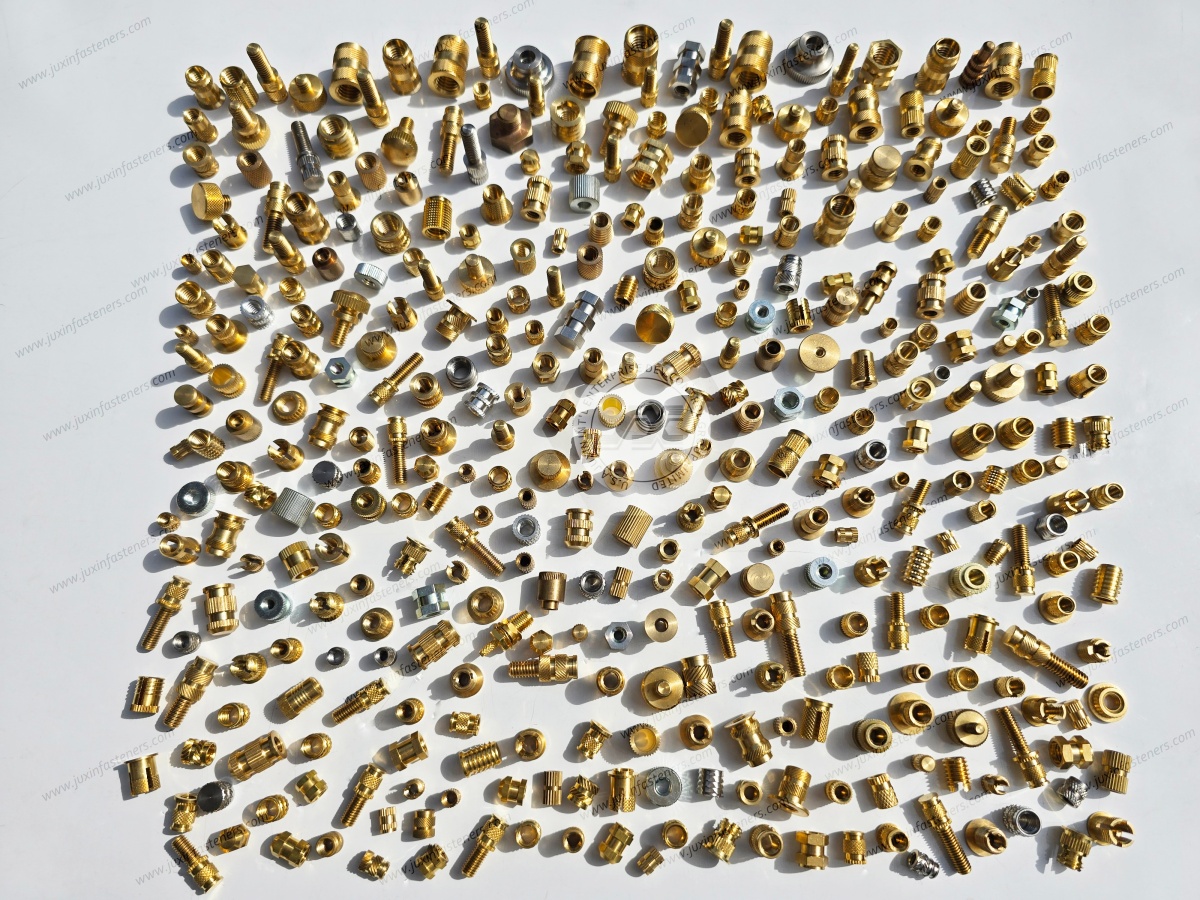
Start with the plastic resin and grade, then determine the installation method, thread specification, insert material, external profile, boss geometry and required mechanical performance.
The complete assembly should be validated before production.
Common materials include ABS, PA/Nylon, PC, PBT, POM, PP, PET, PEEK and glass-filled engineering plastics. The actual resin grade should be considered because material properties affect insert performance.
There is no universal best method. Molded-in, heat staking, ultrasonic and press-in installation can all be suitable depending on the plastic, component geometry, production volume and mechanical requirements.
Yes. Brass is widely used for plastic threaded inserts because of its machinability, mechanical performance and thermal and electrical conductivity.
Boss diameter, wall thickness, height and surrounding geometry directly affect insert retention and the risk of plastic cracking. The insert and boss should be designed together.
Both can be important. Pull-out resistance relates to axial loads, while torque-out resistance relates to rotational loads during screw tightening. The required test should reflect the actual application.
Yes. However, glass-filled polymers can behave differently from unfilled materials. Insert geometry, interference, boss design and installation parameters should be developed according to the actual resin grade.
Yes. Thread diameter, pitch, thread standard, screw length, engagement depth and tightening torque should be considered together with the insert.
Yes. JUXIN Fasteners supports custom OEM threaded inserts based on engineering drawings, samples and application requirements, including customized dimensions, threads, external retention profiles and materials.
The most useful information includes the plastic resin and grade, component drawing, boss dimensions, hole diameter, thread specification, insert dimensions, installation method,
material requirement, required torque, pull-out requirement and estimated annual quantity.
 MORE NEWS
Contact Us
Tel.:
+86 020 8621 0320
+86 020 3121 6067
E-mail:
Technical Support:
Navigation
SEND INQUIREY