
Call Us
+86 136 6007 9809
Call Us
+86 136 6007 9809

Oct. 12, 2026
Industrial Automation & Robotics Fasteners: Precision Mounting and OEM Hardware Solutions
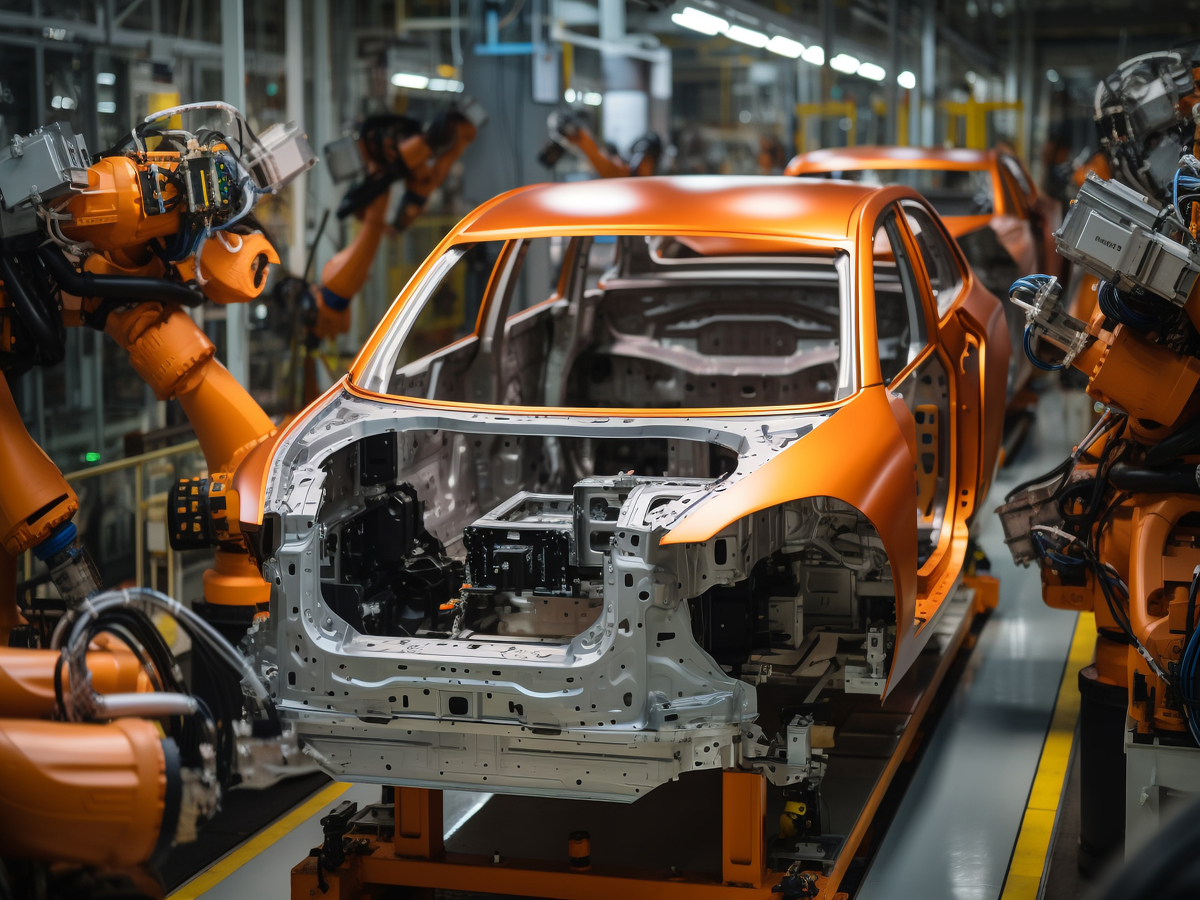
Industrial automation equipment, articulated robots, gantry systems, automated conveyors and precision assembly machines rely on fastening components to connect structural frames,
motion systems, equipment housings and mechanical modules.
Unlike purely static assemblies, many automated machines operate under repeated acceleration, deceleration, vibration and changing load directions.
These conditions can expose weaknesses in joint design, installation consistency and component alignment.
For equipment manufacturers, selecting the correct fastener involves more than choosing a bolt with sufficient tensile strength.
Joint preload, mounting geometry, positional accuracy, material compatibility, assembly sequence and maintenance requirements all influence equipment performance.
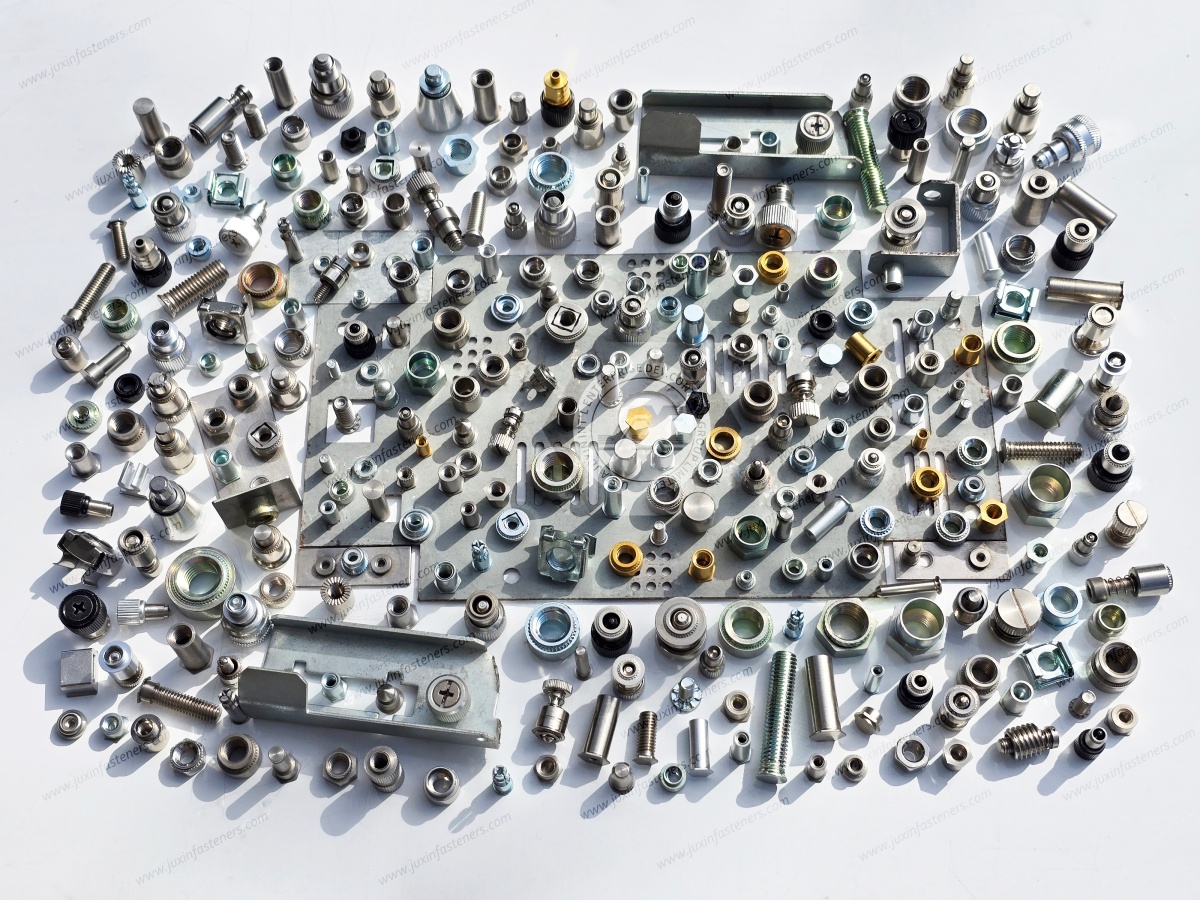
JUXIN FASTENERS supplies industrial fastening components, including machine screws, high-strength threaded fasteners, all-metal prevailing-torque lock nuts,
self-clinching nuts and studs, threaded standoffs, precision lock nuts and drawing-based custom metal components for suitable automation equipment applications.
This guide explains practical fastener selection for industrial automation and robotic systems, with particular attention to dynamic loading, precision mounting,
aluminum framing, production efficiency and OEM supplier qualification.
Fastening Applications in Industrial Automation and Robotics
Automation equipment includes a wide range of mechanical and electrical assemblies.
| Equipment Application | Potential Fastener Solution | Main Engineering Requirement |
|---|---|---|
| Robotic arm housings | Socket head screws and custom bolts | Compact geometry and joint stability |
| Gantry machine frames | High-strength bolts and compatible nuts | Structural stiffness and alignment |
| Linear guide rail mounting | Precision threaded fasteners | Controlled preload and mounting consistency |
| Conveyor support structures | Bolts and prevailing-torque lock nuts | Vibration resistance and serviceability |
| Automation control cabinets | Self-clinching nuts and studs | Efficient sheet metal assembly |
| Electrical and sensor panels | Threaded standoffs and machine screws | Accurate component positioning |
| Precision rotary mechanisms | Precision lock nuts | Axial retention and bearing adjustment |
| Custom robotic fixtures | Drawing-based machined or formed hardware | Fit, geometry and repeatable assembly |
The correct fastening method depends on the load path, assembly design and functional requirements.
A screw suitable for an electrical cover is not necessarily appropriate for a linear guide rail or load-bearing robot mounting joint.
Precision Fastening and Positional Stability in Robotic Systems
Robotic equipment often requires repeatable movement and accurate component positioning.
A fastening system can contribute to positional stability by maintaining the intended connection between mechanical components.
However, fastening alone does not establish the positioning accuracy of a robotic system.
Accuracy also depends on:
Structural stiffness
Machined reference surfaces
Dowel pins and locating features
Bearing and guideway geometry
Joint preload
Thermal expansion
Servo control and calibration
Assembly tolerances
Clamping and Locating Functions Are Different
In precision equipment, bolts primarily provide clamping force.
Accurate component location may instead be established by machined shoulders, dowel pins, locating edges or other dedicated features.
Engineering insight: A bolt should not automatically be expected to provide both precise positioning and reliable clamping.
For a robotic fixture or linear motion assembly, the design may require separate locating and fastening features.
This distinction becomes especially important when equipment must be disassembled and reassembled without losing its reference position.
Preventing Micro-Slip in Precision Machinery Joints
Repeated acceleration can create transverse loading in machine joints.
If the applied load exceeds the joint's resistance to movement, micro-slip may occur.
Potential consequences include:
Fretting damage
Loss of alignment
Changes in joint stiffness
Progressive loosening
Increased maintenance requirements
The appropriate solution depends on the joint geometry and loading.
Possible design measures include adequate preload, suitable contact surfaces, improved locating features and appropriate fastener selection.
Simply selecting a higher-strength bolt may not eliminate micro-slip if the underlying joint design is inadequate.
Socket Head Screws for Compact Automation Assemblies
Socket head cap screws are commonly used in industrial machinery where installation access and compact mounting geometry are important.
ISO 4762 is a relevant standard for metric hexagon socket head cap screws.
Potential applications include:
Robotic equipment housings
Servo motor brackets
Precision fixtures
Machine frame components
Linear motion assemblies
Mechanical support brackets
Head Clearance and Tool Access
Socket head screws allow internal hexagon drive engagement.
However, their heads are not automatically flush with the mounting surface.
A flush installation generally requires an appropriate counterbore or a different screw-head design.
The engineer should consider:
Head diameter and height
Tool clearance
Counterbore dimensions
Thread engagement
Clamped material properties
Installation torque
Engineering insight: A compact screw head can solve a packaging problem while creating an installation or maintenance problem if tool access is not considered.
In tightly packed robotic modules, assembly accessibility should be reviewed before finalizing the fastener drawing.
High-Strength Fasteners for Dynamic Machinery Connections
For applicable metric carbon steel and alloy steel bolts, ISO 898-1 defines mechanical property classes.
Common classes include 8.8, 10.9 and 12.9.
The correct property class depends on the actual joint requirements.
Class 8.8
Class 8.8 bolts may be suitable for many general industrial machinery assemblies when supported by the design calculations.
Class 10.9
Class 10.9 bolts provide higher specified mechanical strength than class 8.8 bolts.
They may be considered where the joint requires higher strength or preload capacity.
Class 12.9
Class 12.9 bolts provide higher specified mechanical strength but require careful consideration of application suitability, fatigue, surface treatment and susceptibility to certain failure mechanisms.
They are not automatically necessary for precision robotics.
Engineering insight: Higher bolt strength does not directly translate into higher positioning accuracy.
If alignment depends on machined reference surfaces or locating pins, changing the bolt property class will not correct an inaccurate locating feature.
The complete mechanical interface must be evaluated.
Linear Guide Rail Fasteners and Mounting Reliability
Linear motion systems are widely used in gantry robots, pick-and-place machines and precision automation equipment.
Guide rail mounting requires attention to both mechanical fastening and geometric alignment.
Important considerations include:
Mounting surface flatness
Reference edge geometry
Screw spacing
Thread engagement
Fastener preload
Guide rail manufacturer requirements
Thermal expansion
Assembly sequence
Preload and Joint Movement
Fastener preload helps clamp the guide rail to its supporting structure.
Insufficient preload may contribute to unwanted movement under operating loads.
However, the appropriate tightening procedure must follow the guide rail and machine design requirements.
Engineering insight: The same nominal screw size may require different installation conditions depending on the guide rail, base material and surface treatment.
For example, a steel guide rail mounted to a steel machine base may behave differently from one mounted to an aluminum support structure.
Material stiffness and thermal expansion can influence the joint.
Fastener selection should therefore be coordinated with the motion-system manufacturer and machine designer.
Aluminum Extrusion Framing and Threaded Connections
T-slot aluminum extrusion framing is widely used in industrial automation because it supports modular machine construction.
Common applications include:
Conveyor support frames
Machine guarding
Sensor mounting structures
Robotic workstations
Adjustable equipment fixtures
These systems often use dedicated profile nuts, slot connectors and threaded fastening elements.
T-Slot Nuts and Profile-Specific Hardware
T-slot nuts are designed to engage compatible extrusion slot geometry.
Different extrusion systems may have different slot dimensions, profiles and installation methods.
A nut suitable for one extrusion series should not automatically be considered compatible with another.
For profile-specific hardware, sourcing teams should provide the extrusion drawing or exact interface specification.
JUXIN FASTENERS can review drawing-based custom threaded components for manufacturing feasibility, but availability of a particular proprietary T-slot connector must be confirmed before quotation.
Thread Stripping in Aluminum Components
Aluminum housings and frames can present thread-strength limitations.
Thread stripping risk depends on:
Aluminum alloy and condition
Thread diameter and pitch
Thread engagement length
Applied preload
Installation method
Repeated disassembly
Where direct threads are unsuitable, the design may require an appropriate threaded insert or another fastening method.
Engineering insight: Increasing bolt strength does not increase the strength of the female thread in a softer aluminum component.
The joint must be designed around the strength of both mating components.
Self-Clinching Nuts and Studs for Automation Enclosures
Industrial automation equipment frequently includes sheet metal electrical cabinets, control panels and protective housings.
Self-clinching fasteners provide reusable threads or fixed threaded attachment points in suitable ductile sheet metal.
Potential applications include:
Electrical control cabinets
Robot controller housings
Sensor mounting panels
Automation equipment covers
Internal support brackets
Self-Clinching Nuts
Self-clinching nuts can eliminate the need for loose nuts during final assembly.
Their suitability depends on the parent sheet thickness, hardness, hole geometry and installation conditions.
Self-Clinching Studs
Self-clinching studs provide a fixed threaded stud for mounting components.
They can be useful when assembly access or component handling makes a separate bolt less convenient.
Threaded Standoffs
Threaded standoffs provide controlled spacing for electrical and mechanical components.
Standoff length, perpendicularity and panel flatness may influence the final assembly.
Engineering insight: A self-clinching fastener should be selected according to the actual sheet material, not only the nominal thread size.
A design validated in one steel panel may require a different fastener configuration for stainless steel or aluminum.
Vibration-Resistant Lock Nuts for Automation Equipment
Industrial automation equipment may experience vibration from motors, gearboxes, conveyors and repeated machine movement.
All-metal prevailing-torque lock nuts provide resistance to rotational loosening through a mechanical locking feature.
Depending on the product design, ISO 7042 and related specifications may apply.
Potential applications include:
Conveyor mounting brackets
Gantry support structures
Vibration-sensitive equipment mounts
Selected motor support assemblies
General machinery joints
Prevailing Torque vs. Clamp Load
Prevailing torque is the resistance generated by the locking feature during thread engagement.
It is not the same as the clamp load holding the joint together.
A lock nut may resist rotation while the joint loses preload through settlement or deformation.
Engineering insight: Locking hardware can reduce the risk of rotational loosening, but it cannot compensate for an inadequately designed joint.
For demanding applications, the OEM should validate the complete connection under representative operating conditions.
Precision Lock Nuts for Rotary Automation Mechanisms
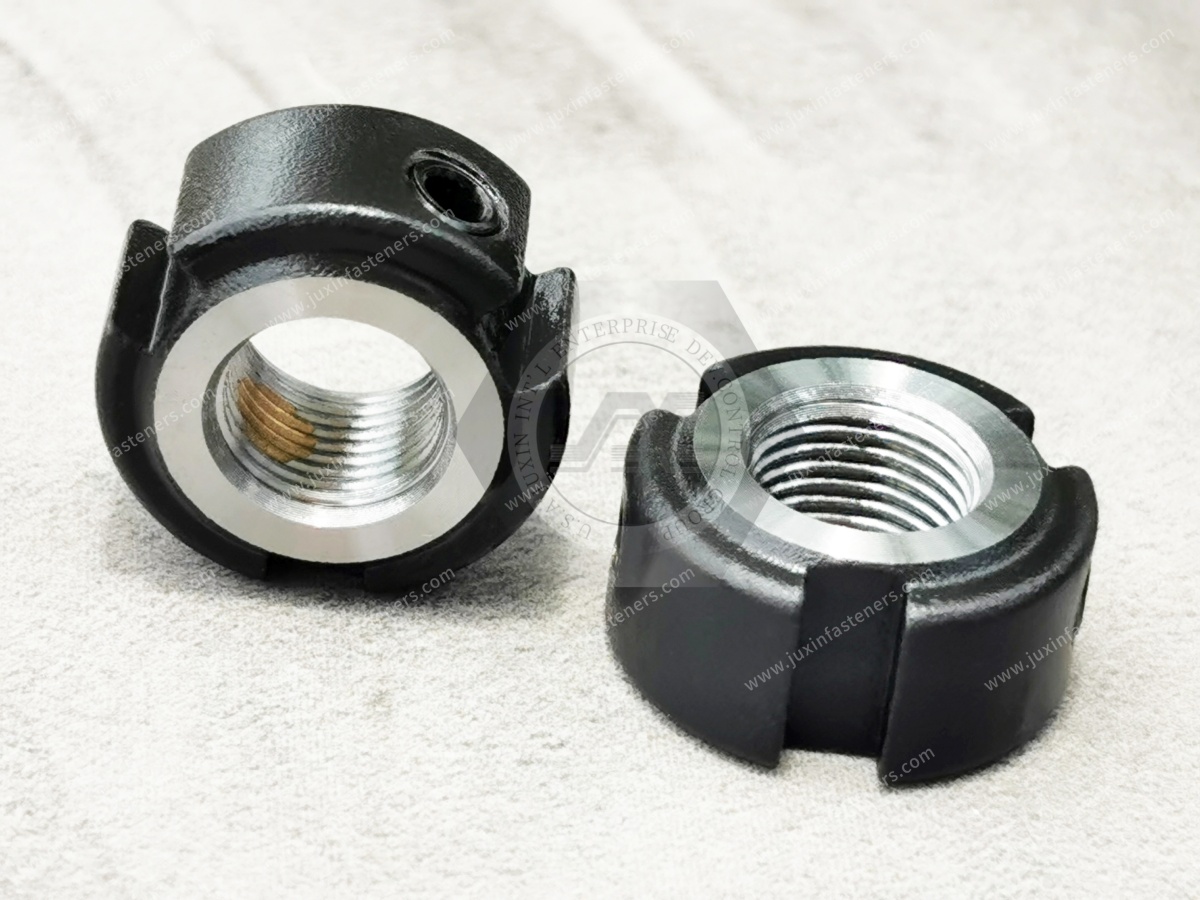
Precision lock nuts are used in selected machinery assemblies to secure or adjust components on threaded shafts.
Potential applications include:
Rotary indexing systems
Precision spindle assemblies
Bearing retention systems
Industrial rotary equipment
The correct lock nut depends on the shaft thread, bearing arrangement and required axial positioning.
Important factors include:
Thread accuracy
Nut face geometry
Axial load
Locking method
Installation accessibility
Shaft and bearing requirements
Precision lock nuts should not be treated as interchangeable with general-purpose hex nuts.
For bearing-related applications, the machine designer should define the required dimensional and functional characteristics.
Custom Cold-Headed and Machined Fasteners for Robotics OEMs
Standard catalog hardware may not meet every automation equipment requirement.
Custom fasteners may be considered where manufacturers require:
Special screw lengths
Modified head profiles
Nonstandard shoulders
Precision spacers
Drawing-specific threaded components
Custom studs
Special nuts
Controlled dimensions for automated assembly
Cold Forming
Cold forming may be suitable for certain fastener geometries and production volumes.
It can offer efficient material utilization and repeatable production for appropriate designs.
However, not every custom component is suitable for cold forming.
CNC Machining
CNC machining may be appropriate for components requiring complex geometry, controlled shoulders or precise dimensional features.
Some parts may require a combination of forming and secondary machining.
Custom Pins and Locating Components
Robotic fixtures and mechanical linkages may require custom pins or locating components.
These parts should be evaluated according to their actual functions.
A locating pin intended for accurate positioning has different design requirements from a pivot pin carrying repeated mechanical loads.
For precision components, the drawing should define the dimensions and tolerances that control function.
Manufacturing Efficiency in Automated Equipment Assembly
Production managers and manufacturing engineers must balance component quality with installation speed, assembly repeatability and cost.
Fastener selection can influence several stages of production.
Automated Feeding and Installation
Fastener geometry, dimensional consistency and surface condition can affect compatibility with automated feeding equipment.
For high-volume assembly, the OEM should verify that the selected component can be handled reliably by the intended installation system.
Assembly Accessibility
Robotic modules may have restricted installation spaces.
Fastener head geometry and tool access should be considered during design.
Torque Control
The relationship between tightening torque and achieved preload depends on friction.
Coating changes, lubrication and mating surface conditions can influence tightening behavior.
A replacement fastener may therefore require installation process review even when its dimensions match the original component.
Tolerance Stack-Up
Multiple fastening components can contribute to assembly variation.
For precision equipment, the designer should identify which dimensions are functionally critical.
Maintenance and Replacement
Automation equipment may require repeated servicing.
The OEM should define when fasteners may be reused and when replacement is necessary.
Prevailing-torque nuts and other special fasteners may have application-specific reuse restrictions.
Total Assembly Cost
The lowest fastener unit price does not always result in the lowest equipment manufacturing cost.
Installation time, tooling, scrap, rework and supply continuity should be included in sourcing decisions.
Material and Surface Treatment Selection
Automation fasteners may be manufactured from carbon steel, alloy steel, stainless steel or other materials depending on the component requirements.
Surface treatment selection should consider:
Corrosion exposure
Thread fit
Installation friction
Mechanical strength
Material compatibility
Appearance
Customer specifications
Carbon Steel and Alloy Steel
These materials are widely used for industrial threaded fasteners.
The required mechanical properties should be defined according to the applicable fastener specification.
Stainless Steel
Stainless steel may be suitable for selected automation equipment applications where corrosion resistance is important.
Applicable parts of ISO 3506 define mechanical properties for relevant stainless steel fasteners.
Protective Coatings
Zinc-based coatings and other finishes may be considered according to the application.
For preload-sensitive joints, coating and lubrication conditions can influence the torque-tension relationship.
Specific coating performance and friction requirements should be agreed during quotation.
International Standards for Automation Fasteners
Applicable standards depend on the component type.
| Product or Requirement | Potentially Relevant Standard |
|---|---|
| Carbon steel and alloy steel bolt mechanical properties | ISO 898-1 |
| Carbon steel nut mechanical properties | ISO 898-2 |
| Hexagon socket head cap screws | ISO 4762 |
| Hexagon head bolts | ISO 4014 / ISO 4017 |
| All-metal prevailing-torque nuts | ISO 7042 where applicable |
| Stainless steel fastener mechanical properties | Applicable parts of ISO 3506 |
| Metric thread specifications | Applicable ISO metric thread standards |
| Inch-series threaded fasteners | Applicable ASME/ANSI standards |
| Material inspection documents | EN 10204 where contractually specified |
Self-clinching fasteners, precision lock nuts and proprietary profile connectors must also be evaluated according to their specific product drawings and requirements.
Metric, UNC, UNF and other thread systems are not directly interchangeable merely because their nominal dimensions are similar.
OEM Supplier Qualification and Alternative Sourcing
Automation equipment manufacturers may seek alternative suppliers for standard and custom fasteners.
Supplier qualification should evaluate both technical suitability and commercial supply capability.
| Evaluation Area | Key Questions |
|---|---|
| Drawing conformity | Are dimensions, threads and tolerances correct? |
| Mechanical properties | Does the fastener meet the specified strength requirement? |
| Installation compatibility | Is the component suitable for the intended assembly method? |
| Functional performance | Are locking, retention or positioning requirements defined? |
| Surface treatment | Does the finish meet the agreed application requirements? |
| Quality inspection | Which dimensions and characteristics require verification? |
| Documentation | Which material or inspection records are required? |
| Commercial supply | What are the MOQ, annual demand and delivery expectations? |
Dimensional Equivalence Is Not Always Functional Equivalence
Two fasteners with the same nominal thread size may differ in:
Head geometry
Thread tolerance
Coating thickness
Installation friction
Locking characteristics
Material properties
Dimensional consistency
For precision automation equipment, alternative sourcing may require sample evaluation and assembly trials before approval.
Request Industrial Automation and Robotics Fasteners
JUXIN FASTENERS supports OEM sourcing and drawing-based technical review for industrial fasteners used in suitable automation and robotic equipment applications.
For robotic systems, gantry machines, conveyors, electrical cabinets and custom machinery, please provide:
2D drawings and available 3D models
Fastener type and thread specification
Material and mechanical property requirements
Critical dimensions and tolerances
Joint loading and installation conditions
Required surface treatment
Inspection and documentation requirements
Prototype quantity and annual forecast
Packaging and delivery requirements
Our team can review the supplied information to discuss suitable standard and custom fastening options and quotation feasibility.
Website: www.juxinfasteners.com
OEM Technical Review & RFQ: info@juxinfasteners.com
Send your drawings and purchasing requirements to discuss fastening solutions for your next industrial automation or robotics project.
Related JUXIN FASTENERS Engineering Solutions
Custom Cold-Headed Fasteners & Special Formed Parts for Industrial OEMs — drawing-based custom fastener manufacturing.
All-Metal Prevailing-Torque Lock Nuts for High-Vibration Industrial Assemblies — vibration-resistant threaded connections.
Self-Clinching Studs for Thin Sheet Metal & Equipment Enclosures — fixed threaded mounting points.
Self-Clinching Nuts for Power Electronics & Sheet Metal Enclosures — reusable threads in suitable sheet metal.
F-Type Precision Locknuts for Spindle Bearings & Rotary Tables — precision threaded bearing retention.
These related topics provide additional guidance on custom fastener selection, precision mechanical connections and OEM sourcing requirements.
 MORE NEWS


Oct. 13, 2026
Contact Us
Tel.:
+86 020 8621 0320
+86 020 3121 6067
E-mail:
Technical Support:
Navigation
SEND INQUIREY