
Call Us
+86 136 6007 9809
Call Us
+86 136 6007 9809

Oct. 12, 2026
Marine-Grade Stainless Steel Fasteners & Corrosion-Resistant Hardware for Offshore Equipment
Marine equipment, offshore installations, coastal industrial facilities and seawater-related processing systems operate in environments where moisture,
chloride exposure and repeated maintenance can significantly influence fastener performance.
Stainless steel fasteners are frequently considered for these applications because of their corrosion resistance. However, the term "marine grade" does not identify a single universal material specification,
and no stainless steel alloy is immune to corrosion under every seawater exposure condition.
For equipment manufacturers, selecting a suitable marine fastener requires evaluation of material grade, mechanical strength, chloride exposure, joint geometry, galvanic compatibility, thread galling and installation procedures.
JUXIN FASTENERS supplies industrial stainless steel fasteners, threaded hardware and drawing-based custom metal components for evaluation in suitable marine and coastal equipment applications.
This guide explains practical material selection, corrosion mechanisms, joint design and OEM sourcing considerations for stainless steel bolts, screws, nuts and custom fastening components used in marine-related equipment.
Marine and Offshore Equipment Fastening Applications
Marine-related industries use threaded fasteners in a wide variety of mechanical and enclosure assemblies.
| Equipment Application | Potential Fastener Solution | Main Engineering Requirement |
|---|---|---|
| Marine equipment enclosures | Stainless steel machine screws and nuts | Corrosion resistance and serviceability |
| Coastal electrical cabinets | Stainless steel screws and threaded hardware | Humidity resistance and maintenance |
| Shipboard auxiliary equipment | Bolts, washers and locking nuts | Joint stability and vibration |
| Desalination equipment housings | Selected corrosion-resistant fasteners | Material compatibility and chloride exposure |
| Deck equipment covers | Stainless steel screws and retained hardware | Repeated access and environmental exposure |
| Coastal ventilation systems | Stainless steel threaded fasteners | Atmospheric corrosion resistance |
| Marine equipment mounting brackets | Bolts and compatible nuts | Mechanical loading and joint design |
| Custom marine equipment | Drawing-based metal fasteners | Geometry, material and production requirements |
The correct material and fastener configuration depend on the actual application.
A fastener suitable for a protected electrical enclosure may not be suitable for continuous seawater immersion, a splash-zone structural connection or a safety-critical lifting assembly.
Understanding 304, 316 and A4 Stainless Steel Fasteners
Austenitic stainless steels are commonly used for industrial threaded fasteners.
Among the most familiar material families are 304-type and 316-type stainless steels.
304-Type Stainless Steel
304-type stainless steel is widely used in general industrial equipment.
It offers corrosion resistance in many atmospheric and indoor environments.
However, chloride-rich marine exposure can create conditions that promote localized corrosion.
304-type stainless steel should not automatically be selected for severe marine exposure without application-specific evaluation.
316-Type Stainless Steel
316-type stainless steel contains molybdenum, which generally improves resistance to certain forms of chloride-induced localized corrosion compared with common 304-type compositions.
It is frequently considered for marine atmospheric and coastal equipment applications.
However, 316 stainless steel is not immune to pitting, crevice corrosion or stress corrosion cracking.
Performance depends on chloride concentration, temperature, oxygen availability, surface condition and joint geometry.
A2 and A4 Fastener Designations
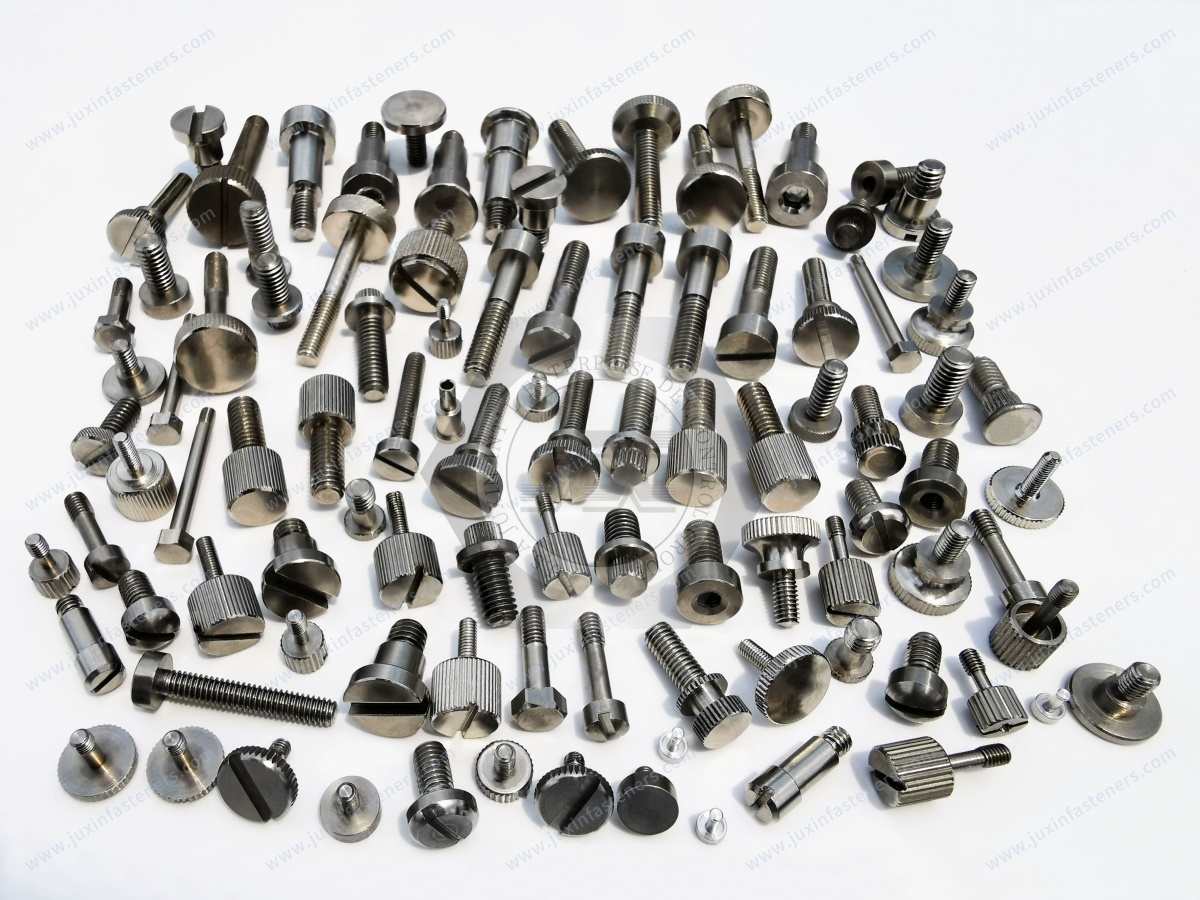
ISO 3506 uses stainless steel material group designations, including A2 and A4, for applicable fasteners.
A2 is commonly associated with 304-type stainless steel compositions.
A4 is commonly associated with molybdenum-bearing 316-type stainless steel compositions.
However, an A4 fastener designation should be interpreted according to the applicable ISO 3506 requirements rather than treated as a complete statement of every metallurgical characteristic.
A4-70 vs. A4-80 Stainless Steel Fasteners
The numerical portion of a designation such as A4-70 or A4-80 identifies a mechanical property class.
It does not simply indicate a different level of corrosion resistance.
For example:
A4-70 identifies an A4 stainless steel fastener meeting the applicable property class 70 requirements.
A4-80 identifies an A4 stainless steel fastener meeting the applicable property class 80 requirements.
The relevant mechanical properties, manufacturing condition and product specification must be considered.
Engineering insight: A4-80 is not automatically more corrosion-resistant than A4-70 merely because its strength class is higher.
For marine OEM procurement, material grade and mechanical property class should be specified separately and accurately.
Pitting Corrosion in Chloride-Containing Environments
Stainless steel relies on a passive surface film for corrosion resistance.
Under unfavorable conditions, chloride ions can contribute to localized breakdown of this passive film.
Pitting corrosion may develop in concentrated areas while much of the surrounding surface appears relatively unaffected.
Factors influencing pitting include:
Chloride concentration
Temperature
Alloy composition
Surface condition
Deposits and contamination
Oxygen availability
Exposure duration
For marine equipment, localized corrosion can be more important than general surface discoloration.
A fastener may appear acceptable during routine visual inspection while localized attack develops in less accessible regions.
Crevice Corrosion Around Fastener Joints
Crevice corrosion can occur in confined spaces where the local chemical environment differs from the surrounding exposed surface.
Potential locations include:
Under bolt heads
Beneath washers
Between overlapping plates
Inside partially sealed joints
Around deposits and trapped moisture
These locations are particularly relevant to threaded assemblies.
Engineering insight: Selecting 316 stainless steel does not automatically eliminate crevice corrosion if the joint traps chloride-containing moisture.
Joint geometry, drainage, sealing and maintenance access can be as important as the nominal alloy designation.
PREN and Stainless Steel Material Selection
The Pitting Resistance Equivalent Number (PREN) is a composition-based indicator commonly used to compare the potential pitting resistance of certain stainless steel alloys.
One commonly used expression is:
PREN = %Cr + 3.3 × %Mo + 16 × %N
Some alloy comparisons use a modified expression that also accounts for tungsten.
The exact expression should be identified when comparing materials.
PREN can be useful when reviewing alloy options, but it has important limitations.
It does not directly establish:
Actual seawater service life
Crevice corrosion resistance of a finished joint
Mechanical strength
Fastener fatigue performance
Surface treatment quality
Suitability for a particular offshore project
Engineering insight: A higher PREN value is not a substitute for application-specific corrosion assessment or qualification testing.
A fastener's final performance depends on the complete material, manufacturing and service conditions.
Duplex Stainless Steel Fasteners: When Are They Relevant?
Duplex stainless steels combine austenitic and ferritic microstructures.
Certain duplex and super duplex alloys can offer higher strength and improved resistance to selected chloride-related corrosion mechanisms compared with common austenitic grades.
They may be considered for demanding offshore or seawater-related applications.
However, duplex fasteners require careful specification of:
Exact alloy grade
Applicable product standard
Mechanical properties
Manufacturing and heat-treatment requirements
Corrosion qualification
Inspection and documentation
Duplex and super duplex fasteners should not be treated as ordinary substitutes for A4 stainless steel bolts.
Their availability, manufacturability and qualification requirements must be confirmed for each project.
JUXIN FASTENERS can review drawing-based inquiries involving special materials, but supply capability for a specific duplex alloy or offshore-qualified component must be established before quotation.
Galvanic Corrosion in Mixed-Metal Marine Assemblies
Marine equipment often combines stainless steel fasteners with aluminum, carbon steel or other structural materials.
When dissimilar metals are electrically connected in the presence of an electrolyte, galvanic corrosion may occur.
The less noble material can experience accelerated corrosion under unfavorable conditions.
Potential examples include:
Stainless steel screws installed in aluminum panels
Stainless steel bolts connecting coated carbon steel structures
Mixed-metal brackets exposed to seawater
Fasteners installed through damaged protective coatings
The risk depends on:
Material combination
Exposed surface area ratio
Electrical continuity
Electrolyte conductivity
Coating condition
Joint geometry
Isolation and Protective Design
Potential mitigation strategies include:
Insulating washers or sleeves
Compatible barrier coatings
Appropriate sealing materials
Material pairing
Moisture management
Protection of exposed substrate surfaces
Engineering insight: A corrosion-resistant stainless steel fastener can still contribute to corrosion damage in the surrounding structure if the complete material combination is unsuitable.
The joint should be evaluated as a system rather than treating the fastener independently.
Thread Galling in Stainless Steel Bolts and Nuts
Thread galling is a common concern in stainless steel threaded assemblies.
Under certain installation conditions, friction and adhesive wear can damage mating thread surfaces.
In severe cases, the threads may seize before the intended preload is achieved.
Factors influencing galling include:
Material pairing
Thread surface condition
Installation speed
Applied load
Lubrication
Thread fit
Contamination
Repeated assembly
Why Stainless-on-Stainless Threads Can Seize
Certain stainless steel combinations are susceptible to adhesive wear.
During tightening, localized material transfer may occur between mating threads.
This can increase friction and damage the threads.
Reducing Galling Risk
Depending on the application, potential measures include:
Suitable thread lubrication
Controlled installation speed
Appropriate thread fit
Clean assembly conditions
Compatible material combinations
Application-specific anti-galling surface treatments
Lubricants and coatings must be compatible with the operating environment and project requirements.
Engineering insight: Adding lubricant changes the torque-tension relationship.
A tightening torque established for an unlubricated joint should not automatically be applied to a lubricated joint.
For preload-sensitive connections, the installation procedure should be reviewed whenever lubrication or surface treatment changes.
Stainless Steel Lock Nuts for Marine Equipment
Marine equipment may experience vibration from engines, pumps, rotating machinery and repeated movement.
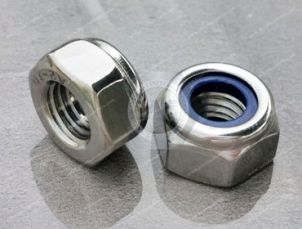
Prevailing-torque lock nuts can provide resistance to rotational loosening.
Potential options include:
All-metal prevailing-torque lock nuts
Nylon-insert lock nuts where suitable
Application-specific locking arrangements
The appropriate design depends on operating temperature, environmental exposure, installation requirements and maintenance procedures.
Locking Function vs. Corrosion Resistance
A lock nut's resistance to loosening and its corrosion resistance are separate performance characteristics.
A stainless steel lock nut may offer corrosion resistance but still require validation of its locking performance.
Similarly, a suitable locking mechanism does not guarantee corrosion resistance in seawater.
For marine equipment, both functions must be evaluated.
Stainless Steel Fastener Strength and Joint Design
Stainless steel fasteners should not be selected solely by comparison with carbon steel bolt property classes.
The applicable mechanical property system may differ.
For example, ISO 3506 stainless steel fastener property classes are not directly equivalent to ISO 898-1 carbon steel property classes.
Designers should evaluate:
Required tensile strength
Proof or yield-related properties
Joint preload
Thread engagement
Fatigue loading
Mating material strength
Installation friction
Environmental exposure
Engineering insight: Replacing a carbon steel bolt with a stainless steel bolt of the same nominal size may change the joint's mechanical capacity.
Material substitution should be approved against the actual design requirements.
Custom Stainless Steel Fasteners for Marine OEM Equipment
Standard catalog fasteners do not cover every marine equipment design.
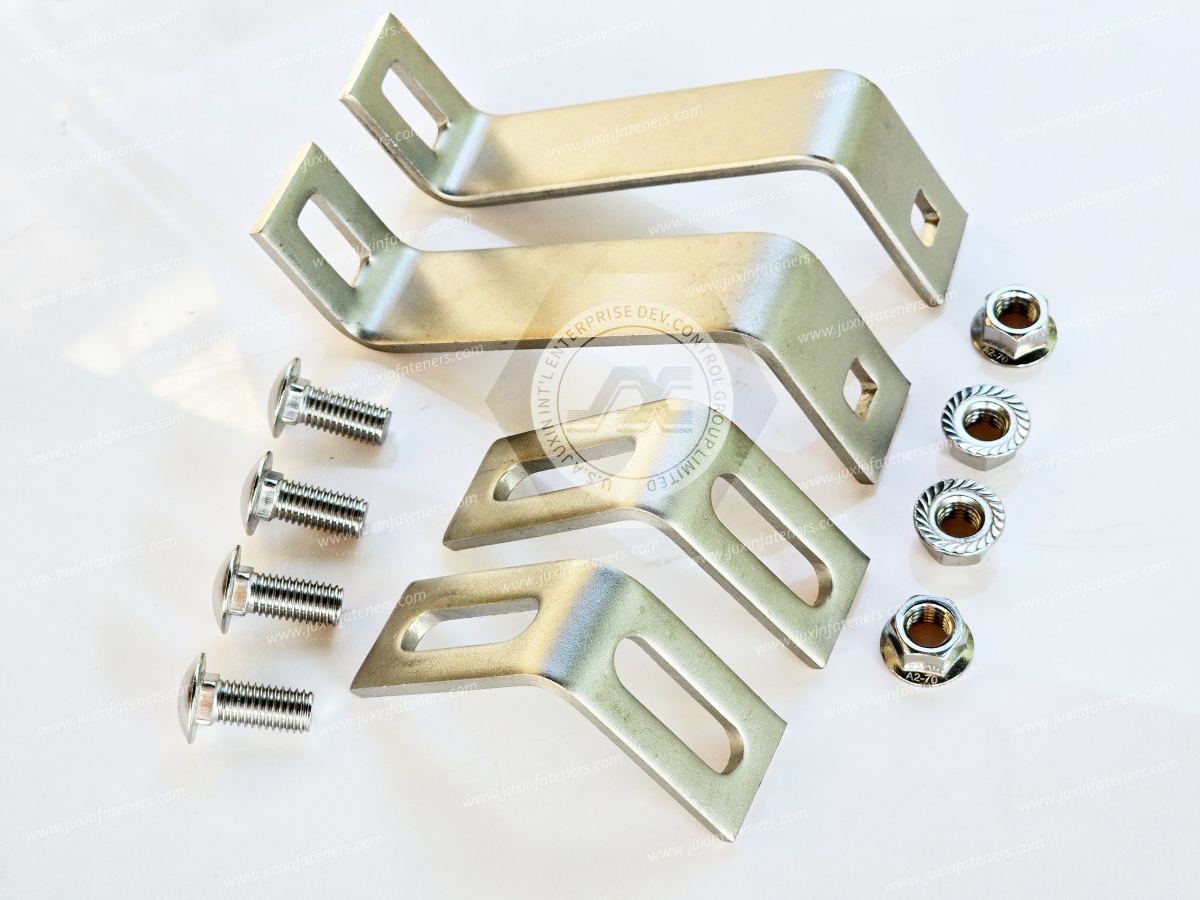
Drawing-based custom hardware may be required for:
Nonstandard screw lengths
Special threaded studs
Modified head geometry
Custom nuts
Precision spacers
Drawing-specific washers
Special mounting hardware
Custom machined components
Manufacturing feasibility depends on material, geometry, tolerance requirements and production quantity.
Cold Forming
Cold forming may be suitable for certain stainless steel fastener geometries and production volumes.
However, material work-hardening behavior and forming requirements must be considered.
CNC Machining
CNC machining may be appropriate for complex geometries, controlled shoulders and drawing-specific dimensions.
Custom Pins and Mechanical Linkages
Marine equipment may contain pivoting mechanisms that require custom pins and retaining hardware.
These components must be evaluated for loading, wear, corrosion and fatigue.
Safety-critical applications, including lifting and life-saving equipment, require project-specific engineering approval and qualification.
A general-purpose custom pin should not be represented as suitable for such applications without the necessary validation.
Surface Finishing and Passivation
Stainless steel fasteners may require surface cleaning or passivation according to the application.
ASTM A967/A967M is a relevant specification for chemical passivation treatments for stainless steel parts.
Passivation can help remove certain surface contaminants and support the formation or restoration of a passive surface condition.
However, passivation does not transform an unsuitable stainless steel grade into a seawater-resistant alloy.
The required treatment, acceptance criteria and documentation should be specified during quotation.
Manufacturing and Assembly Considerations for Marine Equipment
Production managers and manufacturing engineers should evaluate fasteners according to the complete assembly process.
Installation Torque
Stainless steel threaded fasteners may exhibit different friction behavior from coated carbon steel fasteners.
The tightening procedure should be appropriate for the actual fastener and joint.
Tool Accessibility
Marine equipment often contains compact or obstructed installation locations.
Head geometry and tool clearance should be considered during design.
Repeated Maintenance
Marine equipment may require frequent inspection and servicing.
Fastener selection should consider repeated disassembly, thread condition and replacement requirements.
Material Segregation
Where different stainless steel grades are used within the same production facility, material identification and segregation may be important.
Packaging and Handling
Packaging should protect fasteners from mechanical damage and contamination during storage and transport.
Special packaging or labeling requirements should be agreed during procurement.
International Standards and Material Documentation
The applicable standard depends on the fastener and project requirements.
| Product or Requirement | Potentially Relevant Standard |
|---|---|
| Stainless steel fastener mechanical properties | Applicable parts of ISO 3506 |
| Metric hexagon head bolts | ISO 4014 / ISO 4017 |
| Metric hexagon nuts | ISO 4032 where applicable |
| Metric thread specifications | Applicable ISO metric thread standards |
| Inch-series threaded fasteners | Applicable ASME/ANSI standards |
| Stainless steel chemical passivation | ASTM A967/A967M where specified |
| Material inspection documents | EN 10204 where contractually specified |
Marine and offshore projects may also impose requirements from classification societies, equipment specifications or project-specific standards.
These requirements must be identified during supplier qualification.
No classification society approval, offshore certification or material inspection document should be assumed without verification.
OEM Supplier Qualification and Alternative Sourcing
Marine equipment manufacturers may seek alternative suppliers for stainless steel bolts, nuts, screws and custom hardware.
Supplier qualification should consider both technical conformity and commercial supply capability.
| Evaluation Area | Key Questions |
|---|---|
| Material grade | Is the exact stainless steel specification identified? |
| Mechanical properties | Does the fastener meet the required property class? |
| Corrosion exposure | Is the material suitable for the intended environment? |
| Thread compatibility | Are the thread system, pitch and tolerances correct? |
| Surface treatment | Are passivation or other finishing requirements specified? |
| Functional performance | Are locking, retention or load requirements defined? |
| Documentation | Which material and inspection records are required? |
| Commercial supply | What are the MOQ, annual demand and delivery expectations? |
Material Traceability and EN 10204 Documentation
Some marine and offshore projects require material inspection documentation under EN 10204.
The specific document type must be identified in the purchasing requirements.
An EN 10204 3.1 inspection certificate is not automatically supplied with every industrial fastener.
Where required, documentation availability and the relationship between the reported material and the delivered components must be confirmed before order acceptance.
Alternative Material Qualification
Two stainless steel fasteners with the same nominal dimensions may differ in material composition, mechanical properties, surface condition or manufacturing process.
Dimensional similarity alone does not establish suitability for substitution.
For demanding marine applications, material changes should be reviewed by the responsible engineer.
Request Marine Stainless Steel Fasteners and Custom Hardware
JUXIN FASTENERS supports OEM sourcing and drawing-based technical review for industrial stainless steel fasteners used in suitable marine and coastal equipment applications.
For marine equipment, coastal industrial facilities, desalination equipment and offshore auxiliary systems, please provide:
2D drawings and available 3D models
Fastener type and thread specification
Required stainless steel grade
Mechanical property requirements
Actual corrosion exposure conditions
Surface treatment and passivation requirements
Applicable inspection and documentation requirements
Prototype quantity and annual forecast
Packaging and delivery requirements
For submerged, splash-zone, classification-controlled or safety-critical applications, the customer should identify the applicable qualification and approval requirements.
Our team can review the supplied information to discuss suitable standard and custom fastening options and quotation feasibility.
Website: www.juxinfasteners.com
OEM Technical Review & RFQ: info@juxinfasteners.com
Send your drawings and purchasing requirements to discuss stainless steel fastening solutions for your next marine or offshore equipment project.
Related JUXIN FASTENERS Engineering Solutions
Stainless Steel Fasteners for Medical Imaging, Diagnostic & Laboratory Equipment — stainless steel material selection for equipment assemblies.
All-Metal Prevailing-Torque Lock Nuts for High-Vibration Industrial Assemblies — vibration-resistant threaded connections.
Custom Cold-Headed Fasteners & Special Formed Parts for Industrial OEMs — drawing-based custom metal components.
Aerospace Ground Support Equipment Fasteners & Heavy-Duty Structural Hardware — joint loading and heavy equipment fastener selection.
These related topics provide additional guidance on stainless steel hardware, locking fasteners, custom manufacturing and OEM sourcing requirements.
 MORE NEWS


Oct. 13, 2026
Contact Us
Tel.:
+86 020 8621 0320
+86 020 3121 6067
E-mail:
Technical Support:
Navigation
SEND INQUIREY