
Call Us
+86 136 6007 9809
Call Us
+86 136 6007 9809

Sep. 30, 2026
Thin sheet metal creates a fundamental fastening problem: there may not be enough material thickness to form a durable internal thread directly in the panel.
This challenge appears throughout electronics enclosures, industrial control cabinets, telecommunications equipment, automation systems,
HVAC equipment, automotive assemblies, electrical distribution equipment, appliances, and precision sheet-metal fabrication.
Press-installed captive fasteners provide one solution.
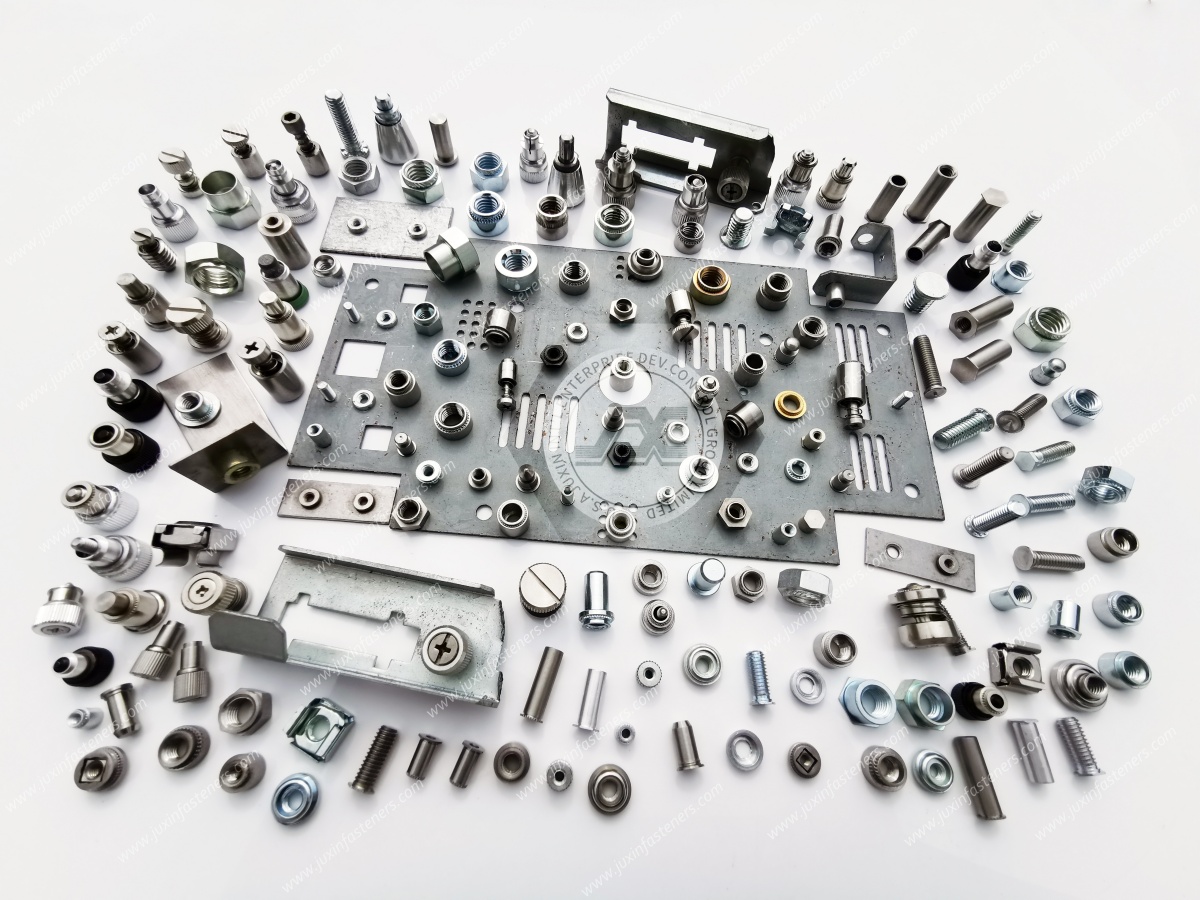
Depending on the component design, self-clinching nuts, studs, standoffs,
and other press-in fasteners can create permanent threaded or mounting features in sheet metal without requiring a loose nut behind the panel.
However, successful installation depends on much more than selecting the correct thread.
The fastener, mounting hole, sheet material, panel hardness, sheet thickness, edge distance, installation force, and surrounding geometry form one mechanical system.
For design engineers, the key question is:
Can the selected panel material properly receive and retain the press-installed fastener?
For procurement and supplier-development teams, another question follows:
Which interface dimensions and installation characteristics must remain equivalent when a self-clinching or press-fit fastener is second-sourced?
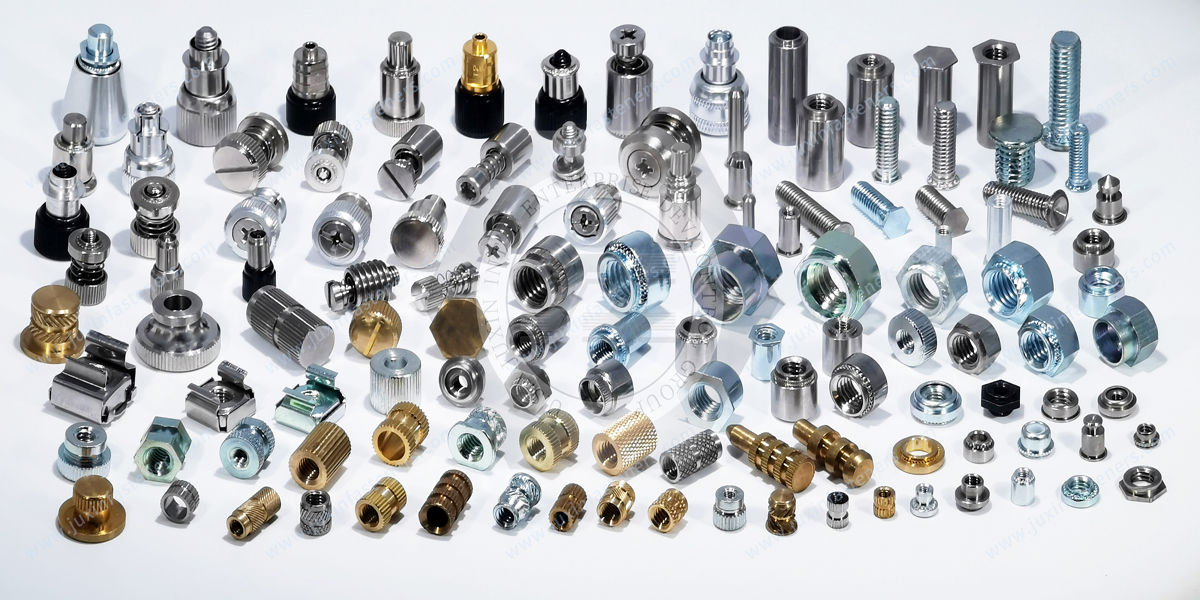
JUXIN FASTENERS supplies standard and drawing-based self-clinching nuts, studs, standoffs, press-in fasteners,
flush-mount components, and related industrial fastening hardware for OEM and production sourcing requirements.
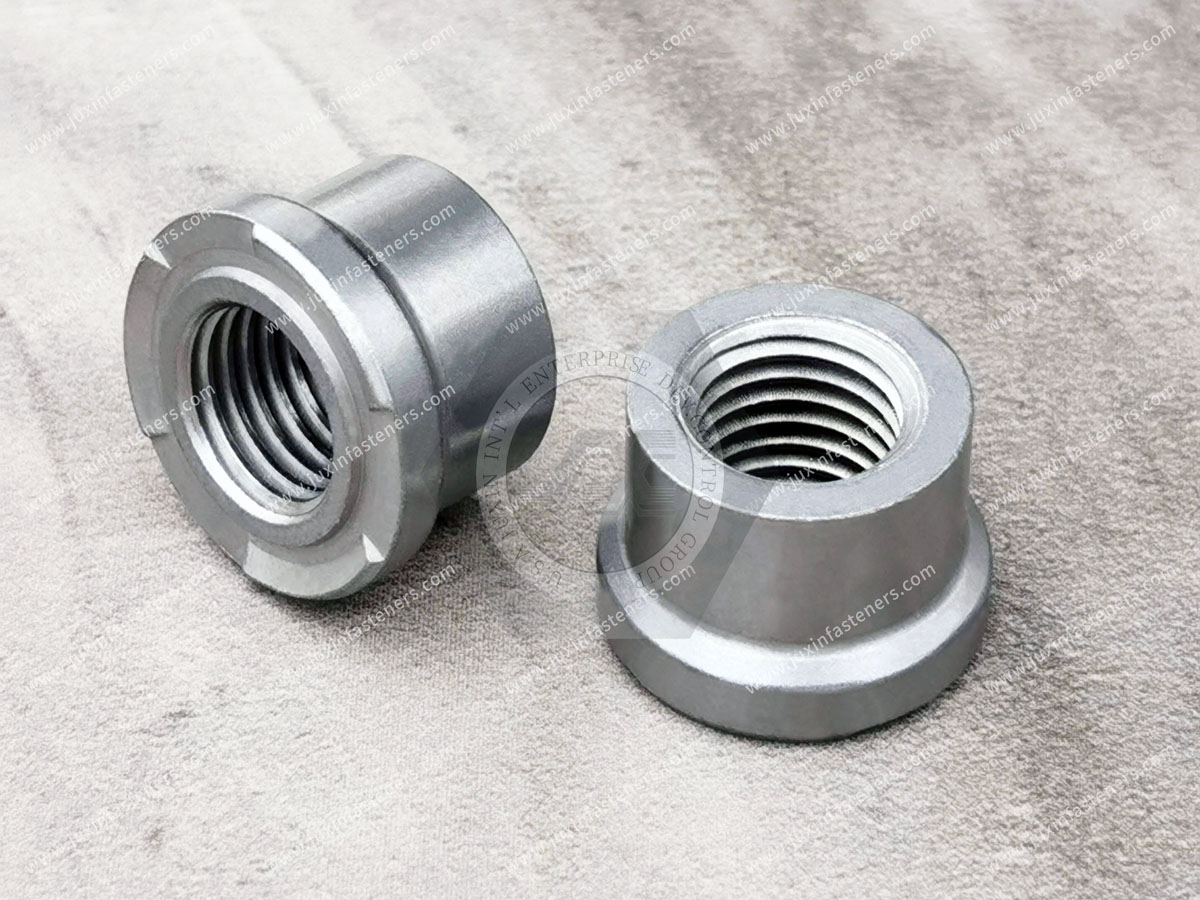
These terms are sometimes used loosely, but they should not automatically be treated as identical.
Press-fit fastener is a broad description for a component installed by pressing it into a prepared receiving feature.
Retention may depend on interference, serrations, knurls, displacement of the parent material, mechanical undercuts, or another geometry specific to the component.
A self-clinching fastener is a more specific type of press-installed fastener designed so that, under controlled installation force, the sheet material flows or displaces into a retention feature on the fastener.
This creates mechanical interlock between the fastener and the panel.
Therefore:
All self-clinching fasteners are press-installed, but not every press-fit fastener should automatically be described as self-clinching.
This distinction is important when reviewing drawings, installation requirements, and second-source components.
Direct tapping depends on having sufficient material thickness for adequate thread engagement.
As sheet thickness decreases, the available number of engaged threads also decreases.
Self-clinching and related press-installed fasteners allow the designer to introduce a separate threaded component into the sheet instead of relying on the sheet itself to provide the full thread.
Potential benefits include:
captive threads;
reduced loose hardware;
installation from a controlled side of the panel;
compatibility with thin-sheet designs;
repeatable mounting locations;
reduced need for welding in suitable applications;
integration into sheet-metal production;
simplified downstream assembly.
But these benefits only apply when the selected fastener is compatible with the panel.
The installation mechanism depends on the specific fastener geometry, but the general self-clinching principle involves controlled displacement of the sheet material.
The panel receives a hole sized according to the specific fastener.
Hole diameter is a functional installation dimension, not merely clearance for the fastener.
The fastener is positioned in the prepared hole from the required installation side.
A press or other suitable installation system applies force between the fastener and panel.
For many self-clinching products, a controlled squeezing action is preferable to impact installation because the objective is to produce predictable material displacement around the retention geometry.
As the fastener seats, sheet material is displaced into the fastener's retention feature.
Depending on the design, this may involve an annular recess, undercut, serrated region, or other engineered geometry.
Installation continues until the required seating condition is achieved.
Correct installation should be judged according to the specific product design and application requirements rather than simply by applying more force.
Excessive force can deform the panel or fastener without improving retention.
Self-clinching nuts create captive female threads in suitable sheet material.
They can be useful in:
electronics chassis;
equipment enclosures;
control cabinets;
brackets;
machinery panels;
telecommunications equipment;
sheet-metal frames.
A self-clinching nut should not be selected only by thread size.
Important interface characteristics can include:
thread size and pitch;
mounting-hole requirement;
sheet thickness;
sheet material;
panel hardness;
fastener material;
installation side;
head or shank geometry;
required push-out resistance;
required torque resistance.
The panel is part of the fastening system.
The same nut may not develop equivalent retention in panels with different materials, hardnesses, or thicknesses.
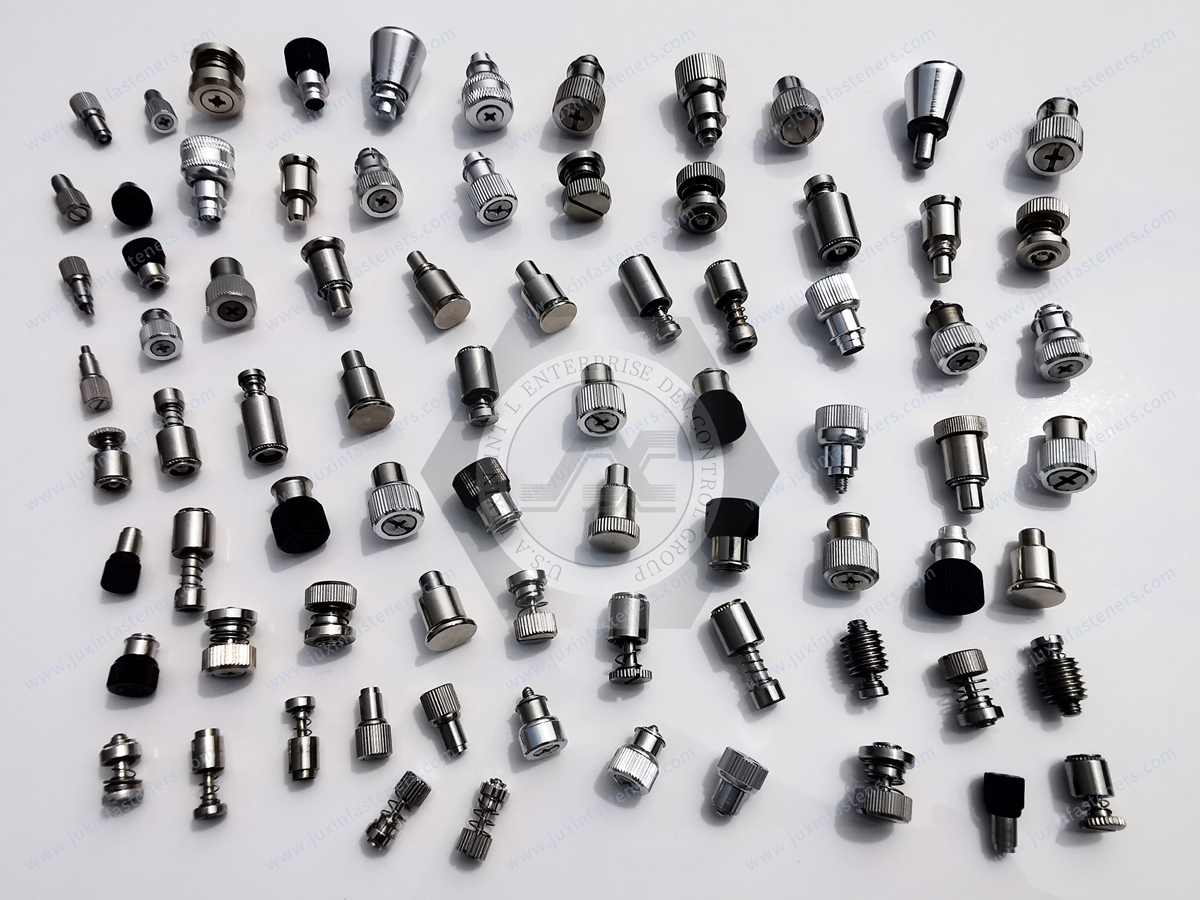
Self-clinching studs create a captive male thread in sheet metal.
They can reduce the need for loose bolts during downstream assembly and may be useful where components are subsequently installed over a fixed threaded stud.
Potential applications include:
equipment mounting;
electrical components;
brackets;
internal enclosure assemblies;
machine panels;
automotive and transportation components.
For engineers, the key dimensions extend beyond thread size.
Relevant characteristics may include:
thread length;
unthreaded section;
installation geometry;
sheet thickness;
mounting-hole diameter;
protrusion length;
fastener orientation.
Where downstream components must fit over multiple studs, positional tolerance also becomes important.
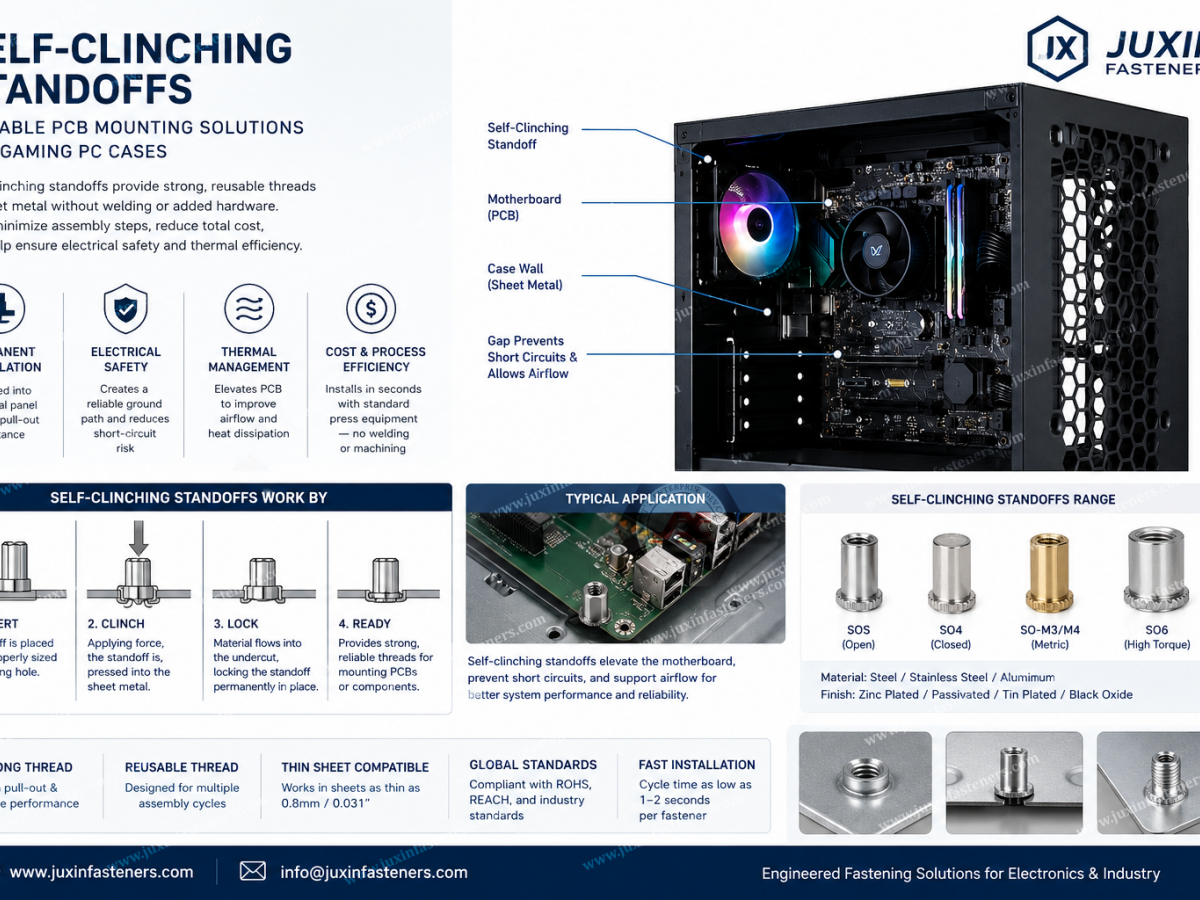
Self-clinching standoffs combine captive installation with controlled spacing.
They may be used to mount:
printed circuit boards;
electronic modules;
internal panels;
shields;
control components;
subassemblies.
The standoff height becomes part of the assembly stack-up.
Therefore, sourcing requirements may include:
thread;
standoff length;
mounting-hole interface;
sheet thickness;
installation side;
mating screw;
required spacing tolerance.
A replacement standoff with the correct thread but incorrect body height is not functionally equivalent.
Some sheet-metal assemblies require minimal projection on one side because another component, cover, gasket, or adjacent panel occupies the available space.
Flush or low-profile press-installed fasteners may be considered for these applications.
However, “flush” should not be assumed from appearance alone.
The required installation geometry, sheet thickness, fastener design, and finished panel condition should be verified.
Self-clinching depends on the panel material being capable of deforming appropriately around the fastener's retention feature.
This creates an important material relationship between the fastener and the receiving sheet.
If the panel is too hard for the selected self-clinching fastener, sufficient material displacement may not occur.
Potential consequences include:
incomplete seating;
poor retention;
fastener rotation;
low push-out resistance;
panel cracking or deformation;
inconsistent installation.
The correct hardness relationship depends on the specific fastener design and material.
Engineers should therefore verify the manufacturer's or approved drawing requirements rather than applying one universal hardness limit to every self-clinching component.
The term “stainless steel sheet” does not by itself establish compatibility with a self-clinching fastener.
Different stainless grades, tempers, cold-work conditions, and sheet conditions can have substantially different hardness.
A fastener suitable for mild steel or aluminum should not automatically be assumed suitable for stainless sheet.
When the panel material changes, the clinching interface should be re-evaluated.
This is particularly important when an enclosure design migrates from carbon steel to stainless steel for corrosion resistance.
A self-clinching fastener needs sufficient panel material to interact with its retention geometry.
If the sheet is thinner than the fastener's intended range, the panel may not provide enough material for the designed mechanical interlock.
Potential problems can include:
weak push-out resistance;
weak torque resistance;
panel distortion;
incomplete seating;
visible deformation on the opposite surface.
For this reason, sheet thickness should be specified as a functional requirement during both engineering selection and procurement.
Do not assume that two panels using the same thread size can use the same self-clinching fastener if their thicknesses differ.
The mounting hole is one of the most important features in a press-installed fastening system.
If the hole is oversized, the fastener may not develop the intended interaction with the surrounding sheet.
If the hole is undersized, insertion can become difficult and the installation process may create excessive deformation.
Relevant hole characteristics include:
diameter;
tolerance;
roundness;
burr condition;
edge quality;
location;
relation to bends and nearby features.
The hole should therefore be produced according to the requirements of the specific fastener rather than selected from a generic bolt-clearance table.
Both punching and drilling may be used in sheet-metal production, but they can produce different hole-edge conditions.
Depending on the process, engineers may need to consider:
burr direction;
rollover;
taper;
local work hardening;
surface distortion;
hole consistency.
For high-volume sheet-metal production, hole-process capability can affect fastener installation consistency.
When qualifying a press-fit fastener, evaluation using production-representative holes is more meaningful than testing only in ideal laboratory coupons.
Installing a press-fit or self-clinching fastener too close to a sheet edge can cause the displaced material to push outward rather than flow uniformly around the fastener.
Possible consequences include:
edge bulging;
cracking;
reduced retention;
visible panel distortion.
The same issue can occur near:
bends;
cutouts;
adjacent holes;
embossments;
other installed fasteners.
The required spacing depends on the specific fastener, panel material, thickness, and surrounding geometry.
Engineers should therefore consider the available material volume around the installation location.
A hole positioned close to a formed bend can introduce several issues.
The bending process may alter local material condition and geometry.
The installation force from a press-fit fastener may also distort the nearby bend.
When fasteners must be installed near formed features, evaluate:
bend radius;
hole-to-bend distance;
panel thickness;
material;
installation direction;
tooling access.
This is especially important in compact enclosure designs where multiple features compete for limited panel area.
A common misconception is that higher press force automatically creates stronger retention.
It does not.
The objective is to fully seat the fastener and create the intended material displacement without unnecessarily crushing the fastener or deforming the panel.
Excessive force can cause:
panel bowing;
fastener deformation;
damaged threads;
excessive witness marks;
altered mounting geometry.
Insufficient force can leave the fastener incompletely seated.
Installation should therefore be controlled according to the selected fastener, panel, tooling, and required seating condition.
Self-clinching fasteners are generally intended to be installed through controlled pressing rather than uncontrolled hammer impact.
Impact can make installation force and material flow less predictable and may damage:
the panel;
the fastener;
threads;
surface finishes;
surrounding geometry.
Production tooling should provide the required alignment and controlled force for the component being installed.
Two important retention concepts for self-clinching hardware are push-out resistance and torque-out resistance.
They should not be treated as the same property.
Push-out resistance relates to the axial force required to dislodge the installed fastener from the panel.
It is influenced by factors such as:
fastener geometry;
panel material;
sheet thickness;
hole condition;
installation quality.
Torque-out resistance relates to the fastener's resistance to rotation within the sheet.
This can be particularly important for captive nuts that must resist the torque applied during mating-screw installation or removal.
A fastener can behave differently under axial and rotational loading.
Therefore, engineers should identify which retention mode matters to the application rather than requesting a generic “holding strength.”
A self-clinching nut can contain a strong internal thread while still being poorly retained in an unsuitable panel.
Conversely, excellent panel retention does not automatically mean the thread itself is suitable for every applied load.
A complete design should distinguish:
Thread Capacity
from
Fastener-to-Panel Retention
from
Panel Structural Capacity
These can be three different limiting conditions.
Both technologies create threads in relatively thin material, but they solve different manufacturing problems.
Typically require:
suitable panel material;
appropriate sheet thickness;
prepared mounting hole;
access for pressing tooling;
controlled installation force.
They can provide compact captive threads where the sheet can support the clinching mechanism.
Can be installed from one side and are useful when backside access is unavailable.
Their retention mechanism and grip-range logic differ from self-clinching hardware.
A useful selection question is:
Can the panel be accessed and supported for a pressing operation during manufacturing?
If yes, a self-clinching solution may be considered.
If installation must occur entirely from one accessible side after the structure is closed, a rivet nut may be more appropriate.
The final choice depends on material, load, serviceability, manufacturing sequence, and application requirements.
Weld nuts and weld studs create permanent threaded features through a welding process.
Self-clinching hardware creates mechanical retention without a weld.
The choice can depend on:
substrate material;
weldability;
thermal distortion;
coating sequence;
installation access;
production equipment;
required performance;
downstream finishing;
automation strategy.
Neither technology is universally superior.
The appropriate method depends on the complete manufacturing architecture.
The production sequence deserves early engineering consideration.
Sheet-metal assemblies may undergo:
painting;
powder coating;
plating;
anodizing;
conversion coating;
other surface treatments.
Installing a fastener before finishing can expose the fastener to downstream processing.
Installing after finishing can create other concerns, including coating damage or changes to the mounting-hole interface.
The correct sequence depends on:
fastener design;
panel material;
finishing process;
corrosion requirements;
electrical requirements;
appearance;
dimensional fit.
This decision should be defined during process planning rather than left until final assembly.
For press-fit and self-clinching fasteners, coating around the mounting hole can alter the effective interface.
Potential issues include:
reduced hole diameter;
coating fracture;
local coating displacement;
inconsistent seating.
Where the installation interface is critical, engineering drawings and process instructions should define the intended relationship between hole dimensions and finishing operations.
Possible causes may include:
unsuitable hole size;
insufficient clinching;
incompatible panel hardness;
inadequate sheet thickness;
incorrect fastener;
installation-process variation.
Potential causes can include:
incomplete installation;
incorrect hole;
unsuitable sheet thickness;
panel material incompatibility;
excessive axial service load.
Possible causes include:
excessive installation force;
insufficient edge distance;
installation too close to a bend;
unsuitable fastener geometry;
insufficient sheet thickness.
Potential causes can include:
incorrect hole size;
burrs;
misalignment;
insufficient force;
unsuitable tooling;
incompatible fastener/panel combination.
Possible causes can include:
tooling contact;
misalignment;
excessive force;
impact installation;
improper handling.
Failure analysis should consider the entire fastener-panel-tooling system rather than assuming the fastener alone is defective.
Self-clinching nuts and standoffs can provide captive threaded mounting points for:
internal panels;
control components;
circuit boards;
brackets;
covers;
electrical hardware.
Server chassis, communications cabinets, racks, and related equipment often use thin sheet and benefit from captive hardware that simplifies assembly.
Machine guards, electrical cabinets, equipment panels, brackets, and control enclosures can use press-installed hardware where thin-sheet captive threads are required.
Suitable sheet-metal assemblies may use clinching nuts, studs, and related hardware where the material, thickness, load,
corrosion requirements, and manufacturing sequence support the technology.
Sheet-metal housings, brackets, access panels, and internal mounting structures can benefit from permanent captive threaded features.
A visually similar self-clinching nut is not automatically an equivalent replacement.
A useful qualification principle is:
Visual Similarity ≠ Dimensional Equivalence ≠ Installation Equivalence ≠ Retention Equivalence ≠ Functional Equivalence
Compare relevant features such as:
thread;
mounting-hole requirement;
shank dimensions;
head geometry;
retention geometry;
overall height;
stud length or standoff height.
Confirm:
fastener material;
mechanical requirements;
hardness where relevant;
surface coating.
Verify the fastener against the actual:
sheet material;
sheet hardness;
sheet thickness;
hole process;
finishing condition.
Evaluate:
tooling;
installation direction;
seating condition;
required press process;
accessibility.
Where required, validate characteristics such as:
push-out resistance;
torque-out resistance;
thread function;
installed height;
panel deformation;
downstream assembly behavior.
This is especially important when a procurement team is replacing an existing branded or proprietary press-installed component with a second-source alternative.
A physical sample can help JUXIN FASTENERS evaluate:
geometry;
dimensions;
thread;
installation features;
general product architecture.
However, reverse measurement alone may not reveal:
original material grade;
hardness;
heat treatment;
coating specification;
intended panel hardness;
original installation force;
required push-out performance;
required torque-out performance.
Whenever possible, samples should be accompanied by drawings, material requirements, application information, or existing specifications.
Before approving a second source for industrial press-fit hardware, consider defining:
approved drawing revision;
fastener type;
thread size and pitch;
mounting-hole diameter and tolerance;
panel material;
panel hardness where relevant;
sheet thickness;
edge-distance requirements;
fastener material;
hardness or heat treatment where applicable;
surface coating;
installation method;
installation side;
required seating condition;
push-out requirements where applicable;
torque-out requirements where applicable;
finishing sequence;
inspection requirements;
sample-validation requirements;
packaging;
production quantity;
estimated annual usage.
For technical review and quotation, provide as much of the following information as applicable:
2D drawing;
3D CAD model where available;
existing or competitor reference part number;
physical sample for cross-reference projects;
required fastener type;
thread size and pitch;
mounting-hole dimensions;
panel material;
panel hardness where known;
sheet thickness;
distance to edges, bends, or nearby features where critical;
fastener material;
surface finish or coating;
installation method;
installation sequence;
push-out or torque-out requirements where specified;
operating environment;
corrosion requirements;
inspection or documentation requirements;
sample quantity;
production quantity;
estimated annual usage.
JUXIN FASTENERS can use this information to evaluate the relevant self-clinching or press-fit product family, panel compatibility,
dimensional requirements, cross-reference feasibility, sample requirements, and production sourcing route.
A press-installed fastener should never be selected as an isolated component.
For engineering teams, the correct decision path is:
Panel Material → Hardness → Sheet Thickness → Hole → Edge/Bend Geometry → Fastener Type → Installation → Retention Requirement → Finishing → Validation
For procurement teams, the sourcing path continues:
Existing Part / Drawing → Critical Interface Review → Panel Compatibility → Cross-Reference → Sample Installation → Functional Validation → Second-Source Approval → Production RFQ
The objective is not simply to find a nut, stud, or standoff with the correct thread.
The objective is to ensure that the fastener, sheet metal, mounting hole, installation process, and required retention performance function together as one engineered system.
Email: info@juxinfasteners.com
Website: www.juxinfasteners.com
 MORE NEWS
Sep. 30, 2026
Sep. 30, 2026
Sep. 30, 2026
Contact Us
Tel.:
+86 020 8621 0320
+86 020 3121 6067
E-mail:
Technical Support:
Navigation
SEND INQUIREY