
Call Us
+86 136 6007 9809
Call Us
+86 136 6007 9809

Sep. 01, 2026
When an injection-molded plastic component requires a permanent and reliable threaded fastening point, molded-in threaded inserts can provide an efficient solution by integrating the metal insert directly into the plastic during the molding process.
Unlike heat staking, ultrasonic insertion or press-in installation, molded-in inserts are positioned inside the injection mold before the polymer is injected.
As the molten plastic flows around the insert, its external knurls, ribs, grooves or undercut features become mechanically integrated with the polymer. Once the plastic cools and solidifies, the metal insert becomes part of the finished component.
This approach can eliminate a secondary insert-installation operation and is particularly attractive for high-volume OEM production where fastening points need consistent positioning and repeatable assembly performance.
Molded-in threaded inserts are used in automotive components, electrical housings, plastic manifolds, industrial equipment, telecom products, medical equipment, electronics and other injection-molded assemblies.
For design engineers and procurement teams, successful insert molding requires the insert, plastic component and injection-molding process to be considered as one integrated system.
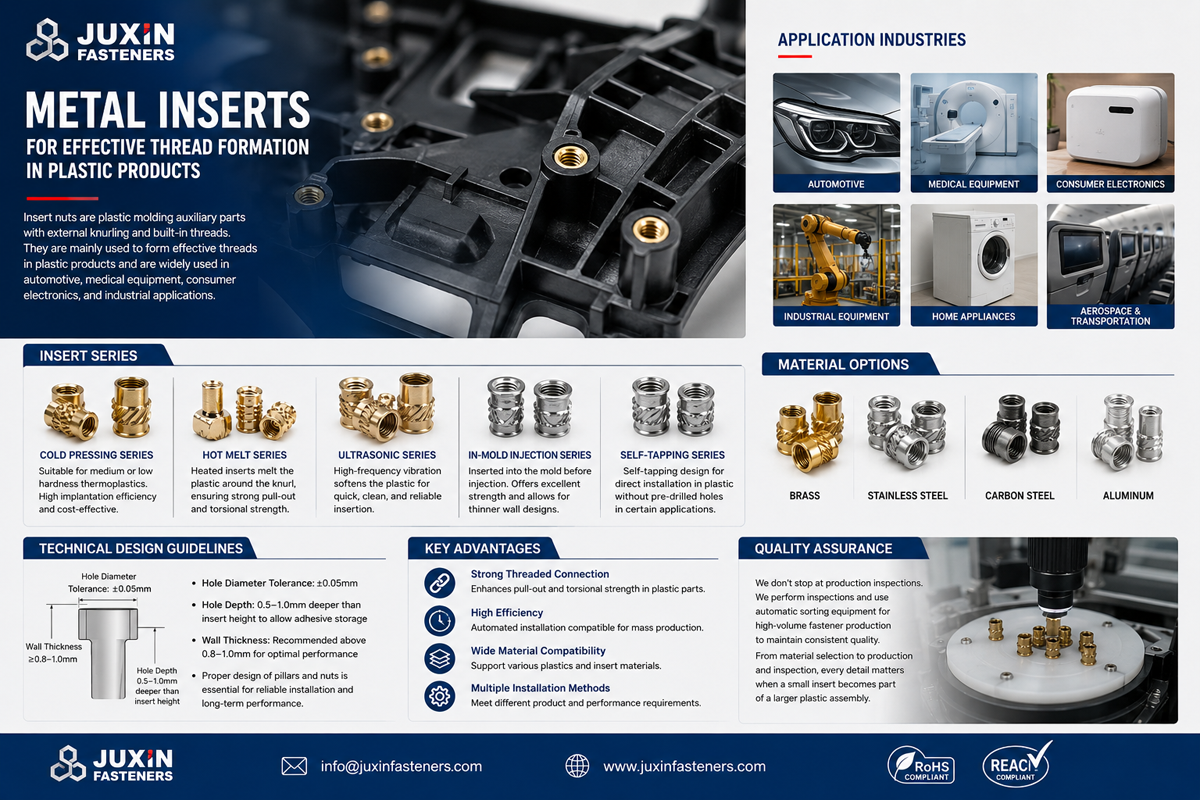
Molded-in threaded inserts are metal fastening components placed inside an injection mold before plastic is injected.
The plastic flows around the external geometry of the insert and solidifies around it.
The finished component contains a metal internal thread that can be used for screw fastening.
A simplified production sequence is:
Insert positioning → mold closing → plastic injection → polymer flow around insert → cooling → mold opening → finished molded-in threaded component
The insert remains permanently integrated into the plastic part.
This makes molded-in inserts different from post-molding solutions such as heat-set inserts, ultrasonic threaded inserts and press-in threaded inserts.
The insert-molding process requires coordination between the fastener supplier, mold designer, injection-molding manufacturer and product engineering team.
The plastic housing, bracket, manifold, cover or other component is designed with the required threaded fastening locations.
The boss geometry should accommodate the selected insert.
The threaded insert is placed into the injection mold at the specified location.
Depending on the tooling design, the insert may be mechanically located, retained by the mold or positioned using an automated loading system.
The mold closes around the insert.
The insert must remain correctly positioned throughout the injection cycle.
Molten plastic enters the mold cavity and flows around the metal insert.
The external profile of the insert provides the mechanical interface between the metal and polymer.
The plastic cools and solidifies around the insert.
The polymer mechanically locks onto the external insert geometry.
After the molding cycle, the finished plastic component is removed from the mold with the threaded insert already integrated.
Depending on the application, inspection may include:
Insert position
Thread condition
Insert height
Alignment
Visual appearance
Pull-out resistance
Torque resistance
Dimensional accuracy
For critical OEM applications, inspection requirements should be established before mass production.
The primary advantage of molded-in inserts for plastic is that the fastening point is created during the injection-molding process.
Because the insert is integrated during molding, manufacturers can potentially eliminate a separate post-molding installation operation.
This can reduce handling and simplify the assembly process.
When tooling and insert positioning are properly controlled, molded-in inserts can provide consistent fastening-point locations.
This is particularly important when the insert must align with another component.
Molded-in inserts can be attractive for high-volume production because the fastening operation is incorporated into the molding cycle.
External knurls, ribs and undercuts create mechanical engagement between the metal insert and polymer.
Integrating the insert during molding can reduce the number of downstream assembly steps.
For products with large annual production volumes, integrating the fastening solution into the molding process can provide manufacturing advantages.
The external geometry of the insert is one of the most important design variables.
The internal thread connects to the mating screw, while the external profile transfers mechanical loads into the surrounding plastic.
Knurled threaded inserts use an external knurl pattern to increase mechanical engagement with the surrounding polymer.
The knurl can provide resistance against rotational movement when the mating screw is tightened.
External ribs can increase contact with the plastic and help provide mechanical retention.
The number, height and geometry of the ribs can be adjusted according to the application.
External undercuts can improve axial retention by allowing the solidified polymer to mechanically lock around the insert.
This can be useful when pull-out resistance is an important design requirement.
A flange can provide a defined seating surface and may help distribute loads around the insert location.
The flange geometry should be evaluated together with the surrounding plastic structure.
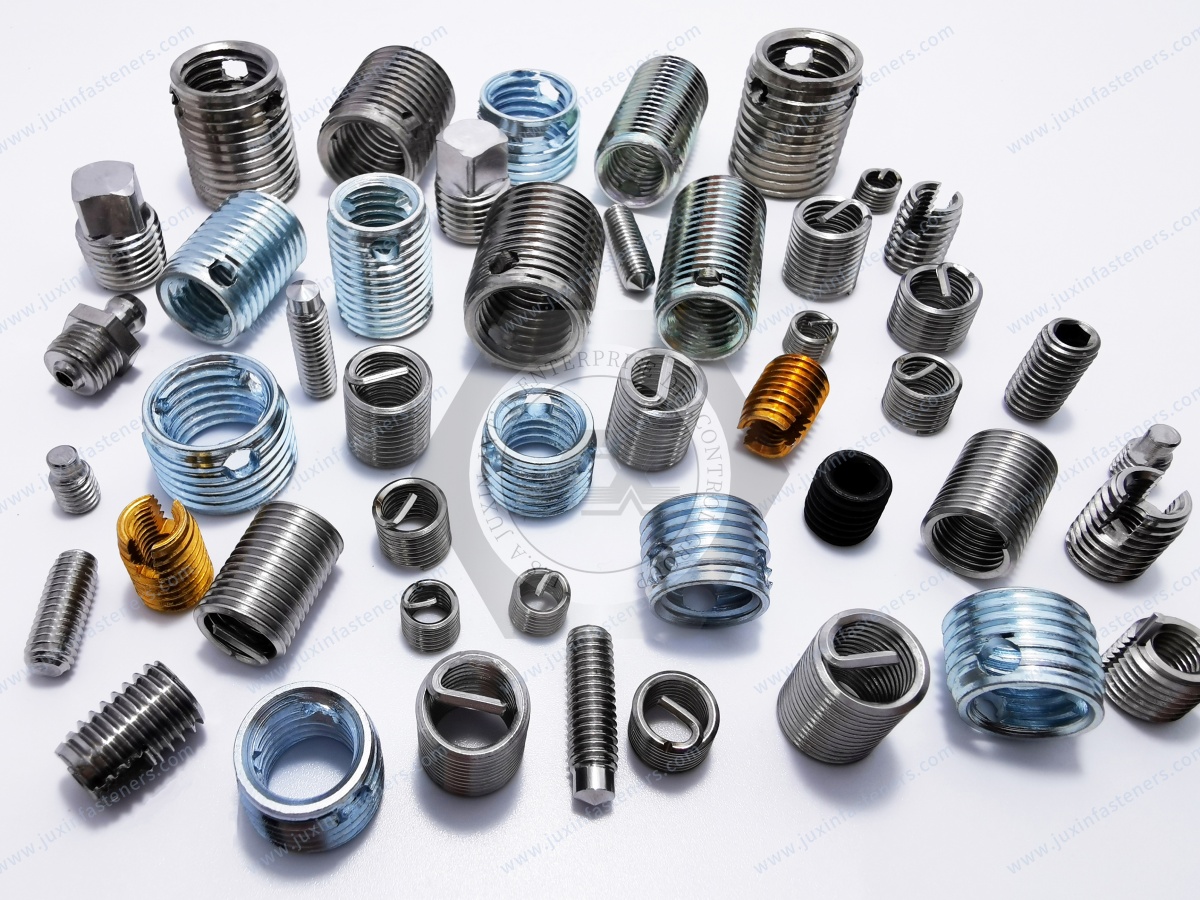
Material selection should consider the mechanical, thermal and environmental requirements of the application.
Brass threaded inserts are widely used in plastic applications because brass provides good machinability and practical mechanical performance.
Brass also has useful thermal conductivity during the injection-molding process.
Typical applications include:
Electronic housings
Electrical components
Automotive plastic parts
Telecom equipment
Industrial equipment
Stainless steel may be selected when improved corrosion resistance or higher mechanical performance is required.
Applications exposed to moisture, chemicals or demanding environments may require a stainless steel solution.
The specific stainless steel grade should be selected according to the application.
Aluminum can be considered where weight reduction is an important design objective.
The insert must still provide the required thread performance and compatibility with the surrounding plastic.
The polymer selected for the injection-molded component directly affects insert performance.
Common thermoplastics include:
ABS
Polycarbonate (PC)
Polyamide (PA / Nylon)
PBT
POM
PP
PET
PEEK
Glass-filled thermoplastics
Material grade matters.
For example, glass-filled nylon may have significantly different shrinkage, stiffness and mechanical behavior compared with unfilled nylon.
High-performance materials such as PEEK may also require specialized tooling and process considerations.
Therefore, molded-in insert selection should be based on the actual resin grade rather than only the generic polymer name.
The plastic boss provides structural support around the metal insert.
A well-designed boss helps distribute the mechanical load from the screw into the surrounding plastic.
The boss must provide enough polymer around the insert to support the required load.
An undersized boss can increase stress concentration.
An oversized boss may increase component weight and consume valuable design space.
Wall thickness affects polymer flow, cooling behavior and mechanical performance.
The wall should be sufficient to support the insert without creating unnecessary material thickness.
Boss height should accommodate the insert length and required seating position.
The mold must also allow the insert to be positioned accurately.
The insert should not be located too close to thin walls, corners, holes or adjacent bosses if these features cannot tolerate the resulting molding and service stresses.
The insert cannot be treated as an independent fastener once it becomes part of an injection-molding process.
The mold designer should evaluate:
Insert location
Insert retention in the mold
Mold cavity geometry
Polymer flow
Gate location
Cooling
Ejection
Insert alignment
Mold wear
Automation requirements
The insert should remain stable during plastic injection.
If the insert moves during molding, the finished thread may become misaligned with the mating component.
Plastic flow is an important consideration in injection molded threaded insert applications.
The polymer must flow around the insert without creating unacceptable defects.
Potential issues can include:
Incomplete filling
Air entrapment
Weld lines
Localized stress
Insert displacement
Cosmetic defects
The insert geometry and mold design should therefore be evaluated together.
For complex components, mold-flow analysis may be useful during product development.
The temperature relationship between the metal insert and molten polymer can affect the molding process.
The insert may be at a different temperature from the surrounding mold before injection.
Depending on the application, preheating the insert may be considered, but the appropriate process depends on the insert material, polymer and molding conditions.
The objective is to achieve stable molding without creating defects or compromising the finished component.
Thread alignment is critical for assemblies where the insert must mate with a screw, stud or another threaded component.
Poor alignment can lead to:
Difficult screw installation
Cross-threading
Increased assembly torque
Component damage
Production delays
The mold tooling and insert-location system should therefore control the position of the insert throughout the molding cycle.
Two important performance characteristics are pull-out resistance and torque-out resistance.
Pull-out resistance measures how well the insert resists axial removal from the plastic.
Performance depends on:
Insert length
External profile
Undercuts
Polymer strength
Boss geometry
Molded interface
Torque-out resistance measures the insert's resistance to rotation when the mating screw is tightened.
External knurling, ribs and other anti-rotation features can improve mechanical engagement with the polymer.
For critical applications, both properties should be tested using production-representative plastic components.
Both methods provide metal threads in plastic, but the timing of installation is different.
| Feature | Molded-In Inserts | Heat Staking Inserts |
|---|---|---|
| Installation | During molding | After molding |
| Secondary installation | Usually not required | Required |
| Mold integration | Required | Generally not required |
| Production flexibility | Lower after tooling is fixed | Higher |
| High-volume production | Highly suitable | Suitable |
| Positioning | Controlled by mold | Controlled by installation equipment |
| Process integration | Injection molding | Post-molding assembly |
Molded-in inserts can be particularly attractive when the product design and annual volume justify integrating the insert into the injection-molding process.
Ultrasonic inserts are installed after molding using localized ultrasonic energy.
Molded-in inserts are incorporated during the injection-molding process.
| Feature | Molded-In Inserts | Ultrasonic Inserts |
|---|---|---|
| Installation timing | During molding | After molding |
| Ultrasonic equipment | Not required | Required |
| Mold integration | Required | Generally not required |
| Post-mold operation | Usually eliminated | Required |
| High-volume production | Suitable | Suitable |
| Process flexibility | Lower after tooling | Higher |
The preferred solution depends on production volume, tooling strategy, component design and manufacturing process.
Press-in inserts rely on mechanical interference after molding.
Molded-in inserts become integrated into the component during molding.
| Feature | Molded-In Inserts | Press-In Inserts |
|---|---|---|
| Installation timing | During molding | After molding |
| Mechanical pressing | Not normally required | Required |
| Mold tooling | Insert integration required | Simpler molding process |
| Secondary operation | Usually eliminated | Required |
| Production flexibility | Lower after tooling | Higher |
| High-volume production | Attractive | Also suitable |
For high-volume products with stable designs, integrating the insert into the molding process can be an efficient option.
Automotive manufacturers use injection-molded plastics in many interior, exterior, electrical and structural applications.
Molded-in inserts can provide fastening points for:
Electronic modules
Plastic brackets
Covers
Sensor housings
Interior components
Electrical assemblies
Applications should be validated for vibration, temperature cycling and long-term mechanical loads.
Electric vehicles use extensive plastic and composite components around electrical systems.
Molded-in threaded inserts can support selected:
Electrical housings
Electronic modules
Sensor assemblies
Plastic covers
Battery-related components
Supporting structures
The insert, polymer and molding process should be evaluated together for thermal and mechanical requirements.
Plastic manifolds may require integrated metal fastening points for connection to other components.
Molded-in inserts can be incorporated into the manifold during injection molding, reducing the need for separate installation operations.
Electrical enclosures often require secure internal mounting points for circuit boards, brackets, covers and other components.
Molded-in inserts can provide consistent fastening locations.
Telecom products frequently use lightweight plastic housings with multiple internal mounting requirements.
Molded-in inserts can support the attachment of internal modules and structural components.
Industrial machinery may use molded plastic housings, control panels and protective covers.
Integrated threaded inserts can provide durable metal fastening points while maintaining a lightweight plastic structure.
Medical and laboratory equipment may use engineered plastics for housings and structural components.
Insert material, polymer compatibility and environmental exposure should be evaluated according to the finished product requirements.
Consumer electronics require lightweight housings with precise screw locations.
Molded-in inserts can provide consistent metal threads for internal components and covers in high-volume manufacturing.
Molded-in inserts are particularly attractive when:
Annual production volume is high
The plastic component design is stable
The insert location is predictable
A secondary installation step should be minimized
Consistent insert positioning is important
The mold can accommodate insert loading
The production process can control insert placement
They may be less attractive during early prototypes or rapidly changing designs where mold tooling has not yet been finalized.
In those cases, post-molding solutions such as press-in, heat-set or ultrasonic threaded inserts may provide greater flexibility.
Standard inserts may not always fit an OEM injection-molded component.
A custom molded-in threaded insert can be developed around the actual component and molding process.
Customization may include:
Outside diameter
Insert length
Thread diameter
Thread pitch
Metric threads
Inch threads
External knurling
Rib geometry
Undercut geometry
Flange design
Material
Surface treatment
Dimensional tolerances
For custom development, a component drawing is particularly useful.
The fastener supplier can evaluate the insert together with the boss dimensions, molding process and required mechanical performance.
For procurement managers and supply chain teams, sourcing should consider the entire manufacturing process rather than the insert unit price alone.
A professional RFQ should ideally include:
Plastic resin and grade
Component drawing
Boss dimensions
Insert location
Thread specification
Insert outside diameter
Insert length
External retention profile
Material
Surface treatment
Required torque
Pull-out requirement
Production volume
Molding process
Packaging requirements
Providing these details helps the supplier recommend an insert that is compatible with the actual injection-molding application.
JUXIN Fasteners supports OEM and industrial customers sourcing molded-in threaded inserts for injection molded parts.
Our fastening solutions can support applications across:
Automotive
EV
Automotive electronics
Electrical equipment
Telecom
Industrial machinery
Plastic manifolds
Medical equipment
Consumer electronics
OEM plastic assemblies
For custom projects, customers can provide engineering drawings, samples or plastic-component specifications for technical evaluation.
The insert can be developed around the complete application:
Plastic resin + boss geometry + insert profile + mold design + thread requirement + mechanical load
This application-focused approach helps engineering and procurement teams select a fastening solution that works with the actual injection-molding process.
If you are sourcing molded-in threaded inserts, injection molded threaded inserts, brass molded-in inserts, threaded inserts for plastic or custom OEM inserts, contact JUXIN Fasteners.
For faster technical evaluation, please provide:
Plastic resin and grade
Component drawing
Boss dimensions
Insert location
Thread size and standard
Insert dimensions
External profile requirements
Material requirement
Surface treatment
Required torque
Pull-out requirement
Estimated annual quantity
JUXIN Fasteners supports OEM and industrial fastening requirements from product specification through production supply.
JUXIN Fasteners
23+ Years of Fastener Industry Experience
OEM & Industrial Fastening Solutions
Email: info@juxinfasteners.com
Website: www.juxinfasteners.com
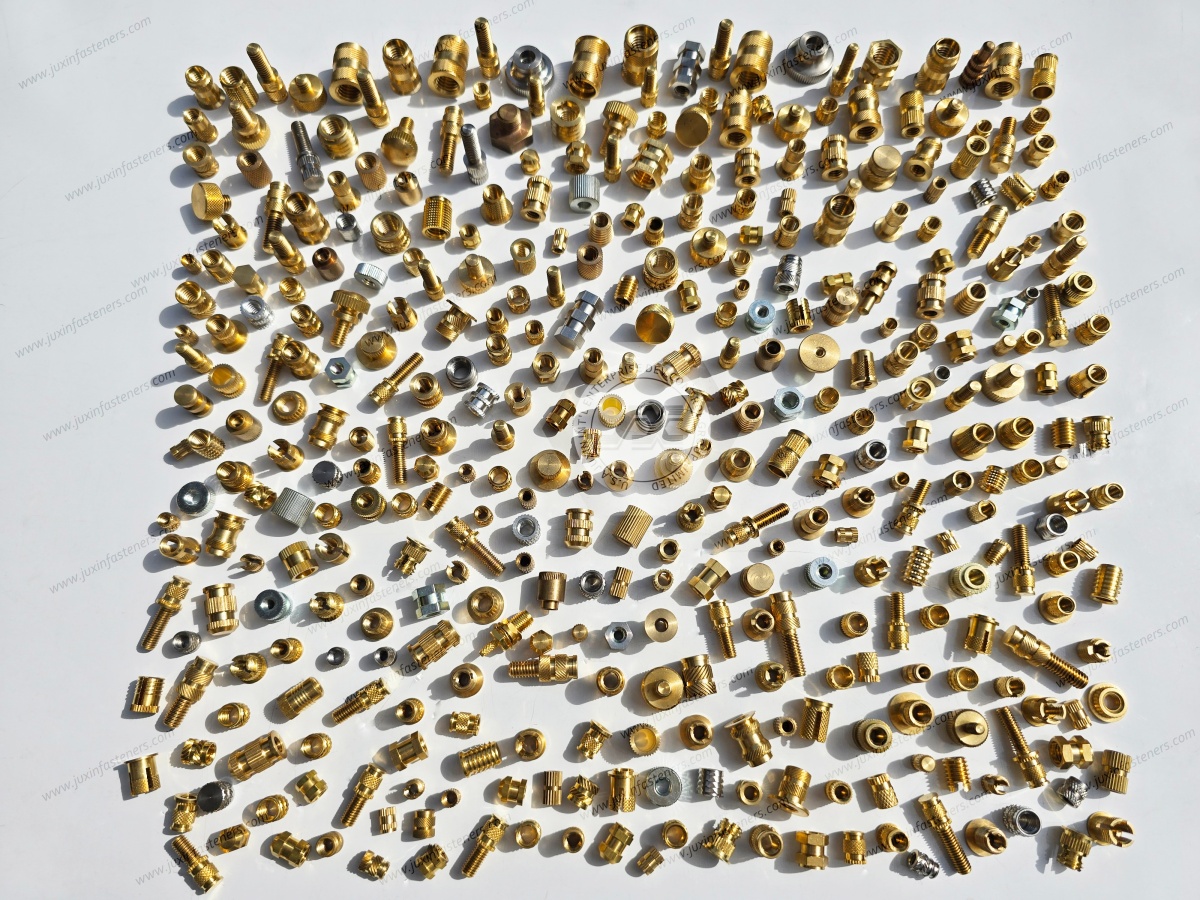
Molded-in threaded inserts are metal inserts positioned inside an injection mold before plastic is injected. The polymer flows around the insert and mechanically integrates with its external profile as the component cools.
Molded-in inserts are installed during injection molding, while heat-set inserts are installed after the plastic component has been molded using controlled heat.
Yes. Molded-in inserts can be particularly attractive for high-volume OEM programs because the insert installation is incorporated into the injection-molding process.
Common retention features include knurling, ribs, grooves, undercuts and flanges. The appropriate geometry depends on the plastic material and required mechanical performance.
Brass is widely used, while stainless steel and aluminum may be selected for applications with specific corrosion, weight or mechanical requirements.
Yes. They can be used in selected automotive plastic housings, electronic modules, brackets, covers and other injection-molded components, subject to application validation.
Yes. Customization can include insert dimensions, thread specifications, external retention geometry, flange design, material and tolerances according to OEM requirements.
The most useful information includes the plastic resin and grade, component drawing, boss dimensions, insert location, thread specification, insert dimensions, required mechanical performance and annual production volume.
 MORE NEWS
Sep. 22, 2026
Sep. 22, 2026
Sep. 22, 2026
Contact Us
Tel.:
+86 020 8621 0320
+86 020 3121 6067
E-mail:
Technical Support:
Navigation
SEND INQUIREY