
Call Us
+86 136 6007 9809
Call Us
+86 136 6007 9809

Sep. 01, 2026
Plastic housings are widely used in automotive electronics, electrical equipment, telecom systems, industrial controls, robotics, consumer electronics and other engineered products.
However, when a plastic housing requires a reliable screw connection, a directly molded or tapped plastic thread may not provide sufficient strength, wear resistance or long-term assembly performance.
Press-in threaded inserts provide a practical way to create reinforced metal fastening points in plastic components using mechanical interference.
Unlike heat staking inserts or ultrasonic threaded inserts, press-in inserts are installed without intentionally melting or softening the surrounding polymer. The insert is mechanically pressed into a prepared hole, while its external ribs, knurls or interference features engage with the plastic.
For design engineers and procurement teams, the key to a reliable press-fit connection is controlling the relationship between the insert outside diameter, hole diameter, interference, boss geometry and plastic material.
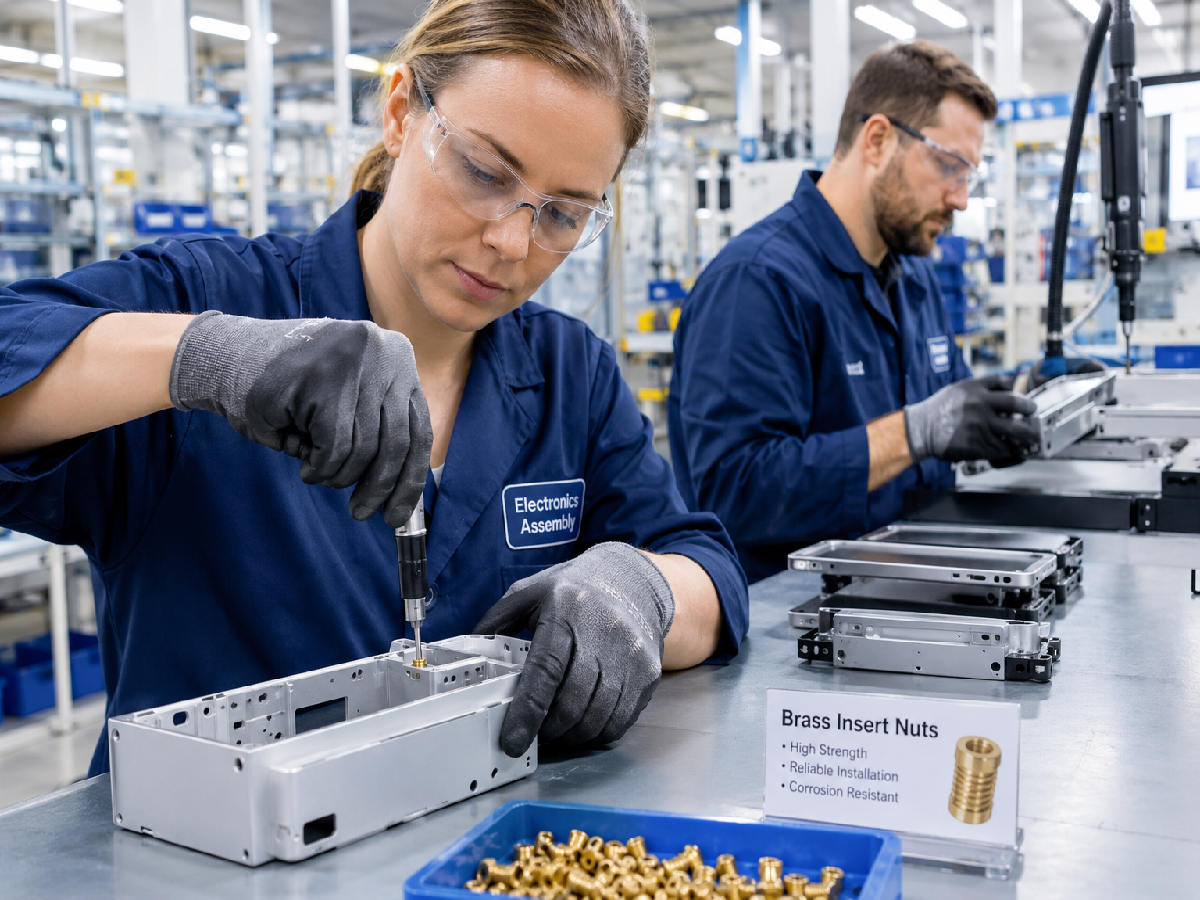
Press-in threaded inserts are metal fastening components designed to provide an internal thread in plastic parts through mechanical installation.
The insert typically contains an internal metric or inch thread for the mating screw and an external retention profile designed to grip the surrounding polymer.
A basic installation sequence is:
Mold or machine the plastic component → create the specified hole → position the insert → apply controlled pressing force → insert reaches final depth → verify position and retention
The process is relatively simple, but the dimensional relationship between the insert and plastic component is critical.
A press-in insert that is too large for the hole can create excessive stress and crack the boss. An insert with insufficient interference may rotate or pull out during assembly.
The principle is based on mechanical interference.
The outside diameter of the insert is intentionally designed to be larger than the prepared hole by a controlled amount.
When the insert is pressed into the hole, the surrounding plastic deforms around the external profile.
Knurls, ribs or grooves increase mechanical engagement and help resist:
Rotation
Pull-out
Axial movement
Assembly forces
The final performance depends on both the insert geometry and the mechanical properties of the plastic.
This is why the same insert specification may not provide identical results in ABS, nylon, polycarbonate or glass-filled engineering plastics.
A controlled installation process normally includes the following steps.
The housing or component is produced by injection molding or another suitable plastic manufacturing process.
The insert boss should be designed before production tooling is finalized.
The hole diameter must be controlled within the specified tolerance.
For injection-molded parts, the hole may be molded directly into the component.
For machined or secondary operations, the hole can be drilled or otherwise prepared according to the design specification.
The press-fit threaded insert is aligned with the hole.
Correct alignment is important for components where the screw must connect with another assembly.
A press, assembly machine or other suitable equipment applies axial force to push the insert into the plastic.
The force should be sufficient to achieve the required seating depth without damaging the component.
The insert should stop at the specified installation depth.
A controlled mechanical stop can help improve consistency during production.
Depending on the application, inspection may include:
Insert height
Insert position
Thread condition
Visual appearance
Pull-out resistance
Torque-out resistance
Dimensional accuracy
For critical OEM applications, production validation should be performed using the actual plastic component and mating screw.
Press-in inserts offer several practical advantages for plastic assemblies.
Unlike heat-set inserts, press-in inserts do not require the surrounding plastic to be intentionally softened with heat.
This can be useful when the component contains heat-sensitive features or when the manufacturer wants to avoid a thermal installation process.
The installation principle is straightforward: align the insert and press it into the prepared hole.
This can simplify some production processes.
Press-in inserts can be installed after the plastic component has been molded.
This provides flexibility when insert installation does not need to be integrated into the injection-molding cycle.
Mechanical pressing can be incorporated into production equipment where consistent insertion force and positioning are required.
For applications where thermal equipment is undesirable or unnecessary, a mechanical press-fit solution may be more practical.
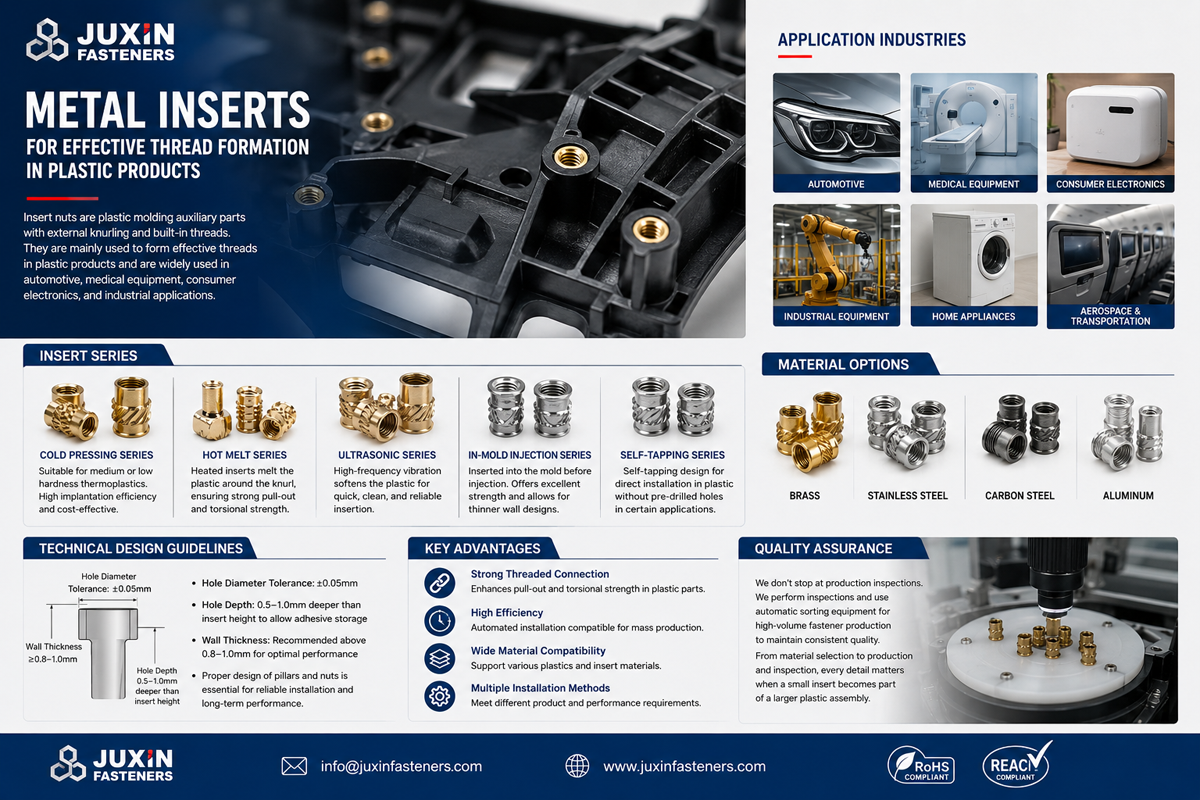
The plastic material strongly affects press-fit performance.
Common materials used in plastic housings include:
ABS
Polycarbonate (PC)
Polyamide (PA / Nylon)
PBT
POM
PP
Glass-filled nylon
Other engineering thermoplastics
The material's hardness, stiffness, ductility and reinforcement content all influence the amount of interference that can be tolerated.
ABS is widely used for housings and electronic components.
Its relatively balanced mechanical properties can make it suitable for various press-fit applications when the boss geometry and interference are properly designed.
Nylon has different mechanical and moisture-related characteristics from ABS.
For nylon components, engineers should consider material grade, moisture condition and dimensional stability during design validation.
PC is commonly used where impact resistance and dimensional performance are important.
The hole and boss design should be validated to avoid excessive installation stress.
Glass-fiber reinforcement can significantly change the mechanical behavior of the plastic.
Press-in insert dimensions should therefore be developed according to the actual grade rather than using a generic plastic specification.
Hole diameter is one of the most important variables in press-in insert design.
The insert must have sufficient interference to remain secure while avoiding excessive stress in the surrounding plastic.
If the hole is too small:
Installation force increases
Boss stress increases
Cracking may occur
Plastic deformation may become excessive
If the hole is too large:
Retention decreases
Insert movement may occur
Torque resistance may be reduced
Pull-out performance may become inadequate
The final hole specification should therefore be established according to the actual insert geometry and plastic material.
The difference between the insert outside diameter and the prepared hole diameter creates the interference fit.
A simplified relationship is:
Interference = Insert Outside Diameter − Hole Diameter
However, there is no universal interference value suitable for every plastic.
The appropriate interference depends on:
Plastic resin
Resin grade
Plastic hardness
Boss dimensions
Insert diameter
Insert length
External knurl geometry
Required insertion force
Pull-out requirement
Torque requirement
Operating environment
For OEM development, the interference should be validated through testing rather than selected solely from a general rule.
The plastic boss provides the structural support for the insert.
The boss should provide enough material around the insert to withstand installation and service loads.
An undersized boss can increase the risk of cracking.
An oversized boss may consume unnecessary space and plastic material.
Wall thickness influences stress distribution around the insert.
Thin-wall components require particular attention to interference and installation force.
Boss height should accommodate the insert length and required installation depth.
The surrounding component geometry should also allow sufficient access for the pressing tool.
The insert should not be positioned too close to another boss, wall, corner or opening if the surrounding plastic cannot accommodate the installation stress.
This is especially important in compact electronic housings.
The required insertion force depends on the interference, plastic properties and insert geometry.
A controlled mechanical press can provide more consistent installation than manual impact methods.
Production equipment may be designed to control:
Pressing force
Insertion depth
Speed
Alignment
Final position
Cycle time
For high-volume OEM production, monitoring insertion force can also provide useful process-control information.
An unexpected increase in force may indicate a hole-diameter problem, insert variation or component issue.
Pull-out resistance measures how well the insert resists axial removal from the plastic.
The result depends on:
Insert length
External profile
Interference
Plastic material
Boss geometry
Installation quality
For applications involving significant axial loads, pull-out testing should be performed using production-representative components.
Torque-out resistance is particularly important when the mating screw is tightened.
If the insert rotates inside the plastic before the screw reaches its specified torque, the assembly can fail even though the insert remains physically inside the component.
External knurls, ribs and other anti-rotation features help transfer torque between the metal insert and surrounding polymer.
For applications requiring repeated assembly and disassembly, torque-out testing should be included in validation.
Both solutions can provide metal threads in plastic, but their installation principles are different.
| Feature | Press-In Threaded Inserts | Heat Staking Inserts |
|---|---|---|
| Installation method | Mechanical pressing | Heat + pressure |
| Polymer softening | Not required | Required |
| Post-mold installation | Yes | Yes |
| Heating equipment | Not required | Required |
| Installation force | Important | Important |
| Hole/interference control | Critical | Important |
| Suitable for automation | Yes | Yes |
| Process complexity | Relatively simple | Thermal process required |
| Plastic compatibility | Material dependent | Thermoplastic dependent |
Press-in inserts can be attractive when the plastic has sufficient strength and ductility to withstand mechanical interference.
Heat staking may be more suitable when controlled polymer softening provides better retention or when the component design favors thermal installation.
Ultrasonic inserts use high-frequency vibration to generate localized heating, while press-in inserts rely primarily on mechanical interference.
| Feature | Press-In Inserts | Ultrasonic Inserts |
|---|---|---|
| Primary mechanism | Mechanical interference | Ultrasonic energy |
| Heat required | No intentional heating | Localized heating |
| Installation equipment | Mechanical press | Ultrasonic equipment |
| Post-mold installation | Yes | Yes |
| Process parameters | Force, depth, interference | Energy, amplitude, pressure, depth |
| Automation | Suitable | Highly suitable |
| Plastic deformation | Mechanical | Thermally assisted |
The best method depends on the resin, component geometry, production volume and required mechanical performance.
Plastic housings for electronic and industrial equipment frequently require internal mounting points.
Press-in threaded inserts can provide metal threads for:
Covers
Brackets
PCBs
Internal modules
Connectors
Access panels
Electrical equipment often combines lightweight plastic enclosures with multiple screw-fastened components.
Press-in inserts can provide reinforced fastening points without adding significant weight to the enclosure.
Industrial machines may use plastic guards, covers, control panels and housings.
Press-in threaded inserts can support mounting requirements where mechanical installation is suitable.
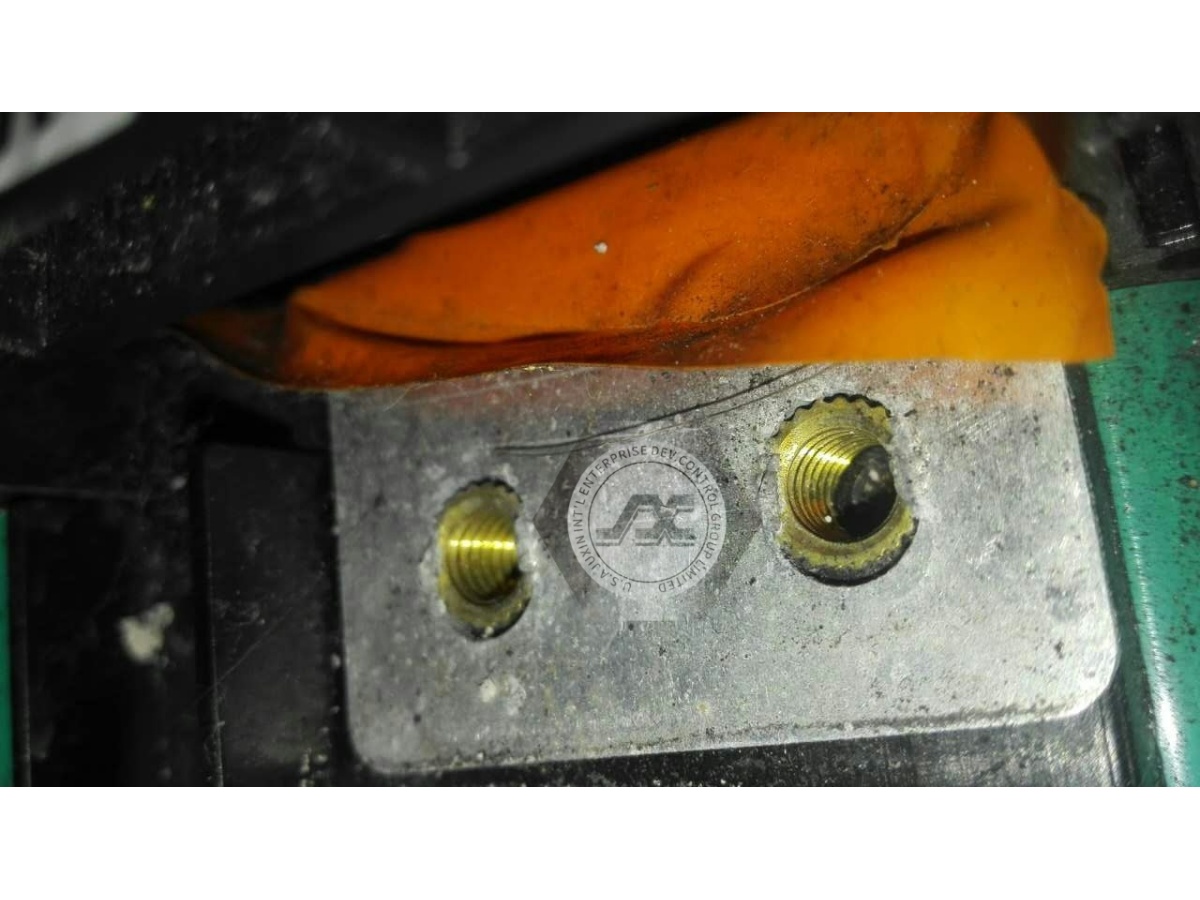
Automotive plastic assemblies can require durable fastening points for electronic modules, covers and brackets.
The insert and plastic component should be validated for vibration, temperature and service loads.
Electric vehicle systems increasingly use engineered plastic components around electronic and electrical assemblies.
Press-in threaded inserts may be considered for selected plastic housings, covers and mounting components where the resin and mechanical design support press-fit installation.
Telecom equipment frequently uses compact housings with numerous internal mounting points.
Press-in inserts can provide practical threaded connections for selected plastic structures and internal components.
Electronic products commonly use lightweight molded housings that require screw assembly.
Press-fit threaded inserts can provide a durable metal interface for repeated or controlled screw fastening.
Robotic systems often use lightweight plastic covers, sensor housings and equipment enclosures.
Press-in threaded inserts can provide mechanical mounting points without requiring a thermal installation process.
Press-in inserts can be considered when:
The plastic can tolerate mechanical interference
Heat should be avoided
Post-molding installation is preferred
A metal thread is required
The component has sufficient boss geometry
Production requires a relatively simple installation process
The required retention performance can be achieved through mechanical engagement
They may be less suitable when the plastic is highly brittle, the boss is extremely thin or the required mechanical load exceeds the capabilities of the press-fit design.
In these cases, engineers may need to compare press-in, heat-set, ultrasonic or molded-in insert solutions.
Standard press-in threaded inserts may not always match an OEM component.
A custom insert can be developed around the actual plastic housing and application requirements.
Customization may include:
Outside diameter
Insert length
Thread diameter
Thread pitch
Metric thread
Inch thread
External knurling
Rib geometry
Anti-rotation features
Material
Surface treatment
Dimensional tolerances
For custom projects, a plastic component drawing is particularly valuable because it allows the insert geometry to be evaluated together with the boss and surrounding structure.
For procurement managers and supply chain teams, sourcing should consider both the fastener and the installation process.
A supplier quotation should ideally be based on:
Plastic resin and grade
Component drawing
Boss dimensions
Hole diameter
Insert outside diameter
Insert length
Thread specification
Material
Surface treatment
Required insertion force
Pull-out requirement
Torque-out requirement
Production volume
Packaging requirements
Providing these details helps avoid a common sourcing problem: receiving a nominally correct thread but an insert that is unsuitable for the actual plastic component.
JUXIN Fasteners supports OEM and industrial customers sourcing press-in threaded inserts for plastic housings, electrical enclosures and engineered plastic components.
Our solutions can support applications across:
Automotive
EV
Electronics
Electrical equipment
Telecom
Industrial machinery
Robotics
Control systems
HVAC
OEM plastic assemblies
For projects requiring custom press-in threaded inserts, customers can provide engineering drawings, samples or application specifications for technical evaluation.
The insert selection can be evaluated according to the complete fastening system:
Plastic material + hole size + boss geometry + insert profile + interference + installation force + required retention
This application-based approach helps procurement and engineering teams identify a suitable fastening solution rather than selecting an insert based only on thread size.
If you are sourcing press-in threaded inserts, press-fit inserts for plastic, threaded inserts for plastic housings or custom OEM threaded inserts, contact JUXIN Fasteners.
For faster technical evaluation, please provide:
Plastic resin and grade
Component drawing
Boss dimensions
Hole diameter
Thread specification
Insert dimensions
Material requirement
Surface treatment requirement
Required torque
Pull-out requirement
Estimated annual quantity
JUXIN Fasteners supports OEM and industrial fastening requirements from product specification through production supply.
JUXIN Fasteners
23+ Years of Fastener Industry Experience
OEM & Industrial Fastening Solutions
Email: info@juxinfasteners.com
Website: www.juxinfasteners.com
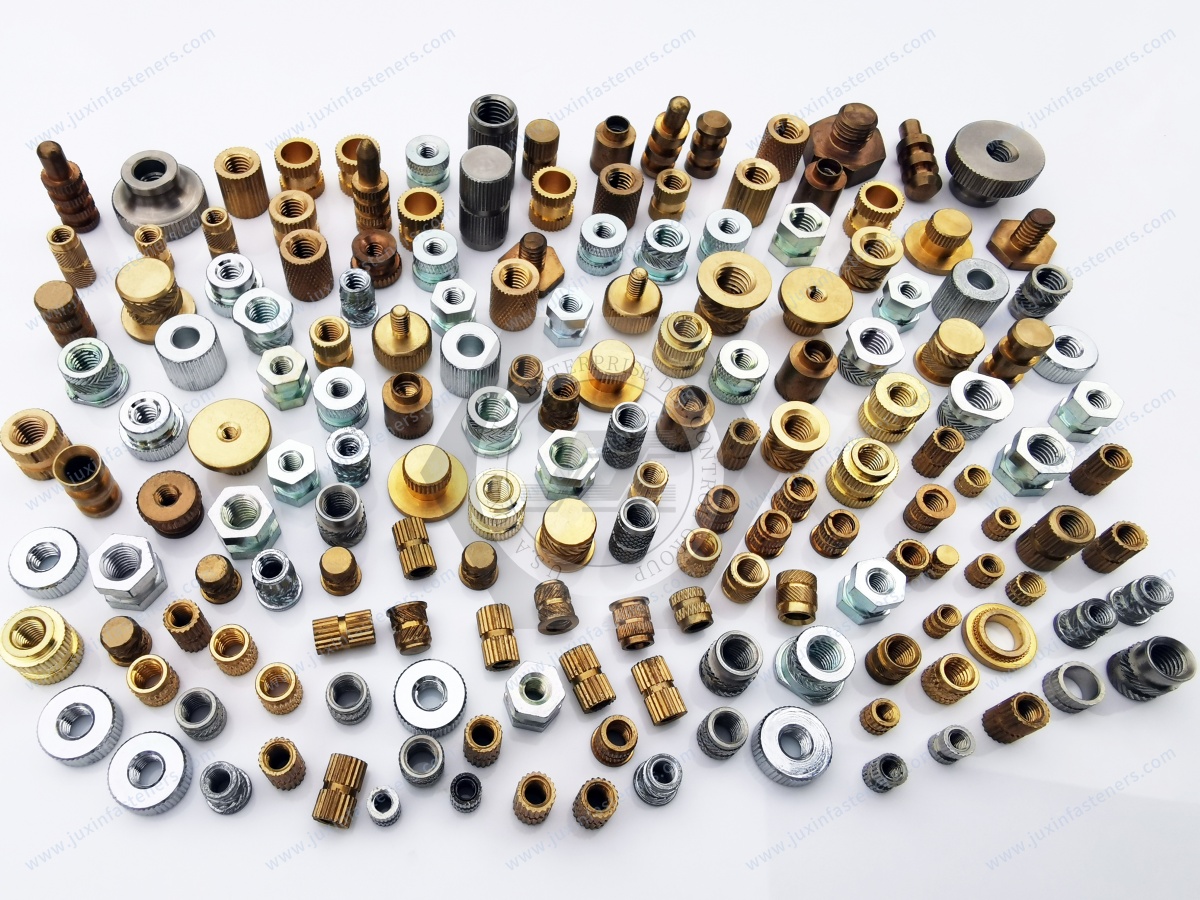
Press-in threaded inserts are metal inserts installed into plastic components through mechanical interference. The external profile engages with the surrounding polymer while the internal thread provides a durable screw connection.
No. Press-in threaded inserts are mechanically installed and do not require intentional heating or melting of the surrounding plastic.
ABS, nylon, polycarbonate, PBT, POM, PP and various engineering plastics may be considered. The actual resin grade and component design should be evaluated before production.
Press-in inserts rely primarily on mechanical interference. Heat-set inserts use controlled heat to soften the thermoplastic so the insert can be installed and retained as the polymer cools.
Hole diameter is critical. Excessive interference can increase installation force and create cracking, while insufficient interference can reduce pull-out and torque resistance.
Retention is created through mechanical interference between the insert and plastic. External knurls, ribs and other profiles can improve resistance to rotation and pull-out.
Yes. Press-in inserts can be used in selected electronic housings, electrical enclosures, telecom equipment and industrial plastic components where the plastic and boss design can support the required interference.
Yes. Customization can include insert diameter, length, thread specification, external knurling, retention geometry, material and dimensional tolerances.
The most useful information includes the plastic resin, component drawing, boss dimensions, hole diameter, thread specification, insert dimensions, required torque, pull-out requirement and estimated production volume.
 MORE NEWS
Sep. 22, 2026
Sep. 22, 2026
Sep. 22, 2026
Contact Us
Tel.:
+86 020 8621 0320
+86 020 3121 6067
E-mail:
Technical Support:
Navigation
SEND INQUIREY