
Call Us
+86 136 6007 9809
Call Us
+86 136 6007 9809

Sep. 01, 2026
Injection-molded plastic components are widely used across automotive, EV, electronics, electrical equipment, telecom, industrial machinery, robotics, HVAC and medical equipment.
While plastic provides excellent advantages in weight reduction, design flexibility and high-volume manufacturing,
directly molded or tapped plastic threads may not provide sufficient durability for demanding screw connections.
Threaded insert nuts provide a metal internal thread inside the plastic component, creating a more durable fastening point for screws and other threaded hardware.
Depending on the plastic component and production process, insert nuts can be installed by heat staking, ultrasonic insertion, press fitting or integrated directly during injection molding.
For OEM manufacturers, selecting the correct threaded insert nut for plastic requires consideration of the thread, insert geometry, plastic resin,
installation method, boss design and required mechanical performance.
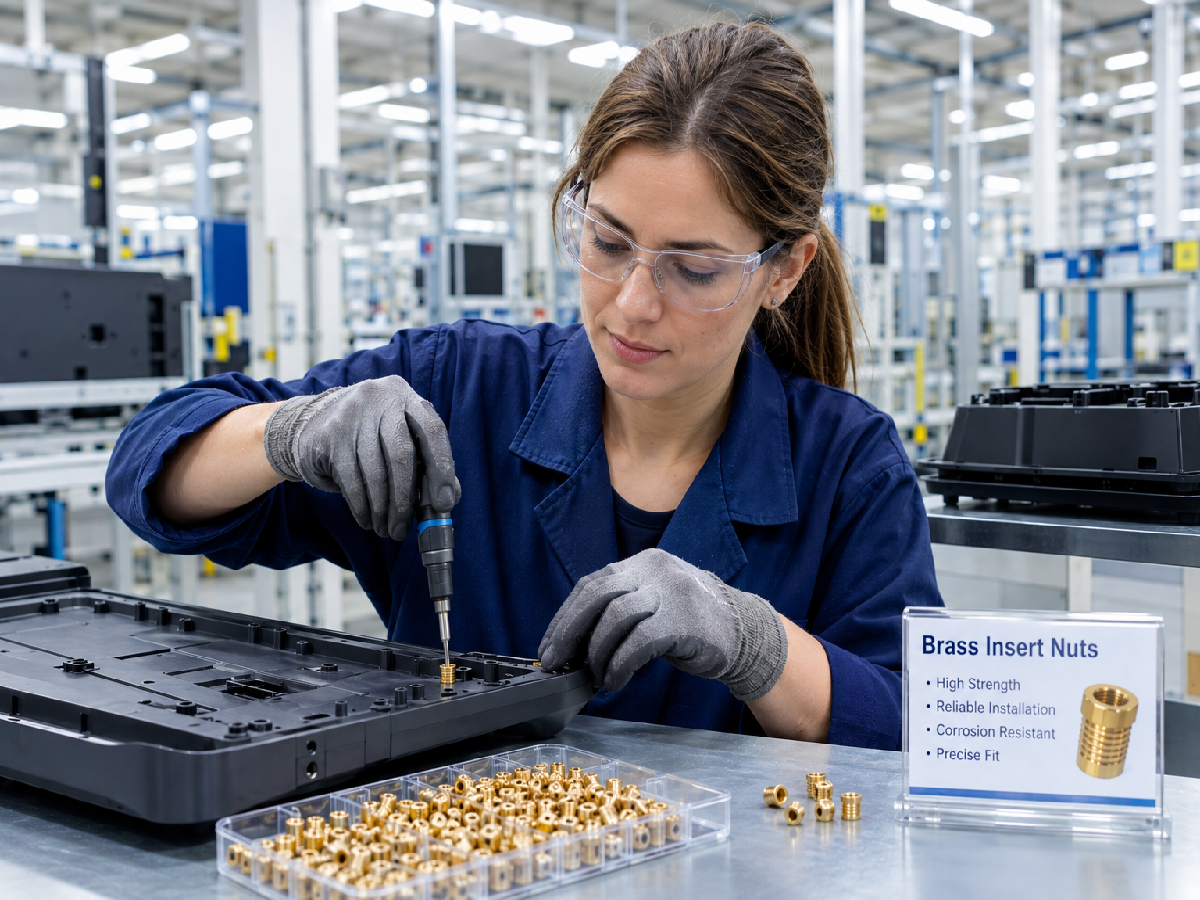
Threaded insert nuts are metal fastening components designed to provide a reinforced internal thread within plastic or composite components.
The external surface of the insert nut engages with the surrounding polymer, while the internal thread provides the connection for a mating screw.
A typical plastic assembly may consist of:
Injection-molded plastic boss → metal insert nut → internal screw thread → mating component
This allows the product designer to use a lightweight plastic structure while maintaining a more durable threaded fastening interface.
Compared with a directly molded plastic thread, a metal insert can be particularly useful where the assembly requires repeated screw installation,
controlled tightening torque or improved resistance to thread stripping.
The decision to use a metal insert should be based on the actual application requirements.
Metal threads can provide greater resistance to wear than threads formed directly in many plastic materials.
This can be valuable when a component is expected to be assembled and serviced repeatedly.
For applications involving higher tightening torque, a metal insert can provide a more robust screw interface than the surrounding polymer alone.
A consistent metal thread can help improve screw installation consistency during production.
If a plastic housing needs to be opened during maintenance, a reinforced threaded connection can be better suited to repeated disassembly.
The insert provides a metal fastening point without requiring the entire component to be manufactured from metal.
The external geometry of the insert nut determines how it interacts with the surrounding plastic.
Different designs can be selected according to the installation method and required mechanical performance.
Knurled insert nuts feature an external knurl pattern designed to create mechanical engagement with the plastic.
Knurling can help resist rotational movement when the mating screw is tightened.
This type of geometry is commonly considered for plastic housings and electronic components.
Ribbed external profiles increase the mechanical interface between the insert and surrounding polymer.
The rib geometry can be designed according to the plastic material and retention requirements.
Barbed profiles can provide mechanical retention within the plastic and may be considered for applications requiring increased resistance to axial movement.
A flange provides a larger seating surface at one end of the insert.
Depending on the component design, the flange can help control installation depth and distribute loads around the fastening point.
Blind-end designs can be useful when the threaded connection should not pass completely through the insert or when the rear side of the plastic component must remain closed.
Through-hole designs allow the mating screw to pass through the complete insert.
They can be suitable for applications where through-fastening or longer screw engagement is required.
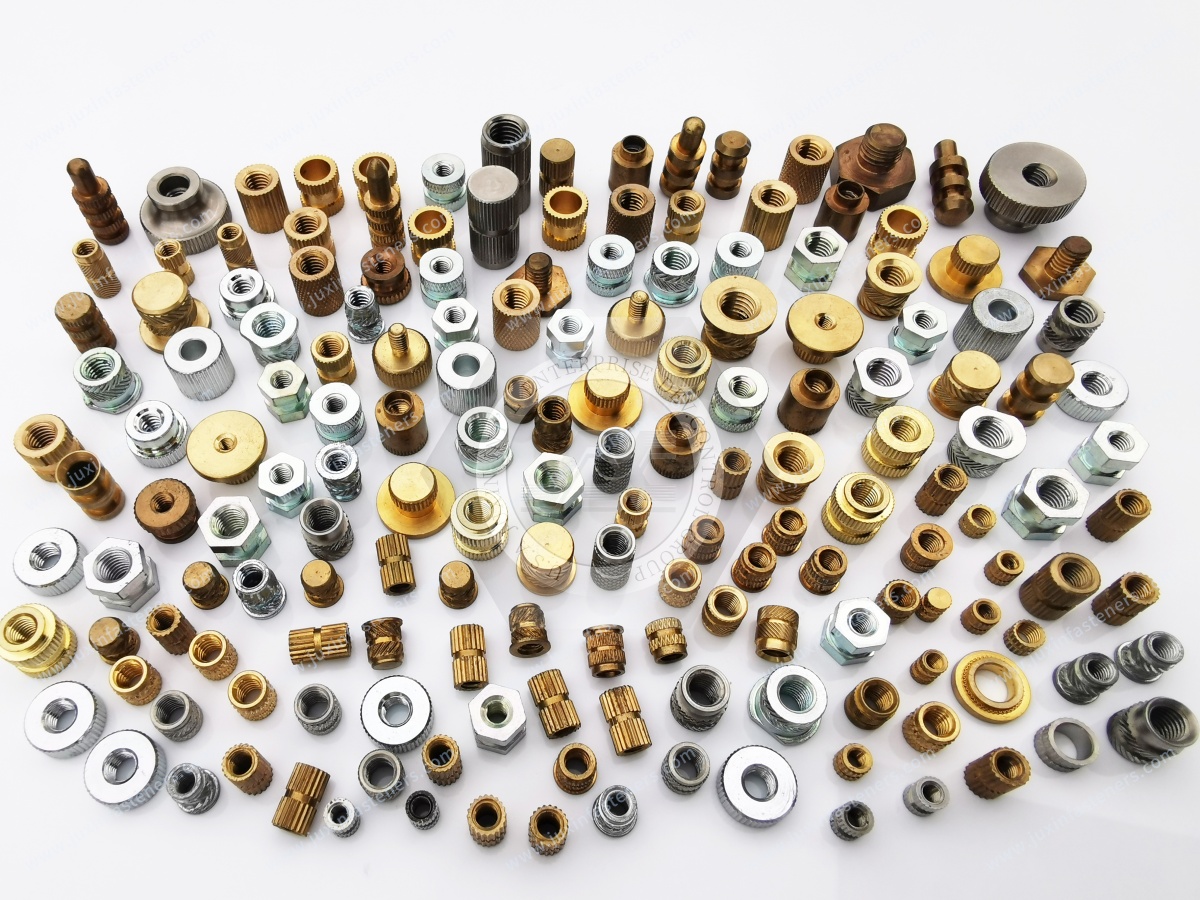
Material selection should be based on the mechanical, environmental and manufacturing requirements of the complete assembly.
Brass insert nuts are widely used for plastic components because brass provides good machinability, practical mechanical performance and useful thermal conductivity.
Brass is commonly considered for:
Electronics
Electrical housings
Automotive plastic components
Telecom equipment
Industrial equipment
Consumer products
It also works well with several insert installation methods, depending on the design.
Stainless steel insert nuts can be selected for applications requiring improved corrosion resistance or higher mechanical performance.
They may be considered for equipment exposed to:
Moisture
Humidity
Chemicals
Outdoor environments
Higher mechanical loads
The specific stainless steel grade should be selected according to the application.
Aluminum insert nuts can be considered when weight reduction is an important design objective.
They can provide a metal threaded interface while helping minimize component weight.
However, the material should be evaluated for the required thread strength, corrosion environment and compatibility with the mating fastener.
The plastic resin is one of the most important variables in insert nut design.
Common injection-molded materials include:
ABS
Polycarbonate (PC)
Polyamide (PA / Nylon)
PBT
POM
PP
PET
PEEK
Glass-filled thermoplastics
Different polymers have different mechanical and thermal properties.
For example, glass-filled nylon generally behaves differently from unfilled nylon during insert installation and service.
Engineers should therefore specify the actual resin grade when developing an OEM insert nut solution.
Different insert nut designs can be installed using different methods.
Heat staking inserts are installed using controlled heat and pressure.
The thermoplastic softens around the insert and then solidifies during cooling.
This method is suitable for many thermoplastic components.
Ultrasonic threaded inserts use high-frequency mechanical vibration to generate localized heat.
The softened polymer flows around the external insert profile before cooling and retaining the insert.
Ultrasonic installation can be attractive for high-volume automated assembly.
Press-in threaded inserts are mechanically pushed into a prepared hole.
The external interference profile creates retention without intentionally heating the plastic.
This can be useful when the plastic can tolerate mechanical interference and a simple post-molding installation process is preferred.
Molded-in threaded inserts are positioned inside the injection mold before plastic injection.
The polymer flows around the insert and integrates it into the finished component.
This approach can reduce secondary installation operations and can be particularly attractive for stable, high-volume OEM production.
For procurement and engineering teams, insert selection should begin with the plastic component and application rather than the insert catalog.
Define:
Metric or inch thread
Thread diameter
Thread pitch
Thread length
Mating screw specification
The insert should be selected together with the actual mating hardware.
The outside diameter determines the required boss and hole geometry.
It must provide sufficient mechanical engagement without creating excessive stress in the plastic.
Insert length affects thread engagement and retention.
The insert should be compatible with the available boss depth.
Knurls, ribs, barbs, grooves and undercuts can be selected according to the required rotational and axial resistance.
The preferred insert geometry depends partly on whether the component will use:
Heat staking
Ultrasonic installation
Press fitting
Injection molding
The resin grade should be specified because material properties can significantly influence installation and retention performance.
The design should establish:
Tightening torque
Pull-out resistance
Torque-out resistance
Repeated assembly requirements
Service temperature
Environmental exposure
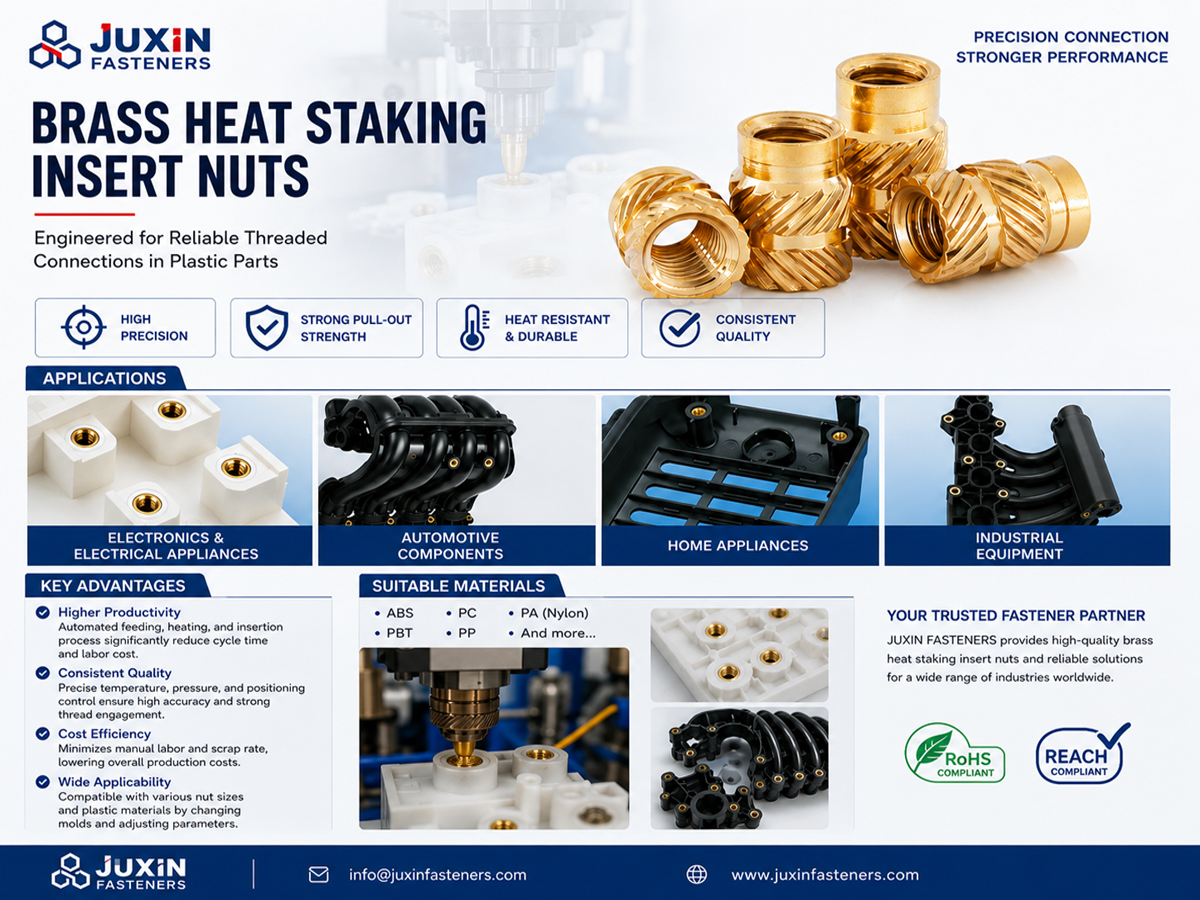
The plastic boss is a critical part of the fastening system.
The boss must provide sufficient polymer around the insert to withstand assembly and service loads.
An undersized boss may crack or deform.
An oversized boss may consume unnecessary material and design space.
Wall thickness affects stress distribution around the insert.
Thin-wall components require careful control of insert dimensions and installation parameters.
The boss should provide sufficient depth for the insert while maintaining adequate structural support.
The insert should be positioned far enough from walls, corners, holes and neighboring bosses to prevent excessive local stress.
This is particularly important for compact electronics and automotive components.
Two important characteristics for plastic insert nuts are pull-out resistance and torque-out resistance.
Pull-out resistance describes how well the insert resists axial removal from the plastic.
It is influenced by:
Insert length
External profile
Boss geometry
Plastic strength
Installation quality
Applied load
Torque-out resistance describes how well the insert resists rotation when the mating screw is tightened.
Knurling, ribs and other anti-rotation features can improve mechanical engagement with the polymer.
For demanding applications, both properties should be validated using production-representative plastic components.
A directly molded plastic thread may be sufficient for simple applications.
However, a metal insert nut can be advantageous when the component requires greater thread durability or repeated assembly.
| Requirement | Direct Plastic Thread | Metal Threaded Insert Nut |
|---|---|---|
| Thread material | Plastic | Metal |
| Wear resistance | Resin dependent | Generally higher |
| Repeated assembly | Application dependent | Well suited to many applications |
| Higher tightening torque | Application dependent | Often advantageous |
| Lightweight component | Yes | Yes |
| Reinforced fastening point | No | Yes |
| OEM production | Possible | Widely used |
The final decision should be based on testing and application requirements.
Automotive manufacturers use injection-molded plastics throughout vehicle systems.
Threaded insert nuts can provide fastening points for:
Electronic modules
Sensor housings
Plastic brackets
Covers
Interior components
Electrical assemblies
Applications should be evaluated for vibration, temperature cycling and long-term service conditions.
Electric vehicles use a growing number of polymer components around electrical and electronic systems.
Threaded insert nuts for EV components may be used in selected housings, covers, electronic modules and supporting plastic assemblies.
Thermal exposure, vibration and mechanical loads should be evaluated during development.
Electrical enclosures often require multiple internal mounting points.
Metal insert nuts can provide reinforced threads for:
PCB mounting
Covers
Brackets
Connectors
Internal modules

Electronic products frequently use compact injection-molded housings.
Threaded insert nuts can provide reliable fastening points while maintaining lightweight construction.
Telecom products use plastic housings and internal mounting structures.
Insert nuts can support the attachment of internal modules, brackets and covers.
Industrial equipment may use plastic control panels, protective covers and housings.
Threaded inserts can provide durable screw connections for components that require maintenance or repeated assembly.
Robotic systems use lightweight plastic components around sensors, controllers and mechanical assemblies.
Insert nuts can provide reinforced mounting points without replacing the plastic component with a heavier metal structure.
Plastic housings, control components and covers used in HVAC systems may require reliable screw connections.
Insert nuts can provide metal fastening points where the polymer alone does not provide the desired thread durability.
Medical and laboratory equipment can use engineered thermoplastic housings and structural components.
Material selection should consider cleaning agents, temperature, corrosion and other application-specific requirements.
For OEM production, insert nut selection should be finalized together with the plastic component design.
A professional specification should include:
Thread size
Thread standard
Insert outside diameter
Insert length
External profile
Flange requirements
Material
Surface treatment
Plastic resin
Boss dimensions
Installation method
Required torque
Pull-out requirement
Torque-out requirement
Annual production volume
This information allows the supplier to evaluate the actual fastening application rather than quoting a generic insert nut.
Standard insert nuts may not always match an OEM plastic component.
A custom threaded insert nut can be developed around the component drawing and production process.
Customization may include:
Custom outside diameter
Custom length
Custom thread
Metric thread
Inch thread
Special knurling
Ribbed profiles
Barbed profiles
Undercuts
Flanges
Blind-end designs
Through-hole designs
Brass
Stainless steel
Aluminum
Special tolerances
Surface treatments
For custom projects, supplying the plastic component drawing is highly recommended.
The insert supplier can evaluate the insert geometry together with the boss, resin and installation process.
For procurement managers and supply chain teams, sourcing should consider the complete cost and performance of the fastening solution.
When requesting quotations, provide:
Plastic resin and grade
Component drawing
Boss dimensions
Thread specification
Insert dimensions
External profile requirement
Material requirement
Surface treatment
Installation method
Required torque
Pull-out requirement
Annual quantity
Packaging requirements
A detailed RFQ helps reduce the risk of receiving a threaded insert with the correct thread but an unsuitable external geometry or installation method.
JUXIN Fasteners supports OEM and industrial customers sourcing threaded insert nuts for injection molded plastic components.
Our solutions can support applications across:
Automotive
EV
Automotive electronics
Electrical equipment
Electronics
Telecom
Industrial machinery
Robotics
HVAC
Medical equipment
OEM plastic assemblies
For custom requirements, customers can provide engineering drawings, samples or application specifications for evaluation.
The insert selection can be considered as a complete system:
Plastic resin + boss design + insert geometry + installation method + thread requirement + mechanical performance
This application-based approach helps procurement and engineering teams identify an appropriate fastening solution for production.
If you are sourcing threaded insert nuts, plastic insert nuts, brass insert nuts, knurled insert nuts, flanged insert nuts or custom OEM threaded inserts, contact JUXIN Fasteners.
For faster technical evaluation, please provide:
Plastic resin and grade
Component drawing
Boss dimensions
Thread size and standard
Insert dimensions
External profile
Material requirement
Surface treatment
Installation method
Required torque
Pull-out requirement
Estimated annual quantity
JUXIN Fasteners supports OEM and industrial fastening requirements from product specification through production supply.
JUXIN Fasteners
23+ Years of Fastener Industry Experience
OEM & Industrial Fastening Solutions
Email: info@juxinfasteners.com
Website: www.juxinfasteners.com
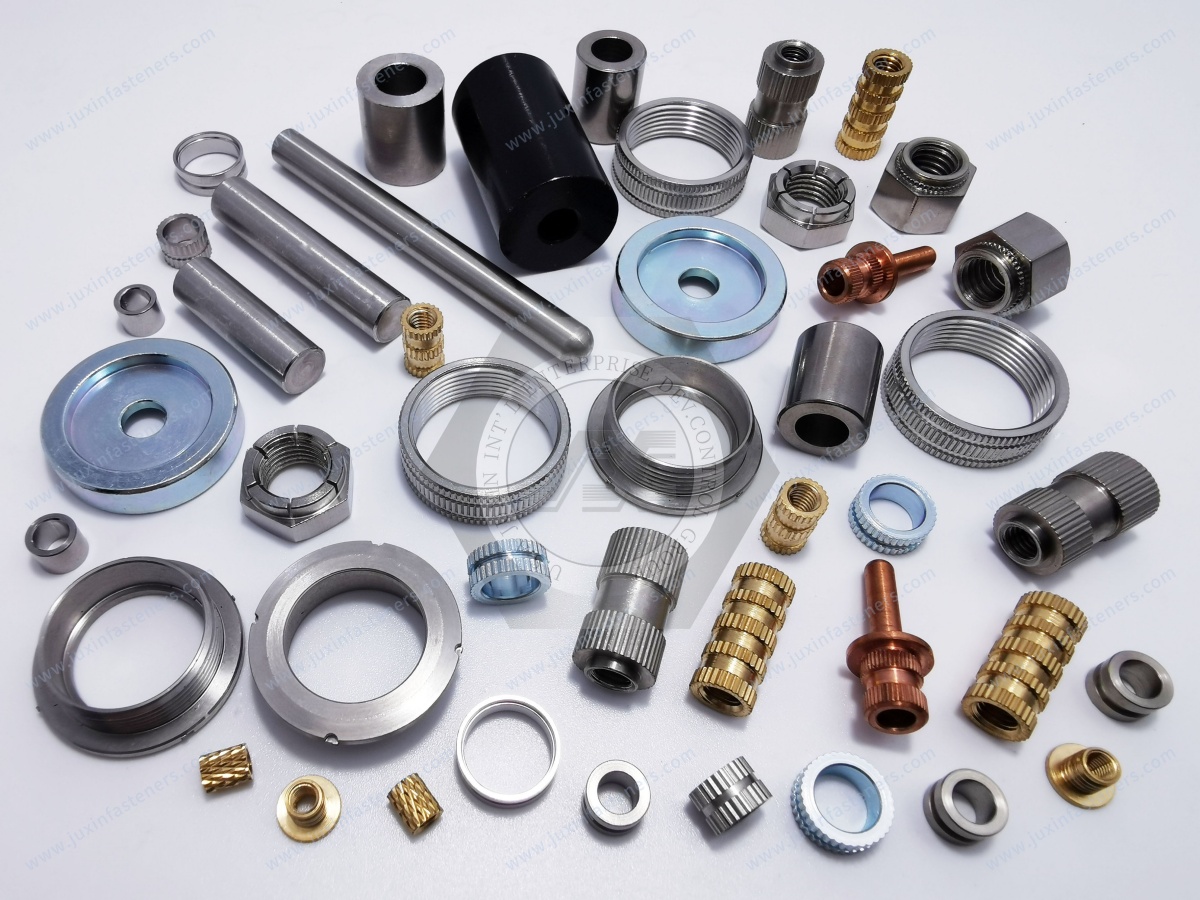
Threaded insert nuts are used to create reinforced metal fastening points inside plastic and composite components.
They are particularly useful when a plastic component requires durable or repeatedly used screw threads.
Yes. Threaded insert nuts can be used in injection-molded plastic components through heat staking, ultrasonic insertion, press fitting or direct insert molding, depending on the design.
Brass is widely used because it offers good machinability, practical mechanical performance and suitable characteristics for many insert installation processes.
Stainless steel and aluminum can be selected for specific applications.
Both use external geometry to improve mechanical engagement with plastic.
Knurling provides a patterned anti-rotation surface, while ribs provide raised external features that can increase mechanical retention.
Yes. Heat-set, ultrasonic and press-in insert nuts can be installed after molding. Molded-in insert nuts are integrated during the injection-molding process.
They can be used in selected automotive and EV plastic components, including electronic housings, sensor assemblies, covers and mounting components.
The complete assembly should be validated for temperature, vibration and mechanical loads.
JUXIN Fasteners supports custom OEM threaded insert requirements based on drawings, samples and application specifications.
Customization can include dimensions, thread, external profile, material and other requirements.
The most useful information includes the plastic resin and grade, component drawing, boss dimensions, thread specification,
insert dimensions, external profile, installation method, required torque, pull-out requirement and annual production volume.
Contact Us
Tel.:
+86 020 8621 0320
+86 020 3121 6067
E-mail:
Technical Support:
Navigation
SEND INQUIREY



