
Call Us
+86 136 6007 9809
Call Us
+86 136 6007 9809

Sep. 14, 2026
When industrial facilities, commercial buildings, equipment platforms, mezzanines, structural modifications, and facade systems require connections to existing concrete,
engineers often need to select a suitable post-installed anchoring system.
Unlike cast-in-place anchors that are positioned before concrete is placed, post-installed anchors are installed into hardened concrete after construction.
The connection therefore depends not only on the strength of the steel component, but also on the interaction between the anchor and the concrete substrate,
the installation process, the anchor layout, and the design requirements.
Two important categories are mechanical undercut anchors and adhesive anchoring systems.
They use fundamentally different load-transfer mechanisms and have different installation considerations.
For engineering and procurement teams, the key question is not simply which anchor is “stronger.” The more useful question is:
Which anchoring system is appropriate for the substrate, load, installation conditions, temperature environment, geometry, and applicable design requirements?
This guide compares undercut mechanical anchors and chemical or adhesive anchors, explains the engineering factors that influence their performance, and highlights sourcing considerations for industrial projects.
Post-installed anchors are fastening systems installed into hardened concrete after the concrete has already been formed and cured.
They can be used for applications such as:
Structural steel attachments
Equipment bases
Industrial platforms
Mezzanine components
Machinery supports
Handrails and barriers
Building services
Facade support systems
Retrofit construction
Equipment replacement or modification
Other engineered concrete connections
Depending on the product design, post-installed anchors can transfer loads through different mechanisms.
Common systems include:
Mechanical expansion anchors
Undercut mechanical anchors
Adhesive or chemical anchors
Other specialized post-installed anchoring systems
The selection should be based on the actual application and the design requirements.
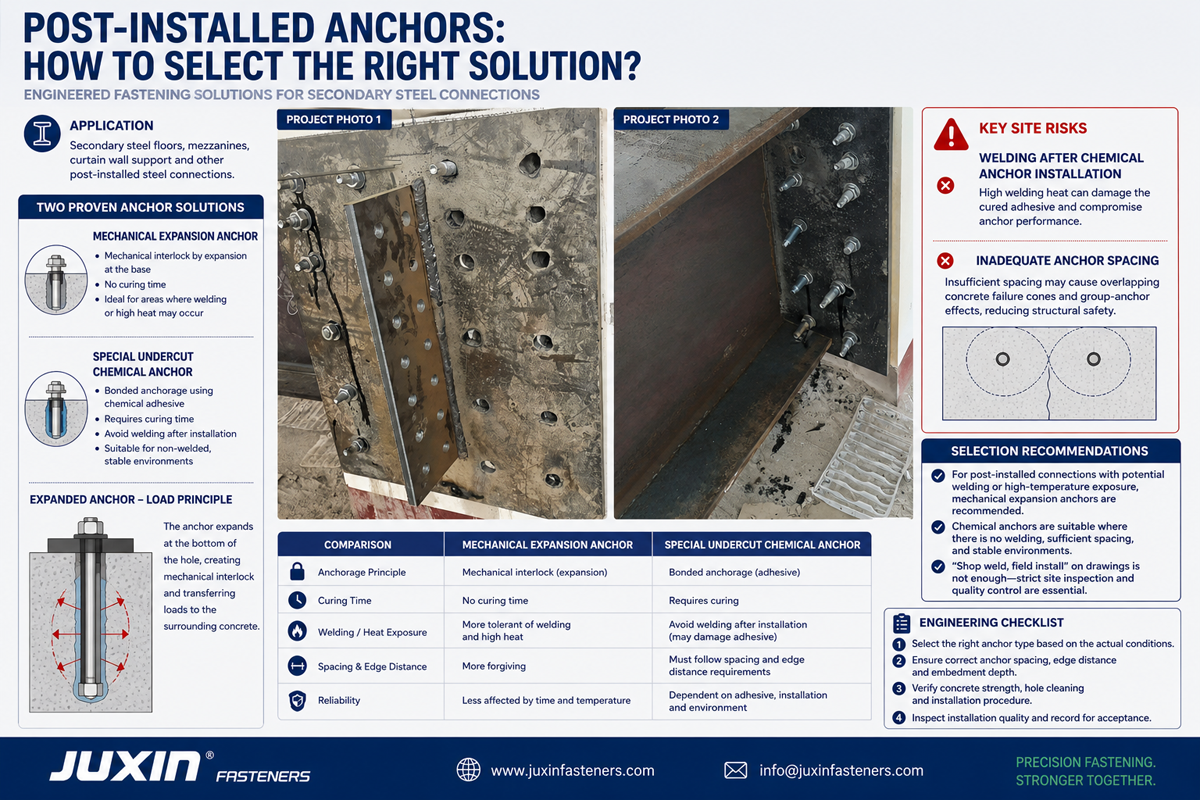
Undercut mechanical anchors are designed to create a mechanical interlock with the concrete substrate.
Unlike a conventional expansion anchor that primarily develops resistance through expansion against the hole wall, an undercut anchor engages a specifically formed undercut region in the concrete.
The anchor therefore transfers load through mechanical interaction between the steel anchor and the surrounding concrete.
A typical undercut anchoring system involves:
Drilling a hole into the concrete
Creating the specified undercut geometry
Cleaning the hole according to the manufacturer's installation procedure
Installing the anchor
Activating the mechanical locking mechanism
Applying the specified installation condition
The exact installation sequence depends on the anchor design.
The important engineering characteristic is that the anchor engages a defined concrete geometry rather than relying solely on friction generated by conventional expansion.
Depending on the anchor and design condition, loads can include:
Tension
Shear
Combined tension and shear
Concrete failure modes can also be important, including concrete breakout and other substrate-related failure mechanisms.
The design capacity therefore cannot be determined from anchor steel strength alone.
Chemical anchors, more precisely referred to in many engineering contexts as adhesive anchors, use a resin-based adhesive system to bond an anchor element into a drilled hole.
The anchor element may be a threaded rod or another approved steel component.
Common adhesive technologies include epoxy, vinylester, and polyester-based systems, although the appropriate chemistry depends on the specific product.
A typical adhesive anchoring installation may involve:
Drilling the hole to the specified diameter and depth
Cleaning the hole according to the adhesive manufacturer's procedure
Injecting or placing the specified adhesive
Installing the threaded rod or anchor element
Maintaining the required installation position
Allowing the adhesive to cure
Applying the specified load after the required curing condition has been reached
Hole cleaning is particularly important because dust and debris can affect the bond between the adhesive system and concrete.
The manufacturer's installation instructions should therefore be treated as part of the anchoring system rather than as an optional construction detail.
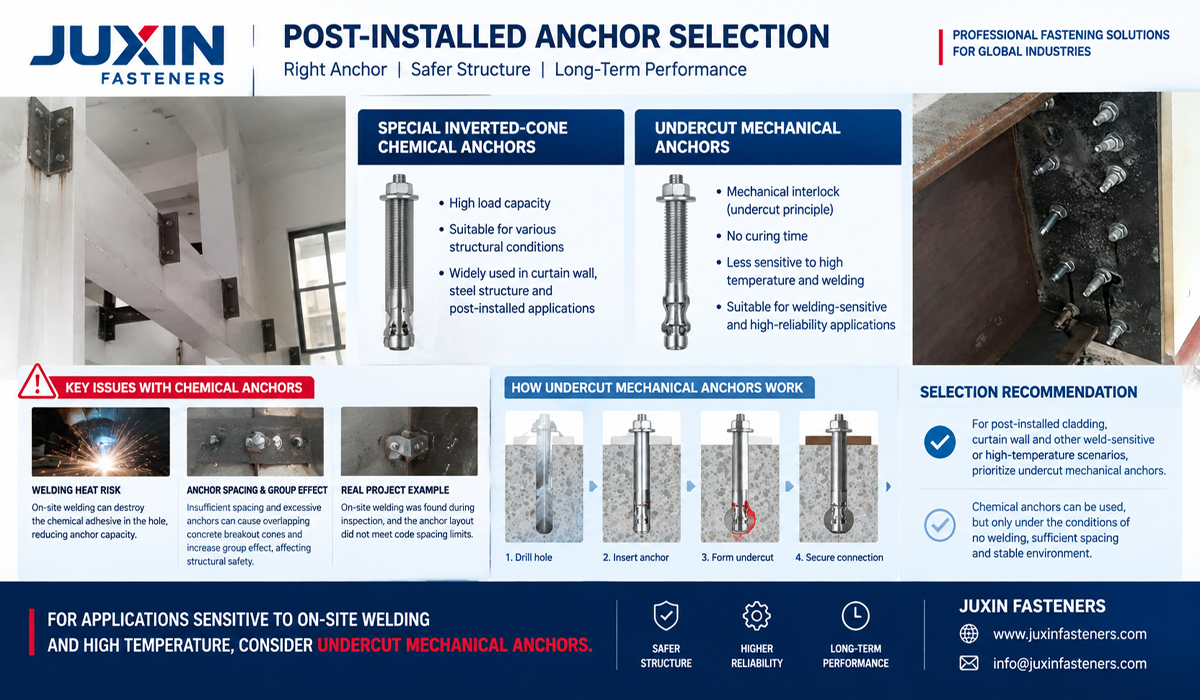
The fundamental difference between the two systems is their primary load-transfer mechanism.
The anchor engages a mechanically formed undercut in the concrete.
The design therefore relies heavily on:
Anchor geometry
Concrete geometry
Embedment
Concrete strength
Edge distance
Anchor spacing
Steel strength
Installation quality
The anchor element is bonded into the drilled hole through an approved adhesive system.
Performance depends on:
Anchor diameter
Embedment depth
Hole diameter
Hole cleaning
Adhesive type
Concrete condition
Installation temperature
Curing conditions
Edge distance
Anchor spacing
Steel strength
Applied loading
Neither mechanism should automatically be described as universally superior.
The correct selection depends on the complete connection design.
One of the more practical issues in industrial retrofit work is the relationship between post-installed anchors and nearby welding.
A drawing may specify that a baseplate or structural component is welded in the factory and then bolted or anchored during site installation. However, construction conditions can sometimes lead to additional field welding.
This creates a potential thermal issue for adhesive anchoring systems.
Adhesive systems have specified installation and service temperature ranges.
If an anchor element is exposed to excessive heat, the temperature of the steel and surrounding adhesive can exceed the limits for which the adhesive system was qualified.
The actual temperature reached by the adhesive depends on factors such as:
Welding current and duration
Weld location
Baseplate thickness
Anchor geometry
Steel thermal conductivity
Distance from the weld
Heat dissipation
Ambient conditions
Welding sequence
Therefore, it is not technically correct to state that every welding operation automatically destroys every chemical anchor.
The correct engineering question is whether the temperature at the adhesive and anchor system remains within the manufacturer's approved limits for the specific product and application.
If field welding may occur close to a post-installed adhesive anchor, the issue should be identified during engineering review rather than discovered after installation.
Possible approaches may include:
Completing welding before anchor installation
Relocating the anchor
Controlling the welding sequence
Establishing a suitable thermal limit
Selecting a fastening system appropriate for the installation sequence
Following the anchor manufacturer's technical requirements
For safety-critical applications, the engineer should determine the acceptable solution based on the project design and product documentation.
Mechanical undercut anchors do not rely on a cured adhesive resin for their primary mechanical interlock.
This removes one particular adhesive-related temperature limitation.
However, it would be incorrect to describe mechanical anchors as completely unaffected by high temperature.
Steel mechanical properties can change with temperature, and the surrounding concrete also has temperature-dependent behavior.
Therefore, if a connection is exposed to substantial heat, the complete system still needs to be evaluated.
The engineering advantage of an undercut mechanical system in a welding-sensitive application is more specifically that it does not have the same adhesive-cure or resin-degradation mechanism as an adhesive anchor.
That is a more useful and technically defensible distinction than simply calling mechanical anchors “heat resistant.”
Another important engineering issue is anchor group behavior.
When several anchors are installed close together, their individual zones of influence within the concrete can overlap.
This can affect the capacity of the group compared with isolated-anchor behavior.
Engineers may need to consider:
Anchor-to-anchor spacing
Edge distance
Embedment depth
Concrete thickness
Load direction
Anchor group geometry
Concrete cracking condition
Baseplate dimensions
Load distribution
For tension loading, concrete breakout can be an important failure mode.
When anchors are positioned close together, the concrete failure surfaces associated with individual anchors can interact.
The resulting group capacity therefore cannot simply be calculated by multiplying the capacity of one anchor by the number of anchors.
Anchor placement near a concrete edge can also change the available concrete resistance.
A small edge distance may increase the possibility of concrete edge failure or other substrate-related failure modes.
For this reason, anchor spacing and edge distance should be established during design rather than adjusted casually during installation.
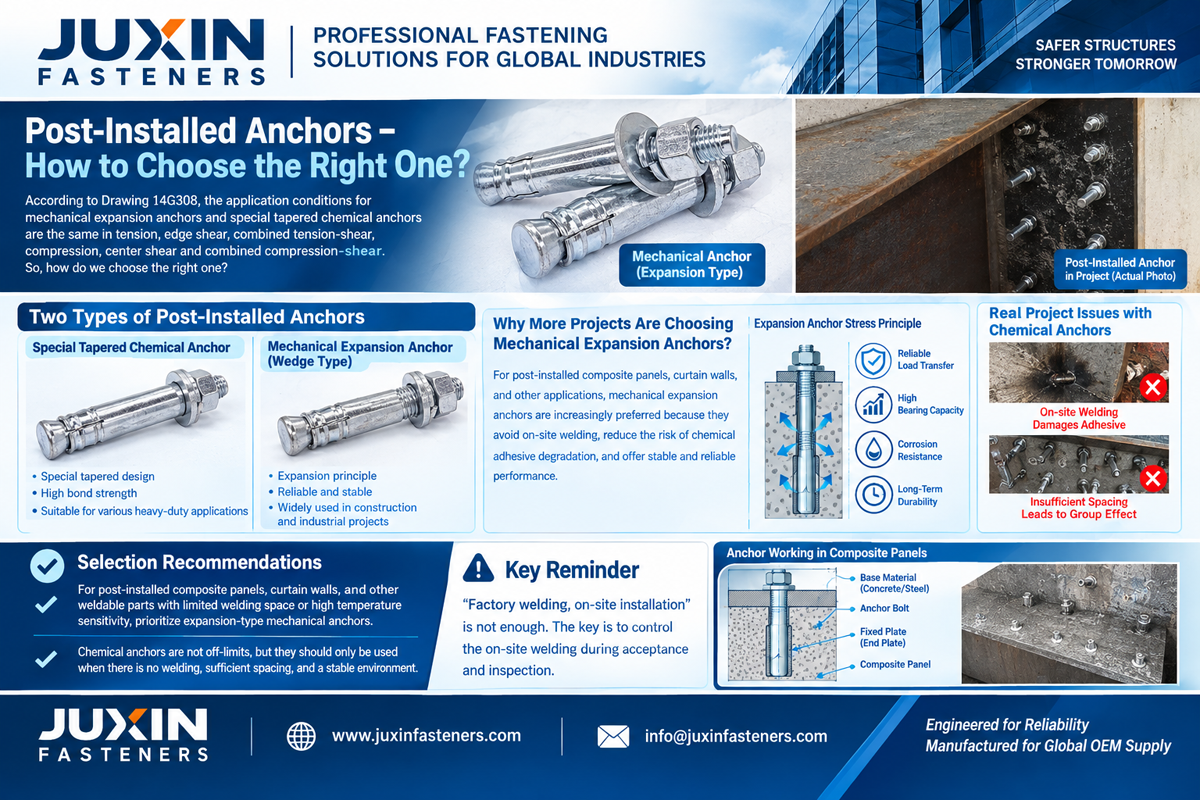
Concrete condition is another important selection parameter.
Some anchoring products are qualified for use in cracked concrete, while others may have more limited application conditions.
Concrete cracking can influence the way loads are transferred around the anchor and can affect the available design resistance.
Engineers should therefore determine:
Whether the concrete is expected to be cracked
The relevant concrete strength
Concrete member thickness
Reinforcement arrangement
Environmental exposure
Required anchor performance
Applicable approval or design method
The anchor manufacturer's published technical data should be checked against the actual project conditions.
| Evaluation Parameter | Undercut Mechanical Anchors | Chemical / Adhesive Anchors |
|---|---|---|
| Primary Load-Transfer Mechanism | Mechanical interlock with an undercut concrete profile | Adhesive bond between anchor element, adhesive and substrate |
| Installation Process | Requires controlled drilling and formation of the specified undercut | Requires drilling, thorough hole cleaning, adhesive installation and curing |
| Curing Requirement | No adhesive curing step | Adhesive must reach the specified curing condition before loading |
| Temperature Consideration | No adhesive-resin curing mechanism, but steel and concrete temperature limits still apply | Adhesive installation and service temperature limits must be observed |
| Field Welding Consideration | Avoid assuming unlimited temperature resistance; evaluate the complete connection | Welding heat near the anchor requires specific thermal evaluation |
| Hole Preparation | Requires correct hole geometry and installation procedure | Hole diameter, depth and cleaning are particularly important |
| Concrete Cracking | Depends on product qualification and design method | Depends on adhesive system qualification and design method |
| Group Anchor Behavior | Influenced by spacing, edge distance, embedment and concrete failure modes | Influenced by spacing, edge distance, embedment, adhesive behavior and concrete failure modes |
| Typical Engineering Use | Structural and industrial connections where mechanical interlock is advantageous | Structural and industrial connections where an approved adhesive anchoring system is appropriate |
The table is a technical comparison framework rather than a universal product-selection rule.
An undercut mechanical anchor may be considered when the project requires a mechanical interlock system and the product is suitable for the substrate and loading conditions.
Potential considerations include:
A defined mechanical locking mechanism is preferred
Adhesive curing is undesirable or impractical
Installation sequencing makes adhesive curing difficult
Temperature exposure needs to be considered carefully
The application requires a particular approved undercut anchoring system
The design has limited tolerance for adhesive-related installation variables
However, the engineer should still verify the specific product's design data, installation procedure, concrete condition, edge distance and spacing requirements.
Adhesive anchoring systems may be attractive when the application benefits from a bonded anchor element and the installation conditions can be controlled.
Potential considerations include:
The required embedment geometry is suitable for an adhesive system
A threaded rod or reinforcing element needs to be installed into existing concrete
The project requires a qualified adhesive anchoring system
The installation team can follow the required hole-cleaning and curing procedures
The temperature range is compatible with the selected adhesive
The application requires a post-installed solution for an existing structure
Adhesive anchors are also widely used for certain retrofit and reinforcement applications, subject to the specific product approval and engineering design.
Industrial mezzanines and equipment platforms often create multiple design requirements simultaneously.
A typical connection may involve:
Steel column
Baseplate
Concrete slab or foundation
Multiple anchors
Steel framing
Applied vertical loads
Horizontal loads
Equipment vibration
Construction tolerances
The anchor selection should therefore be considered as part of the complete structural connection.
For example, simply selecting an anchor with a high tensile steel capacity does not guarantee that the concrete connection will have sufficient capacity.
The engineer may need to check:
Steel failure
Concrete breakout
Pull-out
Concrete edge failure
Pry-out
Shear-related failure
Combined tension and shear
Anchor group effects
The applicable design method should determine which failure modes need to be evaluated.
Facade and exterior support systems introduce additional environmental considerations.
Depending on the project, engineers may need to consider:
Moisture
Temperature variation
Freeze-thaw exposure
Corrosion
Concrete condition
Long-term loading
Installation environment
Inspection access
Corrosion protection should be specified according to the exposure environment and project requirements.
Potential materials or coatings may include:
Zinc-based protective coatings
Hot-dip galvanized systems
Stainless steel
Other approved corrosion-resistant systems
The exact material and finish should be selected based on the environment, structural requirements and applicable product specification.
It is not appropriate to assume that one coating or stainless-steel grade is suitable for every exterior application.
Post-installed anchoring is not governed by one universal international standard covering every product and every application.
The relevant design and qualification requirements depend on the market, substrate, anchor type, structural application and project specification.
European projects may reference EN 1992-4, which provides design provisions for fastenings for use in concrete.
In the United States, concrete anchoring provisions may be addressed through ACI 318, including provisions for anchoring to concrete, together with applicable product evaluation requirements.
Other projects may reference ASTM standards, manufacturer-specific approvals, national regulations, or project-specific specifications.
This distinction is important for procurement.
A supplier should not simply state that an anchor is “ISO/DIN/ASTM compliant” without identifying which product requirement, test method, material standard, or design requirement is actually being referenced.
Procurement teams sourcing anchoring systems should focus on technical equivalence rather than product names alone.
Useful information to review includes:
Confirm whether the quotation is for:
Undercut mechanical anchor
Expansion anchor
Adhesive anchor
Threaded rod
Anchor assembly
Other specified anchoring component
Review:
Anchor diameter
Overall length
Thread size
Embedment
Fixture thickness
Required hole diameter
Required hole depth
Confirm the specified steel grade or material designation where required.
For stainless-steel anchors, the applicable stainless fastener or product specification should be clearly identified rather than relying only on terms such as “316 equivalent.”
Confirm:
Base material
Coating
Coating thickness where specified
Environmental requirements
Applicable corrosion-resistance specification
For mechanical anchors, this may include:
Hole diameter
Hole depth
Installation method
Installation torque
Setting procedure
For adhesive anchors, this may include:
Hole diameter
Hole depth
Cleaning procedure
Adhesive type
Mixing or injection procedure
Cure time
Installation temperature
Service temperature
Depending on the project, procurement may require:
Material certificates
Certificate of conformity
Product technical data
Installation instructions
Test documentation
Product approvals
Inspection records
The exact documentation should be agreed according to the project.
Two quotations may both state “M16 concrete anchor” while representing substantially different products.
For example, one supplier may quote:
Mechanical undercut anchor
Stainless steel
Specific embedment
Approved for cracked concrete
while another supplier may quote:
Adhesive anchor
Carbon steel
Different embedment
Different temperature range
These are not automatically equivalent products.
Procurement teams should therefore compare:
Anchor type
Material
Diameter
Embedment
Installation method
Concrete condition
Approval or qualification
Corrosion protection
Quantity
Packaging
Lead time
Documentation
Commercial terms
Technical equivalence should be established before comparing unit price.
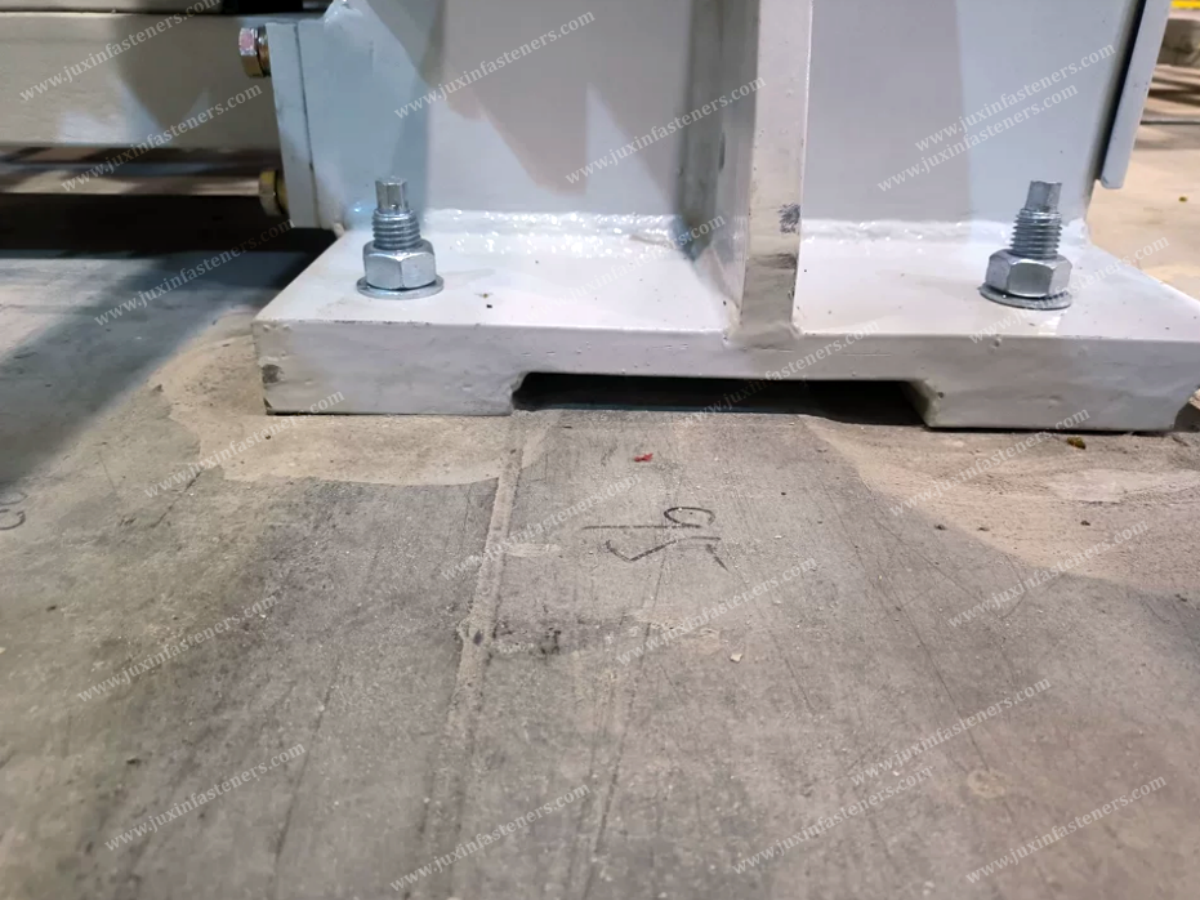
Post-installed anchors belong primarily to the structural anchoring field.
By comparison, many OEM manufacturing projects require custom threaded components that connect metal parts to each other rather than anchoring a structure into concrete.
These applications can include:
Custom screws
Custom bolts
Special nuts
Custom washers
Self-clinching fasteners
Weld nuts
Weld studs
Rivet nuts
Clips and retainers
Plastic and nylon fastening hardware
CNC machined threaded components
The engineering requirements may still involve many of the same principles:
Load
Material
Thread
Geometry
Assembly method
Surface finish
Tolerance
Environment
Production quantity
This is where the distinction between structural anchoring and OEM fastening components becomes important during sourcing.
For OEM applications, a drawing is often the most effective starting point for a custom fastener quotation.
A useful drawing may identify:
Part number
Thread
Diameter
Length
Head configuration
Special geometry
Material
Mechanical requirements
Surface finish
Critical tolerances
Inspection requirements
Revision level
A 3D CAD model can supplement the drawing where complex geometry is involved.
If the customer does not yet have a complete drawing, a supplier may still be able to begin a technical discussion from a sample, photograph, or basic dimensions, depending on the part.
The final production specification should be confirmed before manufacturing.
The steel tensile capacity is only one part of an anchoring system.
Concrete failure, edge distance, embedment, spacing and load direction can all affect the connection.
Adhesive anchors can be highly effective when correctly specified and installed, but they also introduce hole-cleaning, curing and temperature considerations.
Mechanical anchors do not rely on adhesive resin, but steel and concrete still have temperature-dependent properties.
If welding may occur near an installed anchor, the thermal effect should be reviewed before construction.
Multiple anchors cannot always be treated as independent individual anchors.
Spacing, edge distance and concrete failure mechanisms need to be considered.
Nominal diameter alone does not define a complete anchoring system.
A lower unit price may correspond to a different material, anchor mechanism, embedment, approval, installation method or corrosion protection system.
For an engineered anchoring project, a practical workflow can be:
Application Definition → Load Assessment → Substrate Review → Anchor Type Selection → Layout Design → Product Qualification → Installation Planning → Technical RFQ → Quotation Comparison → Procurement → Installation Inspection
For OEM fastening components, the workflow may instead be:
Drawing/CAD/Sample → Technical Clarification → Feasibility Review → Quotation → Sample/Prototype → Validation → Production
Understanding which workflow applies prevents structural anchoring products from being mixed with conventional OEM fasteners during sourcing.
An engineering or procurement inquiry does not always need to begin with a complete specification.
Depending on the project stage, useful starting information may include:
Part number
Drawing
CAD file
Sample
Photograph
Basic dimensions
Material, if known
Thread specification
Surface finish, if known
Quantity or estimated quantity
Application
Required timing
If some information has not yet been finalized, it can simply be identified as open for clarification.
This is particularly useful for custom fasteners because suppliers can review the available information first and then identify the specific technical points that need confirmation.
JUXIN FASTENERS focuses on industrial and OEM fastening components, including custom and non-standard products developed according to customer drawings, specifications, samples, or application requirements.
Product categories include:
Custom screws
Custom bolts
Custom nuts
Custom washers
Self-clinching fasteners
Weld nuts
Weld studs
Rivet nuts
Blind rivets
Clips and retainers
Plastic and nylon fastening hardware
CNC machined fasteners and components
Stainless steel fasteners
High-strength fasteners
These components can support applications across automotive, EV-related assemblies, sheet metal, machinery, electrical equipment, HVAC, rail transit, construction equipment, robotics, and other industrial systems.
For projects involving concrete anchoring, the anchor system itself should be specified and qualified according to the applicable structural requirements.
For projects involving custom threaded components, JUXIN FASTENERS can review available drawings, CAD files, samples, photographs, dimensions, and other technical information to discuss the appropriate sourcing route.
Post-installed anchors are engineered systems rather than generic threaded fasteners.
Undercut mechanical anchors and chemical or adhesive anchors use different load-transfer mechanisms and therefore have different installation and design considerations.
The most important selection factors include:
Load type
Concrete condition
Concrete strength
Anchor diameter
Embedment depth
Edge distance
Anchor spacing
Anchor group configuration
Installation method
Temperature
Corrosion environment
Applicable approvals
Design standard
Inspection requirements
For undercut mechanical anchors, mechanical interlock is the defining feature.
For adhesive anchors, the bond between the anchor element, adhesive and substrate is central to performance, making hole preparation, adhesive selection, curing and temperature control important.
Field welding near installed anchors should be evaluated as part of the installation sequence rather than treated as an afterthought.
For procurement, the objective should be to compare technically equivalent systems rather than simply compare nominal diameter or unit price.
For OEM manufacturing applications, the requirement may instead be a custom screw, bolt, nut, washer, self-clinching fastener, weld fastener, rivet nut, clip, retainer, or other threaded component.
In those cases, drawing-based or sample-based sourcing provides a practical route from engineering requirement to production.
Post-installed anchors are fastening systems installed into hardened concrete after the concrete has been formed and cured.
Depending on the product, load transfer may occur through mechanical expansion, mechanical undercut interlock, adhesive bonding, or another engineered mechanism.
An undercut mechanical anchor develops resistance through mechanical engagement with a specifically formed undercut in the concrete.
A chemical or adhesive anchor bonds a threaded rod or other anchor element into a drilled hole using a qualified adhesive system.
Neither system is universally better.
Selection depends on the concrete condition, load, embedment, edge distance, spacing, installation sequence, temperature, environment, applicable approvals and design requirements.
Yes. Welding near an adhesive anchor can introduce significant heat into the baseplate, anchor steel and surrounding adhesive.
Whether the installation remains acceptable depends on the actual temperature reached and the allowable temperature range of the specific adhesive system.
Field welding should therefore be evaluated against the manufacturer's technical requirements and project design.
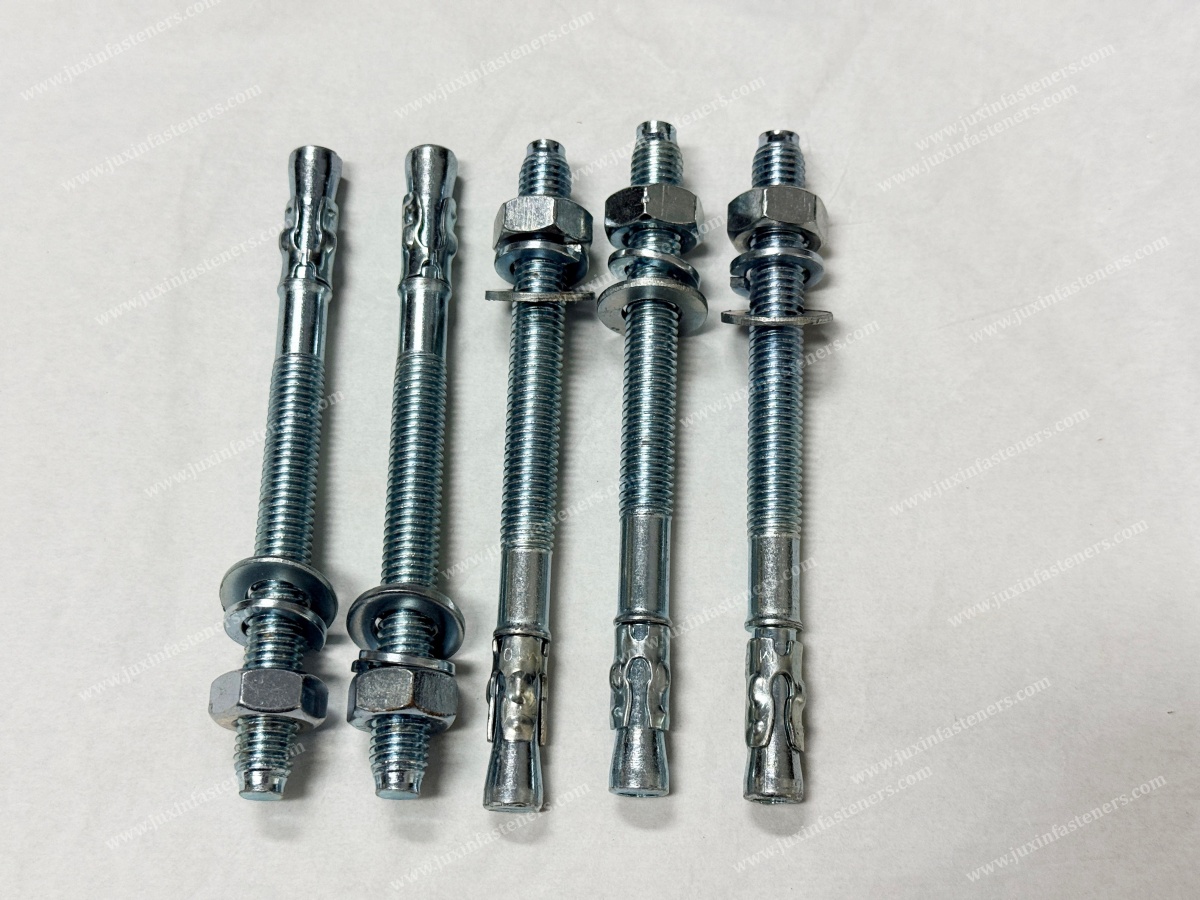
No anchor system should be described as completely unaffected by heat.
Undercut mechanical anchors do not rely on adhesive resin, which removes one specific adhesive-related thermal concern.
However, the steel anchor and surrounding concrete still have temperature-dependent properties.
Closely spaced anchors can interact through the surrounding concrete. Their concrete failure surfaces may overlap, meaning the group capacity may not equal the sum of the capacities of individual isolated anchors.
Spacing, edge distance, embedment, load direction and concrete condition should therefore be considered in the design.
Both can be important.
The connection may fail through the steel anchor or through the surrounding concrete.
Potential concrete failure modes include breakout, pull-out, edge-related failure and other mechanisms depending on the anchor system and loading.
The applicable standard depends on the market, anchor type and project.
European projects may use EN 1992-4 for the design of fastenings in concrete. U.S.
projects may use provisions such as ACI 318 for anchoring to concrete, together with applicable product evaluation requirements.
The exact design and qualification requirements should be identified for the specific project.
They can be used for suitable engineered connections, provided that the selected anchor system is appropriate for the substrate, loads, geometry, installation conditions and applicable design requirements.
The complete connection should be designed rather than selecting the anchor by nominal diameter alone.
Post-installed anchoring systems can be used in various facade and exterior applications when the selected product and installation method are qualified for the specific substrate, environmental exposure, loads and design requirements.
Useful starting information can include a drawing, CAD model, sample, photograph, part number, basic dimensions, material, thread specification, finish, quantity and application.
Not every project has all of this information at the beginning. The available information can be reviewed first, with open technical points clarified before final quotation or production.
For engineered industrial projects, the correct fastening solution begins with understanding the actual connection rather than selecting a product by name alone.
JUXIN FASTENERS supports OEM and industrial sourcing for custom screws, bolts, nuts, washers, self-clinching fasteners, weld fasteners, rivet nuts, clips, retainers, plastic and nylon fastening hardware, and other custom fastening components.
If you have a drawing, CAD file, sample, photograph, or existing specification, you can start with the information currently available.
Our team can review the requirement, clarify open technical points, and discuss a suitable quotation route for custom industrial fasteners and threaded components.
Email: info@juxinfasteners.com
Website: www.juxinfasteners.com
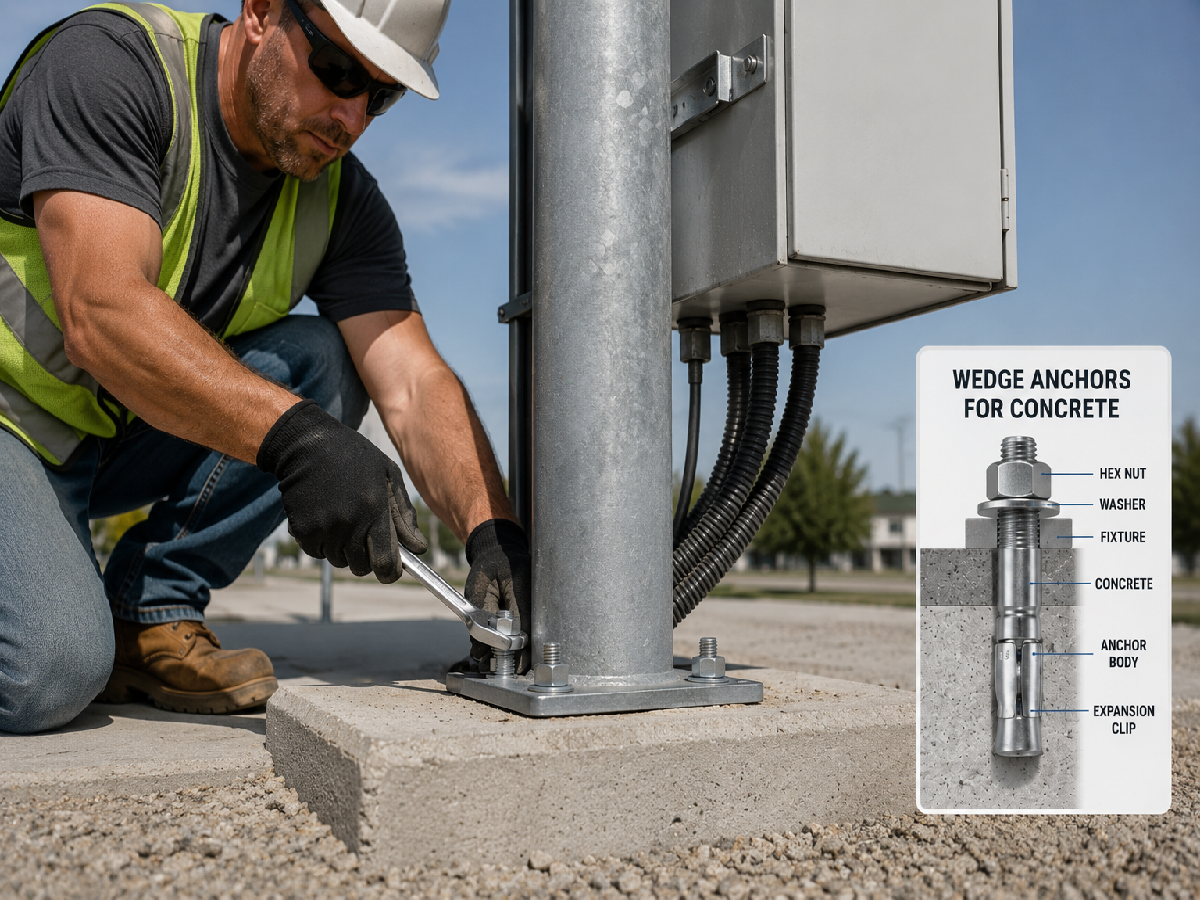
 MORE NEWS
Sep. 14, 2026
Sep. 13, 2026
Contact Us
Tel.:
+86 020 8621 0320
+86 020 3121 6067
E-mail:
Technical Support:
Navigation
SEND INQUIREY