
Call Us
+86 136 6007 9809
Call Us
+86 136 6007 9809

Sep. 14, 2026
In heavy metallurgical operations, steelmaking equipment, large machinery, and other demanding industrial systems, mechanical fastening assemblies can operate under high static loads,
cyclic loading, vibration, thermal cycling, and difficult maintenance conditions.
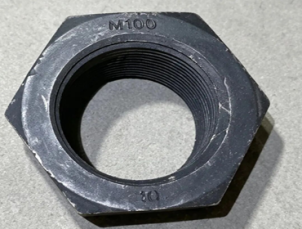
Large-diameter threaded components such as heavy-duty M100 nuts may be used where substantial clamping forces and large structural interfaces require a correspondingly large threaded connection.
In applications such as converter or AOD furnace support systems, trunnion assemblies, heavy machinery, mining equipment, and large industrial foundations,
the fastening system must be designed around the complete joint rather than the nut alone.
The engineering challenge is not simply selecting a larger nut. Engineers must consider thread geometry, mating bolt or stud design, material and mechanical properties,
preload, locking method, environmental conditions, installation access, inspection, and long-term maintenance.
This guide explains the engineering considerations behind heavy-duty M100 nuts, large-diameter industrial nuts, custom threaded components,
and vibration-resistant locking arrangements, while also providing a practical sourcing framework for OEMs, plant engineers, procurement teams, and industrial equipment manufacturers.
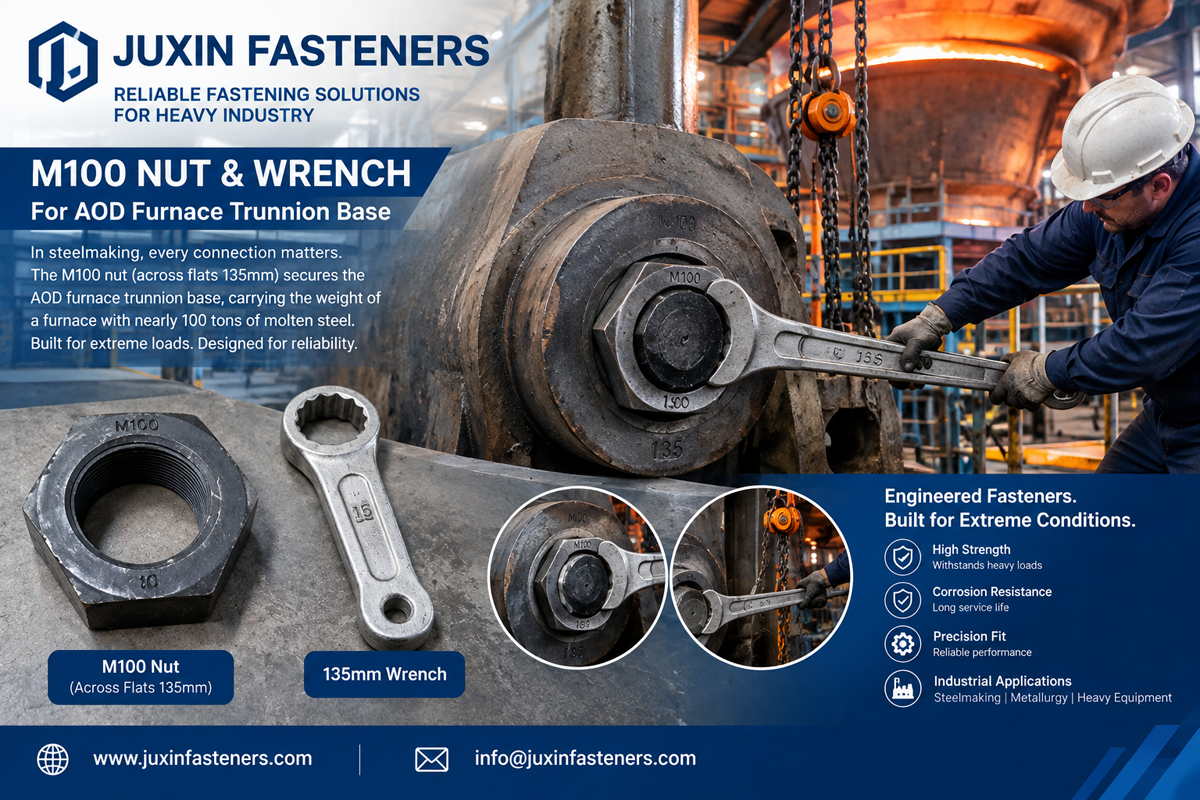
Large industrial equipment creates fastening conditions that are very different from ordinary commercial assemblies.
A large-diameter threaded joint may need to accommodate:
High tensile preload
High static or cyclic loading
Multi-directional vibration
Repeated equipment movement
Thermal expansion and contraction
Large structural interfaces
Difficult installation access
Long maintenance intervals
Exposure to heat, dust, moisture, oil, scale, or corrosive environments
In steelmaking and metallurgical equipment, trunnion or support connections may be exposed to substantial mechanical cycling and temperature variation. However, the exact loading condition depends on the equipment design, joint geometry, operating cycle, foundation arrangement, and fastening specification.
For this reason, a heavy-duty M100 nut should not be selected solely because the nominal thread diameter is M100.
The nut, mating bolt or stud, joint members, locking method, preload, and installation procedure must be evaluated as one fastening system.
An M100 nut is a large-diameter metric nut designed around a nominal 100 mm metric thread diameter.
The designation alone does not define the complete component.
An engineering specification may also need to define:
Thread diameter
Thread pitch
Internal thread tolerance
Nut height
Across-flats dimension
Across-corners dimension where relevant
Chamfer geometry
Bearing surface configuration
Material
Mechanical property class where applicable
Heat treatment
Surface condition or coating
Corrosion requirements
Mating bolt or stud specification
Inspection requirements
For a custom large-diameter nut, these parameters should be controlled from the customer's drawing or approved technical specification rather than assumed from the M100 designation alone.
This is particularly important because large-diameter nuts may be designed for specific equipment rather than simply selected from a general-purpose catalog.
Fastener loosening is fundamentally a joint engineering problem.
A threaded connection relies on sufficient clamp load and appropriate joint design to maintain contact between the connected components. Under transverse vibration,
cyclic loading, impact, or repeated movement, relative motion can occur within the joint.
If the joint experiences sufficient transverse displacement, thread and bearing-surface interactions can contribute to progressive self-loosening.
The practical engineering objective is therefore not simply to make the nut heavier or larger.
The objective is to create a fastening system that maintains the required joint condition under the actual service loads.
Important variables include:
Initial preload
Joint stiffness
Bolt or stud stiffness
Joint material and thickness
Load direction
Transverse movement
Surface condition
Thread geometry
Thread engagement
Locking method
Thermal cycling
Installation accuracy
This is why large-diameter fastener sourcing should begin with the application and joint requirements rather than the nut size alone.
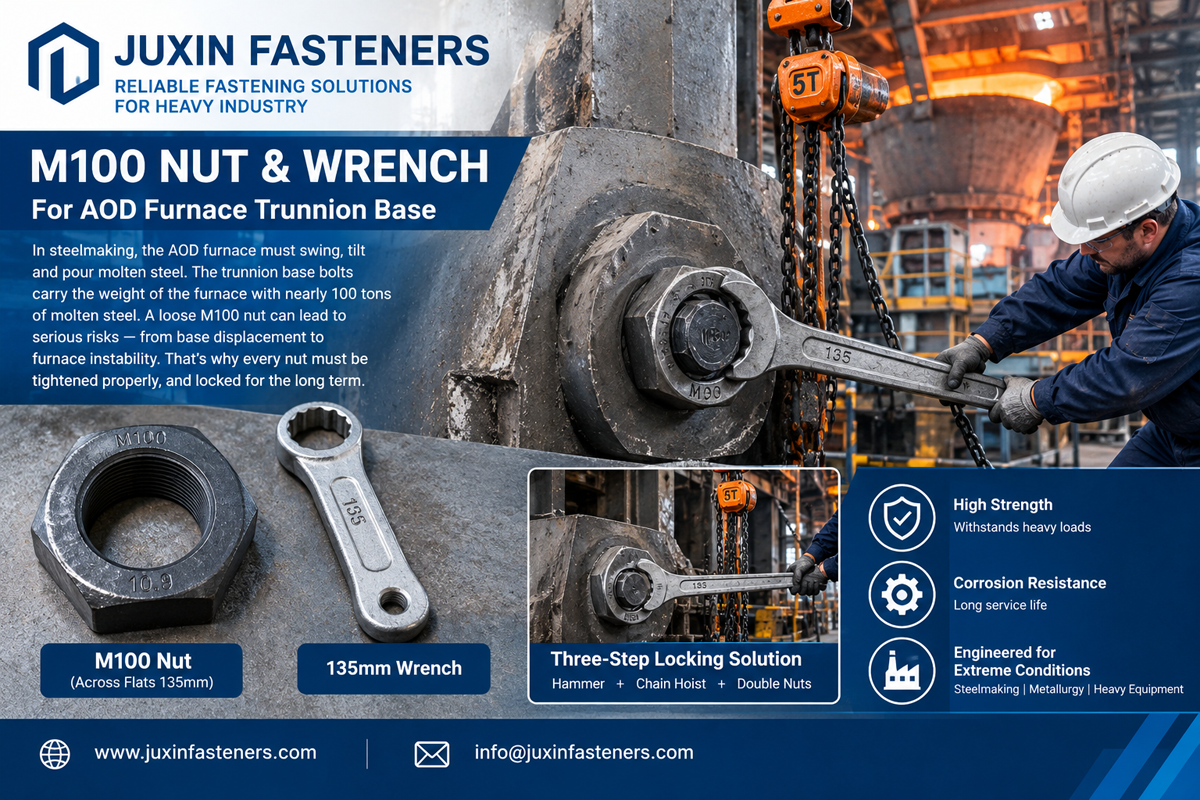
Several engineering strategies may be considered when designing or maintaining large industrial threaded joints.
The purpose of tightening is to establish an appropriate clamp load in the joint.
For large fasteners, achieving a repeatable preload can become more difficult because the required installation force and available tooling increase substantially.
Depending on the equipment design, installation may involve hydraulic tensioning, hydraulic torque tooling, mechanical torque tooling, or other controlled methods.
The appropriate method should be established by the equipment manufacturer, engineering specification, and applicable installation procedure.
Generic impact or striking methods should not automatically be treated as equivalent to controlled preload methods.
A dual-nut arrangement can be used in some applications where additional resistance to rotational loosening is required.
The primary nut establishes the principal clamping function, while the secondary nut is positioned and tightened according to the specified locking arrangement.
The effectiveness of a dual-nut configuration depends on:
Nut geometry
Thread fit
Tightening sequence
Relative nut positions
Applied torque or preload
Joint loading
Thread condition
Installation procedure
A dual-nut arrangement should therefore be designed as a defined locking system rather than simply adding a second nut to an existing assembly.
Large-diameter threads require appropriate control of pitch, thread form, tolerance, and mating components.
For metric threads, designations such as 6H internal thread and 6g external thread are common examples of ISO metric thread tolerance classes.
However, the correct tolerance should always be specified according to the actual thread standard, mating components, application, and drawing.
Thread tolerance should not be selected solely because it appears frequently in general-purpose fasteners.
For large custom components, the supplier should manufacture and inspect the thread according to the approved specification.
Material selection should be based on the required mechanical properties, operating environment, manufacturing route, temperature exposure, corrosion conditions, and mating fastener specification.
Alloy steels may be considered where high mechanical strength and toughness are required.
Examples that may appear in industrial fastener specifications include:
42CrMo4
AISI 4140
These designations should not be treated as automatically interchangeable. The actual material specification, chemical composition, mechanical properties,
heat treatment condition, and applicable standard should be agreed in the engineering documentation.
For demanding large-diameter fasteners, quenching and tempering may be used to achieve the required mechanical properties.
The final heat-treatment condition should be defined by the applicable material and fastener specification.
Depending on the requirement, technical documentation may include:
Tensile strength
Yield or proof strength
Hardness
Impact properties where specified
Heat-treatment condition
Material test documentation
The required values should come from the approved drawing, standard, customer specification, or project engineering requirements.
Stainless steel or other materials may be appropriate for applications where corrosion resistance, temperature performance, or other environmental characteristics are more important than maximum mechanical strength.
However, material selection should not be made simply from the words "heavy-duty."
The correct material is the one that satisfies the complete application requirement.
Large industrial fasteners may require surface protection or controlled lubrication depending on the operating environment and installation procedure.
Potential considerations include:
Black oxide
Zinc-based protective systems
Phosphate-based surface treatments
Corrosion-resistant materials
Anti-seize compounds
Assembly lubricants
Thread protection during storage and transportation
The selected surface treatment should be compatible with the required corrosion resistance, temperature, friction behavior, dimensional requirements, and tightening procedure.
This point is especially important for large threaded assemblies because lubrication can change the friction coefficient and therefore affect the relationship between applied torque and resulting preload.
A coating or lubricant should therefore not be specified independently from the installation method.
Large-diameter fasteners are often application-specific.
An OEM may require a nut with a non-standard height, unusual bearing surface, modified wrenching dimensions, special chamfers, a particular material, or a thread configuration defined by the equipment drawing.
This creates a strong need for drawing-based manufacturing of large-diameter fasteners.
Typical custom requirements may include:
M100 or other large nominal thread sizes
Special thread pitch
Non-standard nut height
Custom across-flats dimensions
Special external geometry
Modified chamfers
Special bearing surfaces
Defined material
Heat-treatment requirements
Surface treatment requirements
Inspection requirements
For these components, the approved engineering drawing should remain the primary manufacturing reference.
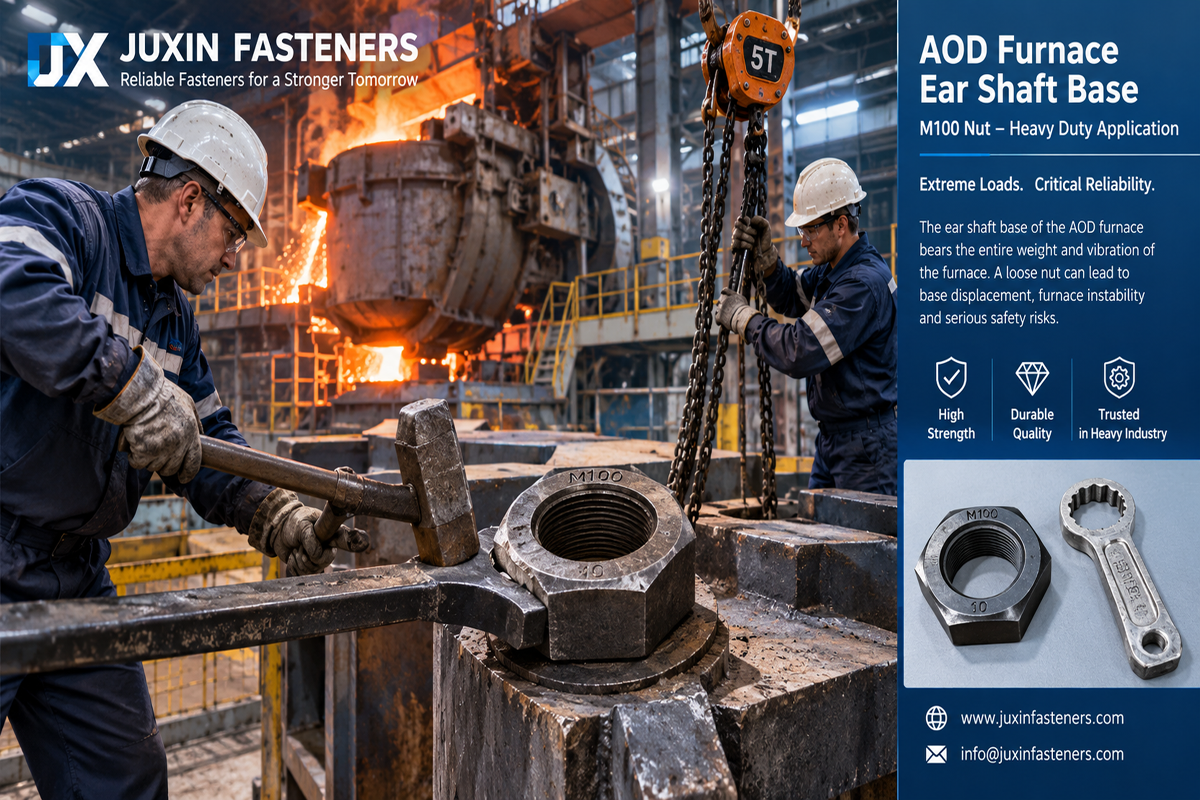
A useful drawing for a custom M100 nut may define:
Nominal thread size
Thread pitch
Thread standard
Internal thread tolerance
Nut height
Across-flats dimension
Chamfer dimensions
Bearing surface requirements
Material specification
Mechanical property requirements
Heat-treatment condition
Surface treatment
Inspection requirements
Applicable standards
Revision level
If a customer already has a complete drawing, that drawing should be the starting point for quotation and technical review.
If the drawing is not yet complete, the inquiry does not have to stop.
A supplier can first review the information that is available and identify the remaining technical points that need clarification.
Industrial procurement teams often assume that every custom fastener inquiry must begin with a complete engineering package.
In practice, early-stage sourcing may start with much less information.
For example:
Have a production drawing?
Send the drawing.
Have a CAD model but no finalized drawing?
Send the CAD information available.
Have a physical sample?
Describe the sample and provide photographs or dimensions where possible.
Only have photographs and basic dimensions?
That can still be a useful starting point for technical discussion.
Know the material and thread but not the final quantity?
Provide the estimated demand range if available.
Still defining the specification?
Explain the application and current requirements, and the supplier can identify which technical details still need to be confirmed.
This approach reduces unnecessary barriers between engineering and procurement teams and the supplier.
The objective of the first RFQ is to establish a technically useful starting point, not to force the buyer to create a perfect specification before asking a question.
For large industrial fasteners, procurement should evaluate more than unit price.
Important sourcing factors may include:
Large internal threads require appropriate inspection methods and suitable gauges or measurement equipment according to the specified thread standard and inspection plan.
The inspection method should be agreed with the drawing and applicable standard.
Where material certification or traceability is required, the purchase specification should define the required documentation.
Depending on the project, this may include:
Material certificates
Heat-treatment records
Mechanical test results
Dimensional inspection records
Thread inspection records
Surface-treatment documentation
The exact documentation should be based on the project requirement rather than automatically adding every possible certificate to every RFQ.
For critical industrial applications, traceability may be important from incoming material through manufacturing and final inspection.
The required level of traceability should be agreed during supplier qualification and purchasing.
Large threaded components require careful handling during international transportation.
The supplier and buyer should consider:
Thread protection
Rust prevention
Impact protection
Lifting and handling
Crating requirements
Identification and labeling
Shipping weight and dimensions
For M100-class components, thread damage during transportation can create unnecessary installation problems even when the component itself was correctly manufactured.
When comparing quotations for large industrial fasteners, procurement teams should avoid comparing only the price per piece.
Two M100 nuts can have the same nominal thread diameter but different:
Materials
Mechanical properties
Dimensions
Thread tolerances
Heat-treatment conditions
Surface treatments
Inspection requirements
Documentation
Packaging
Delivery conditions
Therefore, a technically comparable quotation should be based on the same engineering requirements.
This creates a more meaningful comparison between suppliers and reduces the risk of selecting a lower-priced component that is not technically equivalent.
The difference between a heavy-duty M100 nut and an ordinary industrial nut is not simply the physical size.
The engineering distinction may involve the complete specification and application.
| Requirement | General Industrial Nut | Heavy-Duty Custom Nut |
|---|---|---|
| Thread size | Standard sizes | May include M100 or other large sizes |
| Geometry | Standardized | May be drawing-specific |
| Material | Standard options | Application-specific |
| Heat treatment | Depending on class | Often defined by requirement |
| Thread specification | Standard | Controlled to project specification |
| Inspection | Standard requirements | May include project-specific inspection |
| Application | General machinery | Heavy machinery and demanding equipment |
| Sourcing | Catalog or standard production | Often drawing-based |
The correct selection depends on the application, not on the label "heavy-duty."
Large-diameter custom nuts and threaded components may be considered in applications such as:
Steelmaking equipment
AOD and converter support systems
Metallurgical machinery
Mining equipment
Crushers and heavy processing machinery
Large industrial presses
Heavy machinery foundations
Structural equipment assemblies
Energy and power-generation equipment
Large rotating machinery
OEM industrial equipment
The exact fastening design varies significantly between applications.
A nut suitable for one machine should not automatically be substituted into another machine simply because the thread diameter is identical.
AOD furnace and converter systems provide a useful example of why large industrial fastening must be treated as a complete engineering problem.
Trunnion and support connections may experience:
Repeated movement
Cyclic loading
Vibration
Large structural forces
Thermal variation
Maintenance constraints
The fastening arrangement therefore needs to be considered together with:
Trunnion geometry
Baseplate design
Foundation interface
Bolt or stud dimensions
Nut dimensions
Preload requirements
Locking arrangement
Installation access
Inspection requirements
A large M100 nut may be one component of such an assembly, but the complete connection determines the engineering performance.
An M100 thread designation does not define material, nut height, mechanical properties, or complete joint performance.
A dual-nut arrangement can provide a mechanical locking strategy, but its effectiveness depends on the design and installation method.
The relationship between applied torque and achieved preload depends on friction, lubrication, thread condition, geometry, and installation method.
Simply writing "4140 steel" or "42CrMo4" may not fully define the required component.
The heat-treatment condition and required mechanical properties may also need to be specified.
A lower price is not meaningful if material, inspection, geometry, or documentation requirements are different.
Early-stage engineering projects often do not have every specification finalized.
A useful supplier should be able to review the available information and identify what still needs clarification.
A practical sourcing process can follow this sequence:
Step 1 — Define the application
Explain where the fastener will be used and the basic operating conditions.
Step 2 — Provide the available technical information
Send a drawing, CAD file, sample information, photographs, dimensions, or part number.
Step 3 — Identify known specifications
Where available, provide thread size, pitch, material, mechanical requirements, finish, quantity, and inspection requirements.
Step 4 — Technical clarification
The supplier identifies missing or ambiguous requirements that could affect manufacturing or quotation.
Step 5 — Feasibility review
The supplier reviews the geometry, material, thread, manufacturing requirements, and inspection requirements.
Step 6 — Quotation
The quotation should clearly identify the technical basis, quantity, commercial terms, and any assumptions.
Step 7 — Sample or development stage
Where required, samples can be evaluated against the approved requirements before production.
Step 8 — Production and supply
Once the specification is approved, production proceeds against the controlled technical documentation.
JUXIN FASTENERS supports OEM and industrial customers with custom fastening components developed from engineering requirements, drawings, CAD information, samples, photographs, and dimensional data.
Our product scope includes:
Custom screws
Custom bolts
Custom nuts
Custom washers
Self-clinching fasteners
Weld nuts
Weld studs
Rivet nuts
Blind rivets
Clips and retainers
Plastic and nylon fastening hardware
CNC-machined fastener components
Other drawing-based and non-standard fastening components
For large-diameter or special threaded components, the appropriate manufacturing route depends on the component geometry, material, dimensions, quantity, and technical requirements.
JUXIN FASTENERS can work with customers at different stages of development.
If you have a complete drawing, we can review the drawing.
If you have a CAD model, we can start from the available technical information.
If you have a physical sample or photographs with dimensions, those can provide a starting point for discussion.
If the specification is still being developed, we can help identify the technical information that should be clarified before quotation or production.
Heavy-duty M100 nuts are not simply oversized versions of standard nuts.
For large industrial fastening systems, engineers and procurement teams should evaluate:
Thread size and pitch
Mating bolt or stud
Thread tolerance
Nut geometry
Material
Mechanical properties
Heat treatment
Surface protection
Preload requirements
Locking method
Operating temperature
Vibration and cyclic loading
Inspection requirements
Traceability requirements
Packaging and transportation
For steelmaking equipment, trunnion systems, heavy machinery, mining equipment, and other demanding applications, the fastening system should be engineered around the complete joint.
For procurement teams, the most effective approach is to provide the information already available and allow the supplier to identify the remaining technical requirements.
That creates a more efficient path from engineering concept → technical clarification → feasibility review → quotation → sample → production.
Heavy-duty M100 nuts are large-diameter threaded components used in demanding industrial fastening assemblies where a large metric thread and
substantial clamping capability are required. Potential applications include heavy machinery, metallurgical equipment, mining equipment, large structural assemblies, and other OEM industrial systems.
The exact suitability depends on the complete joint design and specified mechanical requirements.
A properly designed dual-nut arrangement can increase resistance to rotational loosening by creating a defined mechanical locking relationship between two mating nuts.
Its effectiveness depends on the nut geometry, thread fit, tightening sequence, preload, joint loading, and installation procedure. It should not be treated as a universal solution for every vibrating joint.
Thread tolerance affects the mating relationship between the nut and bolt or stud.
For metric threads, designations such as 6H and 6g are common ISO tolerance classes, but the correct tolerance should be determined from the applicable thread specification and engineering drawing.
For large custom fasteners, appropriate thread inspection is important because assembly problems become particularly costly when the component is large and difficult to replace in the field.
Alloy steels may be considered where high mechanical strength and toughness are required. Examples include 42CrMo4 and AISI 4140, depending on the applicable material specification.
The actual material, heat-treatment condition, mechanical properties, and inspection requirements should be defined by the engineering specification rather than assumed from a material name alone.
Yes. Custom large-diameter nuts and threaded components can be developed from customer engineering drawings when the required geometry, thread specification, material, and other technical requirements are defined.
If the final drawing is not yet available, an inquiry can also begin with a CAD model, physical sample, photograph, basic dimensions, or other available technical information.
Procurement does not necessarily need a perfect RFQ package to begin.
Useful starting information may include a drawing, CAD file, sample, photograph, part number, thread size, dimensions, material, estimated quantity, application, or known quality requirements.
The supplier can then identify which additional information is needed for a technically meaningful quotation.
If you are sourcing heavy-duty M100 nuts, large-diameter nuts, custom bolts, threaded components, or other non-standard industrial fasteners, send us the information you already have.
Have a drawing? Send it.
Have a CAD model? Send it.
Have a sample or photograph with dimensions? Start with that.
Still developing the specification? Tell us about the application and current requirements.
JUXIN FASTENERS can review the available information and help identify the technical details required for the next stage of sourcing.
Email: info@juxinfasteners.com
Website: www.juxinfasteners.com
 MORE NEWS
Sep. 14, 2026
Sep. 13, 2026
Contact Us
Tel.:
+86 020 8621 0320
+86 020 3121 6067
E-mail:
Technical Support:
Navigation
SEND INQUIREY