
Call Us
+86 136 6007 9809
Call Us
+86 136 6007 9809

Sep. 21, 2026
Railway rolling stock contains extensive electrical, communication, control and auxiliary mechanical equipment packaged inside sheet-metal cabinets, enclosures, consoles and service-access areas.
These assemblies must operate through repeated vehicle movement, vibration, mechanical shock, temperature changes and long maintenance lifecycles.
At the same time, maintenance teams require access to electrical and mechanical equipment throughout the service life of the vehicle.
Where a threaded attachment point is located near an accessible sheet-metal edge, rail transit clip-on nuts can provide a practical removable fastening architecture.
Strong-grip U-nuts, J-nuts, enclosed-thread clip nuts and other spring fasteners can create
captive threaded positions without requiring a technician or production operator to hold a conventional loose nut behind the panel.
However, railway fastener selection requires an important engineering distinction:
A clip that remains securely attached to a panel is not automatically a vibration-qualified threaded joint.
The complete assembly must be evaluated as:
Clip Nut + Panel + Mating Screw + Mounted Component + Assembly Process + Rail Service Environment
This distinction is fundamental when selecting clip-on nuts for rolling-stock equipment cabinets and service panels.
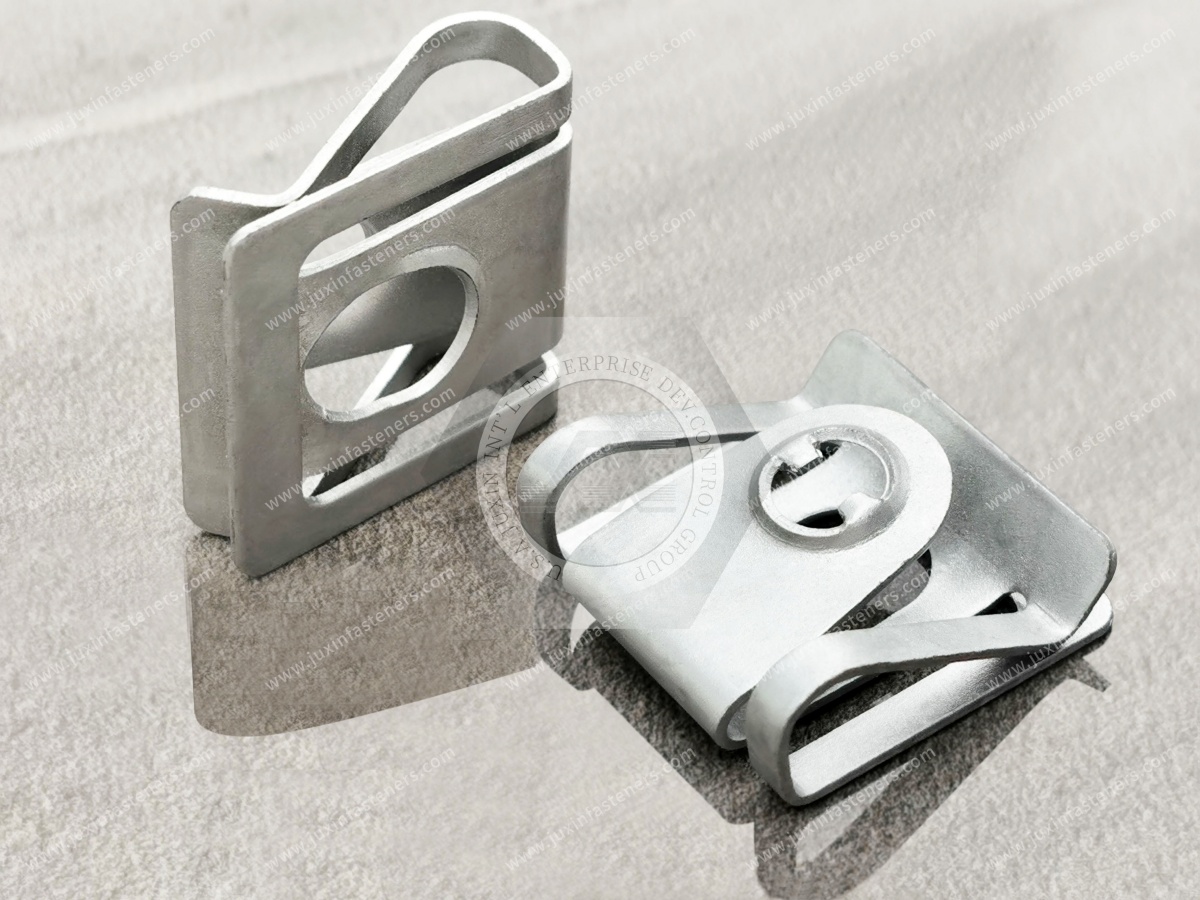
A rail transit clip-on nut is not a separate universal fastener category with automatic railway qualification.
It is an edge-mounted spring fastener selected and validated for an appropriate rolling-stock application.
Possible configurations include:
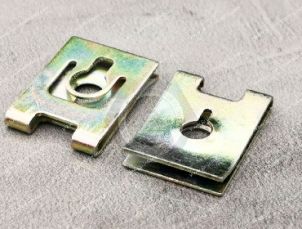
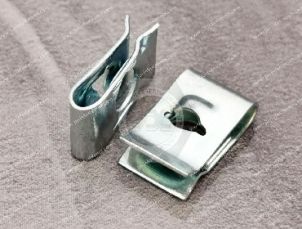
U-nuts;
J-nuts;
strong-grip clip-on nuts;
enclosed hex clip-on nuts;
low-profile clip nuts;
machine-screw spring nuts;
tapping-screw clips;
drawing-specific spring fasteners.
Their suitability depends on the actual railway assembly.
Potential applications include appropriate:
electrical equipment cabinets;
auxiliary control enclosures;
communication equipment housings;
passenger information equipment enclosures;
interior service panels;
maintenance-access covers;
removable partitions;
ceiling-access panels;
equipment guards;
non-structural brackets.
The correct application depends on:
panel geometry;
load;
vibration environment;
maintenance strategy;
fire requirements where applicable;
corrosion exposure;
project-specific railway requirements.
Not every fastener inside a rail vehicle performs the same function.
A useful engineering approach is to divide potential applications into functional zones.
These may include joints associated with major vehicle structure, safety systems or other high-consequence load paths.
Such locations require dedicated engineering and qualification.
A generic clip-on nut should not be selected simply because it offers convenient assembly.
Some equipment mounting points can carry significant:
mass;
dynamic loads;
shock loads;
vibration loads.
The fastener architecture must therefore be evaluated according to the complete equipment mounting system.
This is an important potential application zone for clip-on nuts.
Examples include appropriate:
cabinet covers;
service doors;
secondary enclosure panels;
removable equipment shields.
Clip-on nuts can be particularly useful where maintenance technicians need repeated access behind:
interior panels;
ceiling panels;
wiring-access covers;
service compartments.
This leads to an important selection rule:
Railway Location Alone Does Not Determine Fastener Suitability
The fastener function and load path must be understood first.
Rail vehicles can expose equipment assemblies to combinations of:
cyclic vibration;
mechanical shock;
thermal cycling;
humidity;
condensation;
contamination;
repeated maintenance access.
These conditions can affect both the spring clip and the final screw joint.
This is one of the most important distinctions in rail clip-on nut engineering.
Clip retention describes how effectively the spring fastener remains positioned on the sheet-metal edge before and during screw installation.
It depends on factors such as:
spring geometry;
panel thickness;
material condition;
clip geometry;
surface finish.
Threaded-joint stability describes whether the final assembled joint maintains its intended mechanical function during service.
It depends on the complete:
Screw + Clip Thread + Panel + Mounted Component
system.
Therefore:
Strong Panel Grip ≠ Automatic Screw-Locking Performance
The spring arms of a U-nut or J-nut primarily retain the clip on the panel.
They should not automatically be described as applying a locking preload to the mating screw.
Screw loosening can depend on:
initial clamp;
friction;
transverse movement;
joint stiffness;
vibration;
thermal cycling;
screw locking feature where specified.
Therefore:
Clip Spring Force → Primarily Panel Retention
Threaded-Joint Resistance to Loosening → Complete Joint Behavior
Railway vibration should not be treated as a generic marketing condition.
The vibration experienced by a fastener can depend on:
vehicle type;
mounting location;
equipment mass;
bracket stiffness;
panel stiffness;
local resonance;
operating environment.
A fastener suitable for an interior lightweight access panel should not automatically be assumed suitable for a heavier equipment installation.
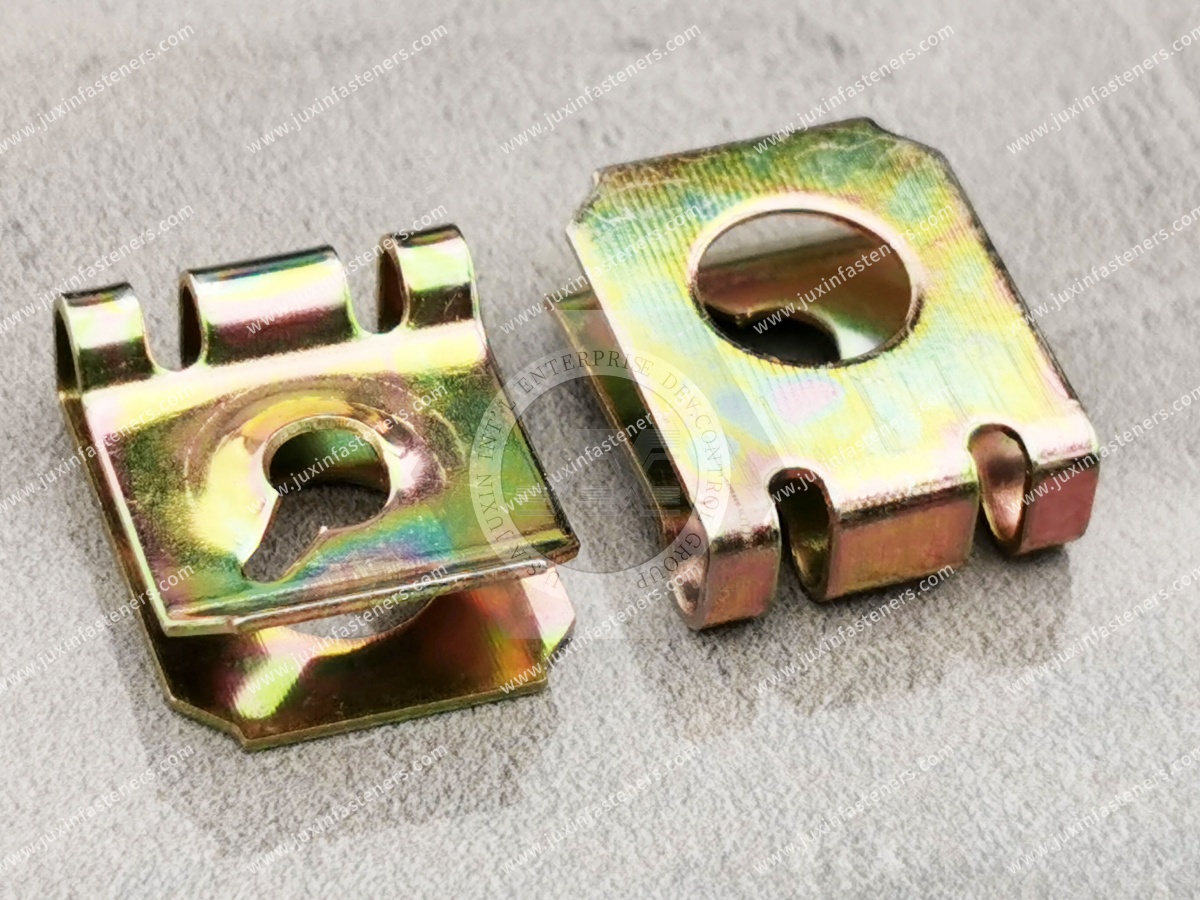
Another important engineering distinction is:
Vibration Exposure ≠ Fatigue Life
Vibration creates cyclic loading.
Fatigue describes progressive damage under repeated stress cycles.
Whether a clip develops fatigue damage depends on factors including:
stress amplitude;
geometry;
material;
heat treatment;
surface condition;
number of cycles.
Therefore a “vibration-resistant” marketing description does not establish a quantified fatigue life.
Rail vehicles can experience transient mechanical events in addition to continuous vibration.
Depending on the application, these can arise from:
coupling;
braking;
track discontinuities;
operational impacts.
Shock loads can create different load paths from steady cyclic vibration.
The fastening system should therefore be evaluated against the actual project requirement rather than a generic “rail vibration” label.
One Information Gain point often missed in generic fastener selection is the effect of the cabinet itself.
A sheet-metal cabinet has its own:
stiffness;
mass;
natural frequencies.
If equipment excitation interacts with the cabinet structure, local motion at a fastener location can differ from the overall vehicle vibration.
Therefore:
Vehicle Vibration Input ≠ Automatically Fastener Local Load
Cabinet and panel behavior matter.
A clip-on nut interacts directly with the panel edge.
Repeated motion can therefore affect not only the clip but also the substrate.
Potential issues include:
edge fretting;
coating wear;
local indentation;
hole elongation;
clip migration.
The panel should therefore be considered part of the fastening system.
Rail vehicles contain many electrical and electronic cabinets.
Potential clip-on nut applications can include appropriate:
cabinet covers;
removable side panels;
inspection panels;
auxiliary brackets;
cable-management covers.
Clip-on nuts can simplify final assembly where backside access is restricted.
A metal clip-on nut inside an electrical cabinet should not automatically be described as providing:
protective earthing;
electrical bonding;
EMI shielding;
controlled electrical continuity.
These functions require dedicated electrical design and validation.
Mechanical attachment and electrical functionality should be specified separately.
Passenger information equipment can include:
display controllers;
communication equipment;
network devices;
auxiliary electronics.
Clip-on nuts may be useful for appropriate serviceable covers and brackets.
The actual vibration, fire and electrical requirements depend on the equipment and vehicle program.
Rolling stock can contain communication and control equipment in confined equipment spaces.
Clip-on nuts may support suitable:
covers;
secondary brackets;
service panels.
Safety-critical signaling equipment should follow the applicable project and system qualification requirements.
A generic clip-on nut should not be represented as automatically qualified for safety-critical signaling hardware.
Passenger-area panels often conceal:
wiring;
lighting systems;
HVAC distribution;
communication equipment;
service components.
Where the architecture uses removable screw-fastened panels near accessible edges, clip-on nuts can provide replaceable threaded attachment points.
Rail vehicles can remain in service for long periods.
Maintenance strategy therefore matters during fastener selection.
A service panel may be removed repeatedly during:
scheduled inspection;
wiring work;
equipment replacement;
refurbishment.
This makes maintainability a legitimate fastener-selection variable.
A clip-on nut may be removable or replaceable, but this does not mean it can undergo unlimited screw installation cycles without change.
Repeated service can affect:
clip threads;
screw threads;
spring geometry;
panel edge;
coatings.
Where lifecycle service access is important, the expected removal/reinstallation requirement should be defined and validated.
One practical advantage of clip-on nuts is that the operator does not normally need to hold a loose conventional nut behind the panel during final screw assembly.
This can simplify assembly inside:
narrow cabinet spaces;
interior cavities;
service compartments.
However, terminology matters.
A conventional clip-on nut generally needs access to a suitable panel edge during installation.
Therefore:
No Backside Nut Handling ≠ Universal Blind Installation
If the required thread is located away from an accessible edge, another architecture such as a blind rivet nut may be more appropriate.
U-nuts can provide useful edge-mounted threaded attachment where the geometry allows the clip to straddle the panel edge.
Selection should consider:
panel thickness;
grip range;
hole setback;
throat depth;
thread position.
J-nuts use an asymmetric spring geometry that can suit particular edge and assembly configurations.
The choice between U-nut and J-nut should be based on the actual panel geometry rather than naming preference.
For more detail, see U-Nuts vs J-Nuts Geometry.
Where handling, assembly or service conditions require increased panel retention, strong-grip clip geometries may be evaluated.
However:
Higher Grip Force ≠ Automatically Better Railway Fastener
Excessive grip can create:
difficult installation;
panel deformation;
coating damage;
excessive clip stress.
The objective is controlled retention appropriate to the panel.
Some railway equipment applications may benefit from clip assemblies incorporating a dedicated nut element.
Potential considerations include:
thread engagement;
installation envelope;
required torque;
panel grip;
serviceability.
See Strong-Grip Clip-On Enclosed Hex Nuts.
Clip-on nut selection should use the actual finished panel interface.
Relevant factors include:
base sheet thickness;
manufacturing tolerance;
paint;
powder coating;
plating;
other surface layers.
For detailed guidance, see Panel Thickness Selection Guide.
A clip interacts with the finished panel rather than only the nominal bare-metal thickness.
If the design is near the edge of the fastener's grip range, coating variation can affect:
installation force;
retention;
alignment.
Therefore:
Nominal CAD Thickness ≠ Always Effective Assembly Thickness
The distance between the panel edge and screw-hole center is critical for edge-mounted fasteners.
Incorrect setback can cause:
screw misalignment;
cross-threading;
clip displacement;
abnormal installation torque.
Rail equipment programs commonly use metric threads.
RFQs should specify:
nominal diameter;
pitch;
mating screw requirements.
Do not rely only on descriptions such as:
M5 rail clip nut
or:
M6 railway U-nut
Two M6 U-nuts can differ in:
grip range;
throat depth;
hole setback;
spring geometry;
thread construction;
overall envelope;
material;
coating.
Therefore:
Same Thread Size ≠ Interchangeable Railway Fastener
Specification-controlled spring steel can provide the elastic behavior required for many clip-on fastener designs.
Performance depends on the complete manufacturing system, including:
material;
thickness;
forming;
heat treatment;
geometry.
Material name alone does not establish railway performance.
Stainless spring materials can be considered where their mechanical and environmental characteristics fit the application.
However:
Stainless ≠ Corrosion-Proof
and:
Stainless ≠ Automatic Railway Qualification
Material selection should follow the actual environment and project specification.
Corrosion exposure varies significantly by fastener location.
Potential exposure may be relatively controlled but can still involve:
humidity;
cleaning agents;
condensation.
Conditions may involve:
temperature variation;
condensation;
contamination.
These can experience substantially more severe exposure.
Therefore:
One Railway Vehicle ≠ One Corrosion Environment
For applicable steel fasteners, electroplated coating systems can be specified according to relevant international requirements such as ISO 4042 where appropriate.
The coating selection should be controlled by the customer or application specification.
The coating can influence:
corrosion protection;
dimensional fit;
friction;
appearance.
For susceptible hardened or high-strength spring-steel clips, manufacturing and electroplating can require hydrogen-embrittlement risk controls.
Risk depends on factors including:
material condition;
hardness/strength;
processing;
coating route;
applied stress.
No universal baking recipe should be assigned to every rail clip-on nut.
Where salt-spray testing is specified, ISO 9227 provides recognized laboratory test methods.
However, ISO 9227 does not prescribe one universal exposure period for railway clip-on nuts.
Test duration and acceptance criteria should come from the applicable product or customer specification.
Laboratory salt-spray testing should not be converted directly into claims such as:
years of railway service;
maintenance interval;
corrosion-free lifetime.
Real rail environments can involve:
wet/dry cycles;
condensation;
contamination;
cleaning chemicals;
temperature changes;
coating damage.
Railway equipment may be subject to project-specific vibration and shock qualification requirements.
The relevant requirements depend on:
equipment category;
installation location;
vehicle;
customer specification.
A standard industrial clip-on nut should not be advertised as automatically railway vibration-qualified without supporting validation.
Testing a clip by itself does not necessarily reproduce the final service condition.
The production assembly includes:
Clip + Panel + Screw + Cabinet / Cover + Mounted Equipment
Therefore, when dynamic performance matters, assembly-level validation can provide more relevant evidence than evaluating the clip alone.
EN 45545-2 addresses fire behavior requirements for materials and components used on railway vehicles.
It should not be presented as a generic dimensional, mechanical or vibration standard for metal clip-on nuts.
For an all-metal clip-on nut, applicability depends on:
the component;
associated materials/coatings;
installation;
vehicle fire-safety requirements;
customer specification.
Therefore:
EN 45545-2 Mentioned in a Rail Project ≠ Clip-On Nut Automatically “EN 45545 Certified”
If the fastening assembly includes:
polymer isolators;
plastic retainers;
organic coatings;
bonded materials,
their fire behavior may require evaluation under applicable rolling-stock fire requirements.
Do not transfer the qualification of one material automatically to the complete fastening assembly.
A fastener used successfully on one train platform should not automatically be described as qualified for another.
Programs can differ in:
vibration requirements;
corrosion environment;
fire requirements;
panel geometry;
service strategy;
customer specifications.
Potential problems include:
clip migration;
panel-edge wear;
coating damage;
thread stripping;
cross-threading;
screw loosening;
clip fatigue;
corrosion;
maintenance-cycle wear.
For systematic troubleshooting, see Clip-On Nut Failure Analysis.
Possible causes include:
incorrect grip range;
panel thickness variation;
insufficient retention;
wrong geometry;
installation error.
Possible contributors include:
insufficient initial clamp;
transverse movement;
poor joint stiffness;
unsuitable locking strategy;
thermal cycling.
Do not automatically solve screw loosening by increasing clip grip force.
Possible contributors include:
excessive spring deflection;
cyclic panel movement;
geometry-related stress concentration;
material/process variation.
The root cause should be established through inspection and controlled testing.
Potential causes include:
excessive grip force;
incorrect grip range;
repeated clip replacement;
panel material characteristics;
vibration-induced movement.
Investigate:
environment;
clip coating;
panel coating;
coating damage;
contamination;
dissimilar-metal interfaces.
Do not assume that stainless steel automatically eliminates every corrosion mechanism.
| Engineering Requirement | Selection Consideration |
|---|---|
| Removable equipment cabinet cover | Clip-on nut may be suitable |
| Accessible sheet-metal edge | Suitable for conventional edge clip |
| Confined backside access | Captive clip can simplify screw assembly |
| Mid-panel blind thread | Consider another fastening architecture |
| Repeated maintenance access | Define service-cycle requirement |
| Continuous vibration | Validate complete joint |
| Shock exposure | Follow project/equipment requirement |
| Thin sheet-metal panel | Control grip and local deformation |
| Interior environment | Define actual corrosion exposure |
| Exterior/underbody exposure | More demanding corrosion evaluation required |
| Electrical bonding | Dedicated electrical design required |
| Fire requirement | Evaluate applicable materials/components |
| Safety-critical attachment | Dedicated qualification required |
Is the fastener used in:
electrical cabinet;
communication enclosure;
passenger information equipment;
interior panel;
machinery service panel;
another subsystem?
Is it retaining:
cover;
door;
panel;
bracket;
shield?
Is the joint:
auxiliary;
serviceable;
equipment-related;
structural;
safety-critical?
Specify:
material;
thickness;
tolerance;
finish;
flange width;
edge radius;
hole setback;
throat depth.
Specify:
thread diameter;
pitch;
screw specification;
screw length;
finish where relevant.
Specify applicable:
vibration;
shock;
equipment mass;
mounting location.
Include:
temperature;
humidity;
condensation;
cleaning chemicals;
exterior exposure where relevant.
Specify:
expected access frequency;
removal/reinstallation cycles;
replacement policy.
Identify the actual:
railway standard;
OEM requirement;
equipment specification;
customer-specific requirement.
Evaluate:
Production Clip + Production Panel + Production Screw + Production Cover / Cabinet + Production Assembly Process
A clip fitting a prototype cabinet demonstrates initial geometric compatibility.
It does not establish:
vibration endurance;
shock resistance;
fatigue life;
corrosion durability;
maintenance-cycle durability.
Those requirements must be validated according to the actual rail program.
Two suppliers can both offer:
M6 Railway U-Nut
while the parts differ in:
grip range;
free-state geometry;
spring force;
hole setback;
throat depth;
thread geometry;
material condition;
coating.
Therefore:
Same Catalogue Description ≠ Same Assembly Behavior
Supplier changes should be evaluated against the controlled application requirements.
Procurement comparison should consider more than unit price.
A useful model is:
Fastener Cost + Installation Cost + Assembly Risk + Rework Cost + Maintenance Cost + Replacement Cost
A slightly lower unit price may not create the lowest lifecycle cost if the fastener causes:
installation difficulty;
cross-threading;
panel damage;
service problems.
Rail engineers may search:
rail transit clip-on nuts;
railway spring nuts;
rolling stock U-nuts;
train equipment cabinet fasteners;
railway service panel fasteners;
vibration-resistant railway fasteners;
rolling stock electrical cabinet fasteners.
These searches indicate engineering and application-selection intent.
Sourcing teams may search:
railway clip nut supplier;
rail transit fastener manufacturer;
rolling stock spring nut supplier;
railway U-nut manufacturer;
train equipment cabinet fastener supplier;
custom rail spring fasteners.
These searches indicate commercial supplier-selection intent.
When requesting engineering and commercial evaluation from JUXIN FASTENERS, provide where applicable:
rolling-stock program;
vehicle type;
subsystem;
equipment application;
joint criticality;
2D drawing;
3D model where available;
assembly drawing;
current fastener sample;
current supplier part number;
thread size;
thread pitch;
mating screw specification;
screw material;
screw finish;
panel material;
nominal panel thickness;
thickness tolerance;
finished panel thickness;
panel coating;
flange width;
edge geometry;
hole diameter;
hole setback;
throat-depth requirement;
available fastener envelope;
clip-retention requirement where defined;
joint mechanical requirements;
vibration requirement;
shock requirement;
equipment mass where relevant;
installation location;
temperature range;
humidity/condensation exposure;
corrosion requirement;
coating specification;
corrosion test method;
test duration where specified;
acceptance criteria;
fire-related requirements where applicable;
maintenance-access requirement;
expected service cycles;
installation method;
screwdriving method;
automated-feeding requirement;
packaging requirement;
inspection requirement;
documentation requirement;
sample quantity;
prototype quantity;
production quantity;
annual demand;
program timing;
customer-specific standards.
Potential applications include suitable equipment-cabinet covers, electrical enclosures, service panels, access covers, interior panels and auxiliary brackets.
Not automatically. Clip retention on the panel and screw-joint stability are different mechanical functions.
No. Dynamic requirements depend on the vehicle, equipment, installation location and customer specification.
It eliminates the need to hold a loose backside nut during final screw assembly, but a conventional clip generally requires access to a suitable panel edge.
They can be useful for removable service panels and covers where replaceable threaded attachment points are desirable.
No such assumption should be made. Where repeated maintenance access is expected, the required service cycles should be defined and validated.
EN 45545-2 concerns fire behavior requirements for materials and components used on railway vehicles. It is not a generic mechanical or vibration certification for clip-on nuts.
No. Stainless materials can offer useful corrosion characteristics in appropriate environments, but material choice also depends on spring behavior, geometry, cost and the complete assembly.
No. Laboratory salt-spray testing is useful for defined corrosion-testing purposes but should not be converted directly into years of railway service.
Not automatically. Grounding and bonding require dedicated electrical design and validation.
JUXIN FASTENERS can review available drawings, samples, panel geometry, screw requirements, environmental conditions,
service requirements and production demand to identify candidate clip-on nut configurations for evaluation.
A sourcing request may begin:
“Need M6 vibration-resistant clip nut for railway cabinet.”
That description is not enough to control the assembly.
Engineering should determine:
Which Rolling-Stock Subsystem?
What Component Is Being Retained?
Is the Joint Auxiliary or Safety-Critical?
What Is the Panel Material?
What Is the Finished Panel Thickness?
What Is the Edge Geometry?
What Is the Hole Setback?
What Screw Is Used?
What Vibration Requirement Applies?
What Shock Requirement Applies?
What Is the Equipment Mass?
What Corrosion Environment Applies?
How Often Will the Panel Be Removed?
Which Project-Specific Railway Requirements Apply?
The sourcing path becomes:
Rolling-Stock Subsystem → Joint Function → Criticality → Panel Geometry → Screw / Thread → Dynamic Environment
→ Corrosion Environment → Maintenance Requirement → Clip Architecture → Samples → Assembly Validation → Controlled Specification → Production RFQ
This turns a generic railway hardware inquiry into an engineering-controlled sourcing process.
JUXIN FASTENERS supports OEM and industrial sourcing for appropriate rolling-stock fastening applications, including:
rail transit clip-on nuts;
U-nuts;
J-nuts;
strong-grip clip-on nuts;
enclosed hex clip-on nuts;
low-profile clip nuts;
metric spring nuts;
carbon spring-steel clips;
stainless spring clips where appropriate;
drawing-based spring fasteners.
Potential applications include appropriate:
electrical equipment cabinets;
communication equipment enclosures;
passenger information equipment housings;
machinery service panels;
interior access panels;
ceiling-access panels;
auxiliary covers;
non-structural brackets.
For related engineering guidance, see:
Strong-Grip Clip-On Nuts for Vibration-Resistant Assemblies
Strong-Grip Clip-On Enclosed Hex Nuts
Panel Thickness Selection Guide
Sheet-Metal Fastener Selection Guide
Carbon Steel Clip-On Nuts: Material & Coating Guide
304 vs 316 Stainless Clip-On Nuts
Metric Clip-On Nuts Selection Guide
For a rail transit clip-on nut RFQ or engineering review, send your drawing, rolling-stock application, panel material, finished thickness, edge geometry,
hole setback, mating screw specification, vibration and shock requirements, corrosion requirements, maintenance-cycle requirements, sample quantity and estimated annual demand to:
For rolling-stock applications, the correct sourcing question is not simply:
“Which clip nut is vibration-resistant?”
It is:
“Which clip geometry, panel interface, threaded joint, material, finish and validation plan match the actual rolling-stock equipment location and service environment?”
 MORE NEWS
Contact Us
Tel.:
+86 020 8621 0320
+86 020 3121 6067
E-mail:
Technical Support:
Navigation
SEND INQUIREY