
Call Us
+86 136 6007 9809
Call Us
+86 136 6007 9809

Sep. 30, 2026
Thin sheet metal creates a fundamental fastening problem: the panel may be strong enough to form an enclosure, chassis, cabinet, bracket,
or equipment housing, but too thin to provide sufficient thread engagement for a conventional tapped hole.
Increasing sheet thickness only to obtain more thread engagement adds material, weight, and cost. Welding a nut or stud can solve the threading problem,
but introduces heat, weld spatter, distortion, secondary finishing considerations, and additional process requirements.
Self-clinching fasteners provide another approach: create a permanent threaded or mounting feature by mechanically locking the fastener into the sheet itself.
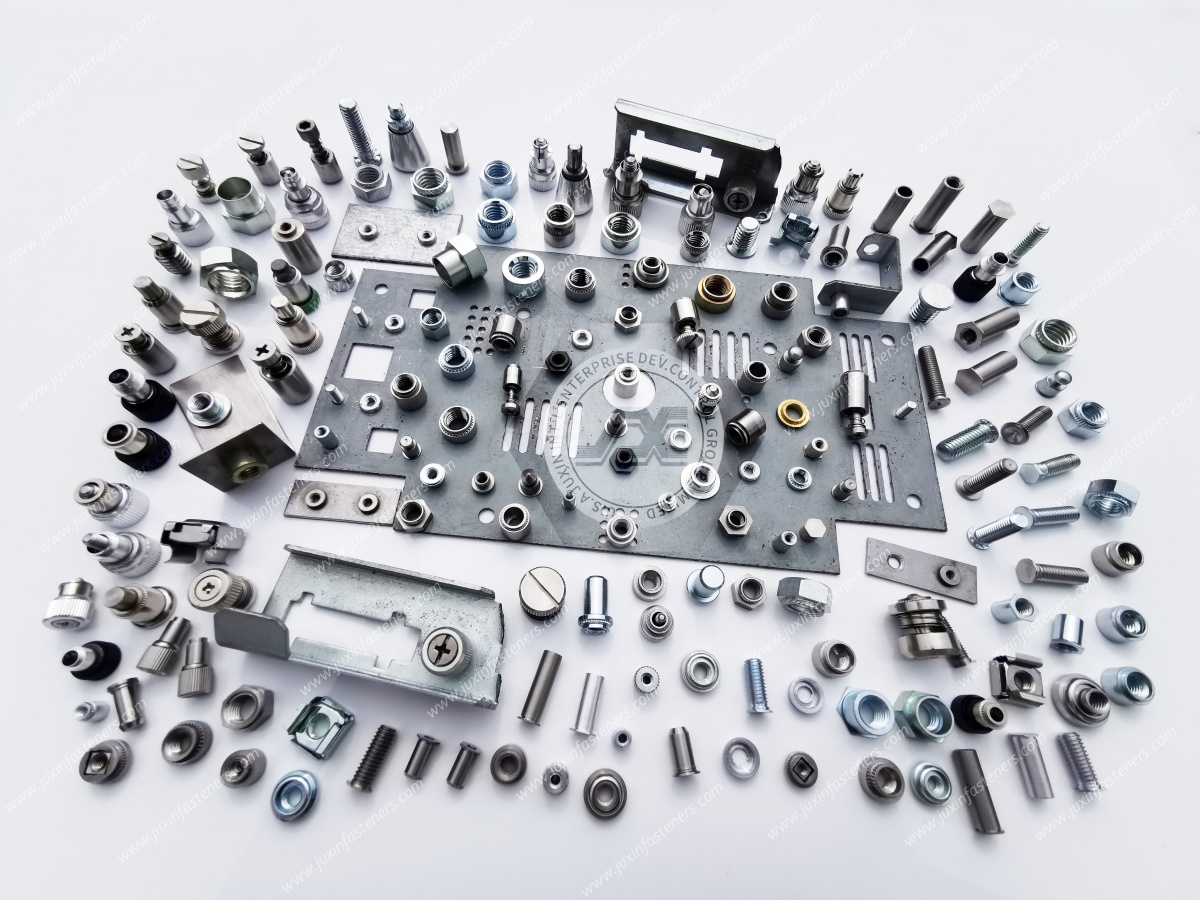
Common configurations include:
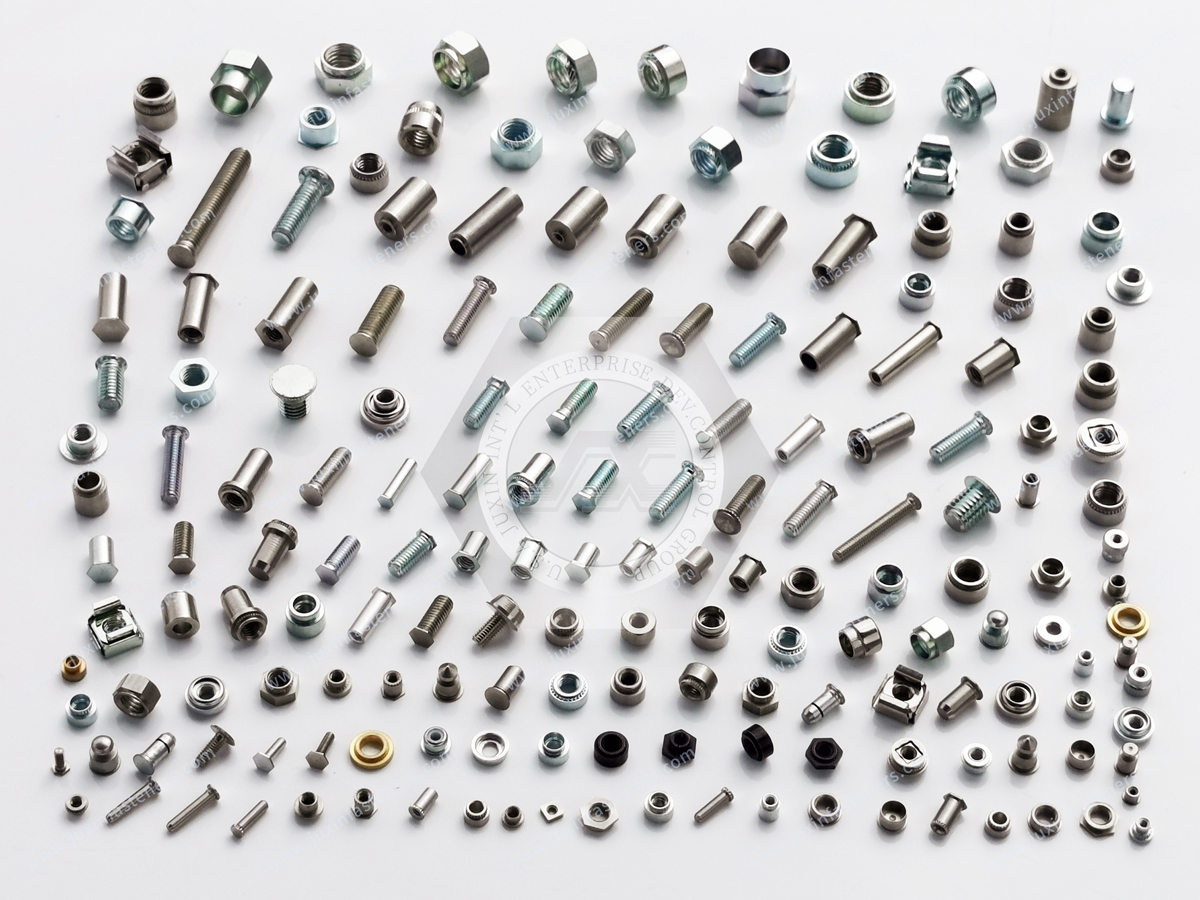
self-clinching nuts;
self-clinching studs;
self-clinching standoffs;
flush fasteners;
other press-installed sheet metal components.
They are widely used in electronics enclosures, telecommunications equipment, industrial control cabinets, automation equipment, railway electrical equipment,
HVAC assemblies, power distribution hardware, automotive electronics, and other precision sheet-metal products.
JUXIN FASTENERS supplies standard and drawing-based self-clinching and press-in fasteners for OEM and sheet-metal fabrication programs,
supporting dimensional cross-reference, material and finish review, sample evaluation, and second-source development.
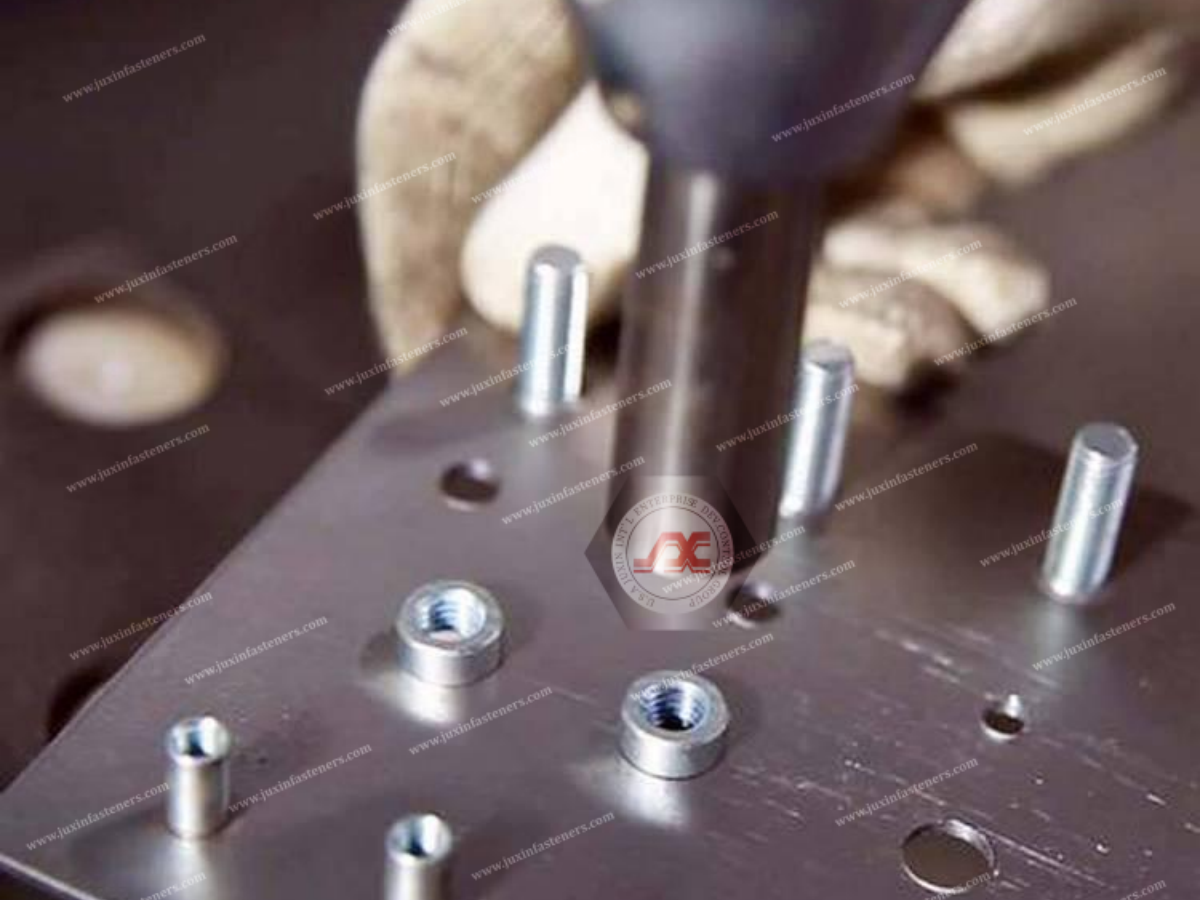
A self-clinching fastener does not normally stay in the sheet simply because it is pressed tightly into a hole.
Its retention depends on controlled displacement of the parent sheet.
During installation, a correctly sized fastener is placed into a properly prepared mounting hole and compressed using a controlled press operation.
The sheet material flows into an engineered recess or undercut in the fastener.
At the same time, anti-rotation features mechanically engage the sheet.
The result is a permanent mechanical interlock.
This creates two important retention functions:
Axial Retention → Resistance to Push-Out
and
Rotational Retention → Resistance to Torque-Out
These are related, but they are not the same performance characteristic.
This distinction is important for engineers comparing self-clinching fasteners.
Push-out resistance describes the force required to dislodge the installed fastener axially from the sheet.
It can be influenced by:
sheet material;
sheet thickness;
fastener geometry;
hole diameter;
installation force;
installation quality.
Torque-out resistance describes the fastener's ability to resist rotation within the sheet.
This becomes particularly important when a mating screw or nut is tightened.
A self-clinching nut could theoretically have adequate axial retention but inadequate rotational resistance for the required assembly torque.
Therefore:
Push-Out Performance ≠ Torque-Out Performance
Both should be evaluated according to the joint function.
Self-clinching nuts create reusable internal machine threads in thin sheet.
Typical applications include:
electrical cabinets;
server and telecommunications chassis;
automation enclosures;
control panels;
railway equipment housings;
HVAC panels;
power distribution equipment;
electronic assemblies.
The nut is installed permanently during fabrication, eliminating the need for a loose nut during final assembly.
This can improve assembly efficiency where rear-side access later becomes restricted.
A self-clinching stud creates a permanently mounted male thread.
Potential applications include:
equipment mounting;
grounding or electrical assemblies where specifically designed;
brackets;
stacked panels;
control equipment;
component mounting.
Because the stud remains attached to the panel, final assembly can often be completed by placing the mating component over the stud and installing a nut.
This reduces loose hardware during assembly and maintenance.
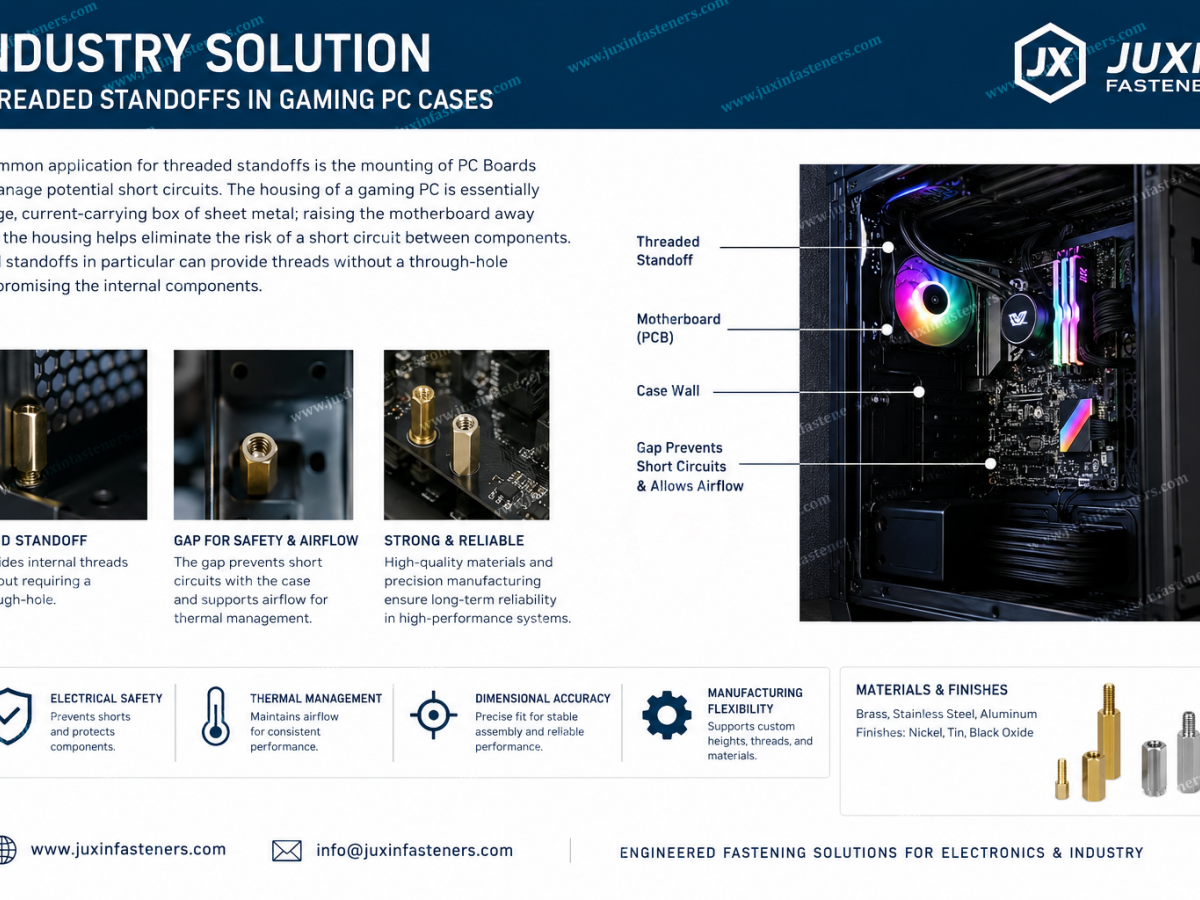
Self-clinching standoffs combine permanent panel attachment with controlled spacing.
They are particularly useful for:
printed circuit boards;
control modules;
electronic subassemblies;
internal panels;
sensors;
equipment modules.
Important design characteristics can include:
standoff height;
internal or external thread;
mounting-hole geometry;
panel thickness;
material;
installation force;
dimensional tolerance.
In electronics equipment, standoff height can be as important as thread size because it controls component spacing.
Self-clinching fasteners depend on available sheet material flowing into the retention feature.
If the sheet is too thin, there may not be enough material to form the required mechanical interlock.
Potential results include:
reduced push-out resistance;
reduced torque-out resistance;
panel deformation;
incomplete clinching;
premature fastener loosening.
Therefore, engineers should not specify a self-clinching component from thread size alone.
The required sheet thickness must be considered at the beginning of selection.
For conventional self-clinching installation, the sheet must generally be capable of plastically flowing around the fastener's clinching features.
If the parent sheet is too hard relative to the selected fastener design, proper material flow may not occur.
Possible consequences include:
incomplete installation;
damaged clinching features;
poor retention;
panel cracking or distortion.
This is especially important when working with:
stainless steel;
hardened sheets;
specialty alloys;
high-strength materials.
Do not assume that a self-clinching fastener designed for aluminum or mild steel can automatically be installed into a harder stainless steel panel.
The fastener series and sheet condition must be checked.
The mounting hole is one of the most critical interfaces in a self-clinching joint.
An oversized hole can reduce the amount of sheet material available for proper mechanical interlocking.
Possible consequences include:
reduced torque-out resistance;
reduced push-out resistance;
loose installation.
An undersized hole can create different problems:
difficult insertion;
excessive deformation;
panel distortion;
damage to the fastener or sheet.
For this reason:
Nominal Thread Size Does Not Determine Mounting Hole Size
The mounting-hole requirement should follow the actual self-clinching fastener geometry or approved drawing.
Sheet-metal mounting holes may be produced by punching, laser cutting, drilling, or other fabrication methods.
The resulting edge condition can differ.
Punched holes, for example, can have:
rollover;
burnish;
fracture;
burr.
These characteristics may affect installation depending on fastener design and sheet thickness.
Engineers should therefore control:
hole diameter;
burr condition;
flatness;
hole quality.
When punching is used, installation orientation relative to the punch direction may also matter for some self-clinching designs.
The component drawing or validated installation process should define the correct condition.
Placing a self-clinching fastener too close to the edge of a panel can restrict the material flow required during installation.
Possible results include:
edge bulging;
sheet distortion;
cracking;
reduced retention.
This creates an important design trade-off in compact enclosures.
Engineers frequently want mounting points close to:
enclosure walls;
bends;
corners;
cutouts.
But the self-clinching process needs sufficient surrounding material.
Therefore, fastener location should be considered during sheet-metal design rather than added after the enclosure geometry has been finalized.
A similar issue occurs near sheet-metal bends.
Installing too close to a formed edge can influence:
sheet flatness;
local stiffness;
material flow;
tooling access.
The assembly sequence matters.
Design engineers should consider whether the fastener will be installed:
before bending or after bending.
That decision can affect tooling access and dimensional stability.
A common production mistake is assuming that higher press force automatically creates a stronger clinched joint.
It does not.
The objective is controlled material displacement.
Excessive force can:
crush the sheet;
deform the fastener;
distort the panel;
create visible marking;
damage threads;
reduce assembly consistency.
Insufficient force can leave the fastener incompletely seated.
Therefore:
Correct Installation Force > Maximum Installation Force
Production settings should be validated for the actual fastener, sheet material, and thickness.
Self-clinching hardware is generally designed for controlled pressing rather than hammering or uncontrolled impact installation.
A parallel squeezing action helps produce consistent material flow around the fastener.
Installation equipment may include:
hydraulic presses;
pneumatic presses;
servo presses;
automated insertion equipment.
The tooling should apply load squarely to the fastener and panel.
Angular loading can create uneven installation and panel distortion.
This is an important manufacturing decision that generic fastener catalogs often under-explain.
Installing the fastener before coating can provide direct contact between the clinching features and the base sheet.
However, subsequent finishing may:
coat exposed threads;
change electrical contact;
affect appearance;
require masking.
Installing after finishing avoids some of these issues, but the coating itself may influence:
material flow;
seating;
surface damage;
retention.
For anodized, painted, powder-coated, or plated panels, the process sequence should therefore be reviewed as part of the fastening design.
There is no universal answer.
Both technologies can create reusable threads in thin sheet, but their installation architectures differ.
Generally best suited where:
press access is available during fabrication;
controlled sheet material and thickness are known;
high-volume repeatability is important;
a permanent integrated thread is required.
Often useful where:
installation is possible from only one side;
the assembly is already closed;
field installation or later-stage installation is required;
press access to both sides is unavailable.
Therefore:
Self-Clinching Nut ≠ Rivet Nut
They solve related but different manufacturing problems.
Weld nuts provide another method for adding permanent threads to sheet metal.
They may be appropriate when:
the parent material is weldable;
welding is already part of the manufacturing process;
the design specifically requires welded attachment.
Self-clinching fasteners avoid the welding heat-affected process and can be useful where:
distortion is undesirable;
weld spatter is unacceptable;
thermal processing is undesirable;
production architecture favors mechanical insertion.
Again, neither method is universally superior.
The correct choice depends on the assembly.
Tapped holes can be simple and effective when the parent material provides sufficient thread engagement.
But very thin sheet may not provide enough engaged threads for the required load or service cycles.
Self-clinching hardware allows a stronger dedicated thread feature to be integrated without increasing the entire panel thickness.
This can support lightweight enclosure design.
Common self-clinching fastener materials can include carbon steel and stainless steel, depending on the fastener design and application.
Selection should consider:
sheet material;
sheet hardness;
corrosion environment;
mechanical requirements;
appearance;
electrical requirements;
surface finish.
Material should not be selected independently from the parent panel.
A fastener and sheet may be mechanically compatible but environmentally incompatible.
When different metals are combined in the presence of moisture or another electrolyte, galvanic corrosion may become a design consideration.
Applications involving:
aluminum panels;
stainless fasteners;
coated carbon steel;
outdoor equipment
should therefore be reviewed as complete material systems.
Potential solutions may involve suitable material pairing, coatings, isolation, or other application-specific corrosion strategies.
Electronics and telecommunications equipment frequently use self-clinching nuts, studs, and standoffs because thin sheet chassis require multiple reusable mounting points.
Common requirements include:
compact geometry;
precise spacing;
flush panel surfaces;
PCB mounting;
repeated maintenance access.
This makes self-clinching hardware particularly suitable for scalable sheet-metal production.
Automation systems use large numbers of:
control cabinets;
sensor mounts;
equipment panels;
electronics chassis;
machine guards.
Self-clinching hardware can reduce loose parts and provide repeatable mounting interfaces during assembly.
For high-volume machinery programs, automated or semi-automated insertion can also support production consistency.
Railway electrical cabinets, equipment enclosures, lighting assemblies, and interior subassemblies often combine thin sheet with maintenance-access requirements.
Depending on the project and assembly, self-clinching fasteners can provide permanent threaded interfaces for removable equipment and covers.
Railway-specific material, corrosion, vibration, and project requirements should be reviewed separately from the basic clinching function.
Automotive electronics, interior structures, control modules, battery-related enclosures, and auxiliary equipment can use press-installed hardware where
lightweight sheet structures require permanent threaded attachment points.
Selection should consider:
sheet material;
coating sequence;
vibration;
corrosion;
assembly automation;
project-specific qualification requirements.
A procurement team may receive two parts that both appear to be:
M5 Self-Clinching Nut
That does not establish equivalence.
Two M5 components can differ in:
mounting-hole diameter;
shank dimensions;
clinching geometry;
minimum sheet thickness;
panel hardness capability;
material;
finish;
push-out performance;
torque-out performance.
Therefore:
Same Thread ≠ Same Installation Interface ≠ Same Performance
This is one of the most important principles when second-sourcing self-clinching fasteners.
For an existing production component, provide:
manufacturer part number if available;
2D drawing;
physical sample;
thread size;
panel material;
panel thickness;
mounting-hole diameter;
surface finish;
application;
required performance.
JUXIN FASTENERS can use these inputs to evaluate dimensional and functional cross-reference requirements.
Visual inspection can identify many physical features, but it cannot reliably establish every critical parameter.
A sample may not reveal:
exact material;
hardness;
heat treatment;
coating specification;
dimensional tolerance;
required push-out force;
required torque-out resistance.
For OEM second-source development:
Drawing + Sample + Application Information provides a much stronger qualification basis than a sample alone.
Before approving an alternative self-clinching fastener supplier, verify the characteristics that are critical to the application.
These may include:
thread dimensions;
mounting-hole interface;
shank dimensions;
head dimensions;
overall length;
standoff height;
material;
hardness where required;
surface treatment;
dimensional tolerances;
installation performance;
push-out resistance;
torque-out resistance;
corrosion requirements;
inspection requirements;
lot traceability.
Not every project requires every test.
The validation plan should match the component's function and customer requirements.
For faster engineering review and quotation, provide:
fastener type;
thread size;
drawing;
existing part number where applicable;
physical sample where available;
parent sheet material;
sheet thickness;
sheet hardness where known;
mounting-hole diameter;
edge distance;
nearby bends or formed features;
required fastener material;
surface finish;
corrosion requirement;
push-out requirement where specified;
torque-out requirement where specified;
installation process;
annual usage;
order quantity;
inspection documentation requirements;
traceability requirements.
For custom or cross-reference programs, clearly identify which dimensions or performance characteristics are critical-to-function.
For design engineers:
Sheet Material → Sheet Thickness → Hardness → Joint Function → Fastener Type → Hole Geometry → Edge Distance → Installation Process → Performance Validation
For procurement and supplier-development teams:
Existing Part / Drawing → Critical Dimensions → Material & Finish → Installation Interface → Sample Evaluation
→ Push-Out / Torque-Out Validation Where Required → Second-Source Approval → Production RFQ
The central engineering principle is simple:
A self-clinching fastener is not selected by thread size alone.
Its performance depends on the interaction between the fastener geometry, parent sheet material, sheet hardness, sheet thickness,
mounting hole, installation process, and required joint performance.
Treating those elements as one system helps engineering teams design more reliable thin-sheet assemblies and helps procurement teams qualify
alternative sources without introducing hidden installation or performance differences.
Email: info@juxinfasteners.com
Website: www.juxinfasteners.com
 MORE NEWS
Sep. 30, 2026
Sep. 30, 2026
Sep. 30, 2026
Contact Us
Tel.:
+86 020 8621 0320
+86 020 3121 6067
E-mail:
Technical Support:
Navigation
SEND INQUIREY