
Call Us
+86 136 6007 9809
Call Us
+86 136 6007 9809

Sep. 30, 2026
Spring washers are among the most familiar components in mechanical fastening—and also among the most misunderstood.
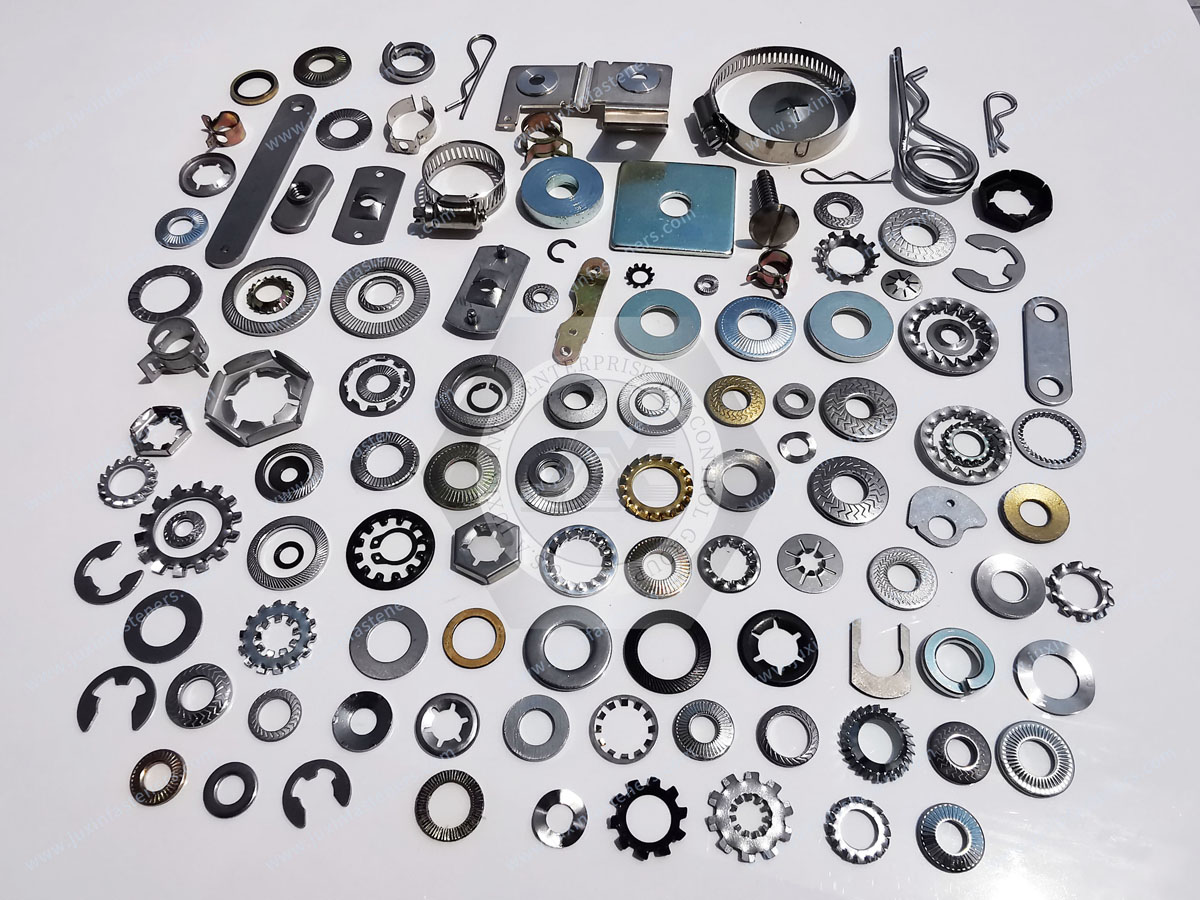
Split spring lock washers, conical spring washers, Belleville washers, disc springs, wave-type spring elements,
and flat washers may all appear beneath a bolt head or nut, but they do not perform the same mechanical function.
This distinction matters in industrial automation, heavy equipment, railway equipment, machinery, pumps, power equipment,
automotive assemblies, and other applications where bolted-joint reliability is critical.
A common engineering assumption is:
“If the joint can loosen, add a spring washer.”
That is too simple.
A bolted joint can lose clamp load through several different mechanisms, including:
embedding and surface settlement;
plastic deformation;
coating or gasket creep;
thermal expansion differences;
insufficient initial preload;
vibration-induced transverse movement;
rotation of the bolt or nut.
These failure mechanisms are not equivalent.
Therefore, the first engineering question should not be:
“Which spring washer should I use?”
It should be:
“Why is this joint losing preload or loosening?”
Only after identifying the failure mechanism should the engineer select the washer, locking element, or joint architecture.
JUXIN FASTENERS supplies spring lock washers, Belleville washers, disc springs, flat washers, stamped washer components,
vibration-resistant fasteners, and drawing-based fastening hardware for OEM and industrial sourcing programs.
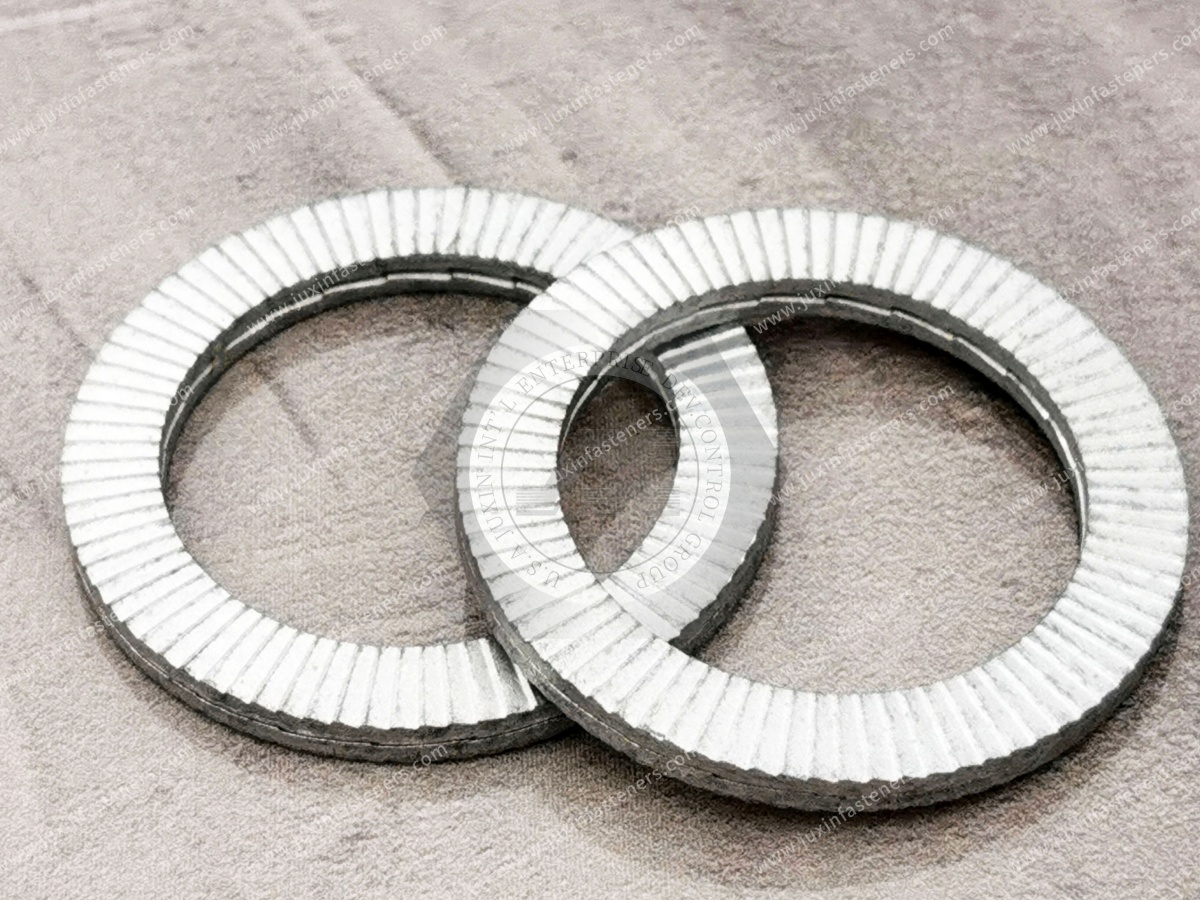
A spring element stores mechanical energy when it is elastically deflected.
In a bolted assembly, an appropriate spring element can increase the available elastic deflection within the joint system.
This can be useful where controlled spring travel is required to accommodate limited:
settlement;
dimensional variation;
thermal movement;
axial displacement;
preload variation.
But not every product called a “spring washer” provides enough usable deflection under the actual bolt load to perform meaningful compensation.
This is especially important when comparing traditional split lock washers with engineered Belleville disc springs.
These terms are often mixed together, but engineers should distinguish them.
Real contact surfaces are not perfectly smooth.
After tightening, microscopic surface irregularities can flatten under contact pressure.
Additional settlement can occur at:
bolt-head bearing surfaces;
nut bearing surfaces;
washers;
joint interfaces;
coatings;
rough surfaces.
This small dimensional change can reduce bolt elongation and therefore reduce preload.
Materials such as polymers, gaskets, coatings, and some softer metals can change dimension under sustained compression.
Temperature can accelerate this behavior.
This can reduce clamp load over time even if the bolt and nut do not rotate.
A different mechanism occurs when joint movement—particularly transverse movement—allows relative rotation between threaded components.
This is not simply elastic relaxation.
A washer capable of providing some spring deflection should not automatically be assumed to prevent rotational self-loosening.
That distinction is fundamental.
The traditional split spring lock washer is one of the most widely recognized washer designs.
Its helical split geometry creates some elastic deformation as the joint is tightened.
However, engineers should not automatically treat a split spring washer as a universal solution for vibration-induced bolt loosening.
In a sufficiently preloaded bolted joint, the washer may become substantially flattened.
Once flattened, the remaining available spring travel may be limited compared with purpose-designed disc springs or longer elastic fastener systems.
Therefore, the correct engineering question is not:
“Does the washer look spring-loaded?”
It is:
“How much usable elastic deflection remains at the actual operating clamp load?”
For joints requiring validated resistance to rotational loosening under vibration, the locking strategy should be selected and tested specifically for that failure mechanism.
A flat washer primarily performs bearing and load-distribution functions.
Depending on the design, it can:
distribute bearing pressure;
protect the mating surface;
provide a controlled bearing interface;
bridge an oversized or irregular hole;
support another locking or spring element.
A spring washer introduces elastic geometry.
Therefore:
Flat Washer = Primarily Bearing / Load Distribution
Spring Element = Elastic Deflection
These functions can overlap in some designs, but they should not be confused.
Belleville washers—also called conical spring washers or disc springs in appropriate configurations—use a conical geometry to generate spring force as the disc is compressed.
Compared with conventional helical split washers, disc springs can provide substantial spring force within relatively small axial space.
They are used where engineers need a defined relationship between:
Load ↔ Deflection
Potential applications include:
bolted joints;
bearing preload;
valve systems;
clamping systems;
machinery;
thermal compensation;
electrical equipment;
industrial mechanisms.
The important difference is that a Belleville washer should be treated as an engineered spring element rather than simply as a generic anti-loosening washer.
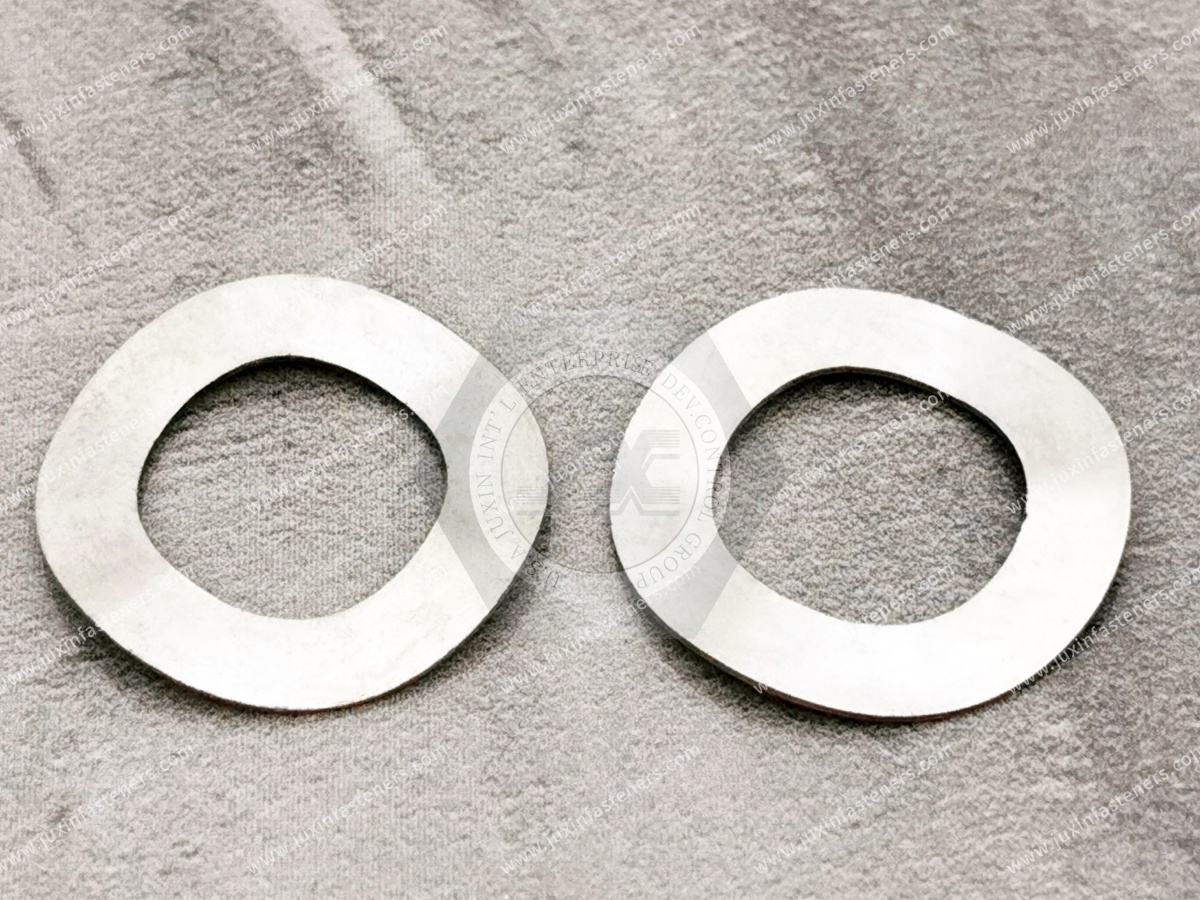
A disc spring does not simply have two conditions—“compressed” and “not compressed.”
Its spring force changes as deflection changes.
Therefore, important engineering variables can include:
outside diameter;
inside diameter;
material thickness;
free cone height;
material;
heat treatment;
operating deflection.
These characteristics determine the load-deflection behavior.
When a procurement team second-sources a Belleville washer, matching only OD, ID, and thickness may not be sufficient if spring performance is critical.
An elastic spring element needs available deflection to accommodate dimensional change.
If a disc spring is driven into an unsuitable condition for the intended design, its ability to provide the required additional travel can change substantially.
The operating point should therefore be considered on the load-deflection curve.
This is why Belleville washer selection should be based on:
Required Load + Required Deflection + Available Space + Operating Range
rather than bolt diameter alone.
One major advantage of disc springs is the ability to combine them into stacks.
Disc springs nested in the same orientation act together.
Conceptually, a parallel arrangement increases the force capability while maintaining a deflection characteristic associated with the individual disc geometry.
Typical representation:
(((
Alternating disc orientation increases the available stack deflection.
Typical representation:
()()
Engineers can combine groups to obtain different force and deflection characteristics.
This allows the spring system to be tailored to the mechanical application.
However, stacking also introduces additional considerations such as:
friction between discs;
guidance;
alignment;
available space;
load distribution;
manufacturing tolerances.
For critical spring applications, the complete stack should be evaluated rather than multiplying catalog values without considering the assembly.
Bolted-joint behavior depends on both the bolt and the clamped members.
When tightened, the bolt stretches elastically while the joint members compress.
A simplified engineering model treats them as interacting springs.
This matters because a small amount of joint settlement can cause different preload loss depending on the elastic characteristics of the system.
A short, stiff bolted joint can respond differently from a longer, more elastic fastener arrangement.
Adding an engineered spring element can alter the effective stiffness and available deflection of the system.
But the spring element must operate within a useful range to provide the intended effect.
A spring washer does not compensate for an incorrectly tightened bolt.
If initial preload is too low, the joint may experience:
separation;
slip;
vibration;
fatigue loading;
self-loosening.
Before changing the washer, engineers should verify:
bolt size;
property class;
tightening method;
friction condition;
target preload;
joint geometry;
bearing surfaces.
A fastening accessory cannot correct a fundamentally incorrect bolted-joint design.
Washer selection also affects the interface beneath the bolt head or nut.
If the bearing area is too small for the substrate, local pressure can cause:
indentation;
embedding;
coating damage;
surface deformation.
This is particularly important with:
aluminum;
polymers;
painted surfaces;
softer metals;
thin sheet.
A spring element should therefore be evaluated not only for spring behavior but also for how load reaches the mating component.
Where necessary, a suitable flat washer or other bearing arrangement may be used as part of the joint architecture.
A hardened washer placed against a substantially softer substrate can create high local bearing pressure.
Conversely, a washer without suitable mechanical properties can deform under bolt preload.
The correct combination depends on:
bolt preload;
washer geometry;
washer material;
substrate material;
bearing area;
application requirements.
Material hardness should therefore be treated as part of the complete joint design.
Bolted assemblies may contain materials with different coefficients of thermal expansion.
Examples include:
steel fasteners with aluminum structures;
metal fasteners with polymer components;
mixed-metal equipment;
assemblies exposed to large temperature cycles.
Temperature changes can alter relative dimensions and therefore affect preload.
In suitable applications, an engineered spring element can provide additional elastic travel.
However, spring selection must also consider how the spring material itself behaves at the operating temperature.
Spring materials can lose force through relaxation when exposed to combinations of:
elevated temperature;
high stress;
long service time.
Therefore, a disc spring that performs correctly at room temperature should not automatically be assumed suitable for a substantially higher service temperature.
Critical applications should specify:
operating temperature;
exposure duration;
material requirement;
required residual spring performance.
Hydrogen embrittlement is an important consideration for susceptible high-strength steel components exposed to processes or environments that can introduce hydrogen.
However, it should not be described using one universal hardness threshold or one universal baking procedure for every spring washer.
Risk depends on factors including:
material strength and hardness;
manufacturing process;
cleaning and pickling processes;
electroplating process;
applied stress;
service environment.
Where hydrogen-embrittlement risk is relevant, the material, coating route, process controls, and applicable customer or international requirements should be reviewed together.
Procurement teams should not assume that a generic statement such as “baked after plating” is sufficient evidence of risk control.
Washer coatings may be selected for corrosion resistance, appearance, or other functional requirements.
But coatings can also influence:
friction;
dimensions;
surface interaction;
hydrogen-embrittlement risk for susceptible high-strength steels depending on processing route.
Where torque-preload behavior is important, changing coating systems should not automatically be treated as a cosmetic substitution.
| Joint Requirement | Potential Washer Type | Primary Engineering Function |
|---|---|---|
| Bearing-load distribution | Flat washer | Distribute bearing pressure |
| Traditional spring washer requirement | Split spring washer | Limited elastic/spring geometry; evaluate actual application |
| Defined high spring force in compact space | Belleville / disc spring | Controlled elastic load-deflection |
| Greater spring travel | Disc spring stack in series | Increased deflection capability |
| Increased spring force | Disc spring stack in parallel | Increased force capability |
| Validated vibration locking | Application-specific locking system | Resist rotational self-loosening |
This table is a selection starting point rather than a universal recommendation.
A critical distinction for engineers and procurement teams is:
Elastic Compensation ≠ Positive Locking ≠ Vibration Resistance
Depending on the application, vibration-resistant threaded joints may use technologies such as:
prevailing-torque lock nuts;
all-metal lock nuts;
nylon insert lock nuts;
wedge-locking systems;
thread-locking compounds;
mechanical locking features;
application-specific locking fasteners.
Each uses a different mechanism.
The correct solution depends on:
joint movement;
temperature;
serviceability;
preload;
vibration;
reuse requirements;
environment.
Do not select a split spring washer simply because the RFQ says “anti-vibration.”
Spring action and rotational locking are different functions.
Spring behavior also depends on geometry, thickness, material, heat treatment, and operating deflection.
This is particularly important for Belleville washers and disc springs.
The intended elastic compensation may be reduced or changed.
A correct spring washer can still damage a soft substrate.
Settlement, creep, thermal effects, and actual rotation must be distinguished.
Corrosion performance is only one consideration.
Geometric similarity does not guarantee equivalent spring performance.
Spring elements may be used in machine assemblies requiring controlled axial force, compensation, or bearing preload.
Where vibration loosening is the primary concern, the locking mechanism should be evaluated separately.
Bolted joints can experience shock, vibration, high clamp loads, and environmental exposure.
The joint should be designed around the actual load path and movement rather than relying on a washer as a universal remedy.
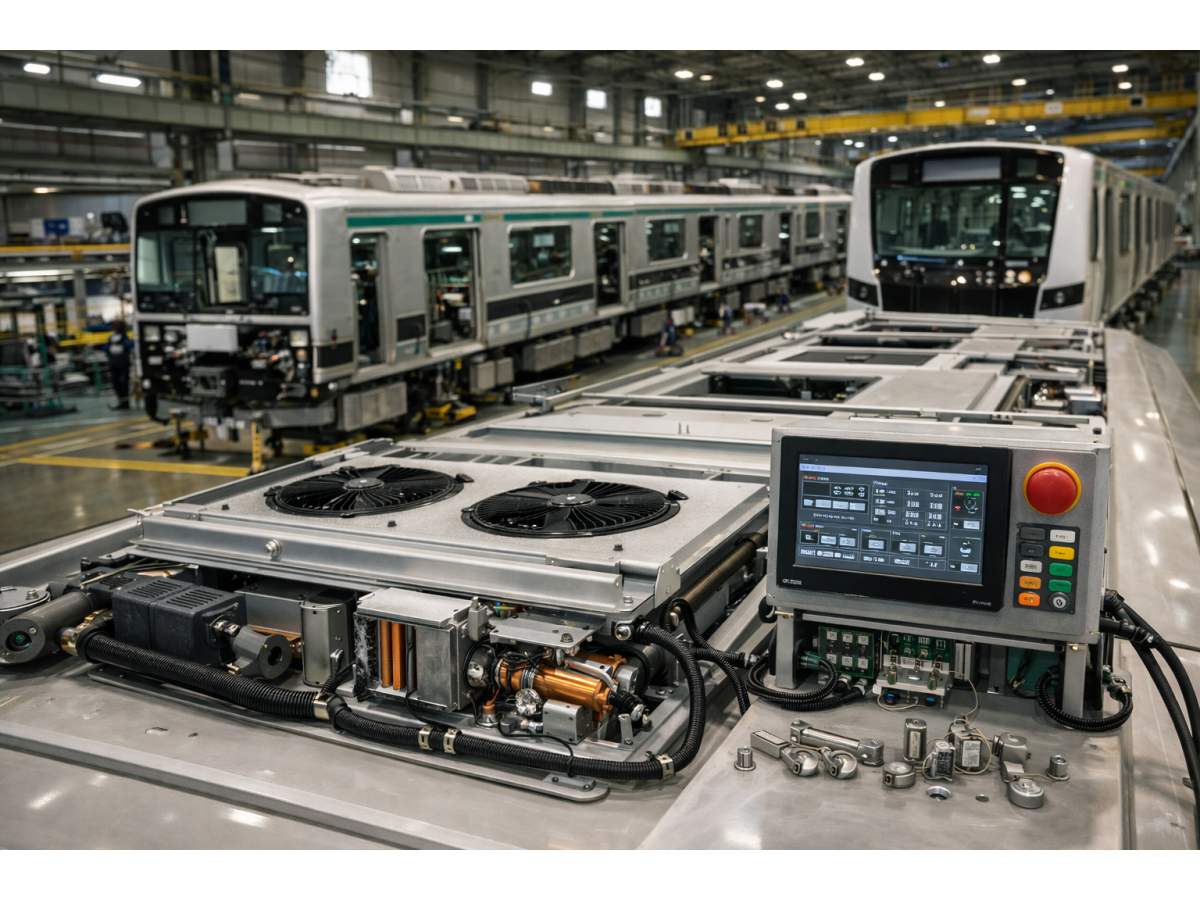
Railway mechanical and interior equipment can contain vibration-exposed bolted joints.
Fastener and locking selection should follow the applicable project requirements, joint function, environmental conditions, and required standards.
Thermal cycling, vibration, structural loading, and long service periods can make preload behavior important.
Engineered disc springs may be used where controlled spring force or compensation is required.
Disc springs and other elastic components may be used for bearing preload, mechanical compensation, valve systems, or bolted assemblies depending on the machine design.
A second-source spring washer should not be approved solely because its dimensions look similar.
A useful qualification principle is:
Visual Similarity ≠ Material Equivalence ≠ Spring Equivalence ≠ Joint Equivalence
nominal size;
inside diameter;
outside diameter;
section dimensions;
free geometry;
material;
hardness where specified;
surface finish;
applicable ISO/DIN or customer specification.
inside diameter;
outside diameter;
thickness;
free height;
cone height;
material;
heat treatment;
hardness where specified;
surface finish;
load-deflection requirement;
operating deflection;
applicable specification.
If spring performance matters, dimensional inspection alone may not establish functional equivalence.
For engineered disc springs, procurement teams may need functional verification at defined deflections.
A meaningful requirement should identify:
test deflection;
expected force or force range;
test condition;
sample plan;
acceptance criteria.
Simply requesting “spring force” without defining deflection is incomplete because spring force changes with displacement.
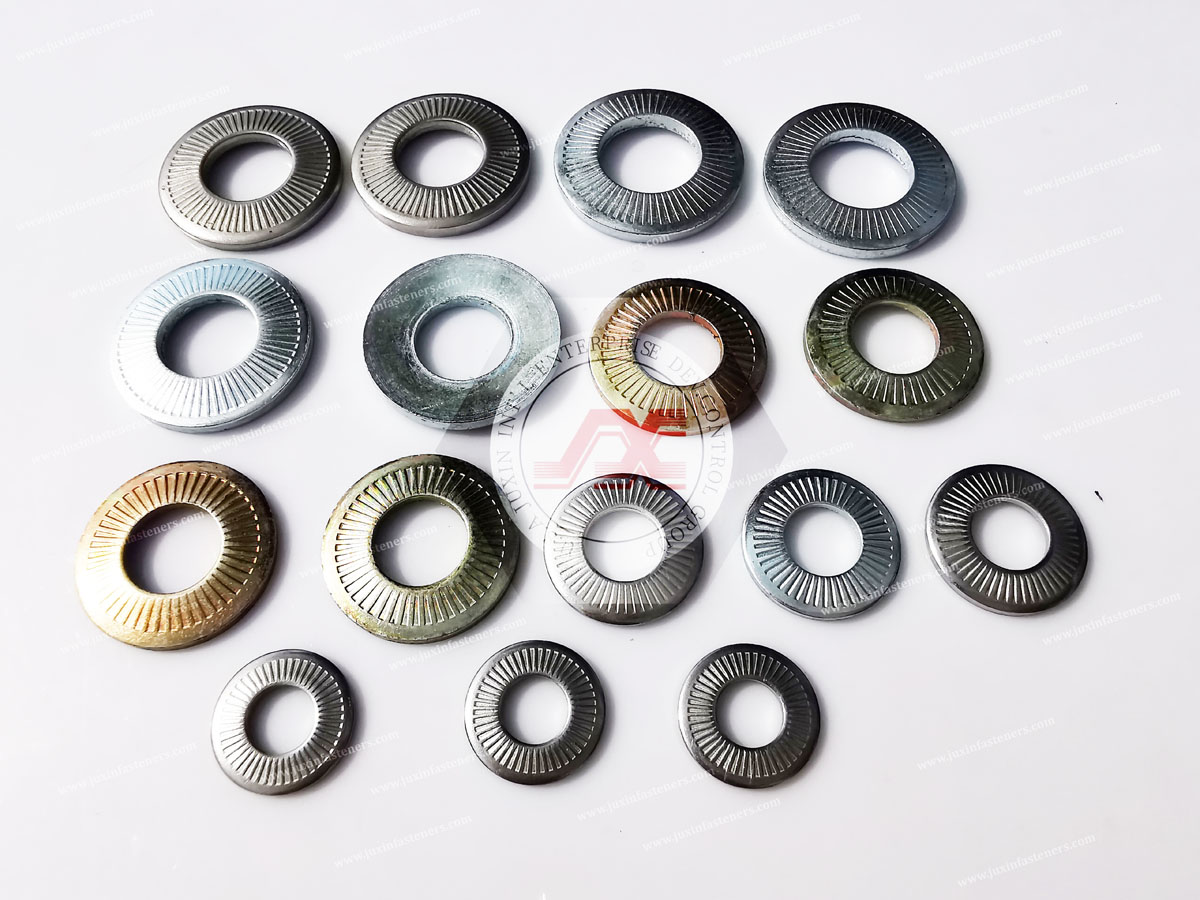
A physical washer sample can help identify:
configuration;
dimensions;
thickness;
free height;
finish.
But a sample may not reveal:
exact material;
heat treatment;
hardness requirement;
load-deflection specification;
coating specification;
hydrogen-embrittlement process requirements;
original tolerance;
operating conditions.
For second-source development, drawings and application requirements should accompany samples whenever possible.
Before approving a second source for spring washers or disc springs, consider defining:
approved drawing revision;
washer type;
nominal bolt or shaft size;
inside diameter;
outside diameter;
thickness;
free height where applicable;
cone height where applicable;
material;
heat treatment;
hardness where specified;
surface finish;
applicable ISO, DIN, EN, ASME/ANSI, SAE, ASTM or customer requirements;
required spring force;
test deflection;
operating deflection;
operating temperature;
corrosion requirement;
hydrogen-embrittlement controls where relevant;
inspection requirements;
sample-validation requirements;
packaging;
production quantity;
estimated annual usage.
For technical review and quotation, provide as much of the following information as applicable:
2D drawing;
3D model where relevant;
existing or competitor part number;
physical sample for cross-reference;
washer type;
nominal bolt size;
inside diameter;
outside diameter;
thickness;
free height or cone height where applicable;
required material;
hardness or heat treatment where specified;
coating or finish;
target bolt preload where relevant;
tightening torque where specified;
required spring force and corresponding deflection;
operating temperature;
vibration or dynamic loading information;
corrosion environment;
applicable international or customer standard;
inspection/documentation requirements;
sample quantity;
production quantity;
estimated annual usage.
JUXIN FASTENERS can use this information to evaluate washer configuration, dimensional and material requirements, existing-part cross-reference feasibility, sample requirements, and the appropriate production sourcing route.
For engineering teams, the correct path is:
Identify Failure Mechanism → Determine Required Function → Calculate Joint/Load Requirements → Select Washer or Locking Technology → Define Material & Finish → Validate
For procurement teams:
Drawing / Existing Part → Critical Characteristic Review → Dimensional & Material Cross-Reference → Spring Performance Review → Sample Validation → Second-Source Approval → Production RFQ
The most important principle is:
Do not ask whether a spring washer is “good for vibration” until you know why the bolted joint is losing clamp load.
Embedding, creep, thermal movement, insufficient preload, and vibration-induced rotational loosening are different engineering problems.
The correct fastening solution begins by identifying which one is actually occurring.
Email: info@juxinfasteners.com
Website: www.juxinfasteners.com
 MORE NEWS
Sep. 30, 2026
Sep. 30, 2026
Sep. 30, 2026
Contact Us
Tel.:
+86 020 8621 0320
+86 020 3121 6067
E-mail:
Technical Support:
Navigation
SEND INQUIREY