
Call Us
+86 136 6007 9809
Call Us
+86 136 6007 9809

Sep. 02, 2026
Glass-filled plastics and reinforced polymers are widely used in automotive, electrical, industrial and high-performance applications where higher stiffness, dimensional stability and mechanical strength are required.
However, adding glass fiber to a polymer changes the behavior of the material around a fastening point.
When a metal threaded insert is installed into a glass-filled plastic component, the insert, polymer matrix, reinforcement fibers and surrounding boss work together as a mechanical system.
For this reason, threaded inserts for glass-filled plastics require a more application-specific approach than inserts used in many unfilled thermoplastics.
Design engineers, structural engineers, procurement managers and supply chain teams should consider the resin grade, fiber content, fiber orientation, boss geometry,
insert profile, installation method and required mechanical performance before releasing an insert specification.
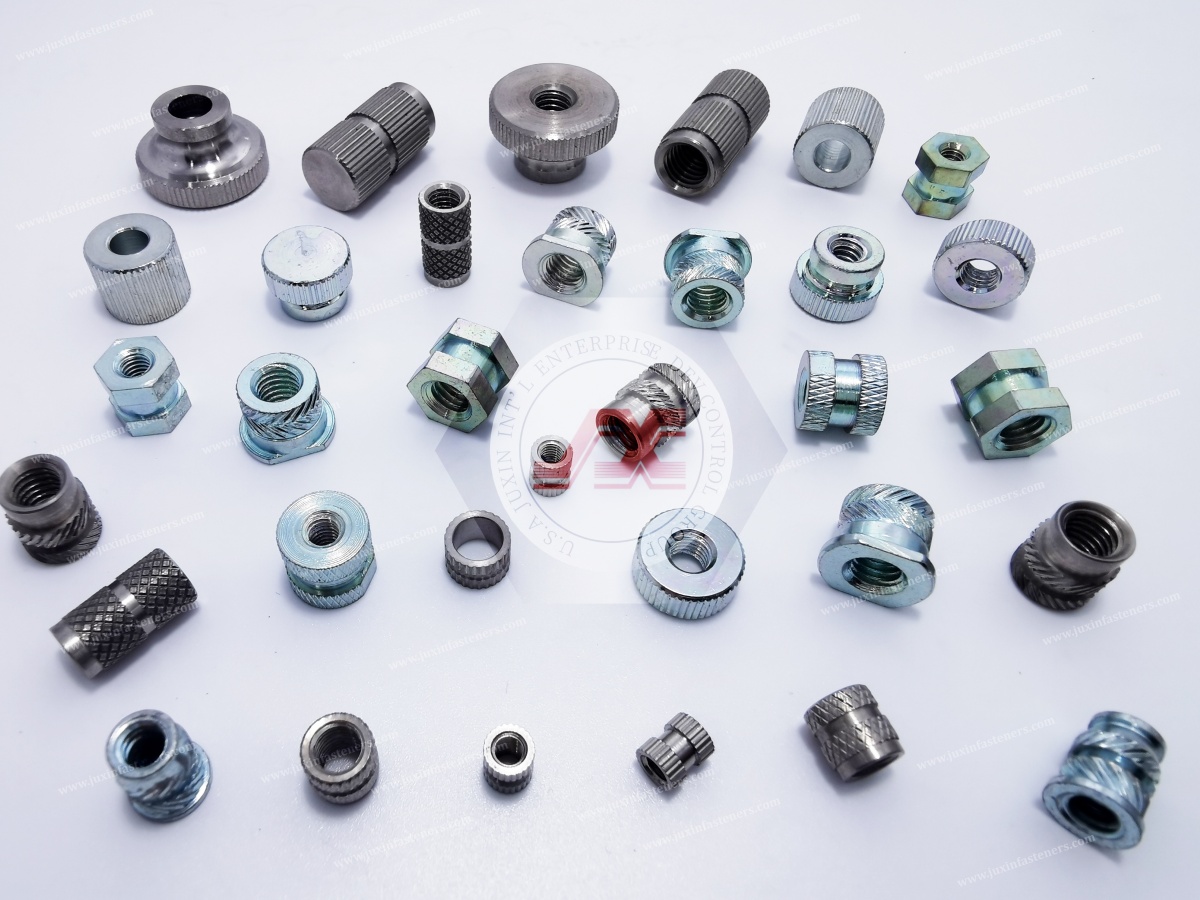
Glass-filled polymers can provide higher stiffness and strength than many unfilled plastics.
A metal threaded insert adds a durable internal thread to the component.
This combination can provide a practical fastening solution for injection-molded structural and semi-structural components.
The metal insert provides the screw interface while the reinforced polymer transfers loads into the surrounding component.
Typical reasons for using glass-filled plastic threaded inserts include:
Creating durable metal threads
Improving resistance to thread stripping
Supporting repeated assembly
Providing controlled screw engagement
Increasing fastening reliability
Integrating fastening points into lightweight components
Supporting automated OEM assembly
The insert should be designed as part of the component rather than treated as an isolated hardware item.
Glass-filled plastics are polymers reinforced with glass fibers.
Common examples include:
Glass-filled nylon / PA
Glass-filled PBT
Glass-filled PEEK
Glass-filled polycarbonate
Other reinforced engineering thermoplastics
The percentage of glass fiber can vary significantly between material grades.
A 15% glass-filled material may behave differently from a 30% or 40% glass-filled grade.
Therefore, specifying only "glass-filled nylon" may not provide enough information for an insert supplier.
The actual resin grade and reinforcement level should be included whenever possible.
One of the most important considerations when designing threaded inserts for reinforced plastics is fiber orientation.
During injection molding, glass fibers can become oriented according to polymer flow.
This means that the mechanical properties of the component may not be completely uniform in every direction.
Around a threaded insert boss, fiber orientation can influence:
Local stiffness
Stress distribution
Pull-out performance
Cracking behavior
Dimensional stability
Long-term mechanical performance
For demanding applications, the insert location and boss geometry should therefore be considered together with the injection-molding process.
Threaded inserts for glass-filled nylon are particularly relevant to automotive, electrical and industrial applications.
Glass-filled PA can provide increased stiffness and strength compared with unfilled nylon.
However, it can also create a different installation environment for the insert.
Engineers should evaluate:
PA resin grade
Glass-fiber percentage
Moisture condition
Boss diameter
Boss wall thickness
Insert diameter
Insert length
Installation method
Required torque
Pull-out strength
A design developed for unfilled nylon should not automatically be transferred to glass-filled nylon without validation.
PBT is commonly used in electrical, electronic and automotive components.
Glass-filled PBT can provide enhanced stiffness and dimensional stability.
For threaded inserts for glass-filled PBT, the insert profile and installation process should be evaluated against the actual PBT grade.
Important considerations include:
Fiber reinforcement
Component wall thickness
Boss geometry
Installation temperature
Insert retention
Tightening torque
Operating temperature
Applications may include electrical housings, automotive connectors, electronic modules and industrial components.
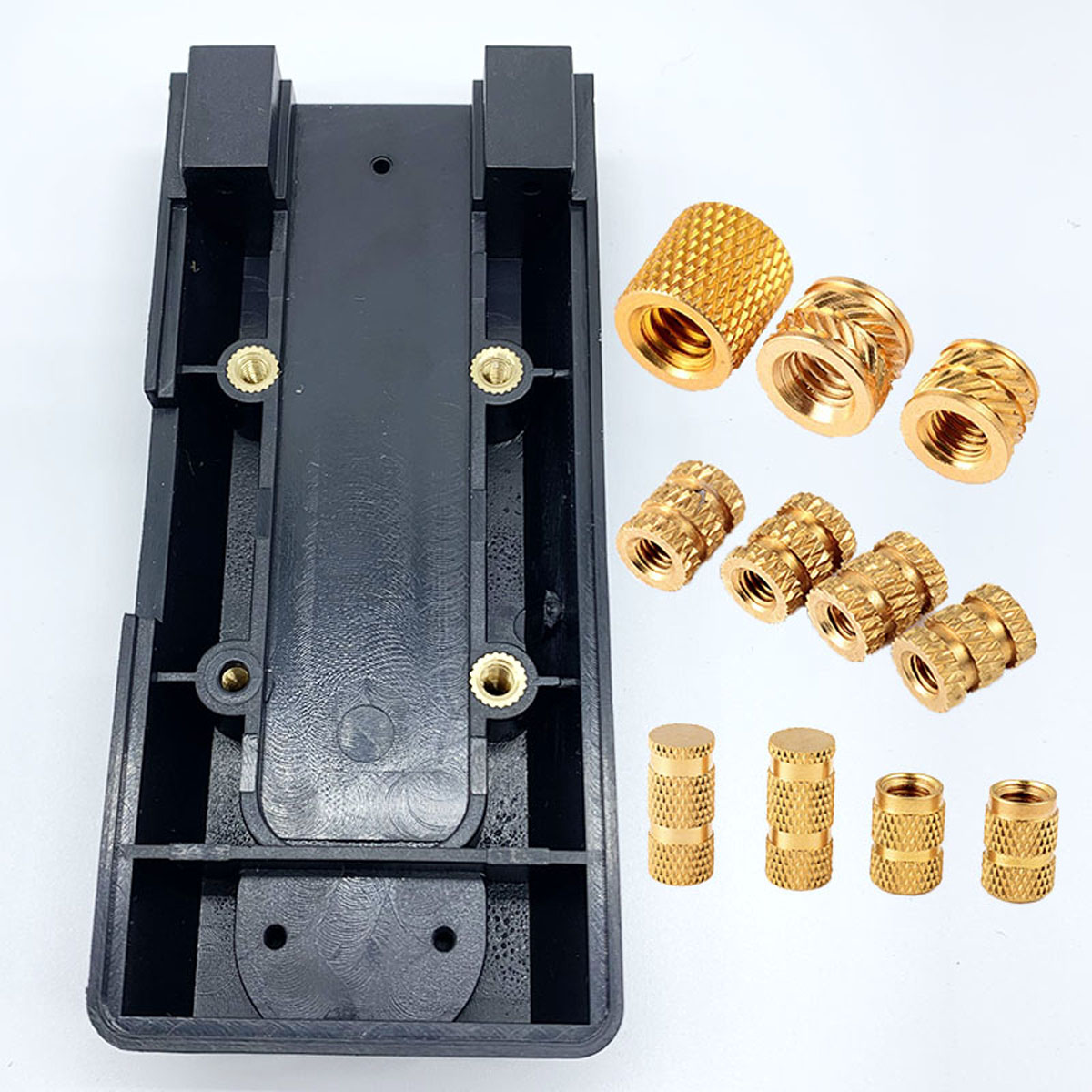
Glass-filled PEEK is a high-performance engineering material used in demanding applications.
The combination of PEEK and glass fiber can provide high mechanical performance and dimensional stability.
For threaded inserts for glass-filled PEEK, the design process should consider:
PEEK grade
Glass-fiber content
Component geometry
Processing conditions
Installation method
Operating temperature
Chemical exposure
Required mechanical performance
Because PEEK differs significantly from common thermoplastics, insert installation parameters should be developed specifically for the actual material and component.
A threaded insert does more than provide an internal thread.
The external surface transfers mechanical loads into the surrounding polymer.
Depending on the insert design, external features can include:
Knurling
Ribs
Barbs
Grooves
Undercuts
Flanges
The objective is to achieve sufficient mechanical retention without creating excessive local stress.
A more aggressive external profile is not automatically a better solution.
The profile must be matched to:
Resin + fiber content + boss geometry + installation method + required load
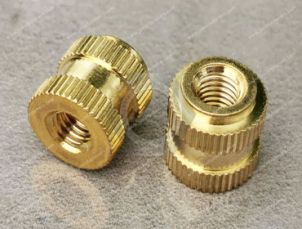
Knurled threaded inserts use an external pattern to increase mechanical engagement with the surrounding plastic.
Knurl geometry can help resist rotational movement when the mating screw is tightened.
However, the knurl should be selected according to the actual material and component design.
An aggressive knurl in a thin or brittle boss may increase local stress rather than improve the overall fastening system.
Undercut profiles can allow the polymer to mechanically lock around the insert.
This can increase axial retention in suitable applications.
Undercut geometry may be considered when pull-out resistance is an important design requirement.
The surrounding plastic must have sufficient material and suitable flow characteristics to engage with the profile.
A flange provides a defined seating surface at the end of the insert.
Depending on the component design, a flange can help distribute loads and control the insert's position.
Flanged inserts can be useful when the component geometry allows a larger seating area around the fastening point.
The plastic boss is critical to insert performance.
Important dimensions include:
Boss outside diameter
Boss height
Wall thickness
Hole diameter
Insert outside diameter
Insert length
Installation depth
Distance from edges
Nearby ribs
Adjacent features
The boss should provide sufficient structural support without creating unnecessary material concentration.
Thin boss walls can increase the risk of local damage during insert installation.
Excessive interference can create high radial stress.
Insufficient interference can reduce retention.
For this reason, the relationship between insert outside diameter, hole diameter and boss dimensions should be evaluated as a complete system.
Insert length influences the available load-transfer area.
A longer insert can provide additional engagement with the surrounding polymer, but the available boss depth must be sufficient.
Insert length should be selected according to:
Required pull-out resistance
Boss height
Component thickness
Available thread engagement
Installation depth
A longer insert is not automatically the correct solution.
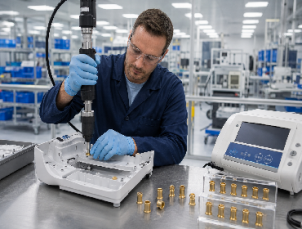
Several installation methods can be considered depending on the resin and component design.
Molded-in inserts are positioned in the injection mold before the plastic is injected.
The polymer flows around the external insert profile during molding.
Advantages can include:
Integrated fastening points
High production efficiency
Consistent insert location
Reduced secondary assembly
Suitability for high-volume OEM production
Mold design and insert positioning are particularly important.
Heat staking inserts are installed after molding.
Controlled heat softens the thermoplastic around the installation point, allowing the insert to be pressed into position.
For glass-filled plastics, the actual resin grade and reinforcement level should determine the installation parameters.
Important process variables include:
Temperature
Heating time
Installation force
Insertion depth
Cooling time
Ultrasonic threaded inserts use localized mechanical energy to generate heat around the insert.
This method can provide fast and repeatable installation for suitable high-volume applications.
The ultrasonic process should be developed for the specific glass-filled polymer and component.
Press-in threaded inserts rely on mechanical interference rather than thermal softening.
They can be considered when:
Heat should be avoided
Post-molding installation is required
The plastic can tolerate insertion force
Simple mechanical installation is preferred
For glass-filled plastics, the interference level should be carefully controlled.
Press-in applications require a controlled relationship between the insert and prepared hole.
Too much interference can increase:
Installation force
Radial stress
Boss deformation
Cracking risk
Too little interference can reduce:
Pull-out resistance
Torque-out resistance
Long-term retention
Because reinforced plastics have different stiffness and fracture behavior from unfilled polymers, press-fit parameters should be established using the actual material grade.
Pull-out resistance is the axial force required to remove the insert from the plastic component.
It can be influenced by:
Insert length
External profile
Boss geometry
Plastic strength
Glass-fiber content
Fiber orientation
Installation method
Component thickness
For demanding OEM applications, pull-out testing should be performed using representative production components.
Torque-out resistance describes the ability of the insert to resist rotation when the mating screw is tightened.
This is particularly important when a defined screw tightening torque is required.
The result can be affected by:
External knurl geometry
Insert diameter
Boss dimensions
Plastic properties
Fiber orientation
Installation quality
Screw torque
The insert should therefore be selected according to the actual assembly torque rather than thread size alone.
Automotive, EV, industrial and power-electronics applications may experience repeated temperature changes.
Different materials can expand and contract at different rates.
The fastening system should therefore be evaluated under the actual or representative temperature range.
Important considerations include:
Plastic thermal expansion
Insert material
Component geometry
Temperature range
Number of thermal cycles
Retention after cycling
For demanding applications, thermal-cycle testing can be included in the validation program.
The metal used for the threaded insert should also be selected according to the application.
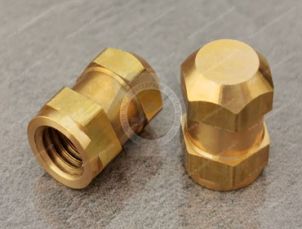
Brass threaded inserts are widely used for plastic and reinforced plastic components.
Brass can provide:
Good machinability
Reliable internal threads
Electrical conductivity
Thermal conductivity
Practical cost efficiency
It is commonly considered for automotive electronics, electrical equipment, industrial housings and electronic products.
Aluminum threaded inserts can be considered where weight reduction is important.
They can provide a metal fastening interface while minimizing additional mass.
Stainless steel threaded inserts can be considered for applications requiring increased corrosion resistance or specific mechanical performance.
Potential applications include:
Outdoor equipment
Industrial machinery
High-humidity environments
Marine-related equipment
Corrosive environments
The appropriate grade should be selected according to the actual operating environment.
Automotive manufacturers use reinforced plastics in many applications where stiffness, weight and dimensional stability are important.
Threaded inserts for automotive glass-filled plastics can support:
Electronic housings
Sensor assemblies
Brackets
Covers
Electrical modules
Structural plastic components
The fastening system may need to withstand:
Vibration
Thermal cycling
Repeated assembly
Automotive environmental exposure
Application-specific validation is recommended for critical fastening points.
EV systems increasingly use engineered polymers for electrical and mechanical components.
Potential applications include:
Battery-related components
Electronic housings
Power electronics
Charging equipment
Sensor assemblies
Electrical modules
For threaded inserts for EV components, engineers should consider temperature, vibration, dimensional stability and long-term retention.
The insert material should also be evaluated for compatibility with the operating environment.
Glass-filled polymers are frequently used in electrical components because they can provide stiffness and dimensional stability.
Threaded inserts can provide durable fastening points for:
Electrical housings
Connectors
Control modules
Power electronics
Terminal assemblies
Protective covers
Brass may be considered where electrical conductivity is relevant.
Industrial equipment and robotics often require lightweight housings and reliable mounting points.
Threaded inserts for reinforced plastic components can be used for:
Sensor mounting
Controller housings
Protective covers
Brackets
Actuator components
Electronic modules
Repeated assembly and vibration should be considered where components require regular service.
The term "composite" covers a wide range of material systems.
Not every composite behaves like an injection-molded glass-filled thermoplastic.
Composite components may include different reinforcement architectures, resin systems and manufacturing processes.
For threaded inserts for composite components, engineers should therefore evaluate:
Resin system
Fiber type
Fiber orientation
Laminate structure
Component thickness
Local reinforcement
Insert geometry
Load direction
Installation process
In some composite applications, the fastening solution may need to be integrated into the laminate or molded structure rather than installed using a conventional press-fit method.
Reinforcement changes material behavior.
Insert selection should consider the actual glass-fiber content and resin grade.
Injection molding can influence fiber orientation around the boss.
This can affect local mechanical performance.
More aggressive external geometry does not automatically mean better retention.
It may increase installation force or local stress.
High interference can create cracking or deformation.
Insufficient surrounding plastic can reduce the strength of the fastening point.
The internal thread is only one part of the insert specification.
Outside diameter, length, profile and installation method are equally important.
For automotive, EV and industrial applications, the fastening system may experience significant temperature variation.
Retention should be evaluated after representative environmental exposure where required.
A robust validation program should use the actual:
Resin + fiber content + component geometry + insert + installation process + mating screw
Potential tests include:
Measures axial retention of the insert.
Measures resistance to insert rotation.
Confirms thread performance and assembly consistency.
Evaluates performance after multiple screw installation and removal cycles.
Checks insert position, height, alignment and thread condition.
Evaluates retention and dimensional behavior after temperature changes.
Depending on the application, testing may include humidity, vibration, corrosion or chemical exposure.
For an RFQ, procurement teams should provide as much application information as possible.
Recommended information includes:
Plastic resin
Resin grade
Glass-fiber percentage
Component drawing
Boss diameter
Boss height
Wall thickness
Hole diameter
Insert outside diameter
Insert length
Thread specification
External profile
Installation method
Insert material
Surface treatment
Required tightening torque
Pull-out requirement
Operating temperature
Environmental conditions
Annual production volume
This information allows the supplier to evaluate the insert as part of the complete fastening application.
Standard inserts may not always meet the requirements of a reinforced plastic component.
Custom threaded inserts for glass-filled plastics can be developed around the customer's component geometry and production process.
Customization may include:
Thread size
Thread pitch
Outside diameter
Overall length
Thread depth
Knurl geometry
Rib geometry
Barb profile
Undercuts
Flanges
Blind-end configuration
Through-hole configuration
Brass
Aluminum
Stainless steel
Special dimensional tolerances
Surface treatments
For custom OEM projects, engineering drawings and resin specifications provide valuable information for insert development.
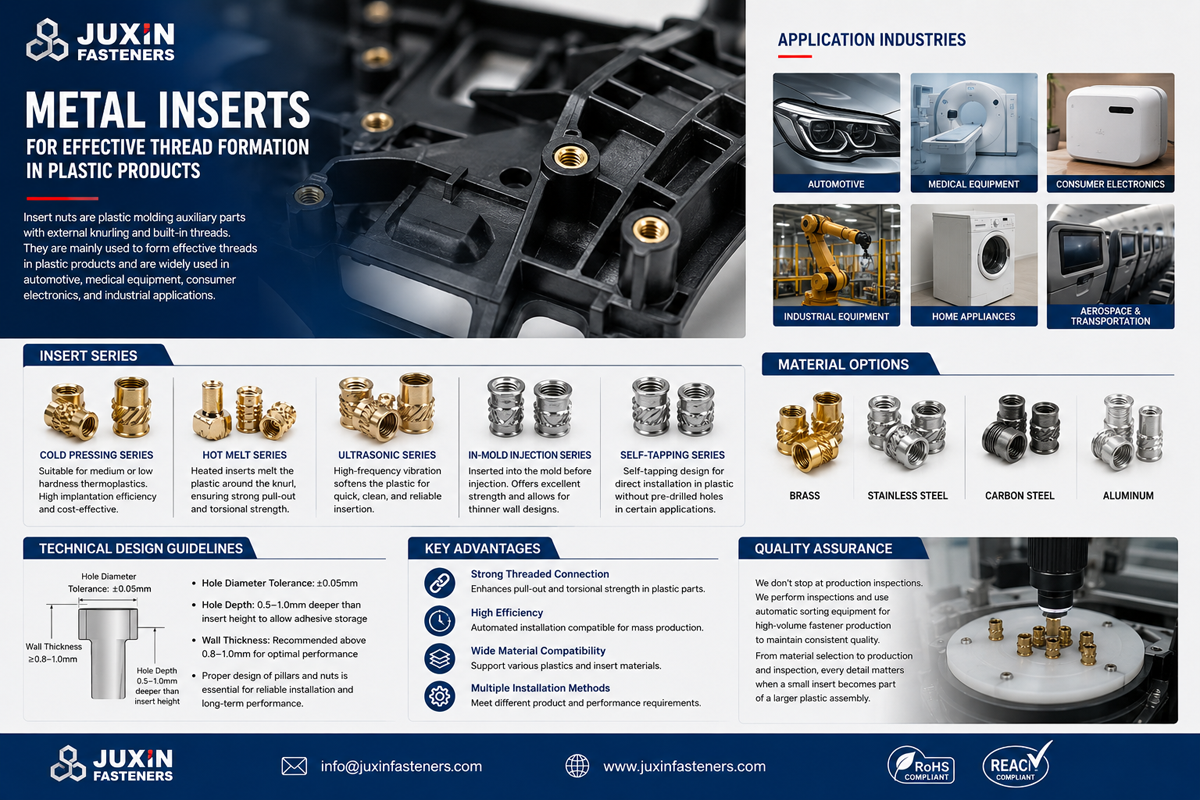
JUXIN Fasteners supports OEM and industrial customers sourcing threaded inserts for glass-filled plastics, reinforced polymers and composite components.
Our threaded insert solutions can support applications across:
Automotive
EV
Electrical equipment
Electronics
Power electronics
Industrial machinery
Robotics
Telecom
HVAC
Medical equipment
Precision equipment
Composite components
Available fastening approaches can include:
Molded-in threaded inserts
Heat staking inserts
Ultrasonic threaded inserts
Press-in threaded inserts
JUXIN supports custom requirements based on engineering drawings, component specifications and application conditions.
The objective is to match the insert to the complete fastening system:
Resin + glass-fiber content + fiber orientation + boss geometry + insert profile + installation method + mechanical requirements
If you are sourcing threaded inserts for glass-filled nylon, glass-filled PBT, glass-filled PEEK, reinforced plastics, composite components or other engineered thermoplastics, contact JUXIN Fasteners.
For faster technical evaluation, please provide:
Plastic resin and grade
Glass-fiber content
Component drawing
Boss dimensions
Wall thickness
Hole diameter
Thread specification
Insert dimensions
External profile
Installation method
Insert material
Surface treatment
Required tightening torque
Pull-out requirement
Operating temperature
Environmental conditions
Estimated annual quantity
JUXIN Fasteners supports OEM and industrial fastening requirements from product specification through production supply.
JUXIN Fasteners
23+ Years of Fastener Industry Experience
OEM & Industrial Fastening Solutions
Email: info@juxinfasteners.com
Website: www.juxinfasteners.com
Yes. Threaded inserts can be used in glass-filled nylon, but the resin grade, glass-fiber content, boss geometry, installation method and mechanical requirements should be evaluated together.
Glass-filled plastics can provide higher stiffness and strength than many unfilled polymers, but insert performance depends on the complete fastening system. Fiber orientation, boss geometry and installation conditions can significantly affect retention.
There is no single best insert for every application. Molded-in, heat staking, ultrasonic and press-in inserts can all be considered depending on the resin, component geometry, production process and required mechanical performance.
Yes. Fiber content and orientation can influence local stiffness, stress distribution, pull-out performance and dimensional behavior around the insert.
Yes, provided the component can tolerate the required interference and installation force. Hole diameter, insert outside diameter and boss geometry should be validated to avoid excessive stress or insufficient retention.
Knurled inserts can provide mechanical engagement with reinforced polymers, but the knurl geometry should be matched to the resin, fiber content, boss thickness and installation process.
Brass, aluminum and stainless steel are common options. Brass is widely used for general industrial and electronic applications, aluminum can reduce weight, and stainless steel can be considered where corrosion resistance or specific mechanical performance is required.
Typical validation can include pull-out testing, torque-out testing, screw installation testing, repeated assembly, dimensional inspection and environmental or thermal-cycle testing where required.
Yes. JUXIN Fasteners supports custom threaded inserts based on OEM drawings, component specifications and application requirements, including customized dimensions, threads, external profiles and materials.
 MORE NEWS
Contact Us
Tel.:
+86 020 8621 0320
+86 020 3121 6067
E-mail:
Technical Support:
Navigation
SEND INQUIREY