Call Us
+86 136 6007 9809
Call Us
+86 136 6007 9809

Sep. 02, 2026
Both tapped plastic threads and threaded inserts can be effective fastening solutions for plastic components.
The better choice depends on the load, tightening torque, number of assembly cycles, plastic material, boss design, service requirements and manufacturing process.
Directly tapped plastic threads can be suitable for low-load applications with limited assembly cycles and controlled tightening torque.
Threaded inserts should be evaluated when the application requires:
Repeated assembly and disassembly
Higher or more consistent tightening torque
Better thread durability
Longer service life
More consistent machine-screw engagement
Improved resistance to thread wear in demanding applications
The engineering objective is not simply to choose a metal insert over a plastic thread. It is to select the simplest fastening method that reliably satisfies the complete application requirement.
A tapped plastic thread is a female thread machined or formed directly into a plastic component.
During assembly, a machine screw engages directly with the polymer threads.
This approach eliminates the additional component and installation process associated with a threaded insert. For suitable materials and loading conditions, it can provide a simple and economical fastening solution.
Common applications include:
Plastic housings
Covers
Electronic enclosures
Sensor housings
Consumer products
Low-load equipment assemblies
Components that are assembled only a limited number of times
However, polymer threads do not behave exactly like metal threads.
The engineering performance depends strongly on the plastic resin, reinforcement, thread geometry, boss design, tightening torque and service temperature.
The plastic component does not require a separate threaded insert.
This can reduce:
Component count
Assembly operations
Insert installation requirements
Secondary processing
For simple, low-load applications, eliminating the insert may reduce piece-part cost.
However, piece-part price should not be the only procurement consideration. Assembly labor, scrap, service requirements and lifecycle performance can change the total cost of ownership.
Depending on the plastic component and production process, threads may be created by tapping, molding or other forming methods.
This can be attractive for high-volume products where the design has already been validated for direct plastic threading.
The most obvious failure mode is thread stripping.
If the applied torque or axial load exceeds the load-bearing capability of the polymer threads, the screw can pull through or damage the thread profile.
This risk increases when:
The plastic has relatively low shear strength
Thread engagement is short
Tightening torque is excessive
The boss is undersized
The assembly is repeatedly serviced
Many thermoplastics are viscoelastic materials.
Under sustained mechanical loading, polymer deformation can occur over time.
This means that a threaded connection designed only from its initial tightening condition may not behave the same way after long-term exposure to load or elevated temperature.
Repeated installation and removal can gradually damage polymer threads.
The problem is particularly important when a product must be opened for:
Maintenance
Battery replacement
Calibration
Service
Inspection
Repair
For these applications, engineers should evaluate whether the direct plastic thread can maintain acceptable performance throughout the expected product life.
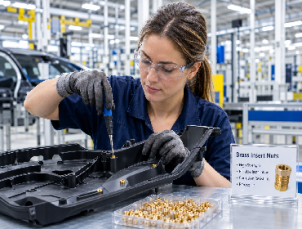
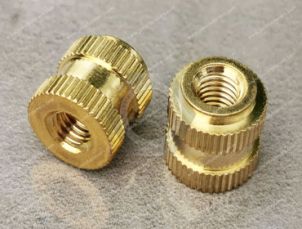
A threaded insert is a separate component installed into a plastic part to provide a more durable internal thread.
The insert transfers the screw engagement from the polymer itself to a metal or other engineered insert material.
Common threaded insert designs include:
Heat-staking inserts
Ultrasonic inserts
Press-fit inserts
Barbed inserts
Molded-in inserts
Flanged inserts
Knurled inserts
Custom threaded bushings
Materials can include brass, stainless steel and aluminum, depending on the application.
Threaded inserts are widely used in plastic housings and structural components where the screw connection must provide predictable mechanical engagement over the product's service life.
One of the strongest reasons to evaluate a threaded insert is repeated assembly.
When a plastic housing is opened and closed many times, the polymer threads can experience wear.
A properly selected threaded insert provides a durable machine-screw interface that is designed for repeated assembly and serviceability.
Typical applications include:
Medical equipment housings
Automotive service components
Electronic enclosures
Battery-related assemblies
Industrial sensors
Handheld equipment
Equipment requiring periodic maintenance
When a joint requires higher or more tightly controlled tightening torque, engineers should evaluate whether the plastic thread can safely withstand the applied load.
A metal threaded insert can provide a more stable thread interface while transferring the resulting forces into the surrounding polymer structure.
The insert itself does not eliminate polymer deformation. Boss geometry, resin properties and installation quality still determine the overall joint performance.
For products expected to remain in service for years, thread durability can become more important than the initial component cost.
A threaded insert can help reduce the risk of premature failure associated with:
Thread wear
Thread stripping
Repeated assembly
Over-torque events
Service operations
A properly manufactured insert provides a defined internal thread geometry.
This can improve consistency between the screw and the female thread compared with relying entirely on a polymer thread.
However, the complete assembly still depends on dimensional control of the insert, hole, boss and mating screw.
| Engineering Factor | Directly Tapped Plastic Thread | Threaded Insert |
|---|---|---|
| Component cost | Lower potential cost | Higher component cost |
| Part count | One integrated component | Plastic part + insert |
| Assembly process | Simpler | Requires insert installation or molding |
| Low-load applications | Often suitable | May be unnecessary |
| Repeated assembly | Limited by resin and design | Generally better suited |
| Thread wear | Polymer-dependent | Insert material provides durable thread |
| Tightening torque | Must be carefully controlled | Can support more demanding joint designs |
| Creep consideration | Important | Still important in surrounding plastic |
| Boss design | Important | Critical |
| Installation control | Relatively simple | Insert installation must be controlled |
| Serviceability | Application-dependent | Often advantageous |
| TCO | Potentially lower for simple applications | Can be lower when lifecycle risk matters |
Thread stripping occurs when the polymer surrounding the screw thread cannot withstand the applied shear loading.
Typical causes include:
Excessive tightening torque
Insufficient thread engagement
Weak polymer
High operating temperature
Small boss dimensions
Repeated assembly
Engineers should evaluate both the screw and the plastic thread rather than selecting tightening torque independently of the component design.
A plastic thread may initially provide sufficient clamping force but gradually deform under sustained loading.
This is especially relevant for thermoplastics exposed to:
Continuous loads
Elevated temperatures
Long service periods
Material selection and joint design therefore need to be evaluated together.
Repeated screw installation can progressively damage polymer thread surfaces.
Signs include:
Increasing assembly torque variation
Reduced thread engagement
Loose screws
Visible thread deformation
Plastic debris
If the product requires frequent service, a threaded insert may provide a more robust design solution.
Using an insert does not automatically guarantee a successful plastic fastening system.
The insert and plastic boss must be designed as one mechanical system.
An improperly designed boss can crack during insert installation or assembly.
Potential causes include:
Insufficient boss wall thickness
Excessive installation force
Incorrect hole size
Excessive interference
Poor insert geometry
Brittle or highly filled resin
A preliminary DFM guideline is to provide adequate boss wall thickness around the insert, but the correct dimension must be validated according to the resin, insert geometry, hole design and installation method.
Pull-out occurs when the insert is extracted from the plastic under axial loading.
The resistance depends on factors such as:
Insert outside diameter
Engagement length
Knurl or undercut geometry
Polymer properties
Installation quality
Boss geometry
For preliminary engineering analysis, a simplified polymer shear model can be expressed as:
Fp ≈ π × Dout × Leng × τpoly
Where:
Fp = simplified pull-out estimate
Dout = effective insert outside diameter
Leng = effective engagement length
τpoly = relevant polymer shear strength
This equation is only a preliminary engineering approximation. Actual pull-out performance must be validated through component-level testing and application-specific design analysis.
Torque-out occurs when the insert rotates inside the plastic instead of maintaining a stable threaded connection.
Potential causes include:
Incorrect hole size
Insufficient interference or retention geometry
Inadequate installation
Poor insert selection
Insufficient boss strength
Insert geometry should therefore be selected according to both the plastic material and the installation method.
Direct plastic threading can be a good solution when most of the following conditions apply:
The screw connection carries relatively low mechanical loading.
The product is assembled once or only a limited number of times during its expected life.
The assembly process can maintain a suitable tightening torque without excessive variation.
The product does not require frequent disassembly or long-term repeated servicing.
In these conditions, adding a threaded insert may create unnecessary component and assembly complexity.
A threaded insert should be evaluated when several of the following conditions apply:
| Requirement | Direct Plastic Thread | Threaded Insert |
|---|---|---|
| Low-load enclosure | Suitable candidate | Optional |
| Limited assembly | Suitable candidate | Optional |
| Frequent service | Risk should be evaluated | Strong candidate |
| Repeated assembly | Risk should be evaluated | Strong candidate |
| Higher tightening torque | Requires careful validation | Strong candidate |
| Long product life | Material-dependent | Strong candidate |
| High temperature | Requires resin evaluation | Strong candidate |
| High-value housing | Failure risk matters more | Strong candidate |
| Tight quality requirements | Application-dependent | Strong candidate |
The decision should always be based on the complete joint design rather than on a single rule such as assembly-cycle count.
Brass is widely used for plastic threaded inserts because it offers a practical balance of:
Machinability
Thread performance
Corrosion resistance
Thermal conductivity
Cost
Compatibility with common insert installation processes
Brass inserts are commonly considered for:
ABS
PA / Nylon
PA66-GF30
PC
PBT
PET
POM
Other engineering thermoplastics
Stainless steel can be considered when the application requires higher corrosion resistance, higher mechanical performance or specific material compatibility.
Common choices include:
Stainless steel 304
Stainless steel 316
Stainless steel 303
Selection should consider the complete environment, including temperature, moisture, chemical exposure, mechanical load and mating fastener material.
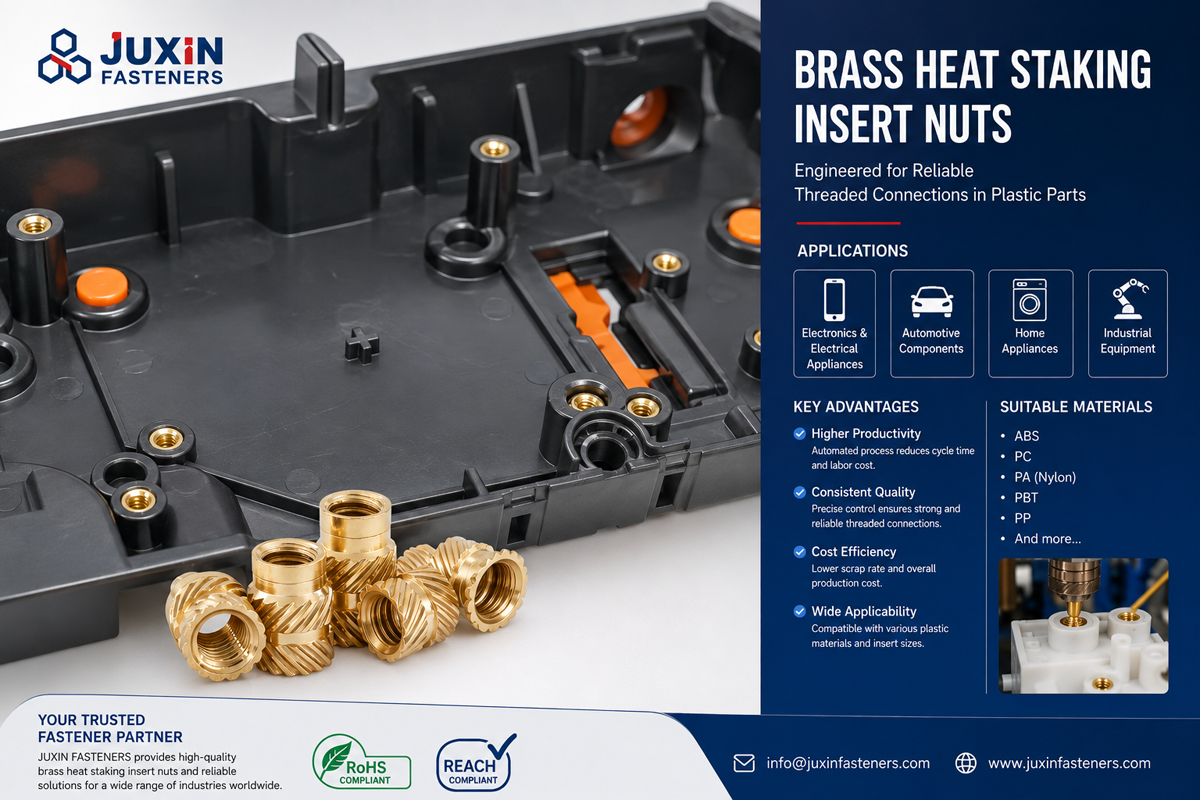
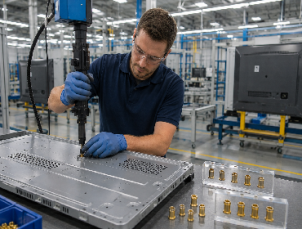
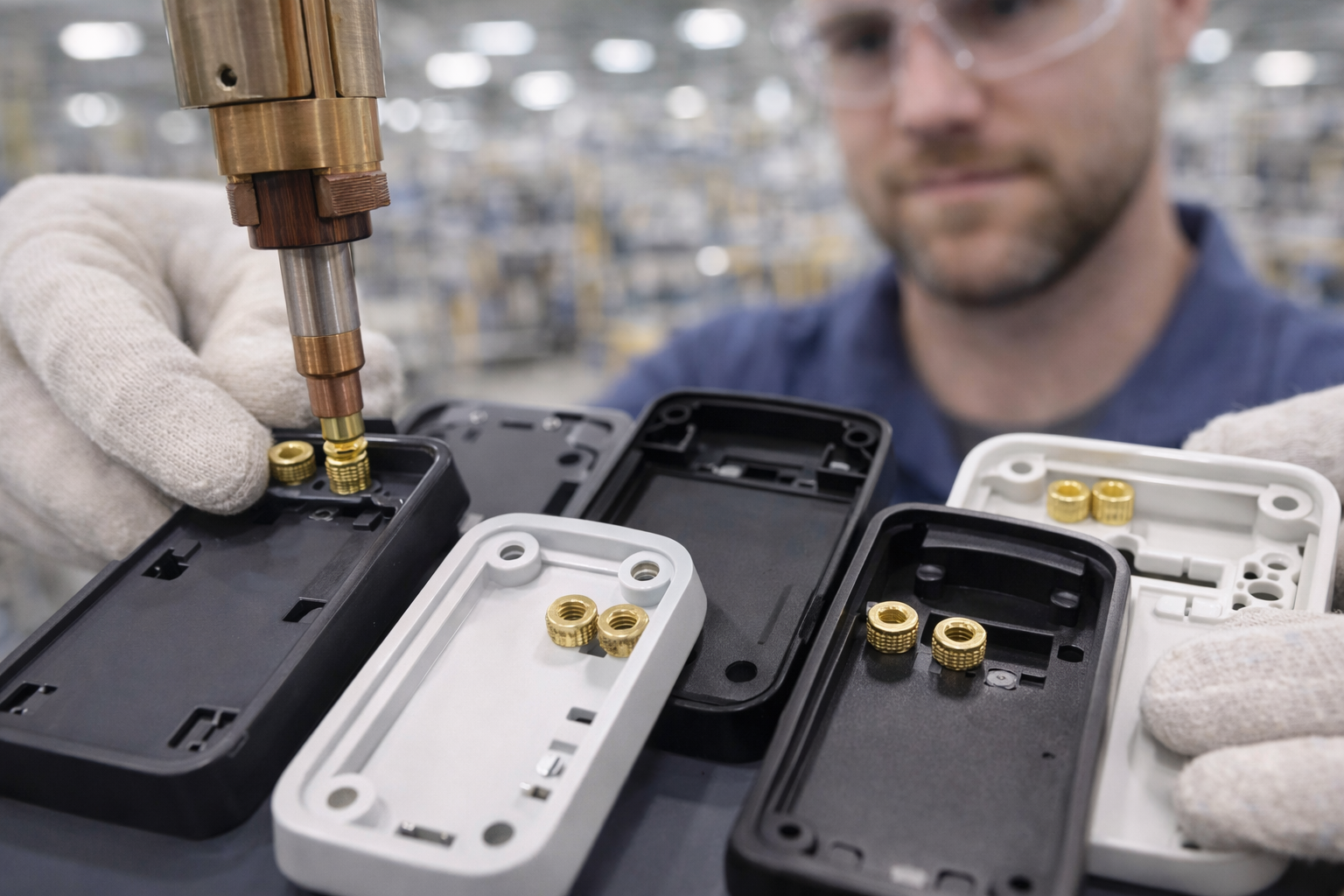
Heat staking softens the surrounding thermoplastic so that the insert can be embedded into the plastic component.
Advantages include:
Controlled installation
Good retention when properly designed
Suitable for many thermoplastic housings
Good production scalability
Ultrasonic installation uses vibration and heat generated at the interface to embed the insert into the plastic.
It can provide efficient automated installation when the plastic material and component geometry are suitable.
Typical operating frequency ranges used for ultrasonic plastic joining equipment can include approximately 20–40 kHz, depending on the equipment and process.
Press-fit inserts are mechanically installed into a prepared hole.
They can be attractive when:
Heat should be avoided
Ultrasonic equipment is not preferred
The plastic component has sufficient mechanical strength
The hole and interference can be controlled accurately
The correct installation method depends on resin properties, insert geometry, production volume and required retention performance.
The plastic resin has a major influence on threaded joint performance.
Engineers should consider:
Tensile strength
Shear strength
Creep behavior
Operating temperature
Glass-fiber reinforcement
Moisture absorption
Chemical exposure
Dimensional stability
Manufacturing process
Common materials used with threaded inserts include:
ABS
PA / Nylon
PA66-GF30
PC
PBT
PET
PEEK
POM
Epoxy
Bakelite and other thermosets
Glass-filled plastics can provide higher stiffness and strength, but they may also introduce different installation and boss-design considerations.
Therefore, the insert should be selected together with the actual resin grade rather than treating all plastics as equivalent.
The boss is one of the most important elements in a plastic threaded connection.
A good design should evaluate:
Boss outside diameter
Hole diameter
Insert outside diameter
Insert engagement length
Wall thickness
Distance to nearby features
Draft and molding limitations
Installation force
Local stress concentration
As a preliminary DFM guideline, the boss wall around an insert should provide sufficient material to resist installation and service loads. A commonly used starting point is a boss wall thickness around 0.8× the insert outside diameter, but this is not a universal standard.
The actual design must be validated according to:
Plastic resin
Reinforcement
Insert geometry
Installation method
Load
Temperature
Required safety factor
For hole depth, providing some additional depth beyond the insert length can help accommodate installation variation, but the actual value should be determined from the insert and component design.
When troubleshooting a plastic threaded joint, engineers should identify the actual failure mechanism rather than immediately changing the fastener.
| Failure | Possible Cause | Engineering Response |
|---|---|---|
| Thread stripping | Excessive torque / short engagement | Review thread design and torque |
| Boss cracking | Thin boss / excessive installation force | Increase support or change insert/process |
| Insert pull-out | Insufficient retention | Review insert geometry and engagement |
| Insert torque-out | Poor retention or hole condition | Review hole and insert design |
| Loose screw | Creep / relaxation | Review resin and joint design |
| Thread wear | Repeated assembly | Evaluate threaded insert |
| High torque variation | Dimensional or process variation | Review screw, insert and installation process |
Procurement teams often compare the unit price of a plastic component with and without an insert.
That comparison is incomplete.
A more useful TCO model considers:
Total Cost = Component Cost + Installation Cost + Quality/Rework Cost + Lifecycle/Service Risk
For a simple enclosure assembled once, a direct plastic thread may provide the best economic solution.
For a high-value product that requires repeated servicing, the additional cost of an insert may be justified by reducing the risk of:
Stripped threads
Housing replacement
Assembly defects
Service failures
Rework
Warranty exposure
The cheapest fastener is not necessarily the lowest-cost fastening solution.
When sourcing threaded inserts for plastic components, procurement teams should provide as much of the following information as possible:
Application
Plastic component
Assembly environment
Annual quantity
Production location
Required delivery schedule
Metric or inch thread
Thread size
Thread pitch
Thread tolerance
Internal thread requirement
Outside diameter
Overall length
Flange requirement
Knurl or retention geometry
Blind or through thread
Head configuration
Brass
Stainless steel
Aluminum
Lead-free brass where required
Other specified material
Heat staking
Ultrasonic
Press-fit
Molded-in
Customer-specified process
2D drawing
3D model
Material specification
Surface finish requirement
Mechanical performance requirements
Applicable compliance requirements
A complete RFQ package allows the supplier to evaluate the insert and the plastic component as a complete fastening system.
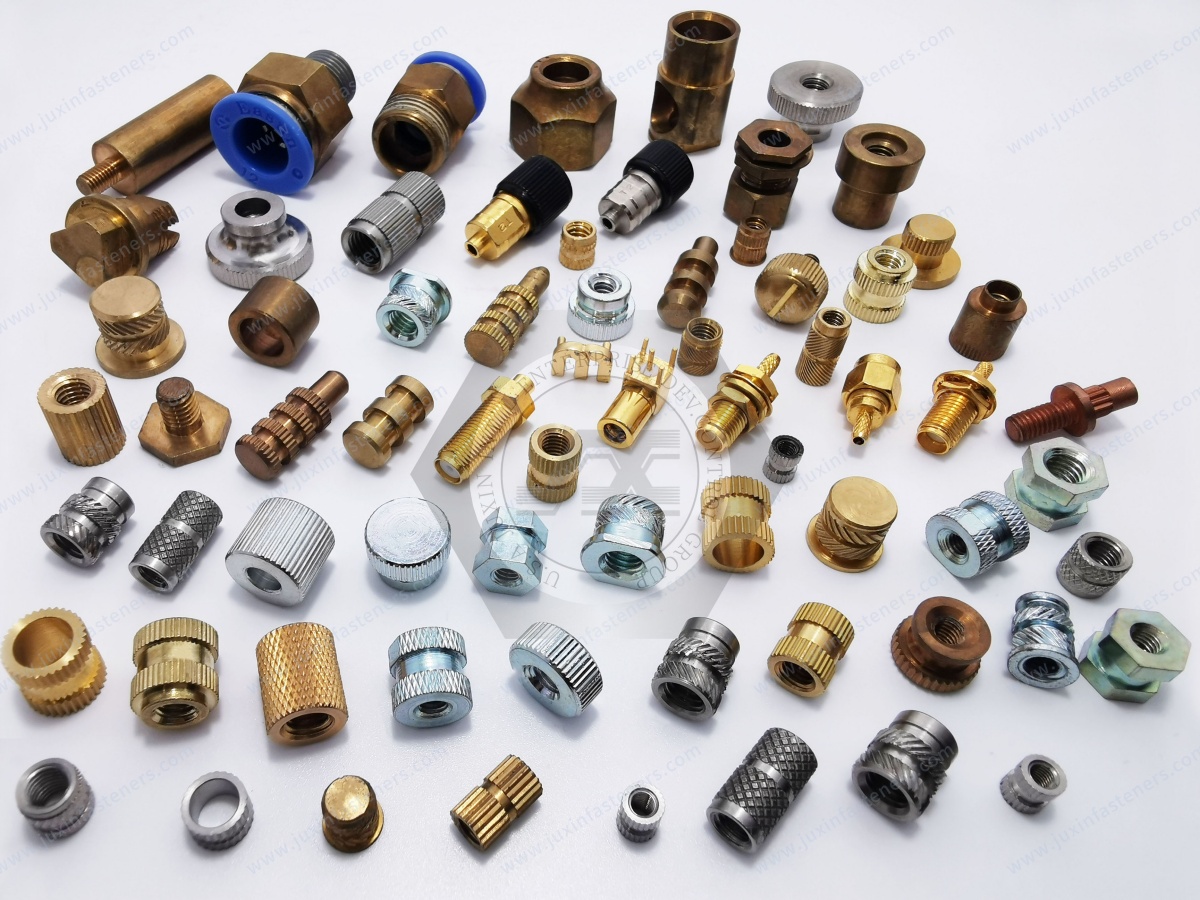
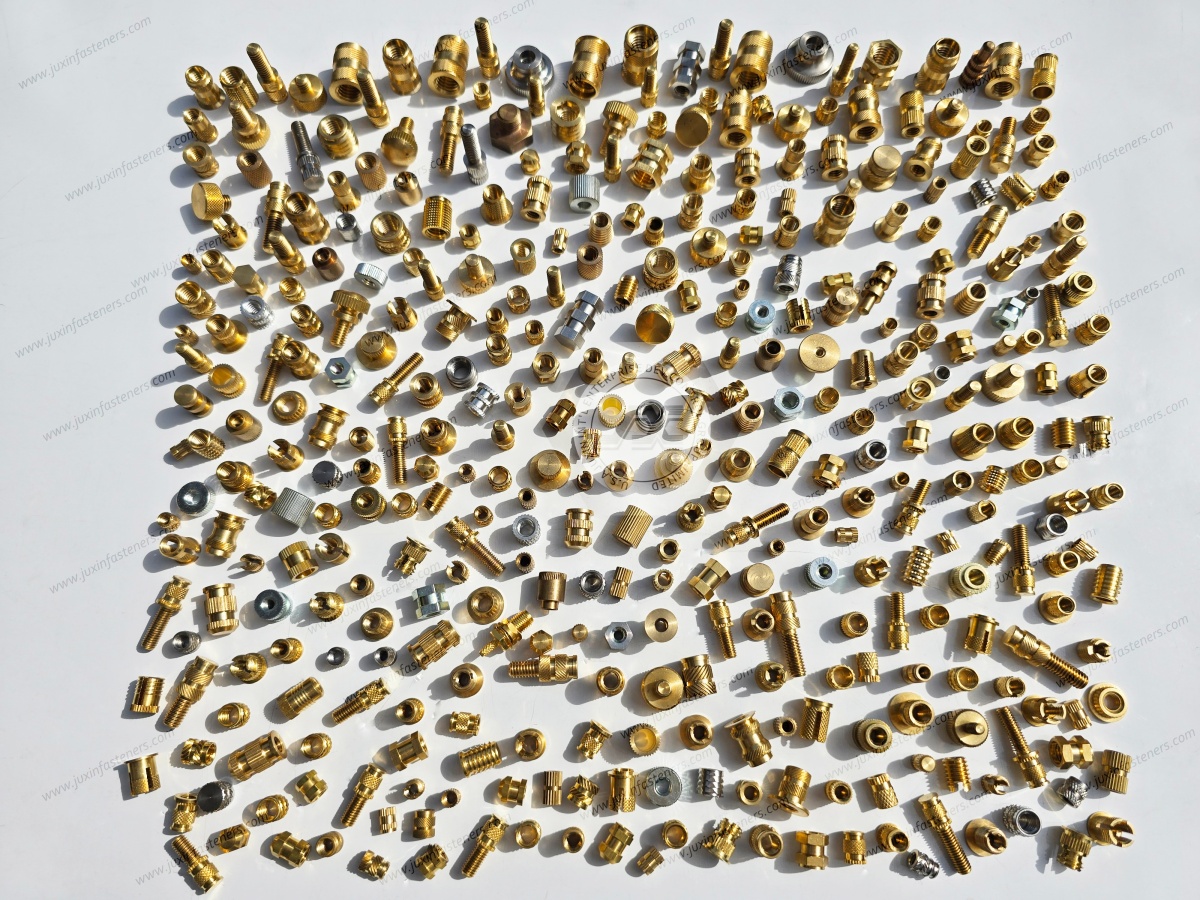
JUXIN Fasteners supplies threaded inserts and custom precision turned components for OEM plastic assemblies.
Available threaded insert solutions include:
Brass heat-staking inserts
Ultrasonic inserts
Press-fit inserts
Barbed inserts
Molded-in inserts
Flanged inserts
Straight and symmetrical inserts
Micro threaded inserts
Stainless steel inserts
Aluminum inserts
Lead-free brass options where required
Custom threaded bushings
Thread sizes can be developed across a broad range, including M1.6–M10 and #2-56 to 3/8-16, with typical insert lengths from approximately 2–20 mm, depending on design.
Available geometries can include:
Diamond knurl
Helical or opposing diagonal knurl
Longitudinal ribs
Deep annular undercuts
Tapered pilots
JUXIN can also support custom CNC-turned components such as:
Threaded bushings
Threaded standoffs
Precision pins
Custom shafts
Drawing-based turned hardware
For OEM projects, insert selection should begin with the application rather than with a catalog part number.
JUXIN can evaluate requirements including:
Plastic resin
Thread specification
Insert geometry
Installation method
Boss design
Material
Surface finish
Drawing requirements
Production quantity
Manufacturing capabilities include CNC machining, cold forging, stamping, screw heading and injection molding, supporting different OEM fastening and precision component requirements.
JUXIN operates under an ISO 9001 quality management system and can support projects requiring RoHS and REACH-related compliance documentation, subject to the specific product and material requirement.
Threaded inserts for plastic components are commonly evaluated in applications including:
Diagnostic housings, equipment covers, instrument assemblies and serviceable plastic enclosures.
Sensors, air intake components, interior assemblies and plastic structural or protective housings.
Electronic enclosures, control modules, handheld devices and smart sensors.
Machine covers, control panels, equipment housings and serviceable assemblies.
Sensor housings, actuator covers, lightweight structural components and equipment enclosures.
Plastic frames, housings and components where low weight must be combined with a durable threaded connection.
Not automatically in every application. A properly designed plastic thread can be sufficient for low-load applications. Threaded inserts are often advantageous when repeated assembly, higher tightening torque, thread durability or long-term serviceability are important.
Brass inserts are commonly used with ABS and many other thermoplastics. The correct insert geometry and installation process should be selected according to the specific ABS grade and component design.
Yes. Threaded inserts can be used with reinforced thermoplastics such as PA66-GF30, but boss geometry, installation force, hole dimensions and resin behavior require careful validation.
Neither method is universally better. Heat staking and ultrasonic insertion should be selected according to the resin, insert geometry, production requirements, equipment and required retention performance.
No. A metal insert provides a durable threaded interface, but the surrounding plastic can still creep or stress-relax under sustained loading. The complete joint must therefore be designed for the actual service conditions.
Start with the application environment and mechanical requirements. Brass is a common choice for many plastic housings, while stainless steel may be preferred where corrosion resistance or specific mechanical/environmental requirements justify it.
Yes. JUXIN supports custom threaded inserts and precision CNC-turned components based on customer drawings, specifications and application requirements.
The decision between a tapped plastic thread and a threaded insert should not be based simply on component price.
For simple, low-load assemblies with limited service requirements, a direct plastic thread may be the most efficient solution.
For applications involving repeated assembly, higher tightening torque, demanding service requirements or greater thread durability, a threaded insert should be evaluated.
The key engineering principle is:
Use the simplest fastening method that reliably satisfies the complete application requirement.
That means evaluating the plastic resin, thread geometry, boss design, installation method, mechanical load, tightening torque, assembly cycles, operating environment and expected product life together.
For OEM products, the right threaded insert is not simply a metal component added to plastic. It is part of the overall mechanical joint design.
JUXIN Fasteners provides threaded inserts, custom threaded bushings and precision CNC-turned components for OEM plastic applications.
With experience in engineered fastening and custom component manufacturing, JUXIN supports customers from product specification and drawing review through production and quality control.
For OEM threaded insert requirements, contact:
Email: info@juxinfasteners.com
Website: www.juxinfasteners.com
Share your drawing, plastic material, thread specification and application requirements with the JUXIN engineering team for a suitable threaded insert solution.
Contact Us
Tel.:
+86 020 8621 0320
+86 020 3121 6067
E-mail:
Technical Support:
Navigation
SEND INQUIREY