
Call Us
+86 136 6007 9809
Call Us
+86 136 6007 9809

Sep. 30, 2026
Vibration-resistant fasteners are used to reduce the risk of threaded-joint loosening in machinery, vehicles,
transportation equipment, industrial automation, heavy equipment, and other assemblies exposed to dynamic loading.
However, specifying a “locking fastener” does not automatically create a vibration-resistant joint.
Bolted-joint reliability depends on the interaction among preload, joint stiffness, transverse movement, mating surfaces,
thread friction, bearing friction, material behavior, temperature, installation control, and the selected locking mechanism.
For design engineers, the first question should therefore be:
Why is the joint losing clamp load or rotating loose?
For procurement and supplier-development teams, the corresponding question is:
Which dimensions, materials, locking characteristics, and validation requirements must remain equivalent when qualifying a second source?
JUXIN FASTENERS supplies standard and drawing-based threaded fastening components, including nylon insert lock nuts, all-metal prevailing-torque nuts,
flange lock nuts, and related industrial fasteners for OEM and production sourcing requirements.
Not every loose bolted joint has failed for the same reason.
Two mechanisms should be distinguished:
preload loss and rotational self-loosening.
They can occur together, but they are not identical.
A tightened bolt or screw creates clamp load between the joint members.
That preload can decrease without the nut visibly rotating.
Possible causes include:
embedding of surface asperities;
compression or relaxation of coatings;
deformation of soft joint materials;
gasket relaxation;
polymer creep;
thermal expansion differences;
insufficient initial preload;
localized bearing-surface deformation.
Once clamp load falls, the joint becomes more susceptible to relative movement.
Rotational self-loosening can occur when cyclic transverse movement creates sufficient relative slip at the thread and bearing interfaces.
Under severe conditions, repeated movement can progressively reduce clamp load as the threaded components rotate relative to each other.
This is why high vibration alone does not fully describe the engineering problem.
A better question is:
Does the applied dynamic loading cause sufficient relative movement within the joint to defeat the friction and preload that normally resist rotation?
In many bolted joints, preload is the first defense against movement.
If adequate clamp load keeps the joint members from slipping relative to one another, the threaded fastener may experience less of the transverse movement associated with self-loosening.
Problems arise when:
preload is too low;
installation torque is inconsistent;
bearing surfaces settle;
soft materials deform;
joint members move under transverse loading;
thermal cycling changes clamp load;
the joint lacks sufficient stiffness.
A locking nut can add resistance to rotation, but it cannot automatically correct an inadequately designed joint.
This distinction matters when troubleshooting field failures.
Replacing a standard nut with a lock nut may help in some applications, but the underlying cause should still be identified.
Prevailing-torque nuts create rotational resistance that exists independently of the final bearing-surface clamp load.
Two common families are nylon insert lock nuts and all-metal prevailing-torque lock nuts.
A nylon insert lock nut uses a polymer locking element that interferes with the mating male thread.
As the bolt enters the insert, the polymer deforms around the thread profile and creates prevailing torque.
This makes nylon insert lock nuts useful in many general industrial assemblies where resistance to unintended rotation is required.
Potential applications include:
industrial machinery;
equipment housings;
brackets;
automotive auxiliary assemblies;
material-handling equipment;
electrical and mechanical equipment;
serviceable assemblies.
The presence of a nylon insert does not make the nut universally suitable for every vibration environment.
Engineers should consider:
operating temperature;
mating thread condition;
required prevailing torque;
installation and removal cycles;
chemical exposure;
coating compatibility;
required service life;
assembly preload;
maintenance requirements.
Polymer locking elements can respond differently to temperature, repeated installation, chemicals, and long-term loading.
Where performance is critical, the specific nut design and material should be validated under the intended operating conditions.
All-metal lock nuts create prevailing torque through controlled deformation or interference within the metallic locking section rather than through a polymer insert.
They can be considered when the application requires a locking system without a polymer locking element.
Depending on the nut design and application, potential advantages can include suitability for temperature conditions
beyond those appropriate for some polymer inserts and compatibility with certain demanding industrial environments.
However, “all-metal” does not automatically mean “better.”
Engineers still need to evaluate:
nut design;
mating bolt properties;
thread condition;
prevailing torque requirements;
installation torque;
coating;
temperature;
corrosion environment;
reusability requirements.
Different all-metal lock-nut geometries create locking action in different ways. They should not be treated as interchangeable simply because they share the same thread size.
| Selection Factor | Nylon Insert Lock Nut | All-Metal Prevailing-Torque Nut |
|---|---|---|
| Locking mechanism | Polymer-to-thread interference | Metallic thread-section interference/deformation |
| Polymer locking element | Yes | No |
| Temperature consideration | Limited by selected polymer grade and application | Often considered where polymer limitations are undesirable |
| Repeated assembly | Must be validated for required cycles | Must also be validated for required cycles |
| Thread interaction | Polymer interference | Metal-to-metal interference |
| Typical decision driver | General-purpose locking and serviceability | Temperature, environment, or application-specific requirements |
This table is a selection starting point rather than a universal performance ranking.
Actual suitability depends on the specific product, joint, material, environment, and validation requirements.
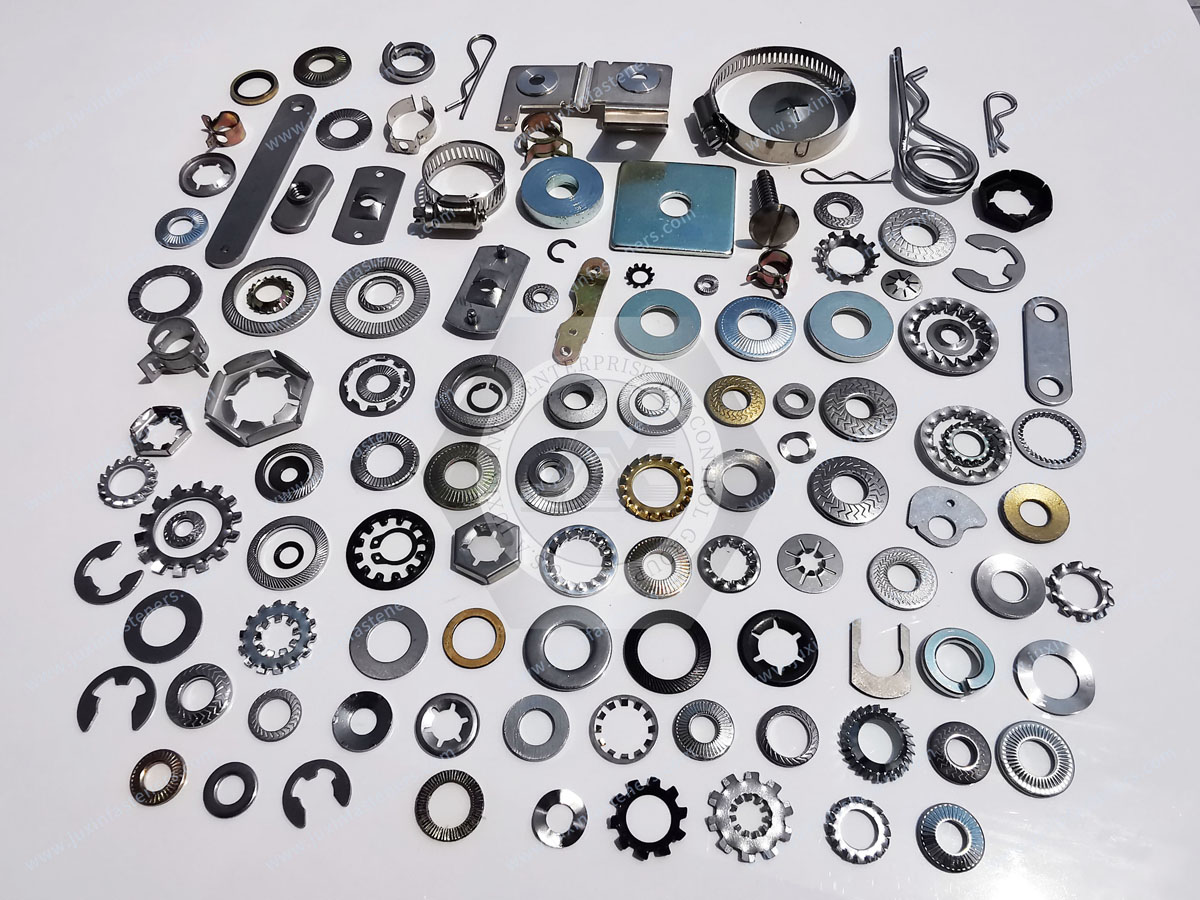
Spring washers and split lock washers are widely recognized fastening components, but their function should not be overstated.
A traditional split lock washer should not automatically be assumed to maintain preload or prevent self-loosening in a severe transverse-vibration joint.
Its actual behavior depends on:
washer geometry;
fastener size;
surface hardness;
joint material;
clamp load;
bearing interface;
vibration amplitude;
joint movement.
Once a split washer is substantially flattened under tightening, its available elastic travel may be limited relative to the total behavior of the bolted joint.
Therefore, engineers should not select a split lock washer merely because the application “has vibration.”
The complete joint and required locking performance should determine the fastening strategy.
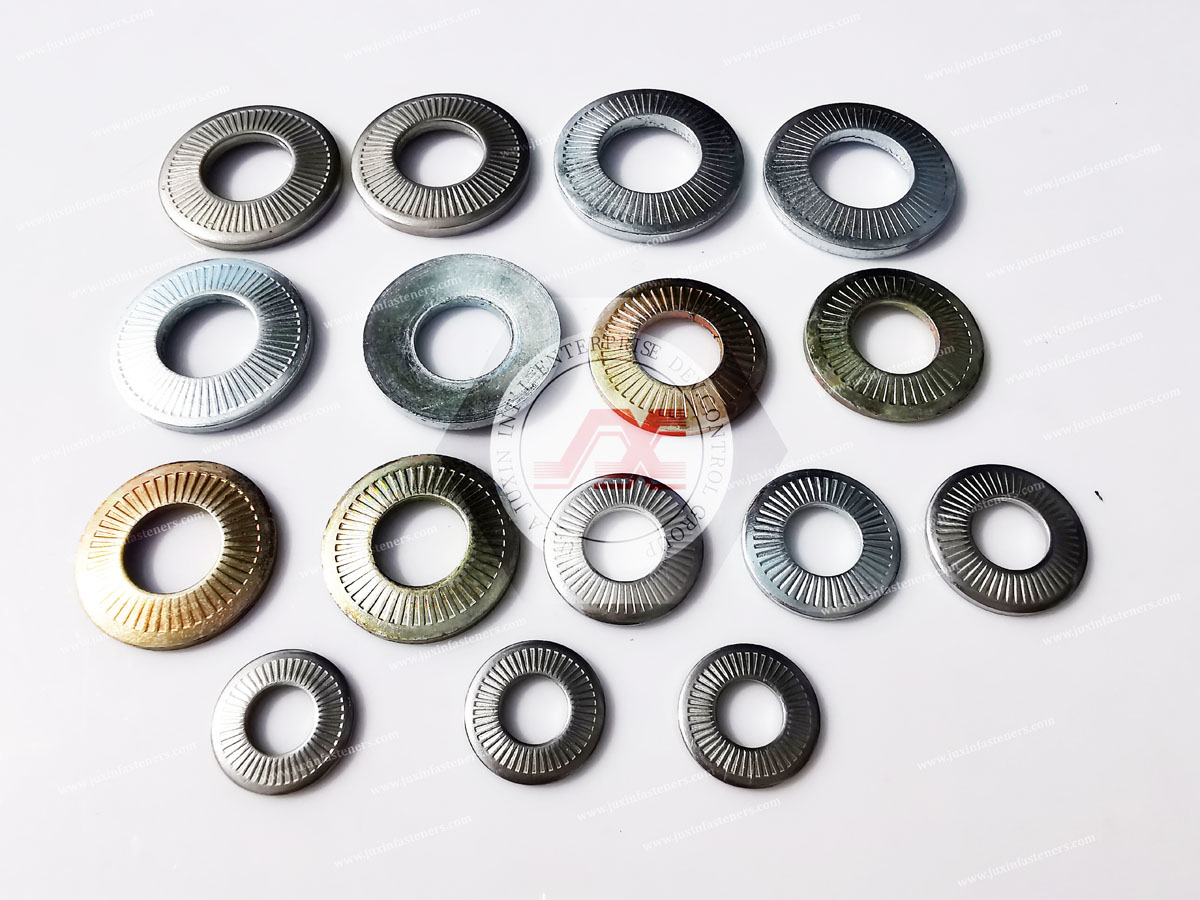
Serrated flange nuts, serrated bearing surfaces, and other ribbed locking geometries use interaction with the mating surface to increase resistance to rotation.
These designs can be effective in appropriate assemblies, but the mating surface is part of the locking mechanism.
Engineers should evaluate:
surface hardness;
coating;
paint;
aluminum or other softer substrates;
allowable surface marking;
electrical grounding requirements;
corrosion protection;
serviceability.
A locking feature that performs well against a hard steel surface may behave differently against painted sheet metal or softer aluminum.
Surface damage can also affect corrosion protection.
Transverse-vibration testing is commonly used to evaluate the behavior of threaded joints and locking systems under controlled lateral movement.
The well-known Junker-type test principle applies repeated transverse displacement to a bolted joint while monitoring changes in clamp load.
Such testing can be valuable because severe transverse movement is particularly effective at exposing susceptibility to rotational self-loosening.
However, a laboratory transverse-vibration test should not automatically be interpreted as a prediction of service life in every machine or vehicle.
Real applications may involve different:
joint stiffness;
vibration frequencies;
displacement amplitudes;
temperatures;
surface conditions;
fastener materials;
lubrication;
loading directions;
installation conditions.
Testing should therefore be selected and interpreted according to the actual qualification objective and applicable customer requirements.
Before choosing a locking component, engineers can work through the joint in the following order.
Is the problem caused by:
rotational loosening;
surface settlement;
polymer creep;
thermal cycling;
gasket relaxation;
substrate deformation;
inadequate installation preload?
Different mechanisms require different solutions.
Is the joint primarily exposed to:
axial cycling;
transverse movement;
combined loading;
impact;
structural flexing?
Transverse relative movement is particularly important when evaluating self-loosening risk.
A steel-to-steel joint behaves differently from a fastener clamping:
aluminum;
plastic;
coated sheet metal;
composites;
gasketed interfaces.
Soft or compressible materials may create preload-loss mechanisms that a locking nut alone cannot eliminate.
Consider:
operating temperature;
corrosion exposure;
chemicals;
moisture;
maintenance conditions;
required coating.
This step can affect the choice between nylon-insert and all-metal locking systems.
Will the fastener be installed once, or removed repeatedly during maintenance?
If repeated installation is expected, prevailing-torque behavior after the required number of assembly cycles should be considered.
For important joints, specify what actually needs to be demonstrated.
Possible requirements may include:
dimensional inspection;
prevailing torque;
installation torque;
clamp-load behavior;
vibration testing;
corrosion testing;
repeated installation evaluation;
application assembly trials.
Motors, actuators, conveyors, robotic equipment, machine frames, and reciprocating mechanisms can expose bolted connections to repeated dynamic loading.
Fastener selection should consider both vibration and the repeatability required for automated assembly.
Vehicle structures and auxiliary systems experience road-induced vibration, thermal cycling, impact, and repeated loading.
Different joints may require different locking strategies depending on whether they are structural, serviceable, temperature-sensitive, or exposed to corrosion.
Railway interior and equipment assemblies can experience long-duration vibration and repeated service loading.
Locking hardware may be considered for equipment mounting, interior assemblies, lighting hardware, brackets,
and other appropriate fastening locations, subject to the applicable project and railway requirements.
Construction machinery, agricultural equipment, forklifts, conveyors, and other industrial equipment can combine vibration with shock loading, contamination, and demanding maintenance environments.
Material, coating, locking method, and serviceability should be evaluated together.
Rotating equipment, power-generation machinery, enclosures, and auxiliary systems may include vibration-prone threaded joints.
The required solution depends on the actual joint rather than the industry label alone.
A lock nut can resist rotation but cannot automatically solve preload loss caused by settlement, deformation, or poor joint design.
Thread and bearing friction affect the relationship between installation torque and achieved preload.
Changing coating, lubrication, or locking geometry can change assembly behavior.
A locking mechanism that incorporates polymer must be evaluated against the required operating environment and selected material grade.
Prevailing torque can change with repeated installation and removal.
Required reuse cycles should be defined and validated when they matter to the application.
Two lock nuts with the same thread and similar external dimensions can use different locking geometries, materials, coatings, or prevailing-torque characteristics.
For procurement managers and supplier-development engineers, qualifying a second source requires more than finding a visually similar nut or washer.
A useful sourcing principle is:
Visual Similarity ≠ Dimensional Equivalence ≠ Material Equivalence ≠ Locking Equivalence ≠ Functional Equivalence
Depending on the component, compare:
thread size;
thread pitch;
thread tolerance/class where specified;
overall height;
width across flats;
flange dimensions;
locking-section geometry;
washer dimensions;
mating-fastener requirements.
Confirm the specified:
material;
property class or mechanical requirements where applicable;
heat treatment where applicable;
locking-element material;
surface coating.
For prevailing-torque fasteners, the locking characteristic itself is part of the functional specification.
The qualification plan may need to address:
initial prevailing torque;
installation behavior;
removal behavior;
repeated-use requirements;
interaction with the mating thread.
Where vibration resistance is critical, qualification should reflect the actual application or agreed validation method rather than relying solely on dimensional inspection.
Lock nuts cannot be evaluated independently from the male thread.
Mating-fastener characteristics that may affect performance include:
thread dimensions;
thread condition;
coating;
lubrication;
material;
hardness;
surface damage.
This becomes particularly important during second sourcing.
A lock nut tested on one mating bolt condition may not behave identically with a differently coated or lubricated production bolt.
Procurement specifications should therefore define the relevant mating-thread requirements when prevailing torque or installation behavior is critical.
Before approving a second source for vibration-resistant threaded hardware, consider defining:
approved drawing or specification;
fastener type;
thread size and pitch;
thread tolerance/class where applicable;
material;
mechanical property requirements;
surface coating;
locking mechanism;
polymer insert material where applicable;
prevailing-torque requirements where applicable;
operating temperature;
corrosion requirements;
reuse requirements;
mating fastener;
inspection requirements;
validation requirements;
packaging;
sample quantity;
production quantity;
estimated annual usage.
Documentation and testing requirements should be defined according to the specific OEM or industrial program rather than assumed universally.
JUXIN FASTENERS supports OEM manufacturers, industrial equipment companies, engineering teams, and procurement organizations sourcing standard and drawing-based threaded fastening components.
Relevant product families include:
nylon insert lock nuts;
all-metal prevailing-torque lock nuts;
flange lock nuts;
related threaded fasteners;
spring washers and retention components where appropriate.
For an existing production component, send the current drawing, specification, reference part number, or physical sample for cross-reference evaluation.
For a new application, provide the joint materials, thread requirements, operating environment, locking requirement, and expected production conditions.
The objective is not simply to supply a fastener labeled “vibration resistant.”
The objective is to match the locking mechanism to the joint design, dynamic loading, environment, assembly process, maintenance requirement, and sourcing specification.
For technical review and quotation, provide as much of the following information as applicable:
2D drawing;
3D model where available;
existing or reference part number;
physical sample for cross-reference projects;
fastener or locking type;
thread size and pitch;
mating bolt specification;
joint materials;
material and mechanical requirements;
surface coating;
operating temperature;
corrosion environment;
vibration or dynamic-loading conditions;
required prevailing-torque criteria where applicable;
reuse requirements;
validation or testing requirements;
required inspection documentation;
sample quantity;
production quantity;
estimated annual usage.
JUXIN FASTENERS can use this information to evaluate product configuration, dimensional requirements,
material and coating specifications, sample requirements, and the appropriate sourcing route.
Email: info@juxinfasteners.com
Website: www.juxinfasteners.com
 MORE NEWS
Sep. 30, 2026
Sep. 30, 2026
Sep. 30, 2026
Contact Us
Tel.:
+86 020 8621 0320
+86 020 3121 6067
E-mail:
Technical Support:
Navigation
SEND INQUIREY