
Call Us
+86 136 6007 9809
Call Us
+86 136 6007 9809

Sep. 03, 2026
Why Bolts Lose Clamping Force Without Loosening: Stress Relaxation and Preload Loss
A bolted joint can lose a significant portion of its original clamping force even when the bolt has not rotated.
The bolt head may remain in its original position. The nut may show no visible movement. A locking feature may still be engaged.
Nevertheless, the internal tensile force in the bolt can decrease over time.
This condition is important in automotive powertrains, electric vehicle battery systems, industrial machinery, heat exchangers, pressure equipment,
power generation assemblies and other applications where joint integrity depends on sustained clamping force.
Loss of preload can contribute to joint separation, leakage, relative movement, fatigue damage or reduced assembly reliability.
The underlying cause is not always conventional thread loosening.
Instead, the joint may experience stress relaxation, material creep, embedment, gasket compression set or differential thermal expansion.
Understanding these mechanisms is essential for engineers designing reliable bolted joints and for procurement teams specifying suitable industrial fasteners.
JUXIN FASTENERS supplies high-strength bolts, nuts, threaded studs, washers and customer-specific industrial fastening components for OEM equipment manufacturers and international industrial supply chains.
This guide explains why clamping force can decrease without thread rotation, how engineers can evaluate preload retention and what information should be included when sourcing fasteners for demanding applications.
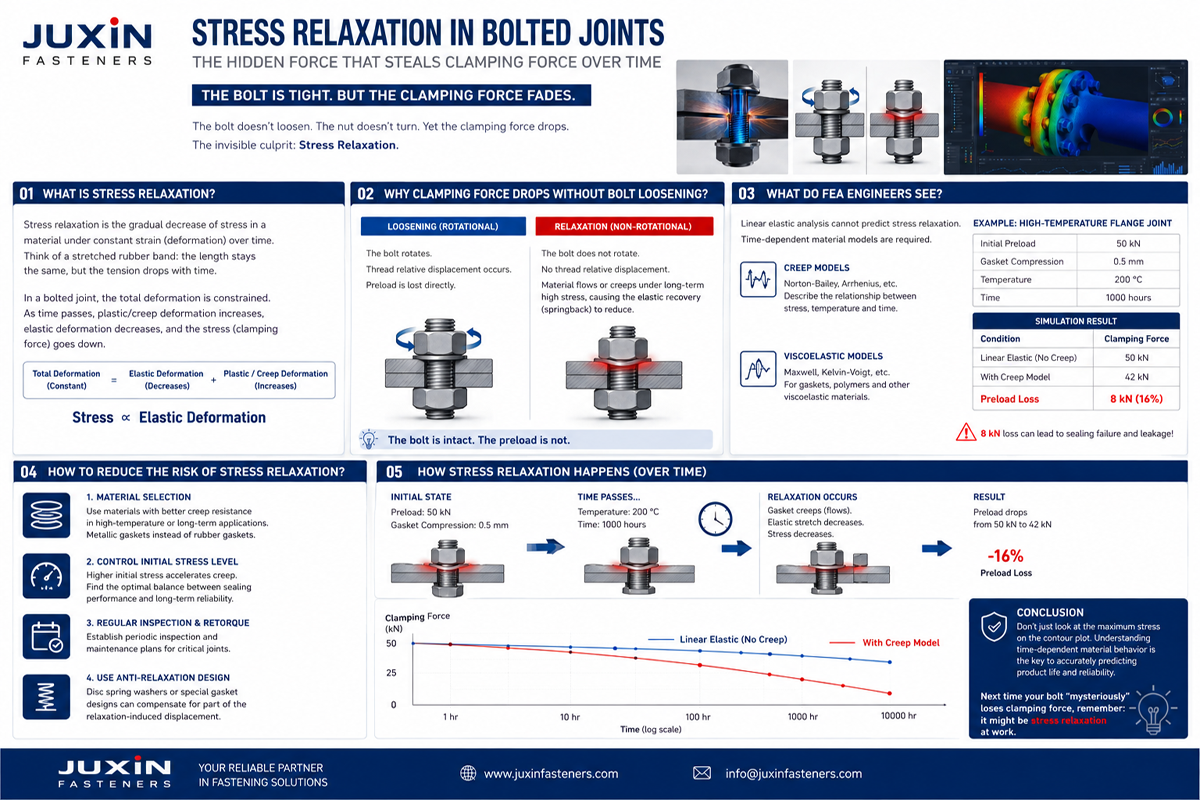
1. Rotational Loosening Versus Non-Rotational Preload Loss
One of the most important distinctions in bolted-joint engineering is the difference between rotational loosening and preload loss without rotation.
Both mechanisms can reduce the clamping force holding an assembly together.
However, they occur through different physical processes.
Rotational Loosening
Rotational loosening occurs when relative movement and joint conditions allow a threaded fastener to rotate in the loosening direction.
In some applications, transverse vibration or repeated joint movement can promote self-loosening.
As the threaded connection backs off, the bolt's elastic elongation decreases.
The resulting clamping force may fall.
A simplified sequence is:
Joint movement or vibration → Thread rotation → Reduced bolt elongation → Preload loss.
Rotational loosening may be addressed through appropriate joint design, preload control and validated locking features.
Non-Rotational Preload Loss
Non-rotational preload loss occurs when the bolt's elastic deformation decreases without the threaded connection backing off.
Possible mechanisms include:
Stress relaxation
Creep
Joint settlement
Embedment at contact surfaces
Gasket compression set
Local plastic deformation
Differential thermal expansion
Temperature-dependent material behavior
The bolt remains in position, but the mechanical relationship between the bolt and clamped components changes.
A simplified sequence is:
Time-dependent deformation or settlement → Reduced elastic bolt elongation → Lower tensile force → Reduced clamping force.
Why the Difference Matters
A prevailing-torque lock nut or other anti-rotation feature may reduce the risk of rotational loosening in a suitable application.
However, it cannot automatically prevent preload loss caused by creep, gasket compression or joint settlement.
A joint that never rotates can still lose clamping force.
Engineers must identify the actual failure mechanism before selecting a corrective fastening solution.
2. How Bolt Preload Is Created
When a bolt is tightened, it undergoes elastic elongation.
At the same time, the connected components are compressed.
The bolt behaves approximately like a tensile spring, while the clamped joint members behave as a compressive spring system.
The resulting tensile force in the bolt creates the joint's clamping force.
For a simplified linear-elastic bolt model:
F = kb × δb
Where:
F = bolt tensile force
kb = effective bolt stiffness
δb = elastic bolt elongation
The effective stiffness depends on the bolt geometry, material properties and the lengths of the different loaded sections.
The joint members also have an effective compressive stiffness.
The bolt and clamped components must therefore be evaluated as an interacting mechanical system.
Why Elastic Deformation Matters
The bolt's elastic elongation stores energy.
This elastic deformation allows the connection to maintain clamping force while accommodating small changes in joint geometry.
If permanent deformation reduces the thickness of the clamped assembly, the bolt can lose some of its original elastic stretch.
The remaining bolt tension may consequently decrease.
This can occur even when the bolt and nut have not moved rotationally.
3. Stress Relaxation in Bolted Joints
Stress relaxation describes a reduction in stress over time under a constrained deformation condition.
In a simplified constant-total-strain material model:
εtotal = εelastic + εinelastic
Where:
εtotal = total strain
εelastic = recoverable elastic strain
εinelastic = time-dependent creep or other inelastic strain
If the total strain remains constrained and inelastic strain increases, the elastic portion can decrease.
For a linear-elastic material response:
σ = E × εelastic
Where:
σ = stress
E = elastic modulus
As the elastic strain decreases, the corresponding elastic stress decreases.
This provides a simplified explanation of material stress relaxation.
Important Engineering Distinction
A real bolted joint is not always a constant-total-strain system.
It contains multiple components with different stiffnesses, materials and temperature-dependent behavior.
The bolt, nut, washers, flanges, gaskets and connected structures interact mechanically.
Therefore, the actual preload loss must be evaluated using the complete joint configuration.
Stress relaxation in the bolt material and relaxation caused by deformation of the clamped members are related but distinct phenomena.
4. Joint Settlement and Embedment Relaxation
Not all preload loss requires long-term high-temperature creep.
Some loss occurs shortly after assembly.
Contact surfaces are not perfectly smooth.
Even machined components contain microscopic surface irregularities.
When a joint is tightened, local contact pressure can flatten surface asperities or cause small amounts of permanent deformation.
This process is commonly associated with embedment or joint settlement.
Potential locations include:
Under the bolt head
Under the nut
Washer interfaces
Thread contact surfaces
Coated bearing surfaces
Gasket interfaces
Connected component surfaces
As these surfaces settle, the total clamped thickness may decrease.
The bolt then loses some elastic elongation.
Why Short Bolts Can Be Sensitive to Settlement
A relatively short, stiff bolt may have only a small amount of elastic elongation at its target preload.
A small reduction in joint thickness can therefore represent a meaningful proportion of that elongation.
A more compliant bolt may be less sensitive to the same dimensional change.
However, the effect depends on the complete joint stiffness and geometry.
Coatings and Contact Surfaces
Surface treatments can influence friction, contact behavior and local deformation.
A change in coating may affect both the achieved installation preload and the subsequent settlement behavior.
For critical assemblies, coating selection should be coordinated with the approved tightening procedure.
5. Material Creep and Time-Dependent Deformation
Creep is time-dependent deformation under sustained stress.
Its significance depends on material, temperature, stress level and exposure duration.
In a bolted joint, creep may occur in:
Bolt material
Nut material
Gaskets
Polymer components
Aluminum components
Other clamped materials
The resulting dimensional changes may reduce bolt preload.
Polymers and Elastomers
Polymers and elastomers can exhibit viscoelastic behavior.
Their deformation depends on both load and time.
Examples include:
Rubber gaskets
Polymer washers
Plastic housings
Sealing materials
Composite components
Even at moderate temperatures, sustained compression can produce time-dependent deformation.
The actual behavior depends on the polymer formulation, temperature, stress and exposure duration.
Aluminum and Other Light Alloys
Aluminum components are widely used in automotive, EV battery and industrial equipment.
Their behavior under sustained load depends on alloy, temper, temperature and stress.
Local deformation at bearing surfaces or threaded interfaces can contribute to preload loss.
Differential thermal expansion between aluminum and steel may also influence the joint.
No single temperature should be treated as a universal creep threshold for all aluminum alloys.
Carbon and Alloy Steel Fasteners
Carbon steel and alloy steel bolts can provide reliable preload in many industrial applications.
However, their mechanical properties and long-term behavior depend on the selected grade, heat treatment, temperature and stress.
Property classes 8.8, 10.9 and 12.9 should not be assumed to have identical elevated-temperature performance.
The applicable fastener standard and engineering specification must govern selection.
Stainless Steel Fasteners
Stainless steel may be selected for corrosion resistance or specific service requirements.
However, stainless steel fasteners also have temperature-dependent mechanical properties.
A2-70 and A4-80 designations do not establish universal elevated-temperature creep performance.
The selected material and operating conditions must be evaluated.
High-Temperature Alloy Fasteners
Certain high-temperature applications may require specialized alloy steels or precipitation-hardened alloys.
Examples encountered in industrial engineering specifications include ASTM A193 B7 bolting and certain high-temperature alloy grades.
However, these materials have different allowable service conditions.
ASTM A193 B7, ASTM A320 L7, A286 and nickel-based high-temperature alloys should not be grouped as mechanically equivalent materials.
Each must be evaluated according to its applicable specification and service environment.
6. Thermal Expansion and Preload Changes
Bolted joints often contain components made from different materials.
When temperature changes, those materials may expand or contract at different rates.
The resulting change in joint geometry can increase or decrease bolt preload.
For example, a steel bolt clamping an aluminum component may experience a different thermal response from a steel bolt clamping steel components.
The direction and magnitude of preload change depend on:
Bolt material
Joint-member materials
Coefficients of thermal expansion
Grip length
Joint geometry
Temperature distribution
Initial preload
Joint stiffness
Temperature-dependent material properties
Heating and Cooling Cycles
A joint may experience an increase in preload during one part of a thermal cycle and a decrease during another.
If local yielding, creep or settlement occurs during the cycle, the joint may not return to its original preload after cooling.
This is particularly relevant to:
Automotive powertrains
EV battery enclosures
Power electronics equipment
Heat exchangers
Industrial compressors
High-temperature machinery
Thermal expansion should therefore be evaluated together with material deformation and the complete joint design.
7. Bolt Stiffness, Joint Stiffness and Preload Retention
The relative stiffness of the bolt and clamped components influences joint behavior.
In a simplified model:
kb = effective bolt stiffness
km = effective joint-member stiffness
For a small permanent reduction in clamped thickness, a more compliant bolt can reduce the resulting preload loss.
This principle is useful when evaluating grip length and spring compensation.
However, bolt stiffness should not be minimized without considering the complete loading conditions.
Longer Grip Length
Increasing the effective elastic length of a bolt can increase its compliance.
A longer, more compliant bolt may experience a smaller reduction in tensile force for the same small amount of joint settlement.
However, longer bolts are not automatically suitable for every assembly.
Design engineers must also consider:
Available installation space
Required thread engagement
External loading
Fatigue performance
Joint separation risk
Bolt bending
Assembly geometry
Manufacturing requirements
A fixed grip-length-to-diameter ratio should not be presented as a universal design requirement.
Reduced-Shank and Special Bolt Designs
Some applications use bolts with selected shank geometries to influence stiffness and stress distribution.
Such designs require engineering analysis of tensile strength, fatigue behavior and manufacturing feasibility.
A reduced shank should not be introduced without validating the complete load path.
8. Belleville Washers and Spring Compensation
Belleville washers, also called disc spring washers, are conical spring elements.
When compressed, they provide an elastic force-deflection response.
In suitable bolted joints, a correctly designed disc spring arrangement can add compliance.
This additional elastic reserve may help compensate for limited joint settlement or relaxation.
How Spring Compensation Works
Consider a joint containing a compressible gasket.
Over time, the gasket may experience a reduction in thickness.
Without additional compliance, this dimensional change may reduce bolt tension.
A properly selected disc spring can change its deflection as the joint geometry changes.
This may help maintain part of the original clamping force.
Applications Where Spring Compensation May Be Considered
Gasketed joints
Polymer or composite assemblies
Thermally cycled equipment
Selected industrial machinery
Connections with limited maintenance access
Assemblies requiring controlled preload retention
Why Belleville Washers Are Not a Universal Solution
Disc springs must be selected according to their load-deflection characteristics.
Important considerations include:
Required preload
Available deflection
Spring stiffness
Installation height
Material
Temperature capability
Fatigue requirements
Bearing surfaces
Joint geometry
An incorrectly selected spring washer may provide insufficient compensation or introduce additional assembly problems.
Disc springs should not be assumed to prevent rotational loosening or guarantee preload retention.
The complete arrangement must be validated.
9. Gasket Relaxation and Flange Connections
Gasketed joints are especially sensitive to preload loss.
A gasket may undergo compression set, creep or stress relaxation under sustained loading.
As gasket thickness changes, the clamping force provided by the bolts may decrease.
This can affect sealing performance.
Factors Affecting Gasketed Joint Reliability
Gasket material
Initial gasket compression
Bolt preload
Flange stiffness
Operating temperature
Internal pressure
Thermal cycling
Surface finish
Installation sequence
Long-term gasket behavior
A higher bolt strength grade does not automatically prevent gasket relaxation.
The gasket, flange and bolting system must be designed together.
Retightening and Maintenance
Some assemblies may have approved retightening or maintenance procedures.
However, retightening is not appropriate for every gasket or bolted joint.
The equipment manufacturer's instructions must govern any retorque procedure.
For pressure-containing equipment, safety and qualification requirements are particularly important.
10. Finite Element Analysis of Bolt Preload Relaxation
Finite element analysis can help engineers evaluate bolted joints with complex geometry, material behavior and thermal loading.
However, the model must represent the physical mechanisms relevant to the application.
Limitations of Linear-Elastic Analysis
A purely linear-elastic model can estimate stresses and deformations under specified loading conditions.
It does not, by itself, predict time-dependent creep or stress relaxation.
If the model contains no time-dependent material behavior, it cannot directly represent progressive creep-related preload loss.
Time-Dependent Material Modeling
For applications where creep is significant, engineers may use suitable time-dependent constitutive material models.
Depending on the application, the analysis may consider:
Temperature-dependent material properties
Time-dependent creep strain
Stress-dependent deformation
Joint-member stiffness
Bolt elastic deformation
Gasket compression and recovery
Differential thermal expansion
Contact conditions
Installation preload
Operating load cycles
The model must be calibrated using relevant material data.
Norton-Type Creep Models
A simplified Norton-type creep relationship may be written as:
dεcreep/dt = A × σⁿ
Where:
dεcreep/dt = creep strain rate
A = material and temperature-dependent coefficient
σ = relevant stress measure
n = stress exponent
More advanced models may include explicit time and temperature dependence.
The appropriate creep law depends on the material and loading conditions.
Model parameters must be obtained from suitable experimental data.
A creep equation alone does not establish the long-term performance of a specific bolted joint.
Why Material Data Matters
A finite element model may appear precise while producing unreliable predictions if the material parameters are inappropriate.
Important inputs may include:
Elastic modulus
Yield behavior
Temperature-dependent properties
Creep characteristics
Gasket compression behavior
Contact friction
Thermal expansion
Initial preload
For demanding applications, analysis should be supported by relevant testing or validated material information.
11. Illustrative Preload-Loss Calculation
A simplified elastic model can demonstrate why joint settlement affects bolt preload.
Assume a bolted joint experiences a small permanent reduction in clamped thickness.
For a simplified bolt-and-joint spring system, the preload reduction may be approximated as:
ΔF = keq × Δs
Where:
ΔF = reduction in preload
Δs = permanent settlement or thickness reduction
keq = equivalent stiffness of the interacting bolt and joint system
For a simplified two-spring representation:
keq = (kb × km) / (kb + km)
Where:
kb = effective bolt stiffness
km = effective joint-member stiffness
Illustrative Example
Assume:
Effective bolt stiffness = 200 kN/mm
Effective joint-member stiffness = 800 kN/mm
Permanent joint settlement = 0.02 mm
The equivalent stiffness is:
keq = (200 × 800) / (200 + 800)
keq = 160 kN/mm
The estimated preload reduction is:
ΔF = 160 × 0.02
ΔF = 3.2 kN
If the initial preload were 40 kN, the simplified model would estimate a remaining preload of approximately 36.8 kN.
This corresponds to an 8% reduction.
Important Limitation
This example is an illustrative calculation using assumed values.
It is not a JUXIN FASTENERS laboratory test, field measurement or validated FEA result.
Actual preload loss depends on the complete joint design, contact conditions, material behavior and operating environment.
The example demonstrates how a small dimensional change can influence bolt tension.
12. Engineering Design Strategies to Reduce Preload Loss
Stress relaxation and settlement cannot always be eliminated completely.
However, their effects may be reduced through suitable engineering design.
Select Appropriate Fastener Materials
The bolt material should match the mechanical requirements, operating temperature and service environment.
High-strength fasteners are not automatically suitable for elevated-temperature applications.
Evaluate Bolt Elastic Compliance
Where appropriate, additional elastic compliance may reduce sensitivity to small changes in joint thickness.
The design must still satisfy strength, fatigue and installation requirements.
Control Joint Contact Conditions
Bearing surfaces, washers, coatings and mating components can influence settlement behavior.
The approved assembly should define the required contact conditions.
Consider Spring Compensation
Properly selected disc springs may help maintain clamping force in suitable applications.
Their effectiveness must be validated.
Select Suitable Gaskets
Gasket material and compression behavior can significantly influence long-term preload retention.
The gasket should be evaluated together with the flange and bolt system.
Control Initial Preload
The initial preload must be sufficient for the joint function without exceeding applicable material and component limits.
No single percentage of yield strength is appropriate for every application.
Validate Thermal Performance
Where temperature changes are important, engineers should evaluate differential expansion and time-dependent material behavior.
Define Inspection and Maintenance Requirements
Critical joints may require specified inspection methods or maintenance procedures.
These should be established by the equipment manufacturer.
13. High-Strength Bolts and Custom Fastener Selection
JUXIN FASTENERS supplies industrial fasteners that may be considered for demanding mechanical applications.
Relevant product families include:
Property class 8.8 bolts
Property class 10.9 bolts
Property class 12.9 bolts
Stainless steel bolts
Industrial nuts
Lock nuts
Threaded studs
Flat washers
Custom threaded components
Customer-specific CNC machined parts
The correct product depends on the approved engineering specification.
Why Higher Strength Is Not Always Better
A higher property class provides different specified mechanical strength characteristics.
However, preload retention also depends on stiffness, temperature, joint settlement and the connected materials.
Replacing a property class 8.8 bolt with a 10.9 or 12.9 bolt does not automatically eliminate stress relaxation.
The underlying mechanism must first be identified.
Custom Bolt Geometry
Some OEM applications require special bolt lengths, shank configurations, thread lengths or bearing features.
JUXIN FASTENERS welcomes drawing-based inquiries for customer-specific industrial fasteners.
Manufacturing feasibility and the final technical requirements must be confirmed before quotation.

14. Automotive and Electric Vehicle Applications
Automotive and EV assemblies may combine steel fasteners with aluminum, polymer and gasketed components.
Potential applications include:
Battery enclosure assemblies
Powertrain equipment
Cooling system supports
Electronic equipment housings
Structural brackets
Mechanical mounting interfaces
EV Battery Enclosures
EV battery enclosures may contain aluminum structures, sealing gaskets and steel or stainless steel fasteners.
Thermal cycling and gasket compression behavior can influence preload retention.
Engineers should evaluate the complete sealing and fastening system.
A particular bolt or washer cannot independently guarantee an IP67 or IP68 enclosure rating.
Ingress protection performance must be verified at the complete enclosure level.
Automotive Powertrains
Powertrain assemblies may experience vibration, cyclic loading and elevated temperatures.
Fastener selection should consider mechanical strength, fatigue, preload and thermal behavior.
Cooling System Assemblies
Cooling components may contain gasketed or sealed mechanical connections.
The fastening system must provide the required clamping function without damaging the sealing interface.
Leak-tight performance must be validated separately.
15. Heavy Industrial Machinery and Powertrains
Industrial machinery may contain highly loaded bolted joints in:
Gearboxes
Compressors
Pumps
Engine assemblies
Mechanical supports
Heavy equipment
Industrial drive systems
These joints may experience sustained loading, vibration and temperature changes.
For some applications, preload loss can increase the risk of joint movement or fatigue damage.
The engineering specification should address both static strength and long-term joint behavior.
Property class 10.9 or 12.9 bolts may be considered where their specified properties meet the design requirements.
However, bolt grade selection must be supported by the actual joint analysis.
16. Heat Exchangers, HVAC and Pressure Equipment
Heat exchangers and pressure-related assemblies may contain bolted flanges and gasketed connections.
Long-term sealing performance depends on the interaction between bolts, flanges, gaskets and operating conditions.
Potential challenges include:
Gasket creep
Thermal expansion
Elevated temperature
Pressure loading
Repeated thermal cycling
Preload relaxation
Some applications specify alloy steel stud bolts and compatible nuts under standards such as ASTM A193 and ASTM A194.
The selected grade must meet the applicable design and service requirements.
A material grade should not be assigned a universal maximum service temperature without considering the relevant standard, stress level and equipment design.
For pressure-containing joints, approved engineering specifications and qualification requirements must govern fastener selection.
17. Procurement and Total Cost of Ownership
For procurement managers, fastener selection should not be based solely on unit price.
A lower-priced fastener may create additional costs if it does not meet the required mechanical or environmental performance.
Potential lifecycle costs include:
Unplanned maintenance
Assembly rework
Equipment downtime
Replacement parts
Inspection
Field service
Warranty-related costs
Supplier quality issues
The correct sourcing decision should consider the required joint performance over the intended service life.
Supplier Evaluation Priorities
Procurement teams should verify:
Correct material grade
Applicable fastener standard
Mechanical property requirements
Heat-treatment requirements
Surface treatment
Dimensional tolerances
Inspection requirements
Traceability requirements
Required documentation
Production quantity
Lead time
Packaging requirements
Where the project requires material test reports, PPAP documentation or other qualification records, these requirements should be identified in the RFQ.
Availability and scope must be confirmed with the supplier.
Engineering and Procurement Decision Matrix
| Evaluation Factor | Engineering Priority | Procurement Consideration |
|---|---|---|
| Material selection | Strength and temperature suitability | Approved material grade |
| Bolt stiffness | Joint compliance and preload retention | Drawing-controlled geometry |
| Gasket behavior | Compression and relaxation | Approved gasket specification |
| Coating | Friction and corrosion compatibility | Consistent finish requirements |
| Installation preload | Joint reliability | Controlled assembly specification |
| Creep data | Time-dependent performance | Required supporting documentation |
| Inspection | Verification of critical characteristics | Supplier acceptance criteria |
| Traceability | Product identification | Lot and document requirements |
| Lifecycle cost | Reliability and maintenance | Total cost of ownership |
This matrix highlights an important sourcing principle:
Fastener selection should be based on the required performance of the complete joint, not simply purchase price per piece.
18. International Standards and Engineering References
Applicable standards depend on the fastener type and intended application.
Relevant references may include:
ISO 898-1 for mechanical properties of applicable carbon steel and alloy steel bolts, screws and studs
ISO 898-2 for mechanical properties of applicable carbon steel and alloy steel nuts
ISO 3506-1 for mechanical properties of applicable corrosion-resistant stainless steel bolts, screws and studs
ISO 3506-2 for mechanical properties of applicable corrosion-resistant stainless steel nuts
ISO 16047 for torque/clamp force testing
ISO 965 for metric thread tolerances
ISO 4042 for electroplated coating systems for threaded fasteners
ASTM A193 for applicable alloy steel and stainless steel bolting materials
ASTM A194 for applicable nuts used in specified high-pressure or high-temperature service
Additional ISO, DIN, EN, ASTM, ASME or JIS requirements may apply according to the customer specification.
The correct standards should be identified in the approved engineering documentation.
Metric, UNC, UNF, BSW and BSF threads are not directly interchangeable.
19. OEM Fastener Procurement and Custom Manufacturing
JUXIN FASTENERS welcomes inquiries for standard and custom industrial fasteners based on customer drawings and purchasing requirements.
Potential customization requirements include:
Special bolt lengths
Custom thread lengths
Nonstandard studs
Special head geometries
Customer-defined material grades
Specified surface treatments
Dimensional tolerances
Custom washers
Special fastening components
CNC machined parts
Customer-specific packaging
All custom requests require technical review.
Manufacturing feasibility, inspection requirements, MOQ, pricing and lead time must be confirmed during the quotation process.
20. What to Include in a High-Reliability Fastener RFQ
A complete RFQ helps engineers and purchasing teams obtain accurate technical and commercial responses.
Recommended information includes:
2D engineering drawing
Available 3D CAD model
Drawing number and revision
Fastener type
Material grade
Mechanical property requirements
Thread diameter and pitch
Bolt length and grip length
Required tolerances
Surface treatment
Operating temperature range
Environmental exposure
Target preload or tightening requirements
Joint-member materials
Gasket information where relevant
Inspection requirements
Documentation and traceability requirements
Order quantity
Estimated annual demand
Delivery destination
Requested delivery schedule
For critical applications, include the applicable qualification and approval requirements.
21. Frequently Asked Questions
Can a bolt lose preload without rotating?
Yes. Stress relaxation, creep, joint settlement, gasket compression and thermal effects can reduce clamping force without thread rotation.
What is the difference between bolt loosening and stress relaxation?
Rotational loosening involves relative thread rotation. Stress relaxation involves a reduction in stress over time under constrained deformation conditions.
Why does a bolt remain visually tight after losing clamping force?
The threaded connection may remain in the same position even though the bolt's elastic elongation has decreased.
Can vibration cause preload loss without thread rotation?
Vibration may contribute to joint movement, embedment or other mechanical changes. The actual mechanism must be evaluated.
Do high-strength bolts prevent stress relaxation?
Not automatically. Higher static strength does not eliminate gasket creep, joint settlement or thermal effects.
Can Belleville washers help maintain bolt preload?
Properly selected disc springs may help compensate for some joint settlement or relaxation. Their suitability must be validated.
Does increasing bolt length improve preload retention?
Additional elastic compliance can reduce sensitivity to small dimensional changes in suitable designs, but the complete joint requirements must be considered.
Can a linear-elastic FEA model predict creep relaxation?
Not by itself. Time-dependent material behavior must be represented to model creep-related preload loss.
What causes preload loss in gasketed flanges?
Potential causes include gasket compression set, creep, thermal expansion and changes in joint geometry.
Can JUXIN FASTENERS supply custom bolts for demanding industrial applications?
JUXIN FASTENERS welcomes drawing-based inquiries for standard and custom industrial fasteners. Manufacturing feasibility and technical requirements must be confirmed.
22. Related Industrial Fastening Solutions
For related engineering and purchasing requirements, consider the following JUXIN FASTENERS product families:
High-Strength Hex Bolts
Property Class 8.8 Bolts
Property Class 10.9 Bolts
Property Class 12.9 Bolts
Stainless Steel Bolts
Industrial Hex Nuts
All-Metal Lock Nuts
Nylon-Insert Lock Nuts
Custom Threaded Studs
Industrial Washers
Custom CNC Machined Components
Automotive Fastening Solutions
EV Battery Equipment Fasteners
HVAC and Heat Exchanger Fastening Solutions
These product families address different mechanical, material and installation requirements.
The appropriate solution should be selected according to the approved joint design.
23. Request a Quote for High-Strength Bolts and Custom Fasteners
JUXIN FASTENERS supplies high-strength industrial bolts, nuts, threaded studs, washers and custom fastening components for OEM manufacturers and international industrial supply chains.
We welcome inquiries from mechanical engineers, structural engineers, manufacturing engineers, production managers, procurement specialists, purchasing managers and supplier development teams.
For applications involving preload retention, thermal cycling, creep-sensitive materials or demanding mechanical loads, please provide your engineering drawings and the applicable joint requirements.
Our team can review the requested fastener configuration and discuss suitable product options, customization requirements and quotation details.
Company: JUXIN FASTENERS
Website: www.juxinfasteners.com
Email: info@juxinfasteners.com
Send your 2D/3D drawings, BOM or RFQ to JUXIN FASTENERS to discuss high-strength bolts, custom studs and industrial fastening components for your next OEM project.
Contact Us
Tel.:
+86 020 8621 0320
+86 020 3121 6067
E-mail:
Technical Support:
Navigation
SEND INQUIREY



