
Call Us
+86 136 6007 9809
Call Us
+86 136 6007 9809

Oct. 09, 2023
Custom aluminum CNC machining is widely used to manufacture precision mechanical components where low weight, dimensional accuracy,
thermal performance, corrosion resistance and complex geometry must be combined in a single part.
For industrial OEMs, however, sourcing an aluminum CNC part involves much more than sending a CAD file to a machine shop.
The final cost, tolerance capability and component performance can depend on:
aluminum alloy;
raw-material condition;
part geometry;
tolerance requirements;
datum strategy;
wall thickness;
machining sequence;
tool access;
surface finish;
anodizing or coating;
inspection requirements;
production volume.
A part that appears simple in CAD can become expensive or difficult to manufacture when every dimension is tightly toleranced or when thin walls distort after material removal.
JUXIN FASTENERS supports drawing-based custom aluminum CNC machined components together with industrial fasteners and assembly hardware for OEM applications.
Capabilities can include CNC milling, CNC turning, drilling, tapping, precision features and secondary finishing according to customer drawings and application requirements.
For drawings, specifications and RFQs, contact info@juxinfasteners.com.
Aluminum CNC machining is a subtractive manufacturing process in which computer-controlled machine tools remove material from aluminum stock to create the required geometry.
Depending on the component, machining operations may include:
CNC milling;
CNC turning;
drilling;
boring;
reaming;
tapping;
threading;
chamfering;
engraving;
multi-operation machining.
The process is suitable for prototypes, engineering samples, low-to-medium volume production and higher-volume precision components where machining remains technically and economically appropriate.
Common product searches include:
custom aluminum CNC machining
aluminum CNC machining parts
custom aluminum CNC parts
precision aluminum machining
CNC machined aluminum components
aluminum machining services
CNC milling aluminum
CNC turning aluminum
OEM aluminum parts
For industrial procurement, the drawing and specification should remain the controlling technical documents.
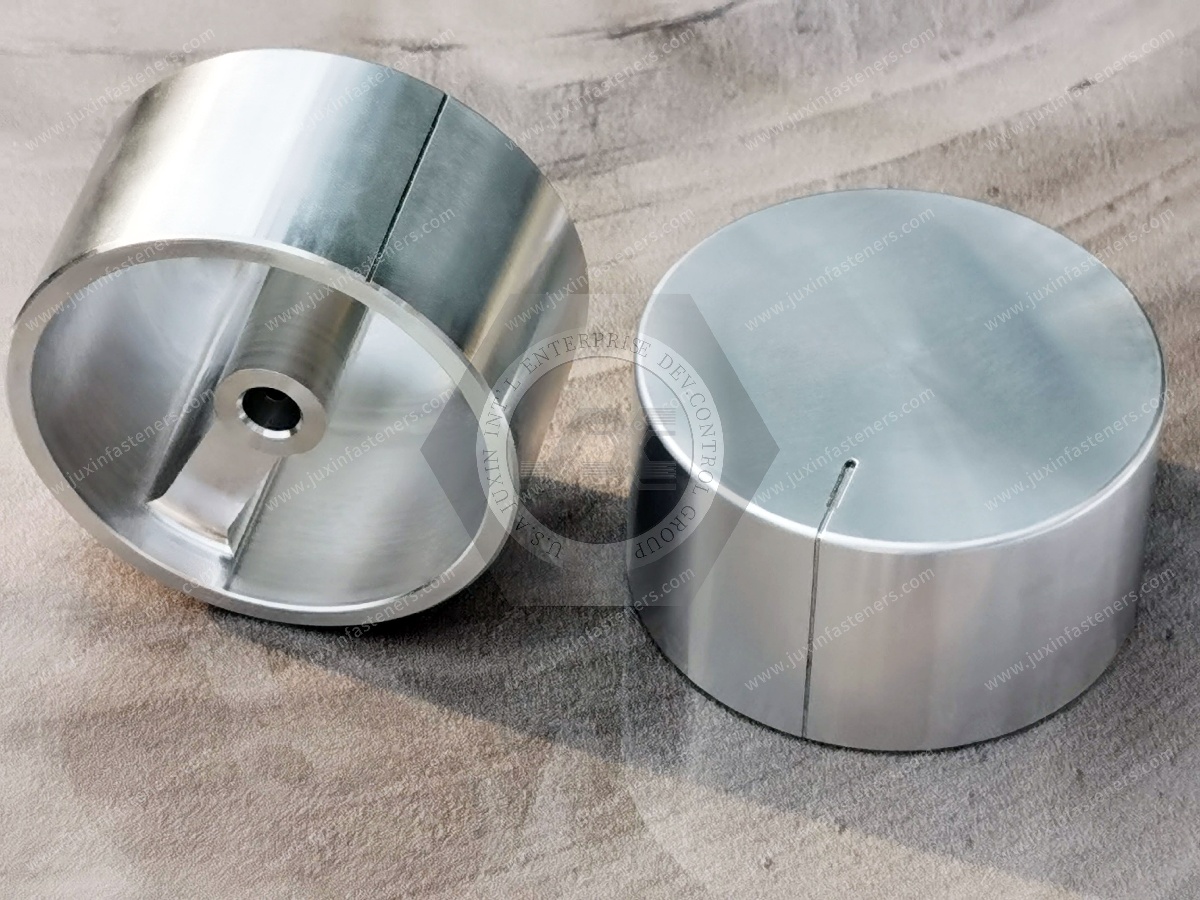
Aluminum alloys offer a useful combination of properties.
Depending on alloy and temper, benefits can include:
relatively low density;
good strength-to-weight ratio;
good machinability;
thermal conductivity;
electrical conductivity;
corrosion resistance;
anodizing compatibility;
dimensional manufacturing capability.
This combination makes aluminum particularly useful where designers need to reduce mass while retaining mechanical and thermal functionality.
Applications range from structural brackets and housings to heat sinks, manifolds, electronics components and precision equipment parts.
"Aluminum" is not a complete material specification.
Different alloys provide significantly different combinations of:
strength;
machinability;
corrosion resistance;
anodizing response;
thermal behavior;
weldability;
fatigue performance;
raw-material cost.
The alloy should therefore be selected according to component function rather than simply choosing whichever aluminum grade is easiest to purchase.
6061 is one of the most widely recognized aluminum alloys for CNC machined industrial components.
It provides a useful balance of:
machinability;
mechanical strength;
corrosion resistance;
anodizing capability;
general availability.
Potential applications include:
brackets;
housings;
mounting components;
equipment parts;
structural supports;
electronics hardware;
thermal-management components.
For many general-purpose OEM machined components, 6061 is a practical starting point.
6082 is widely used in European engineering applications and can be relevant where structural strength is important.
Potential applications include:
structural machine components;
equipment brackets;
mechanical supports;
transportation equipment;
industrial assemblies.
For international projects, procurement teams should specify the required alloy and temper explicitly rather than assuming that 6061 and 6082 can always be substituted without review.
7075 is commonly considered when higher mechanical strength is required.
Potential applications include:
high-load structural components;
performance equipment;
precision mechanisms;
motorsport components;
qualified aerospace-related components.
However, higher strength does not automatically make 7075 the best choice.
Engineers should also consider:
corrosion behavior;
finishing requirements;
cost;
availability;
manufacturing requirements.
Material selection should always reflect the actual load case and operating environment.
A simplified decision framework is:
Need a versatile general-purpose machined aluminum alloy?
6061 may be appropriate.
Need a structural alloy commonly used in European engineering applications?
6082 may be considered.
Need significantly higher mechanical strength?
7075 may be appropriate after evaluating corrosion, finishing and cost.
The final selection should be based on engineering requirements rather than alloy popularity.
Specifying only the alloy number may not completely define the material.
The temper condition influences mechanical properties and machining behavior.
For drawing-based production, procurement should identify the required material condition where relevant.
Material certification requirements should also be defined before quotation if traceability is required.
Many aluminum alloys can be machined efficiently because they allow relatively high cutting speeds and effective material removal when appropriate tools and parameters are used.
However, "easy to machine" does not mean that every aluminum part is easy to manufacture.
Complex geometry can introduce challenges involving:
chip evacuation;
built-up edge;
burr formation;
thin-wall vibration;
thermal effects;
distortion;
tool access.
Machining strategy must therefore be matched to the actual part.
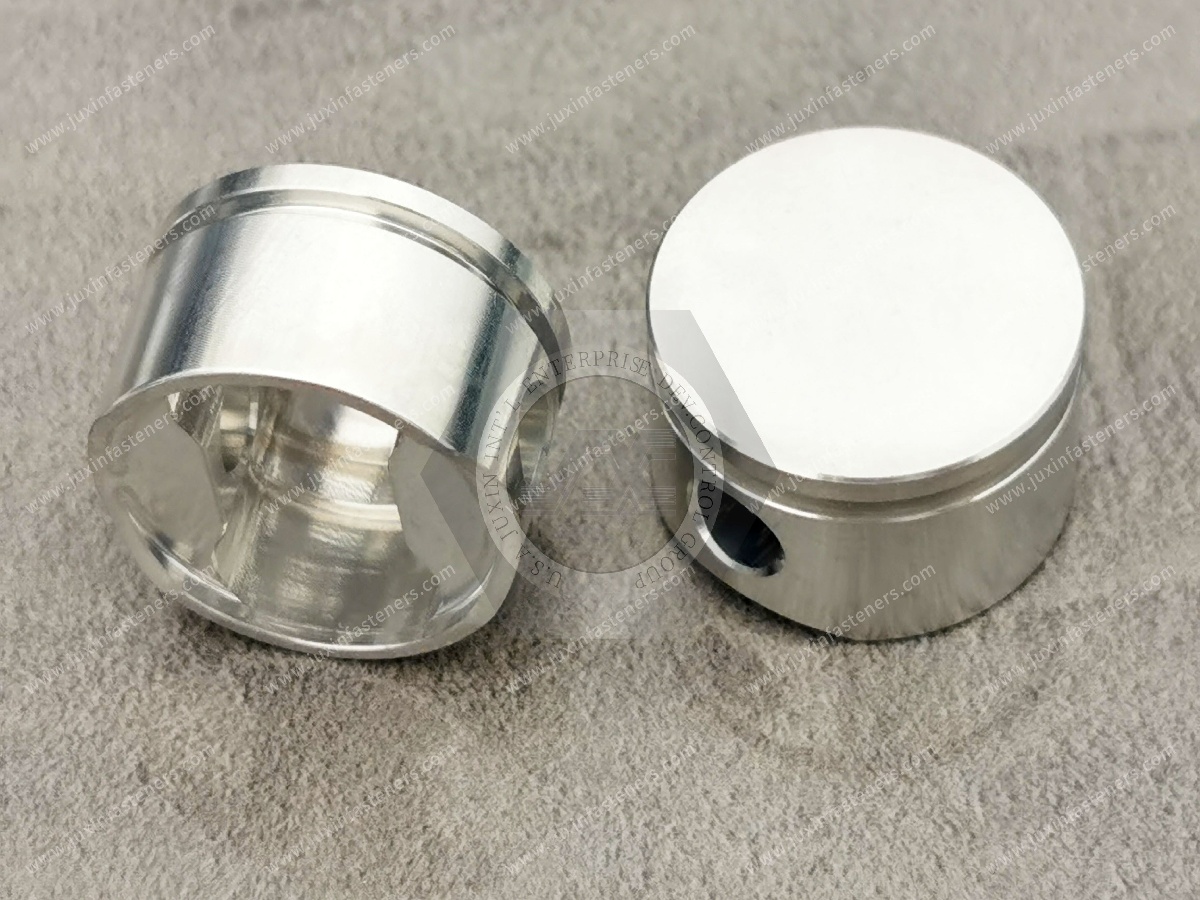
Some aluminum machining conditions can cause material to adhere to the cutting edge.
This phenomenon, commonly called built-up edge, can negatively affect:
surface finish;
dimensional accuracy;
tool life;
burr formation.
Control methods can include appropriate:
cutting-tool geometry;
cutting speed;
feed rate;
coolant or lubrication;
chip evacuation.
The correct machining process is therefore more important than simply classifying aluminum as a "soft metal."
Deep pockets, drilled holes and internal cavities can trap chips.
Poor chip evacuation can lead to:
recutting;
surface scratches;
tool damage;
inconsistent dimensions.
For complex parts, toolpath design and coolant strategy can therefore directly influence quality.
Modern CNC equipment can manufacture highly accurate components, but specifying unnecessarily tight tolerances increases production cost.
Tighter tolerances can require:
slower machining;
additional finishing passes;
more stable fixturing;
temperature control;
additional inspection;
higher scrap risk.
A better drawing distinguishes between:
function-critical dimensions;
assembly-critical dimensions;
general dimensions.
This allows manufacturing effort to be concentrated where precision actually matters.
A common sourcing problem occurs when every dimension on a drawing receives the same tight tolerance.
This may make quotation significantly more expensive without improving product performance.
Design engineers should identify:
bearing fits;
sealing interfaces;
alignment features;
threaded positions;
mating surfaces;
datum-related dimensions
as critical where appropriate.
Non-critical geometry can often use more economical general tolerances.
This improves both manufacturability and supplier comparability.
Geometric Dimensioning and Tolerancing can provide a clearer definition of functional geometry than simply applying ± tolerances to every feature.
Depending on the component, relevant controls can include:
position;
flatness;
perpendicularity;
parallelism;
profile;
runout.
The datum structure should reflect how the component functions in the actual assembly.
A technically correct datum strategy can reduce inspection ambiguity between customer and supplier.
Thin-wall aluminum components are common in lightweight engineering.
They are also one of the more challenging CNC machining conditions.
Removing material can redistribute residual stress within the raw stock.
The part can then move during or after machining.
Distortion can also result from:
clamping force;
machining heat;
asymmetric material removal;
insufficient structural support.
A thin wall that is perfectly positioned in the CAD model may therefore move after unclamping.
When a thin aluminum component moves during machining, the intuitive response may be to clamp it more tightly.
That can make the problem worse.
Excessive fixture force can elastically deform the part during machining.
The component may measure correctly while clamped but spring back after removal.
This creates a critical distinction between:
in-process dimensional accuracy and free-state dimensional accuracy.
For thin-wall parts, fixture design is part of the dimensional-control strategy.
The order in which material is removed can influence distortion.
A process may use:
rough machining;
controlled stock allowance;
intermediate relaxation;
semi-finishing;
final finishing.
The optimal sequence depends on geometry, material condition and tolerance requirements.
This is why complex thin-wall components should be reviewed through DFM before production.
CNC machining is a subtractive process.
When a finished component occupies only a small fraction of the original billet, substantial material may become chips.
For low-to-medium volume production, machining may still be the most economical approach because tooling investment is low.
For higher volumes, engineers may evaluate near-net-shape starting forms such as:
extrusions;
forgings;
castings.
These can reduce machining time and raw-material removal.
The correct process should be selected according to lifecycle volume and component geometry.
Raw-material form can significantly affect cost.
Provides flexibility and is well suited to prototypes and varied geometry.
Can be advantageous when the component has a repeated cross-section.
May become economical at higher volumes where substantial material would otherwise be machined away.
Procurement should therefore evaluate the manufacturing route as annual demand increases.
A prototype process is not always the optimal production process.
CNC milling tools are round.
This means perfectly sharp internal corners cannot normally be created by standard end milling.
A drawing requiring a zero-radius internal corner may require:
additional machining processes;
EDM;
special tooling;
design modification.
Allowing appropriate internal radii can reduce machining time and cost.
Deep narrow pockets can require:
long-reach tools;
reduced cutting parameters;
multiple machining steps;
additional vibration control.
Tool deflection can affect dimensional accuracy and surface quality.
Where possible, designers should avoid extreme depth-to-width relationships unless they are functionally necessary.
A feature may be geometrically possible in CAD but difficult to reach with a cutting tool.
Poor tool access can require:
extra setups;
special tooling;
multi-axis machining;
EDM;
component redesign.
Every additional setup can increase:
cost;
lead time;
tolerance accumulation;
inspection requirements.
Early DFM review can identify these issues before the drawing is released.
For tapped holes, drawings should distinguish between:
drill depth;
usable thread depth;
full-thread requirement.
A cutting or forming tool needs additional space beyond the required functional thread in many designs.
Ambiguous thread-depth specifications can create unnecessary manufacturing problems.
Aluminum components may include:
tapped metric threads;
UNC/UNF threads;
threaded inserts;
press-fit inserts;
self-clinching hardware where the design permits.
Directly tapped aluminum can be appropriate for many applications.
However, if the joint will be repeatedly assembled and disassembled or must carry higher thread loads, a threaded insert may provide better durability.
JUXIN FASTENERS also supplies threaded inserts and other fastening solutions that can be integrated into machined aluminum components.
A threaded insert may be worth evaluating when:
frequent service is expected;
thread wear is a concern;
higher pull-out strength is required;
a damaged thread must be replaceable;
stronger thread material is desirable.
The correct solution depends on the aluminum alloy, wall thickness, load and assembly process.
This decision should ideally be made before the CNC drawing is finalized because insert selection affects hole geometry.
Anodizing is widely used for aluminum components because it can improve surface properties and corrosion resistance while providing a controlled appearance.
Potential anodizing requirements can include:
natural finish;
black finish;
other specified colors;
functional anodizing;
harder anodized surfaces where appropriate.
However, anodizing changes the surface condition of the part.
This must be considered during dimensional planning.
Anodizing forms an oxide layer at the aluminum surface.
Depending on process type and thickness, this can affect:
hole diameter;
outside diameter;
thread fit;
bearing fits;
mating surfaces.
For precision components, engineers should identify whether critical dimensions apply:
before anodizing;
after anodizing.
Machining allowances may need to be planned accordingly.
Some features may need to remain free of anodizing or another coating.
Potential examples include:
electrical contact surfaces;
grounding areas;
precision fits;
threaded features;
sealing interfaces.
If masking is required, it should be clearly identified on the drawing.
"Anodize black" alone may not provide enough information for a complex industrial component.
For visible components, color consistency can become an important purchasing requirement.
However, anodized color can vary because of:
alloy composition;
material lot;
surface preparation;
machining direction;
anodizing process.
Aesthetic requirements should therefore be defined separately from dimensional and corrosion requirements.
For critical cosmetic parts, customer-approved reference samples may be useful.
Depending on the component, secondary finishes can include:
sandblasting;
bead blasting;
brushing;
polishing;
conversion coating;
painting;
powder coating;
laser marking.
Each process should be selected according to functional requirements.
For example, a blasted finish may improve visual uniformity but can also change surface texture.
A decorative requirement should not unintentionally interfere with a sealing or precision mating surface.
Specifying very low roughness across the entire part can substantially increase machining cost.
Critical surface-finish requirements should be applied where they provide functional value, such as:
sealing surfaces;
bearing interfaces;
sliding surfaces;
precision mating features.
Non-critical surfaces can often use standard machined finishes.
Burrs can create problems in:
assembly;
electrical systems;
fluid systems;
sealing interfaces;
handling.
For fluid manifolds and internal passages, hidden burrs can be particularly important.
The drawing should identify special edge or cleanliness requirements where necessary.
Aluminum CNC parts used in liquid cooling, hydraulic or fluid systems may require more than dimensional inspection.
Residual:
chips;
cutting fluid;
particles;
abrasive media
can contaminate the final system.
For these applications, procurement should specify cleanliness requirements where they are functionally necessary.
AI data centers and HPC infrastructure are creating growing demand for precision thermal-management hardware.
Potential aluminum CNC components include:
cold-plate structures;
manifold components;
pump components;
liquid-cooling brackets;
CDU mechanical components;
heat-spreader structures;
equipment mounting components.
These parts can combine dimensional, sealing, thermal and cleanliness requirements.
For liquid-cooling components, drawing review should consider:
sealing surfaces;
flatness;
internal passages;
thread integrity;
burr removal;
cleanliness;
corrosion compatibility.
This is significantly more demanding than machining a simple mounting bracket.
For heat-transfer components, a surface can be dimensionally within thickness tolerance while still having unacceptable flatness.
Poor flatness can reduce contact quality between:
heat-generating device;
thermal interface material;
cold plate;
heat sink.
Thermal components should therefore define the geometric characteristics that influence heat transfer rather than relying only on overall thickness.
Power electronics systems use aluminum components for:
heat sinks;
inverter housings;
converter structures;
power-module supports;
busbar mounting structures;
electrical cabinets.
Thermal conductivity, dimensional stability and surface treatment can all influence component performance.
Where electrical grounding is required, anodizing or coating should be reviewed because insulating surface layers can affect electrical contact.
Electric vehicle systems can require CNC-machined aluminum components for:
battery-pack structures;
cooling components;
manifolds;
brackets;
pump housings;
sensor mounts;
prototype battery hardware.
For battery and cooling applications, engineers should consider:
galvanic corrosion;
sealing;
thermal cycling;
coolant compatibility;
vibration;
dimensional stability.
Aluminum components should be evaluated as part of the complete fastening and sealing system.
Aluminum components are often assembled using stainless steel or coated steel fasteners.
In wet or conductive environments, dissimilar-metal combinations can create galvanic corrosion risk.
Designers should evaluate:
alloy combination;
electrolyte exposure;
surface-area ratio;
coatings;
isolation methods;
drainage.
This becomes especially important in outdoor equipment, EV thermal systems and liquid-cooling assemblies.
Custom aluminum CNC parts can be used for:
prototype components;
brackets;
sensor mounts;
actuator components;
thermal-management hardware;
motorsport components;
manufacturing fixtures.
Production automotive components require the applicable customer quality and validation requirements.
CNC machining is particularly valuable during prototype and development stages because design changes can be implemented without dedicated casting or forging tooling.
Semiconductor manufacturing equipment can require precision aluminum components with demanding:
geometry;
flatness;
surface finish;
cleanliness;
dimensional consistency.
Potential parts include:
equipment plates;
mounting structures;
precision brackets;
automation components;
instrument housings.
Material, surface treatment and contamination requirements should be defined according to the actual equipment environment.
Robotics and automation systems frequently use machined aluminum because it provides a useful combination of stiffness and low mass.
Potential components include:
robot brackets;
actuator housings;
sensor mounts;
end-effector components;
positioning fixtures;
linear-motion structures.
Weight reduction can be particularly valuable in moving assemblies because lower mass reduces inertia.

Aluminum CNC machining can support:
radio housings;
heat sinks;
communication equipment frames;
mounting brackets;
RF-related mechanical structures.
Thermal management and corrosion resistance are often key design considerations.
Precision aluminum components can be used in appropriate medical equipment applications such as instrument structures, equipment housings and mechanical assemblies.
However, medical components may require controlled materials, documentation, surface requirements and regulatory qualification.
A generic CNC machining process should not automatically be described as medical-qualified.
High-strength aluminum alloys are widely used in aerospace engineering.
However, aerospace production requires controlled material certification, process approval, traceability, inspection and customer qualification.
JUXIN FASTENERS' general CNC machining capability should not be interpreted as automatic aerospace certification.
Aerospace projects should be evaluated according to the specific drawing, documentation and qualification requirements.
Prototype priorities often include:
fast turnaround;
design flexibility;
small quantity;
engineering validation.
Production priorities can shift toward:
cycle-time reduction;
fixture optimization;
stable tooling;
process capability;
inspection efficiency;
raw-material utilization.
A machining process developed for five prototypes should not automatically be used unchanged for 50,000 production parts.
As volume increases, DFM and process optimization become increasingly important.
CNC machining is particularly attractive when:
tolerances are important;
geometry is complex;
production volume does not justify expensive dedicated tooling;
design revisions are likely;
high-quality machined surfaces are required;
multiple features must be integrated into one component.
CNC machining may not be the most economical process when:
annual volume is extremely high;
geometry can be efficiently die cast;
the component has a constant extrusion-friendly profile;
extensive material must be removed from a large billet;
tolerance requirements are relatively loose.
Alternative manufacturing routes can include:
aluminum extrusion;
die casting;
forging;
sheet-metal fabrication;
near-net-shape production followed by finish machining.
A capable supplier should help determine whether CNC machining is technically and commercially appropriate rather than simply machining every drawing from solid stock.
For procurement teams, the largest cost driver is often not the raw aluminum itself.
Cost can be influenced by:
machining time;
number of setups;
tolerance;
tool access;
deep cavities;
thin walls;
surface finish;
inspection;
finishing;
quantity.
This explains why two parts with similar weight can have very different prices.
A small lightweight component may require hours of precision machining.
A heavier but geometrically simple component may be much faster to produce.
Procurement teams should therefore compare supplier quotations against:
process assumptions;
tolerance capability;
inspection scope;
material certification;
finishing requirements
rather than simply comparing price per kilogram.
For custom aluminum CNC components, a good RFQ review should identify:
unclear tolerances;
difficult internal corners;
deep cavities;
thin-wall risks;
tool-access problems;
ambiguous threads;
coating-sensitive dimensions;
inspection requirements.
Resolving these issues before production can prevent repeated quotation revisions and engineering changes later.
Inspection requirements depend on component complexity and application.
Potential methods include:
calipers and micrometers;
height gauges;
bore gauges;
thread gauges;
pin gauges;
optical measurement;
coordinate measuring machines;
surface roughness measurement.
Inspection should focus on characteristics that influence fit, function and assembly.
Where required, material documentation can support confirmation of:
alloy;
temper;
material lot;
supplier documentation.
Traceability requirements should be specified during RFQ because they can affect sourcing and production controls.
For new drawing-based components, a first article can help verify:
dimensions;
geometry;
material;
finish;
assembly fit.
Customers should define whether a formal first-article report is required and which characteristics must be included.
For an accurate quotation, provide:
2D engineering drawing
3D CAD model where available
aluminum alloy
temper
quantity
annual demand
dimensional tolerances
GD&T requirements
critical dimensions
thread specifications
surface roughness
deburring requirements
anodizing or coating
cosmetic requirements
masking requirements
material certification requirements
inspection requirements
first-article requirements
cleanliness requirements where applicable
packaging
target delivery schedule
Providing both 2D and 3D data can significantly reduce quotation ambiguity.
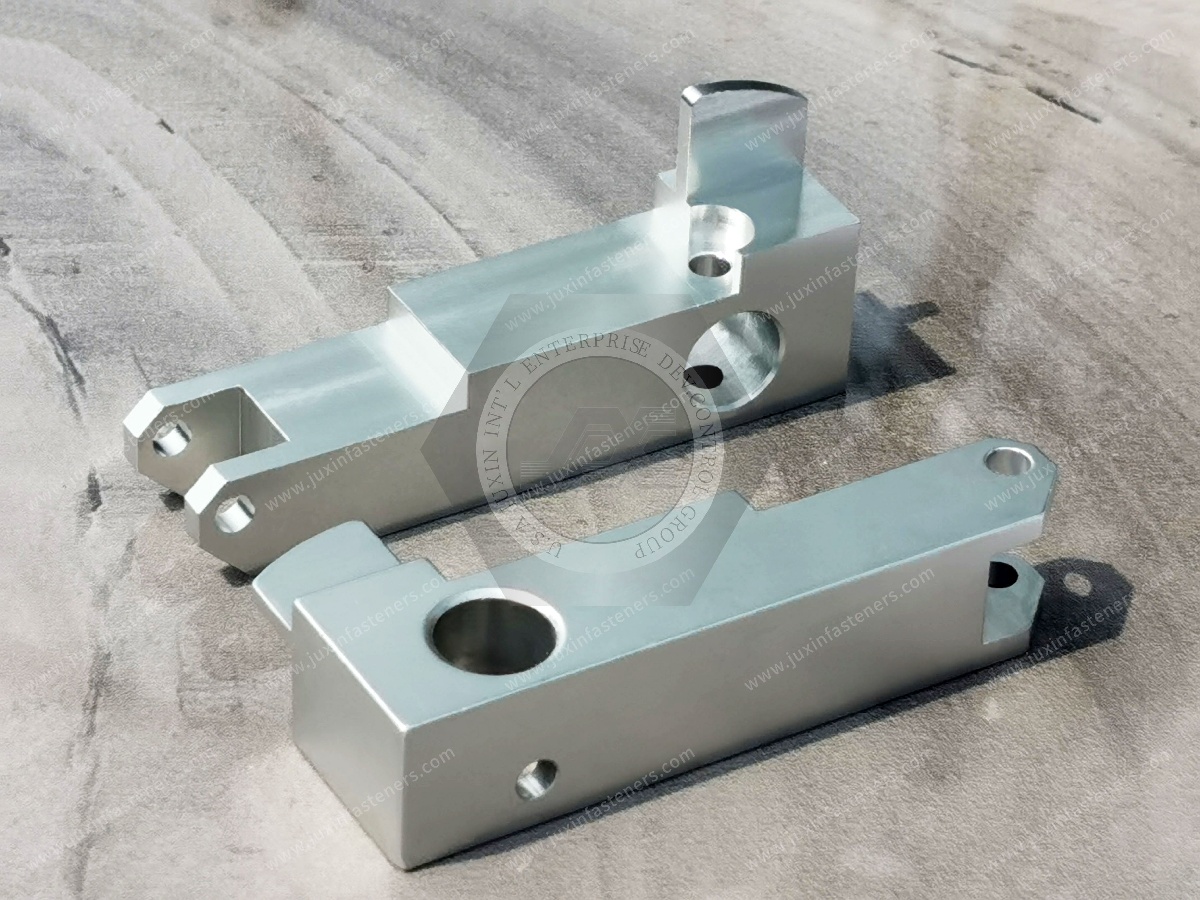
JUXIN FASTENERS supports industrial OEM customers requiring custom machined components together with fastening hardware.
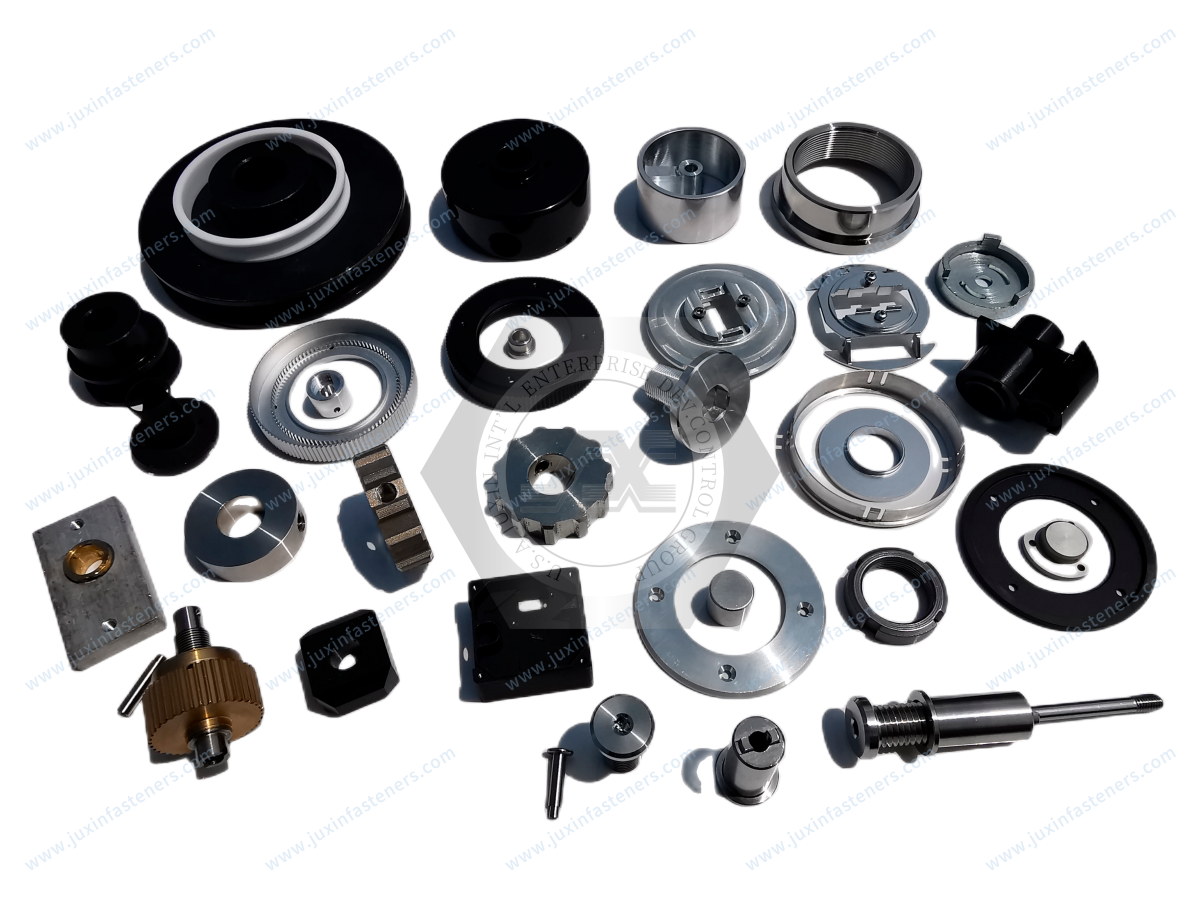
Our supply scope can include:
custom aluminum CNC machined parts
stainless steel CNC parts
carbon steel machined components
precision brackets
housings
spacers
sleeves
threaded components
custom fasteners
self-clinching fasteners
blind rivet nuts
weld fasteners
threaded inserts
high-strength bolts and nuts
This combination is particularly useful where a machined component must interface with threaded inserts, bolts, lock nuts or other fastening hardware.
Rather than treating the machined component and fastener as unrelated purchases, engineering teams can review the complete mechanical interface.
6061 is widely used for general-purpose machined components because it provides a useful balance of machinability, strength, corrosion resistance and finishing capability.
Other alloys such as 6082 and 7075 may be preferable for specific requirements.
No. 7075 provides higher strength in many conditions, but material selection must also consider corrosion behavior, finishing, cost and application requirements.
Yes, but achievable tolerance depends on geometry, size, wall thickness, material condition, fixturing, machining process and inspection conditions.
Material removal can redistribute residual stresses, while clamping force and machining heat can also contribute to deformation.
No. Excessive clamping can deform a thin part during machining, causing it to spring back after release.
Yes. The anodized oxide layer can affect critical dimensions, including holes, external diameters, threads and fits. Critical dimensions should be reviewed before finishing.
No. Tight tolerances should be applied where they provide functional value. Blanket tight tolerances can unnecessarily increase cost and lead time.
Yes. Threaded inserts can be useful where repeated assembly, higher thread durability or stronger thread engagement is required.
Not necessarily. It is a subtractive process, so substantial material can become chips. At higher volumes, extrusions, forgings or cast preforms may reduce material removal.
Ideally provide a 2D drawing and 3D CAD model together with material, finish, quantity, tolerances, inspection requirements and target delivery schedule.
The key question in aluminum CNC machining is not simply:
"Can this geometry be machined?"
Modern CNC equipment can manufacture highly complex components.
The more useful questions are:
Can it be machined repeatedly at the required tolerance? Can it be inspected efficiently? Will it remain dimensionally stable after unclamping and finishing?
And is CNC machining still the right manufacturing route at the projected production volume?
For design engineers, these questions improve DFM and component reliability.
For thermal and structural engineers, they connect material, flatness, interfaces and finishing to actual system performance.
For procurement and supplier-development teams, they create clearer quotations and more meaningful supplier comparisons.
JUXIN FASTENERS supplies custom aluminum CNC machining parts, precision machined components and fastening solutions for automotive and EV equipment,
AI data-center liquid cooling, power electronics, industrial automation, semiconductor equipment, telecommunications and other industrial OEM applications.
For quotation, DFM review or drawing-based sourcing support, send your 2D drawing, 3D model, material requirement and expected quantity to:
 MORE NEWS
Sep. 27, 2026
Sep. 27, 2026
Sep. 27, 2026
Contact Us
Tel.:
+86 020 8621 0320
+86 020 3121 6067
E-mail:
Technical Support:
Navigation
SEND INQUIREY