
Call Us
+86 136 6007 9809
Call Us
+86 136 6007 9809

Oct. 09, 2023
DIN 7967 self-locking counter nuts are thin-profile mechanical locking elements used to provide additional resistance to unintended rotation in threaded assemblies where installation space and component weight are limited.
Unlike a conventional full-height hex nut intended to carry the primary clamping load of a bolted joint, a DIN 7967 counter nut is generally used as a secondary locking element.
Its formed spring-steel geometry creates resistance against rotation while occupying substantially less axial space than many conventional lock-nut designs.
This makes DIN 7967 self-locking counter nuts relevant to compact machinery, adjustment mechanisms, linkage systems,
equipment assemblies and other applications where engineers need additional mechanical locking without adding a full-height second nut.
However, DIN 7967 should not be treated as a universal replacement for every jam nut, prevailing-torque lock nut or full-height structural nut.
Correct selection depends on the thread size, primary fastener, preload strategy, available axial space, vibration environment, material, temperature, corrosion protection and maintenance requirements.
JUXIN FASTENERS supplies DIN 7967 self-locking counter nuts together with all-metal lock nuts, nylon-insert lock nuts,
flange lock nuts, locking washers and other vibration-resistant fastening components for industrial OEM applications.
For drawings, specifications and RFQs, contact info@juxinfasteners.com.
DIN 7967 defines a thin, formed self-locking counter nut designed for use on threaded fasteners.
The product may be searched under terms including:
DIN 7967 self-locking counter nut
DIN 7967 lock nut
locking counter nut
thin self-locking nut
spring steel counter nut
sheet metal lock nut
prevailing-torque counter nut
lightweight locking nut
vibration-resistant counter nut
Its thin profile distinguishes it from conventional full-height hex nuts and many other prevailing-torque nuts.
The component is generally formed from spring-capable metallic material so that its locking geometry can interact elastically with the mating thread.
For engineering procurement, the DIN designation, thread size, material, finish and functional locking requirements should be defined rather than purchasing solely by the generic term "jam nut."
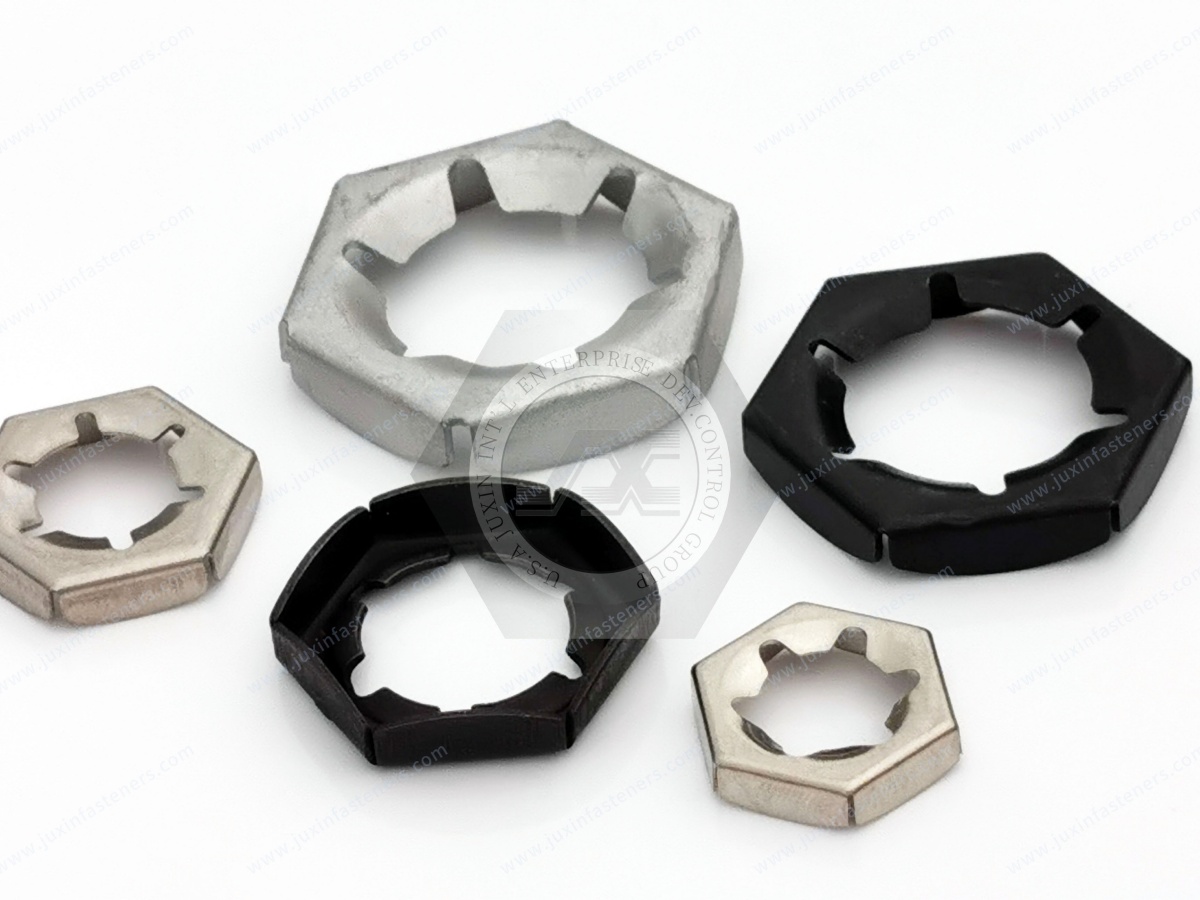
The terms "counter nut" and "jam nut" are sometimes used loosely in commercial markets, but their locking mechanisms can differ.
A conventional thin jam nut typically relies on the interaction between two threaded nuts.
A DIN 7967 self-locking counter nut incorporates formed geometry intended to create its own resistance to rotation on the mating thread.
This distinction matters because two components with similar overall height may behave very differently in an assembly.
Procurement teams should therefore avoid substituting a conventional thin hex nut for a DIN 7967 component without engineering approval.
One of the most important design principles for DIN 7967 is understanding its role in the joint.
A conventional primary nut may be responsible for generating and sustaining the required clamp load.
The DIN 7967 counter nut provides an additional locking function.
This means engineers should distinguish between:
clamping function and locking function.
They are related, but they are not identical.
A locking component can resist rotation without necessarily being intended to carry the same structural load as a full-height nut.
This distinction prevents a common design mistake: selecting a thin locking component merely because it fits the thread and assuming it can replace the primary load-bearing nut.
Many mechanical assemblies have limited axial space.
Adding a second conventional hex nut can increase:
overall assembly height;
bolt length;
component mass;
interference with nearby parts.
A thin counter nut can provide a more compact secondary locking method.
This can be useful in:
linkages
adjustment mechanisms
actuators
machinery
equipment brackets
threaded rods
compact electromechanical assemblies
The value is therefore not simply "lightweight."
The more important engineering advantage is locking functionality with limited axial packaging space.
DIN 7967 self-locking counter nuts use formed elastic geometry that creates interference or prevailing resistance against the mating thread.
When the nut is threaded onto the fastener, its locking section elastically interacts with the thread.
This produces rotational resistance.
The locking action therefore does not depend solely on clamp friction between two flat nut faces.
This type of mechanism belongs broadly to the family of mechanically prevailing-torque locking solutions.
The exact geometry should follow the applicable standard or approved drawing.
This distinction is particularly important.
Prevailing torque is the rotational resistance created by a locking feature before or independently of final joint seating.
Tightening torque is the torque applied during installation.
Bolt preload is the tensile force generated in the bolt that clamps the joint members together.
These three quantities should not be treated as interchangeable.
A nut can produce substantial prevailing torque while the joint still has inadequate preload.
For critical assemblies, engineers should therefore evaluate both:
locking resistance;
achieved clamp load.
This is one of the most important concepts when specifying any prevailing-torque fastener.
Suppose an installation tool reports a total torque value.
Part of that torque may be consumed by:
thread friction;
bearing friction;
prevailing torque from the locking feature.
Only part of the applied torque contributes to generating bolt tension.
Therefore, simply increasing installation torque because a self-locking nut "feels tight" can produce inconsistent preload.
This becomes especially important in automated assembly.
If a production line changes from a conventional nut to a prevailing-torque nut, the tightening strategy may need to be reviewed.
A conventional jam-nut arrangement typically uses two nuts tightened against one another.
This creates a locking effect through thread loading and friction between the nuts.
DIN 7967 uses a different locking principle based on its formed self-locking geometry.
May be appropriate when:
standard nut geometry is preferred;
axial space permits two nuts;
a traditional double-nut method is acceptable.
May be appropriate when:
axial space is restricted;
low component mass is useful;
a thin secondary locking element is preferred;
formed mechanical locking is required.
The two should not be treated as automatically interchangeable.
DIN 985-style nylon-insert lock nuts use a polymer insert to generate prevailing torque against the bolt thread.
DIN 7967 uses metallic formed geometry.
This creates different application considerations.
Potential advantages include:
compact axial profile;
all-metal locking mechanism;
no polymer insert;
suitability for applications where thin packaging is important.
Potential advantages include:
familiar prevailing-torque behavior;
broad commercial availability;
convenient single-nut locking solution.
Temperature, chemical exposure, available space and joint architecture can influence the selection.
For elevated-temperature environments, an all-metal solution may be preferable where polymer insert capability would be exceeded.
A full-height all-metal prevailing-torque nut can combine the primary nut function and mechanical locking function in one component.
DIN 7967 is much thinner and is generally used differently.
A full-height all-metal lock nut may be preferable when:
the nut itself must carry the primary joint load;
a single-nut solution is preferred;
sufficient axial space is available;
higher structural capability is required.
DIN 7967 may be preferable where a primary nut already exists and compact secondary locking is required.
DIN 25201 wedge-lock washer pairs resist loosening through cam geometry at the bearing interface.
DIN 7967 creates locking resistance through the threaded interface.
This difference matters.
Wedge-lock washers act beneath the nut or bolt head.
DIN 7967 acts directly on the mating thread.
The appropriate technology depends on:
joint geometry;
available axial space;
surface condition;
maintenance strategy;
thread accessibility;
locking requirement.
There is no single anti-loosening technology that is best for every bolted joint.
Thread-locking adhesives can provide chemical resistance to rotational loosening and may also provide sealing functions in some applications.
DIN 7967 provides a mechanical locking method.
A mechanical counter nut may be preferred when:
curing time is undesirable;
adhesive contamination must be avoided;
disassembly is expected;
the assembly process favors dry mechanical components.
Thread adhesive may be preferable where:
axial space is extremely limited;
sealing is required;
a secondary mechanical nut cannot be accommodated.
The decision should be based on assembly requirements rather than habit.
DIN 7967 counter nuts require material capable of maintaining the elastic characteristics of the formed locking geometry.
Suitable spring-capable carbon steel is commonly relevant.
The international OEM specification should define material and mechanical requirements according to the applicable DIN standard, drawing or customer specification rather than relying on a local material designation.
Relevant material requirements can include:
strength;
hardness;
elasticity;
forming capability;
fatigue behavior;
corrosion compatibility.
The locking function depends on controlled elastic interaction with the bolt thread.
If the material is too soft, the locking feature may permanently deform and lose prevailing torque.
If the material or heat treatment is inappropriate, the component may crack during forming or installation.
Therefore, material selection and manufacturing process are directly connected to functional locking performance.
DIN 7967 counter nuts are typically produced using precision forming and stamping processes.
Depending on the design, manufacturing stages can include:
blanking;
piercing;
forming;
locking-feature formation;
thread-related forming;
heat treatment where required;
surface finishing;
inspection.
For high-volume production, progressive tooling can provide consistent geometry and economical production.
The critical issue is not the specific die architecture used by one factory.
The critical issue is whether the final product consistently meets the required dimensional and functional characteristics.
Small changes in formed geometry can influence prevailing torque.
Manufacturing variation can therefore affect:
installation torque;
locking resistance;
thread engagement;
repeatability.
For OEM supply, dimensional inspection alone may not always be sufficient.
Functional locking characteristics may also need to be controlled according to the applicable specification.
Stamped thin-metal components can develop burrs at cut edges.
Excessive burrs can affect:
installation;
handling;
surface treatment;
assembly clearance;
adjacent components.
Burr condition should therefore be controlled according to drawing and application requirements.
A universal burr-height value should not be assumed unless it is specified by the customer or applicable standard.
Depending on the material and operating environment, surface treatments may include:
phosphate finishes;
zinc-based coatings;
zinc-flake coating systems;
other customer-specified protective finishes.
The selected coating should consider:
corrosion resistance;
coating thickness;
friction;
prevailing torque;
installation behavior;
environmental compliance.
This is an important engineering consideration.
A surface coating changes the interface between the counter nut and bolt thread.
That can influence:
friction;
installation torque;
prevailing torque;
wear;
repeat installation behavior.
Changing the coating without functional review can therefore change the behavior of the locking system.
For OEM programs, coating approval should not be treated purely as a cosmetic decision.
A purchasing specification should avoid relying solely on descriptions such as "black" or "zinc coated."
Where corrosion resistance matters, define:
coating type;
coating thickness where applicable;
corrosion-performance requirement;
test method;
environmental compliance.
This gives procurement teams a measurable basis for supplier comparison.
DIN 7967 counter nuts must match the mating thread correctly.
Important factors include:
nominal thread diameter;
thread pitch;
thread tolerance;
bolt coating;
thread damage;
thread cleanliness.
An incorrect pitch or damaged bolt thread can affect both installation and locking behavior.
For OEM assembly, the nut should be validated with the actual mating fastener rather than evaluated in isolation.
Prevailing-torque locking elements interact directly with the thread.
Changes in the mating bolt can therefore influence performance.
Examples include:
coating thickness;
lubrication;
thread rolling quality;
thread damage;
contamination.
A locking nut qualified on one bolt configuration may behave differently on another.
This is especially relevant when procurement changes bolt suppliers.
Installation should follow the approved joint specification and applicable DIN requirements.
A typical assembly strategy can involve:
installing and tightening the primary fastener or nut according to the joint design;
installing the DIN 7967 counter nut onto the mating thread;
applying the specified locking procedure;
confirming correct seating and engagement.
A universal additional rotation such as "60° to 90°" should not be applied automatically to every DIN 7967 application.
The correct installation requirement should come from the approved specification or validated assembly process.
A fixed angle does not account for variations in:
thread size;
thread pitch;
nut geometry;
coating;
lubrication;
mating fastener;
application requirements.
For production engineering, the installation method should therefore be validated for the actual assembly.
Disassembly procedures should avoid damaging the mating thread or deforming the locking element.
Whether the counter nut can be reused should depend on:
applicable product specification;
locking-feature condition;
thread condition;
corrosion;
measured prevailing torque where required.
Reuse should not be assumed for critical applications.
Many prevailing-torque fasteners exhibit different resistance during initial installation and subsequent reuse.
Wear and plastic deformation can reduce locking resistance.
For assemblies requiring repeated maintenance, engineers should define whether:
the nut is single-use;
limited reuse is permitted;
replacement is required after disassembly.
This should be included in service documentation rather than decided informally during maintenance.
DIN 7967 counter nuts can be particularly useful in threaded adjustment mechanisms.
Potential examples include:
linkage adjustments;
actuator stops;
positioning screws;
threaded rods;
equipment alignment mechanisms.
The thin profile allows a setting to be mechanically secured without adding the axial height of another full-size nut.
This is a more precise application concept than describing DIN 7967 simply as a lightweight nut.
DIN 7967 counter nuts may be considered for appropriate non-safety-critical vehicle assemblies such as:
linkage mechanisms;
adjustment systems;
auxiliary brackets;
actuator assemblies;
equipment mechanisms.
For EV platforms, compact locking components can also be relevant to thermal-management equipment, actuators and auxiliary mechanical systems.
Safety-critical automotive applications require OEM-approved specifications and validation.
A commercial DIN 7967 component should not automatically be presented as suitable for steering, braking or other safety-critical systems.
Industrial machinery can use thin locking counter nuts in:
adjustment mechanisms;
machine controls;
linkages;
actuator systems;
threaded positioning assemblies;
equipment brackets.
Their compact profile can be useful where a conventional double-nut arrangement would occupy excessive space.
Robotic and automated equipment frequently contains compact threaded adjustment mechanisms.
Potential applications include:
sensor positioning;
actuator adjustments;
linkages;
mechanical stops;
guide systems.
For automated assembly, prevailing torque consistency may become an important process-control characteristic.
AI data-center infrastructure contains pumps, cooling distribution units, valves, actuators, fans and mechanical adjustment systems.
DIN 7967-type locking components may be relevant to suitable compact threaded mechanisms within these systems.
Where humidity or coolant exposure is present, material and corrosion protection should be selected accordingly.
HVAC and cooling equipment can contain:
actuator linkages;
valve mechanisms;
pump assemblies;
fan equipment;
adjustment hardware.
Thin-profile mechanical locking can be useful where space is constrained and threaded settings must remain stable.
Power-conversion equipment, UPS systems and electrical cabinets contain mechanical structures and adjustment hardware.
DIN 7967 counter nuts can be considered for suitable mechanical threaded connections where compact secondary locking is required.
They should not automatically be used on electrical current-carrying connections without specific electrical and thermal evaluation.
Rail equipment experiences vibration and long service cycles.
DIN 7967 counter nuts may be used in suitable approved mechanical assemblies, but railway applications should follow the applicable system specification and validation requirements.
A generic DIN component designation alone does not establish railway qualification.
The lightweight and compact nature of DIN 7967 may appear attractive for aerospace assemblies.
However, aerospace fastening components require controlled specifications, materials, traceability and qualification.
A commercial DIN 7967 counter nut should not automatically be described as aircraft-qualified.
Use in aerospace systems requires approval under the applicable customer and industry requirements.
DIN 7967 can be attractive when:
secondary locking is required;
axial space is limited;
low component mass is beneficial;
an all-metal locking method is preferred;
a primary nut or threaded assembly already provides the main structural function;
a compact mechanical solution is preferable to adhesive locking.
Another locking method may be preferable when:
the nut must carry the primary structural load;
very high clamp loads are required;
a single full-height lock nut is simpler;
repeated reuse is necessary;
thread accessibility is limited;
a validated wedge-locking system is preferred;
surface or assembly conditions make another locking technology more reliable.
Alternatives include:
all-metal prevailing-torque nuts;
nylon-insert lock nuts;
flange lock nuts;
wedge-lock washers;
safety washers;
thread-locking adhesives;
positive mechanical locking systems.
A useful engineering decision path is:
Need a primary load-bearing nut with mechanical locking?
Consider a full-height all-metal lock nut.
Need a polymer-based prevailing-torque solution at suitable temperature?
Consider a nylon-insert lock nut.
Need severe-vibration locking at the bearing interface?
Evaluate a wedge-lock washer system.
Need compact secondary locking with minimal axial height?
DIN 7967 may be a suitable candidate.
This type of functional selection is more useful than simply comparing unit prices between unrelated locking technologies.
Depending on the applicable specification, inspection can include:
thread size;
dimensional geometry;
thickness;
formed locking geometry;
material;
hardness where required;
surface finish;
burr condition;
coating;
functional locking behavior.
For OEM programs, functional prevailing-torque testing may be more meaningful than dimensional inspection alone for certain critical characteristics.
Procurement and supplier-development teams should evaluate whether a supplier can control:
forming consistency;
material;
heat treatment where applicable;
locking geometry;
thread compatibility;
surface treatment;
functional performance;
batch traceability.
A low-cost stamped component can still create expensive assembly problems if prevailing torque varies significantly between lots.
For an accurate quotation and technical review, provide:
DIN 7967 designation
thread size
thread pitch
required dimensions
mating bolt specification
material requirement
hardness or mechanical requirements if specified
surface treatment
corrosion requirement
operating temperature
vibration environment
intended locking function
primary nut or joint configuration
annual usage
order quantity
inspection requirements
functional test requirements
documentation requirements
packaging
delivery schedule
For non-standard designs, provide a 2D drawing or physical sample.
JUXIN FASTENERS supports OEM, Tier-1 and industrial supply-chain customers requiring standard and custom locking components.
Our fastening portfolio includes:
DIN 7967 self-locking counter nuts
all-metal prevailing-torque lock nuts
nylon-insert lock nuts
flange lock nuts
Fuji-style all-metal flange lock nuts
DIN 25201 wedge-lock washers
DIN 9250 safety washers
spring washers
disc spring washers
high-strength bolts and nuts
self-clinching fasteners
blind rivet nuts
weld fasteners
threaded inserts
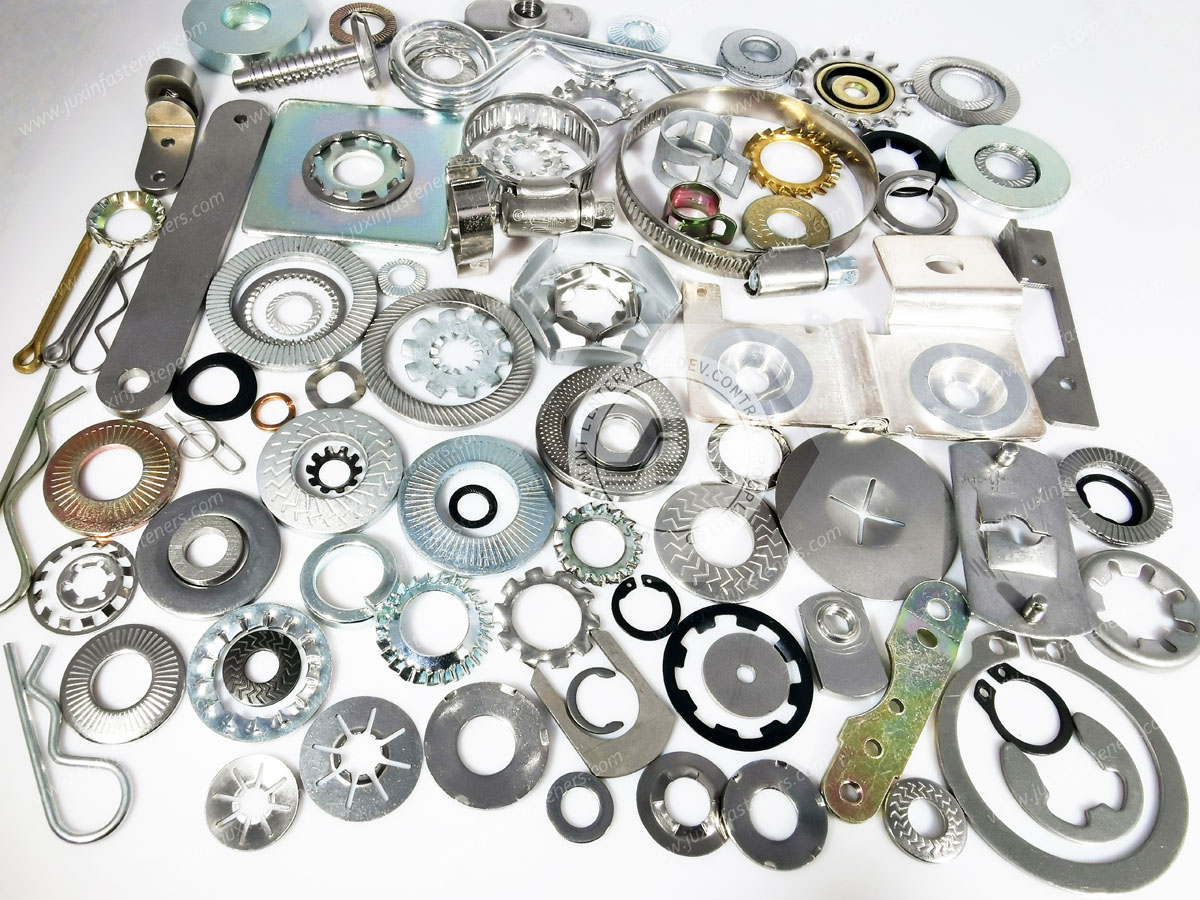
custom stamped components
This allows engineering teams to select locking technology according to the actual joint rather than forcing every anti-loosening problem into one product category.
For procurement teams, it also enables multiple fastening requirements to be reviewed under a coordinated sourcing and quality process.
It is a thin-profile formed locking nut designed to provide additional rotational resistance on a threaded fastener while occupying relatively little axial space.
It is often described commercially as a counter nut or jam-type locking nut, but its formed self-locking mechanism distinguishes it from a conventional thin hex jam nut.
Generally, it should be treated as a locking or counter-nut component rather than automatically assumed to replace a full-height load-bearing nut. The approved joint design determines its function.
Prevailing torque is rotational resistance produced by the locking feature. Preload is the tensile force in the bolt that clamps the joint together.
No. A nut can produce high rotational resistance without generating sufficient bolt preload.
A universal fixed-angle rule should not be assumed. Installation should follow the applicable standard, joint specification or validated assembly procedure.
Neither is universally better. DIN 7967 provides a compact all-metal locking option, while nylon-insert nuts provide another type of prevailing-torque locking.
Temperature, space, load and application requirements determine selection.
Not exactly. Full-height all-metal lock nuts can serve as primary nuts in appropriate designs, while DIN 7967 has a thin counter-nut configuration and should be selected according to its intended joint function.
Reuse should follow the applicable specification and validated locking performance. Prevailing torque can change after repeated installation.
Yes. Coating and lubrication can alter friction and interaction with the mating thread, affecting installation and prevailing torque.
Provide the DIN designation, thread size and pitch, material, coating, mating bolt, joint function, quantity, corrosion requirements, functional test requirements and delivery schedule.
DIN 7967 self-locking counter nuts are most valuable when engineers understand what they are designed to do:
provide compact mechanical locking at a threaded interface without requiring the axial space of another conventional full-height nut.
Their value should therefore be evaluated through the complete joint.
For design engineers, that means distinguishing between primary clamp load and secondary locking.
For manufacturing engineers, it means understanding how prevailing torque interacts with tightening strategy.
For procurement and supplier-development teams, it means controlling material, forming geometry, coating, mating-thread compatibility and functional locking performance rather than purchasing only by thread size.
JUXIN FASTENERS supplies DIN 7967 self-locking counter nuts, all-metal lock nuts, nylon-insert lock nuts, flange lock nuts,
locking washers and custom vibration-resistant fastening components for industrial OEM applications.
For quotation, drawing review or application support, send your specification, drawing and expected quantity to:
 MORE NEWS
Sep. 27, 2026
Sep. 27, 2026
Sep. 27, 2026
Contact Us
Tel.:
+86 020 8621 0320
+86 020 3121 6067
E-mail:
Technical Support:
Navigation
SEND INQUIREY