
Call Us
+86 136 6007 9809
Call Us
+86 136 6007 9809

Aug. 20, 2023
Modern vehicle manufacturing, EV battery systems, rail transit equipment, aerospace-related structures, robotics, electronics enclosures,
and industrial machinery increasingly use lightweight materials to reduce system mass while maintaining functional performance.
Thin aluminum sheet is particularly attractive where weight reduction, corrosion resistance, manufacturability, or thermal characteristics are important.
However, creating a reliable threaded connection in thin sheet can be challenging.
Traditional tapping may provide insufficient thread engagement in thin material.
Welding a nut introduces heat into the parent structure and may create additional distortion, coating, process, and accessibility considerations.
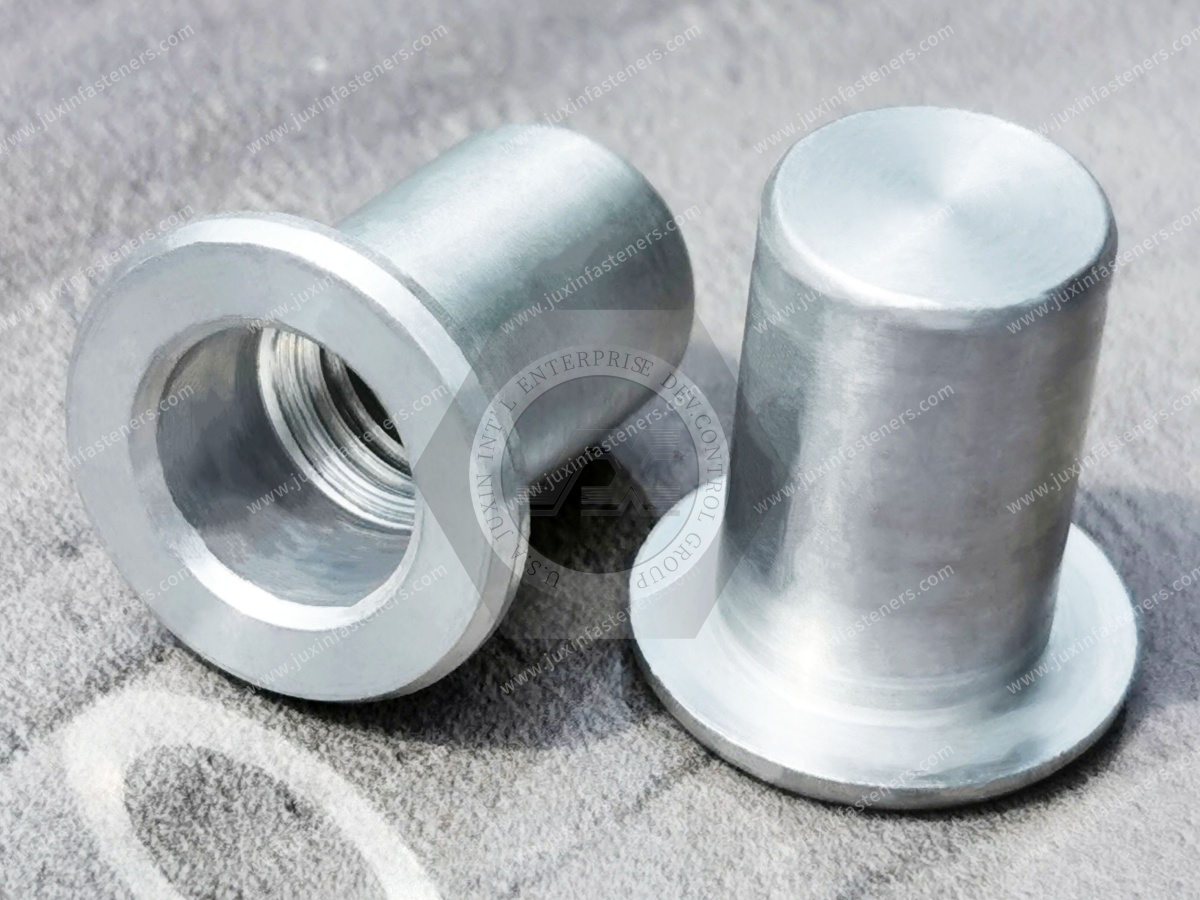
Aluminum closed-end blind rivet nuts provide another solution.
They create a retained internal thread through single-sided installation while allowing the blind side of the panel to remain inaccessible during assembly.
A closed-end configuration can also help close the direct passage through the threaded fastener body, while an optional sealing interface can address the fastener-to-panel interface.
This makes aluminum closed-end blind rivet nuts relevant to:
EV battery enclosures
Automotive body panels
Automotive electronic housings
Rail transit interiors and equipment
Aerospace-related lightweight equipment
Electronics enclosures
Robotics
Industrial machinery
HVAC equipment
Lightweight sheet-metal structures
JUXIN FASTENERS supplies blind rivet nuts, closed-end rivet nuts, sealing rivet nuts, threaded inserts, self-clinching fasteners, and other industrial fastening components for OEM and production applications.
The correct aluminum rivet nut should be selected according to the actual panel material, thickness, hole geometry, grip range, mating screw, assembly torque, environmental exposure, and required mechanical performance.
The primary reason to consider an aluminum blind rivet nut is not simply that aluminum is lighter than steel.
The real engineering objective is to create an effective threaded fastening point while controlling total assembly mass and maintaining the required joint performance.
Aluminum blind rivet nuts can provide:
Low-density fastening hardware
Single-sided installation
Retained internal threads
Compatibility with thin sheet
Closed-end configurations
Optional sealing interfaces
Application-specific anti-rotation geometries
Potential mass reduction in large assemblies
They can be useful when hundreds or thousands of threaded fastening points are distributed across a lightweight structure.
At system level, the mass saving depends on the fastener itself, the required flange and body geometry, the mating screw,
the panel reinforcement, and whether additional structure is needed around the fastening point.
Aluminum alloys generally have substantially lower density than conventional carbon and alloy steels.
This makes aluminum attractive for weight-sensitive applications.
However, fastener selection should not be based on density alone.
A lighter fastener may require:
A larger flange
Different body geometry
Different panel reinforcement
Different mating torque
Different grip configuration
Additional anti-rotation features
Therefore, the correct question is not:
“Is aluminum lighter than steel?”
The more useful engineering question is:
“Can the aluminum fastening system meet the required mechanical, environmental, assembly, and service requirements at the lowest practical system mass?”
An aluminum blind rivet nut uses a deformable body that is installed from one accessible side of the panel.
During installation, the installation tool acts on the fastener and causes the body to deform behind the sheet.
The deformed section creates a clamping interface with the parent material.
The resulting joint depends on:
Fastener body geometry
Material
Sheet thickness
Grip range
Hole diameter
Hole tolerance
Installation parameters
Flange geometry
Panel strength
Mating screw torque
This is why an aluminum rivet nut should be selected as part of a complete joint rather than as an isolated threaded component.
One of the main advantages of blind rivet nuts is single-sided installation.
The operator does not need direct access to the backside of the panel during installation.
This can simplify assembly when the rear side is:
Enclosed
Difficult to reach
Occupied by other components
Inside a hollow profile
Behind an electrical enclosure
Inside a battery housing
Potential applications include:
Battery covers
Automotive panels
Electronic housings
Rail equipment
Machinery panels
HVAC housings
Robotic frames
Lightweight equipment structures
A closed-end aluminum rivet nut incorporates a closed distal section at the bottom of the threaded body.
This differs from an open-ended rivet nut, which has an open passage through the body.
The closed-end design can reduce direct passage through the fastener.
This can be useful where the fastener is located on an enclosure boundary or where the designer wants to avoid an open passage through the panel.
However, closed-end construction alone does not automatically make an assembly waterproof or IP-rated.
The surrounding flange interface and the rest of the enclosure still determine the overall environmental protection.
These two functions should be separated.
The closed distal end closes the internal passage of the rivet nut.
A sealing element beneath or around the flange can address the interface between the fastener and the panel.
The complete enclosure may also require:
Cover gaskets
Seams
Cable glands
Connectors
Venting features
Access covers
Other fastener interfaces
Therefore, an aluminum closed-end rivet nut should not automatically be marketed as a “waterproof fastener.”
Its actual sealing contribution depends on its specific design and the complete assembly.
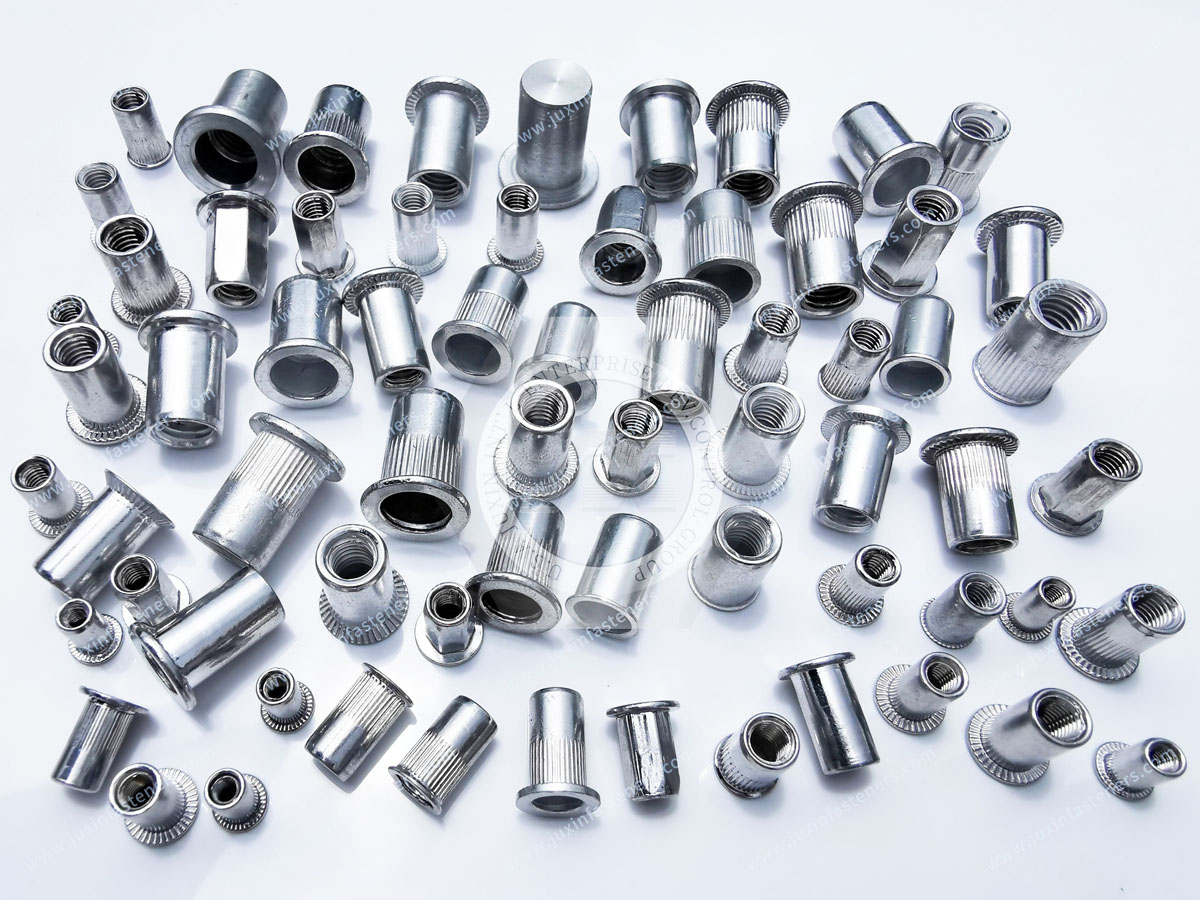
| Rivet Nut Category | Typical Geometry | Potential Material / Finish | Typical Application |
|---|---|---|---|
| Closed-End Aluminum Rivet Nut | Closed distal end with flange | Aluminum alloy, application-specific finish | EV enclosures, electronics |
| Aluminum Flat-Head Rivet Nut | Standard flange and threaded body | Aluminum alloy | Automotive panels, equipment |
| Semi-Hex Aluminum Rivet Nut | Anti-rotation body geometry | Aluminum alloy | High-torque thin-sheet applications |
| Sealing Aluminum Rivet Nut | Closed end with sealing interface | Aluminum alloy, specified seal | Enclosure applications |
| Custom Aluminum Rivet Nut | Customer-specific geometry | Application-specific alloy | OEM lightweight structures |
The final alloy, temper, finish, thread, grip range, and geometry should be defined according to the customer specification.
Small metric threads such as M3, M4, and M5 can be relevant in lightweight assemblies where component size and mass are closely controlled.
Potential applications include:
Sensor brackets
Electronics housings
Automotive trim structures
Control panels
Cable management
Robotics
Instrumentation
Lightweight equipment
The thread size should always be selected according to the required joint load and mating screw rather than by available space alone.
A common sourcing mistake is to assume that:
M5 = one fixed mechanical performance level.
The actual joint performance depends on:
Rivet nut material
Body diameter
Wall thickness
Grip range
Sheet material
Sheet thickness
Hole geometry
Installation quality
Mating screw
Torque
Loading direction
Two M5 aluminum rivet nuts can therefore behave differently when installed into the same panel.
Thin sheet applications are one of the primary use cases for blind rivet nuts.
Potential panel thicknesses depend on the specific rivet nut design and grip range.
The actual selection should consider:
Minimum sheet thickness
Maximum sheet thickness
Local panel geometry
Coatings
Reinforcement
Multi-layer stack-up
The fastener should be selected based on the actual effective grip condition.
A drawing may state:
2.0 mm aluminum sheet.
But the actual fastening location may include:
Surface coating
Formed flange
Reinforcement
Second sheet
Bracket
Adhesive layer
Local embossment
The effective grip condition can therefore differ from the nominal panel thickness.
For production RFQs, suppliers should receive the actual fastener interface wherever possible.
The hole is not merely an opening for the rivet nut.
It directly affects:
Installation
Retention
Anti-rotation
Panel deformation
Flange seating
Fastener alignment
A hole that is too large can reduce mechanical engagement.
A hole that is too small can increase installation difficulty and damage the parent material.
Hole diameter and tolerance should therefore be controlled by the fastener drawing and application specification.
Round rivet nuts may rely on knurling or other external body features to resist rotation.
Semi-hex or hex-profile rivet nuts introduce a geometric anti-rotation interface.
This can be particularly useful when the mating screw requires significant tightening torque.
However, the anti-rotation effect depends on the relationship between:
Fastener geometry + hole geometry + panel material + installation condition.
Changing one element can affect the entire joint.
Semi-hex aluminum rivet nuts can be considered where resistance to rotation is important.
Potential applications include:
Automotive brackets
EV battery structures
Aluminum enclosures
Rail transit panels
Industrial equipment
Lightweight machinery
Electronics housings
The semi-hex profile can provide a geometric interface with the panel hole.
This can reduce reliance on friction alone.
It is technically incorrect to assume that a semi-hex body completely eliminates spin-out.
Performance still depends on:
Hole dimensions
Hole tolerance
Panel hardness
Panel thickness
Body profile
Installation condition
Mating screw torque
For high-load applications, the actual assembly should be tested using the production panel and fastener.
Three different mechanical failure modes should be considered.
The insert moves axially out of the panel.
The insert-to-panel interface fails under rotational loading.
The insert rotates in the panel during screw installation or removal.
These are different failure mechanisms.
An aluminum rivet nut may perform well in one mode but require additional design attention in another.
When an aluminum rivet nut is installed into aluminum sheet, the two materials may have similar general characteristics, but that does not automatically guarantee optimum joint performance.
The design team should consider:
Aluminum alloy
Temper
Sheet thickness
Local hardness
Hole quality
Edge distance
Panel forming
Joint load
The parent sheet can become the limiting component of the joint.
In lightweight structures, engineers often focus on the rated strength of the fastener.
However, the actual failure may occur in:
Parent-sheet deformation
Hole enlargement
Local bearing
Tear-out
Insert rotation
Flange deformation
Therefore, increasing fastener strength does not automatically increase system performance.
The complete joint must be evaluated.
The original concept of fixed installation-force charts for M3, M4, and M5 fasteners is too broad for production engineering.
Installation parameters depend on the specific:
Fastener geometry
Material
Grip range
Panel thickness
Hole
Installation tool
Tool setting
The correct approach is to establish the installation window for the actual production part.
Excessive installation force can deform thin aluminum panels.
Potential results include:
Local dimpling
Panel distortion
Hole enlargement
Surface damage
Reduced flange seating
Reduced sealing performance
Insufficient installation can also cause poor backside formation and inadequate retention.
Therefore, the installation process should be validated rather than set solely from nominal thread size.

Aluminum rivet nuts can be considered for manual, pneumatic, hydraulic, or automated installation depending on the specific part and production process.
Manufacturing engineers should evaluate:
Tool access
Fastener feeding
Installation direction
Mandrel or nosepiece
Stroke
Force
Torque
Cycle rate
Fastener presentation
The production process should use controlled installation parameters appropriate to the actual fastener.
Where a closed-end aluminum rivet nut includes a sealing interface, the sealing system should be evaluated according to:
Seal material
Seal geometry
Flange geometry
Panel surface
Compression
Temperature
Chemical exposure
Assembly process
A sealing ring does not automatically establish an IP rating for the complete enclosure.
Aluminum closed-end blind rivet nuts can be considered for:
Battery enclosure covers
Battery tray components
BMS housing components
High-voltage connector brackets
Electrical protection panels
Cable-routing brackets
Service covers
Thermal-management structures
The actual requirement should determine whether an open-end, closed-end, sealing, or anti-rotation configuration is appropriate.
Weight reduction is important in EV development because mass affects overall vehicle efficiency and packaging.
Fasteners are distributed throughout the vehicle, meaning even relatively small component-level savings can become relevant when repeated across a large production assembly.
However, the correct comparison should consider the complete joint.
For example:
Aluminum fastener + aluminum panel + steel screw
may have a different mass, corrosion, torque, and mechanical behavior from:
Steel rivet nut + aluminum panel + steel screw.
The system should therefore be compared rather than the rivet nut alone.
Potential automotive applications include:
Body panels
Interior structures
Brackets
Underbody components
Electronic housings
Trim structures
Sensor mounting
Lightweight support components
The appropriate rivet nut depends on loading, serviceability, corrosion exposure, and assembly process.
Lightweight aluminum structures are widely used in selected rail transit equipment and interior structures.
Potential applications include:
Interior panels
Equipment cabinets
Electrical housings
HVAC equipment
Passenger-area structures
Cable management
Access panels
Rail applications may impose customer-specific fire, corrosion, vibration, material, and documentation requirements.
Those requirements should be specified by the relevant project rather than assumed for every aluminum rivet nut.
Aluminum electronics housings can benefit from lightweight retained threads.
Potential applications include:
Control boxes
Instrument housings
Communication equipment
Power electronics
Industrial electronics
Outdoor equipment
Closed-end configurations may be considered when an open passage through the fastener is undesirable.
Robotic structures frequently combine:
Aluminum profiles
Sheet-metal covers
Lightweight brackets
Electronics
Cable management
Blind rivet nuts can provide threaded mounting points where backside access is limited.
Potential applications include:
Robot covers
Sensor mounts
Control panels
Cable brackets
Protective guards
Lightweight equipment frames
Aluminum fastening components may also be considered for selected aerospace-related equipment.
However, aerospace programs can require specific:
Alloy
Temper
Surface treatment
Traceability
Qualification
Inspection
Documentation
Aerospace compliance should therefore be based on the actual customer specification rather than a generic product statement.

Aluminum rivet nut selection should identify the required alloy and temper when they materially affect performance.
Potential considerations include:
Mechanical properties
Formability
Corrosion behavior
Weight
Temperature
Surface treatment
Compatibility with the parent material
ASTM B221 covers specified aluminum and aluminum-alloy extruded bars, rods, wire, profiles, and tubes,
while ASTM B211 covers specified rolled or cold-finished aluminum and aluminum-alloy bar, rod, and wire.
These standards may be relevant to specified aluminum feedstock or semi-finished material, but they should not be presented as universal product standards for finished blind rivet nuts.
An aluminum alloy designation alone may not completely define mechanical behavior.
Temper can affect:
Strength
Formability
Hardness
Deformation behavior
Therefore, a production RFQ should identify both alloy and temper where the application requires such control.
This is particularly important for lightweight fasteners that must deform predictably during installation.
Depending on the customer requirement, aluminum rivet nuts may use an appropriate surface treatment or coating.
Potential options can include:
Anodizing
Chemical conversion coating
Other specified protective treatments
MIL-DTL-5541 is a U.S. military detail specification covering chemical conversion coatings on aluminum and aluminum alloys.
It may be relevant where specifically required by a customer or application, but it should not be treated as a universal requirement for all aluminum rivet nuts.
Aluminum naturally forms an oxide film.
However, the existence of a natural oxide layer does not mean every aluminum fastening application is automatically protected against all corrosion environments.
Actual corrosion behavior depends on:
Alloy
Surface condition
Environment
Salt exposure
Moisture
Dissimilar metals
Coating
Electrical contact
Therefore, environmental selection should be application-specific.
One of the most important considerations when using aluminum rivet nuts is galvanic compatibility.
A typical automotive or EV structure may contain:
Aluminum sheet
Aluminum rivet nut
Carbon steel screw
Stainless steel bracket
Coated steel components
If dissimilar conductive metals are exposed to moisture and an electrolyte is present, galvanic interactions may occur.
The correct engineering response is not simply to select a “corrosion-resistant” fastener.
The complete material system must be evaluated.
Galvanic corrosion depends on more than the fastener material.
The design team should consider:
Metal pairing
Electrical contact
Electrolyte exposure
Surface treatment
Coating integrity
Contact area
Environmental conditions
Drainage
Water retention
Therefore, changing an aluminum rivet nut to stainless steel may solve one corrosion concern while creating another galvanic compatibility question.
Material substitution should be reviewed rather than assumed to be an improvement.
An aluminum rivet nut may be used with a steel or stainless steel mating screw depending on the application.
The mating pair should be reviewed for:
Thread compatibility
Torque
Friction
Corrosion
Galvanic interaction
Coating
Service environment
The fastener specification should therefore identify the mating screw where it materially affects joint performance.
A sealing interface can reduce environmental exposure at a specific fastener-to-panel location.
However, sealing should not be assumed to completely eliminate galvanic corrosion risk.
The design should still consider:
Water retention
Coating damage
Fastener-to-panel contact
Electrical continuity
Surface treatment
A seal is one element of the corrosion-control strategy, not a universal substitute for material compatibility.
Aluminum structures may experience dimensional changes with temperature.
In EV and electronics applications, temperature variation can affect:
Panel dimensions
Fastener dimensions
Seal compression
Joint preload
Hole geometry
Mating screw behavior
This becomes particularly relevant where the fastener joins materials with different coefficients of thermal expansion.
A lightweight aluminum fastener can be appropriate for many applications, but low density should never be interpreted as sufficient strength for every application.
Engineers should evaluate:
Tensile loading
Shear loading
Pull-out
Torque-out
Spin-out
Repeated assembly
Vibration
Temperature
The required performance should determine the material and geometry.
Automotive, rail, robotics, and industrial equipment may experience vibration.
Potential concerns include:
Insert movement
Screw loosening
Local sheet deformation
Hole enlargement
Repeated torque cycles
The rivet nut should therefore be evaluated together with the mating screw and joint design.
Where locking is required, the appropriate locking method should be specified separately rather than assuming that the rivet nut itself provides thread locking.
Blind rivet nuts can provide a retained thread for components that may need service removal.
Potential service applications include:
Battery covers
Electronics housings
Control panels
Machinery guards
Access panels
Automotive service components
However, repeated assembly can impose additional load on the insert-to-panel interface.
The required number of service cycles should be included in validation where relevant.
Application-specific validation may include:
Pull-out testing
Torque-out testing
Spin-out testing
Installation testing
Repeated assembly testing
Parent-sheet deformation evaluation
Environmental exposure
Vibration testing
The most useful validation uses the actual:
Rivet nut + panel material + panel thickness + hole + mating screw + installation process.
A catalog tensile or pull-out value is not automatically the performance of the installed assembly.
The actual joint may fail through:
Sheet tear-out
Hole deformation
Insert rotation
Flange deformation
Fastener fracture
Therefore, production validation should reproduce the actual joint whenever practical.
A professional RFQ should define:
Part number
Thread size
Thread pitch
Material
Alloy
Temper where applicable
Surface treatment
Closed-end requirement
Head style
Body geometry
Grip range
Hole diameter
Hole tolerance
Panel material
Panel thickness
Sealing requirement
Mating screw
Assembly torque
Quantity
Packaging
Inspection
Documentation
This is significantly more useful than an RFQ stating only:
“M5 aluminum closed-end rivet nut.”
The cheapest aluminum rivet nut is not automatically the lowest-cost fastening solution.
Procurement should also consider:
Installation tooling
Installation cycle time
Tool maintenance
Fastener rejection
Panel damage
Rework
Packaging
Inventory
Quality inspection
Engineering changes
Supplier qualification
For high-volume automotive programs, small differences in installation performance can become significant at production scale.
Supplier development teams can evaluate:
Can the supplier manufacture the specified aluminum geometry?
Can the supplier control alloy and temper?
Can the supplier control grip range?
Can the supplier control hole-related dimensions?
Can the supplier maintain drawing revision control?
Can the supplier provide agreed inspection documentation?
Can the supplier support samples?
Can the supplier manage engineering changes?
Can the supplier maintain production consistency?
Can the supplier support the required annual volume?
These questions are more meaningful than simply asking whether a supplier “makes aluminum rivet nuts.”
Depending on the customer specification, inspection may include:
Thread inspection
Overall length
Head diameter
Head thickness
Body diameter
Grip-related dimensions
Material verification
Surface treatment verification
Visual inspection
Functional installation
Sample mechanical testing
The inspection plan should be agreed according to the production drawing and purchase specification.
Because the rivet nut becomes the retained internal thread, thread quality is critical.
Inspection can include appropriate:
GO gauges
NO-GO gauges
Dimensional inspection
Functional mating checks
The exact thread specification should be established from the customer drawing.
Depending on the target market and customer requirements, procurement specifications may include:
RoHS requirements
REACH requirements
Restricted-substance requirements
Material declarations
Customer-specific environmental documentation
Lot traceability
Certificate of conformity
These requirements should be confirmed during supplier qualification rather than assumed for every standard component.
Design engineers may search:
“How do I install an aluminum rivet nut in thin sheet?”
Structural engineers may search:
“How do I prevent aluminum rivet nut spin-out?”
Manufacturing engineers may search:
“What installation force and stroke should be used?”
Procurement managers may search:
“Where can I source custom aluminum closed-end rivet nuts?”
Supplier development managers may search:
“What information should be included in an aluminum rivet nut supplier qualification?”
A useful industrial product page needs to answer all of these questions without turning the page into a keyword list.
A practical selection process is:
Application → weight requirement → panel material → alloy → panel thickness → hole → thread → grip range → body geometry →
anti-rotation → closed end → sealing → surface treatment → mating screw → torque → validation
This workflow helps prevent premature specification based only on thread size.
For OEM procurement, the commercial path can be:
Drawing → application review → material and geometry selection → technical clarification → sample quotation →
sample evaluation → mechanical validation → environmental validation where applicable → supplier qualification → production quotation → purchase order → controlled production
This process aligns engineering requirements with procurement requirements.
JUXIN FASTENERS supplies industrial fastening components for OEM and production applications, including:
Aluminum rivet nuts
Closed-end rivet nuts
Sealing blind rivet nuts
Blind rivet nuts
Threaded inserts
Self-clinching fasteners
Weld nuts
Weld studs
Custom screws and bolts
Stainless steel fasteners
High-strength fasteners
CNC machined components
Plastic and nylon hardware
For broader automotive fastening requirements, buyers can also review our industrial and automotive bolts and nuts solution and high-strength bolts and nuts solution.
Some lightweight assemblies require a combination of aluminum, stainless steel, and polymer fastening components.
For precision metal components, review our stainless steel CNC machining parts solution.
For automotive plastic and nylon components used alongside metal fasteners, review our automotive plastic fasteners solution.
This allows engineering and sourcing teams to evaluate the complete fastening architecture rather than selecting each component independently.
For a production sourcing project, provide as much of the following information as possible:
2D drawing
3D model where available
Thread size
Thread pitch
Aluminum alloy
Temper
Panel material
Panel thickness
Hole diameter
Hole tolerance
Grip range
Body geometry
Closed-end requirement
Sealing requirement
Surface treatment
Mating screw
Assembly torque
Environmental conditions
Annual quantity
Packaging
Inspection requirements
Documentation requirements
The more accurately the application is defined, the easier it is to compare supplier quotations on an equivalent technical basis.
If you are developing an EV battery enclosure, automotive panel, rail transit component, electronics housing, robotics system, industrial machine,
HVAC enclosure, or other lightweight sheet-metal assembly requiring a retained internal thread, JUXIN FASTENERS can review your application requirements.
Please send the available drawing or technical information, including:
Panel material
Panel thickness
Thread size
Hole specification
Grip range
Closed-end requirement
Body geometry
Sealing requirement
Aluminum alloy or material requirement
Surface treatment
Mating screw
Assembly torque
Environmental conditions
Estimated annual volume
Quality and documentation requirements
Engineering and sourcing inquiries:
info@juxinfasteners.com
JUXIN FASTENERS can evaluate the available application information and help identify an appropriate aluminum closed-end blind rivet nut configuration for quotation, sampling,
supplier evaluation, and production sourcing.
The final material, geometry, installation parameters, mechanical performance, corrosion strategy,
and environmental performance should always be confirmed against the customer's engineering drawing, validation plan, and purchasing specification.
 MORE NEWS
Sep. 25, 2026

Sep. 25, 2026
Sep. 25, 2026
Contact Us
Tel.:
+86 020 8621 0320
+86 020 3121 6067
E-mail:
Technical Support:
Navigation
SEND INQUIREY