Call Us
+86 136 6007 9809
Call Us
+86 136 6007 9809

Apr. 10, 2026
Aluminum Nylon-Insert Locknuts: Lightweight Fastening Solutions for OEM Applications
Reducing component weight without compromising fastening reliability is an important engineering objective in modern mechanical equipment.
Motorcycle component manufacturers, industrial robotics developers,
automation equipment builders and precision machinery OEMs frequently evaluate lightweight materials when designing mechanical assemblies.
For selected applications, aluminum nylon-insert locknuts provide a lightweight alternative to conventional steel nylon-insert locknuts.
These fasteners combine an aluminum alloy hexagonal nut body with a nonmetallic locking insert that creates resistance to unintended nut rotation.
However, aluminum nylon-insert locknuts are not universal replacements for steel locknuts. Their suitability depends on the required clamp load,
thread strength, operating temperature, mating bolt, vibration conditions and joint design.
This engineering guide explains how to evaluate aluminum nylon-insert locknuts for industrial OEM applications, including material selection
, locking performance, anodizing, manufacturing requirements and procurement considerations.
Juxin Fasteners welcomes technical drawings and sourcing inquiries for aluminum nylon-insert locknuts and drawing-specific lightweight fastening components.
What Are Aluminum Nylon-Insert Locknuts?
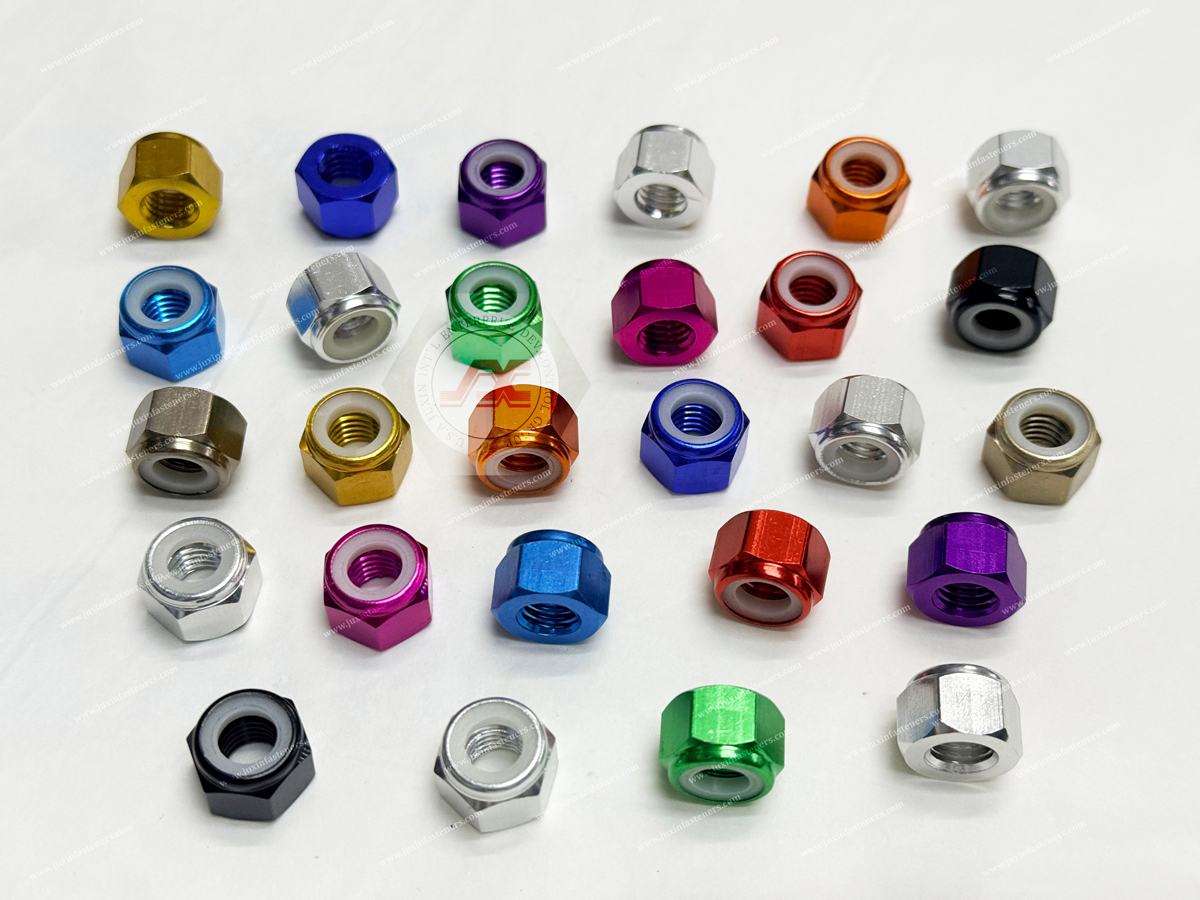
An aluminum nylon-insert locknut is a prevailing-torque fastener consisting of an aluminum alloy nut body and a polymer locking element.
During installation, the mating bolt thread engages the nylon insert.
The insert deforms locally around the bolt thread, creating frictional resistance to rotation.
This prevailing-torque mechanism helps resist unintended nut loosening.
The design is commonly associated with nonmetallic-insert hex locknuts.
For American industrial buyers, the preferred descriptive terminology includes:
Aluminum Nylon-Insert Locknuts
Aluminum Nylon-Insert Hex Locknuts
Aluminum Nylon Insert Lock Nuts
Aluminum Prevailing-Torque Locknuts
For British and European purchasing searches, related terminology includes:
Aluminium Nylon Insert Lock Nuts
Aluminium Nyloc Nuts
Aluminium Locking Nuts
Anodised Aluminium Lock Nuts
Important Product Distinction
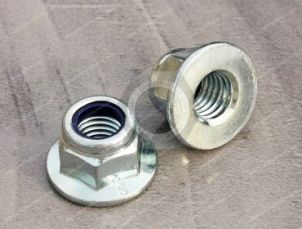
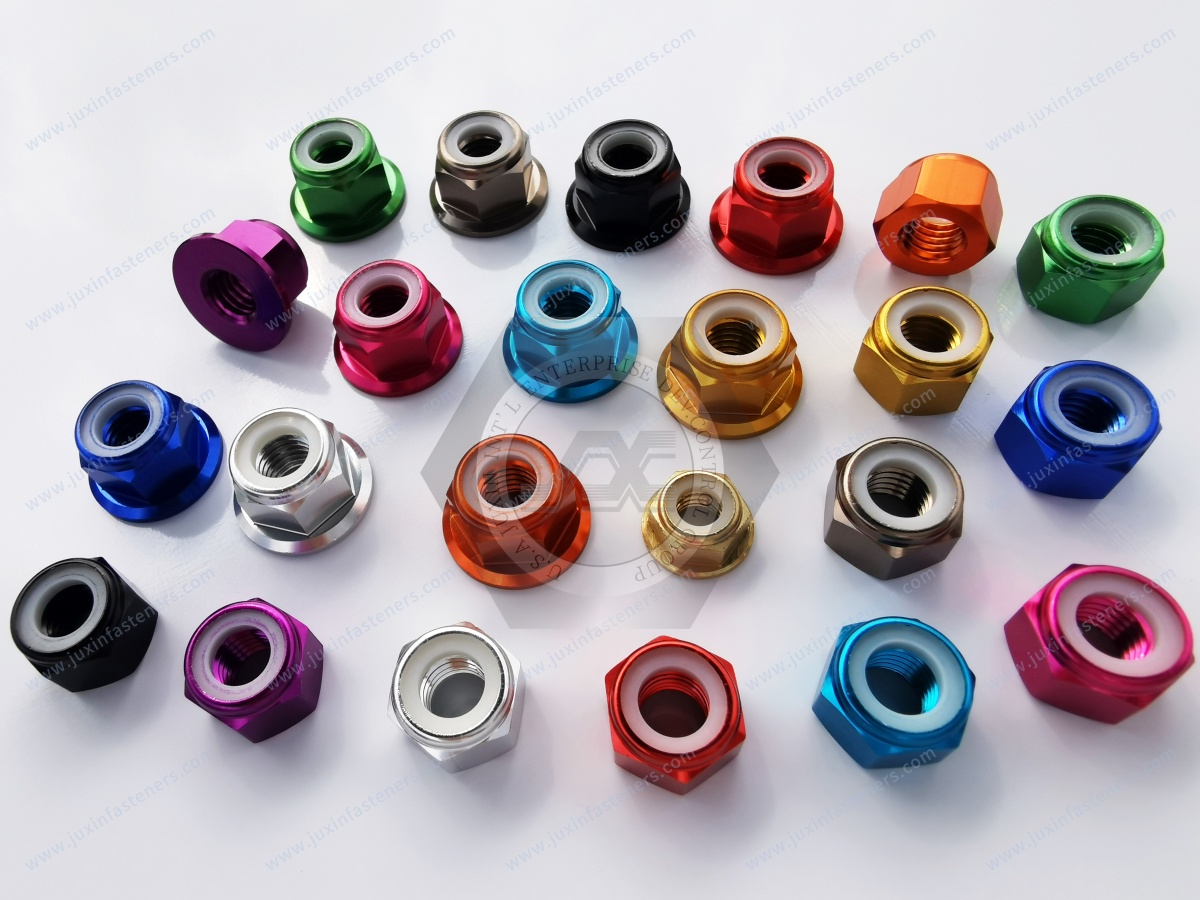
A conventional aluminum nylon-insert hex locknut is different from an aluminum nylon-insert flange locknut.
The flange version includes an integrated bearing flange beneath the hexagonal body.
These designs have different geometry and bearing characteristics and should not be treated as directly interchangeable.
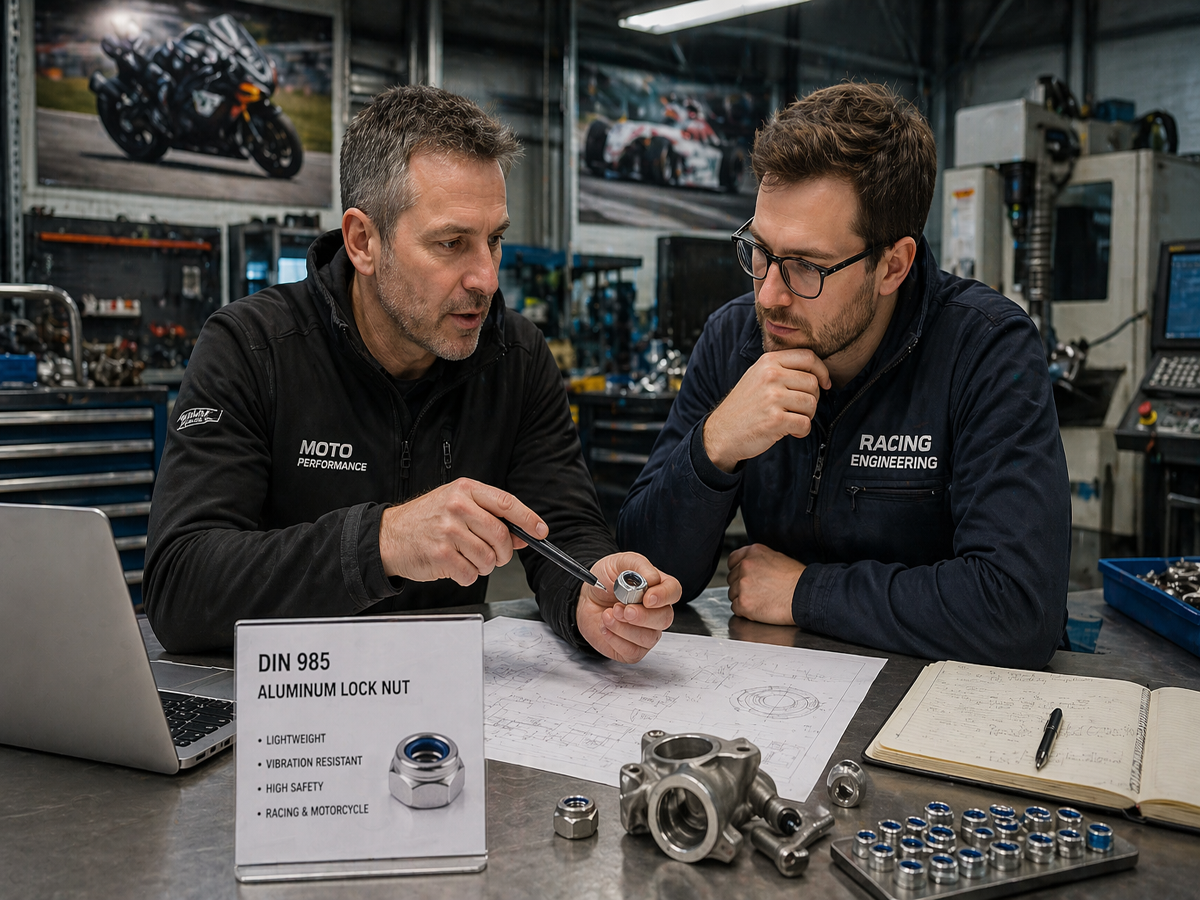
DIN 985-Style Aluminum Nylon-Insert Locknuts
DIN 985 is a widely recognized reference associated with prevailing-torque hexagon nuts using a nonmetallic insert.
Some aluminum nylon-insert locknuts may be manufactured with DIN 985-style dimensions.
However, dimensional similarity does not automatically establish full compliance with the original standard.
Material requirements, mechanical performance and locking characteristics must be verified separately.
For OEM sourcing, the approved drawing should define the required nut dimensions, aluminum material, locking insert and acceptance criteria.
How the Nylon-Insert Locking Mechanism Works
The nylon insert creates resistance when the bolt thread passes through it.
This resistance is known as prevailing torque.
Unlike tightening torque associated with developing joint preload, prevailing torque exists because of the locking feature.
The locking element is intended to resist unintended rotation during service.
However, prevailing torque does not guarantee that the joint maintains sufficient clamp load.
Engineering Information Gain: Prevailing Torque Is Not Clamp Load
Prevailing torque and clamp load are different engineering quantities.
Prevailing torque is rotational resistance generated by the locking feature.
Clamp load is the compressive force holding the assembled components together.
A locknut may retain rotational resistance even when the joint has lost preload due to settlement, deformation or external loading.
Therefore, a reliable fastening system requires appropriate joint design and installation control in addition to a locking feature.
Engineering Recommendation
When evaluating aluminum nylon-insert locknuts, verify both the locking performance and the mechanical strength of the complete bolted joint.
Aluminum Alloy Selection for Nylon-Insert Locknuts
The aluminum alloy and temper influence the mechanical performance of the nut body.
Relevant properties include:
Tensile strength
Yield strength
Thread shear strength
Hardness
Corrosion behavior
Machinability
Dimensional stability
Surface treatment compatibility
Common engineering aluminum alloys include 6061, 2024 and 7075.
However, these alloys are not automatically interchangeable, and their availability for a particular nut design must be confirmed.
6061 Aluminum Nylon-Insert Locknuts
6061 is a widely used aluminum alloy for mechanical components.
It offers a useful combination of low density, machinability and general corrosion resistance.
6061-T6 refers to a specific heat-treated temper.
Potential engineering applications include:
Motorcycle accessories
Industrial automation equipment
Lightweight mechanical brackets
Robotic equipment attachments
Precision machinery
Electronic equipment hardware
Engineering Consideration
The actual thread strength depends on the nut geometry, material condition and mating bolt.
Do not assume that a 6061 aluminum nut can accept the same tightening torque as a steel nut with identical nominal dimensions.
2024 Aluminum Alloy
2024 is an aluminum-copper alloy associated with relatively high mechanical strength.
Its corrosion behavior differs from that of 6061.
When considering 2024 for a custom locknut, engineers should evaluate:
Required temper
Thread strength
Corrosion exposure
Surface protection
Machining feasibility
Cost
Aerospace-related use of 2024 alloy does not establish aerospace qualification for an industrial aluminum locknut.
7075 Aluminum Alloy
7075 is a high-strength aluminum alloy considered in selected weight-sensitive mechanical applications.
However, material strength alone does not determine fastening suitability.
Relevant considerations include:
Specified temper
Thread strength
Corrosion behavior
Stress-corrosion susceptibility
Manufacturing process
Surface treatment
Application loading
Engineering Recommendation
Select the aluminum alloy according to the complete mechanical and environmental requirements.
Do not specify 7075 solely because its nominal strength exceeds that of 6061.
Aluminum Alloy Selection Comparison
| Alloy | General engineering characteristic | Main selection consideration |
|---|---|---|
| 6061 | Versatile lightweight engineering alloy | Temper, thread strength and finish |
| 2024 | Relatively high-strength aluminum-copper alloy | Corrosion protection and temper |
| 7075 | High-strength aluminum alloy | Corrosion behavior, temper and manufacturing |
These are engineering material references rather than confirmed stock or production specifications.
Juxin Fasteners can review drawing-specific material requirements for technical feasibility.
Aluminum Nylon-Insert Locknuts vs Steel Nylon-Insert Locknuts
Aluminum and steel nylon-insert locknuts can perform similar locking functions, but their mechanical capabilities differ.
| Engineering factor | Aluminum Nylon-Insert Locknuts | Steel Nylon-Insert Locknuts |
|---|---|---|
| Component density | Lower | Higher |
| Thread strength | Depends on aluminum alloy and geometry | Depends on steel grade and nut class |
| Weight reduction | Potential advantage | Less favorable for equivalent geometry |
| Prevailing torque | Depends on insert and thread design | Depends on insert and thread design |
| Corrosion | Depends on alloy, finish and mating material | Depends on steel grade and coating |
| Installation torque | Requires aluminum-specific validation | Requires grade- and joint-specific validation |
| Typical selection driver | Weight-sensitive assemblies | Broad range of structural fastening requirements |
Why Aluminum Is Not a Direct Steel Replacement
Aluminum has lower density than steel.
This can reduce fastener mass.
However, aluminum also has different mechanical properties, including thread strength and deformation behavior.
A nut with the same nominal thread size does not necessarily have the same load capacity.
Engineering Recommendation
Evaluate thread engagement, allowable tightening conditions, service loading and joint reliability before approving an aluminum alternative.
Thread Stripping and Tightening Torque
Thread stripping is an important design consideration for aluminum locknuts.
Potential causes include:
Excessive tightening torque
Insufficient thread engagement
Unsuitable aluminum material condition
Incorrect mating thread
Cross-threading
Repeated installation damage
A high-strength steel bolt may be capable of generating loads that exceed the strength of an aluminum nut's internal threads.
Engineering Recommendation
Establish installation requirements using the actual nut, bolt and joint configuration.
Do not transfer steel locknut tightening values directly to aluminum locknuts.
Vibration Resistance and Joint Reliability
Motorcycles, robotics and industrial automation systems may experience dynamic loads and repeated vibration.
The nylon insert helps resist unintended rotation.
However, locking performance is influenced by:
Insert material
Temperature
Mating bolt geometry
Thread finish
Installation history
Vibration conditions
Joint preload
A locking insert cannot compensate for an unsuitable joint design.
Engineering Recommendation
For vibration-sensitive assemblies, validate the complete joint under representative operating conditions.
Temperature Limitations of Nylon Inserts
The operating temperature of an aluminum nylon-insert locknut is limited by more than the aluminum body.
The polymer insert has its own thermal characteristics.
At elevated temperatures, its locking performance may change.
Relevant factors include:
Polymer grade
Continuous operating temperature
Temperature cycling
Installation history
Chemical exposure
Aging
Engineering Recommendation
Do not use a generic nylon-insert locknut in high-temperature applications without confirming the insert material and required functional performance.
Reuse of Aluminum Nylon-Insert Locknuts
Nylon-insert locknuts may experience changes in prevailing torque after repeated installation and removal.
Potential causes include:
Insert wear
Polymer deformation
Thread damage
Contamination
Temperature exposure
Aluminum thread strength and surface condition must also be considered.
Engineering Recommendation
For applications requiring repeated maintenance, establish a reuse policy and functional acceptance criteria.
Do not assume unlimited reuse.
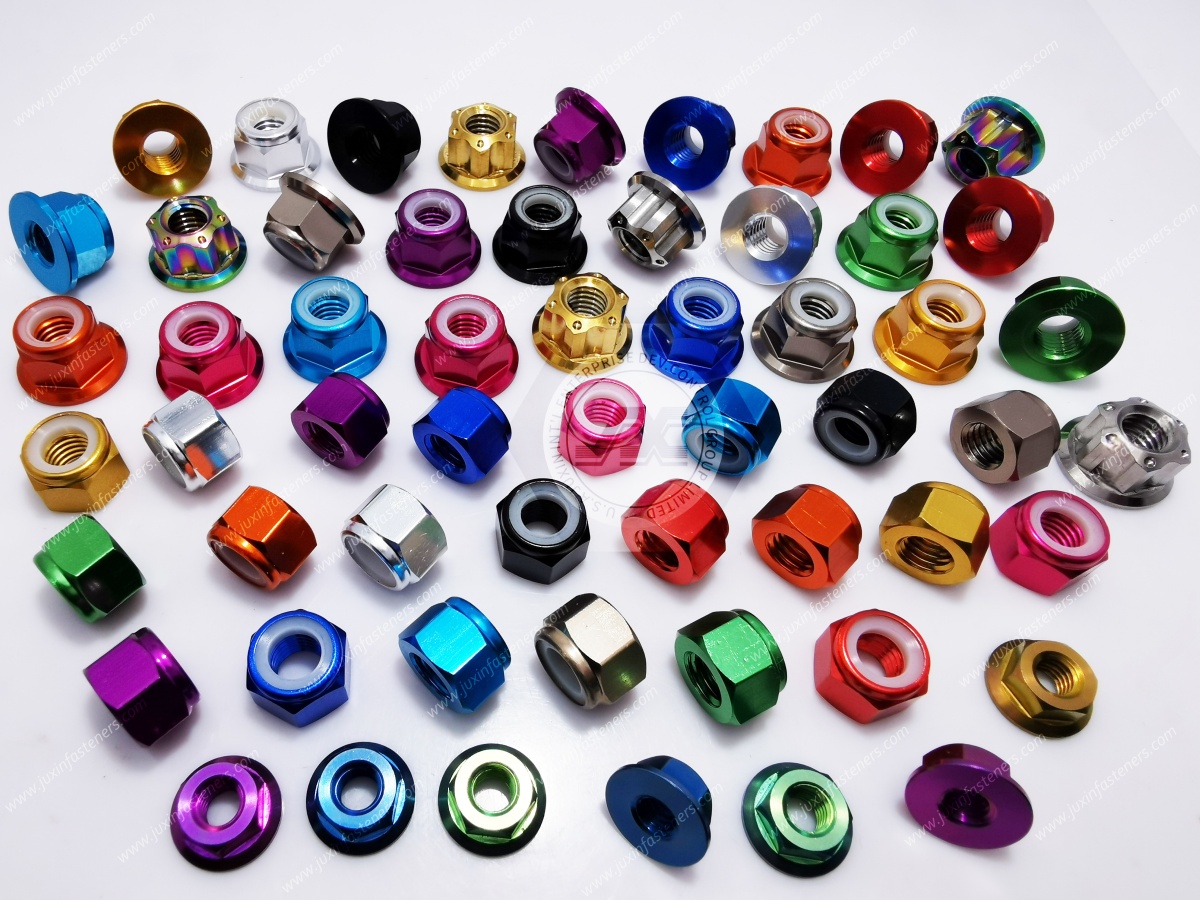
Anodized Aluminum Nylon-Insert Locknuts
Anodizing is a common surface treatment for aluminum components.
It may be selected for:
Appearance
Surface protection
Color identification
Certain wear-related requirements
Potential decorative colors include:
Black
Blue
Red
Gold
Gray
Actual colors and finish options depend on the specified process and manufacturing feasibility.
Anodizing and Thread Tolerance
Anodizing changes the surface condition and dimensions of aluminum components.
For threaded parts, this may affect:
Internal thread clearance
Thread fit
Friction
Installation torque
Prevailing torque
Functional assembly
Engineering Recommendation
Specify dimensional acceptance requirements for the finished component.
Where necessary, evaluate thread fit after anodizing.
Nylon Insert Assembly and Surface Treatment Sequence
The nylon locking element may be sensitive to anodizing chemicals, process temperatures and sealing conditions.
For some designs, the polymer insert is installed after the aluminum nut body has been anodized.
However, the correct manufacturing sequence depends on the product design and process.
Engineering Recommendation
Confirm the process sequence before production approval.
Galvanic Corrosion in Aluminum Locknut Assemblies
Aluminum locknuts may be used with steel or stainless steel bolts.
Dissimilar metal contact in the presence of an electrolyte can create galvanic corrosion risk.
Relevant conditions include:
Moisture
Road salt
Marine exposure
Surface damage
Electrical contact
Material pairing
Engineering Recommendation
Evaluate the complete assembly, not only the aluminum nut's surface finish.
Anodizing should not automatically be considered sufficient galvanic isolation.
Motorcycle OEM and Motorcycle Accessory Applications
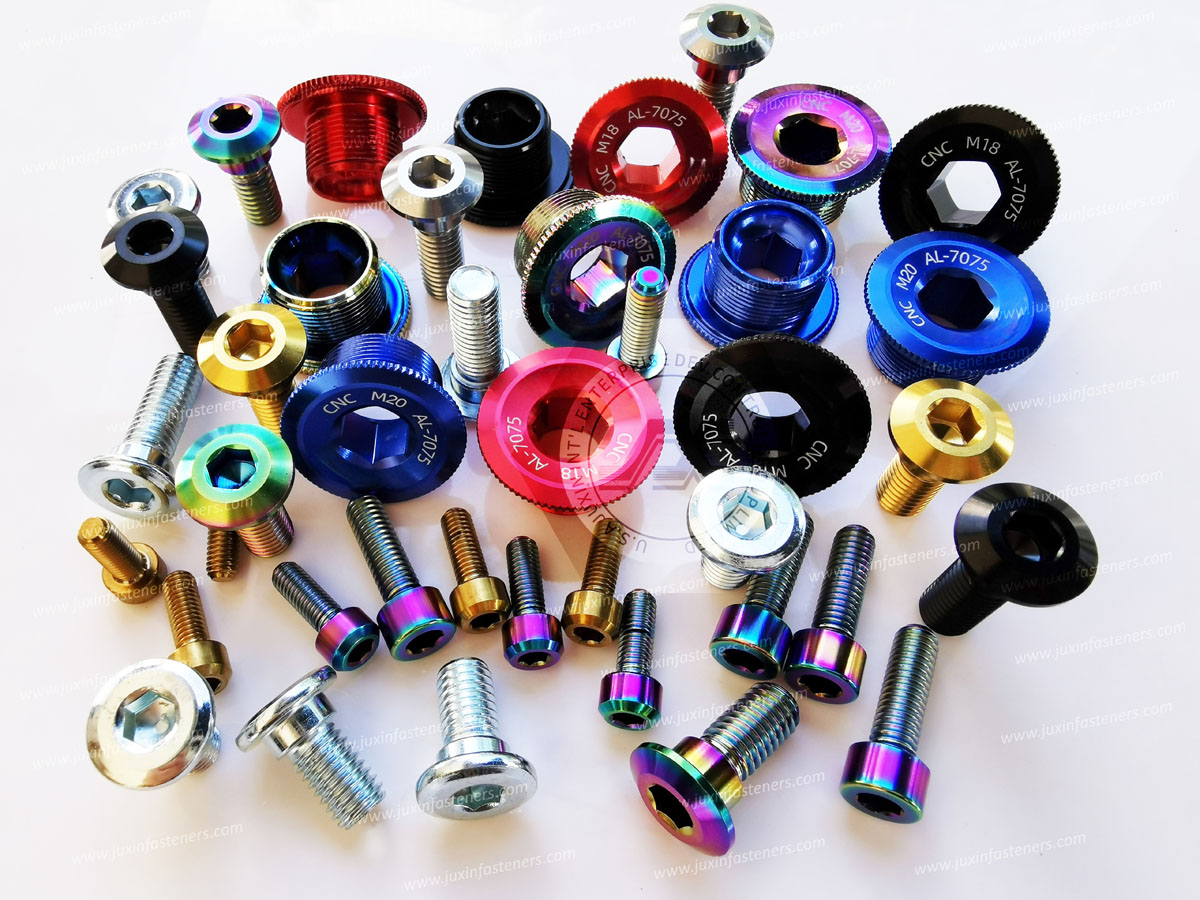
Motorcycle manufacturers and component suppliers may consider aluminum nylon-insert locknuts for selected lightweight assemblies.
Potential applications include:
Fairing attachments
Nonstructural accessory brackets
Decorative hardware
Lightweight covers
Selected equipment mounts
CNC-machined accessory components
Engineering Requirements
Weight reduction
Vibration resistance
Mating bolt compatibility
Corrosion protection
Installation consistency
Serviceability
Surface appearance
Important Safety Limitation
General-purpose aluminum nylon-insert locknuts should not be substituted into wheel retention, braking, steering,
suspension or other safety-critical motorcycle joints without application-specific engineering approval and validation.
Motorsport and Racing Motorcycle Components
Motorsport applications often emphasize lightweight construction.
However, racing environments can also introduce high vibration, thermal exposure and dynamic loads.
Potential opportunities exist in selected noncritical accessory assemblies.
Engineering Recommendation
Assess each connection individually.
Do not equate low fastener mass with suitability for high-load racing components.
Bicycle Component Applications
Bicycle accessory manufacturers may evaluate aluminum nylon-insert locknuts for selected lightweight hardware.
Potential uses include:
Nonstructural equipment mounts
Accessory brackets
Decorative components
Lightweight covers
Engineering Recommendation
Do not use general-purpose aluminum locknuts as unapproved substitutes in braking, steering or wheel-retention assemblies.
Industrial Robotics Applications
Industrial robotics is an important potential market for lightweight mechanical fastening.
Robot systems contain a wide variety of mechanical joints, ranging from auxiliary equipment attachments to highly loaded motion-critical structures.
Aluminum nylon-insert locknuts may be considered for:
Sensor brackets
Noncritical covers
Lightweight instrument mounts
Auxiliary equipment
Selected nonstructural assemblies
Engineering Considerations
Acceleration
Repeated movement
Vibration
Joint stiffness
Maintenance
Installation accessibility
Engineering Recommendation
Determine the function and load of each joint before selecting aluminum fastening hardware.
Industrial Automation Equipment
Automation equipment manufacturers may evaluate aluminum locknuts for selected mechanical components.
Potential applications include:
Sensor mounts
Equipment covers
Lightweight fixtures
Instrument brackets
Noncritical machine accessories
Production Manager Considerations
Assembly efficiency
Tool compatibility
Tightening consistency
Cross-threading prevention
Inspection
Rework
Production cost
Engineering Recommendation
Validate the installation method using representative production components.
UAV and Drone Equipment
Weight reduction is important in many UAV and drone designs.
Aluminum nylon-insert locknuts may be considered for selected noncritical equipment attachments.
Potential applications include:
Auxiliary sensor brackets
Nonstructural covers
Ground-support equipment
Lightweight accessory mounts
Important Qualification Limitation
General industrial aluminum nylon-insert locknuts should not be assumed suitable for flight-control, propulsion, primary structural or other flight-safety-critical connections.
Such applications require appropriate component qualification and engineering approval.
Precision Machinery Applications
Precision machinery manufacturers may require compact, lightweight fastening components.
Potential applications include:
Instrument housings
Small mechanical assemblies
Test fixtures
Precision equipment accessories
Lightweight mounting hardware
Engineering Considerations
Thread fit
Dimensional tolerance
Surface condition
Installation repeatability
Inspection requirements
Electronic Equipment and Machine Vision
Electronic equipment manufacturers may use aluminum locknuts in selected mechanical mounting assemblies.
Potential applications include:
Camera brackets
Sensor mounts
Equipment housings
Noncritical module supports
Instrument mounting systems
Engineering Recommendation
Evaluate electrical contact, material compatibility, corrosion and mechanical loading.
Laboratory and Testing Equipment
Laboratory and testing equipment may require compact mechanical hardware for adjustable or serviceable assemblies.
Potential applications include:
Test fixtures
Instrument mounts
Equipment covers
Lightweight brackets
Auxiliary mechanical assemblies
Engineering Recommendation
Where repeated adjustment is required, evaluate nylon-insert reuse performance and aluminum thread durability.
Marine and Outdoor Equipment
Selected marine and outdoor equipment accessories may use lightweight aluminum fastening hardware.
However, moisture and salt exposure can increase corrosion risk.
Engineering Recommendation
Review alloy selection, mating bolt materials, anodizing and galvanic corrosion before specifying aluminum locknuts.
Aerospace-Related Equipment: Qualification Requirements
Aerospace engineering places significant emphasis on weight reduction.
However, an ordinary industrial aluminum nylon-insert locknut is not automatically an aerospace-approved fastener.
Potential evaluation opportunities may exist in non-flight-critical ground-support equipment and testing fixtures.
Engineering Recommendation
Do not specify general-purpose aluminum nylon-insert locknuts for regulated or safety-critical aircraft assemblies without the required approvals and documentation.
Metric and Unified Inch Thread Selection
International OEM projects may require metric or Unified inch threads.
Examples of metric project requirements include:
M3
M4
M5
M6
M8
M10
M12
These are illustrative inquiry sizes, not a confirmed stock range.
Metric thread requirements may reference ISO 261 and ISO 965.
Unified inch thread requirements may reference ASME B1.1.
Approximate Metric Diameter References
| Metric size | Approximate nominal diameter |
|---|---|
| M3 | 0.118 in |
| M4 | 0.157 in |
| M5 | 0.197 in |
| M6 | 0.236 in |
| M8 | 0.315 in |
| M10 | 0.394 in |
| M12 | 0.472 in |
These conversions are for dimensional reference only.
Metric, UNC, UNF, BSW and BSF thread systems are not directly interchangeable.
Actual inch-thread product availability must be confirmed.
Quality Inspection for Aluminum Nylon-Insert Locknuts
An OEM inspection plan should address both the aluminum body and nylon locking element.
Dimensional Inspection
Internal thread
Across-flats dimension
Nut height
Bearing surface
Locking insert position
Finished dimensions
Material Verification
Aluminum alloy
Specified temper
Material documentation where required
Surface Inspection
Anodized finish
Visible defects
Color consistency
Thread condition
Functional Inspection
Prevailing torque
Installation behavior
Removal behavior
Thread integrity
Reuse performance where specified
Important Standards Clarification
ISO 2320 applies to prevailing-torque steel nuts within its scope.
Its requirements should not automatically be treated as a complete acceptance specification for aluminum nylon-insert locknuts.
Custom aluminum designs may require separately agreed functional criteria.
Production-Line Assembly Considerations
Manufacturing engineers and production managers should evaluate the complete installation process.
Important considerations include:
Nut feeding
Orientation
Thread alignment
Tightening tool settings
Cross-threading prevention
Anodized surface protection
Functional inspection
Rework control
Common Assembly Risks
| Potential problem | Possible cause | Recommended control |
|---|---|---|
| Thread stripping | Excessive tightening | Validate installation limits |
| Cross-threading | Misalignment | Control initial engagement |
| Variable installation torque | Friction and locking variation | Validate production settings |
| Surface damage | Tooling or handling | Review assembly tooling |
| Reduced locking performance | Insert wear or temperature | Define functional tests |
| Corrosion | Unsuitable material pairing | Evaluate service environment |
Engineering Recommendation
Do not apply steel locknut installation settings directly to aluminum locknuts without validation.
Custom Aluminum Nylon-Insert Locknuts for OEM Manufacturing
OEM customers may require special dimensions, materials, finishes or locking characteristics.
Potential customization requirements include:
Drawing-specific geometry
Special thread requirements
Aluminum alloy and temper
Nylon-insert configuration
Anodized finish
Color specification
Prevailing-torque criteria
Dimensional tolerances
Packaging
Part identification
Juxin Fasteners welcomes technical drawings for review.
Manufacturing feasibility, tooling, samples, MOQ and lead times must be confirmed for each project.
Supplier Qualification for Industrial Procurement
Procurement development teams, purchasing managers and supply chain managers should evaluate technical suitability and commercial capability together.
Technical Evaluation
Approved drawing
Material specification
Thread requirements
Locking performance
Surface treatment
Inspection criteria
Manufacturing Evaluation
Process feasibility
Material control
Dimensional consistency
Insert assembly
Surface treatment
Functional inspection
Commercial Evaluation
Prototype requirements
Tooling
MOQ
Annual demand
Unit pricing
Lead time
Packaging
Delivery schedule
Supplier certifications and specific manufacturing capabilities must be confirmed during qualification.
Aluminum Nylon-Insert Locknut RFQ Checklist
| RFQ requirement | Information to provide |
|---|---|
| Drawing | 2D/3D drawing and revision |
| Nut type | Non-flanged or flanged |
| Material | Aluminum alloy |
| Temper | Required material condition |
| Thread | Metric, UNC or UNF |
| Locking element | Polymer specification if required |
| Mating bolt | Material, grade and thread |
| Prevailing torque | Functional requirement |
| Installation | Tightening procedure |
| Loading | Static and dynamic |
| Temperature | Operating range |
| Environment | Corrosion exposure |
| Finish | Anodized or other specified finish |
| Color | Required appearance |
| Inspection | Test criteria and documents |
| Samples | Prototype quantity |
| Annual demand | Estimated purchasing volume |
| Packaging | OEM packaging requirements |
| Schedule | Required delivery date |
Frequently Asked Questions
What is an aluminum nylon-insert locknut?
It is an aluminum alloy nut containing a polymer locking insert that generates prevailing torque against a mating threaded fastener.
Are aluminum nylon-insert locknuts lighter than steel versions?
Yes. Aluminum has lower density than steel, although actual component weight depends on geometry.
Are aluminum nylon-insert locknuts the same as aluminum nylon-insert flange locknuts?
No. The flange design has different geometry and bearing characteristics.
Can aluminum nylon-insert locknuts replace steel locknuts?
Only after confirming thread strength, joint loading, tightening conditions and engineering suitability.
Are aluminum nylon-insert locknuts suitable for motorcycles?
They may be suitable for selected non-safety-critical motorcycle accessories and mechanical assemblies after engineering evaluation.
Can aluminum locknuts be used in robotics and automation equipment?
They may be considered for selected lightweight, noncritical assemblies where the joint requirements are compatible.
Can aluminum nylon-insert locknuts be anodized?
Yes, suitable aluminum nut bodies can be anodized. The process sequence, thread fit and nylon insert compatibility must be evaluated.
Can aluminum nylon-insert locknuts be reused?
Reuse depends on the insert condition, thread integrity and specified prevailing-torque requirements.
Are aluminum nylon-insert locknuts suitable for aerospace applications?
Ordinary industrial products should not be assumed aerospace-qualified without appropriate approval and documentation.
Can Juxin Fasteners review custom aluminum locknut drawings?
Yes. Juxin Fasteners welcomes OEM drawing-based inquiries for technical and manufacturing feasibility review.
Why Work With Juxin Fasteners?
Juxin Fasteners focuses on industrial fastening products and OEM customer requirements.
Our team welcomes inquiries involving:
Aluminum nylon-insert locknuts
DIN 985-style aluminum locknuts
Lightweight aluminum fastening components
Anodized aluminum locknuts
Motorcycle accessory fastening hardware
Industrial robotics and automation fastening requirements
Drawing-specific OEM locknuts
Bulk industrial procurement projects
Product specifications, material options, manufacturing feasibility, MOQ and delivery schedules are subject to project confirmation.
Request an OEM Quotation for Aluminum Nylon-Insert Locknuts
Are you sourcing aluminum nylon-insert locknuts for motorcycle components, industrial robotics,
automation equipment, precision machinery or other lightweight mechanical assemblies?
Juxin Fasteners welcomes technical drawings and RFQs from OEM manufacturers, engineers, production managers,
supplier development teams, purchasing managers and global supply chain professionals.
For efficient technical evaluation, please provide:
2D/3D drawings, aluminum alloy and temper, thread system and size, nut geometry, nylon insert requirements,
mating bolt specification, operating loads, tightening conditions, prevailing-torque requirements, operating temperature,
corrosion environment, surface finish, inspection criteria, prototype quantity, annual demand, packaging and delivery schedule.
Our team can review the project requirements and confirm available product options, technical feasibility and commercial quotation conditions.
Company: Juxin Fasteners
Website: https://www.juxinfasteners.com/
Email: info@juxinfasteners.com
Send your aluminum nylon-insert locknut drawings and OEM RFQ to Juxin Fasteners for technical review and quotation.
Contact Us
Tel.:
+86 020 8621 0320
+86 020 3121 6067
E-mail:
Technical Support:
Navigation
SEND INQUIREY