
Call Us
+86 136 6007 9809
Call Us
+86 136 6007 9809

Apr. 10, 2026
Aluminum Nylon-Insert Locknuts for Motorcycle, Bicycle and Industrial OEM Applications
Lightweight mechanical design is an important consideration for motorcycle manufacturers, bicycle component suppliers, motorsport equipment developers and industrial OEMs.
Reducing fastener mass can contribute to overall assembly weight reduction, particularly in products containing numerous small mechanical components.
However, weight reduction must never compromise joint strength, installation reliability or operational safety.
Aluminum nylon-insert locknuts combine a lightweight aluminum alloy nut body with a polymer locking insert that generates prevailing torque against the mating bolt thread.
For suitable applications, this design provides resistance to unintended nut rotation while offering lower component mass than a geometrically comparable steel locknut.
Potential applications include selected motorcycle accessories, bicycle equipment mounts, lightweight mechanical brackets, precision machinery and noncritical industrial assemblies.
The engineering challenge is determining where an aluminum nylon-insert locknut is appropriate,
how it should be installed and what performance requirements must be verified before production approval.
Juxin Fasteners welcomes technical drawings and OEM inquiries for aluminum nylon-insert locknuts,
anodized aluminum fastening components and drawing-specific lightweight mechanical fasteners.
What Are Aluminum Nylon-Insert Locknuts?
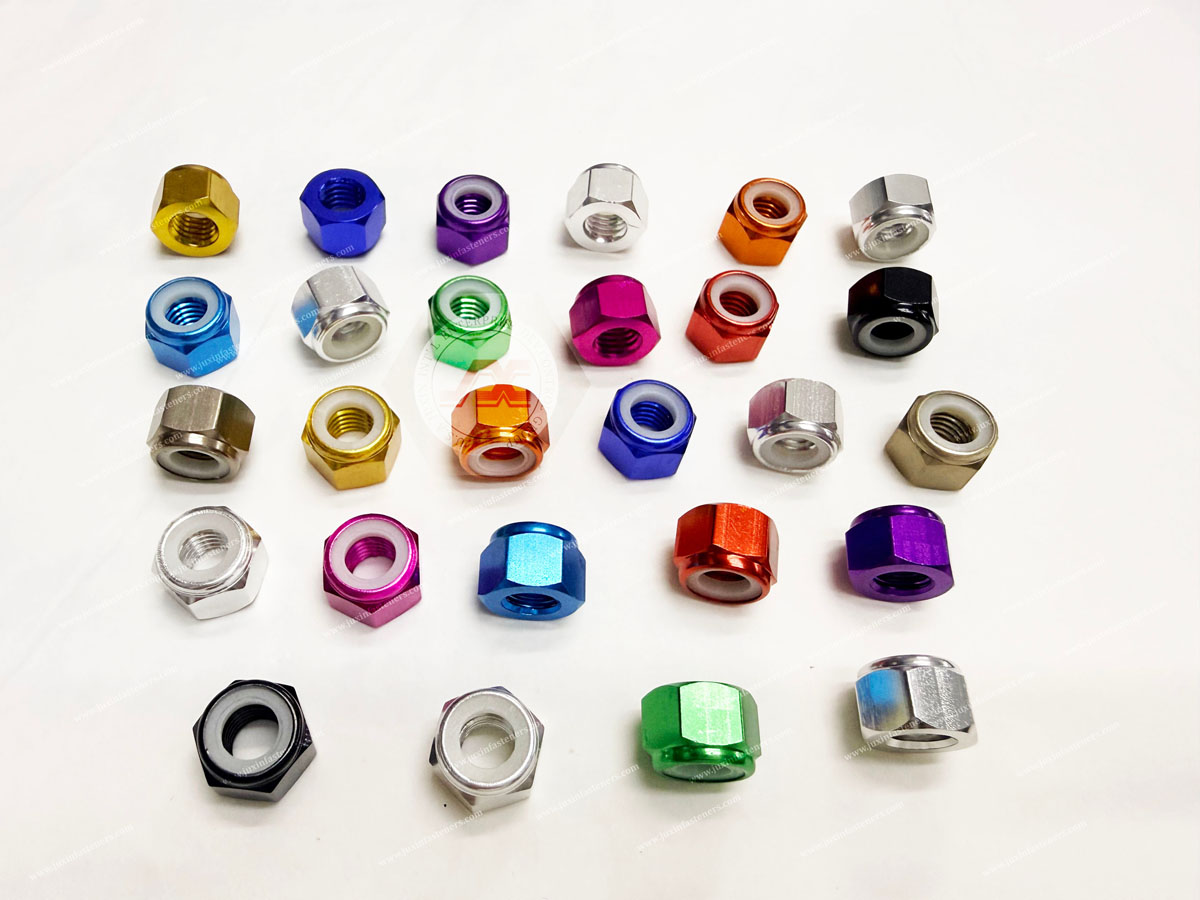
An aluminum nylon-insert locknut is a prevailing-torque nut manufactured with an aluminum alloy body and a nonmetallic locking element.
The nylon insert is positioned near one end of the internal threaded opening.
During installation, the mating bolt engages the metal threads before passing through the locking insert.
The polymer element deforms around the bolt thread, producing resistance to rotation.
This resistance is known as prevailing torque.
Unlike a conventional free-spinning hex nut, a nylon-insert locknut provides additional rotational resistance even before the joint is fully tightened.
Preferred American Industrial Terminology
For the United States and international English-language industrial markets, the preferred product names include:
Aluminum Nylon-Insert Locknuts
Aluminum Nylon-Insert Hex Locknuts
Aluminum Nylon Insert Lock Nuts
Aluminum Prevailing-Torque Locknuts
Related British English terminology includes:
Aluminium Nylon Insert Lock Nuts
Aluminium Nyloc Nuts
Aluminium Locking Nuts
Anodised Aluminium Locknuts
The term Nylock is sometimes encountered in product searches, but Aluminum Nylon-Insert Locknuts is the preferred descriptive terminology for this article.
Engineering Clarification: Locking Resistance Is Not the Same as Joint Preload
The nylon insert creates resistance to rotation.
It does not automatically guarantee that the joint maintains its required clamping force.
Joint preload also depends on tightening conditions, fastener strength, joint stiffness, bearing surfaces and service loading.
A nylon-insert locknut should therefore be evaluated as part of the complete bolted joint.
DIN 985-Style Aluminum Nylon-Insert Locknuts
DIN 985 is a recognized reference for prevailing-torque hexagon nuts with nonmetallic inserts.
Aluminum locknuts may be produced with DIN 985-style geometry where appropriate.
However, a similar external shape does not establish compliance with every material or mechanical requirement of the referenced standard.
For OEM projects, engineers should verify:
Nominal thread size
Thread pitch
Across-flats dimension
Nut height
Bearing geometry
Aluminum alloy and temper
Locking insert design
Prevailing-torque requirements
Dimensional acceptance criteria
The approved drawing and purchasing specification should define the actual product requirements.
Standard Hex Locknuts vs Nylon-Insert Flange Locknuts
A standard aluminum nylon-insert hex locknut has a conventional hexagonal body without an integral flange.
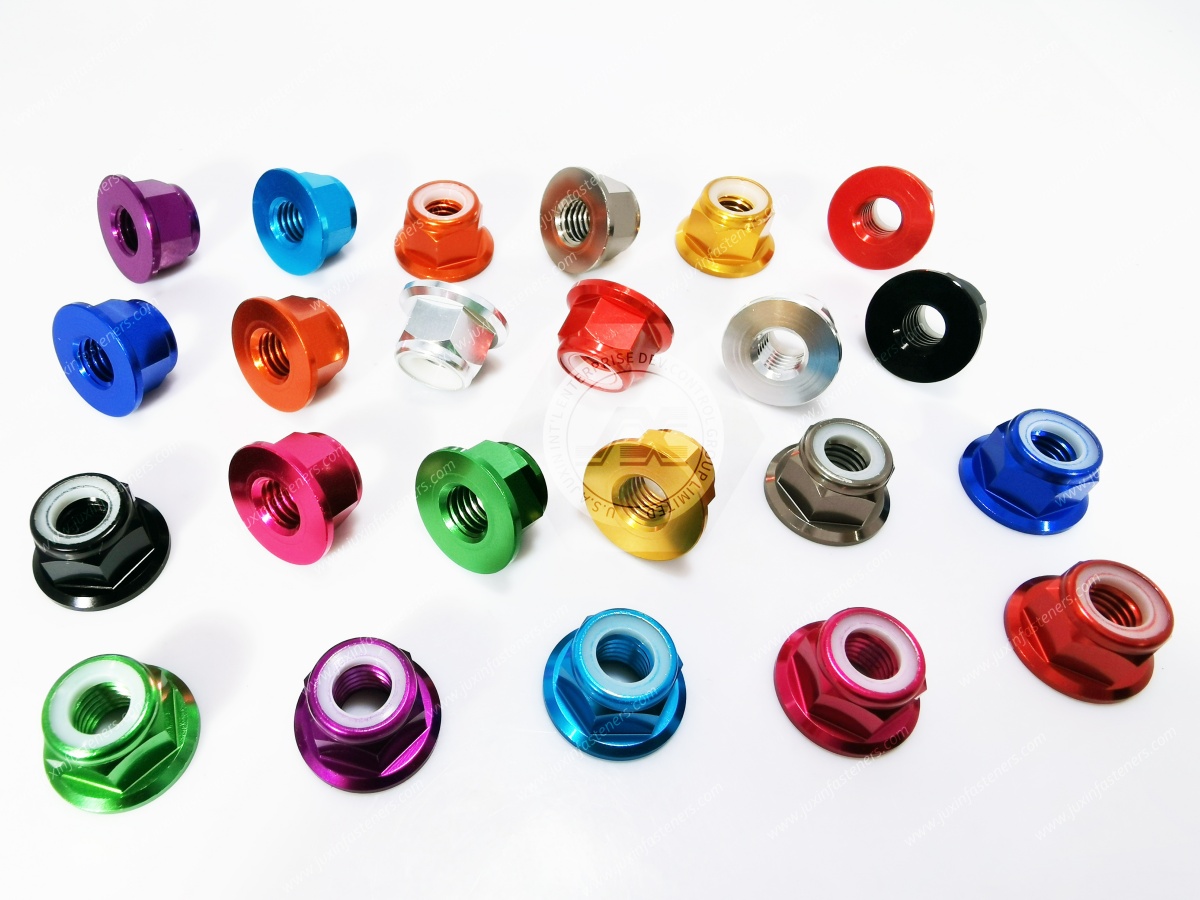
A nylon-insert flange locknut includes an extended bearing surface beneath the hexagonal body.
The two designs differ in geometry, bearing contact and joint requirements.
They should not be treated as directly interchangeable.
For purchasing inquiries, clearly identify whether the required product is a standard hex nylon-insert locknut or a nylon-insert flange locknut.
6061 Aluminum Alloy: Material Selection for Lightweight Locknuts
6061 aluminum is widely used for lightweight engineering components because it offers a useful combination of machinability, mechanical strength and general corrosion resistance.
6061-T6 is a specific heat-treated temper of this alloy.
For aluminum nylon-insert locknuts, material selection must consider more than nominal tensile strength.
Important factors include:
Internal thread strength
Nut wall thickness
Thread engagement
Bearing stress
Dimensional stability
Surface treatment compatibility
Mating bolt material
Required tightening conditions
Why the Correct Temper Matters
The mechanical properties of an aluminum alloy depend on its temper.
A drawing specifying 6061-T6 should not be treated as equivalent to a drawing specifying only 6061 aluminum.
For OEM production, the material designation should be clear enough to support purchasing, manufacturing and inspection.
Engineering Recommendation
Specify the aluminum alloy and temper explicitly.
Where material documentation is required, include that requirement in the RFQ and approved drawing.
Do not assume that every aluminum alloy or temper is available for every nut design.
Lightweight Benefits Compared With Steel Nylon-Insert Locknuts
Aluminum has substantially lower density than steel.
For similar geometry, an aluminum nut can therefore provide meaningful component weight reduction.
However, lower density does not mean equivalent mechanical strength.
| Selection factor | Aluminum Nylon-Insert Locknuts | Steel Nylon-Insert Locknuts |
|---|---|---|
| Component mass | Lower for comparable geometry | Higher |
| Thread strength | Depends on alloy, temper and geometry | Depends on steel grade and nut class |
| Prevailing torque | Determined by insert and thread design | Determined by insert and thread design |
| Corrosion behavior | Depends on alloy, finish and material pairing | Depends on steel grade and coating |
| Tightening requirements | Requires aluminum-specific joint validation | Requires grade- and joint-specific validation |
| Main selection advantage | Weight-sensitive applications | Broad range of structural load requirements |
Engineering Information Gain: Fastener Weight Is Only One Part of the Decision
A lightweight nut is not necessarily the lowest-cost or most reliable option.
If a joint requires higher clamp load than the aluminum nut can safely support, a steel locknut may be more appropriate.
Likewise, if a design requires frequent disassembly, the durability of both the nylon insert and aluminum threads becomes important.
The correct comparison considers:
Fastener mass
Joint strength
Installation requirements
Service environment
Inspection
Maintenance
Total installed cost
How Nylon Inserts Resist Unintended Rotation
The nylon locking element generates prevailing torque through interference with the mating bolt thread.
The locking action depends on the interaction between the polymer insert and bolt geometry.
Relevant variables include:
Insert material
Insert dimensions
Bolt thread profile
Thread finish
Temperature
Installation speed
Previous assembly cycles
The locking feature is not a substitute for adequate joint preload.
Prevailing Torque vs Tightening Torque
Prevailing torque is the rotational resistance caused by the locking feature.
Tightening torque is the applied torque used to install the fastener and develop joint preload.
For a prevailing-torque nut, the total torque observed during tightening includes the contribution of the locking feature and the torque associated with the joint.
Engineering Recommendation
Develop installation procedures using the actual aluminum locknut, mating bolt and assembled components.
Do not assume that a tightening torque specified for a conventional steel nut is suitable for an aluminum nylon-insert locknut.
Vibration Resistance in Motorcycle and Bicycle Assemblies
Motorcycles and bicycles can experience vibration, shock and repeated loading.
A nylon-insert locknut can help resist unintended rotation under suitable operating conditions.
However, vibration-related joint failure may involve more than nut rotation.
Potential mechanisms include:
Insufficient initial preload
Joint settlement
Transverse movement
Thread damage
Bearing surface deformation
Fatigue
Loss of locking performance
Engineering Recommendation
Where vibration is significant, validate the complete bolted joint under representative operating conditions.
Do not rely solely on the presence of a nylon insert.
Thread Stripping: A Critical Aluminum Locknut Design Risk
Aluminum threads generally have different strength and deformation characteristics from steel threads.
When an aluminum nut is assembled with a high-strength steel bolt, the aluminum internal threads may become the limiting component.
Potential causes of thread damage include:
Excessive tightening torque
Incorrect thread engagement
Cross-threading
Material mismatch
Inadequate nut geometry
Repeated installation damage
Engineering Information Gain: Stronger Bolts Do Not Make Aluminum Nut Threads Stronger
A higher-strength steel bolt may be capable of generating forces that exceed the allowable load of the aluminum nut.
This means selecting a stronger bolt does not automatically improve the overall joint.
Engineering Recommendation
Evaluate the nut and bolt as a system.
The allowable tightening conditions should be based on the actual aluminum nut geometry, material condition and joint requirements.

High-Temperature Nylon Inserts: Specification and Verification
The original product category may include applications requiring elevated-temperature resistance.
However, the term high-temperature nylon insert should only be used when the actual polymer grade and its relevant performance requirements have been confirmed.
Different polymer materials can have different thermal behavior.
The operating temperature may affect:
Insert stiffness
Prevailing torque
Long-term deformation
Aging
Reuse performance
Chemical resistance
Important Limitation
A standard nylon-insert locknut should not automatically be considered suitable for engine-adjacent or other high-temperature assemblies.
Engineering Recommendation
For applications involving elevated temperatures, provide the continuous operating temperature, expected temperature peaks and required locking performance.
Juxin Fasteners can review the specification and confirm whether an appropriate product configuration is feasible.
Reuse and Maintenance of Aluminum Nylon-Insert Locknuts
Some motorcycle, bicycle and industrial assemblies require periodic maintenance.
Repeated removal and installation can affect both the nylon locking insert and the aluminum internal threads.
Potential changes include:
Reduced prevailing torque
Insert deformation
Thread wear
Surface damage
Contamination
Engineering Recommendation
For serviceable joints, define whether the nut is intended for single use or controlled reuse.
If reuse is permitted, specify the functional acceptance criteria.
Do not assume unlimited reuse.
Anodized Aluminum Nylon-Insert Locknuts
Anodizing is a common surface treatment for aluminum components.
It may be selected to improve surface characteristics and provide a decorative appearance.
Potential benefits include:
Surface protection
Color identification
Decorative finish
Selected wear-related improvements
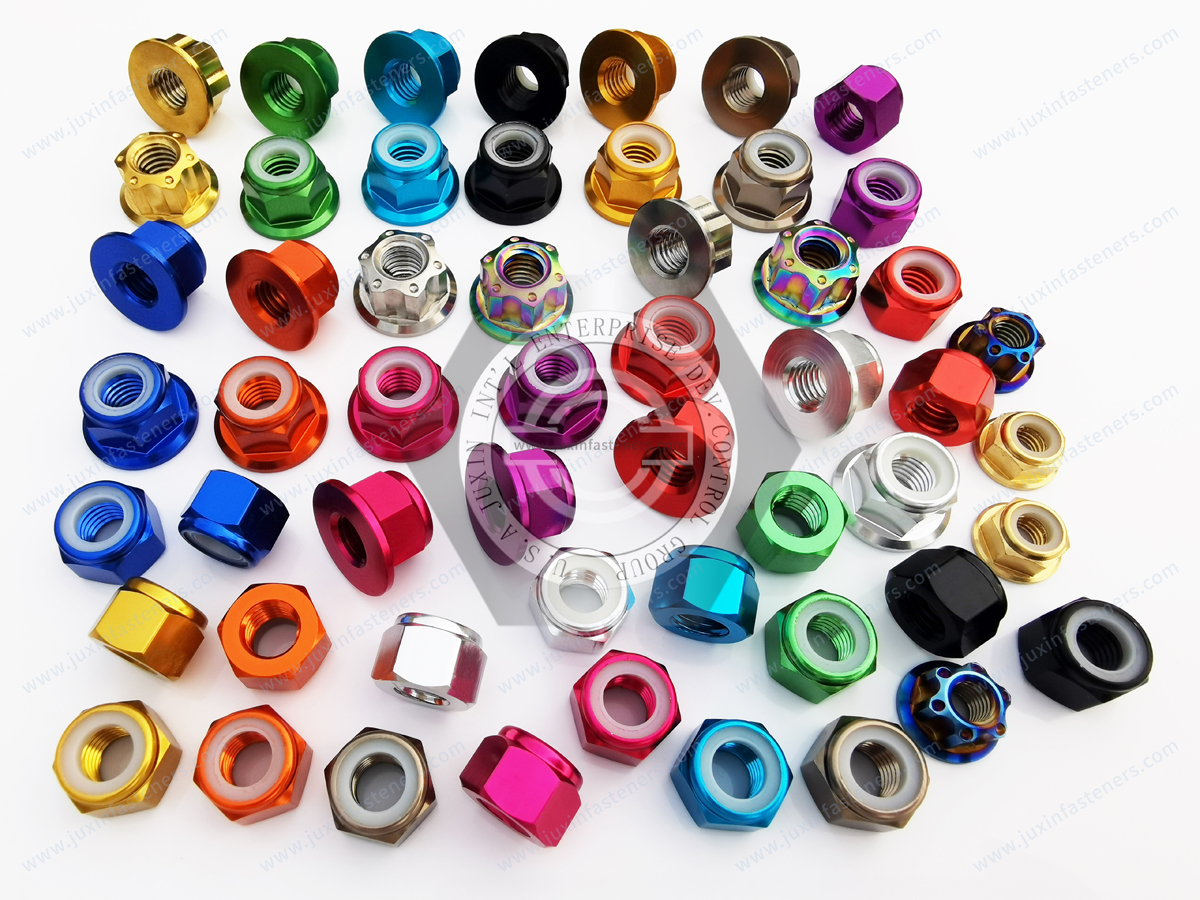
Depending on the specified process and manufacturing feasibility, decorative colors may include:
Black
Blue
Gold
Red
Purple
Gray
Actual color availability must be confirmed.
Why Anodizing Matters for Motorcycle and Bicycle OEMs
For visible accessory hardware, appearance may be an important part of the product specification.
Motorcycle and bicycle component manufacturers may require consistent color and surface appearance across multiple parts.
However, decorative appearance and functional corrosion performance are different requirements.
Engineering Recommendation
Specify both the required finish and the operating environment.
Do not rely on color alone to define anodizing performance.
Anodizing and Internal Thread Fit
Anodizing changes the surface condition of the aluminum nut body.
Depending on the process, it can also affect thread dimensions and installation behavior.
Potential concerns include:
Reduced internal thread clearance
Changed friction
Thread interference
Surface damage during installation
Variation in prevailing torque
Engineering Recommendation
Specify the finished-thread acceptance condition and evaluate functional assembly after surface treatment.
Nylon Insert Installation Sequence
The nylon locking element may not be compatible with all anodizing chemicals, temperatures or process conditions.
For some designs, the aluminum nut body may be anodized before the nylon insert is assembled.
The correct sequence depends on the manufacturing process and insert material.
Engineering Recommendation
Confirm the production sequence during supplier qualification.
Do not assume that the nylon insert can withstand the anodizing process.
Galvanic Corrosion With Steel and Stainless Steel Bolts
Aluminum nylon-insert locknuts may be assembled with steel or stainless steel bolts.
Dissimilar metal contact can create galvanic corrosion risk when moisture or another electrolyte is present.
Relevant factors include:
Mating bolt material
Aluminum alloy
Surface finish
Moisture exposure
Road salt
Coating damage
Electrical contact
Engineering Recommendation
Evaluate the complete assembly and its service environment.
Anodizing alone should not automatically be treated as sufficient galvanic isolation.
Motorcycle OEM Applications
Motorcycle manufacturers and component suppliers may consider aluminum nylon-insert locknuts where reduced mass and suitable locking performance are required.
Potential applications include selected non-safety-critical assemblies.
Fairing and Body Panel Assemblies
Potential applications:
Fairing attachment hardware
Decorative panels
Lightweight covers
Selected nonstructural brackets
Engineering considerations:
Vibration
Surface appearance
Thread strength
Installation accessibility
Maintenance
Windshield and Accessory Mounting
Potential applications:
Noncritical windshield accessory hardware
Instrument brackets
Selected mirror accessory brackets
Auxiliary equipment mounts
Engineering considerations:
Dynamic loading
Wind-induced vibration
Joint stiffness
Environmental exposure
Fender and License Plate Accessories
Potential applications:
Nonstructural fender accessories
License plate mounting kits
Decorative hardware
Lightweight accessory brackets
Engineering considerations:
Road vibration
Corrosion
Installation torque
Surface finish
Engine Covers and External Accessories
Selected external covers and accessories may present opportunities for lightweight fastening.
However, thermal exposure and joint function must be reviewed.
Important Limitation
Do not assume aluminum nylon-insert locknuts are suitable for engine internals, exhaust-adjacent joints or highly loaded powertrain connections.
Brake, Steering and Suspension Safety
General-purpose aluminum nylon-insert locknuts must not be recommended as direct substitutes for approved fasteners in:
Brake caliper retention
Brake disc mounting
Steering assemblies
Suspension load-bearing connections
Wheel retention
Other safety-critical motorcycle joints
These connections require approved fastener specifications and application-specific engineering validation.
Engineering Recommendation
Use aluminum nylon-insert locknuts only where the exact joint requirements have been evaluated and approved.
Motorsport and Racing Motorcycle Applications
Motorsport manufacturers frequently evaluate component weight and assembly efficiency.
Potential opportunities exist in selected noncritical accessories and equipment attachments.
Examples include:
Lightweight bodywork accessories
Instrument mounting
Decorative hardware
Selected equipment brackets
However, racing applications may involve higher vibration, temperature and dynamic loading.
Engineering Recommendation
Do not assume that a component suitable for a standard road motorcycle is automatically suitable for racing conditions.
Bicycle OEM and Component Applications
Bicycle manufacturers and component suppliers also evaluate lightweight fastening hardware.
Potential noncritical applications include:
Accessory mounts
Nonstructural equipment brackets
Decorative hardware
Lightweight covers
Selected instrument attachments
Road Bicycle Applications
Weight reduction and component appearance may be relevant to selected accessory assemblies.
Mountain Bicycle Applications
Off-road vibration, moisture and repeated impacts can affect fastening reliability.
Electric Bicycle Applications
Electric bicycles may introduce additional equipment mounting requirements.
However, the mechanical loads, vibration and electrical environment must be considered.
Safety Limitation
General-purpose aluminum nylon-insert locknuts should not be substituted into bicycle braking, steering,
wheel retention or other safety-critical joints without engineering approval.
Industrial Automation Applications
Aluminum nylon-insert locknuts may be considered in selected lightweight automation equipment assemblies.
Potential applications include:
Sensor brackets
Equipment covers
Lightweight fixtures
Instrument mounts
Noncritical mechanical accessories
Production Engineering Considerations
Assembly cycle time
Nut feeding
Thread alignment
Tightening tool settings
Surface protection
Inspection
Rework
Engineering Recommendation
Validate the installation process using representative production components.
Industrial Robotics Applications
Robotic equipment may contain both lightweight auxiliary assemblies and highly loaded structural joints.
Aluminum nylon-insert locknuts may be considered for selected noncritical components such as:
Sensor mounting brackets
Instrument attachments
Lightweight covers
Auxiliary equipment
Engineering Recommendation
Do not assume that all robotic joints have the same load requirements.
Evaluate each fastening location according to its function.
Precision Machinery and Electronic Equipment
Precision machinery and electronic equipment may require compact, lightweight fastening components.
Potential applications include:
Instrument housings
Test equipment
Sensor mounts
Camera brackets
Equipment covers
Lightweight mechanical supports
Engineering Considerations
Thread fit
Dimensional accuracy
Installation consistency
Electrical contact requirements
Corrosion
Maintenance
UAV and Drone Equipment
Lightweight fastening may also be relevant to selected UAV and drone equipment.
Potential opportunities include noncritical accessory mounts, sensor brackets and ground-support equipment.
Important Limitation
General-purpose aluminum nylon-insert locknuts should not be assumed suitable for flight-control, propulsion, primary structural or other flight-safety-critical connections.
Such applications require appropriate engineering qualification.
Marine and Outdoor Equipment
Selected marine and outdoor equipment accessories may benefit from lightweight fastening hardware.
However, salt exposure and moisture can increase galvanic corrosion risk.
Engineering Recommendation
Review material pairing, surface treatment and environmental requirements before selecting aluminum locknuts.
Metric and Unified Inch Thread Requirements
International OEM customers may request metric or Unified inch-thread configurations.
Examples of metric inquiry sizes include:
M3
M4
M5
M6
M8
M10
M12
M16
These are illustrative inquiry sizes, not a confirmed inventory or manufacturing range.
Metric thread requirements may reference ISO 261 and ISO 965.
Unified inch threads may reference ASME B1.1.
Approximate Metric-to-Inch Diameter References
| Metric thread | Approximate nominal diameter |
|---|---|
| M3 | 0.118 in |
| M4 | 0.157 in |
| M5 | 0.197 in |
| M6 | 0.236 in |
| M8 | 0.315 in |
| M10 | 0.394 in |
| M12 | 0.472 in |
| M16 | 0.630 in |
These are dimensional references only.
Metric, UNC, UNF, BSW and BSF threads are not directly interchangeable.
Availability of specific inch-thread configurations must be confirmed against the approved drawing.
Product Specification and Drawing Requirements
For OEM purchasing, the product specification should be based on an approved drawing rather than a generic product description.
| Specification item | Engineering requirement |
|---|---|
| Product type | Aluminum nylon-insert hex locknut |
| Nut geometry | Standard hex or specified custom design |
| Material | Aluminum alloy |
| Temper | Specified condition |
| Thread | Metric or Unified inch |
| Locking element | Nylon or specified polymer |
| Locking performance | Agreed prevailing-torque criteria |
| Surface treatment | Anodized or other specified finish |
| Color | Approved color reference where required |
| Dimensions | Approved drawing |
| Application | Defined joint and service conditions |
| Inspection | Agreed acceptance requirements |
A 6061-T6 material specification, M3–M16 thread range, particular nylon grade or anodized color must not be assumed available without product confirmation.
Quality Control for Aluminum Nylon-Insert Locknuts
OEM quality planning should address the aluminum nut body, nylon insert, surface finish and functional performance.
Material Inspection
Verify the specified aluminum alloy and temper.
Dimensional Inspection
Check:
Internal thread
Across-flats dimension
Nut height
Bearing surface
Locking insert position
Finished dimensions
Surface Inspection
Evaluate:
Anodized finish
Color consistency where specified
Visible defects
Thread condition
Surface damage
Functional Inspection
Depending on the approved specification, testing may include:
Prevailing torque
Installation behavior
Removal behavior
Thread integrity
Reuse performance
Functional assembly
Standards Clarification
ISO 2320 applies to prevailing-torque steel nuts within its scope.
Its mechanical requirements should not automatically be used as a complete acceptance specification for aluminum nylon-insert locknuts.
For aluminum OEM products, agree on the relevant inspection and functional acceptance criteria before production.
Production-Line Assembly and Manufacturing Consistency
Production managers and manufacturing engineers must consider more than nominal nut dimensions.
Important factors include:
Nut feeding and orientation
Correct thread engagement
Tightening tool compatibility
Prevention of cross-threading
Protection of anodized surfaces
Inspection frequency
Rework control
Packaging and handling
Common Assembly Problems
| Problem | Possible cause | Recommended control |
|---|---|---|
| Thread stripping | Excessive tightening | Validate installation limits |
| Cross-threading | Poor alignment | Control initial thread engagement |
| Variable installation torque | Friction and locking variation | Validate assembly settings |
| Reduced locking performance | Insert wear or temperature | Define functional acceptance criteria |
| Surface damage | Tooling or handling | Review equipment and packaging |
| Corrosion | Unsuitable material pairing | Evaluate service environment |
Engineering Recommendation
Do not apply steel locknut assembly parameters directly to aluminum nylon-insert locknuts without validation.
Custom Aluminum Nylon-Insert Locknuts for OEM Manufacturers
OEM customers may require special dimensions, materials, finishes or functional characteristics.
Potential requirements include:
Drawing-specific geometry
Custom thread configurations
Specified aluminum alloy and temper
Nylon insert design
Anodized finish
Color requirements
Prevailing-torque criteria
Dimensional tolerances
Inspection requirements
OEM packaging
Juxin Fasteners welcomes drawings for technical and manufacturing feasibility review.
Manufacturing process, tooling, prototype availability, MOQ and lead time must be confirmed for each project.
OEM Supplier Qualification and Procurement Considerations
Procurement development teams, purchasing managers and supply chain managers should evaluate both engineering suitability and supply requirements.
Technical Qualification
Approved drawing
Material specification
Thread requirements
Locking performance
Surface finish
Inspection criteria
Manufacturing Evaluation
Production feasibility
Material control
Dimensional consistency
Insert assembly
Surface treatment
Functional inspection
Commercial Evaluation
Prototype requirements
Tooling costs
MOQ
Annual demand
Unit price
Lead time
Packaging
Delivery schedule
Supply continuity
Supplier certifications and specific production capabilities should be verified during qualification.
OEM RFQ Checklist for Aluminum Nylon-Insert Locknuts
To prepare an accurate quotation, please provide the following information.
| RFQ item | Information required |
|---|---|
| Product drawing | 2D/3D drawing and revision |
| Nut type | Standard hex or custom geometry |
| Material | Aluminum alloy |
| Temper | Required material condition |
| Thread | Metric, UNC or UNF |
| Nylon insert | Polymer specification if required |
| Mating bolt | Material, grade and thread |
| Prevailing torque | Functional requirement |
| Installation | Tightening procedure |
| Loading | Static and dynamic |
| Temperature | Operating range |
| Environment | Corrosion exposure |
| Finish | Anodized or other specified finish |
| Color | Approved color reference |
| Inspection | Tests and documentation |
| Prototype | Sample quantity |
| Annual demand | Estimated purchasing volume |
| Tooling | Project requirements |
| Packaging | OEM requirements |
| Delivery | Required schedule |
Frequently Asked Questions
What are aluminum nylon-insert locknuts?
They are aluminum alloy nuts containing a polymer locking insert that creates prevailing torque against a mating threaded fastener.
Are aluminum nylon-insert locknuts lighter than steel locknuts?
Yes. Aluminum has lower density than steel, although actual weight reduction depends on the nut geometry.
Are aluminum nylon-insert locknuts suitable for motorcycles?
They may be suitable for selected non-safety-critical motorcycle accessories and mechanical assemblies after engineering evaluation.
Can aluminum nylon-insert locknuts be used in bicycle applications?
They may be considered for selected noncritical accessory assemblies. Safety-critical connections require approved fastening specifications.
Are aluminum nylon-insert locknuts vibration resistant?
The nylon insert provides resistance to unintended rotation, but complete joint reliability depends on preload, loading and installation conditions.
Can aluminum nylon-insert locknuts be anodized?
Suitable aluminum nut bodies can be anodized. The process sequence, finished thread fit and nylon insert compatibility must be evaluated.
Are high-temperature nylon inserts always available?
No. The polymer material and operating temperature capability must be confirmed for the specific product.
Can aluminum nylon-insert locknuts be reused?
Reuse depends on the condition of the insert and threads and the specified functional acceptance criteria.
Are aluminum nylon-insert locknuts interchangeable with steel locknuts?
Not automatically. Thread strength, joint loading and tightening conditions must be verified.
Can Juxin Fasteners review custom aluminum nylon-insert locknut drawings?
Yes. Juxin Fasteners welcomes OEM drawings for technical and manufacturing feasibility review.
Why Work With Juxin Fasteners?
Juxin Fasteners has more than 20 years of experience serving international industrial fastener customers through B2B sourcing and customer relationships.
We welcome inquiries involving:
Aluminum nylon-insert locknuts
DIN 985-style aluminum locknuts
Anodized aluminum locknuts
Motorcycle accessory fastening hardware
Bicycle accessory fasteners
Lightweight industrial locking nuts
Custom OEM fastening components
Drawing-based bulk procurement projects
Product specifications, material options, manufacturing feasibility, MOQ, lead times and quality documentation requirements are subject to confirmation.
Request a Quotation for Aluminum Nylon-Insert Locknuts
Are you sourcing aluminum nylon-insert locknuts for motorcycle accessories, bicycle components, motorsport equipment or industrial mechanical assemblies?
Juxin Fasteners welcomes inquiries from OEM manufacturers, component suppliers, design engineers, mechanical engineers, manufacturing engineers,
production managers, purchasing specialists, procurement managers, supplier development teams and supply chain managers.
For technical review and quotation, please provide:
2D/3D drawings, aluminum alloy and temper, thread size and system, nut geometry, nylon insert requirements, mating bolt specification,
operating loads, tightening conditions, prevailing-torque requirements, operating temperature, corrosion environment,
anodized finish, inspection criteria, prototype quantity, annual demand, packaging and required delivery schedule.
Our team can review the project and confirm appropriate product options, technical feasibility and commercial quotation conditions.
Company: Juxin Fasteners
Website: https://www.juxinfasteners.com/
Email: info@juxinfasteners.com
Send your aluminum nylon-insert locknut drawings and OEM RFQ to Juxin Fasteners for technical review and quotation.
Contact Us
Tel.:
+86 020 8621 0320
+86 020 3121 6067
E-mail:
Technical Support:
Navigation
SEND INQUIREY



