
Call Us
+86 136 6007 9809
Call Us
+86 136 6007 9809

Apr. 12, 2026
Automotive Hose Clamps, Retaining Clips & Wiring Harness Fasteners: Engineering and OEM Sourcing Guide
Automotive fastening systems must secure components under vibration, temperature cycling, moisture exposure and demanding production conditions.
A hose connection may require controlled radial compression to maintain a seal. A wiring harness clip must retain cables without damaging insulation.
An HVAC duct fastener must hold mating components in position while accommodating assembly tolerances and thermal movement.
Although these components are sometimes grouped under broad descriptions such as automotive clamping rings or buckle fasteners, their mechanical functions are different.
For OEM engineers and automotive component manufacturers, selecting the correct fastening design requires a clear understanding of the component's purpose, material, installation method and service environment.
This guide examines:
Automotive hose clamps and clamping rings
Hose and tube retaining clips
Wiring harness clips and cable retainers
Automotive HVAC duct fasteners
Snap-fit and buckle-style fastening components
Material and corrosion selection
Retention force and sealing requirements
Production-line assembly and inspection
Custom automotive fastener sourcing
Juxin Fasteners welcomes drawing-based inquiries for industrial and automotive fastening components, including application-specific retaining clips,
clamps and related fastening hardware, subject to product and manufacturing feasibility confirmation.
What Are Automotive Hose Clamps and Retaining Clips?
Automotive clamps and retaining clips are mechanical components used to secure, position or support hoses, tubes, cables, ducts and other vehicle parts.
However, not every clamp or clip performs the same function.
Hose Clamps
Hose clamps apply circumferential compression around a hose connection.
Their purpose may be to retain the hose on a fitting, support sealing performance or both.
Common design categories include:
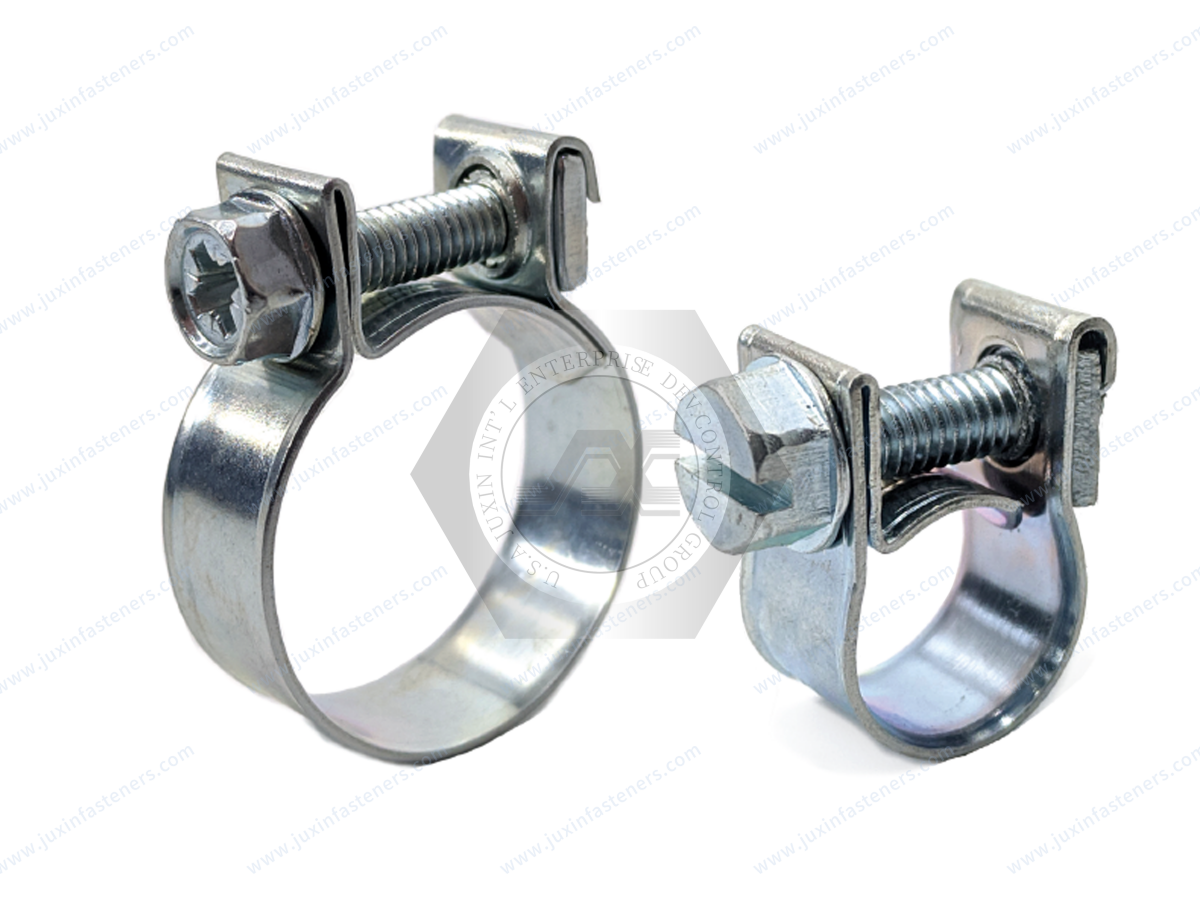
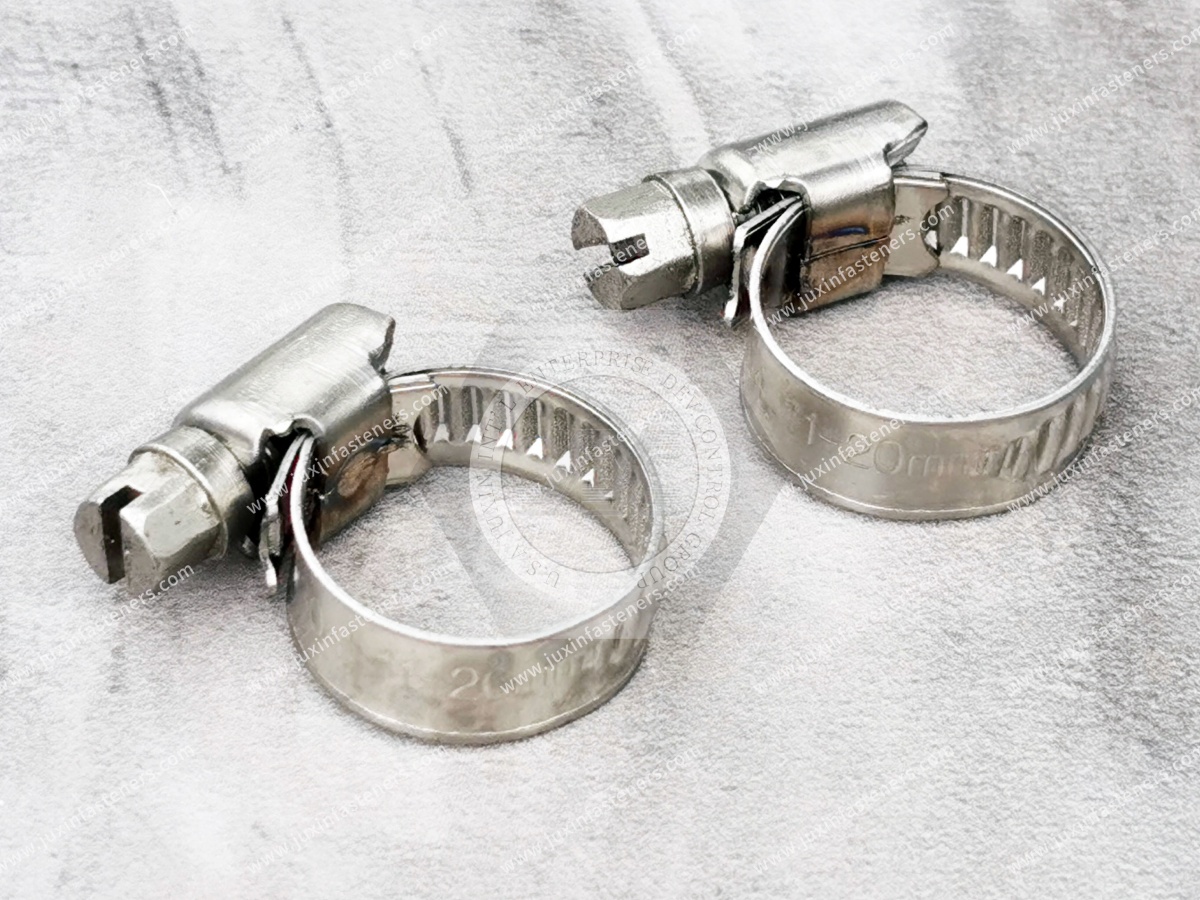
Worm-drive hose clamps
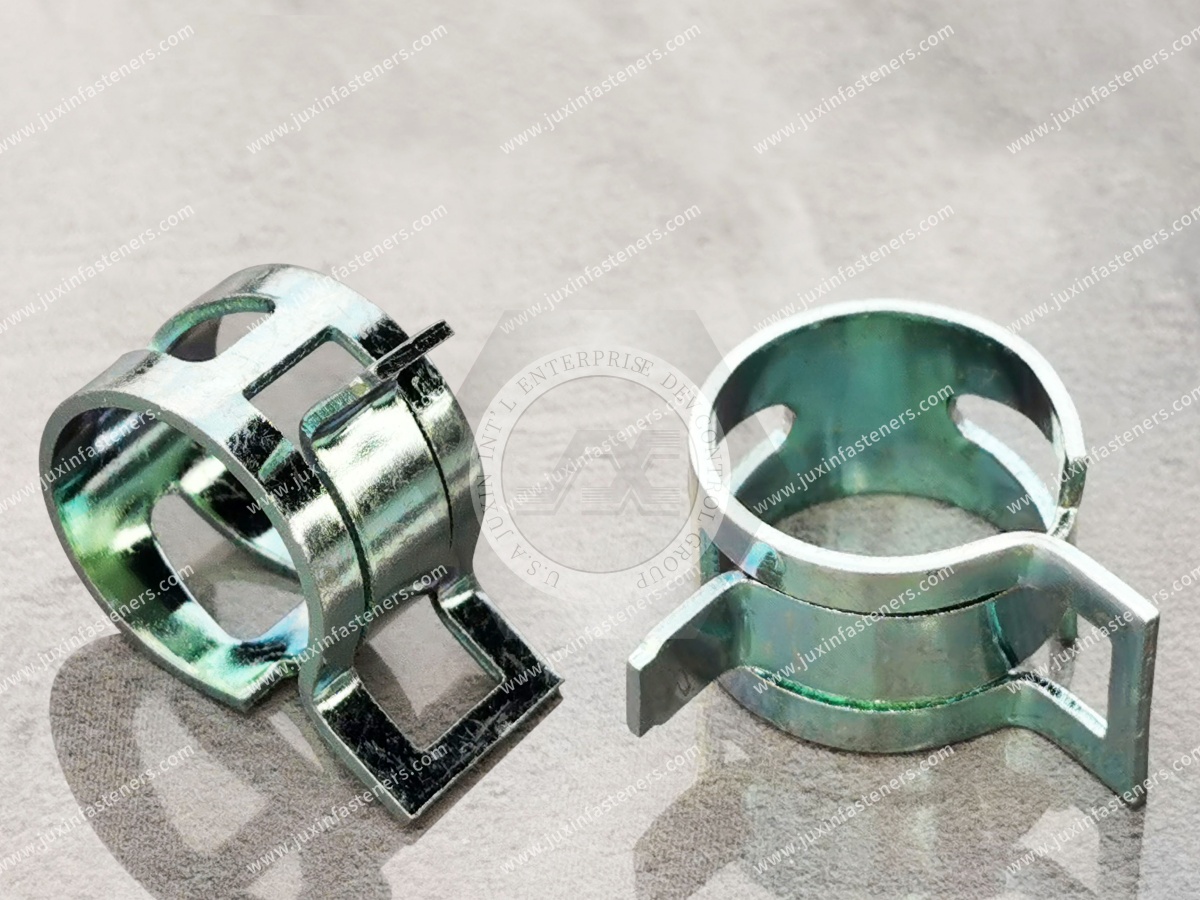
Spring-band hose clamps
Constant-tension hose clamps
Ear clamps
Band clamps
Application-specific formed clamps
These designs differ in tightening method, load distribution, serviceability and ability to accommodate dimensional changes.
Availability of any particular design from Juxin Fasteners requires confirmation.
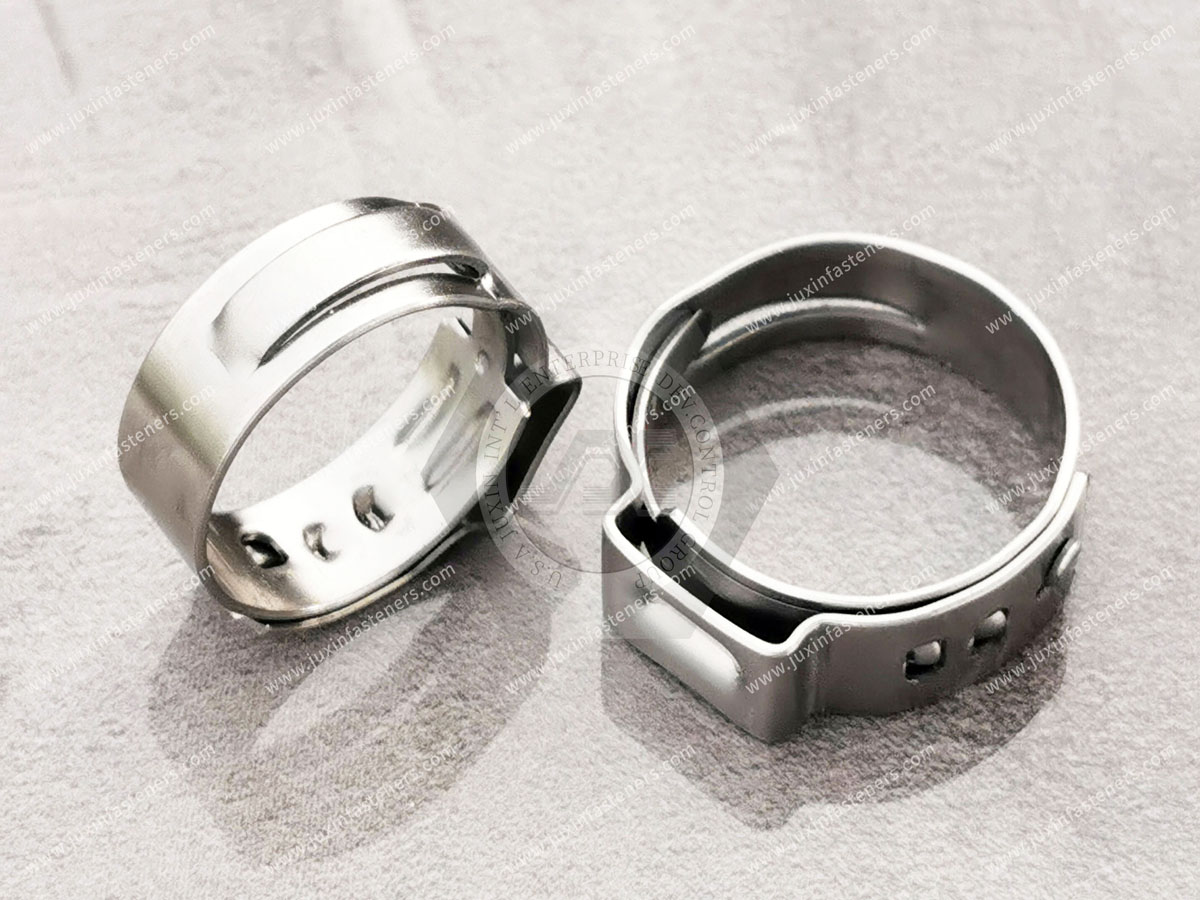
Hose and Tube Retaining Clips
Retaining clips support or position hoses and rigid or flexible tubing.
Their main function may be routing or mechanical retention rather than sealing.
Examples include:
Formed metal retaining clips
Plastic tube clips
Snap-in pipe retainers
Bracket-mounted line clips
Custom retaining rings
Wiring Harness Clips
Wiring harness clips secure electrical cables and cable bundles to designated mounting locations.
Depending on the application, the clip may provide:
Routing control
Retention
Spacing
Abrasion prevention
Assembly identification
Service accessibility
Buckle-Style and Snap-Fit Fasteners
Buckle-style fasteners use an engagement or locking feature to retain a component.
Snap-fit fasteners rely on elastic deformation during assembly.
These terms describe broad mechanical concepts rather than one universal automotive product standard.
The actual geometry must be established by the drawing or reference sample.
Engineering Information Gain: Sealing, Retention and Routing Are Different Functions
A hose clamp intended to maintain sealing pressure cannot automatically be replaced by a retaining clip.
Similarly, a wiring harness clip may provide adequate cable retention but have no capability to seal a fluid connection.
Before selecting a component, define its primary function:
Seal a hose connection
Prevent axial movement
Support a tube or cable
Maintain routing clearance
Retain a panel or duct
Allow controlled service removal
This functional distinction is the first step toward correct fastener selection.
Why Automotive Clamping and Retention Systems Matter
Modern vehicles contain multiple interconnected fluid, electrical, thermal management and ventilation systems.
Fastening components help maintain the intended position and mechanical integrity of these assemblies.
Potential consequences of an unsuitable fastening design include:
Hose movement
Fluid leakage
Tube abrasion
Wiring insulation damage
Electrical faults
HVAC air leakage
Noise and vibration
Assembly rework
Premature component failure
The risk depends on the specific system and the consequences of failure.
Automotive Hose Clamp Engineering: Compression and Sealing
A hose clamp must interact correctly with the hose material and mating fitting.
The required clamp load depends on the connection design.
Relevant factors include:
Hose inside and outside diameter
Hose wall thickness
Hose material and hardness
Fitting geometry
Operating pressure
Fluid type
Temperature
Thermal cycling
Vibration
Clamp width and geometry
Clamp Force Is Not the Same as Sealing Reliability
Increasing clamp force does not always improve sealing.
Excessive compression may damage a hose, deform the fitting or accelerate material degradation.
Insufficient compression may allow leakage or hose movement.
Engineering Recommendation
Determine the acceptable compression range through the hose-and-fitting design, applicable specifications and validation testing.
Do not select a clamp solely by its nominal diameter.
Spring-Band and Constant-Tension Hose Clamps
Some hose systems experience changes in diameter due to temperature cycling, pressure variation or material relaxation.
Spring-band and other constant-tension designs may be considered when the joint needs to accommodate these changes.
However, different clamp geometries provide different force-displacement behavior.
Engineering Recommendation
Compare clamp designs using the actual hose, fitting and operating conditions.
Do not assume that all spring clamps or constant-tension clamps maintain identical force throughout service.
Worm-Drive and Band Clamps
Worm-drive clamps use a screw-driven mechanism to tighten a metal band.
Other band clamp designs may use a formed locking feature or a controlled crimping operation.
Selection factors include:
Installation torque or crimp specification
Band width
Contact pressure distribution
Corrosion resistance
Tool access
Service requirements
Engineering Recommendation
Where a clamp is installed by torque, validate the relationship between installation torque and actual hose compression.
Torque alone does not guarantee sealing performance.
Engine Bay Hose and Fluid Line Applications
Engine compartments expose fastening components to vibration, temperature changes and various automotive fluids.
Potential fastening requirements include:
Coolant hose retention
Low-pressure fluid hose connections
Auxiliary fluid line routing
Small-diameter tube support
Hose-to-bracket retention
Protective line positioning
Coolant Hose Connections
Coolant systems may experience repeated thermal expansion and contraction.
Clamp selection should account for:
Hose material
Temperature range
System pressure
Fitting design
Long-term hose relaxation
Installation process
Fuel and Brake Fluid Systems
Fuel and hydraulic brake systems have demanding safety and compatibility requirements.
General-purpose hose clamps or retaining clips should not be substituted into these connections without the approved system design and applicable qualification.
Engineering Recommendation
For safety-related fluid systems, use the specified connection architecture, materials and validated assembly procedure.
Automotive HVAC Duct and Ventilation Fasteners
Vehicle HVAC systems require reliable mechanical connections between ducts, housings, vents and related components.
Fastening solutions may include:
Snap-fit clips
Plastic retaining clips
Formed metal clips
Duct fastening brackets
Buckle-style retainers
Application-specific connection hardware
HVAC Assembly Requirements
Engineers should consider:
Duct material
Wall thickness
Assembly tolerance
Retention force
Vibration
Thermal expansion
Service access
Noise and vibration behavior
Retention and Air Sealing Must Be Evaluated Separately
A clip may hold two duct sections together without providing an airtight seal.
Where sealing is required, the joint may also depend on:
Gaskets
Foam seals
Mating surface geometry
Controlled compression
Duct stiffness
Engineering Recommendation
Verify both mechanical retention and airflow leakage requirements.
Do not assume that increased clip retention force automatically improves duct sealing.
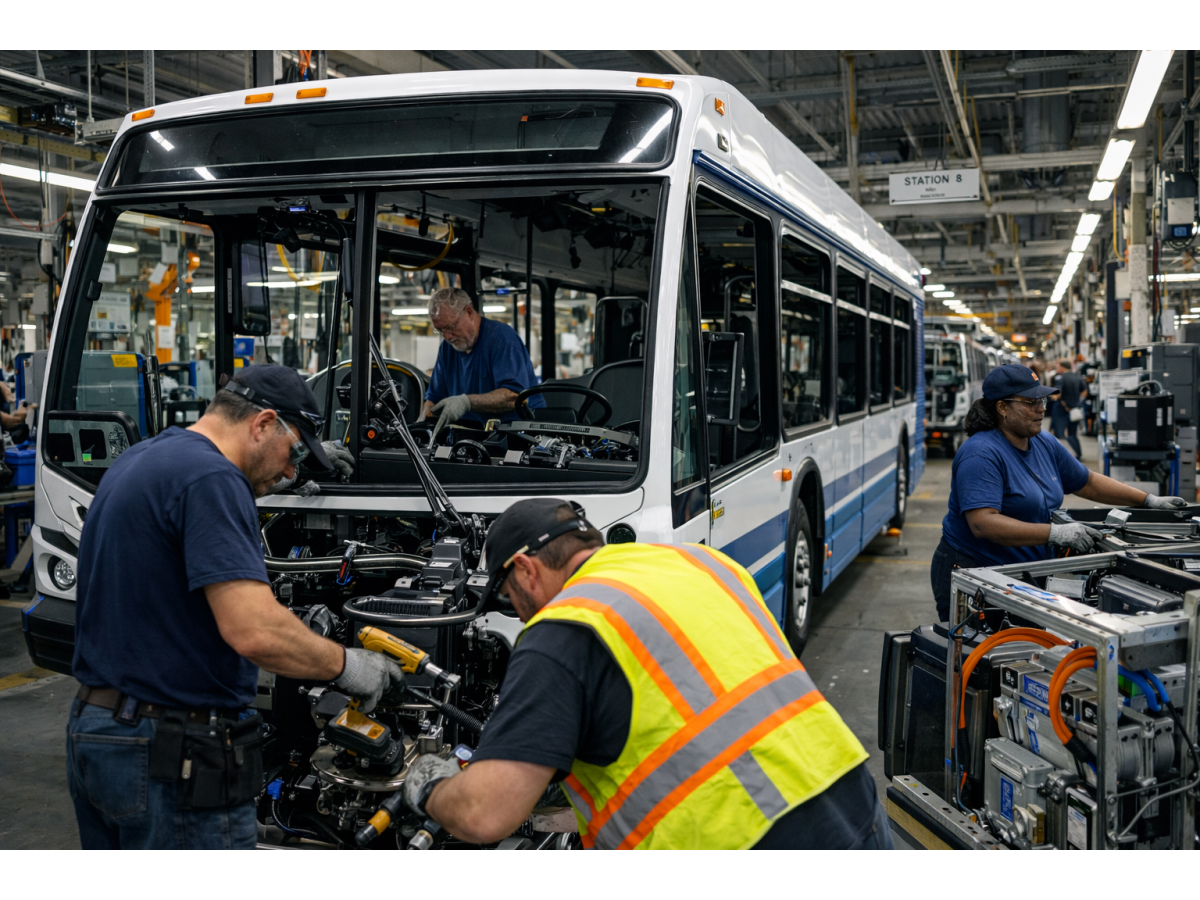
Automotive Wiring Harness Clips and Cable Management
Wiring harness retention is essential for maintaining electrical cable routing and preventing unwanted movement.
Applications include:
Engine compartment harnesses
Interior wiring systems
Sensor cables
Electronic control module wiring
Lighting harnesses
EV auxiliary electrical assemblies
Potential fastening designs include:
Push-in clips
Fir-tree style clips
Edge clips
Cable clamps
Snap-in retainers
Bracket-mounted harness clips
Custom plastic or metal retaining components
Harness Retention Requirements
A suitable wiring harness clip must account for:
Cable bundle diameter
Bundle weight
Mounting hole or panel geometry
Panel thickness
Pull-out force
Installation force
Vibration
Routing clearance
Abrasion protection
Temperature
Engineering Information Gain: High Retention Force Is Not Always Better
A clip that requires excessive insertion force can slow production, damage a mounting hole or cause incomplete assembly.
Likewise, a very rigid retainer may damage cable insulation if the harness is subjected to repeated movement.
The objective is to achieve adequate retention with an acceptable installation process and appropriate protection of the cable bundle.
Engineering Recommendation
Define insertion force, retention force and allowable cable movement as separate design requirements where relevant.
Electric Vehicle Wiring and Cable Routing
EV platforms introduce additional electrical and thermal management components.
Potential fastening requirements include:
Low-voltage wiring harness retention
Sensor cable routing
Thermal management tube support
Battery enclosure auxiliary wiring
Equipment mounting and cable separation
High-Voltage Safety Considerations
EV high-voltage cable routing may require specific electrical clearances, mechanical protection, insulation and approved retention components.
General-purpose clips must not be treated as approved substitutes for high-voltage cable retention without system-level engineering validation.
Engineering Recommendation
For EV projects, identify whether the component is intended for low-voltage wiring,
high-voltage cable management or thermal management plumbing before selecting the fastening system.
EV Battery and Thermal Management Hose Clamps
EV battery systems and power electronics may use liquid cooling circuits.
Potential applications include:
Coolant hose connections
Thermal management tube routing
Auxiliary cooling line support
Pump and heat exchanger connections
Relevant requirements include:
Coolant compatibility
Operating temperature
Pressure
Vibration
Leakage limits
Electrical isolation considerations
Service access
Engineering Recommendation
Treat coolant sealing and mechanical line support as separate requirements.
A retaining clip alone should not be assumed to provide a pressure-tight fluid connection.
Vibration, Noise and Component Protection
Automotive clamps and retaining clips must maintain their function under dynamic conditions.
Potential vibration-related issues include:
Clamp movement
Clip disengagement
Hose abrasion
Cable chafing
Rattling
Fatigue cracking
Loss of retention force
Structural Retention vs Vibration Damping
A rigid clip may provide strong retention but little vibration isolation.
Vibration damping may require a separate elastomeric element, compliant geometry or other engineered feature.
Engineering Recommendation
Do not describe every retaining clip as a vibration damper.
Where vibration isolation is required, specify and validate that function separately.
Automotive Shaft Sealing and External Retaining Applications
Some automotive systems use retaining rings or band-style clamps around shafts, boots or protective covers.
Potential applications include:
Protective boot retention
Flexible cover attachment
Shaft-related protective assemblies
External sealing components
These components may differ substantially from hose clamps and wiring harness clips.
Engineering Recommendation
Specify the actual component geometry and function.
A retaining ring, boot clamp and hose clamp should not be treated as interchangeable simply because each uses a circular form.
Material Selection for Automotive Clamps and Clips
Material selection affects mechanical performance, corrosion resistance, temperature capability and production cost.
Stainless Steel Clamps
Stainless steel may be considered for applications requiring corrosion resistance and suitable mechanical properties.
Potential applications include:
Hose clamps
Metal retaining bands
Selected external mounting components
Moisture-exposed assemblies
However, stainless steel grades have different mechanical and corrosion characteristics.
Engineering Recommendation
Specify the required material grade and service environment.
Do not assume that all stainless steel grades perform identically.
Carbon Steel Fastening Components
Carbon steel may provide a cost-effective option for formed metal clips and retaining components.
Potential considerations include:
Mechanical strength
Formability
Surface treatment
Corrosion exposure
Fatigue
Cost
The coating system should be selected according to the application.
Engineering Plastics
Engineering plastics are commonly considered for clips, retainers and cable management components.
Depending on the design, materials may include:
Polyamide (PA)
Polypropylene (PP)
Polyoxymethylene (POM)
Other specified engineering polymers
These materials differ in stiffness, creep behavior, chemical resistance and temperature capability.
Engineering Recommendation
Select the polymer grade based on actual operating requirements.
Do not assume that all nylon or plastic clips have the same temperature, chemical or UV resistance.
Metal-Plastic Hybrid Components
Some fastening systems combine a metal element with a polymer body or protective insert.
Potential design objectives include:
Mechanical retention
Surface protection
Reduced abrasion
Controlled flexibility
Improved installation behavior
Engineering Recommendation
Evaluate the interaction between the metal and polymer components, including temperature cycling and long-term deformation.
Automotive Clamp and Clip Design Requirements
A reliable component must be evaluated in the context of its mounting interface.
Clamp Diameter and Hose Geometry
For hose clamps, relevant dimensions may include:
Minimum and maximum working diameter
Band width
Band thickness
Contact geometry
Locking feature dimensions
The nominal hose size alone may not define the required clamp.
Mounting Hole and Panel Thickness
For push-in clips and snap-fit retainers, mounting conditions may include:
Hole diameter
Hole shape
Panel thickness
Edge distance
Material stiffness
Insertion direction
A clip designed for one panel thickness range may not retain correctly in a different panel.
Insertion and Retention Force
For production assembly, insertion force and retention force should be evaluated separately.
A component may have adequate retention after installation but still be unsuitable for the production process if insertion force is excessive.
Thermal Expansion and Creep
Plastic clips and flexible hose materials may change dimension or stiffness over time.
Temperature cycling and sustained load can affect retention.
Engineering Recommendation
Validate components under the expected environmental and service conditions rather than relying only on room-temperature dimensional inspection.
Surface Protection and Abrasion Prevention
Fastening components should not create damaging contact with the hose, tube or cable they are intended to secure.
Relevant considerations include:
Edge radius
Burrs
Surface roughness
Contact pressure
Relative movement
Protective liners
Coating condition
Engineering Recommendation
For cable and hose retention, inspect the contact interface as carefully as the fastener itself.
Production-Line Installation and Assembly Efficiency
Automotive production managers and manufacturing engineers must balance reliable fastening with repeatable assembly.
Important production considerations include:
Component feeding
Orientation
Tool access
Installation force
Installation torque
Cycle time
Operator ergonomics
Automated inspection
Rework
Traceability
Manual vs Automated Assembly
Some clips are suitable for manual push-in installation.
Other fastening components may require:
Controlled crimping
Torque-controlled tools
Dedicated installation fixtures
Automated insertion equipment
Verification of final position
Engineering Recommendation
Evaluate the fastening component and installation process together.
A design that performs well in laboratory testing may still create production difficulties if it cannot be installed consistently.
Assembly Error Prevention
Potential errors include:
Wrong clip orientation
Incorrect clamp size
Incomplete engagement
Incorrect tightening
Missing components
Improper hose positioning
Damaged mounting holes
Possible controls include:
Clear part identification
Assembly fixtures
Position verification
Tool setting validation
Visual inspection
Appropriate process documentation
Engineering Recommendation
Define the critical-to-function characteristics that must be controlled during assembly.
Automotive Clamp and Clip Failure Analysis
Understanding common failure modes helps engineers develop suitable specifications and inspection plans.
| Failure mode | Possible contributing factor | Engineering control |
|---|---|---|
| Hose leakage | Insufficient or uneven compression | Validate hose, fitting and clamp system |
| Hose damage | Excessive compression or sharp edges | Review contact geometry and installation |
| Clip disengagement | Insufficient retention or incorrect mounting | Verify engagement and pull-out requirements |
| Cable abrasion | Relative movement or unsuitable contact surface | Review routing and edge protection |
| Clamp corrosion | Unsuitable material or coating | Match material to service environment |
| Plastic clip fracture | Material, geometry or installation stress | Validate insertion and environmental performance |
| Loss of retention | Creep, fatigue or temperature cycling | Evaluate long-term service conditions |
| Production rework | Inconsistent installation | Improve tooling and process verification |
Engineering Information Gain: Distinguish Component Failure From System Failure
A leaking hose connection does not necessarily mean the clamp itself is defective.
The root cause may involve:
Incorrect hose material
Damaged fitting
Incompatible clamp geometry
Improper installation
Thermal relaxation
Incorrect assembly location
Similarly, a detached wiring harness may result from a damaged mounting panel rather than a defective clip.
Engineering Recommendation
Evaluate the complete assembly before changing the fastening component.
Quality Inspection for Automotive Clamps and Clips
An appropriate inspection plan depends on the component's function and criticality.
Dimensional Inspection
Potential characteristics include:
Clamp diameter
Band width
Material thickness
Locking geometry
Mounting dimensions
Hole engagement features
Finished component geometry
Material and Surface Inspection
Depending on the drawing, inspection may address:
Material grade
Surface coating
Corrosion protection
Visible defects
Burrs and sharp edges
Plastic molding condition
Functional Inspection
Depending on the component, functional testing may include:
Insertion force
Retention force
Clamp force
Crimp dimensions
Installation torque
Leak testing of the assembled hose connection
Vibration testing
Thermal cycling
Not every test applies to every product.
Engineering Recommendation
Define the inspection requirements according to the actual function of the component.
Automotive Standards and Qualification Requirements
Automotive fastening components may be subject to product-specific standards, customer drawings and vehicle manufacturer requirements.
For example, ISO 16750 addresses environmental conditions and testing for electrical and electronic equipment installed in road vehicles.
It may be relevant to the broader validation of certain vehicle electrical assemblies, but it is not a universal product standard for hose clamps or retaining clips.
Other requirements may depend on the particular hose system, electrical assembly, material or customer program.
Important Clarification
Do not assume that a component is automotive-qualified merely because it is described as an automotive clamp or clip.
Specific certifications, test reports, production approval requirements and supplier qualifications must be confirmed.
Automotive Fastening Design Trends
Lightweight Components
Vehicle manufacturers may evaluate lightweight polymers and optimized metal designs where mechanical performance allows.
Modular Vehicle Platforms
Some vehicle platforms use shared mounting concepts to reduce part variation.
However, standardization must not compromise application-specific retention or sealing requirements.
Automated Assembly
Production processes increasingly benefit from components with predictable installation characteristics and inspectable final positions.
EV Thermal Management
Battery and power electronics cooling systems create additional requirements for fluid routing, hose retention and mechanical support.
Engineering Recommendation
Evaluate fastening changes based on measurable assembly and system requirements rather than adopting a material or design solely because it is described as lightweight or advanced.
OEM Customization and Drawing-Based Fastening Components
Automotive OEMs and component manufacturers may require application-specific fastening components.
Potential requirements include:
Custom clamp geometry
Special retaining clip dimensions
Application-specific mounting features
Material and coating specifications
Plastic clip designs
Metal-plastic hybrid configurations
Required insertion or retention force
Packaging and part identification
Juxin Fasteners welcomes technical drawings and product requirements for feasibility review.
Specific manufacturing methods, tooling, material availability, MOQ, lead times and production capacity must be confirmed for each project.
Supplier Development and Procurement Considerations
For automotive purchasing and supply chain teams, a suitable fastener supplier must meet both technical and commercial requirements.
Engineering Review
Approved drawing
Product function
Material specification
Dimensional tolerances
Surface treatment
Functional performance
Inspection criteria
Production Review
Manufacturing feasibility
Process consistency
Assembly compatibility
Quality controls
Engineering change management
Packaging requirements
Commercial Review
Prototype quantity
Tooling requirements
MOQ
Annual purchasing volume
Unit price
Lead time
Delivery schedule
Supply continuity
Engineering Recommendation
Request quotations using the approved technical requirements rather than relying only on a product photograph or general product name.
OEM RFQ Checklist for Automotive Hose Clamps and Retaining Clips
| RFQ item | Information required |
|---|---|
| Product drawing | 2D/3D drawing and revision |
| Product type | Hose clamp, retaining clip, cable clip or other |
| Application | Hose sealing, line support, harness retention or duct connection |
| Material | Metal or polymer grade |
| Dimensions | Clamp diameter, band width or mounting geometry |
| Mating component | Hose, tube, cable, panel or fitting |
| Operating temperature | Required temperature range |
| Pressure | System pressure if applicable |
| Loading | Retention and vibration requirements |
| Environment | Moisture, chemicals, salt or other exposure |
| Finish | Coating or surface treatment |
| Installation | Torque, crimp, insertion or snap-fit requirements |
| Functional testing | Retention, leakage or other acceptance criteria |
| Quality documents | Required inspection and material records |
| Prototype | Sample quantity |
| Annual demand | Estimated volume |
| Packaging | OEM labeling and packing requirements |
| Delivery | Required project schedule |
Frequently Asked Questions
What is the difference between an automotive hose clamp and a retaining clip?
A hose clamp generally applies circumferential compression to a hose connection. A retaining clip primarily supports or positions a component. Their functions are not interchangeable.
Can a retaining clip prevent hose leakage?
A retaining clip alone should not be assumed to provide a pressure-tight seal. Sealing depends on the approved hose, fitting and clamp or connection design.
Which materials are used for automotive fastening clips?
Depending on the application, components may use stainless steel, carbon steel, engineering plastics or combined material designs.
Are plastic wiring harness clips suitable for EVs?
They may be suitable for selected applications, but high-voltage cable management and safety-related routing require application-specific qualification.
How do engineers select a hose clamp?
Selection depends on hose dimensions, material, fitting geometry, pressure, temperature, vibration and installation requirements.
What causes automotive clips to fail?
Possible causes include incorrect mounting, unsuitable material, excessive installation force, fatigue, creep, corrosion and vibration.
Can automotive retaining clips be customized?
Custom designs may be evaluated from approved drawings, subject to material, tooling and manufacturing feasibility.
Can Juxin Fasteners review automotive fastening drawings?
Yes. Juxin Fasteners welcomes drawing-based inquiries for relevant industrial and automotive fastening components.
Why Work With Juxin Fasteners?
Juxin Fasteners has more than 20 years of experience serving international industrial fastener customers.
We welcome inquiries involving:
Automotive retaining clips
Hose and tube fastening components
Wiring harness clips
Plastic fastening components
Metal retaining hardware
Custom OEM fastening solutions
Drawing-based industrial fasteners
Product availability, manufacturing capabilities, quality documentation, MOQ and lead times are subject to project confirmation.
Request a Quotation for Automotive Clamps and Retaining Clips
Are you sourcing automotive hose clamps, retaining clips, wiring harness fasteners or custom fastening components for vehicle systems?
Juxin Fasteners welcomes technical inquiries from automotive OEMs, Tier-1 and Tier-2 suppliers, mechanical engineers, design engineers,
manufacturing engineers, production managers, procurement development teams, purchasing managers and supply chain professionals.
For technical review and quotation, please provide:
2D/3D drawings, product function, material specification, dimensions, mating component details, operating temperature,
pressure or loading requirements, installation method, surface treatment, functional acceptance criteria, inspection requirements,
prototype quantity, annual demand, packaging and delivery schedule.
Our team can review the requirements and confirm suitable product options, technical feasibility and commercial quotation conditions.
Company: Juxin Fasteners
Website: https://www.juxinfasteners.com/
Email: info@juxinfasteners.com
Send your automotive clamp, retaining clip or wiring harness fastener drawings and OEM RFQ to Juxin Fasteners for technical review and quotation.
Contact Us
Tel.:
+86 020 8621 0320
+86 020 3121 6067
E-mail:
Technical Support:
Navigation
SEND INQUIREY



