
Call Us
+86 136 6007 9809
Call Us
+86 136 6007 9809

Jun. 20, 2023
Automotive chassis systems operate under complex multi-axial dynamic loading, severe road shock, and aggressive environmental exposure.
Fastener torque attenuation—the gradual loss of clamping force over time due to settlement, vibration, or thermal relaxation—remains a primary failure mode in suspension and subframe assemblies.
This technical guide provides automotive structural engineers, chassis designers, and strategic procurement managers with an advanced analytical framework covering:
Torque Attenuation & Relaxation Mechanics: Addressing pre-coating technologies and all-metal prevailing torque designs compliant with DIN 267 and international standards.
Chassis Fastener Metallurgy: Selecting high-performance carbon and alloy steels (SCM435, SCM440, 35CrMo, 10B21) for Property Classes 8.8 and 10.9.
Thread Accuracy & Coating Management: Controlling pitch diameter adjustments to maintain ISO 6g/6H tolerances post-electrophoresis or zinc-nickel plating.
Assembly Methodologies: Comparative analysis of torque control versus torque-angle tightening in elastic and plastic deformation zones.
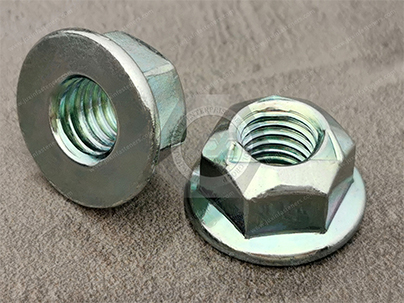 | 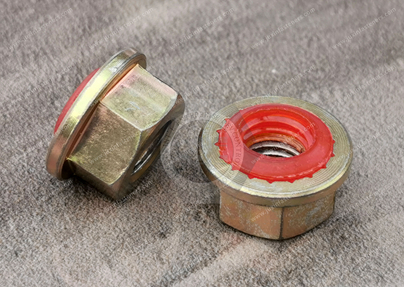 | 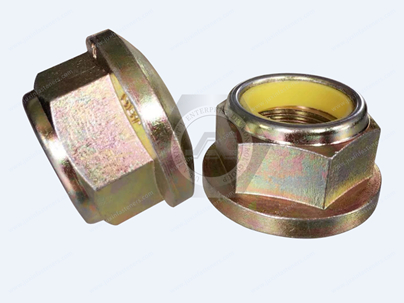 |
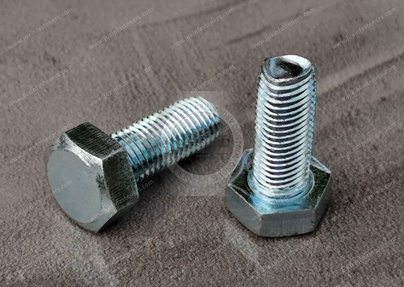
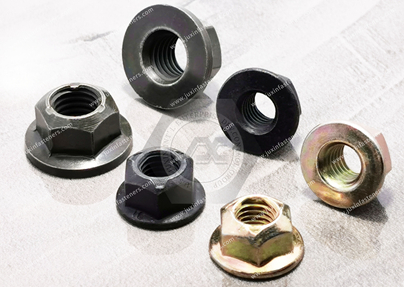
Chassis joints experience continuous micro-slip and dynamic impact forces that drive axial preload decay. To mitigate rotational and non-rotational loosening, modern chassis architectures implement specialized locking features:
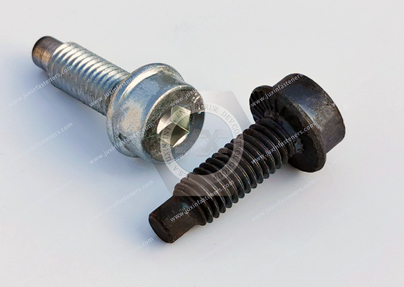
Thread Pre-Coating (DIN 267): Pre-applied micro-encapsulated anaerobic adhesives or dry-film lubricants stabilize friction coefficients during high-speed installation while sealing thread paths against fluid and moisture ingress.
All-Metal Self-Locking Nuts: Utilizing distorted-thread or prevailing-torque collars (such as DIN 980 configurations) to maintain locking torque across multiple service cycles without relying on organic polymer inserts that degrade under high chassis temperatures.
 |  |  |
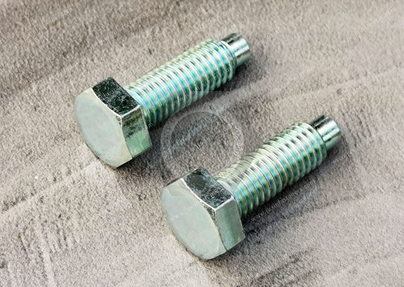
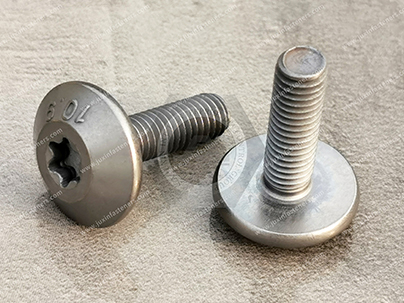
Chassis bolts and nuts are predominantly specified in Property Class 8.8 or 10.9 (with Class 10.9 representing the standard for high-load suspension nodes).
Achieving these performance grades requires precise metallurgical control over carbon equivalents, hardenability, and elongation.
| Fastener Grade | Primary Material Designation | Chemical Composition Profile | Key Application Parameters |
| Property Class 8.8 | 20MnTiB, SCM435, SCM440, 35CrMo | Low-to-medium carbon alloy steels | Used for standard structural brackets; 10B21 viable for sizes $\le$ M8. |
| Property Class 10.9 | SCM435, SCM440, 35CrMo | Chromium-molybdenum alloy steels | High-stress suspension links, control arms, and steering knuckles. (Avoid ML40Cr for sizes $\ge$ M12). |
| Grade 8 & 10 Nuts | 10B21, SWRCH35K, SWRCH45K | Cold-heading carbon steels | Heat treatment governed by thread engagement length (e.g., weld nuts remain unquenched). |
| Chassis Washers | Carbon Steel (20 / 45 Steel) | Stamped cold-rolled plate or heat-treated | Hardness controlled from 200 HV up to 400 HV. |
 |  |  |
To prevent binding or excessive play after post-processing treatments such as cathodic electrodeposition (e.g.,
e-coating/electrophoresis) or heavy zinc-nickel galvanizing, thread pitch diameters must be precision-machined prior to coating.
Manufacturing tolerances follow ISO 965 metric thread standards:
| Part Name / Thread Type | Surface Coating Process | Pre-Treatment Accuracy Grade | Post-Treatment Accuracy Grade |
| External Thread (Bolts) | Electro-Galvanized | 6g | 6h |
| External Thread (Bolts) | Zinc-Aluminum Flake (Geomet/Dacromet) | 6e | 6g (Verified with 6g stop / 6h pass gauges) |
| External Thread (Bolts) | Cathodic Electrophoresis (E-Coat) | 6f | 6g |
| Internal Thread (Nuts) | Zinc-Nickel Alloy (ISO 19598) | 6G | 6H |
| Internal Thread (Nuts) | Thread Locking Adhesive Pre-Coated | 6g (Bolt) | 6H (Mating nut must match 6H tolerance) |
 |  |
Selecting the correct tightening method dictates pre-load dispersion and joint reliability on automotive assembly lines.
Torque Method (Elastic Region): Relies on the linear relationship between tightening torque and axial pre-load within the bolt's elastic zone.
Advantages: Simple operation, inexpensive equipment.
Limitations: High pre-load dispersion ($\pm 30\%$) due to friction coefficient variance, with approximately 90% of input torque consumed overcoming thread and under-head friction.
Torque-Angle Method (Plastic/Elastic Transition): Tightens the fastener to a specified initial torque, then rotates a calibrated angular displacement to stretch the bolt into its controlled yield zone.
Advantages: Direct control of bolt elongation; reduces pre-load scatter to around $\pm 15\%$.
Engineering Requirements: Requires sufficient thread engagement ($\ge 1\times$ bolt diameter, $\ge 6$ active threads), high internal thread shear strength, consistent hole tolerances, and specialized tightening equipment with minimal stick-slip behavior.
 |  |  |
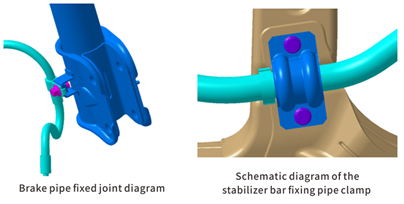
Engineers must account for unique joint geometries and structural interfaces during chassis layout:
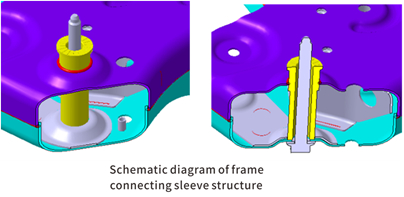
Sleeved Subframe Connections: When fastening sub-frame assemblies across deep upper and lower stamped sheet metal flanges, high-rigidity steel sleeves must be incorporated.
Weld seams around sleeves must be free of spatter to ensure 100% flat bearing contact, and bushings must possess sufficient cross-sectional rigidity to prevent localized crushing.
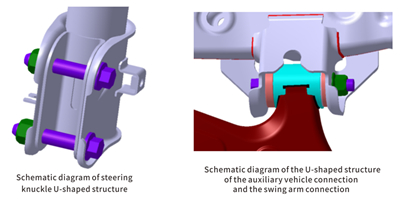
U-Shaped Joint Interfaces: Common in shock absorber-to-steering knuckle or cast subframe-to-control arm connections.
Because stamping springback can cause inconsistent U-opening gaps, designers should prioritize the torque-angle method to overcome assembly gaps, account for e-coating thickness variations on friction coefficients, and monitor tightening curves for premature yield behavior.
Plate-to-Plate Connections: Ensure that sheet metal thickness ($t$) and bolt shoulder distance ($a$) fully comply with clamping thickness envelopes, providing an uninterrupted, flat support face for head-bearing distribution.
Explore our comprehensive engineering library for related fastener solutions:
Juxin Fasteners operates advanced multi-station cold headers, CNC precision turning lathes, and automated optical sorting systems certified to ISO 9001 and IATF 16949 standards.
We partner with global automotive manufacturers and Tier-1 chassis system suppliers to deliver fully traceable, high-performance fastening components.
For technical data sheets, 3D CAD models, PPAP Level 3 documentation, or custom RFQs, contact our engineering sales department:
Official Corporate Website:
Engineering & Sourcing Email: info@juxinfasteners.com
Core Product Capabilities: Chassis High-Strength Bolts (Class 10.9), All-Metal Lock Nuts, Precision Cold-Formed Fasteners, Custom CNC Turned Hardware.
 MORE NEWS
Sep. 25, 2026
Sep. 25, 2026
Sep. 25, 2026
Contact Us
Tel.:
+86 020 8621 0320
+86 020 3121 6067
E-mail:
Technical Support:
Navigation
SEND INQUIREY