
Call Us
+86 136 6007 9809
Call Us
+86 136 6007 9809

Jun. 13, 2024
Automotive Chassis Bolts: Grade 10.9 Fasteners, Joint Design and OEM Sourcing
Automotive chassis assemblies connect structural and mechanical components that experience repeated loading throughout vehicle operation.
Suspension movement, braking, acceleration, road impacts and environmental exposure create demanding conditions for bolted joints.
High-strength automotive fasteners are therefore selected as part of a complete mechanical connection rather than as isolated hardware components.
A property class 10.9 bolt may be appropriate for a particular chassis connection, but its strength classification alone does not establish fatigue performance,
vibration resistance or suitability for a safety-critical application.
Design engineers must consider the load path, joint stiffness, clamping requirements, mating materials and available installation space.
Manufacturing engineers and production managers must control fastener identification, tightening procedures, assembly variation and inspection.
Procurement and supplier-development teams must ensure that automotive bolts, locking nuts and surface treatments conform to approved drawings and customer-specific qualification requirements.
JUXIN FASTENERS supplies high-strength bolts, flange head fasteners, locking nuts and drawing-based threaded components for automotive and industrial OEM applications.
This guide focuses on the selection, design integration and sourcing of automotive chassis bolts, property class 10.9 fasteners, suspension fasteners and EV structural fastening components.
Where Are High-Strength Bolts Used in Automotive Chassis Systems?
Automotive chassis fastening applications may include:
Suspension assemblies
Subframe connections
Control arm mounting points
Steering-related mechanical assemblies
Structural brackets
Powertrain mounting structures
Selected battery enclosure and EV structural connections
The actual fastener specification depends on the vehicle design.
Important Engineering Distinction
Not every chassis connection requires the same property class, head design, thread pitch or locking method.
A suspension pivot connection and a fixed structural bracket connection may have substantially different mechanical requirements.
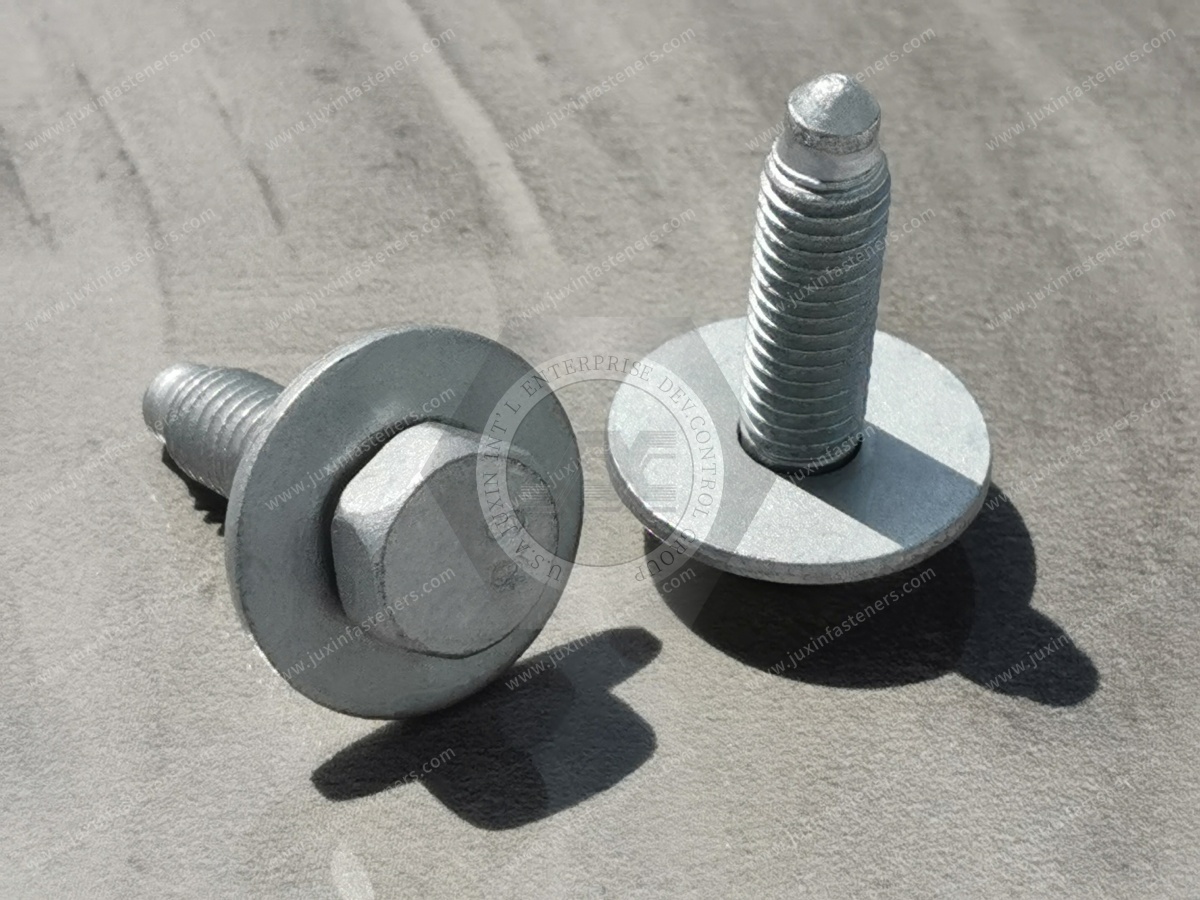
Automotive Chassis Loading Conditions
Chassis joints may experience combinations of:
Static loading
Cyclic loading
Transverse forces
Axial forces
Bending moments
Vibration
Thermal expansion
Environmental corrosion
Engineering Recommendation
Evaluate the actual joint loading and failure modes before selecting a fastener.
ISO Property Classes for Automotive Chassis Bolts
For applicable metric carbon steel and alloy steel fasteners, ISO 898-1 defines mechanical property requirements.
Common property classes include 8.8, 10.9 and 12.9.
| Property class | Nominal tensile strength represented by designation | Selection consideration |
|---|---|---|
| 8.8 | 800 MPa | Suitable for selected engineered structural and mechanical joints |
| 10.9 | 1,000 MPa | Higher-strength applications requiring controlled joint design |
| 12.9 | 1,200 MPa | Specialized applications requiring careful assessment of loading and processing |
These are nominal designation values, not a complete statement of the standard's acceptance criteria.
Important Engineering Principle
A higher property class does not automatically provide better fatigue life, corrosion resistance or vibration performance.
Property Class 8.8 Automotive Bolts
Property class 8.8 fasteners may be specified for selected automotive mechanical and structural connections.
Engineering Considerations
Joint loading
Available bolt diameter
Mating thread strength
Required preload
Environmental exposure
Important Limitation
Property class 8.8 should not automatically replace a specified 10.9 bolt in a safety-critical assembly.
Property Class 10.9 Chassis Bolts
Property class 10.9 bolts are commonly considered for higher-strength mechanical connections.
Potential applications include selected:
Suspension mounting joints
Subframe connections
Structural brackets
Automotive mechanical assemblies
Engineering Considerations
Clamp-load requirements
Joint stiffness
Fatigue loading
Mating component strength
Tightening process
Coating compatibility
Important Limitation
A property class 10.9 bolt does not automatically guarantee resistance to fatigue or loosening.
Property Class 12.9 Automotive Fasteners
Property class 12.9 fasteners may be specified for selected high-strength applications.
However, their use requires consideration of:
Joint geometry
Toughness requirements
Environmental conditions
Manufacturing process
Surface treatment
Hydrogen embrittlement susceptibility
Engineering Recommendation
Do not upgrade an automotive chassis bolt from 10.9 to 12.9 without an approved engineering assessment.
Metric Automotive Bolts vs. SAE Inch-Series Fasteners
Metric automotive bolts may be specified under applicable ISO mechanical and dimensional standards.
Inch-series fasteners may reference SAE J429 and applicable ASME dimensional standards.
Important Compatibility Rule
ISO property classes and SAE grades are not directly interchangeable.
Metric, UNC, UNF, BSW and BSF threads must also be treated as separate thread systems.
Suspension Bolts and Joint Reliability
Suspension connections may experience repeated changes in loading as the vehicle travels over uneven surfaces.
Engineering Considerations
Load direction
Joint movement
Preload
Fatigue
Mating component deformation
Fastener retention
Important Engineering Distinction
Some suspension joints are designed to remain rigidly clamped, while others incorporate controlled movement through bushings or pivot arrangements.
The fastener specification must match the intended joint function.
Control Arm Mounting Bolts
Control arm mounting points may include bushings and other components that influence joint behavior.
Engineering Considerations
Bushing construction
Bolt grip length
Bearing arrangement
Mating bracket geometry
Approved tightening procedure
Important Recommendation
Follow the vehicle or component manufacturer's specified assembly condition.
Subframe Bolts
Subframe connections may transfer mechanical loads between major vehicle structures.
Engineering Considerations
Structural load path
Joint stiffness
Clamp-load retention
Fastener spacing
Mating material
Corrosion protection
Important Limitation
A higher-strength bolt alone cannot compensate for an inadequately designed subframe connection.
Bolt Grip Length and Thread Position
The relationship between unthreaded shank length, clamped component thickness and threaded engagement can affect joint behavior.
Engineering Considerations
Grip length
Thread location
Shear plane
Mating thread
Available clearance
Installation tolerance
Important Engineering Recommendation
Confirm whether the approved drawing requires a partially threaded bolt or a fully threaded screw.
Hexagon Head Bolts for Automotive Chassis
Hexagon head bolts provide external wrenching surfaces.
Relevant metric dimensional standards may include ISO 4014 and ISO 4017, depending on the configuration.
Engineering Considerations
Tool access
Head dimensions
Bearing surface
Grip length
Mechanical property class
Important Procurement Recommendation
Do not substitute a fully threaded screw for a partially threaded bolt solely because the nominal diameter and length match.
Hexagon Flange Bolts
Hexagon flange bolts incorporate an integrated bearing surface.
They may be used in selected automotive chassis and structural assemblies.
Potential Benefits
Integrated bearing area
Reduced separate-part handling in suitable designs
Compatibility with automated assembly
Engineering Considerations
Flange diameter
Bearing pressure
Surface condition
Joint geometry
Approved tightening procedure
Important Limitation
An integrated flange does not automatically eliminate the need for a washer in every design.
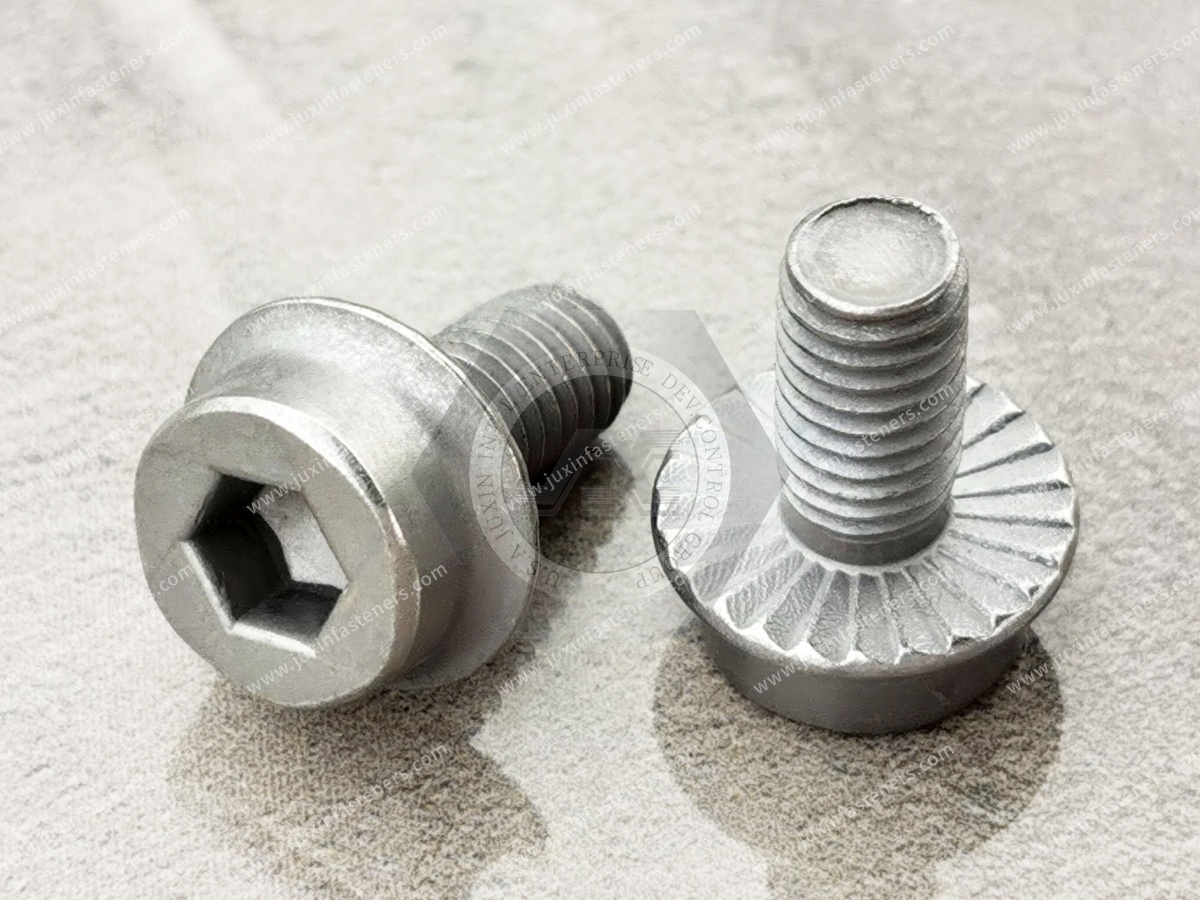
Serrated Flange Bolts and Vibration
Serrated flange bolts have teeth or serrations on the bearing surface.
Their behavior depends on:
Mating material
Surface coating
Bearing pressure
Joint preload
Vibration loading
Important Engineering Distinction
Serrations do not guarantee that a joint will remain secure under all vibration conditions.
They may also damage protective coatings or alter bearing-surface behavior.
Engineering Recommendation
Use serrated flange fasteners only where the approved joint design permits them.
Washer Assembly Bolts
Some automotive fastening arrangements incorporate captive washers or other washer assemblies.
Potential functions include:
Bearing pressure distribution
Assembly handling
Protection of selected mating surfaces
Engineering Considerations
Washer hardness
Washer dimensions
Retention method
Friction characteristics
Joint geometry
Important Limitation
A washer assembly does not automatically provide vibration locking.
Prevailing-Torque Lock Nuts for Automotive Applications
Prevailing-torque nuts provide resistance to rotation through an engineered locking feature.
Potential types include:
Nylon-insert locknuts
All-metal prevailing-torque nuts
Flange locking nuts
Engineering Considerations
Temperature
Thread compatibility
Installation torque
Reuse restrictions
Coating
Joint loading
Important Engineering Principle
Prevailing torque is not the same as bolt preload.
The complete tightening specification must account for the locking feature where applicable.
All-Metal Locking Nuts
All-metal prevailing-torque nuts may be considered for applications where polymer-insert temperature limits or other design requirements make them more appropriate.
Important Limitation
An all-metal locking nut is not automatically suitable for every suspension or chassis joint.
The specific product and approved application must be evaluated.
Nylon-Insert Locknuts
Nylon-insert locknuts may be appropriate for selected automotive and mechanical applications.
Engineering Considerations
Operating temperature
Chemical exposure
Reuse policy
Thread compatibility
Locking performance requirements
Important Limitation
Nylon-insert locknuts should not be assumed suitable for every high-temperature or safety-critical automotive connection.
Why Automotive Chassis Bolts Loosen
Loss of clamp load or joint movement may result from:
Insufficient initial preload
Joint relaxation
Surface settling
Transverse movement
Incorrect fastener
Unsuitable locking arrangement
Assembly variation
Engineering Recommendation
Investigate the complete joint before changing the fastener property class or adding a locking component.
Bolt Preload in Automotive Chassis Joints
Preload is the tensile force introduced into a bolt during tightening.
It creates a corresponding clamping action across the joint.
Important Engineering Principle
Correct preload depends on the approved joint design and assembly process.
Higher tightening torque does not automatically mean a safer connection.
Torque and Friction
Tightening torque is influenced by friction at:
Thread contact surfaces
Bolt-head or nut bearing surfaces
Changes in coating, lubrication or mating material can affect the preload developed at a given torque.
Production Recommendation
Do not reuse a tightening torque after changing the coating or lubrication condition without engineering approval.
Torque-Angle and Other Controlled Tightening Methods
Some automotive applications use torque-angle or other controlled tightening procedures.
Engineering Considerations
Joint stiffness
Fastener behavior
Coating
Friction
Assembly equipment
Service replacement requirements
Important Limitation
Some tightening procedures intentionally produce plastic deformation.
Fasteners used in such procedures may have specific replacement requirements.
Engineering Recommendation
Follow the OEM-approved tightening and reuse instructions.
Fatigue in Automotive Chassis Fasteners
Chassis fasteners may experience repeated loading during vehicle operation.
Relevant fatigue considerations include:
Load amplitude
Mean stress
Preload
Thread geometry
Stress concentration
Joint stiffness
Surface condition
Important Engineering Principle
A higher tensile strength classification does not independently establish superior fatigue performance.
Joint Alignment and Bending
Poor alignment or unsuitable joint geometry may introduce unintended bending loads.
Potential Risks
Uneven bearing pressure
Localized stress
Fatigue damage
Joint distortion
Engineering Recommendation
Review the complete load path and mating geometry before increasing bolt strength.
Corrosion Protection for Automotive Chassis Bolts
Automotive chassis fasteners may be exposed to:
Road salt
Moisture
Temperature cycling
Industrial pollutants
Cleaning chemicals
The required corrosion protection depends on the vehicle environment and OEM specification.
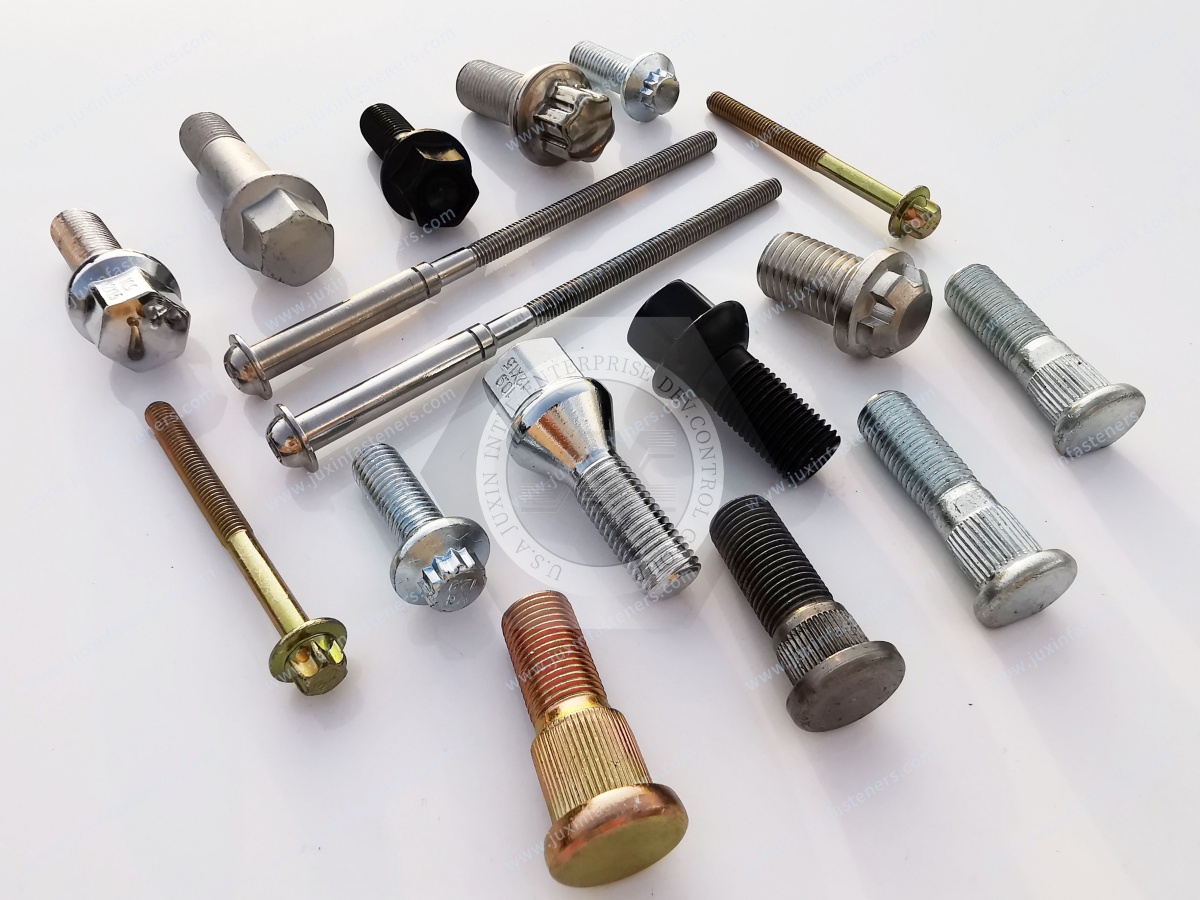
Zinc-Nickel-Coated Automotive Bolts
Zinc-nickel coatings may be specified for selected automotive applications.
Engineering Considerations
Coating specification
Corrosion test requirements
Thread dimensions
Friction characteristics
Hydrogen embrittlement risk
Environmental compliance requirements
Important Limitation
Zinc-nickel plating does not automatically establish RoHS compliance or a particular corrosion-test result.
Zinc-Flake-Coated Chassis Fasteners
Zinc-flake coating systems may be used for selected automotive fasteners.
Engineering Considerations
Coating thickness
Friction control
Corrosion requirements
Installation compatibility
Fastener mechanical properties
Important Limitation
A zinc-flake coating must be evaluated against the customer's actual specification.
Hydrogen Embrittlement Considerations
Certain high-strength steel fasteners may be susceptible to hydrogen embrittlement.
Relevant factors include:
Material strength
Hardness
Processing
Coating method
Hydrogen exposure
Applied stress
Engineering Recommendation
Evaluate the relevant manufacturing and coating controls when specifying high-strength chassis fasteners.
Important Limitation
A post-treatment process or coating designation should not be assumed to eliminate every hydrogen embrittlement risk.
Galvanic Corrosion in EV Chassis Structures
Electric vehicles may incorporate combinations of:
Aluminum structural components
Carbon steel bolts
Stainless steel components
Coated steel brackets
Dissimilar metals can create galvanic corrosion concerns when an electrolyte is present.
Engineering Considerations
Material pairing
Coating continuity
Moisture exposure
Joint design
Maintenance conditions
Engineering Recommendation
Evaluate corrosion protection at the complete joint level.
Steel Bolts in Aluminum Chassis Components
Steel bolts may be used in selected aluminum structures when the connection is properly engineered.
Engineering Considerations
Thread strength
Bearing pressure
Differential thermal expansion
Galvanic corrosion
Preload retention
Important Engineering Distinction
Increasing bolt strength does not automatically improve the strength of the aluminum mating component.
EV Battery Pack Mounting Fasteners
Battery enclosure and mounting structures may use threaded fasteners for mechanical attachment.
Engineering Considerations
Structural loads
Vibration
Corrosion
Thermal expansion
Service access
Approved sealing arrangement
Important Limitation
Mechanical fastener suitability does not independently establish battery safety or electrical protection compliance.
Commercial Vehicle Chassis Fasteners
Trucks, buses and industrial vehicles may have different structural and maintenance requirements from passenger vehicles.
Engineering Considerations
Higher service loads in particular applications
Joint geometry
Corrosion
Maintenance access
Approved fastening specifications
Important Recommendation
Do not transfer a passenger-car bolt specification to a commercial-vehicle application without engineering verification.
Heavy Hex Bolts vs. Automotive Chassis Bolts
Heavy hex bolts are commonly associated with particular structural and industrial fastening standards.
Their head geometry and intended applications may differ from automotive chassis fasteners.
Important Engineering Distinction
A heavy hex bolt should not automatically replace an automotive chassis bolt.
The complete dimensional, mechanical and application requirements must be verified.
Automotive Fastener Inspection and Traceability
For OEM purchasing, the required inspection plan should be established by the customer specification.
Potential requirements include:
Material verification
Mechanical property testing
Thread inspection
Dimensional inspection
Coating inspection
Batch identification
Production records
Important Procurement Principle
The required documentation must be confirmed during supplier qualification.
Do not assume that every supplied bolt includes an identical certification package.
Manufacturing Process Control
Production managers should consider:
Correct fastener part number
Material and property class identification
Tooling compatibility
Tightening program
Coating and lubrication condition
Inspection criteria
Rework procedures
Important Production Principle
Repeatable assembly requires control of the complete fastening process, not merely selection of a high-strength bolt.
Common Automotive Chassis Fastener Problems
| Problem | Potential contributing factor | Engineering response |
|---|---|---|
| Bolt loosening | Loss of preload or joint movement | Review joint design and retention |
| Fatigue cracking | Cyclic loading or stress concentration | Evaluate load path and joint stiffness |
| Thread stripping | Inadequate mating thread strength | Review thread engagement and material |
| Corrosion | Unsuitable coating or material pairing | Evaluate exposure and galvanic compatibility |
| Bolt fracture during tightening | Excessive preload or incorrect procedure | Verify tightening and friction requirements |
| Delayed cracking | Susceptible high-strength steel and hydrogen exposure | Review material and process controls |
| Assembly variation | Tooling or friction inconsistency | Improve production process validation |
| Incorrect replacement | Incomplete part specification | Apply OEM part-number and change control |
Automotive OEM and Tier-1/Tier-2 Supplier Requirements
Automotive manufacturers and suppliers may establish customer-specific requirements for:
Material
Mechanical properties
Dimensional conformity
Coating
Inspection
Traceability
Production approval
Change control
Important Qualification Distinction
A fastener meeting ISO dimensional or mechanical property requirements is not automatically approved for every automotive OEM program.
Customer-specific qualification requirements must be reviewed separately.
Drawing-Based Automotive Fastener Development
Custom chassis fasteners may require:
Special head geometry
Defined grip length
Specific thread length
Controlled bearing surface
Specified coating
Customer-specific mechanical properties
Engineering Recommendation
Use the approved 2D drawing and related specifications as the basis for supplier evaluation.
Second-Source Qualification
Supplier-development teams may seek alternative manufacturers for:
Supply continuity
Capacity planning
Cost management
Lead-time improvement
Regional sourcing diversification
Technical Evaluation
Drawing conformity
Mechanical property class
Material
Thread dimensions
Coating
Friction requirements
Inspection documentation
Production Evaluation
Assembly compatibility
Packaging
Part identification
Change control
Sample approval
Important Procurement Principle
A lower-priced bolt is not automatically a lower-cost solution if it requires assembly revalidation or introduces production risk.
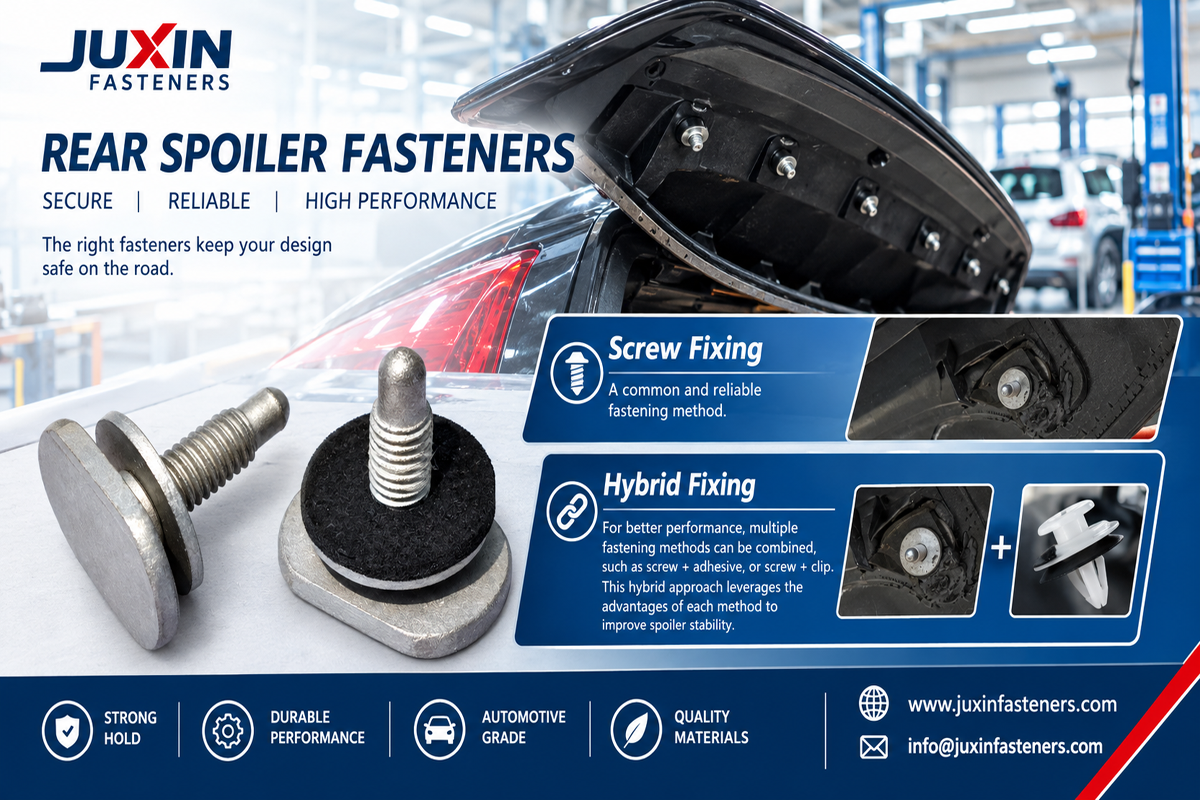
Automotive Chassis Fastener RFQ Checklist
For an efficient quotation, provide:
Approved 2D drawing
Fastener application
Thread system and pitch
Head geometry
Overall length
Grip length
Material
Property class
Surface treatment
Friction requirements
Inspection requirements
Annual purchasing volume
Delivery schedule
For safety-critical applications, include the applicable OEM qualification and production approval requirements.
Frequently Asked Questions
What grade bolts are used in automotive chassis systems?
Depending on the approved design, automotive chassis applications may use property classes such as 8.8, 10.9 or other specified fasteners.
Are property class 10.9 bolts suitable for suspension systems?
They may be suitable for selected suspension applications, but the complete joint design and OEM specification determine suitability.
Are 12.9 bolts better than 10.9 bolts for chassis applications?
Not automatically. Higher strength does not guarantee improved fatigue, corrosion or vibration performance.
Do flange bolts prevent loosening?
Not automatically. The complete joint and retention arrangement determine performance.
Can serrated flange bolts be used in aluminum chassis structures?
Only after evaluating bearing-surface effects, coating damage, corrosion and the approved joint design.
Are zinc-nickel-coated bolts suitable for EV chassis applications?
They may be considered where the specified coating meets the application's requirements.
Can SAE Grade 8 bolts replace ISO property class 10.9 bolts?
Not automatically. They are governed by different standards and may have different dimensions and mechanical requirements.
Can automotive chassis bolts be reused?
Reuse depends on the approved fastener design, tightening method and OEM service instructions.
Do high-strength bolts always require special anti-loosening nuts?
No. The locking method depends on the joint design and loading conditions.
What should an automotive OEM include in a chassis bolt RFQ?
Provide approved drawings, property class, material, coating, friction requirements, inspection specifications, quantity and delivery schedule.
JUXIN FASTENERS: Automotive Chassis Bolts and OEM Fastening Components
JUXIN FASTENERS supplies industrial high-strength fasteners and drawing-based threaded components for automotive and mechanical equipment applications.
Relevant product families include:
Property class 8.8 bolts
Property class 10.9 bolts
Property class 12.9 screws
Hexagon head bolts
Hexagon flange bolts
Automotive locking nuts
All-metal prevailing-torque nuts
Nylon-insert locknuts
Custom threaded components
Specific product suitability, coating requirements, documentation and OEM qualification conditions are reviewed against customer drawings and purchasing specifications.
JUXIN FASTENERS can discuss sample requirements, component feasibility and quotation details for suitable OEM projects.
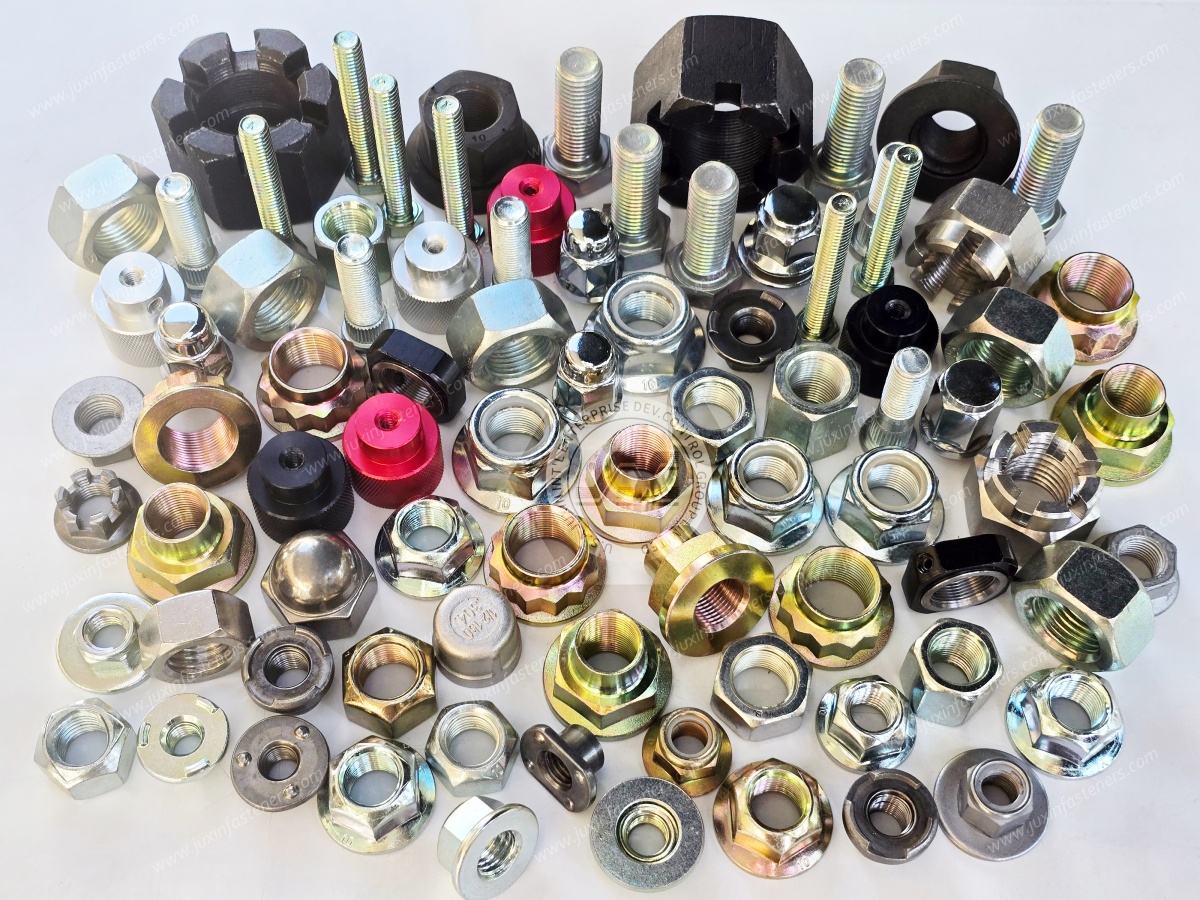
Request an Automotive Chassis Fastener OEM RFQ
Are you sourcing property class 10.9 chassis bolts, suspension fasteners, flange head bolts or custom automotive threaded components?
JUXIN FASTENERS welcomes inquiries from automotive OEMs, Tier-1 and Tier-2 suppliers, structural and mechanical design engineers,
manufacturing engineers, production managers and global procurement teams.
For an efficient technical and commercial review, provide:
Approved drawing + application + thread specification + property class + material + coating + friction requirements + inspection requirements + annual volume + delivery schedule
For safety-critical chassis connections, include the OEM's approved component specification and qualification requirements.
Company: JUXIN FASTENERS
Website: https://www.juxinfasteners.com/
Email: info@juxinfasteners.com
Send your automotive chassis bolt drawings and OEM RFQ requirements to JUXIN FASTENERS for technical review and quotation.
Contact Us
Tel.:
+86 020 8621 0320
+86 020 3121 6067
E-mail:
Technical Support:
Navigation
SEND INQUIREY



