
Call Us
+86 136 6007 9809
Call Us
+86 136 6007 9809

Nov. 12, 2024
Automotive Metric No-Slip Clip-On Barrel Nuts: Sheet Metal Retention, Assembly Design and OEM Supply
Automotive manufacturers frequently need reliable threaded attachment points on sheet metal panels,
flanges and brackets without adding a separate welding operation or requiring access to the reverse side during final assembly.
Automotive metric no-slip clip-on barrel nuts provide one possible solution.
These fastening components combine a threaded barrel or nut feature with a spring clip that grips a compatible panel edge or mounting feature.
They are used where the assembly design benefits from rapid installation, a retained threaded component and the ability to attach or remove a mating screw or bolt.
At Juxin Fasteners, we supply automotive clip-on nuts and drawing-specific sheet metal fastening components for suitable OEM and industrial applications.
Product selection depends on the panel geometry, thread specification, material, surface treatment, installation process and required retention performance.
For mechanical and design engineers, the most important questions concern panel fit, thread alignment, loading and service conditions.
Manufacturing engineers and production managers must also consider installation force, feeding orientation, access, coating variation and production repeatability.
Purchasing and supplier development teams need to confirm that a proposed replacement fastener performs correctly in the actual assembly.
What Is a Metric No-Slip Clip-On Barrel Nut?
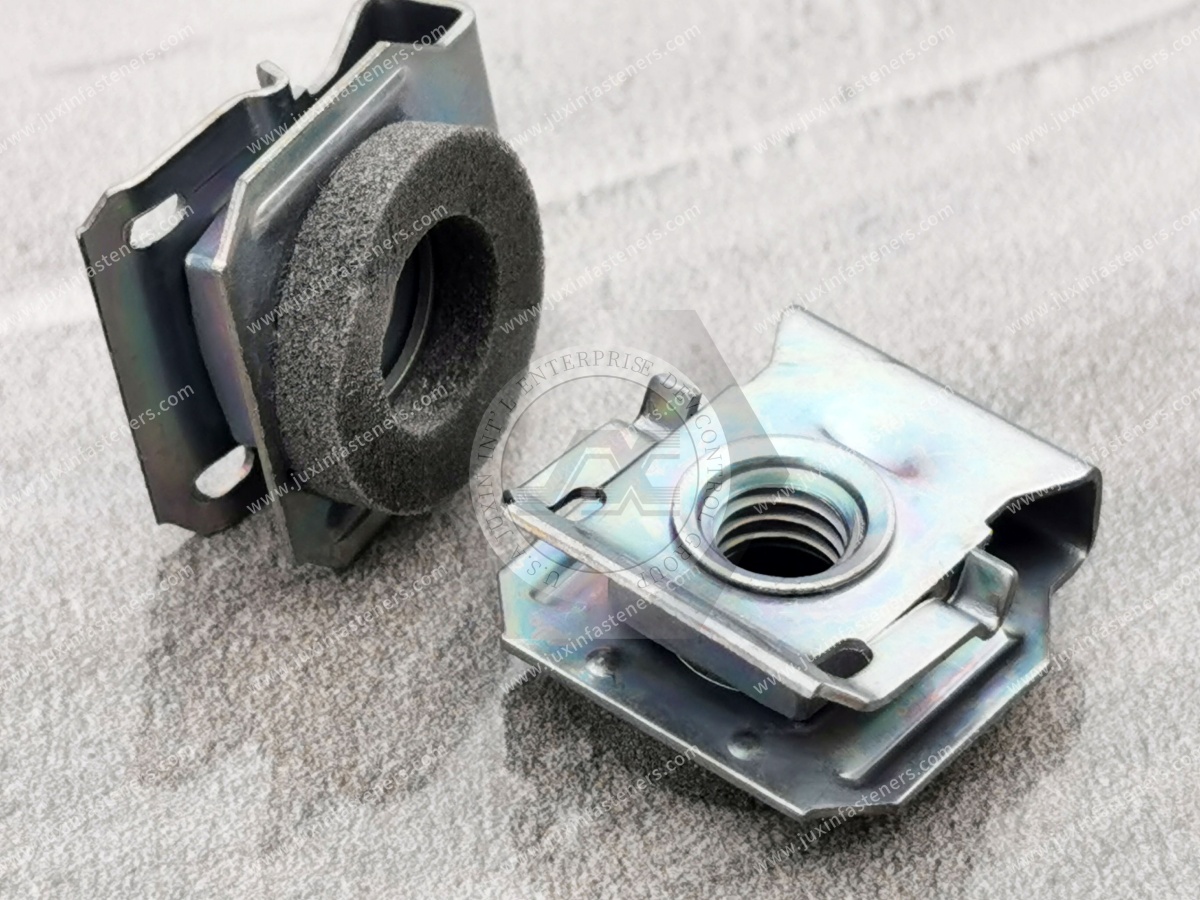
A clip-on barrel nut is a threaded fastening component with an integrated spring clip or retaining feature. It is designed to engage a specified panel edge, flange or mounting location.
The spring portion helps retain the fastener before and during assembly. The threaded barrel receives a compatible mating bolt or screw.
Depending on the design, the fastener may also include anti-rotation features, locating geometry or a low-profile configuration.
The term “no-slip” generally describes an intended retention or positioning function. It should not be treated as a universal mechanical performance rating.
Clip-On Barrel Nuts, U-Nuts and Panel Nuts: Are They the Same?
These terms overlap in industrial purchasing searches, but they are not always interchangeable.
Clip-on barrel nut: Usually refers to a clip-style fastener incorporating a threaded barrel or nut feature.
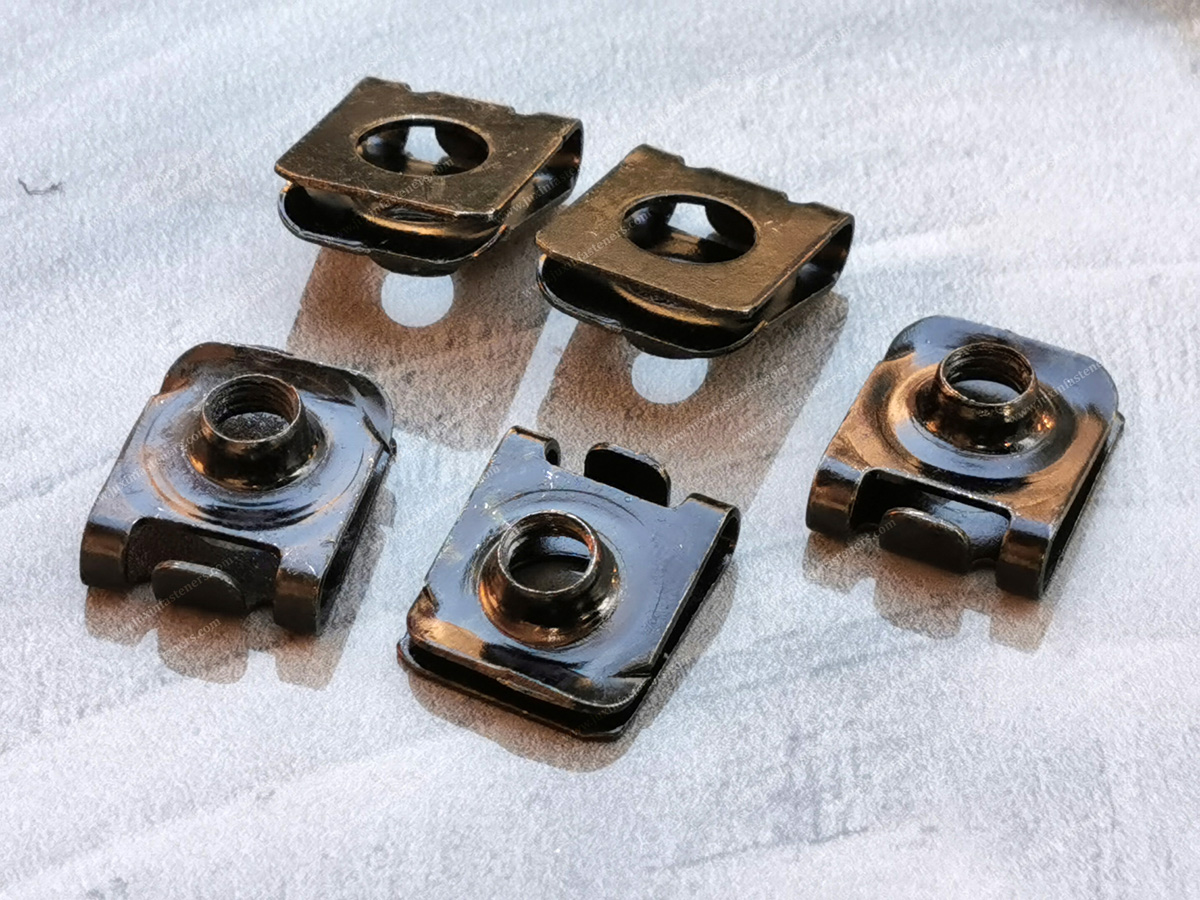
U-nut or U-clip nut: Often describes a U-shaped spring clip that grips a panel edge and provides a threaded or screw-engaging feature.
Panel nut or retainer nut: Broader terms that may include several different fastening geometries.
Speed nut or clip nut for tapping screws: May use a formed thread-engaging feature rather than a conventional internally threaded barrel.
Engineering Recommendation
Identify the fastener by its drawing, geometry, mating screw and panel requirements rather than relying only on a commercial name.
Three Different Retention Functions
A clip-on nut assembly involves three distinct mechanical functions.
| Function | What it controls | Typical evaluation |
|---|---|---|
| Clip retention | Whether the fastener remains attached to the panel before and during assembly | Installation and removal force |
| Nut anti-rotation | Whether the threaded feature rotates or shifts during tightening | Torque and positional checks |
| Bolted-joint anti-loosening | Whether the assembled bolt retains adequate clamp load under service conditions | Joint-specific vibration and preload validation |
A strong spring clip does not automatically make the complete bolted joint vibration-proof.
Likewise, a clip that resists removal from the panel may still permit some movement of the threaded feature if the design includes clearance for alignment.
Why Automotive Manufacturers Consider Clip-On Nuts
Clip-on barrel nuts can simplify certain sheet metal fastening operations by providing a retained threaded attachment point without welding.
Potential advantages include:
Push-on or slide-on installation in compatible geometries
Reduced handling of separate loose nuts
No welding heat during clip installation
Potential compatibility with prefinished or painted panels
Access to threaded fastening points near panel edges
Easier removal and replacement of selected service components
These advantages depend on the actual product and assembly design. A clip-on nut is not necessarily the lowest-cost or strongest option for every joint.
Panel Thickness and Grip Range
The clip must fit the specified panel thickness while maintaining sufficient spring engagement.
If the panel is too thin for the selected clip, the fastener may fit loosely, shift during bolt installation or detach during handling.
If the panel is too thick, excessive spring deflection may make installation difficult, damage the coating or permanently deform the clip.
Design Inputs
Nominal panel thickness
Minimum and maximum thickness tolerances
Paint or coating thickness
Panel material and hardness
Edge geometry
Required insertion and retention forces
Engineering Recommendation
Specify the complete panel thickness range, including the coating condition at the time of clip installation. Do not select a clip solely by nominal sheet gauge.
Panel Edge, Flange and Hole Geometry
Clip-on barrel nuts may be designed to grip a straight sheet edge, formed flange or other specified feature.
Some configurations align with a clearance hole, while others use a locating opening or formed panel feature.
Critical dimensions may include the distance from the panel edge to the bolt-hole center, flange width, edge radius, hole diameter and available installation travel.
A fastener that fits the sheet thickness may still be unsuitable if its threaded barrel does not align with the mounting hole.
Engineering Recommendation
Review the fastener drawing and panel drawing together. For automated assembly, evaluate the combined tolerance stack-up rather than checking each part independently.
Thread Alignment and Bolt Engagement
Correct thread alignment is essential for repeatable assembly.
Misalignment may cause cross-threading, elevated installation torque, incomplete seating or damage to the clip.
The designer should confirm the relationship between the barrel axis, panel hole, mating bolt and component being secured.
Important Considerations
Thread designation and tolerance
Bolt entry angle
Available lead-in
Required thread engagement
Bolt length
Clearance for the barrel
Expected component movement during assembly
A floating or clearance-providing nut feature may help accommodate limited assembly variation, but the permitted movement must be confirmed for the specific design.
Metric Thread Selection
Common automotive metric fastening requirements may include M3, M4, M5, M6 and M8, depending on the product configuration.
Actual sizes must be confirmed against the supplied fastener drawing. The presence of a nominal thread size does not establish that every clip design is available in that size.
Metric threads should be specified using the appropriate ISO metric thread designation and pitch.
UNC and UNF inch-thread systems are separate. They cannot be treated as direct substitutes for metric threads, even where nominal dimensions appear similar.
Clip Spring Material and Retention Performance
The spring portion must provide sufficient elastic recovery for the intended installation and service conditions.
Performance depends on the material grade, heat treatment or forming condition, geometry, surface finish and operating temperature.
Potential failure mechanisms include permanent deformation, fatigue cracking, loss of spring force and corrosion-related damage.
Engineering Recommendation
Where clips will be removed and reinstalled during maintenance, define the expected service cycle and evaluate retention after representative handling.
Reusability should not be assumed without testing.
Carbon Steel and Stainless Steel Clip-On Nuts
Material selection affects mechanical behavior, corrosion resistance, forming characteristics and cost.
| Material family | Potential advantage | Main design consideration |
|---|---|---|
| Carbon steel or spring steel | Suitable strength and spring characteristics for many designs | Grade, heat treatment, coating and corrosion exposure |
| Stainless steel | Corrosion resistance in selected environments | Exact grade, spring properties, forming behavior and cost |
| Mixed-material assembly | Allows different functions for clip and threaded feature | Compatibility, corrosion and joint construction |
Important Distinction
Not every stainless steel grade provides the same spring characteristics, and not every clip-on nut is manufactured from a single material.
Material and construction should be confirmed on the drawing or product specification.
Surface Coatings and Corrosion Protection
Potential finishes for suitable steel components may include zinc plating, zinc-nickel coating or other specified protective systems.
Selection depends on the operating environment, material compatibility, appearance requirements and installation process.
Coating thickness can affect clip fit, while friction and coating damage during installation may influence retention and corrosion behavior.
Black oxide should not be treated as equivalent to a high-performance corrosion-resistant coating.
Engineering Recommendation
Specify the required corrosion performance and evaluate the installed assembly, including exposed edges, contact areas and any damage created during installation.
Clip-On Nuts on Aluminum Panels
Aluminum panels are common in lightweight automotive and industrial equipment.
A steel clip-on nut installed on aluminum may create dissimilar-metal corrosion concerns when moisture or another electrolyte is present.
The clip may also mark or deform softer panel surfaces.
Engineering Recommendation
Review panel hardness, clip contact pressure, coating protection and galvanic compatibility.
A fastener that performs well on steel sheet should not automatically be approved for aluminum without evaluation.
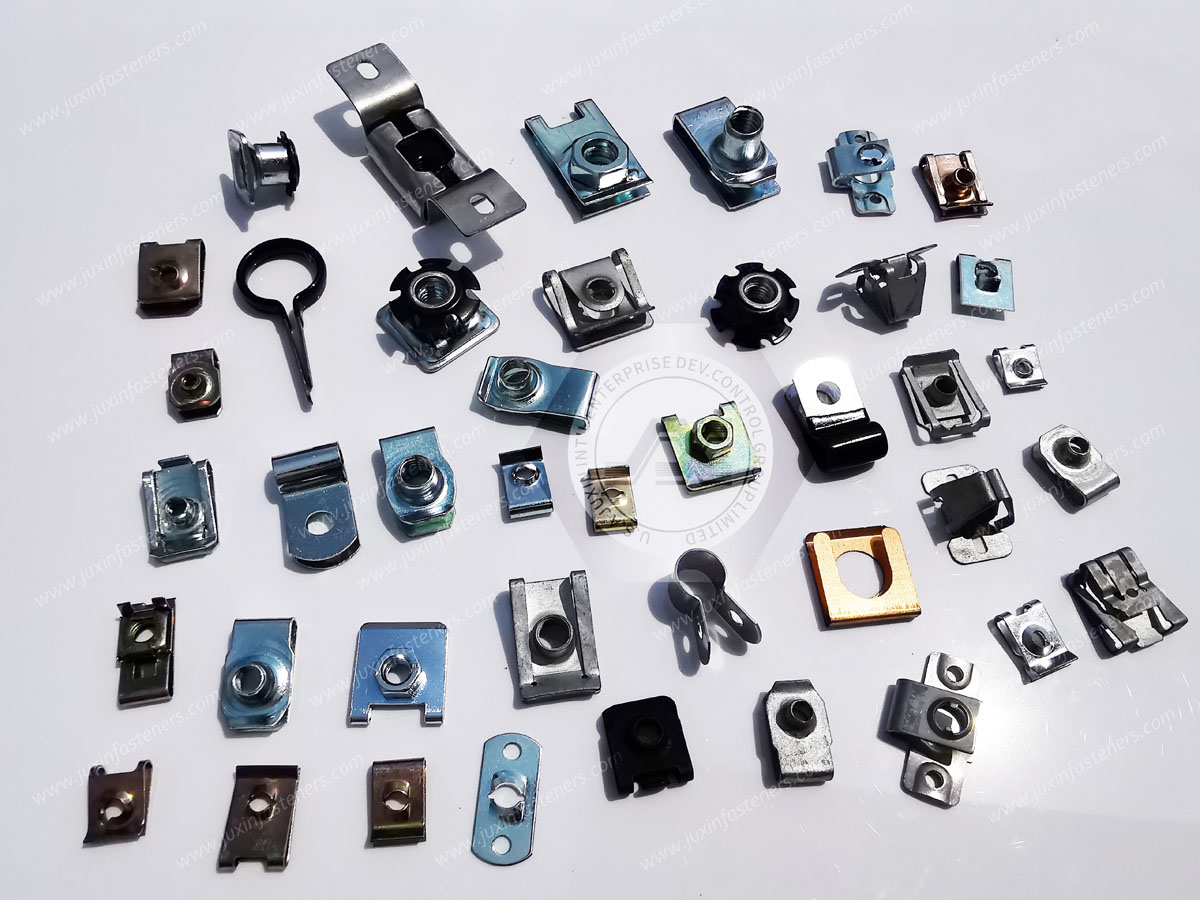
Types of Automotive Clip-On Nut Designs
Juxin Fasteners' source product range includes several related configurations. The exact construction and availability of each design should be confirmed for the project.
Metric No-Slip Clip-On Barrel Nuts
These products combine a metric threaded feature with a spring clip intended to retain the nut on a compatible panel or flange.
Typical selection factors include thread size, clip opening, panel thickness, hole alignment and assembly torque.
No-Slip Clip-On Nuts
This broader category emphasizes retention or positioning features intended to reduce movement during assembly.
Performance should be evaluated using the actual panel and mounting geometry.
Low-Profile Clip-On Nuts
Low-profile configurations may be useful where the assembly has limited clearance behind or around a panel.
The reduced package height must still provide sufficient bolt engagement and acceptable retention.
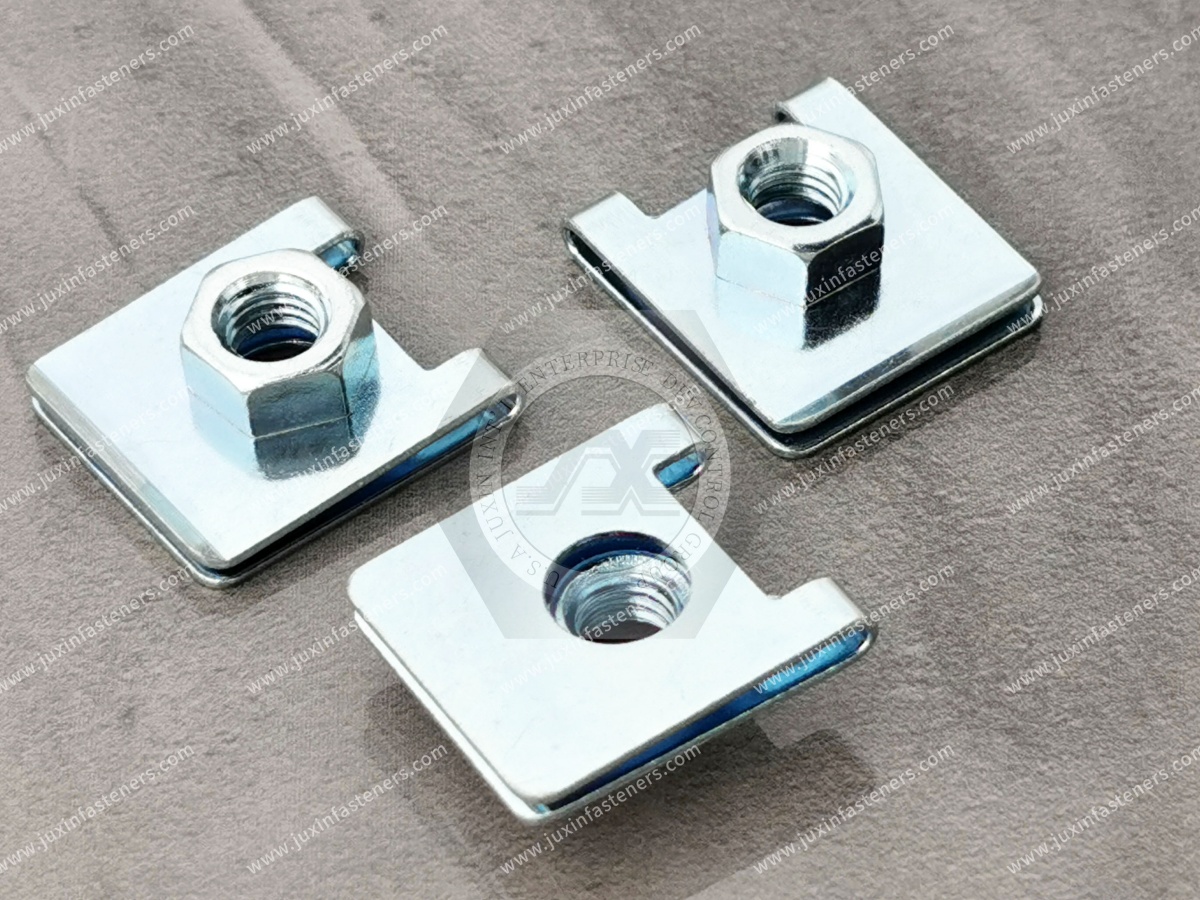
Enclosed-Hex Clip-On Nuts
Some clip assemblies retain a hexagonal nut within a formed metal housing or clip structure.
Engineers should confirm the nut's permitted movement, anti-rotation mechanism and assembly clearance.
Clip-On Nuts for Tapping Screws
These products may be designed to engage tapping screws rather than conventional machine screws.
A clip nut for a tapping screw is not automatically interchangeable with an internally threaded barrel nut.
Clip-On Nuts for Flanged Edges
Flanged-edge designs are intended for specific panel or bracket profiles.
Correct edge geometry, flange thickness and installation direction are essential.
Selection Recommendation
Compare the exact fastening geometry and function, not just the commercial category name.
Automotive Body Panels and Brackets
Clip-on barrel nuts may be considered for suitable vehicle body panels, access covers, protective shields, brackets and other noncritical attachments.
They can be useful where a removable bolted connection is required but welding a nut to the panel would add an undesirable operation.
Designers must still evaluate joint loading, corrosion exposure, available installation space and maintenance access.
Important Limitation
A clip-on nut should not be assumed suitable for crash-critical, occupant-restraint or primary structural connections without the required engineering qualification.
Automotive Interior Assemblies
Vehicle interiors often require compact fastening solutions for covers, trim-related brackets and equipment mounting points.
Important considerations include installation accessibility, appearance, squeak-and-rattle performance, thread alignment and service removal.
A spring clip can retain the fastener during assembly, but noise prevention depends on the complete joint and component support.
Electric Vehicle Equipment and Enclosures
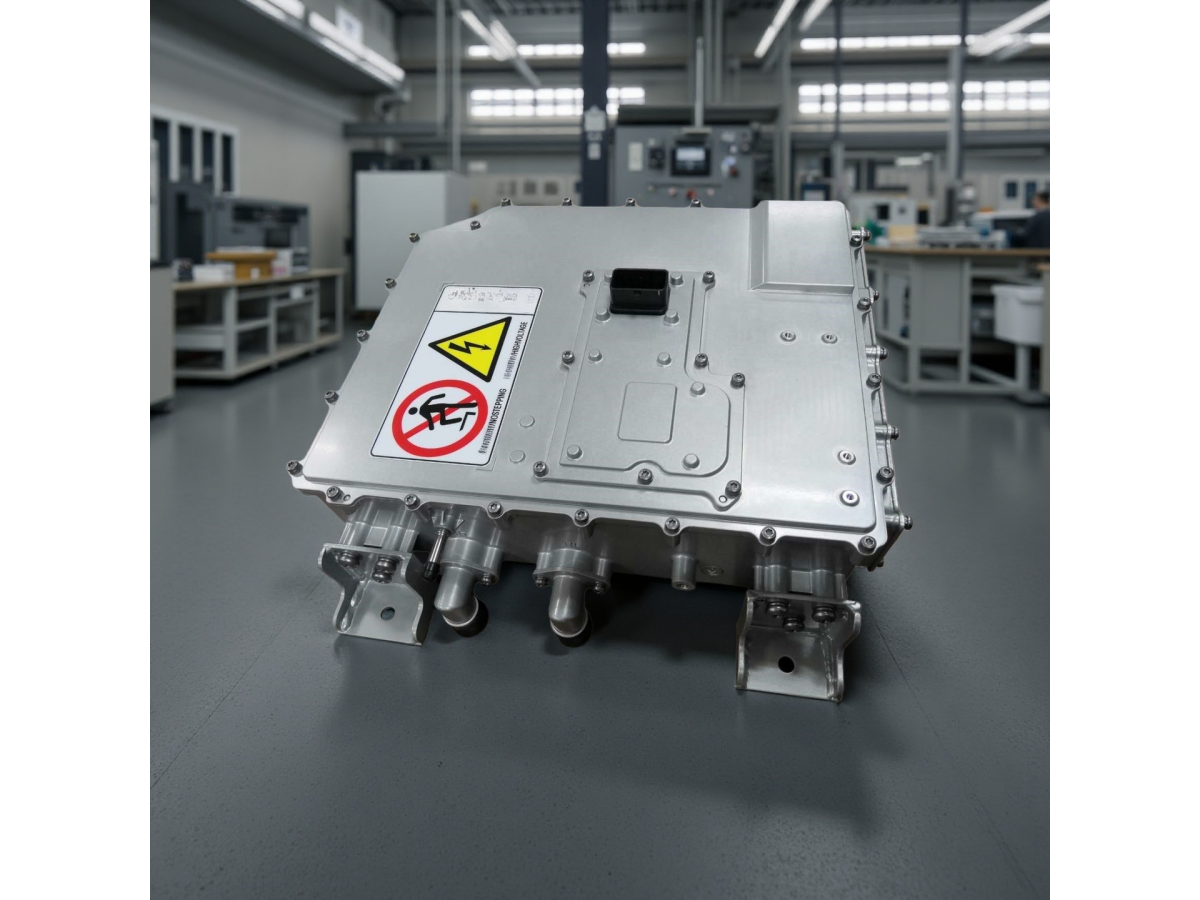
Clip-on nuts may be considered for selected EV auxiliary covers, electrical equipment housings and service-access panels.
They can offer an alternative to welded nuts where the geometry and mechanical requirements are compatible.
Important Limitation
A clip-on nut does not provide an environmental seal or electrical insulation by itself. High-voltage systems,
battery enclosure sealing interfaces and safety-critical connections require dedicated validation.
Electrical Cabinets and Industrial Control Equipment
Thin-wall cabinets, access panels and control equipment housings may benefit from clip-on threaded attachments.
Key requirements include panel thickness, electrical clearances, coating compatibility, serviceability and corrosion protection.
For grounding or protective-earth connections, the complete electrical bonding path must be separately evaluated.
Industrial Machinery and Equipment Guards
Potential applications include removable machine covers, protective guards, access doors and auxiliary equipment panels.
The design should account for vibration, repeated maintenance, operating temperature and exposure to oils or cleaning chemicals.
Important Limitation
Equipment guards and safety-related components may have specific retention requirements.
Clip-on fasteners must be assessed within the complete safety design.
Does a Clip-On Barrel Nut Prevent Vibration Loosening?
Not automatically.
A clip-on nut can remain attached to the panel while the mating bolt loses preload. Conversely,
a well-designed bolted joint may resist loosening even when the clip is primarily intended for assembly retention.
Under transverse vibration, joint movement can contribute to rotational self-loosening when the clamped parts slip relative to each other.
Engineering Recommendation
Evaluate bolt preload, joint stiffness, mating-surface conditions and any required locking feature. Do not rely solely on the spring clip to prevent bolt self-loosening.

Tightening Torque and Threaded Joint Performance
The permissible assembly torque depends on the mating bolt, threaded feature, clip construction, panel and overall joint design.
Excessive tightening torque may deform the clip, rotate the retained nut, damage the panel or strip the thread.
Insufficient tightening may leave inadequate clamp load.
Engineering Recommendation
Establish the assembly specification using the complete joint and verify that the clip-on nut remains correctly positioned during tightening.
Installation Force and Retention Force
Installation force describes the effort required to fit the clip onto the panel.
Retention or removal force describes the resistance to the clip being displaced or removed under specified conditions.
These values are related but not identical.
A clip with very high insertion force may slow production or damage coatings, while a clip with insufficient retention may fall off during handling.
Production Recommendation
Specify an acceptable functional range where installation and retention forces are critical to automated or manual assembly.
Manual and Automated Assembly
Clip-on barrel nuts can be installed manually or through suitable mechanized processes.
For production managers, the important question is whether the fastener can be fed, oriented and installed consistently.
Production Considerations
Part feeding and orientation
Clip opening consistency
Panel edge accessibility
Installation direction
Insertion force
Coating variation
Thread alignment
Tool wear
Inspection and rework
Engineering Recommendation
Evaluate the fastener using actual production panels and assembly equipment before releasing it for volume manufacturing.
Common Clip-On Nut Failure Modes
| Failure mode | Possible cause | Recommended investigation |
|---|---|---|
| Clip falls off during handling | Inadequate grip or incorrect panel thickness | Review clip opening, spring condition and panel tolerances |
| Difficult installation | Excessive interference or incorrect edge geometry | Check panel thickness, coating and insertion direction |
| Nut shifts during tightening | Insufficient locating control | Review hole alignment and anti-rotation geometry |
| Cross-threading | Barrel misalignment or incorrect bolt entry | Check thread position, bolt lead-in and assembly tooling |
| Clip permanently deforms | Excessive installation deflection | Review material, geometry and grip range |
| Bolt loosens in service | Inadequate preload or joint movement | Evaluate the complete bolted joint |
| Corrosion at clip contact area | Coating damage or dissimilar metals | Review coating, material pairing and environment |
| Rattle or noise | Insufficient component restraint | Review joint preload, clearances and vibration behavior |
The correct corrective action depends on the root cause. Increasing clip spring force is not a universal solution.
Clip-On Barrel Nuts Versus Weld Nuts and Rivet Nuts
Each fastening method has different manufacturing implications.
| Fastener type | Installation principle | Typical design advantage | Main limitation |
|---|---|---|---|
| Clip-on barrel nut | Spring clip engages a panel edge or feature | Removable retained threaded attachment without welding | Requires compatible edge geometry and retention |
| Weld nut | Nut welded to a compatible substrate | Permanent threaded attachment | Requires welding process and qualification |
| Blind rivet nut | Insert mechanically deformed in a prepared hole | Internal thread with one-sided installation | Requires suitable hole, grip range and setting process |
| Conventional nut and bolt | Separate threaded components | Broad configuration flexibility | May require reverse-side access or nut handling |
Engineering Recommendation
Choose the attachment method based on geometry, required loads, assembly sequence, serviceability and total installed cost.
OEM Custom Clip-On Barrel Nuts
Juxin Fasteners welcomes inquiries for standard and drawing-specific clip-on nuts.
Potential requirements include custom spring clip geometry, metric thread dimensions, low-profile construction, enclosed nut features, material selection, surface treatment and packaging.
Feasibility depends on the actual drawing, production requirements and commercial conditions.
Supplier Qualification and Alternative Part Validation
Purchasing specialists, procurement managers and supplier development teams should confirm more than the nominal thread size when qualifying a new clip-on nut supplier.
Key Review Items
Drawing and revision
Thread designation
Panel thickness range
Edge and hole geometry
Clip material and construction
Surface finish
Insertion and retention requirements
Thread alignment
Tightening torque compatibility
Corrosion requirements
Inspection and sample approval
Annual demand
MOQ and lead time
Packaging and change control
Why Same-Size Clip Nuts May Not Be Interchangeable
Two clip-on nuts with the same metric thread can differ in spring opening, barrel position, clip length, flange geometry and retention force.
These differences may cause assembly problems even when the mating bolt fits both products.
Engineering Recommendation
Validate an alternative part on the actual panel and assembly line before approving substitution.
Total Installed Cost for Production Managers
The lowest fastener unit price does not necessarily provide the lowest assembly cost.
A practical cost comparison should consider part feeding, installation time, panel preparation, scrap, rework, coating damage, inspection and service access.
For high-volume programs, consistent clip geometry and predictable installation behavior may be as important as the purchase price.
Quality Inspection for Clip-On Barrel Nuts
Inspection requirements should reflect the product drawing and application.
Potential checks include:
Thread dimensions and functional gauging
Clip opening and overall dimensions
Barrel position
Material and coating specification
Visual defects
Installation fit on representative panels
Retention or removal force where specified
Torque-related functional checks where specified
No single test establishes suitability for every automotive application. Acceptance criteria should be agreed before production.
Frequently Asked Questions
What is an automotive metric no-slip clip-on barrel nut?
It is a clip-style threaded fastener intended to attach to a compatible panel or flange and provide a retained metric threaded connection.
Is a clip-on barrel nut the same as a U-nut?
The terms may overlap, but the exact geometries and thread-engaging features can differ. Check the drawing before substitution.
Do clip-on barrel nuts prevent bolts from loosening under vibration?
Not automatically. Clip retention and bolted-joint resistance to self-loosening are different functions.
Can clip-on nuts be installed without welding?
Yes, suitable clip-on designs are installed mechanically. Panel preparation and access requirements still depend on the product.
Can clip-on nuts be used on aluminum panels?
Potentially, but panel hardness, grip, coating damage and galvanic corrosion must be evaluated.
Can clip-on barrel nuts be reused?
Some designs may tolerate removal and reinstallation, but reuse must be evaluated against the intended service conditions.
Can a metric clip-on nut replace an inch-thread nut?
Not without confirming the exact thread system and mating components. Metric and UNC/UNF threads are not directly interchangeable.
What information is needed for an OEM clip-on nut quotation?
The product drawing, thread specification, panel geometry, material, coating, functional requirements, quantity and delivery needs should be provided.
Juxin Fasteners: Automotive Clip-On Barrel Nuts and OEM Supply
Juxin Fasteners supplies industrial fastening components and welcomes drawing-specific inquiries for automotive metric clip-on barrel nuts and related sheet metal retention products.
Relevant product categories include:
Metric no-slip clip-on barrel nuts
Automotive clip-on nuts
Spring clip nuts
Low-profile clip-on nuts
Enclosed-hex clip-on nuts
Clip-on nuts for tapping screws
Flanged-edge clip-on nuts
Custom OEM panel fasteners
Exact sizes, materials, finishes, manufacturing feasibility, inspection documentation, MOQ and lead times require technical and commercial confirmation.
Request a Quote for Automotive Metric Clip-On Barrel Nuts
Are you sourcing automotive metric no-slip clip-on barrel nuts, spring clip nuts, sheet metal retainer nuts or custom clip-on fastening components?
Juxin Fasteners welcomes inquiries from mechanical engineers, design engineers, manufacturing engineers, production managers, purchasing specialists and supplier development teams.
For technical review and quotation, please provide:
Fastener drawing and revision + metric thread designation and pitch + panel material and thickness range + edge or flange geometry
+ hole size and location + available installation space + required insertion and retention forces + assembly torque requirements + surface finish
+ corrosion environment + inspection requirements + prototype quantity + annual demand + packaging + target delivery schedule.
Company: Juxin Fasteners
Website: https://www.juxinfasteners.com/
Email: info@juxinfasteners.com
Send your clip-on barrel nut drawings and OEM RFQ to Juxin Fasteners for technical confirmation, product selection and quotation.
Contact Us
Tel.:
+86 020 8621 0320
+86 020 3121 6067
E-mail:
Technical Support:
Navigation
SEND INQUIREY



