
Call Us
+86 136 6007 9809
Call Us
+86 136 6007 9809

Nov. 09, 2024
EV Battery Pack Rivet Nuts: Sealed Threaded Inserts for Aluminum Battery Enclosures and OEM Assembly
Electric vehicle battery enclosures combine demanding requirements for mechanical protection, environmental sealing,
lightweight construction, manufacturing efficiency and service accessibility.
Many battery pack designs use aluminum sheet, extruded profiles, steel panels or mixed-material structures.
These materials create challenges when designers need durable internal threads in relatively thin sections or locations where the reverse side of the panel cannot be reached during final assembly.
Blind rivet nuts, also called rivet nuts or blind threaded inserts, provide one possible solution.
They create an internally threaded attachment point by mechanically deforming a specially designed insert within a prepared hole.
Unlike a welded nut, a blind rivet nut can be installed without a welding operation. Its suitability depends on the substrate, grip range, installation method, joint loading and environmental requirements.
At Juxin Fasteners, our rivet nut product range includes standard and drawing-specific designs for suitable automotive, battery enclosure, electrical equipment and industrial applications.
For EV battery manufacturers, choosing the correct rivet nut involves more than thread size. Engineers must also consider pull-out resistance,
spin-out torque, sealing performance, galvanic corrosion, production-line installation and long-term joint reliability.
Why Blind Rivet Nuts Are Used in EV Battery Enclosures
A battery enclosure may require removable covers, service panels, brackets, electrical components and thermal management accessories.
In some locations, conventional nuts are difficult to install because the back of the sheet is inaccessible after fabrication.
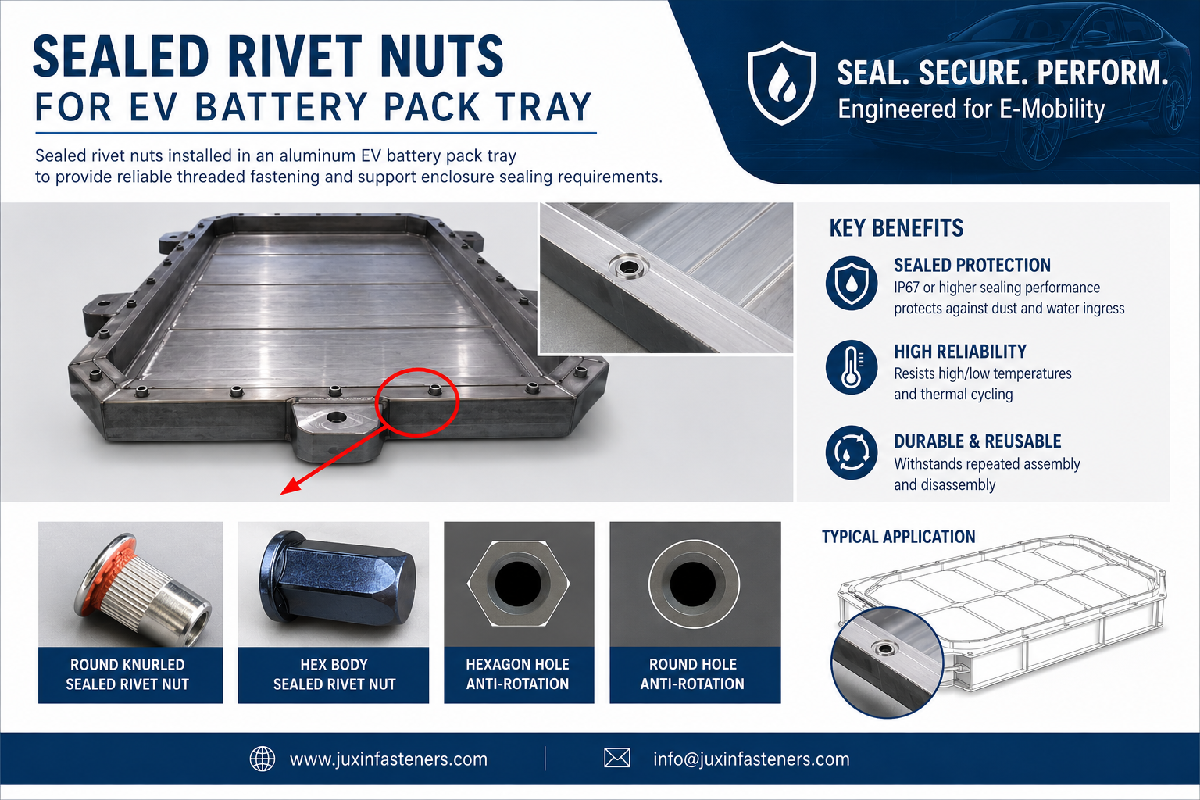
Blind rivet nuts create an internal thread from one accessible side of a compatible panel.
Potential Benefits
One-sided installation
Internally threaded attachment points
Compatibility with selected thin-wall structures
No local welding operation during insert installation
Potential simplification of downstream assembly
Removable mating bolts for service access
These benefits are application-dependent. A rivet nut does not automatically replace every welded nut, machined thread or structural fastening system.
Rivet Nuts Versus Weld Nuts in Battery Manufacturing
| Design consideration | Blind rivet nut | Weld nut |
|---|---|---|
| Installation method | Mechanical deformation | Welding |
| Backside access during installation | Often unnecessary | Depends on welding method and equipment |
| Heat input during installation | No welding heat | Welding heat is introduced |
| Substrate requirements | Suitable hole, thickness and deformation behavior | Weldable materials and compatible welding process |
| Joint strength | Depends on insert, sheet and installation | Depends on nut, weld and sheet |
| Process controls | Hole quality, installation stroke or force | Welding current, force, time and alignment |
| Rework | Requires a defined removal and repair process | Requires a defined weld repair process |
Engineering Recommendation
Select the attachment method according to the complete battery enclosure manufacturing sequence, rather than assuming one technology is universally stronger or less expensive.
Rivet Nut Design Requirements for EV Battery Packs
A rivet nut used in an automotive battery enclosure must be compatible with several interacting requirements.
Mechanical Retention
The insert must resist the relevant pull-out, spin-out and service loads without unacceptable deformation of the base material.
Threaded Joint Reliability
The mating bolt must achieve the required clamping force without damaging the insert or substrate.
Environmental Protection
The joint must be compatible with the battery enclosure's sealing and corrosion-protection strategy.
Production Repeatability
The installation process must consistently form the rivet nut within the specified grip range.
Serviceability
Where battery covers or equipment panels require removal, the joint must accommodate the intended maintenance procedure.
Important Distinction
A rivet nut is a threaded attachment component, not a complete battery enclosure sealing or crash-protection system.
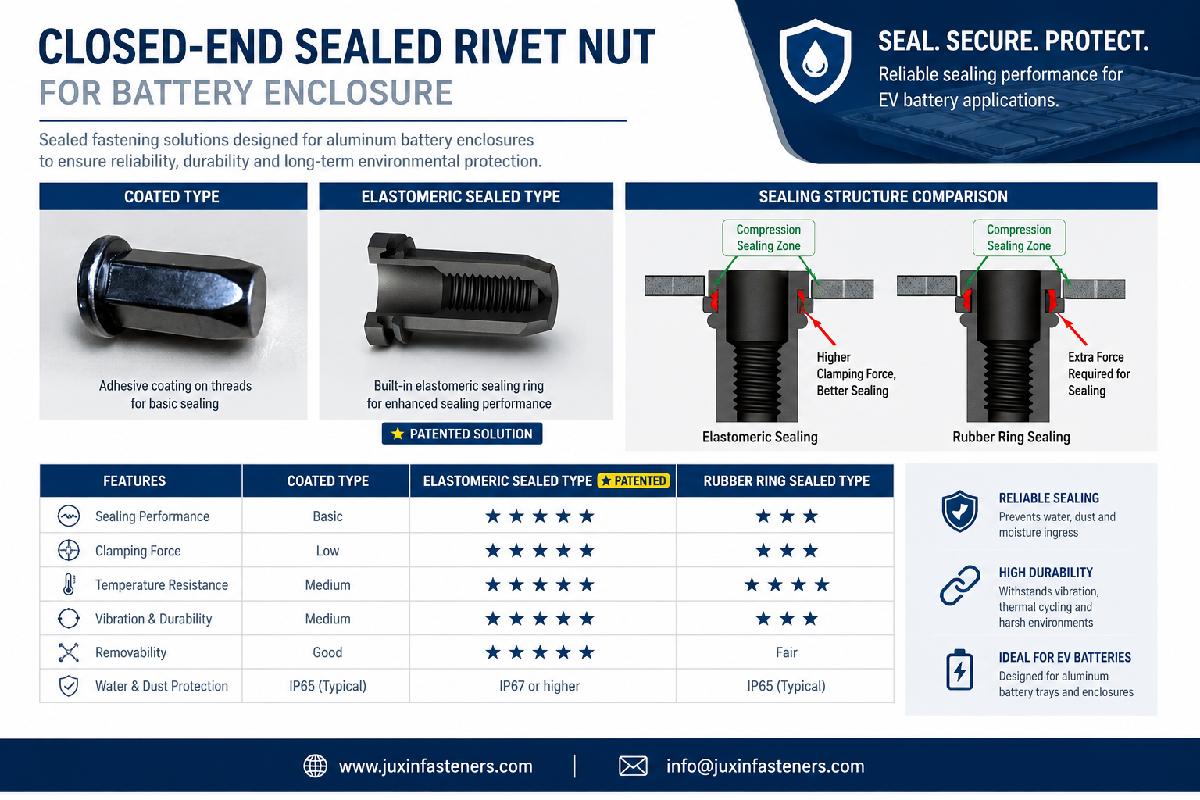
Rivet Nut Types for EV Battery Enclosures
Different rivet nut designs address different installation and retention requirements.
| Rivet nut design | Main characteristic | Selection consideration |
|---|---|---|
| Round-body rivet nut | Cylindrical body | Hole preparation and spin-out resistance |
| Knurled-body rivet nut | Textured exterior | Substrate hardness and anti-rotation performance |
| Hex-body rivet nut | Polygonal body | Hexagonal hole accuracy and torque resistance |
| Heavy-duty rivet nut | Reinforced or application-specific geometry | Sheet thickness, installation force and load capacity |
| Closed-end rivet nut | Closed threaded barrel | Thread-end sealing and available internal length |
| Large-flange rivet nut | Increased flange bearing area | Flange seating, surface pressure and packaging |
| Flange-sealing rivet nut | Designed sealing feature at the flange | Gasket compression and assembly-level leak testing |
Important Engineering Distinction
A sealed rivet nut, a closed-end rivet nut and a high-torque hex-body rivet nut are not necessarily the same product.
The required features must be confirmed on the drawing.
Hex-Body and Twist-Resistant Rivet Nuts
Hex-body rivet nuts use a polygonal body installed into a matching hole.
This geometry can provide increased resistance to insert rotation compared with certain round-body designs.
Potential Applications
Battery enclosure covers
Aluminum profiles
Equipment brackets
Electrical housing panels
Engineering Considerations
Hexagonal hole dimensions
Hole corner geometry
Sheet thickness
Material hardness
Installation force
Spin-out torque
Flange seating
Important Distinction
Anti-rotation resistance prevents the insert body from turning in the sheet. It does not automatically prevent the mating bolt from loosening under vibration.
Where rotational bolt loosening is a concern, the complete threaded joint requires a suitable locking strategy.
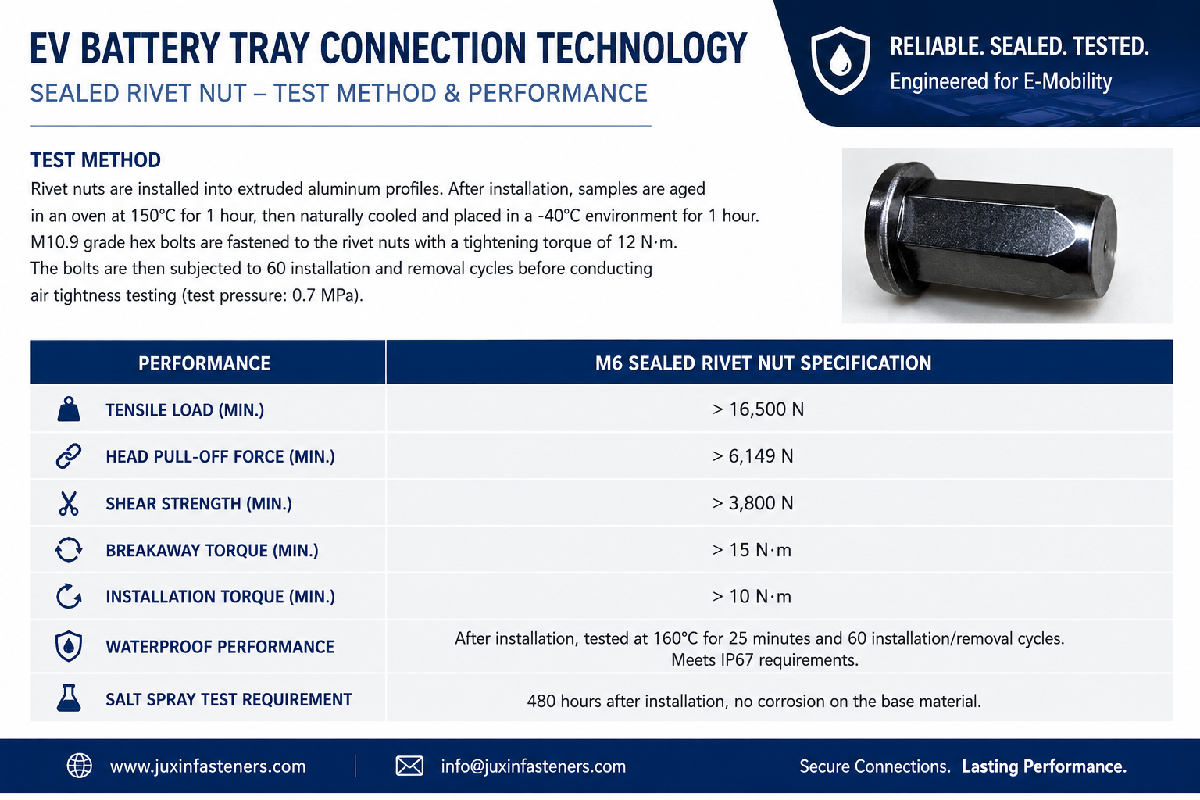
Heavy-Duty Rivet Nuts for Higher Attachment Loads
Heavy-duty rivet nuts may incorporate geometry intended for higher retention or torque requirements.
However, a stronger insert does not guarantee a stronger assembled joint.
Why Substrate Strength Matters
The surrounding aluminum or steel sheet may fail before the insert itself.
Potential failure modes include:
Sheet pull-through
Local deformation
Hole enlargement
Insert rotation
Thread stripping
Fatigue damage
Engineering Recommendation
Specify required joint performance using the actual substrate material and thickness.
Do not select a heavy-duty insert solely from its nominal thread diameter.
Screw-Locking Rivet Nut Assemblies
Some applications require both a mechanically retained threaded insert and resistance to mating-bolt loosening.
These are separate design functions.
A rivet nut may be selected for attachment to the sheet, while the mating bolt and any locking feature are selected to control joint loosening.
Engineering Recommendation
Validate the complete fastener combination, including installation torque, bolt preload, insert spin-out resistance and intended service conditions.
Lightweight Aluminum Battery Enclosures
Aluminum is frequently considered for EV battery enclosures because it offers useful weight and manufacturing characteristics.
Blind rivet nuts can provide internal threads in suitable aluminum sheets and profiles without introducing welding heat during insert installation.
However, successful installation depends on the alloy, temper, wall thickness and local geometry.
Engineering Considerations
Aluminum alloy and temper
Nominal and minimum wall thickness
Hole geometry
Local reinforcement
Flange bearing area
Installation deformation
Pull-out and spin-out requirements
Important Limitation
No universal aluminum wall thickness or rivet nut size can be recommended without reviewing the actual joint design.
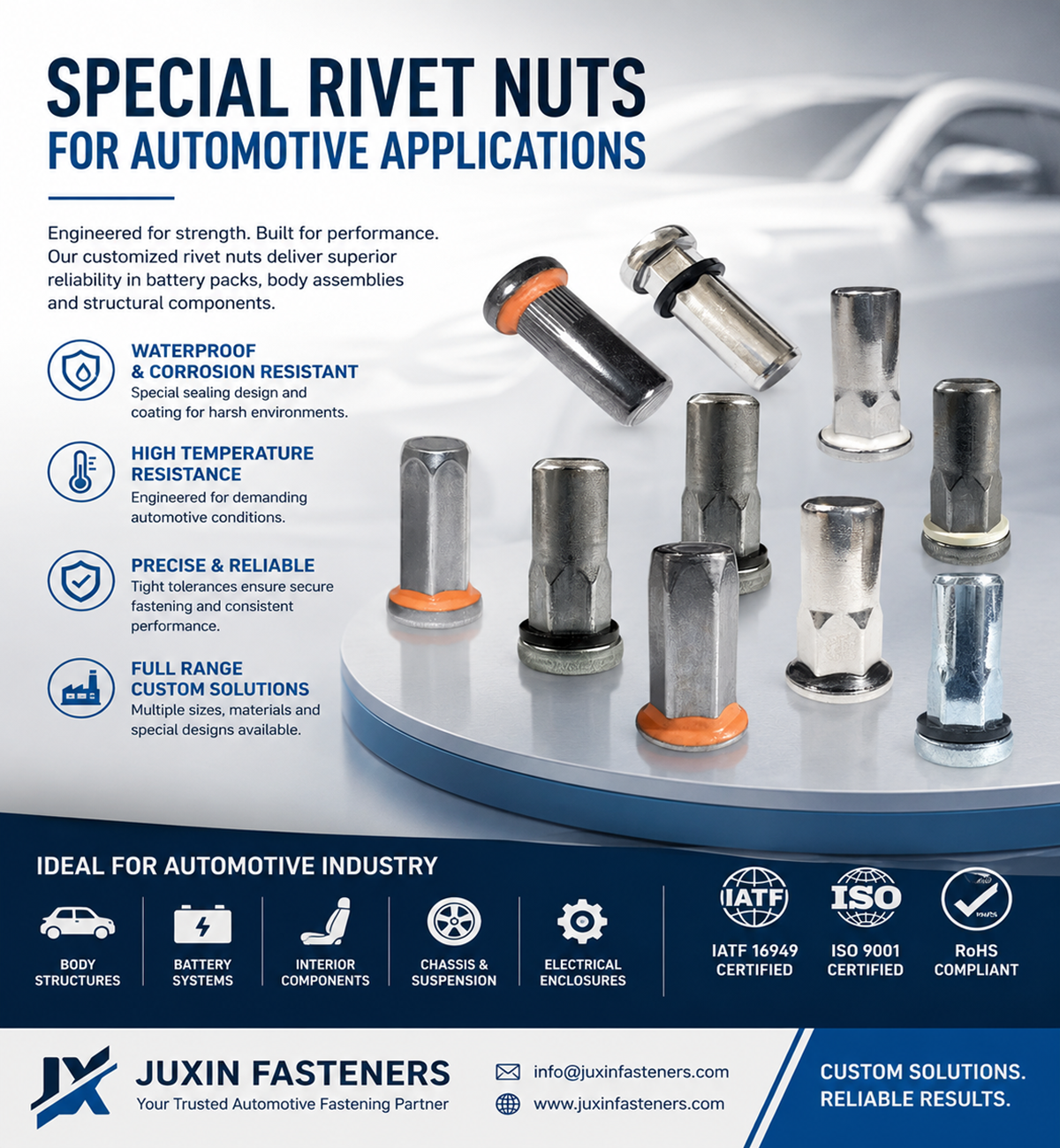
Blind Rivet Nut Grip Range and Sheet Thickness
Grip range describes the substrate thickness range for which a particular rivet nut design is intended.
The installation deformation must occur correctly within this range.
If the Substrate Is Too Thin
Potential problems include insufficient clamping, excessive deformation or inadequate retention.
If the Substrate Is Too Thick
Potential problems include incomplete collapse, poor backside formation or inadequate grip.
Engineering Recommendation
Specify the actual material thickness, including relevant tolerances and any stacked layers involved in the installation.
Rivet Nut Hole Size and Hole Quality
Hole preparation directly affects installation performance.
Important Variables
Hole diameter
Hole shape
Burrs
Edge distance
Hole location
Substrate flatness
Coating thickness
A hole that is too large may reduce retention or allow insert rotation.
A hole that is too small may prevent proper installation or damage the insert.
Production Recommendation
Control hole preparation before installing rivet nuts in high-volume battery enclosure production.
Rivet Nut Pull-Out Strength
Pull-out resistance describes the attachment's ability to withstand an applied extraction load under specified test conditions.
Performance depends on the insert geometry, installation quality, substrate and loading direction.
Important Limitation
A pull-out value measured in one sheet material cannot automatically be transferred to another material or thickness.
Engineering Recommendation
Evaluate pull-out performance using representative battery enclosure materials.
Rivet Nut Spin-Out Torque
Spin-out torque describes resistance to rotation of the installed insert relative to the substrate.
It is particularly important when tightening or removing a mating bolt.
Engineering Considerations
Body geometry
Hole geometry
Substrate hardness
Installation quality
Coating and surface condition
Mating bolt torque
Important Distinction
Spin-out torque is not equivalent to the bolt's tightening torque or achieved clamp load.
Engineering Recommendation
Define an appropriate margin between the required assembly conditions and the insert's rotational retention capability.
Installation Force, Stroke and Repeatability
Blind rivet nuts are installed by controlled deformation of the insert body.
Depending on the tooling, the installation process may be controlled by force, stroke or another defined parameter.
Potential Installation Problems
Under-setting
Over-setting
Insert tilting
Flange distortion
Thread damage
Incorrect backside formation
Production Recommendation
Validate the setting process with the actual insert, panel and installation equipment.
Sealed and Closed-End Rivet Nuts for Battery Housings
Environmental protection is a major consideration in EV battery enclosure design.
A closed-end rivet nut has a closed barrel that may help prevent a leakage path through the threaded end of the insert.
However, other potential leakage paths remain.
Possible Leakage Paths
Between the rivet nut flange and sheet
Around the installation hole
Through damaged sealing material
Along the mating bolt interface
Through the surrounding enclosure joint
Important Distinction
A closed-end rivet nut is not automatically a waterproof assembly.
Flange-Sealing Rivet Nuts
Some rivet nut designs incorporate sealing features at the flange.
Their effectiveness depends on:
Sealing material
Surface finish
Flange geometry
Installation force
Panel flatness
Temperature exposure
Chemical compatibility
Engineering Recommendation
Evaluate the sealing system as an assembly.
IP67 and IP68 Battery Enclosure Requirements
Ingress protection classifications describe the performance of an enclosure under specified test conditions.
A rivet nut alone cannot establish an IP67 or IP68 rating for a battery enclosure.
Engineering Recommendation
Where a project specifies ingress protection, validate the complete enclosure with its actual fasteners, gaskets, covers and assembly process.
Electrical Insulation and High-Voltage Battery Systems
Some battery assemblies require controlled electrical isolation between components.
Ordinary steel, stainless steel and aluminum rivet nuts are electrically conductive.
Important Distinction
A standard metal rivet nut is not an insulating fastener.
Specialized insulated attachment designs may use nonconductive components or insulating interfaces, but their electrical performance must be verified.
Engineering Considerations
Dielectric requirements
Creepage distance
Clearance
Insulating material
Temperature
Moisture
Mechanical loading
Engineering Recommendation
Do not approve a fastening component for high-voltage isolation based solely on an “insulating rivet nut” product description.
Material Selection for EV Battery Rivet Nuts
Material selection affects installation behavior, corrosion resistance, strength, weight and compatibility with the substrate.
| Material | Potential advantage | Main engineering consideration |
|---|---|---|
| Carbon steel | Mechanical strength and cost options | Coating, corrosion and compatibility with aluminum |
| Stainless steel | Corrosion resistance in suitable environments | Installation force, galling and galvanic compatibility |
| Aluminum | Low weight and compatibility with selected aluminum structures | Strength, deformation and thread durability |
Carbon Steel Rivet Nuts
Carbon steel rivet nuts may be selected for suitable automotive and industrial assemblies.
Surface treatments may include zinc-based or other specified protective coatings.
Engineering Consideration
When installed in aluminum, the combination requires evaluation for galvanic corrosion.
Stainless Steel Rivet Nuts
Stainless steel rivet nuts may be considered where corrosion resistance is important.
However, the material grade and installation characteristics must match the application.
Engineering Consideration
Stainless steel inserts installed in aluminum may create galvanic corrosion concerns in the presence of an electrolyte.
Aluminum Rivet Nuts
Aluminum rivet nuts offer a lightweight option for suitable structures.
Engineering Consideration
The insert must provide adequate thread strength, retention and fatigue performance for the actual loading conditions.

Galvanic Corrosion in Mixed-Material Battery Enclosures
When dissimilar conductive metals are in electrical contact and exposed to an electrolyte, galvanic corrosion may occur.
This is relevant to steel or stainless steel rivet nuts installed in aluminum battery enclosures.
Potential Mitigation Measures
Suitable material selection
Protective coatings
Electrical isolation where appropriate
Sealing
Moisture control
Corrosion testing
Engineering Recommendation
Evaluate the complete joint rather than assuming that a corrosion-resistant insert eliminates galvanic corrosion risk.
Battery Pack Cover Fastening
Battery enclosure covers may require removable fasteners for inspection, repair or service.
Rivet nuts can provide threaded attachment points where the enclosure design permits their use.
Engineering Considerations
Cover flange stiffness
Bolt spacing
Gasket compression
Rivet nut flange height
Mating bolt preload
Sealing interface
Service cycles
Important Distinction
The rivet nut provides an attachment point. The cover gasket and joint design establish the environmental seal.
Engineering Recommendation
Validate cover fastening and sealing together.
Battery Module and Internal Bracket Mounting
Rivet nuts may be considered for selected internal brackets, electrical equipment supports and auxiliary attachments.
Engineering Considerations
Static and dynamic loading
Thermal expansion
Electrical clearance
Corrosion
Assembly access
Serviceability
Important Limitation
Battery module restraint and crash-critical attachments require dedicated engineering approval.
Battery Thermal Management Equipment
EV battery systems may incorporate cooling plates, manifolds, pumps, valves, hoses and related mounting brackets.
Rivet nuts can provide attachment points for selected auxiliary components.
Engineering Considerations
Vibration
Coolant exposure
Thermal cycling
Corrosion
Installation access
Service requirements
Important Limitation
A rivet nut should not be assumed suitable for pressure containment or fluid sealing without application-specific validation.
Heavy-Duty and Anti-Rotation Rivet Nut Selection
For higher installation torque or retention requirements, engineers may consider heavy-duty or hex-body designs.
Engineering Recommendation
Compare:
Pull-out performance
Spin-out torque
Grip range
Required hole geometry
Installation force
Substrate deformation
Production tooling
Important Limitation
Higher nominal strength is not sufficient evidence of suitability for battery crash structures.
Automotive and EV Applications
Potential applications include:
Battery enclosure covers
Electrical housings
Selected brackets
Interior components
Auxiliary equipment mounting
Thermal management accessories
Engineering Recommendation
Define the actual loading and environmental requirements for each application.
Battery Management System and Electrical Enclosures
Battery management system (BMS) housings and other electrical enclosures may require compact threaded attachment points.
Engineering Considerations
Panel thickness
Internal clearance
Electrical isolation
Sealing
Corrosion
Serviceability
Important Limitation
The use of a rivet nut does not establish compliance with electrical safety or ingress-protection requirements.
Energy Storage Systems
Rivet nuts may also be considered for suitable energy storage equipment, including:
Battery cabinets
Equipment enclosures
Auxiliary brackets
Control panels
Service covers
Engineering Considerations
Outdoor exposure
Thermal cycling
Corrosion
Maintenance
Assembly access
Engineering Recommendation
Select materials and sealing features according to the actual equipment environment.
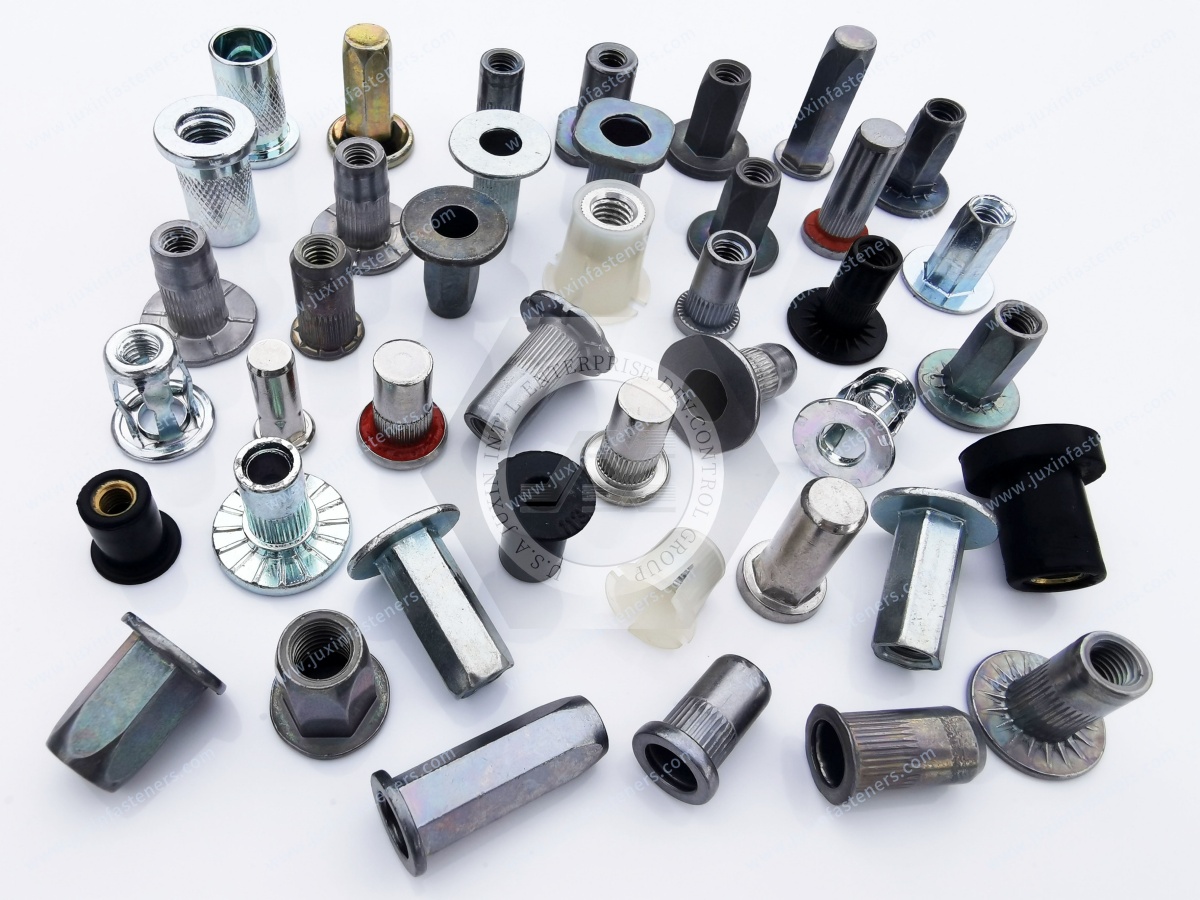
Production-Line Installation of EV Rivet Nuts
High-volume automotive production requires consistent installation quality.
Key Production Factors
Hole preparation
Insert feeding
Orientation
Tool access
Installation force or stroke
Flange seating
Thread protection
Inspection
Rework
Production Recommendation
Establish a validated installation process before increasing production volume.
Automated Rivet Nut Installation
Automated equipment may improve repeatability when the insert and substrate are compatible with the process.
Potential Challenges
Feeding jams
Incorrect orientation
Variation in installation deformation
Tool wear
Hole misalignment
Thread damage
Engineering Recommendation
Validate the selected rivet nut using the actual automated installation equipment.
Installation Quality Inspection
Inspection requirements depend on the customer drawing and application.
Potential Checks
Hole dimensions
Insert position
Flange seating
Installed height
Thread accessibility
Backside deformation
Pull-out resistance
Spin-out torque
Visual damage
Important Limitation
Not every test is required for every rivet nut application.
Production Recommendation
Define inspection methods and acceptance criteria according to the actual joint requirements.
Common EV Rivet Nut Failure Modes
| Failure mode | Possible contributing factor | Recommended investigation |
|---|---|---|
| Insert spins during bolt tightening | Insufficient anti-rotation retention | Check hole geometry and installation |
| Insert pulls out | Inadequate grip or substrate strength | Review grip range and sheet properties |
| Thread stripping | Excessive bolt torque or insufficient thread strength | Review bolt, insert and tightening specification |
| Water leakage | Incomplete sealing at flange or hole | Review sealing system and enclosure testing |
| Local corrosion | Dissimilar metals or damaged coating | Review material pairing and protection |
| Insert tilting | Hole or installation misalignment | Check tooling and hole preparation |
| Inconsistent installation | Process or material variation | Review setting parameters and inspection |
| Bolt loosening | Joint movement or inadequate locking strategy | Review preload and mating bolt design |
Engineering Recommendation
Correct the root cause rather than automatically selecting a larger or stronger insert.
OEM Custom Rivet Nuts for EV Battery Manufacturers
Juxin Fasteners welcomes inquiries for standard and drawing-specific rivet nuts.
Potential requirements include:
Metric thread specifications
Custom body dimensions
Hex-body geometry
Large flange designs
Closed-end structures
Sealing features
Material selection
Surface treatment
Special grip ranges
Functional inspection requirements
Packaging
Manufacturing feasibility depends on the drawing, material, performance requirements and production volume.
Metric and Inch Thread Specifications
EV rivet nuts are commonly specified using metric thread designations.
However, some industrial or export applications may require unified inch threads.
ISO Metric Threads
Metric threads use metric diameter and pitch designations.
UNC and UNF Threads
Unified inch threads follow separate dimensional requirements.
Important Distinction
Metric, UNC, UNF and legacy British thread systems are not directly interchangeable.
Engineering Recommendation
Confirm the actual thread designation and mating bolt before approving a replacement insert.
Supplier Qualification for Automotive Rivet Nuts
Purchasing managers and supplier development teams should evaluate:
Product drawing and revision
Thread designation
Material grade
Surface treatment
Grip range
Hole requirements
Pull-out and spin-out performance
Sealing requirements
Installation process compatibility
Inspection documentation
Sample approval
Annual demand
MOQ
Lead time
Packaging
Change control
Alternative Supplier Validation
Two rivet nuts with the same nominal thread size may differ in:
Body geometry
Flange dimensions
Grip range
Installation deformation
Pull-out performance
Spin-out torque
Coating
Sealing behavior
Engineering Recommendation
Validate an alternative supplier's insert using the actual enclosure material and production tooling.
Total Installed Cost
The lowest unit price does not necessarily provide the lowest manufacturing cost.
Relevant factors include:
Hole preparation
Installation cycle time
Tool wear
Scrap
Rework
Inspection
Sealing failures
Downstream assembly problems
Procurement Recommendation
Compare suppliers using the complete installation and quality requirements.
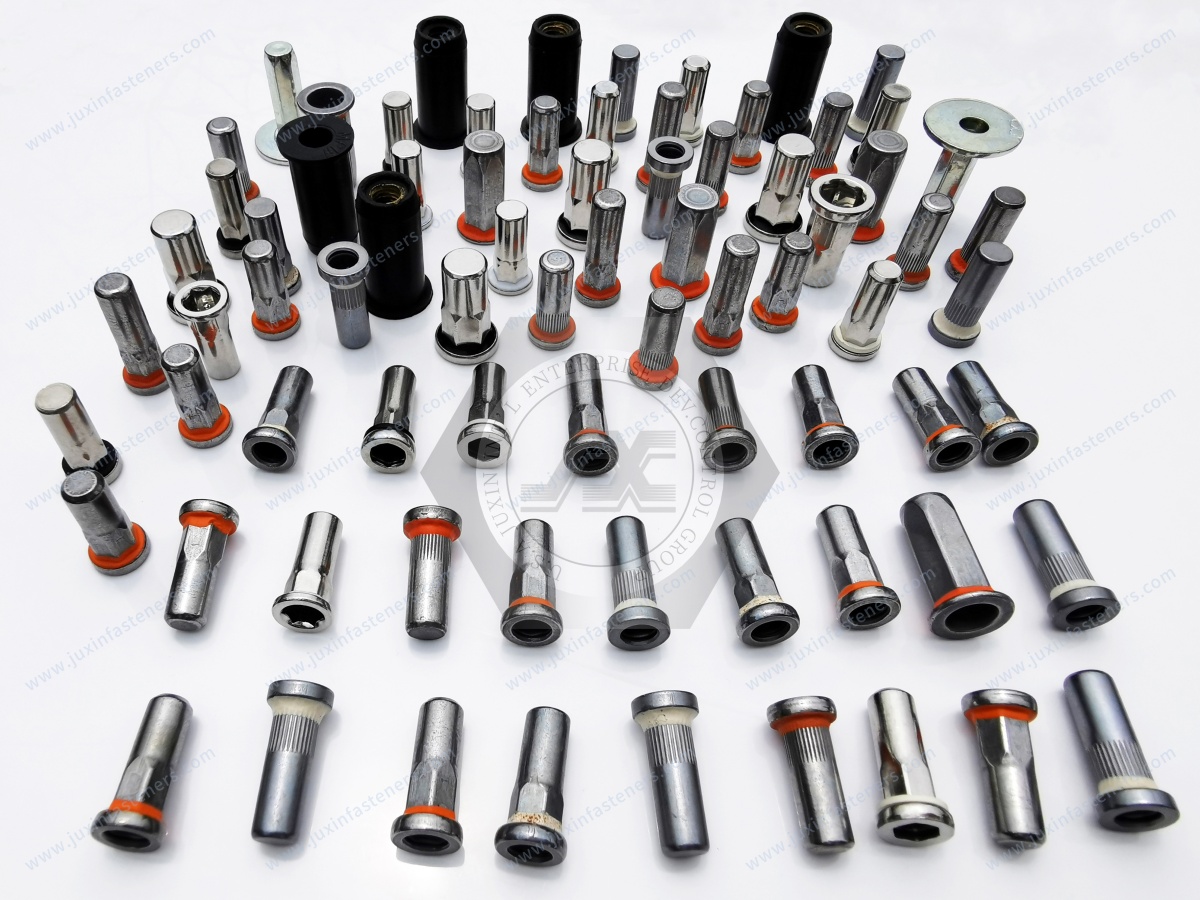
Frequently Asked Questions
Can blind rivet nuts be used in aluminum EV battery enclosures?
Yes, in suitable designs. The alloy, thickness, hole geometry, installation process and required joint performance must be evaluated.
Are closed-end rivet nuts waterproof?
A closed-end design may block leakage through the threaded barrel, but the complete installation must be evaluated for sealing performance.
Do sealed rivet nuts guarantee IP67 or IP68 protection?
No. Ingress protection applies to the tested enclosure configuration.
Are hex-body rivet nuts vibration-resistant?
Hex-body geometry may improve insert anti-rotation performance. It does not automatically prevent mating-bolt self-loosening.
Can rivet nuts replace welded nuts?
In some applications, but the replacement must be evaluated for strength, installation, sealing, corrosion and production requirements.
Are stainless steel rivet nuts better than aluminum rivet nuts?
Neither is universally better. The correct choice depends on joint strength, weight, installation and corrosion compatibility.
Can rivet nuts be used for high-voltage insulation?
Standard metal rivet nuts are conductive. Electrical isolation requires an appropriately designed and validated assembly.
What information is needed to specify an EV battery rivet nut?
At minimum, the thread, substrate material and thickness, hole geometry, required loads, installation conditions and environmental requirements should be defined.
Can Juxin Fasteners supply custom automotive rivet nuts?
Juxin Fasteners welcomes drawing-specific inquiries. Material, dimensions, performance requirements, inspection scope and commercial terms require confirmation.
Juxin Fasteners: EV Battery Pack Rivet Nuts and OEM Supply
Juxin Fasteners supplies blind rivet nuts and drawing-specific threaded inserts for suitable automotive, battery enclosure and industrial applications.
Relevant product categories include:
Standard blind rivet nuts
Hex-body rivet nuts
Knurled-body rivet nuts
Heavy-duty rivet nuts
Closed-end rivet nuts
Flange-sealing rivet nuts
Large-flange rivet nuts
Custom automotive threaded inserts
Exact product availability, material grades, dimensions, inspection documentation, MOQ and lead times are subject to technical and commercial confirmation.
Request a Quote for EV Battery Pack Rivet Nuts
Are you sourcing automotive blind rivet nuts, sealed threaded inserts, hex-body rivet nuts or custom fastening components for an EV battery enclosure?
Juxin Fasteners welcomes inquiries from design engineers, mechanical engineers, manufacturing engineers, production managers, purchasing specialists and supplier development teams.
For technical review and quotation, please provide:
Rivet nut drawing and revision + thread designation + body and flange dimensions + material grade + coating + substrate material and thickness
+ grip range + hole geometry + installation method + pull-out and spin-out requirements + mating bolt specification + sealing requirements
+ temperature and corrosion exposure + inspection documentation + prototype quantity + annual demand + packaging + target delivery schedule.
Company: Juxin Fasteners
Website: https://www.juxinfasteners.com/
Email: info@juxinfasteners.com
Send your EV battery enclosure rivet nut drawings and OEM RFQ to Juxin Fasteners for technical confirmation, product selection and quotation.
Contact Us
Tel.:
+86 020 8621 0320
+86 020 3121 6067
E-mail:
Technical Support:
Navigation
SEND INQUIREY



